

Gaspard LEZIN
Fiat to Crypto Payment Gateway Explained How It Works
Learn what a fiat to crypto payment gateway is, how payins and payouts work, fees, compliance and how to choose the right provider for your business.
A customer is on your checkout page right now. They're ready to pay with a card because that's what feels normal to them. You, on the other hand, would rather receive USDC so you can settle faster, hold a stable dollar balance, or move funds globally without relying on a local banking setup.
That mismatch is more common than most founders expect.
It shows up in SaaS, online communities, digital goods, agencies, and cross-border ecommerce. Customers want familiar payment methods. Businesses want flexible settlement. A fiat to crypto payment gateway sits in the middle and handles that handoff.
The mistake is thinking this is only a conversion tool. It isn't. The useful way to think about it is as a system with three connected jobs: payins, a unified balance, and payouts. First, the customer pays using the method they prefer. Then the business sees those funds in one place. Finally, the business chooses how to receive them, whether that means a bank account or stablecoins like USDC.
That sounds simple on the surface, but people usually get confused. They ask questions like:
Who is responsible for compliance
When do screening checks happen
What changes between custodial and non-custodial flows
How is settlement timing different from card settlement
What's the fastest way to launch without building everything from scratch
Those are the questions that matter when you're picking a provider.
Table of Contents
Introduction to Fiat to Crypto Payment Gateways
A simple example makes this easier.
Say you run a subscription product for customers in several countries. One customer pays by card in their local fiat flow. You don't want to collect and manually move those funds later. You want the system to receive the payment, process it cleanly, and settle your side in USDC.
That's the job.
A fiat to crypto payment gateway lets the buyer stay in their preferred payment experience while your business controls the form of settlement on the back end. In other words, customers pay the way they want, and the business gets paid the way it chooses.
Why this mismatch keeps happening
Most internet businesses now sell across borders before they're fully set up for cross-border money movement. Product teams build global access first. Finance and payment operations catch up later.
That creates a gap:
Customers think locally. They reach for card, wallet, bank, or crypto based on habit.
Businesses think operationally. They care about treasury, payout flexibility, reporting, and where funds should land.
Payment teams think in flows. They need one system that connects both sides.
A gateway closes that gap.
The part people miss
Many articles frame this as a pricing or exchange-rate question. Those matter, but they're not the whole story.
The harder issue is responsibility. In a real payment flow, compliance checks aren't something you bolt on afterward. In a typical fiat-to-crypto gateway path, the customer's fiat payment is first authorized and screened, then the gateway executes crypto conversion or off-ramp logic before settlement. Guidance on crypto-to-fiat settlement timing also notes that KYC, KYB, sanctions screening, KYT, and transaction monitoring need to happen before relevant funds move, so compliance timing becomes a hard dependency of the payment flow.
That's why founders can't treat compliance as a legal footnote. It affects the order of operations.
What a Fiat to Crypto Payment Gateway Really Is
The easiest way to understand a fiat to crypto payment gateway is to stop thinking about it as a single payment event.
Think of it more like a three-room system inside one building.
The front room accepts money from customers. The middle room records and organizes it. The back room sends money out the way your business wants to receive it.
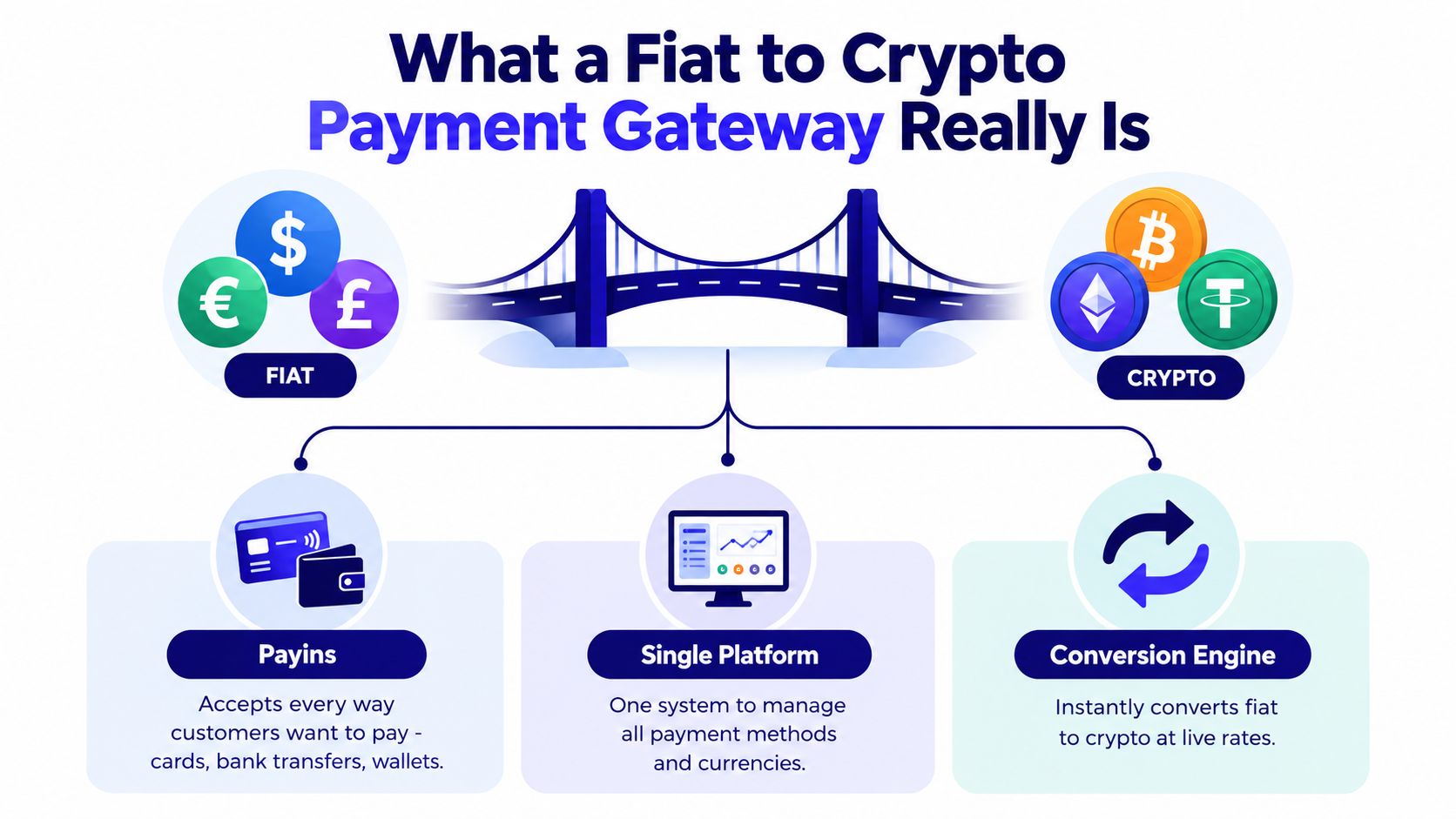
Payins are the front door
Payins are all the ways a customer can complete a purchase.
That can include cards, bank methods, wallets, or crypto. The point isn't that every business needs every method. The point is that your checkout should meet customers where they already are.
If you've ever mixed up gateway and processor roles, this explainer on payment processor vs gateway is a useful refresher. Founders often use the terms interchangeably, but the distinction matters once you start deciding who handles authorization, routing, and settlement logic.
The balance is the control room
The middle layer is where many teams finally get clarity.
You don't want separate operational silos for card receipts, bank receipts, and crypto receipts. You want one place to see what came in, what's pending, what settled, and what can be paid out.
That's why a unified balance matters. It turns a messy set of incoming payment methods into one operational view.
A gateway becomes much more useful when it stops being “the crypto option” and starts being the place where all incoming money is managed consistently.
Payouts are where the business gets choice
This is the part that makes the model click.
Accepting crypto is one thing. Settling in crypto is another. A business can let the customer pay in fiat and still choose to receive stablecoins. It can also let the customer pay in crypto and receive funds to a wallet or another destination.
Stablecoin settlement matters because it gives the business a predictable unit for internet-native payouts and treasury handling. You're not forcing the customer into that choice. You're making it on the business side.
One product, four ways to use it
There are platforms built around this model. Suby is one example. Its positioning is straightforward: payment infrastructure for the global internet economy where customers can pay by card or crypto, and businesses choose how they receive the money. Its official materials describe four uses inside one product: Suby Payments for API-first card and crypto acceptance, Suby Crypto as a crypto payment gateway that handles the swap and sponsors the gas, Suby Gating for paid access to Discord, Telegram, files, and licences, and Suby Invoicing so the client pays how they want while the business receives what it wants. The docs also note that merchants can price in USD or EUR and that the merchant API lives under /v3 with authentication via the X-Suby-Api-Key header, where the key prefix determines live or sandbox mode in the official introduction.
Core idea: One checkout can accept card or crypto. The business then decides whether funds should end up in a bank flow, a balance, or stablecoins such as USDC.
How Payins Balance and Payouts Work Together
Once the model is clear, the next question is sequence. What happens first, what happens next, and where can things go wrong?
The short answer is that money doesn't move in one jump. It moves in stages, and those stages matter.

The payment starts before conversion
In a fiat-to-crypto setup, the first event is usually the customer's payment attempt. If they pay by card, that means authorization and screening happen up front. Only after that does the system move into conversion or payout logic.
Founders sometimes assume the gateway just “turns fiat into crypto” as a post-processing step. In practice, the system has to decide whether it can move forward before relevant funds move.
Compliance sits inside the flow
This is the operational point that deserves more attention.
Recent independent guidance points out that coverage of the category often skips the practical split of compliance work between custodial and non-custodial models, even though merchants often keep the ultimate regulatory responsibility in many jurisdictions while providers may shoulder more controls in custodial setups. The same market coverage says the broader crypto on-ramp and fiat gateway market is projected at USD 3.64 billion in 2026 and USD 25.9 billion by 2034, and another estimate says fiat-to-crypto gateways were 44.5% of crypto payment processor banking-vertical revenue in 2025, according to market analysis of crypto on-ramp and fiat gateway infrastructure.
So when you evaluate a provider, ask a basic question: who performs which checks, and at what point in the flow?
Practical rule: If a provider can't clearly explain when KYC, AML, sanctions screening, KYT, and monitoring happen, you don't yet understand your launch risk.
Timing is different on chain and off chain
Founders also mix up two kinds of settlement.
There's the on-chain leg, where a crypto transfer gets confirmed on a network. Then there's the fiat leg, where money may still move over banking rails.
Published merchant guidance notes that stablecoin-based checkout can settle on chain within seconds or minutes depending on network conditions, with confirmation ranging from under a second on faster chains like Solana to roughly 12–15 seconds on Ethereum, while the fiat leg usually settles through ACH, SEPA, or wire on a T+1 or T+2 basis in merchant settlement guidance for crypto payment gateways.
That difference is why payment ops teams need realistic expectations. The chain can finalize quickly. The bank leg may still move on a slower clock.
A deeper look at that back-end movement helps here in this overview of a settlement processor.
Later in the flow, teams usually care about reporting, visibility, and where the money lands. Here's a quick visual summary before payout decisions start:
Why a unified balance changes operations
When different payment methods land in a single operational view, finance gets a cleaner workflow.
Instead of one tool for card activity, another for crypto receipts, and a spreadsheet for payout planning, the team can review incoming funds together, reconcile them, and choose a payout method based on need. That's a very different operating model from treating crypto as a side channel.
Integration Options From API to Paylinks and Widgets
The best integration path depends less on ideology and more on your team.
If you have engineers and want payment logic tied tightly into your product, you'll lean toward an API. If you want to test demand fast, paylinks are usually the easiest start. If you need something in between, a hosted widget can get you live without rebuilding checkout from scratch.
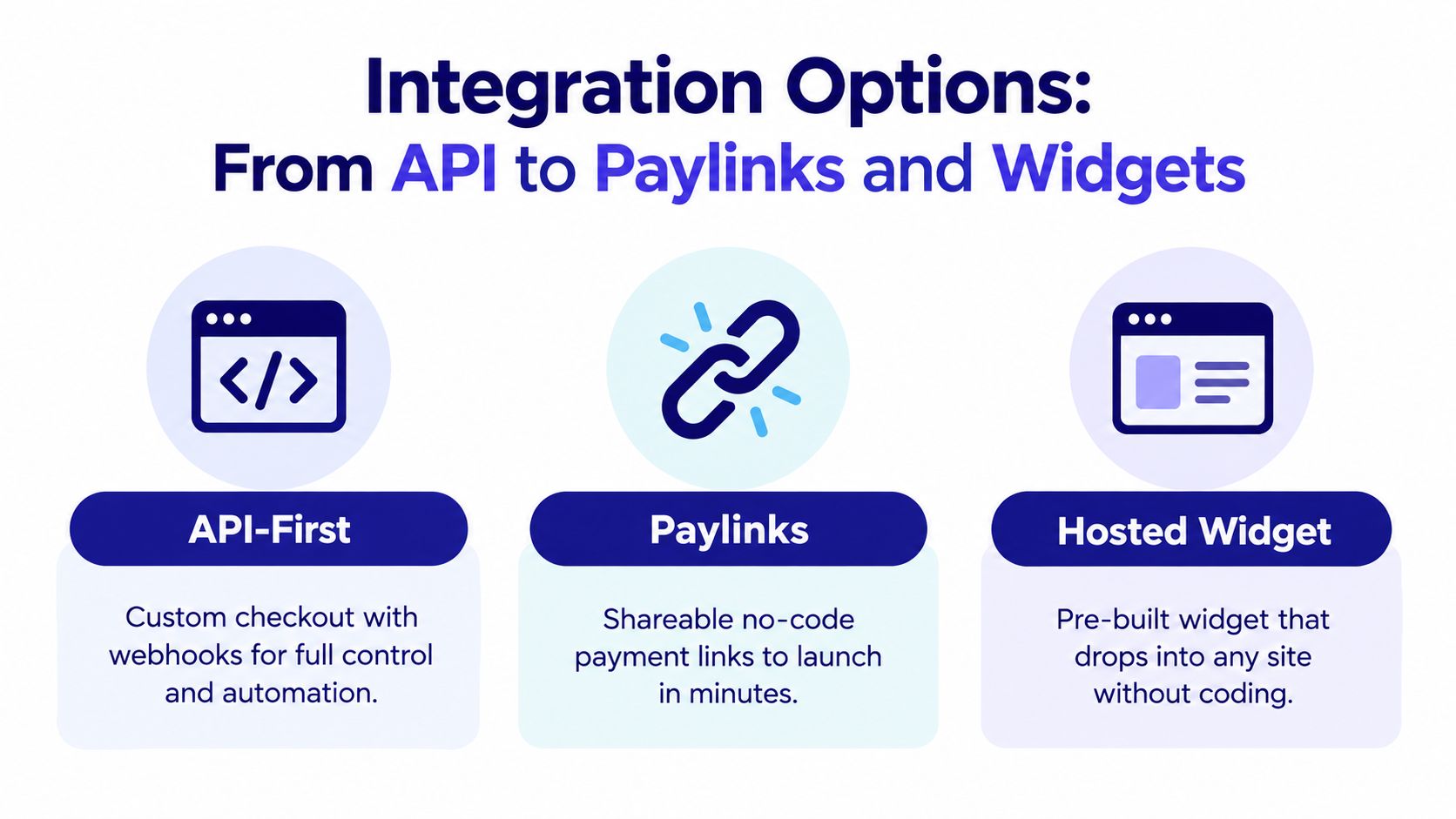
API for full control
An API-first route makes sense when checkout is part of the product experience, not just a payment page bolted on afterward.
You'll usually want this if you need:
Custom checkout logic, where pricing, entitlements, and payment events trigger product access
Webhooks and automation, so your app reacts when payment lands
Subscription handling, especially if payment state needs to sync with billing access
Deeper reporting control, where your own systems consume payment data directly
If you're comparing what an API-led rollout looks like in practice, this guide on payment gateway API integration is a helpful reference.
Paylinks for speed
Paylinks are often the smartest first step for a founder-led team.
You create a product, generate a payment link, and send it in email, chat, a landing page, or an invoice flow. That's useful when you want to validate pricing, geography, or demand before committing engineering time.
Short version: if your question is “will customers buy this,” paylinks answer it faster than a full checkout rebuild.
Widgets for a middle ground
Hosted widgets sit in a practical middle space.
They're useful when you want the payment experience embedded in your site, but you don't want to own every part of the checkout stack. You get a more native feel than a shared link, without the full implementation burden of a custom flow.
Choosing Your Integration Path
Integration Method | Effort and Control | Best For |
|---|---|---|
API | Higher effort, highest control | SaaS, apps, platforms, custom subscription logic |
Paylinks | Lowest effort, lighter control | Fast launches, testing offers, invoices, simple sales flows |
Hosted Widget | Moderate effort, moderate control | Businesses that want embedded checkout without a full custom build |
Native access products and community use cases
Not every payment flow ends with shipping a physical item or activating a SaaS seat.
Some businesses sell access. That's where native integrations matter. Official documentation says setup for Discord starts at the product level: create a product, choose Discord under Integration, connect the server, select the role to grant on payment, and save. It also says the system generates a PayLink and activates native checkout for that role in the Discord integration guide.
That's a good example of the difference between “supports payments” and “supports the business model.”
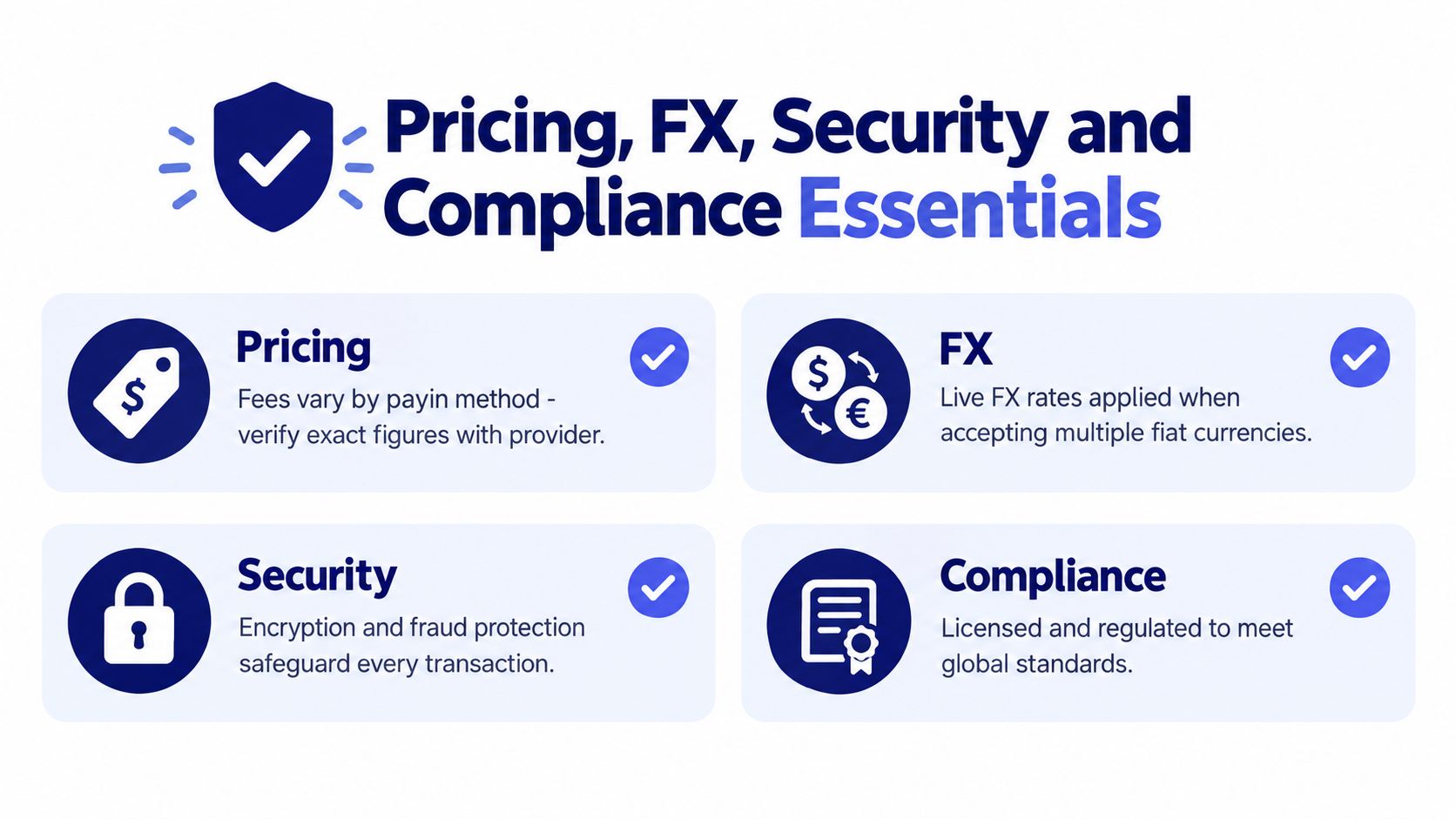
Pricing FX Security and Compliance Essentials
Founders often want a simple answer and don't get one.
The price of a fiat to crypto payment gateway usually depends on how the customer pays, not just on the fact that crypto appears somewhere in the settlement flow. Card economics, bank method costs, crypto network fees, conversion logic, and payout handling can all affect the final structure.
Start with pricing method by method
Don't ask, “what's the flat rate?”
Ask, “what does this method cost, what does that method cost, and what changes when I settle differently?” Pricing depends on the payin method used, so you should verify exact figures directly on the provider's pricing page rather than assuming one universal fee. If you want a framework for reviewing that page carefully, this article on payment gateway pricing is a solid starting point.
FX should be visible, not mysterious
If the customer pays in one unit and the business receives another, you need to know how the quote is created.
Official product documentation for a crypto payment flow can be helpful here because it shows what a transparent setup looks like. Suby's documentation says crypto payments are priced in USD, converted at checkout using Pyth price feeds, and shown to the customer as both the USD amount and the exact token amount before confirmation. Its supported-currencies docs also say those crypto payments are non-custodial, funds are sent directly to the configured wallet address, and the customer pays network gas fees at the time of the on-chain transaction in the supported currencies documentation.
That's the kind of mechanics you want to confirm with any provider, even if you use a different one.
Security and trust checks to confirm
Before launch, get clear answers to a small set of operational questions:
Security controls: Is payment processing handled with verified security standards such as PCI-DSS Level 1 through the provider's documented setup?
Authentication: Does the system support Strong Customer Authentication and two-factor authentication where relevant?
Disputes and refunds: What happens when a customer disputes a payment or needs a refund?
Compliance ownership: Which party handles KYC, KYB, sanctions checks, transaction monitoring, and reporting obligations?
Custody model: Does the provider hold funds, or do funds go directly to your wallet or designated destination?
The real due diligence question isn't “does this gateway support crypto?” It's “can this provider explain the operational chain from payin to payout without hand-waving?”
Custodial and non-custodial changes the responsibility split
This is the often-missed part.
In a custodial model, the provider may carry more of the control framework because funds pass through its environment. In a non-custodial model, the merchant may still keep more responsibility than expected, even if the technical flow feels simpler on the surface.
That's why “who does what” should be documented before launch, not discovered after your first payout issue.
Real World Use Cases for Modern Businesses
Abstract explanations only go so far. It helps to see where this shows up in day-to-day work.
SaaS and web apps
A software company sells subscriptions to customers in different countries. One user pays by card, another prefers a wallet, and another wants to pay in crypto. The business doesn't want separate systems for each case.
The useful setup is one checkout that accepts those payins while the company chooses how funds are settled on its side. That keeps product access simple and finance operations cleaner.
Cross-border ecommerce
An online store sells digital or physical goods internationally. Some buyers trust card checkout. Others prefer crypto because it's easier for them than local banking.
The merchant's real need isn't “add crypto for the sake of it.” It's to accept more buyer preferences while preserving control over settlement and payout destination.
Agencies and freelancers
A client wants to pay the invoice by card because that's how their company works. The agency would rather receive USDC because it simplifies international payouts and balance management.
That's a textbook fiat-to-crypto gateway use case. The buyer sticks with a familiar payin method. The seller receives funds in the format that fits operations better.
Paid communities and digital access
A creator runs a Discord or Telegram community with premium access. Members want a smooth payment experience. The creator wants payment and access control connected, not stitched together manually.
For this kind of flow, native community integrations matter more than generic checkout capability. And when crypto is part of the mix, a gateway can remove extra wallet friction by handling swap logic and settlement choices in the background.
Paid access businesses usually don't need more payment tools. They need fewer moving parts between payment, entitlement, and payout.
How to Choose the Right Provider and Get Started
A good provider should make four things obvious.
First, what payin methods you can offer. Second, where incoming funds appear and how clearly they're reported. Third, how you can settle or pay out, including whether you can receive to bank rails or stablecoins like USDC. Fourth, who owns compliance tasks at each point in the flow.
If you're comparing options, use a simple checklist:
Coverage of payment methods: Can customers pay by the methods your market uses?
Settlement flexibility: Can the business receive funds the way finance wants to receive them?
Integration fit: Do you need API control, or would paylinks or a hosted checkout get you live faster?
Operational clarity: Can your team understand balances, reconciliation, and payout status without guesswork?
Verified security and compliance: Are the provider's controls and responsibilities clearly documented?
The most practical launch path is usually staged. Start with the lowest-friction method that lets you validate demand, then move deeper into API integration when volume and product requirements justify it.
For teams evaluating one platform that covers multiple paths, the key thing to verify is whether it supports both sides of the promise: customers can pay by card or crypto, and the business can choose how to receive the money. If it also offers native Discord and Telegram support for subscriptions, paid access, and online communities, that can save a lot of operational glue work.
If you're exploring a fiat to crypto payment gateway, Suby is built around that exact payment-versus-settlement flexibility. It provides an API for card and crypto payments, plus native Discord and Telegram flows, so customers can pay the way they want while your business chooses how to receive funds.
