

Gaspard LEZIN
Mastering Revenue Recognition with Stripe
Your definitive 2026 guide to revenue recognition stripe. Master ASC 606, handle subscriptions and refunds, and simplify global payments with our guide.
When you're running a business using a payment processor, it's easy to get excited seeing payments hit your account. But there's a crucial accounting principle you can't ignore: revenue recognition. In simple terms, you can only record income when you've earned it, not just when a customer pays you.
Think of it this way: if a customer pays $1,200 for an annual subscription in January, that isn't $1,200 of January revenue. From an accounting perspective, it's $100 of revenue earned each month for the next year.
Why Accurate Revenue Recognition Matters
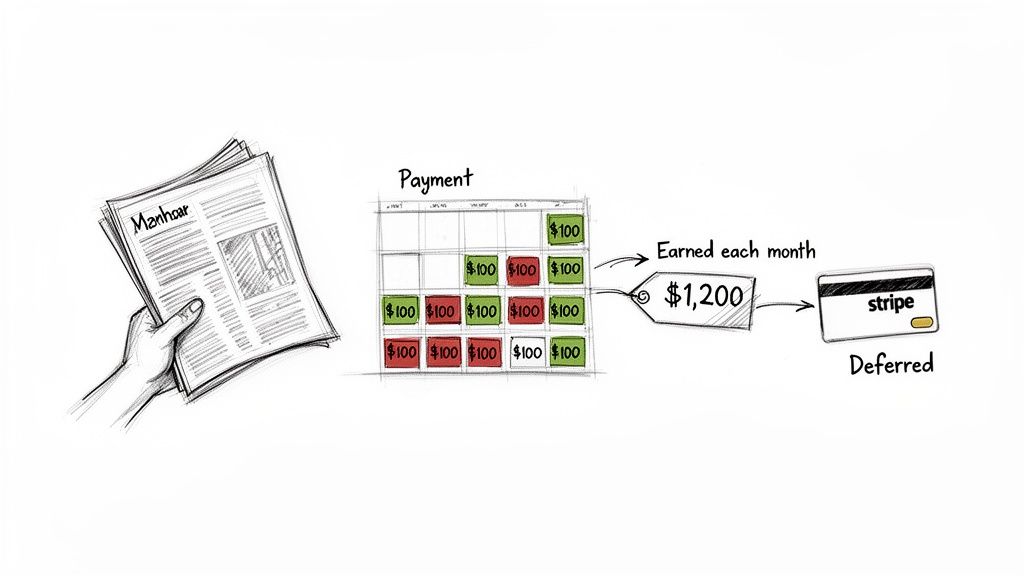
At its core, proper accounting comes down to a simple idea: cash in the bank isn't the same as revenue earned. This is the foundation of modern accounting standards like ASC 606 and IFRS 15. For any business that delivers a service over time, like a SaaS platform, a creator community, or an e-commerce store with a subscription box, getting this right is non-negotiable for understanding your financial health.
Let's go back to that $1,200 annual plan. The moment your customer's card is charged, your cash balance looks great. But you haven't actually delivered a full year of service. You have an obligation to that customer for the next 12 months.
Because of this, accounting rules say you can only recognize a fraction of that payment as revenue each month. The rest of the cash, the unearned portion, sits on your balance sheet as a liability called deferred revenue. It's essentially money you owe back in the form of future services.
The Impact on Your Business
Nailing revenue recognition does more than just keep your accountant happy, it impacts almost every aspect of your business. It ensures your financial statements tell the truth about your company's performance, which is exactly what potential investors, partners, and even banks need to see to trust you.
Accurate revenue recognition is the difference between simply seeing cash come in and truly understanding your business's momentum and stability.
This precise timing also brings clarity to your most important growth metrics. Without it, trying to calculate things like Monthly Recurring Revenue (MRR) and Annual Recurring Revenue (ARR) becomes a messy, error-prone headache. A big influx of cash from annual renewals in January could make it look like you had a massive growth spurt, only to be followed by what looks like a slump. This hides the real story: the stable, predictable growth of your subscription base.
For companies operating internationally, this gets even trickier. You have to account for revenue correctly while also dealing with currency fluctuations. Our API helps solve this by letting businesses accept card payments globally, while businesses receive payouts in a stablecoin like USDC. This takes currency volatility out of the revenue equation. We even have native integrations for Discord and Telegram, so communities can manage subscriptions and paid access with that same clear, stable settlement process.
How Stripe Automates Revenue Recognition
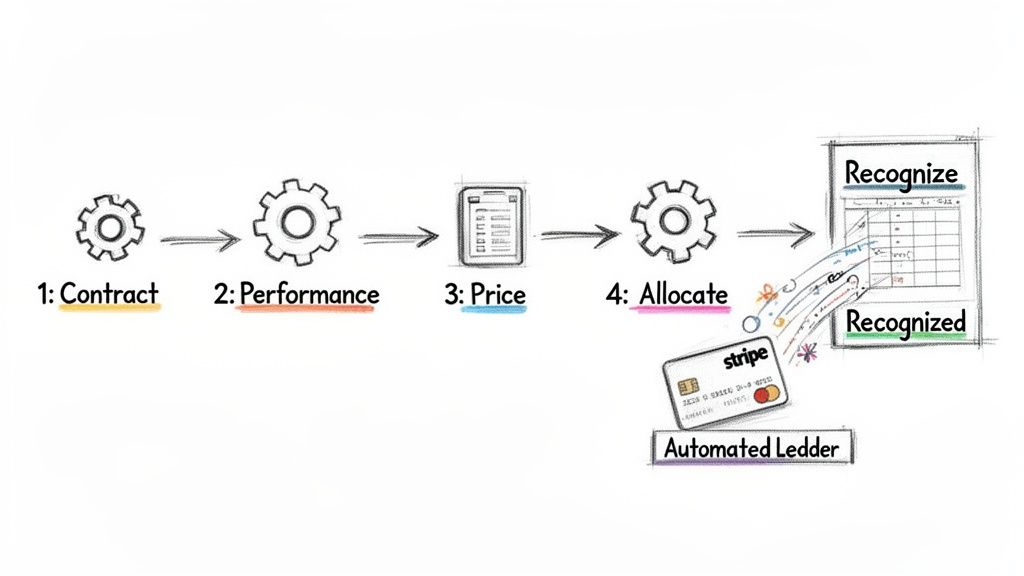
If you've ever tried to manage subscription accounting manually, you know it's a headache. You're constantly trying to connect payments, service periods, and journal entries, and one slip-up can throw everything off. Stripe’s Revenue Recognition product was built to tackle this exact problem, turning raw transaction data into compliant financial reports automatically.
At its core, the tool is engineered to follow the five-step model of ASC 606. It applies these accounting rules to every single invoice and subscription payment that flows through your account. Think of it as an expert accounting assistant working tirelessly in the background, making sure every dollar is categorized correctly.
Demystifying Key Accounting Terms
To really grasp what the system is doing for you, it helps to be familiar with a few key concepts from accrual accounting. These are the building blocks that Stripe’s system juggles on your behalf.
Deferred Revenue: This is cash you’ve collected for a service you haven't delivered yet. Say a customer pays for a $1,200 annual plan upfront. That entire $1,200 is initially booked as deferred revenue. It’s technically a liability because you still owe the customer a full year of service.
Recognized Revenue: This is the portion of deferred revenue that you’ve actually earned. In our annual plan example, you would "recognize" $100 of revenue each month as you provide the service. The deferred revenue balance shrinks as the recognized revenue balance grows.
Contra-Revenue: These are deductions from your gross revenue. This category includes things like refunds, credit card disputes (chargebacks), and discounts. They directly reduce the amount of revenue you can ultimately recognize.
The system automatically creates and updates ledgers to track these balances for every customer. This completely gets rid of the tedious and error-prone work of maintaining massive spreadsheets, a task that quickly becomes impossible as your business scales.
From Raw Data to Compliant Ledgers
What makes Stripe's automation so effective is how it handles the entire transaction lifecycle. When a customer pays, Stripe doesn't just see a lump sum of cash hitting your account. It immediately logs the transaction and starts calculating how to spread that revenue over the correct service period.
Stripe launched its Revenue Recognition tool in 2022 to implement the ASC 606 five-step model with precision, automating the double-entry accounting for every transaction. Many users report that this automation cuts down manual errors by as much as 90%. Later updates added near real-time reporting, which is a game-changer for businesses needing a live pulse on their performance. You can learn more about how the tool has evolved in this detailed guide on their revenue recognition tool.
This process feeds directly into clear financial reports that give you a true picture of your key performance indicators.
By translating every payment event into a proper accounting entry, Stripe gives you a reliable, real-time view of your true financial health, which is essential for accurate forecasting and strategic planning.
To illustrate the difference, here's a quick comparison of using the feature versus trying to do it all by hand.
Stripe Revenue Recognition Feature vs Manual Accounting
Feature | Stripe Revenue Recognition | Manual Accounting |
|---|---|---|
Revenue Scheduling | Automatically calculates and schedules revenue recognition over the service period. | Requires manual creation of amortization schedules in spreadsheets for each contract. |
Ledger Entries | Creates automated, double-entry ledgers for every transaction. | Demands manual journal entries for each event (payment, refund, service delivery). |
Compliance | Built-in logic for ASC 606 and IFRS 15, ensuring consistent application. | Compliance relies entirely on the accountant's knowledge and is prone to human error. |
Reporting | Generates real-time financial reports (balance sheet, income statement) automatically. | Reporting is periodic and time-consuming, often with a significant data lag. |
Scalability | Easily handles thousands of transactions without a drop in performance. | Becomes unmanageable and extremely costly as transaction volume grows. |
As you can see, the automated approach not only saves an immense amount of time but also significantly improves accuracy and scalability.
To truly master how Stripe streamlines revenue, it's worth thinking about the broader impact of efficient Accounting Process Automation on your entire financial operation. While the payment processor handles its side brilliantly, a modern payment layer can simplify global operations even further. Our API, for instance, lets any business accept payments by card or crypto from anywhere, and you receive stable USDC payouts. For community-based businesses using platforms like Discord or Telegram, our native integrations manage subscriptions and access seamlessly with the same stablecoin settlement benefit.
Translating Reports into Accounting Entries
Your dashboard is an incredible tool, but it's not an accounting ledger. It's the source of truth for your sales, but that raw data needs to be translated into the language of accounting: journal entries. This is the crucial step that connects the real-world activity in your payment processor to your official books.
Think of it this way: the reports speak the language of payments and transactions, while your accounting software speaks in debits and credits. The key is to map every event correctly to ensure your financial statements are accurate and can stand up to scrutiny.
The Basic Accounting Flow of a Subscription
Let's use a classic example for a SaaS business. A new customer loves your product and signs up for an annual plan, paying $1,200 upfront with their credit card.
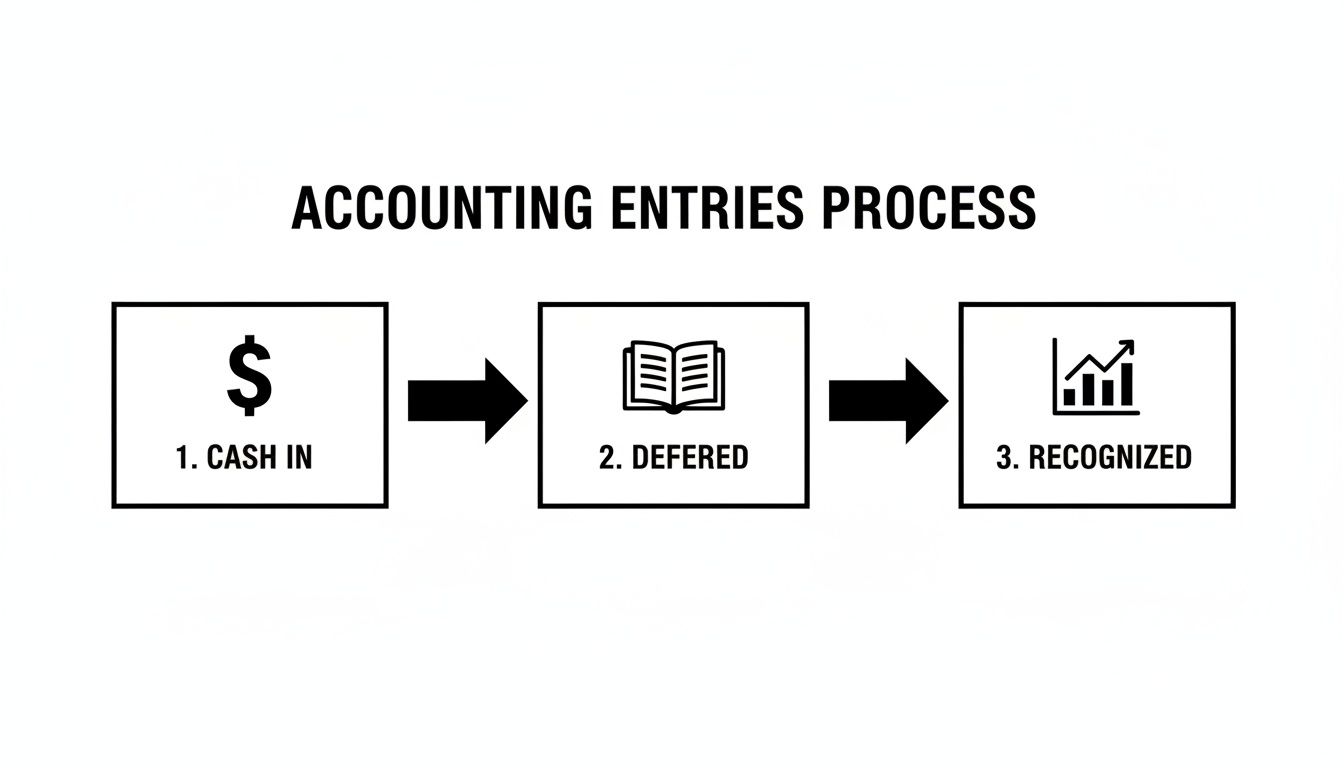
That $1,200 hits your account, but you haven't actually earned it all yet. According to revenue recognition principles (like ASC 606), you only earn it as you deliver the service over the next 12 months. This creates two immediate entries on your books:
Debit Cash: Your cash account goes up by $1,200.
Credit Deferred Revenue: A liability account called Deferred Revenue also goes up by $1,200. This represents your promise to provide the service for the full year.
Now, the clock starts ticking. As each month passes, you deliver on that promise. At the end of the first month, you get to recognize one-twelfth of that revenue. You'll make another journal entry:
Debit Deferred Revenue: Your liability drops by $100.
Credit Recognized Revenue: Your actual revenue on the income statement increases by $100.
You simply repeat this $100 entry every month. After a year, the deferred revenue balance for that customer is back to $0, and you've correctly recognized the full $1,200 over the period you provided the service.
Mapping Reports to Your Ledger
This might sound tedious, but you are given the reports to make this process much more manageable. The two most valuable reports for this are the revenue waterfall and the balance summary.
These reports are specifically designed to give you a structured view of how revenue is earned over time, exactly what you need to create your journal entries.
The system tracks every single transaction with incredible precision, which is how it can generate reports that account for everything from new sales to refunds and disputes. As they detail in their official documentation, recent improvements have made it even easier to reconcile gross totals against your balance summary, which is a huge help for ASC 606 compliance.
Here’s how you can put the data to work:
Balance Summary: Use this report to confirm the cash deposits from your payment processor. It's the basis for your initial cash debit.
Revenue Waterfall Report: This is your cheat sheet for monthly recognition. It tells you exactly how much revenue to recognize each month, making it straightforward to create the entry that moves money from deferred to recognized revenue.
Accounting for Fees
One detail that often trips people up is handling processing fees. These fees are a cost of doing business, not a reduction in your revenue. They need to be recorded separately as an expense.
Let's go back to our $1,200 sale. You won't actually see the full amount in your bank account; the processor takes its cut first.
A proper journal entry would capture this reality:
Account | Debit | Credit |
|---|---|---|
Cash | $1,164.60 | |
Processing Fees (Expense) | $35.40 | |
Deferred Revenue | $1,200.00 |
(This example uses a standard fee for illustration. Your actual costs will differ based on card type and location. If you want to get into the weeds, you can learn more about what are Stripe fees in our dedicated guide.)
This entry perfectly reflects what happened: you received less cash, you incurred an expense, but you still owe your customer $1,200 worth of service. By isolating the fees, you keep your revenue numbers clean and get a true picture of your profitability.
For businesses operating globally, we’ve found that using a modern payment solution can simplify this even further. Our API, for instance, lets any business accept payments by card or crypto from anywhere, and you receive the settlement in USDC. This neatly sidesteps the complexities of currency conversion and fluctuating exchange rates, making revenue reporting much cleaner. With direct integrations into platforms like Discord and Telegram, monetizing your community with subscriptions becomes just as straightforward, as users pay with cards and businesses receive USDC.
Handling Complex Subscription Scenarios
Clean, predictable subscriptions are great in theory, but reality is always a bit messier. Customers upgrade, downgrade, ask for refunds, and live all over the world. Getting your revenue recognition right means you have a solid game plan for these common, but complex, situations so your financial picture stays accurate.
Let's start with the basics: refunds and chargebacks. When you refund a customer, it's not just money going out the door. In accounting terms, this is a contra-revenue event. Think of it as directly unwinding a sale. It reduces the revenue you've already recognized or the deferred revenue you planned to recognize, preventing you from overstating your income. The reports are your friend here, making it easy to spot these events and book them correctly against your gross revenue.
Subscription Changes and Proration
Things really get interesting when customers change their plans mid-month. Whether it’s an upgrade to a premium tier or a downgrade to a basic one, a prorated charge or credit is usually calculated to make the billing fair. Your revenue recognition schedule has to keep up.
Imagine a customer on a $20/month plan decides to upgrade to your $50/month plan exactly halfway through the month. The billing adjustment is handled, and your accounting needs to reflect that you earned revenue at two different rates during that single month.
This is where having an automated system is a lifesaver:
Upgrades: The higher revenue rate kicks in the moment the change is made.
Downgrades: You'll start recognizing revenue at the lower rate, and any credits issued to the customer will decrease your deferred revenue balance.
Cancellations: Revenue recognition stops cold on the cancellation date. Any remaining deferred revenue from that subscription might need to be written off or refunded.
This flow, from cash in, to deferred revenue, and finally to recognized revenue, is the heart of accrual accounting. Subscription changes simply create real-time adjustments to this process.
This process can get even more granular with different billing models. If you're charging based on consumption, you can learn more in our guide to Stripe usage based billing.
Free Trials and One-Time Fees
Not everything is a simple recurring payment. Free trials and one-time setup fees are common, and they each have their own place in your books under ASC 606.
A free trial doesn’t bring in cash, so it’s not revenue. Instead, it’s best treated as a marketing expense. Revenue recognition for that customer doesn't start until their card is actually charged.
One-time setup fees are a bit different. It’s tempting to book that cash as revenue right away, but if the fee doesn’t provide a distinct, standalone value, ASC 606 says you can't. Instead, you should spread that fee over the expected customer lifetime. So, a $100 setup fee from a customer you expect to keep for 24 months should be recognized at a rate of $4.17 per month, right alongside their regular subscription revenue.
The Challenge of Multi-Currency Payments
If you’re running a global business, you’ve felt the headache of multi-currency accounting. A customer pays in Euros or Pounds, but you report your financials in USD. The problem is that exchange rates are constantly moving targets.
This currency fluctuation can create foreign exchange gains or losses on your income statement that have nothing to do with how well your business is actually performing. You might recognize revenue at one rate, but by the time you get paid out, the rate has changed, leaving you with a reconciliation nightmare. It's a huge time sink for finance teams.
A modern payments layer can completely solve this. Our API lets you accept card payments from anywhere in the world, but your settlement arrives in USDC, a stable digital currency pegged to the US dollar. This takes foreign exchange volatility right out of the equation. The revenue you recognize is the cash you actually get, making cross-border reconciliation incredibly simple and your cash flow predictable. This is a game-changer, especially for creators and businesses managing global communities on platforms like Discord and Telegram.
Automating and Reconciling Your Financial Data
Sooner or later, every scaling business hits a wall with manual bookkeeping. What started as a manageable spreadsheet task quickly becomes a major drain on your time, riddled with potential for human error. Automating your back office isn't just a nice-to-have, it's the only way to build a reliable financial foundation you can trust as you grow.
When it comes to automating revenue recognition, you're essentially at a fork in the road. You can use a dedicated product, or you can build a custom solution from the ground up using an API and webhooks. There’s no single right answer, the best choice hinges on your budget, engineering resources, and how complex your business model really is. Some teams even reevaluate their processor entirely at this stage, and it helps to understand why do founders prefer Lemon Squeezy over Stripe before committing to a long-term accounting workflow.
Choosing Your Automation Path
Think of a native tool as the "plug-and-play" option. It’s designed to get you up and running quickly, handling the complexities of ASC 606 compliance right out of the box. It takes your raw transaction data and automatically turns it into the structured financial reports your accountant needs. If your business model is a good fit for this ecosystem, this is a fantastic, low-effort path.
The other route is building a completely custom solution with webhooks. This gives you ultimate flexibility. You can bake in your own unique business logic, pull in data from other payment processors, and craft a system that's a perfect match for your operations. But be warned, this path demands a serious investment in engineering, not just to build it, but to maintain it as your business and accounting standards inevitably change.
The best choice really boils down to your company's complexity and technical muscle. A straightforward SaaS business can do great with a pre-built tool. But if you have unusual revenue streams or a multi-processor setup, the flexibility of a custom build might be non-negotiable.
No matter which path you take, one detail that often gets overlooked is data freshness. This is simply how long it takes for new transactions, refunds, and other events to show up in your financial reports. It’s a make-or-break factor for a smooth month-end close.
Understanding Data Freshness and Reconciliation
Nothing is more frustrating than trying to close the books when your data is a day behind. You need to know the timelines. While automation is incredibly reliable, it’s not instantaneous. For example, historical data changes can take up to 24 hours to process, and new ledger entries might have an 8-9 hour delay before they're available. You can dig into the specifics by checking the data freshness timelines on Stripe's documentation.
Knowing these built-in delays lets you create a realistic workflow for closing your books. At its core, reconciliation is about one thing: making sure the numbers in your payment system match the numbers in your accounting software.
A solid reconciliation checklist looks something like this:
Verify Cash Deposits: Does the cash sent to your bank account match the deposit records?
Check Revenue Reports: Use finalized revenue reports to create the monthly journal entry for your recognized revenue.
Confirm Balances: Is the deferred revenue balance in your accounting system in sync with the deferred revenue report?
Book Expenses: Remember to account for fees, refunds, and chargebacks as separate line items.
For any business that isn't paid in full at the moment of sale, like subscriptions or long-term service contracts, getting a handle on deferred revenue is critical. If you're looking for more practical examples of how this works, these deferred revenue income examples are a great resource.
Finally, you need to test your setup thoroughly. Automation is great, but blind trust is a recipe for disaster. Before you bet your books on a new workflow, you need to run some drills. We've put together a handy guide on using Stripe test cards that lets you simulate different scenarios without touching real money. It's the perfect way to make sure your reconciliation process is truly ironclad.
A Simpler Approach to Global Payments with Suby
Even with the best accounting software for revenue recognition, many businesses still get bogged down by the core mechanics of moving money across borders. The real headaches often come from currency conversion, slow bank transfers, and unpredictable payout schedules. It's a constant source of friction that slows you down.
That’s the exact problem a modern payment layer like Suby is built to solve. Think of it as an abstraction layer over the messy parts of global finance.
Our API lets you accept standard card payments or even crypto from anyone, anywhere. But the magic happens on the other side. Instead of juggling multiple currencies and waiting on traditional bank settlements, your business gets paid out instantly in USDC, directly to your wallet.
Modernizing Your Global Revenue
This direct-to-wallet settlement model completely changes the game for revenue management. You're no longer wrestling with foreign currency accounts or trying to reconcile mismatched reports from different payment systems. It sidesteps the accounting nightmares and hidden fees that come with currency volatility.
The concept is straightforward: Your customers pay with their card, and your business receives stable, predictable revenue in USDC. This cleans up your accounting and dramatically improves your cash flow.
For any international business, this approach unlocks some immediate and powerful benefits:
No More Currency Risk: Because every payout lands as USDC, you’re protected from the ups and downs of foreign exchange rates. The revenue you recognize on your books is the exact amount you hold.
Healthier Cash Flow: Payouts are fast and direct. The days of waiting for slow international wires or dealing with frustrating payout holds are over.
Simplified Reconciliation: When all your revenue arrives in a single, stable currency, your accounting becomes cleaner, faster, and far less prone to errors.
Designed for Creators and Digital Businesses
Beyond the API, we've also built native integrations for the places where modern communities live. Creators and community managers can use Suby to sell subscriptions and access on platforms like Discord and Telegram with just a few clicks. The payment experience is seamless, allowing you to build a global membership without hitting the usual payment roadblocks.
So, whether you’re running a SaaS platform, an e-commerce shop, or monetizing a digital community, Suby gives you a clear path to accepting payments from around the world. Your customers get a simple checkout they recognize, and your business gets the speed, stability, and simplicity of USDC settlements.
Frequently Asked Questions
Let's dig into some of the most common questions we hear from founders and finance teams. We'll clear up the confusion and give you some practical advice you can use right away.
How Does ASC 606 Impact SaaS Businesses Specifically?
For any SaaS business, ASC 606 is the rulebook for how you report subscription income. The core principle is simple: you can only recognize revenue as you actually earn it by providing your service, not all at once when the customer pays.
Imagine a customer signs up for a $1,200 annual plan. You can't just book that $1,200 in January. Instead, you have to recognize $100 in revenue each month over the course of the year. This method smooths out your income and gives a much more accurate view of your company's financial health, which is exactly what investors want to see. Properly using revenue recognition helps you automate this monthly process.
What Is the Difference Between Deferred Revenue and Recognized Revenue?
This is a classic accounting concept, but it's easy to grasp. Just think of it as "money received" versus "money earned." They're two sides of the same coin, but they show up in different places on your financial statements.
Deferred revenue is cash you've collected from a customer for a service you haven't delivered yet. It sits on your balance sheet as a liability because, technically, you still owe that value to the customer.
Recognized revenue, on the other hand, is the portion of that deferred revenue you've officially earned. Each month, as you deliver your software or provide access to your community, a piece of that liability (deferred revenue) moves over to your income statement and becomes an asset (recognized revenue).
Can I Automate Revenue Recognition Without a Specific Add-On Product?
Yes, you definitely can. Many businesses opt to build their own solution using a payment processor's extensive API and webhooks. By listening for events like invoice.paid and customer.subscription.created, your engineering team can write custom logic to apply accounting rules and generate the correct journal entries.
Be warned, though, this is a significant project. It's not a one-and-done task. It demands dedicated developer time for the initial build and, more importantly, for ongoing maintenance as your pricing models evolve or accounting standards change. While a DIY approach offers total control, a purpose-built product can handle these complexities right out of the box, potentially saving you hundreds of engineering hours.
Another headache, especially for global businesses, is handling multiple currencies. One modern alternative is to use a payment layer that abstracts this away. Our API, for example, allows any business to accept payments by card or crypto from anywhere, but receive every payout settled in stable USDC. This completely removes currency fluctuations from the reconciliation equation. For creators, we even offer native integrations for Discord and Telegram to manage subscriptions where customers pay by card and the business receives USDC.
Suby is a payment gateway and payment processor. Your customers pay with card, bank transfer, Apple Pay, Google Pay, Klarna, and more, or stablecoins, and you get paid out to your bank account, or directly in stablecoins (USDC, EURC) to your wallet. Anywhere in the world, no bank account required. Because settlement lands in one stable unit, your revenue recognition gets simpler: the amount you recognize is the amount you actually hold, with no foreign exchange gains or losses to reconcile across currencies. Start for free on suby.fi.
