

Gaspard LEZIN
Encryption Standards: A Complete Guide for 2026
Understand encryption standards, from AES and TLS to key management and compliance. Learn how to choose and implement systems effectively.
Most advice on encryption standards is too shallow. It tells teams to pick AES-256, turn on TLS 1.3, and move on, as if cryptography were a one-time configuration choice instead of a living control that needs ownership, review, and migration plans. That mindset is how organizations end up with strong algorithms wrapped around weak key handling, stale protocols, and no clear record of what is deployed.
A more practical approach to encryption focuses on operations. Standards matter, but they only work when someone knows which systems use them, who manages the keys, how long those keys should live, and when a standard needs to be replaced. That's the operational gap many organizations face. The algorithm is only the start.
Table of Contents
Why Picking the Right Algorithm Is Not Enough
The common mistake is treating encryption standards like a shopping list. Choose a known algorithm, enable it once, and assume the job is done. In production, that approach falls apart because the risk isn't only the cipher, it's the lifecycle around it, especially key secrecy, revocation, review, and replacement.
The U.S. NIST description of DES captures the basic problem well, because symmetric encryption is efficient only when the same key stays secret and strong enough to resist brute-force search NIST DES overview. The UK ICO goes further and says organizations should use trusted algorithms, keep keys secret, set finite key lifespans where appropriate, be able to revoke compromised keys, and regularly review whether encryption is still appropriate ICO encryption implementation guidance. That's not a crypto setting, that's governance.
Why encryption standards need ownership and review
A useful mental model is inventory, not installation. If no one can answer where encryption is used, what protects it, who owns the keys, and when the next review happens, then the standard is already drifting out of control. Teams often get caught during audits and incidents in this scenario, because they know they “use encryption,” but they don't know where the weak link sits.
Practical rule: if you can't name the owner of a keyset, you don't really control the standard that depends on it.
The gap gets worse as attack methods evolve. The ICO explicitly notes that organizations must set their own review period based on context, because the effectiveness of encryption can change when new attack techniques emerge ICO encryption implementation guidance. That makes encryption standards an ongoing review problem, not a compliance checkbox.
A practical starting point is to scan exposed systems, then compare what you find against an external risk signal such as an InsecureWeb dark web scan. That kind of check doesn't replace cryptography work, but it can tell you whether exposed credentials or leaked assets are already turning a theoretical weakness into an active one. In practice, that's how encryption failures often surface, through the ecosystem around the data, not just the algorithm itself.
Core Encryption Concepts Every Team Should Know
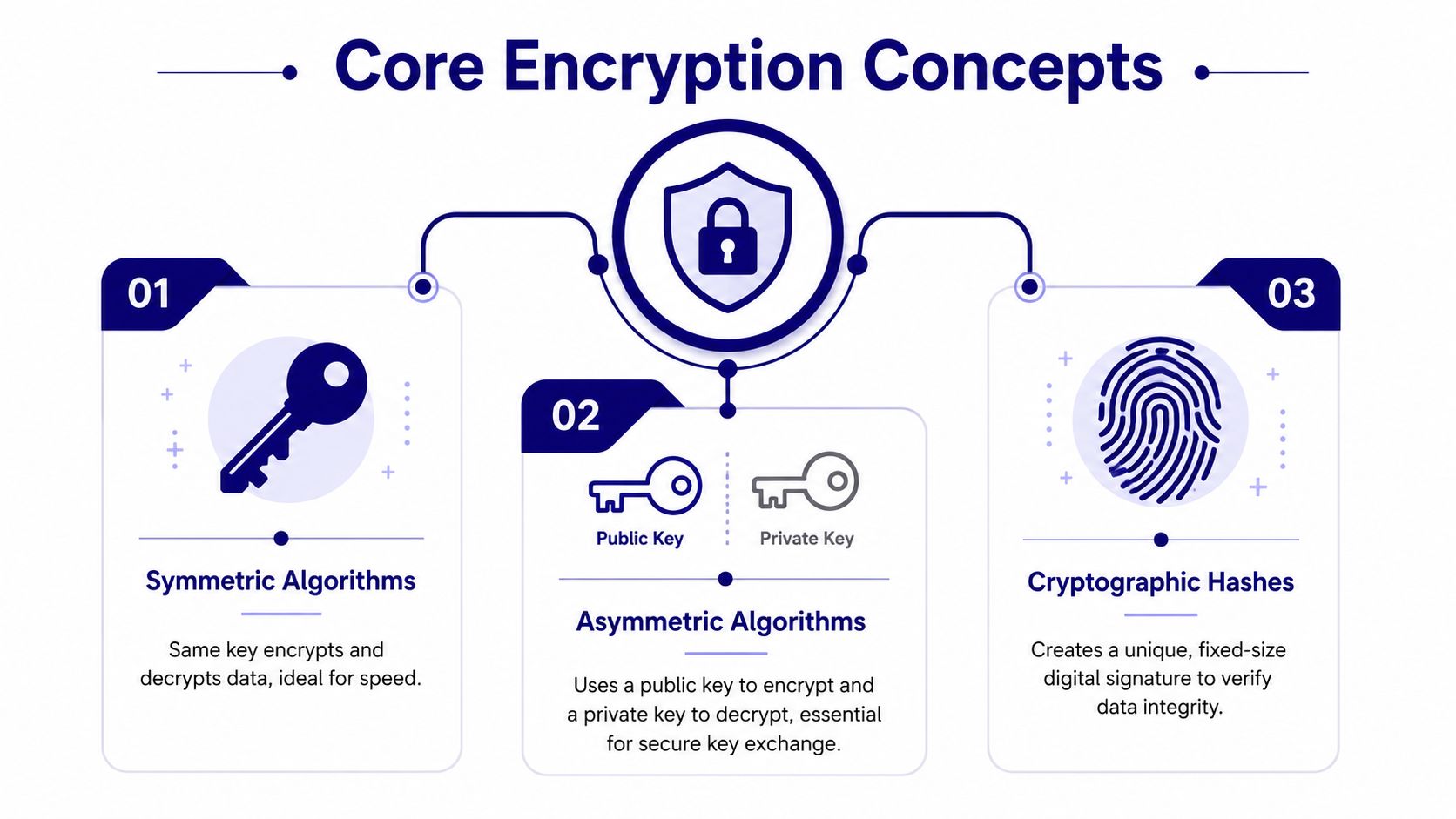
Most implementation bugs happen because teams mix up three different tools. Symmetric encryption protects data efficiently, asymmetric encryption solves key exchange and identity problems, and hashes verify integrity without revealing the original content. If you understand those roles, protocol choices become a lot less mysterious.
Symmetric encryption
Think of symmetric encryption as a sealed envelope with one key. The sender and receiver both use the same key, which makes it fast and practical for large volumes of data. That's why it shows up everywhere in storage protection and session encryption.
DES is the classic example of the model. It uses a 64-bit block size and a 64-bit key, but only 56 bits are user-selected key bits, which is part of why it was later phased out in favor of AES Britannica DES history. The important lesson isn't nostalgia, it's that a symmetric cipher can be efficient and still become obsolete when the security margin is no longer enough.
Asymmetric encryption
Asymmetric encryption is the public noticeboard model. Anyone can use the public key to send you something securely, but only the private key can open it. That solves the distribution problem, which is why asymmetric methods matter so much for establishing trust at the edge of a system.
The W3C's cryptography guidance names ECDH, ML-KEM, and HQC as current recommended key exchange algorithms, which shows how the standards conversation has moved beyond generic “strong encryption” advice W3C cryptography usage. In practice, this is the machinery behind secure setup, not the bulk data path itself.
Cryptographic hashes
Hashes are the fingerprint check. They don't encrypt data, they produce a fixed-size digest that lets you verify whether content changed. That makes them essential for integrity checks, software distribution, and password handling systems that should never store plain secrets.
The W3C document describes cryptography as providing confidentiality, integrity, data authenticity, non-repudiation, and authentication W3C cryptography usage. That broader framing matters, because teams often talk about encryption as if it only means secrecy. In production, integrity is just as important.
Major Standards Organizations and Their Recommendations
Standards bodies don't just pick algorithms, they define the acceptable operating range for real systems. That includes key sizes, lifecycle expectations, and which older choices should be retired. If you're building a policy people can defend, those details matter more than the brand name of the cipher.
The European Payments Council is unusually direct here. It says AES is the recommended standard for new systems, 128-bit AES is the recommended standard for new applications, and AES-256 is recommended when long-term confidentiality of several decades is required EPC cryptographic guidance. It also says organizations should no longer use 768-bit RSA or 130-bit ECC keys or less, and should avoid 1024-bit RSA and 160-bit ECC for new applications unless they're only protecting low-value data for a short time EPC cryptographic guidance.
What the major bodies actually recommend
The W3C guidance is useful because it names mechanics, not just goals. It recommends AES with a 256-bit key length for symmetric encryption, and lists ECDH, ML-KEM, and HQC as the current recommended key exchange algorithms W3C cryptography usage. That gives web teams a practical reference point when designing standards for browser-facing systems and APIs.
NIST's FIPS record matters for a different reason. It identifies FIPS 197 as the AES standard, and the CSRC record shows that the standard was withdrawn on May 9, 2023 NIST CSRC record. That publication-status detail is the kind of thing teams miss when they copy older policy templates without checking whether the underlying documentation is still current.
Use Case | Recommended Algorithm | Key Size | Protection Duration |
|---|---|---|---|
New systems | AES | 128-bit | General new application use EPC cryptographic guidance |
New systems with long retention needs | AES | 256-bit | Several decades EPC cryptographic guidance |
Symmetric data protection | AES | 256-bit | Recommended by W3C for symmetric encryption W3C cryptography usage |
PCI DSS compliance guidance is worth mapping against these recommendations if your environment touches payment data, because compliance teams usually want to know not only what you chose, but why that choice is defensible. The best policies tie the algorithm back to retention, threat model, and review cadence.
The strongest policy is the one your auditors can read and your engineers can still operate six months later.
Choosing Protocols for Data in Transit and at Rest
Protocol choice is where abstract crypto advice meets actual systems. The transport layer, remote admin paths, email, and storage all have different constraints, and they shouldn't be forced into one generic rule. Secure design starts by separating movement of data from storage of data.
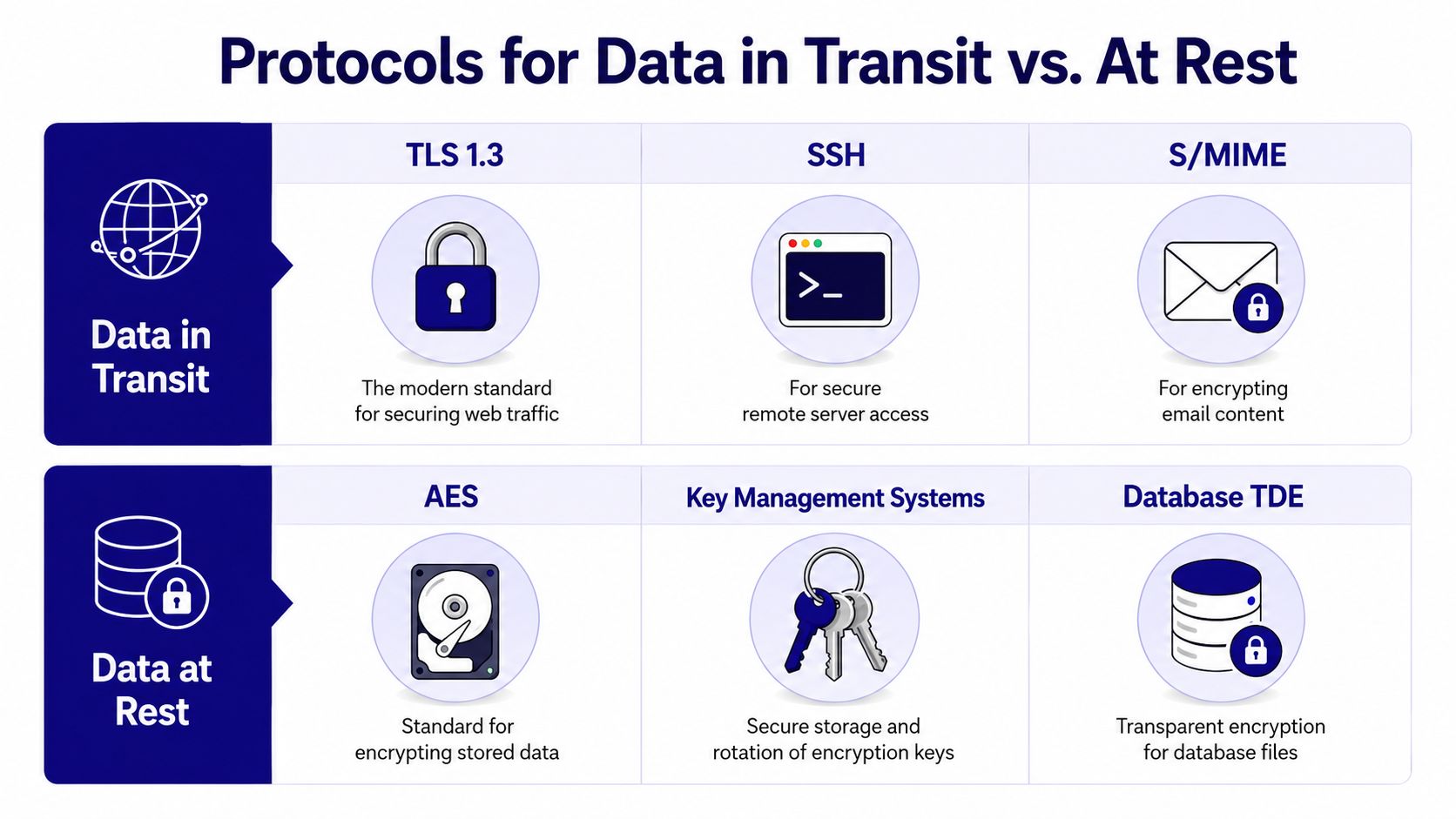
The UK ICO explicitly advises modern encrypted communications such as TLS 1.3 and warns against all SSL versions because of known vulnerabilities ICO encryption guidance. CIS is similarly concrete. It requires encryption when electronic PII is transmitted, says public-facing websites should use HTTPS instead of HTTP where technically feasible, and says they should use HSTS to redirect HTTP requests to HTTPS where feasible CIS encryption standard.
Transit protection and storage protection are not the same problem
For in-transit data, the practical baseline is clear. CIS lists TLS 1.2 or later, SSH 2.0 or later, WPA2 or later with WiFi Protected Setup disabled, and encrypted VPNs as acceptable methods CIS encryption standard. That's a useful reminder that a strong website configuration doesn't automatically secure admin access or wireless traffic.
At rest, the decision is usually about scope. Full-disk encryption helps if a drive is lost, database encryption helps with stored records, and application-level encryption gives the narrowest exposure if you need specific fields protected. The trade-off is operational complexity, because the tighter the scope, the more key handling and implementation discipline you need.
If your threat model includes stolen backups or copied disks, storage encryption needs to be part of the design, not a later hardening task.
The mistake I see most often is teams securing the public edge well, then leaving internal transfer paths and backup workflows under-specified. That creates a false sense of safety. A strong protocol on the front door doesn't help much if the keys, admin sessions, or stored exports are weaker than the internet-facing path.
Navigating Compliance Across Jurisdictions and Sectors
Encryption policy gets messy fast once a company operates across borders. Laws, sector rules, and technical baselines don't always line up, and a single global rule often fails because it's either too loose for one region or too rigid for another. The policy that survives is usually the one built from the strictest applicable control set, then documented clearly.
The Global Partners Digital world map of encryption laws shows that national rules can vary substantially, and South Africa's Electronic Communications and Transactions Act is a good example because it permits encryption use regardless of algorithm, key length, implementation technique, or medium, as long as it complies with the Act GP Digital encryption law map. That legal permissiveness doesn't mean every protocol is wise for production, it just means policy makers can't assume one country's legal baseline will govern the entire fleet.
Why one global policy often fails
The practical answer is to separate legal permission from operational preference. A multinational team may be allowed to use a broad set of algorithms in one place, but still need to follow stricter protocol baselines such as TLS 1.2 or later, SSH 2.0 or later, or WPA2 or later in day-to-day operations CIS encryption standard. That's why standards harmonization is a policy problem, not just a cryptography problem.
Documentation is what keeps that policy usable. If you need to explain why one business unit uses one control set and another business unit uses a tighter one, the decision record has to show jurisdiction, data type, retention period, and operational owner. A clean compliance documentation process is what turns those choices into something audit-ready instead of tribal knowledge.
The operational pattern I trust is simple. Identify the most restrictive sector or geography that applies to the data, use that as the default baseline, and then document every exception with a business reason and a review date. That's slower than copying a single global template, but it's the only approach that doesn't fall apart when regulators, auditors, or customers ask hard questions.
Implementation Best Practices and Common Migration Pitfalls
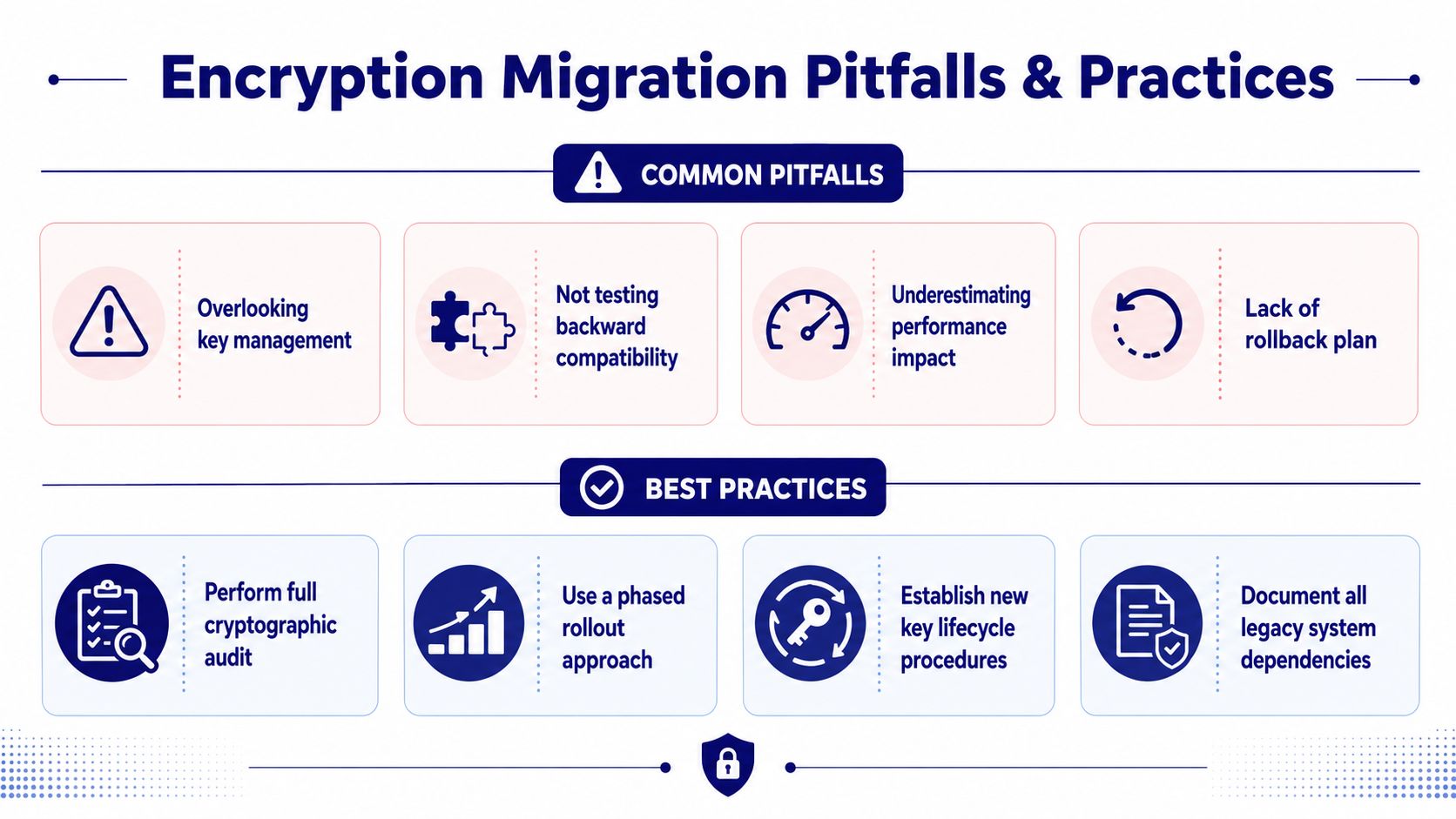
Most encryption migrations fail for boring reasons. Keys are hardcoded, old and new systems can't talk to each other, performance assumptions are wrong, or nobody wrote down how to roll back. The algorithm choice usually isn't the failure point. The migration mechanics are.
A good migration starts with a full cryptographic audit. You need to know where encryption exists, which libraries or protocol versions are in use, where keys live, and which dependencies still expect legacy behavior. If you skip that inventory step, you end up discovering the weakest system during the cutover window, which is the most expensive time to find it.
What breaks during real migrations
One of the most common mistakes is assuming backward compatibility is automatic. In reality, old clients, partner integrations, batch jobs, and stored archives often depend on exactly the protocols you're trying to retire. If you don't test those paths, a “security upgrade” can become an outage.
A phased rollout is safer because it gives you a chance to compare behavior before and after the change. That means staging, a controlled pilot, key lifecycle updates, and a rollback plan that's already been tested. The point isn't to move slowly forever. The point is to avoid forcing every dependency to change at once.
The other trap is lifecycle neglect. If you rotate keys without updating ownership, logging, and revocation processes, you've only moved the problem around. That's why operational notes should travel with the crypto change itself, not live in a separate document nobody reads.
For a concrete example of how teams document sensitive technical changes, the structure used in payment gateway API integration guidance is a decent model. Even though the subject is different, the discipline is the same. Define the integration points, verify the dependencies, and make sure every change has an exit path.
Building a Cryptographic Inventory and Review Process
Encryption gets stronger when it becomes visible. That means building a cryptographic inventory that records every implementation, its purpose, its owner, the keys involved, and the review schedule attached to it. Without that, teams end up with scattered controls that look secure on paper but can't be governed in practice.
The UK ICO recommends maintaining a cryptographic inventory and planning for rapid transitions when standards change ICO encryption implementation guidance. That advice is more important than it sounds, because standards drift, software libraries age out, and migration becomes painful when nobody remembered which service depended on the old choice. A strong data protection policy usually reflects the same principle, control the asset, the owner, and the review cycle, not just the algorithm name.

How to make encryption governable
Start with discovery, then classify what you find by risk and data sensitivity. After that, assign ownership to a person or team that can approve changes, not just note them. Finally, set the review cadence based on the system's exposure, retention needs, and regulatory context.
A cryptographic inventory is only useful if someone can act on it before a standard ages out.
That sounds simple, but it's the difference between a managed control and a pile of disconnected settings. Teams that do this well can answer three hard questions quickly. What are we using, why are we using it, and how fast can we change it when the standard moves?
If you run payments, subscriptions, gated communities, or international invoicing, the same governance mindset applies to the payment layer as well. Suby gives businesses one API to accept card or crypto payments, plus native integrations with Discord and Telegram for subscriptions, paid access, and online communities. If you're thinking about how to let customers pay any way they want while your business receives what it wants, visit Suby and review how its payment and settlement options fit your setup.
