

Gaspard LEZIN
SaaS Payment Gateway Explained for Global SaaS Growth
Learn what a SaaS payment gateway is, how payins, balance and payouts work, and how to choose one for global SaaS checkout.
You launch a SaaS product expecting the hard part to be acquisition, onboarding, and retention. Then the first international customers arrive. One wants to pay by card, another prefers a wallet, a third asks for a bank transfer, and someone else wants to use crypto. Your checkout accepts only one or two methods, settlement arrives in an inconvenient currency, and your team starts stitching together billing, payment processing, reconciliation, and payouts.
That's why a SaaS payment gateway shouldn't be treated as a small checkout component. It can shape conversion, recurring revenue, dispute handling, and how quickly your company enters new markets. A useful way to evaluate it is to follow the money through three stages: payins, the internal balance, and payouts.
This guide explains that model from the ground up. You'll learn what a gateway does, how it differs from a processor and subscription system, which technical and security capabilities matter, how API and hosted implementations compare, and how flexible settlement changes the decision for global SaaS teams. If checkout performance is part of a broader growth program, working with a best seo agency for saas can also help connect payment improvements with acquisition and conversion strategy.
Table of Contents
Introduction Why Your SaaS Checkout Decides Revenue
A customer reaches your SaaS checkout ready to subscribe. The plan looks clear, but the preferred wallet is missing. Authentication sends them through an unexpected redirect, or the payment descriptor creates doubt. Each interruption gives them a reason to stop before the first recurring charge.
International sales make these gaps harder to manage. A card that succeeds in one market may face more issuer scrutiny in another. Cross-border card traffic is usually 5 to 15 percentage points lower than domestic traffic because issuers apply stronger fraud and risk controls, according to MetricHQ's payment acceptance benchmarks. A gateway that only passes card details leaves your team handling the connections between payment methods, currencies, fraud checks, and settlement.
The payment gateway market also reflects a broader shift in what this infrastructure needs to do. Estimates place the global market between USD 26.7 billion in 2024 and USD 48.17 billion in 2025, depending on the research firm. One outlook projects USD 245.71 billion by 2033, while another forecasts USD 48.4 billion by 2029. The estimates use different methods, yet both point to a large category with continued double-digit growth, as shown in Grand View Research's market outlook.
For a SaaS founder, evaluate the full movement of money, not only card acceptance. Payins bring funds in through the methods customers choose. The internal balance records and organizes those funds. Payouts send them to your business through a settlement option that fits operations, whether that means a bank account or, where supported, a stablecoin.
That model changes checkout and integration decisions. You can compare providers by payment coverage, recurring billing support, reconciliation, and settlement flexibility. If acquisition also needs attention, best seo agency for saas describes a partner focused on SaaS growth.
What a SaaS Payment Gateway Really Is
A payment gateway is the customer-facing and API-facing layer that captures payment details, protects them, requests authorization, and returns the result to your application. It connects your checkout to the systems that approve transactions and move funds.
Think of a restaurant. The checkout is the waiter taking the order. The gateway records the request and sends it into the kitchen. The processor communicates with the card network and banks, while the merchant account is the place where accepted funds are held before settlement. These components often come from one provider, but they perform different jobs.
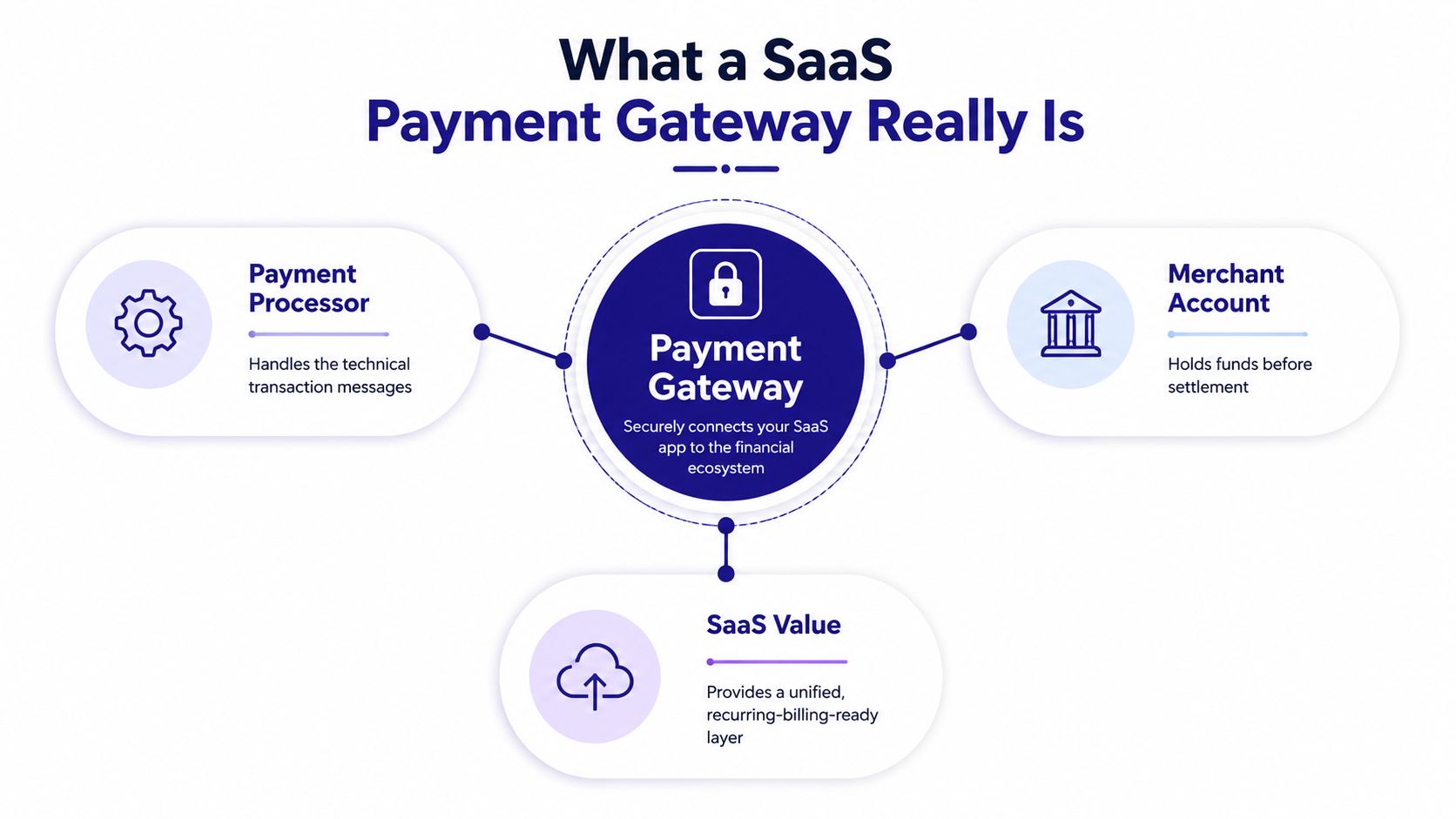
The gateway, processor, and merchant account
A payment processor handles transaction messages and communicates with acquiring and issuing institutions. The merchant account holds funds before they settle to the business. The gateway gives your frontend, backend, or hosted checkout a controlled way to initiate the payment and receive the authorization response.
For SaaS, that basic flow isn't enough. A subscription product also needs billing logic that knows when to charge, which plan applies, what happens after an upgrade, and how to respond when a renewal fails. The gateway may provide some of that logic, or it may connect to a separate subscription billing system.
Why recurring billing changes the design
A one-time purchase has a clear beginning and end. A subscription creates an ongoing relationship between your product, the customer, and the payment method. Your system needs recurring charges, payment-method storage through tokens rather than raw card data, cancellation events, retries, and webhooks that tell your application what happened.
A webhook is especially important because your application shouldn't assume that a browser redirect proves payment success. The payment provider sends a server-to-server event, your backend verifies it, and your product updates access or account status. That separation protects against customers receiving access when a payment is still pending or failing.
Practical rule: Treat payment authorization, subscription status, and product access as related events, not as one event.
Generic e-commerce gateways often handle the initial charge well but leave SaaS-specific cases to your team. Trials, proration, seat changes, usage-based billing, failed renewals, and churn recovery all require lifecycle logic. Before choosing a provider, ask whether those functions are native, available through an API, or something your engineers must build and maintain.
How a Modern SaaS Payment Gateway Works
The cleanest mental model has three connected parts: payins, balance, and payouts. This view matters because the customer's payment method and your preferred settlement method don't have to be identical.
Payins accept the customer's preferred method
Payins are the methods your customer uses to fund a purchase or subscription. Depending on the provider, that can include cards, wallets, bank transfers, BNPL, and crypto. The goal isn't to display every method to every visitor. It's to offer the relevant options for the customer, market, device, transaction type, and risk profile.
The checkout then sends the payment request through the gateway. The provider may tokenize credentials, apply fraud checks, request authentication, and route the transaction to an acquiring path. Your application receives the result through the API and webhook layer.
The balance gives your team one operational view
A unified balance reduces the need to reconcile every payment rail separately. Instead of checking one dashboard for card receipts, another for crypto, and another for bank payments, your finance and operations teams can work from one payment record and one balance view.
Suby Payments is documented as an API-first payments stack that can accept payments in USD and settle them in EUR, AED, or USDC. That supports a concrete flow where a customer pays by card and the business receives USDC, while still allowing other combinations. The Suby Payments documentation describes the supported payin and settlement model.
Payouts determine how the business receives funds
Payouts are where gateway selection becomes a treasury and operations decision. A SaaS business may want settlement to a bank account for ordinary expenses, or it may prefer a stablecoin for a cross-border workflow. The right setup depends on accounting, liquidity, local banking access, treasury policy, and what the business needs to do with the funds.
For example, a customer can pay by card in USD. The payment enters the provider's balance, and the business can choose a supported settlement route such as EUR, AED, or USDC. That's different from asking the customer to use crypto. The customer gets a familiar checkout, while the business chooses a different way to receive the money.
The same infrastructure can support a subscription SaaS, an international agency invoice, or a digital community with paid access. The shared principle is straightforward: customers pay in a method they understand, and businesses receive funds in a method they can use.
Here's a visual walkthrough of the money flow:
Must Have Features Security and Compliance for SaaS
A provider can support many payment methods and still be a poor SaaS choice. Evaluation should start with the full payment path, from checkout rendering to issuer response, then continue through renewal, refund, dispute, reporting, and settlement.
Performance affects completed payments
Measure latency at p75, p95, and p99 during peak concurrency, not just with an average. Industry guidance notes that abandonment increases when checkout exceeds roughly 1.5 seconds, and even a 100 millisecond delay can materially reduce conversion. The checkout speed analysis from SpeedXMedia explains why teams need to inspect the complete path, including frontend work, fraud checks, gateway calls, and issuer round trips.
Authorization rate deserves the same attention. General card-not-present e-commerce commonly benchmarks around 85% to 92%, while optimized merchants may reach 90% to 95% or 91% to 96% with tokenization and smart routing, based on MetricHQ's SaaS payment acceptance reference. Ask how the provider handles network tokens, local acquiring, routing choices, retries, and issuer declines.
Recurring revenue needs operational controls
A serious SaaS gateway should support one-time charges and subscriptions without forcing your team to create separate payment systems. Check for:
Subscription events: Confirm that renewals, cancellations, plan changes, and payment failures can reach your application through webhooks.
Payment recovery: Ask how failed recurring charges are surfaced and what tools help customers update their payment details.
Refunds: Verify whether refunds carry an additional fee. Suby documents zero-fee refunds as a product capability.
Disputes: Look for evidence collection, representment workflows, descriptor controls, and visibility into the reason for each dispute.
Reporting: A real-time dashboard should help teams inspect payments, subscriptions, churn, payouts, and reconciliation.
Subscription disputes often come from descriptor confusion, forgotten trials, annual-plan surprises, and seat-based price increases. Industry billing guidance commonly places a healthy SaaS dispute rate around 0.1% to 0.3%, while rates above 0.5% require active remediation, according to Fincoro's SaaS billing dispute guidance.
Security should reduce your burden
Confirm the provider's compliance scope and the responsibilities that remain with your team. Suby documents a PCI-DSS Level 1-certified processing partner, along with Strong Customer Authentication and two-factor authentication. Tokenization and encryption should keep sensitive payment credentials away from ordinary application storage.
For a practical review of form handling, access controls, and payment-page safeguards, consult these payment form security best practices. You can also review Suby's explanation of PCI DSS compliance before deciding which integration model fits your team.

Integration Options From API to Paylinks and Hosted Checkout
Your implementation choice determines how much control your team has and how much payment infrastructure it must operate. There isn't one universally correct approach.
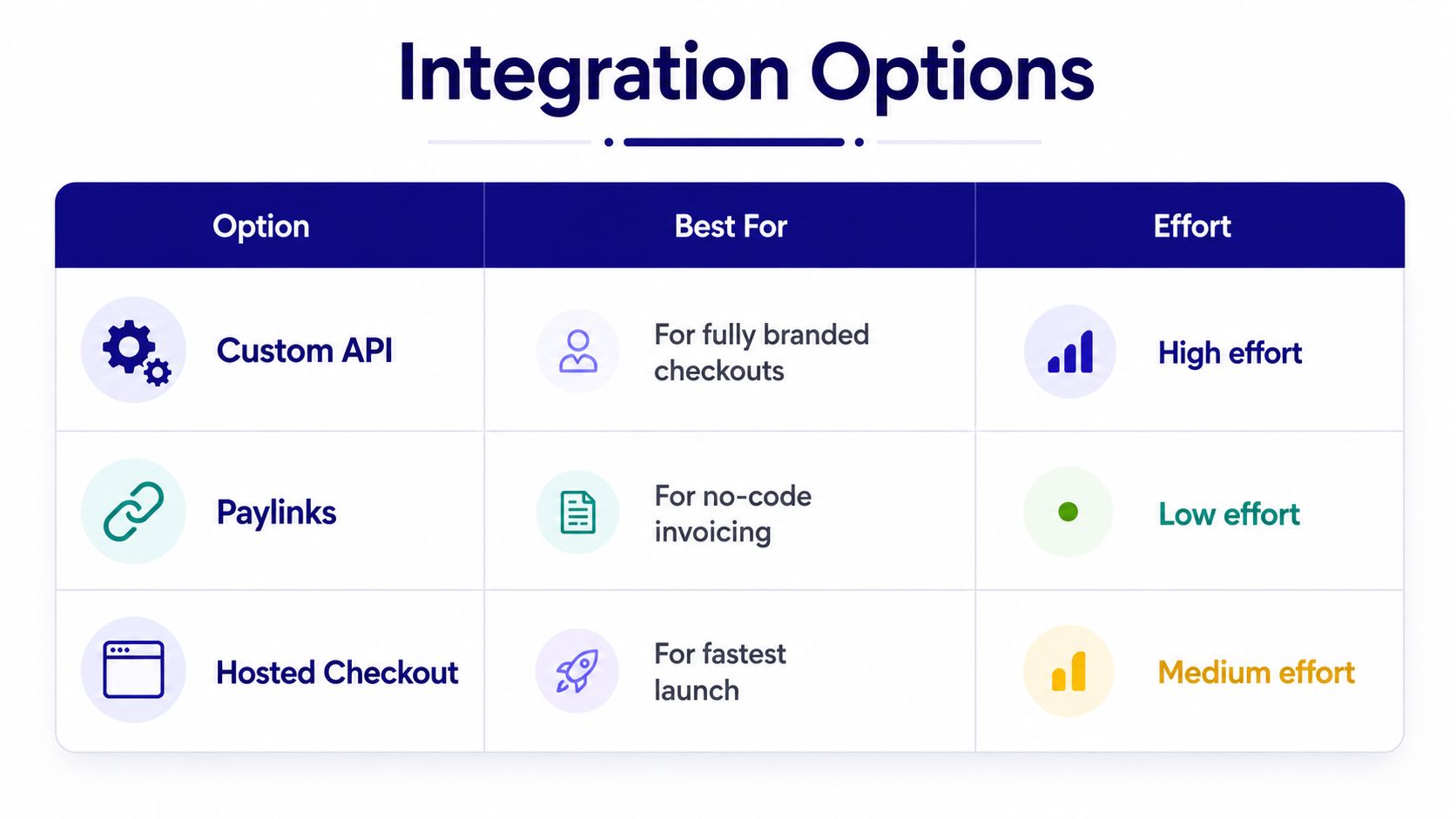
Custom API
An API integration keeps your product in control of the payment experience. Your backend creates a checkout session or payment request, your frontend collects the required information through the provider's components, and webhooks update subscription and access status.
Choose this route when your pricing is complex, your checkout is central to the product, or you need custom entitlement logic. The trade-off is engineering responsibility. Your team must handle event verification, idempotency, error states, retries, test environments, and monitoring. Suby documents an API-first approach for accepting card or crypto payments, and its payment gateway API integration guide covers the implementation concept.
Paylinks
Paylinks are useful when you need to sell without building a complete checkout. You can generate a payment link for a plan, invoice, membership, or one-time product and share it through email, chat, a landing page, or a sales conversation.
They're a good fit for early validation, agencies, internal operators, and teams that need to launch quickly. You give up some control over the surrounding experience, but you also avoid building payment screens before you know which offer customers want.
Hosted checkout
Hosted checkout gives you a provider-managed payment page that you can connect to from your application. It usually offers a faster route to a consistent flow and can reduce the amount of sensitive payment handling your team must manage directly.
Suby also documents native integrations with Discord and Telegram for use cases such as subscriptions, paid access, and online communities. Its Discord integration can automatically gate roles, channels, and servers after payment, and it supports checkout inside Discord, where customers can pay by card or stablecoin without leaving the server. The Discord integration documentation describes that workflow.
Real World Use Cases for SaaS and Cross Border Teams
Suby is documented as one product with four ways to use it: Suby Payments, Suby Crypto, Suby Gating, and Suby Invoicing. The homepage describes the product as supporting API access, paylinks, invoicing, and content gating in one account.
Suby Payments for product teams
A SaaS builder can use the API-first payment stack to place cards and crypto in one checkout. This is useful when the product wants a standard subscription experience while still serving customers who prefer alternative payment rails.
The payment record, subscription event, and payout information can then fit into the same operational workflow instead of being split across unrelated tools.
Suby Crypto for crypto-native customers
Suby Crypto handles the swap and sponsors the gas. Settlement can go to a non-custodial wallet or into the Suby balance, giving the business a choice between direct wallet settlement and centralized operational visibility.
That separation matters. The customer can complete a crypto payment without requiring your team to design every conversion and network-fee step itself.
Suby Gating for paid access
Suby Gating supports paid access for Discord, Telegram, downloads, and courses. A creator or SaaS operator can connect payment to entitlement, so a successful payment grants access to the content or community rather than requiring manual approval.
Teams evaluating Telegram memberships can also review this practical guide on how community managers accept payments in Telegram.
Suby Invoicing for international clients
Suby Invoicing lets a client choose how to pay while the business chooses how to receive the funds. That pattern fits agencies, consultants, and SaaS companies with larger B2B invoices, especially when the customer's preferred payment method differs from the supplier's preferred settlement currency.
For more context on designing this kind of cross-border flow, see the cross-border payment gateway guide.
Your SaaS Payment Gateway Buyer Checklist and Next Steps
A good shortlist should answer operational questions, not just compare logos. Before signing up, verify these points in the provider's official documentation:
Payin coverage: Can customers use the cards, wallets, bank methods, BNPL options, and crypto rails that matter in your target markets?
Balance visibility: Do all payment methods appear in one operational view with clear transaction and settlement records?
Settlement choice: Can you receive funds through a bank account or stablecoins such as USDC, where supported?
Subscription support: Are recurring charges, webhooks, cancellations, retries, and plan changes documented clearly?
Integration fit: Can you start with a paylink or hosted checkout, then move to an API without replacing the payment layer?
Security controls: Confirm tokenization, authentication, two-factor authentication, dispute handling, and PCI-DSS scope.
Performance reporting: Look for latency percentiles, authorization outcomes, decline reasons, and payment recovery signals.
Pricing: Pricing depends on the payment method used, so don't assume a single flat rate. Check the Suby pricing page for exact figures before estimating unit economics.
Start with the smallest implementation that lets you validate the payment experience. A paylink can test demand, while an API integration can support a branded checkout once your pricing and entitlement model are stable. Keep the event model clean from the beginning, especially around payment success, subscription status, refunds, and disputes.
A SaaS payment gateway becomes valuable when it connects customer choice with business control. Your buyers can use the method they trust, while your team can manage the balance, payouts, subscriptions, and access rules from infrastructure designed for recurring and cross-border commerce.
Suby provides an API for accepting card or crypto payments, plus native Discord and Telegram integrations for subscriptions, paid access, and online communities. Visit Suby to review the payment, crypto, gating, and invoicing options, then check the pricing for the payment methods that match your SaaS model.
