

Gaspard LEZIN
Usage Based Billing: A Guide for Global SaaS in 2026
Learn how usage based billing works, from pricing models to technical implementation. A complete guide for global businesses to align revenue with value.
A lot of founders reach the same pricing wall at roughly the same stage.
The product is working. Customers are signing up in different countries. Some barely touch the product, others run heavy workflows every day, and your flat monthly plan starts creating awkward conversations. Light users feel overcharged. Heavy users become expensive to support. Finance wants predictability, product wants flexibility, and customers want a bill they can understand.
That tension gets sharper when you sell globally. You might meter usage perfectly, generate invoices cleanly, and still run into payment friction, currency mismatches, payout delays, or messy reconciliation across markets. Pricing and payments stop being separate problems. They become one operating system problem.
That's why usage based billing matters now. It isn't just another SaaS pricing trend. In 2026, 60% of companies are either fully implementing or experimenting with consumption-based pricing, and its prevalence in B2B SaaS has nearly doubled over the past five years, according to OneBill's usage-based billing implementation guide. That tells you something important. This model has moved from edge case to mainstream.
For internet-native businesses, the fundamental question isn't whether usage based billing is interesting. It's whether your product, billing logic, and payment stack are ready to support it without confusing customers or breaking operations.
Table of Contents
Introduction Why Flat-Rate Pricing Is Breaking
The simplest mental model
What it is not
A quick comparison
Per-unit pricing
Tiered pricing
Volume pricing
Overage pricing
Hybrid pricing
Why founders like this model
Where customer trust gets won or lost
Metering comes first
Aggregation and rating
Invoicing and controls
Infrastructure and data platforms
AI makes forecasting harder
Billing is not the same as collection
Why settlement design matters
Conclusion The Future of Value-Based Pricing
Introduction Why Flat-Rate Pricing Is Breaking
Flat-rate pricing works well when customer behavior is similar.
It breaks when one customer stores a small amount of data and another pushes large volumes through your API every day, yet both pay the same monthly fee. One feels punished for being small. The other becomes unprofitable without notice. If you sell internationally, the mismatch gets worse because the bill already carries enough cognitive load from tax, currency, and payment friction.
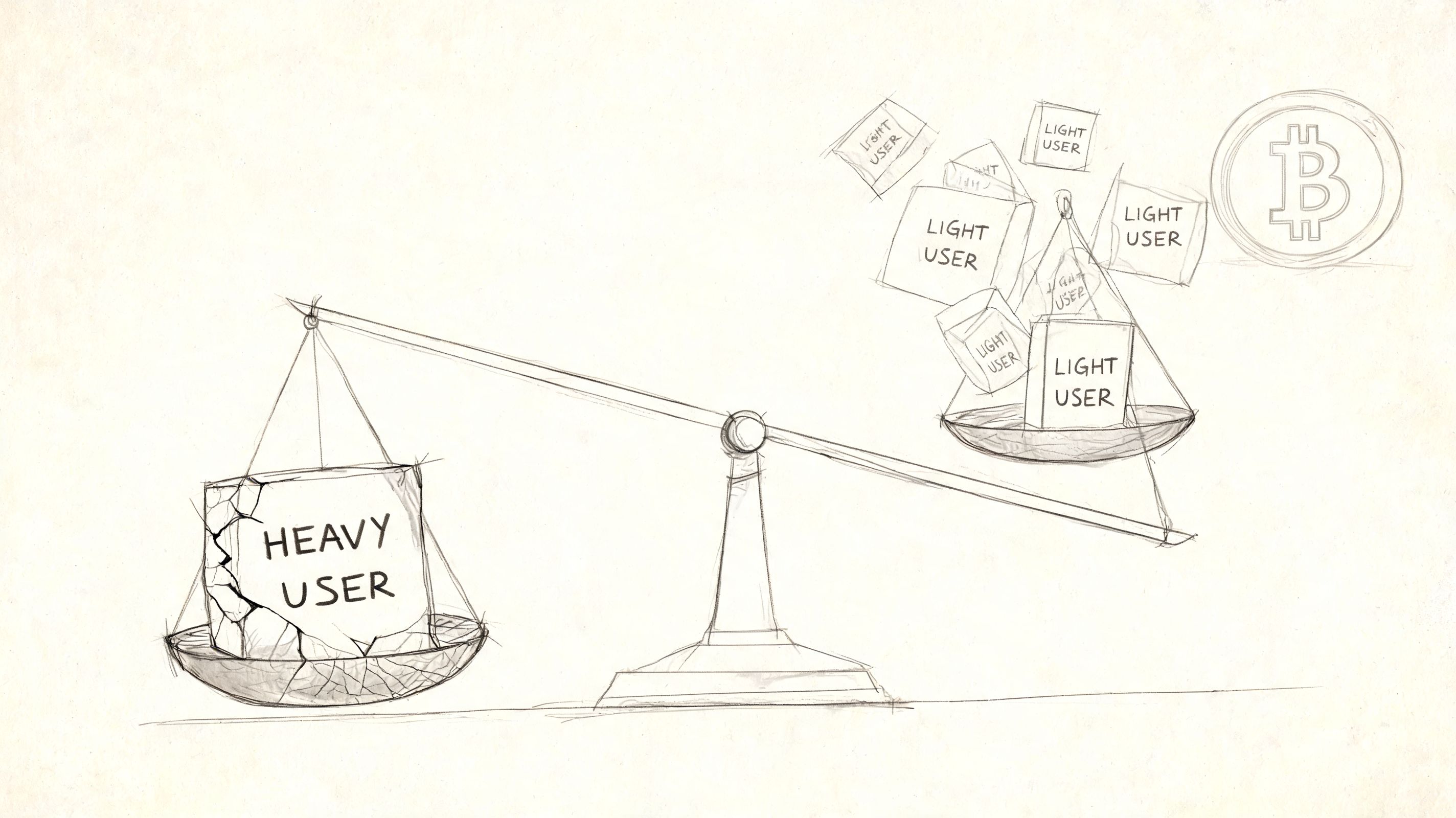
Usage based billing fixes a specific problem. It ties what the customer pays to something measurable inside the product. Instead of charging only for access, you charge for consumption, output, or activity that maps more closely to value. That's why it has become more common across software and API businesses.
A simple example makes the pressure obvious:
Flat plan problem: A team with occasional usage pays the same as a team running intensive workflows.
Per-seat problem: A company with few seats but heavy automation may consume far more infrastructure than a larger team with lighter usage.
Global problem: Even when pricing is fair on paper, collecting payment across borders can still delay cash and complicate settlement.
Practical rule: If your cost scales with customer activity, your pricing usually needs to acknowledge that activity too.
This doesn’t mean every business should abandon subscriptions. It means founders should stop assuming a fixed monthly plan is the default answer, and it helps to weigh usage billing against the broader range of SaaS subscription models before committing. In many categories, especially cloud, APIs, data products, and AI tools, the old model no longer reflects how value is created.
What Exactly Is Usage Based Billing
Think about an electricity bill.
You don't pay the same amount every month just because you have access to the grid. You pay based on how much electricity you use over a billing period. That's the core idea behind usage based billing. A customer consumes something measurable, the business tracks it, then converts that usage into a charge.
The simplest mental model
The cleanest way to understand this model is to separate three ideas:
Access means a customer can use the product.
Usage means the customer performs something measurable inside it.
Billing means you translate that measured activity into money.
For a software business, that measurable activity could be storage, bandwidth, API calls, transactions, messages sent, or active users. The exact metric depends on what your product delivers and what your customer can understand without a glossary.
Usage-based billing has older roots than many founders realize. Stripe explains that this model is rooted in industries like cloud computing, utilities, and telecommunications, where consumption is naturally measurable and providers meter usage before billing on a defined cycle, such as monthly or annually, using metrics like data usage, minutes of call time, or API calls, in its guide to usage-based billing models.
That history matters because it removes some of the mystery. This isn't a weird pricing invention from modern SaaS. It's a long-running billing logic applied to digital products.
What it is not
Founders often confuse usage based billing with a few adjacent ideas, including proration, so it helps to be clear on the prorated charge meaning when customers change plans partway through a period.
It is not the same as charging per seat. Seat-based pricing says, “You have five users, so you pay for five users.” Usage pricing says, “You consumed this amount of product activity, so you pay for that activity.” Those can overlap in a hybrid setup, but they are different levers.
It is also not random or uncontrolled pricing. Good usage billing is based on defined units, clear rules, and predictable billing cycles.
Here's a useful way to compare the two approaches:
Model | What the customer pays for | Best fit |
|---|---|---|
Seat-based subscription | Access by user or team | Tools where value tracks closely with headcount |
Usage based billing | Measured product activity | Products where value and cost vary by consumption |
Customers usually accept variable bills when the unit is clear, visible, and easy to relate to product value.
That last part is where many teams get stuck. They choose a metric engineers like, not a metric customers understand. Billing by “background compute duration” might reflect your infrastructure cost, but billing by “reports generated” or “API calls processed” may be far easier for a buyer to reason about.
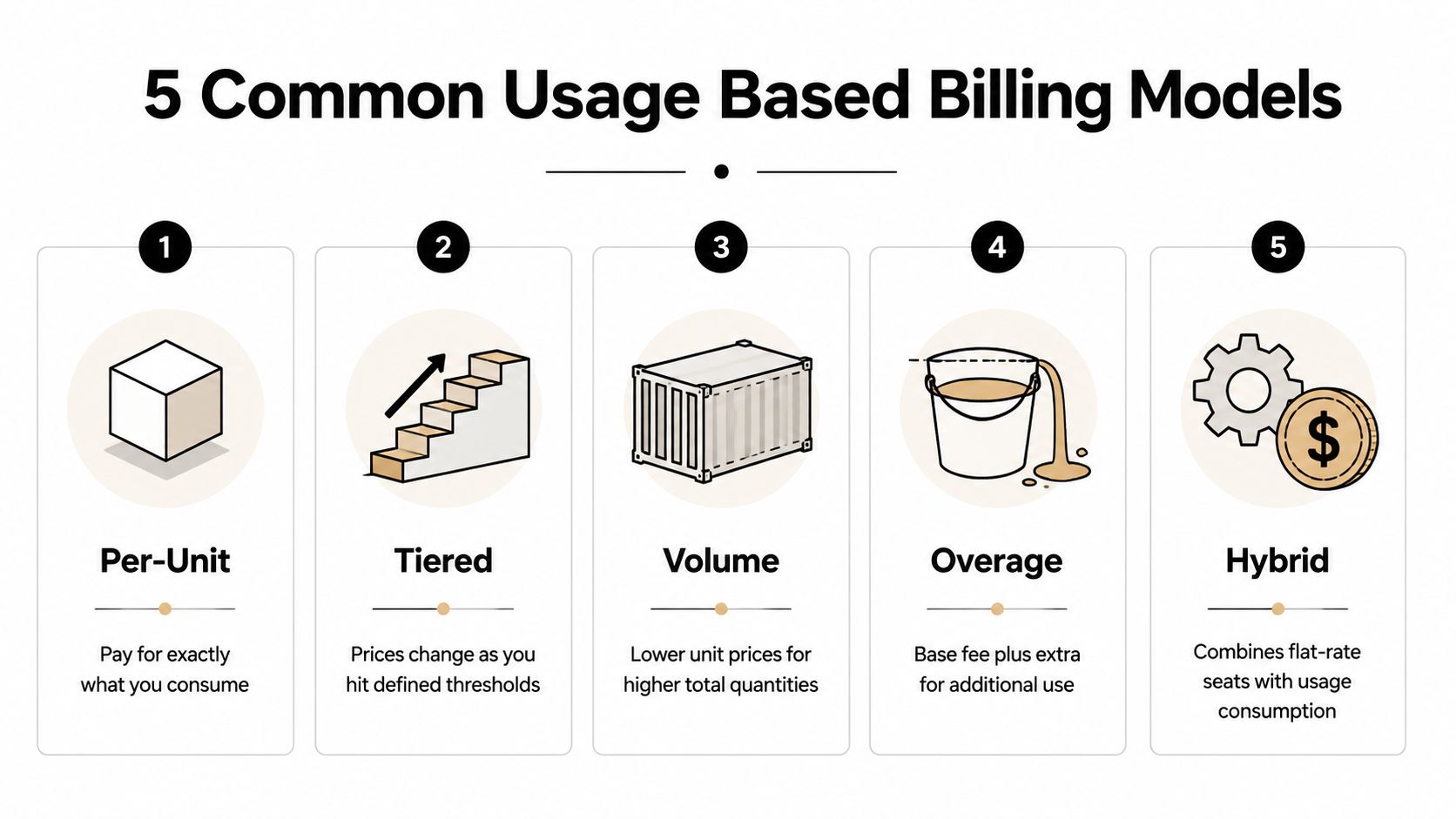
Comparing The 5 Common Usage Based Billing Models
There isn't one single version of usage based billing. Most companies pick a model based on what customers need to predict, what finance needs to recognize, and how much pricing complexity the product can support.
A quick comparison
Model | How it works | Main strength | Common drawback |
|---|---|---|---|
Per-unit | One rate for each unit consumed | Easy to explain | Bills can feel unpredictable |
Tiered | Different rates at different thresholds | Rewards growth with structure | Harder to model at the edges |
Volume | Total usage moves all units to a lower rate | Encourages consolidation | Customers may misunderstand the discount logic |
Overage | Base amount included, extra charged beyond it | Gives a predictable starting point | Overages can irritate customers |
Hybrid | Subscription plus usage charges | Balances predictability and flexibility | More operational complexity |
Per-unit pricing
This is the cleanest form. One unit has one price, and the customer pays for however many units they consume.
If you run an API product, this model often feels natural. A customer makes requests, you meter requests, and the invoice reflects the total. It's simple, direct, and easy for small teams to test.
Per-unit pricing works best when:
The unit is obvious: API calls, messages, or files processed are easy to count.
Usage varies widely: Small customers can start small without buying a large package.
You want low sales friction: Buyers don't need a custom contract to begin.
Its weakness is budget anxiety. When usage spikes, the invoice follows.
Tiered pricing
Tiered pricing changes the rate at defined thresholds. The first layer of usage is priced one way, later layers are priced another way.
This works well when you want a progression that feels fair without forcing customers into a totally bespoke plan. It gives you more control over monetization than plain per-unit pricing and more flexibility than a fixed subscription.
A founder might choose tiered pricing when the product serves both early-stage startups and large teams, but the same public pricing page still needs to make sense.
Tiered pricing often works better than flat per-unit pricing when you need one pricing structure to serve multiple customer sizes.
The downside is explanation. If sales, product, and finance each describe the tiers differently, customers will lose confidence fast.
Volume pricing
Volume pricing sounds similar to tiered pricing, but the commercial effect is different. In a volume model, the total quantity consumed can determine a lower unit price across the full amount.
This model can be useful when you want customers to centralize more usage with your platform. It creates a clear incentive to put more workload in one place.
Use it carefully, though. Customers often assume “discounted after threshold” when you mean “discounted across total volume,” or the reverse. That small misunderstanding can turn into a painful invoice dispute.
Overage pricing
Overage pricing starts with a base allocation. The customer pays a recurring fee that includes some usage, then pays more if they cross the limit.
A lot of SaaS companies like this model because it gives both sides something useful. The customer gets a predictable baseline. The business gets recurring revenue plus expansion when usage grows.
This approach fits products where people want some certainty before they commit. It also works for businesses transitioning from classic subscriptions into more flexible monetization.
Common strengths and risks:
Good for onboarding: Buyers can understand the included amount quickly.
Good for packaging: Marketing can still present clean plans.
Risky without alerts: Customers dislike surprise overages if they can't see them coming.
Hybrid pricing
Hybrid pricing combines a subscription element with usage charges. A team might pay a platform fee, a seat fee, or a base plan, then also pay for high-cost activity such as storage, compute-heavy actions, or advanced AI usage.
For many internet businesses, this is the most practical model because it reflects how value is delivered in layers. Access has value. Heavy usage has extra value. Expensive workloads create real provider cost.
Hybrid pricing often works when your product has both stable and variable components:
Stable layer: Seats, workspace access, support level, or feature bundle
Variable layer: API calls, bandwidth, storage, tokens, or premium processing
Commercial benefit: A predictable floor with room for account expansion
The tradeoff is operational. Hybrid models demand stronger systems, clearer invoices, and tighter customer communication than a single flat plan.
The Business Impact of Switching to Usage Billing
Founders usually start by treating pricing as a packaging decision. In practice, switching to usage billing changes acquisition, expansion, retention, and how customers judge fairness.

Why founders like this model
The biggest commercial advantage is reduced entry friction. A prospect who hesitates at a large fixed contract may still try a product if the bill grows with actual use. That gives product-led companies a cleaner land-and-expand path.
For existing customers, the model can improve expansion revenue because spend rises as usage rises. You don't always need a new sales process to capture more value. The product itself becomes the expansion path.
This also changes how you read familiar SaaS metrics:
Customer acquisition cost: Lower-friction entry can make early conversion easier, but you may recover revenue over time rather than upfront.
Lifetime value: Strong accounts can grow naturally if usage and value rise together.
Net dollar retention: Accounts can expand without adding seats, which matters for products driven by automation, data, or AI workflows.
Churn analysis: Variable pricing adds nuance. A customer may not fully churn, but reduced usage can still lower account value. That's why it helps to pair pricing changes with careful reading of SaaS churn rate patterns and retention signals.
Where customer trust gets won or lost
Usage billing only feels fair when customers can see it coming.
Stripe notes in its explanation of usage-based billing and billing cycle design that a best-practice system aggregates usage continuously but invoices on a defined cycle, and that shorter cycles offer fresher visibility while longer cycles can reduce invoice churn. That detail sounds operational, but it is strategic. Billing frequency shapes customer trust.
A practical pattern looks like this:
Continuous tracking: Customers need current visibility, not just an end-of-month surprise.
Defined invoice timing: Finance still needs a stable close process.
Alerts before finalization: Spikes should trigger review before they become disputes.
Itemized invoices: Customers should understand what happened without opening a support ticket.
A short discussion of these tradeoffs helps:
If customers can't estimate next month's bill, they won't feel in control, even if your pricing is technically fair.
That's why usage billing is never just a finance project. Product, support, growth, and engineering all shape whether the model feels transparent or stressful.
Technical Patterns for Implementing Usage Based Billing
A good usage based billing system is less like a price list and more like a measurement pipeline.
If you miss events, duplicate them, or process them too late, billing accuracy breaks. Once that happens, trust breaks with it.
Metering comes first
Metronome describes usage-based billing as a metering-and-rating engine in its overview of how usage-based billing works. That framing is useful because it forces the right priority order. Before you debate plans and discounts, you need reliable capture of billable events.
Metering means recording the raw actions that matter. Depending on the product, those might include API calls, gigabytes processed, feature activations, or minutes consumed.
Good metering needs a few qualities:
Completeness: Every billable event is captured.
Deduplication: The same event isn't counted twice.
Timestamp integrity: Usage lands in the right billing period.
Auditability: Teams can trace a charge back to source activity.
If your team is thinking about broader cash operations as well as billing logic, it's worth reading Arlo Inc.’s piece on improving Shopify store cash conversion cycles. It's focused on commerce, but the operating lesson carries over. Billing design only helps when cash collection and reconciliation are equally disciplined.
Aggregation and rating
Once raw events exist, you need to aggregate them into something billable.
Aggregation answers questions like, “How many API calls did this customer make this month?” Rating answers the next question, “Given this customer's pricing terms, what do those calls cost?”
Complexity enters the process here. A single product may support standard pricing, negotiated enterprise terms, tiered usage, credits, and regional rules. The rating engine has to apply the right logic without engineering manually patching edge cases every month.
A high-level flow usually looks like this:
Capture the event at the moment of usage.
Validate the event so malformed or duplicate records don't flow downstream.
Aggregate usage by customer, metric, and billing period.
Apply pricing rules based on plan terms.
Store billable results for invoice generation and review.
For teams comparing approaches, this overview of usage-based billing implementation tradeoffs is useful because it frames the decision from an operator's point of view, not just a finance one.
Invoicing and controls
Invoicing is the visible output, but it shouldn't be the first place anyone discovers a problem.
That's why mature systems add customer-facing controls before invoice finalization. A founder doesn't need to overengineer this on day one, but some safeguards matter early.
A practical starter set includes:
Usage dashboards: Let customers monitor current consumption.
Threshold alerts: Warn before a customer crosses meaningful limits.
Manual review rules: Flag strange spikes that may reflect abuse, bugs, or integration errors.
Clear line items: Make the bill readable by finance and by the operator using the product.
Operator mindset: Treat billing data like financial data, not analytics data. Tolerable errors in a dashboard become intolerable errors on an invoice.
That's the key implementation lesson. Fancy pricing logic won't save a weak metering layer.
Real-World Examples of Usage Based Billing
The easiest way to evaluate usage based billing is to look at categories where it already feels normal.
Infrastructure and data platforms
Cloud infrastructure is the most familiar example. Customers consume compute, storage, or data transfer, and the provider bills based on that consumption. This works because the unit is measurable and the relationship between use and cost is relatively easy to explain.
Data platforms use a similar logic. A team stores data, runs workloads, or processes queries, and their bill reflects those activities. What matters isn't the exact packaging. What matters is the operating pattern. The customer consumes a metered resource, and the provider converts that usage into a charge at the end of the cycle.
These examples are helpful because they show where usage billing is strongest:
The unit is measurable
Customer behavior varies significantly
Provider cost also scales with usage
Heavy users receive meaningfully more value than light users
When those conditions exist, flat pricing starts looking artificial.
AI makes forecasting harder
AI products introduce a new budgeting problem because the visible user action often hides variable token or compute consumption underneath.
GitHub's Copilot billing change is a clear example. As of June 1, 2026, GitHub's model charges based on GitHub AI Credits consumed by token usage, including input, output, and cached tokens, according to GitHub's announcement about Copilot moving to usage-based billing. That shifts budgeting from seats or request counts to workload composition.
That distinction matters. Two teams can each “use AI” but generate very different cost profiles. One may send short prompts. Another may run multi-step agent workflows with long context windows. Same feature category, different billing outcome.
For founders building AI features, that creates two immediate jobs:
Pick a billing unit customers can reason about
Give teams tools to forecast before broad rollout
A product manager should also think about pooled versus isolated usage. If usage is pooled at the organization level, finance gets flexibility but internal accountability gets fuzzier. If you allocate by team, spend control improves but capacity can sit unused.
The hard part of AI billing isn't only charging for usage. It's helping buyers understand which behaviors create cost.
That's why many AI companies pair token-based billing with credits, dashboards, or spend alerts. The billing unit may be technical under the hood, but the customer experience can't stay technical.
Integrating Global Payments for Your Usage Model
A lot of teams stop at the invoice.
They've solved metering, aggregation, and pricing logic, but they still haven't solved the last mile. How does a customer in one country pay, and how does the business receive funds in a way that's predictable enough to run operations?
Billing is not the same as collection
Usage based billing creates variable invoices. Global payments add another layer of variance if your collection stack depends on slow bank flows, local payout complexity, or currency conversion at multiple steps.
For an internet-native business, that matters for practical reasons:
Cash planning: You want to know when funds settle, not just when an invoice is issued.
Reconciliation: Finance needs a clean path from usage record to paid invoice to settlement.
Customer experience: Checkout has to feel familiar, especially for international buyers.
Tax operations: Cross-border billing still needs compliant records and jurisdiction-aware handling. If you sell in Europe, this EU VAT validation guide is a useful reference for understanding one part of that operational layer.
The payment rail should support the pricing model, not fight it. If your product can expand usage instantly but your cash collection drags behind or lands in fragmented currencies, your billing sophistication won't translate into operating simplicity.
Why settlement design matters
For global SaaS and online businesses, one practical option is Suby, which provides an API that allows businesses to accept payments by card or crypto, while businesses receive USDC. It also offers native integrations with Discord and Telegram for use cases like subscriptions, paid access, and online communities. In plain terms, users pay with cards, businesses receive USDC. That can fit a usage billing setup where you need to collect recurring or variable invoices internationally without relying on traditional payout flows. Businesses evaluating this setup can also review Suby's perspective on billing for SaaS products.
The broader lesson is bigger than any one tool. Once you move to value-based pricing, your collection layer should preserve that clarity. A customer shouldn't face friction paying a valid invoice, and your finance team shouldn't need a second reconciliation project after the bill is paid.
For global usage models, a solid payment design usually includes:
Familiar payment methods for buyers
Consistent settlement output for the business
Support for recurring and one-time payment flows
A clear integration surface, such as API and webhooks
Alignment with digital products and cross-border operations
That's the missing link many founders overlook. Pricing logic decides what the customer owes. Payment infrastructure decides whether that revenue arrives cleanly.
Conclusion The Future of Value-Based Pricing
Usage based billing works because it matches a simple commercial truth. Customers don't all get the same value from a product, and many software businesses don't incur the same cost for every account.
That's why flat pricing starts to strain as products become more global, more automated, and more tied to measurable consumption. The better model is often the one that connects price to a unit customers can understand and your systems can measure accurately.
The catch is implementation. You need trustworthy metering, sensible rating rules, clear invoices, and customer visibility before charges are finalized. Then you need payment collection that can handle international customers without turning settlement into its own operational mess.
For internet-native businesses, this is becoming normal product work. Pricing is no longer just a sales artifact. It's part of product design, billing architecture, and payment operations.
The companies that get usage based billing right usually do one thing well. They make value easier to buy, easier to measure, and easier to pay for.
Suby is a payment gateway and payment processor built for exactly this collection problem. Your customers pay with card, bank transfer, Apple Pay, Google Pay, Klarna, and more, or stablecoins, and your business gets paid out to your bank account, or directly in stablecoins (USDC, EURC) to your wallet, anywhere in the world, no bank account required. With an API, webhooks, and native Discord and Telegram integrations, it lets a usage based billing model settle variable, recurring invoices from customers in any market cleanly, without the cross-border payout drag that usually undermines metered pricing.
