

Gaspard LEZIN
What Is a Merchant of Record and Why Does It Matter?
Discover what a merchant of record is, how it simplifies global sales, tax, and compliance, and why it's a game-changer for businesses seeking growth.
Imagine you're running a fast-growing online business. You’ve got customers popping up everywhere, from London to Tokyo to São Paulo. It’s exciting, but it also brings a wave of complexity. How do you handle sales tax in Germany? What about VAT in the UK? What's the deal with payment compliance in Brazil?
Instead of drowning in paperwork and trying to become an international tax lawyer overnight, you bring in a partner to handle it all. That partner is a Merchant of Record (MOR), and they take on the full financial and legal weight of every single transaction for you.
What Is the Merchant of Record Model?
Think of a Merchant of Record as a global reseller for your business. In the eyes of the law and the customer's bank, the MOR is the legal entity making the sale.
This is a crucial distinction. When you work with an MOR, you aren't technically selling directly to the end customer. The MOR buys your product and then resells it to the customer, managing the entire transaction from the moment they click "buy" to the money landing in your account. The customer sees the MOR's name on their credit card statement, not yours. For you, this simple shift unlocks the ability to sell worldwide without the immense operational headache.
How an MOR Simplifies Your Business
The real magic of an MOR is that it absorbs all the messy, complicated, and time-consuming parts of international sales. This frees you up to focus on what you actually love doing, like building great products, marketing your brand, and connecting with your community.
Here’s a quick rundown of what an MOR takes off your plate:
Global Compliance: The MOR is responsible for calculating, collecting, and remitting all local sales taxes, VAT, and other duties for every country you sell in.
Payment Processing: It handles the entire payment flow, from accepting credit cards to maintaining strict PCI-DSS compliance so you don't have to.
Liability Management: All the financial risk, including painful chargebacks and fraud attempts, lands on the MOR’s shoulders, not yours.
This model is a game-changer for digital businesses like SaaS platforms, e-commerce stores, and creator communities on Discord or Telegram. These businesses often serve a global audience from day one, and trying to handle compliance manually across dozens of countries is a recipe for disaster.
A merchant of record model helps you stop worrying about the regulatory and tax compliance issues involved with accepting payments from around the globe, so you can skip the hassle and focus on what you do best.
Modernizing Payouts with an MOR
Traditionally, an MOR would handle currency conversions and wire payouts to your bank account. This process often gets bogged down by slow SWIFT transfers, high bank fees, and unpredictable delays. But that’s the old way of doing things.
At Suby, we pair the legal protection of the MOR model with the speed and efficiency of stablecoin settlements. We provide an API that allows any business to accept payments by card or crypto, and we also offer native integrations with Discord and Telegram. Your customers pay with their Visa or Mastercard, and you get paid out in fast, reliable USDC. You can learn more about how this simplifies handling international payments on our blog.
This hybrid approach cuts out the friction of old-school banking. No more surprise currency conversion fees, frustrating payout holds, or waiting days for cross-border transfers to clear. You get the legal shield of an MOR combined with the speed of USDC, giving you a powerful foundation to scale your business globally with total confidence.
What a Merchant of Record Actually Handles for You
A Merchant of Record does way more than just process a payment. Think of it as a complete operational partner that takes on the messy, high-risk, and frankly, tedious parts of selling products around the world. This frees you up to focus on what you actually do best, building great products and connecting with your customers.
By becoming the legal seller of your product for every transaction, the MOR steps in and takes full financial and legal responsibility. Let's break down what that really means and which tasks you get to wipe off your to-do list for good.
Global Tax and VAT Compliance
One of the biggest headaches of selling internationally is the tangled, ever-changing web of global tax laws. An MOR shoulders this entire burden.
Instead of you trying to keep track of sales tax rates in dozens of different countries (a full-time job in itself), the MOR automatically figures out the correct sales tax, VAT, or GST for each customer based on their location. More importantly, the MOR is legally on the hook for collecting those taxes and sending them to the right government agencies.
This is no small feat. A huge part of the MOR's job is managing complex global sales tax compliance, making sure you're playing by the rules in every single region. This single function can save you from disastrous fines and legal trouble down the road.
Secure Payment Processing
Every single online payment has to be secure and meet a long list of strict industry rules. An MOR handles the entire payment infrastructure, making sure every sale is buttoned up and protected.
This typically includes:
PCI-DSS Compliance: The MOR maintains full Payment Card Industry Data Security Standard compliance. This is a notoriously difficult and expensive certification process for handling credit card data that you now get to skip entirely.
Multiple Payment Methods: They offer a wide range of payment options, from standard credit cards like Visa and Mastercard to popular local methods, which makes for a much smoother checkout for your international customers.
Data Security: They are the ones responsible for protecting sensitive customer data, shielding both you and your buyers from the fallout of a potential data breach.
By owning the entire payment stack, the MOR ensures your checkout isn't just compliant but is also built to convert customers from all over the world.
Fraud and Chargeback Management
Chargebacks and fraud are an ugly, but inevitable, part of selling online. They can drain your time and money fast. An MOR acts as your front-line defense.
When a customer disputes a charge, it's the MOR's name on their bank statement. That means the MOR is the one who has to deal with the bank and manage the entire dispute process. They handle all the paperwork and communication, protecting you from the direct financial hit of many chargebacks.
An effective MOR uses sophisticated fraud detection tools to analyze transactions as they happen, flagging suspicious activity before the payment even goes through. This proactive screening cuts your risk and protects your bottom line.
Payouts and Currency Management
So, the sale is done, taxes are handled, and the money has been collected. Now, how do you actually get paid? The MOR simplifies this final, crucial step.
The old way involved converting a dozen different currencies back to your own, which meant you were at the mercy of terrible exchange rates and unpredictable bank fees. Modern MORs have found a much better way.
For instance, at Suby, we use an MOR model where your customers can pay by card in their local currency. We handle all the transaction complexity behind the scenes and then settle your funds directly to you as stable USDC.
This gives you a massive advantage: fast, predictable payouts without the delays and hidden costs of the traditional banking system. You can see exactly how we keep your business safe and your payouts smooth in our guide to Suby’s compliance framework. It’s a clean, simple system built for modern digital businesses.
MOR vs Payment Processor vs Payment Facilitator
Figuring out online payments can feel like you're learning a new language. You’ll hear terms like “payment processor,” “payment facilitator,” and “merchant of record” thrown around, sometimes as if they mean the same thing. They absolutely do not.
The model you choose has a massive impact on your legal risk, how much administrative work you’re signing up for, and your ability to sell around the world. Let's break down what each one actually does.
Comparing Payment Models: MOR vs Payment Processor vs Payment Facilitator
To really grasp the differences, it helps to see them side-by-side. This table cuts through the jargon and shows you exactly who is responsible for what in each setup. Notice how liability shifts as you move from a basic processor to a full MOR solution.
Feature | Merchant of Record (MOR) | Payment Processor | Payment Facilitator (PayFac) |
|---|---|---|---|
Who is the legal seller? | The MOR provider | You (the business owner) | You (the business owner) |
Sales Tax & VAT Liability | Handled entirely by the MOR | Your responsibility | Your responsibility |
Payment Compliance (PCI DSS) | Handled by the MOR | Your responsibility | Handled by the PayFac |
Chargeback & Fraud Liability | Handled by the MOR | Your responsibility | Your responsibility |
Global Currency Conversion | Handled by the MOR | Basic, often with high fees | Typically handled by the PayFac |
Onboarding Speed | Very Fast | Slow (requires own merchant account) | Fast (uses PayFac's account) |
As you can see, the Merchant of Record takes on the entire burden of the transaction's legal and financial complexities, which is a world away from simply processing a payment.
The Ground Floor: Payment Processors
A Payment Processor is the most fundamental piece of the puzzle. Think of it as a secure courier for financial data. When a customer types in their credit card number, the processor just passes that information safely between your website, the customer's bank, and your bank.
And that's it. Its job is done. All the messy stuff, like taxes, legal compliance, fraud, and chargebacks, is still 100% on your shoulders.
A Step Up: Payment Facilitators
Next, you have the Payment Facilitator, or PayFac. This is a definite step up in convenience. They make it much easier to get started because they let you operate under their master merchant account, saving you from the headache of applying for your own.
But don't get it twisted, a PayFac still leaves you holding the bag for most of the hard parts. You’re the one who has to figure out sales tax in different states and VAT in different countries. You’re the one legally responsible for the sale. A PayFac is a great tool, but it's not the complete answer for selling globally without a dedicated finance team.
The All-in-One Solution: The Merchant of Record
This brings us to the Merchant of Record (MOR), which is a totally different ballgame. An MOR doesn’t just process the payment, it becomes the legal seller of your product for that transaction.
This is a profound shift. The MOR takes on the full legal and financial liability for every sale. In effect, they act as a reseller for your business, insulating you from the operational chaos.
This diagram shows how the MOR sits at the top of the pyramid, absorbing all the complexity of taxes, payments, and fraud for you.
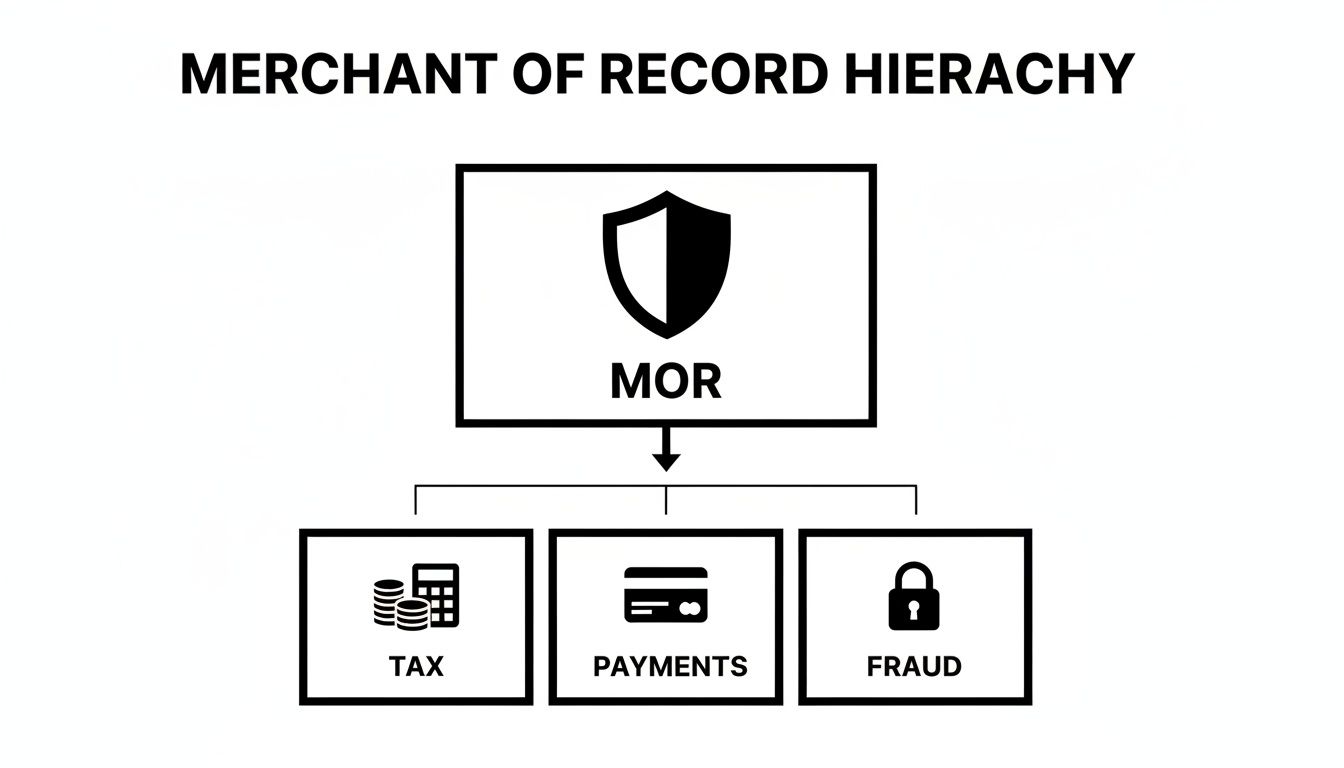
The peace of mind this provides is huge. It's no surprise that 66% of companies using an MOR report being 'highly confident' about their international expansion plans, a big jump from the 50% who try to manage it all themselves. The data shows that 40% of sellers get bogged down managing multiple payment partners and 37% struggle with navigating international laws, exactly the problems an MOR is designed to solve.
A Merchant of Record is a game-changer because it takes on full financial and legal liability. For a SaaS company, a creator, or a digital goods seller, this means you can get to market fast without building an entire compliance department from scratch.
For a hands-on look at these concepts, this guide on how to accept payments on your website is a great resource.
With a modern solution like Suby, we’ve made this even more direct. We provide an API and also have native integrations with platforms like Discord and Telegram. We handle all the MOR complexities behind the scenes, so when users pay with their card, you get paid out quickly and reliably in USDC. It's the legal shield of a traditional MOR combined with the speed and efficiency of stablecoin settlements, cutting out the friction of old-school global banking.
The Real Pros and Cons of Using a Merchant of Record
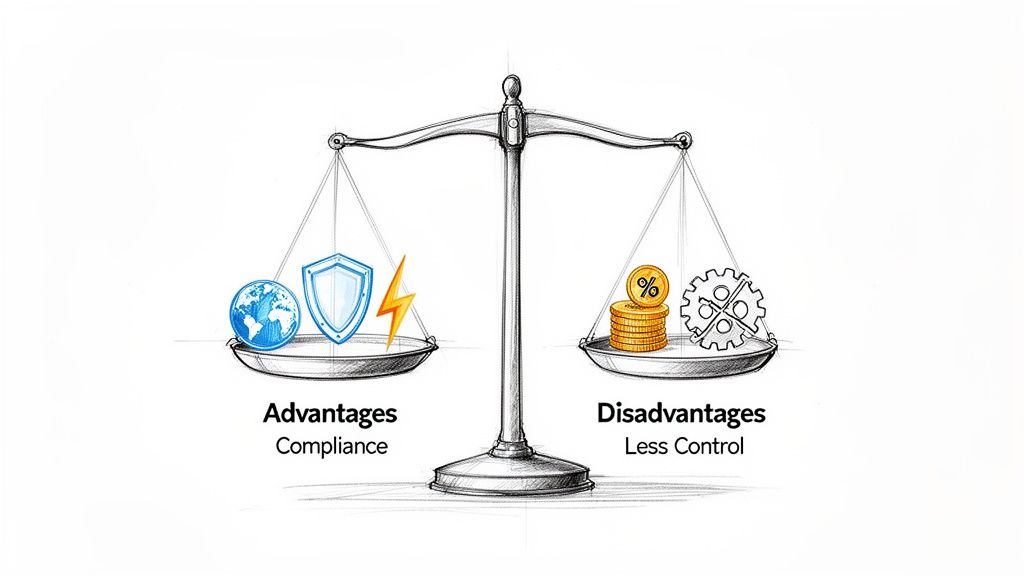
No single payment solution is perfect for every business, and the merchant of record model is no different. It’s a powerhouse for some, but it’s crucial to look at both sides of the coin to figure out if it's the right fit for you.
For most online businesses, especially those aiming for a global audience, the benefits are incredibly compelling. They solve the biggest, most expensive headaches of international growth. But like any major business decision, there are trade-offs. Let's dig into the real-world pros and cons you should expect.
The Powerful Advantages of an MOR
The biggest, most immediate benefit of a merchant of record is how drastically it simplifies your business. By stepping in to take on the legal and financial liability for every single transaction, an MOR lifts a massive weight off your shoulders.
Here’s what that actually looks like in practice:
Massively Reduced Compliance Risk: An MOR deals with the tangled mess of global tax laws, including sales tax, VAT, and GST. This means you don't have to become an expert on the tax codes of dozens of countries just to make a sale.
Simplified Global Expansion: You can start selling to customers almost anywhere in the world, practically overnight. The MOR already has the legal and financial infrastructure in place, letting you tap into new markets without the pain of setting up local business entities.
Lower Operational Overhead: You can forget about the high costs of hiring tax specialists, compliance lawyers, and a dedicated finance team to juggle international payments. That capital and energy can be poured back into what you do best: your product and marketing.
The true value of an MOR isn't just about outsourcing tasks, it's about outsourcing risk. You get to focus on building your business while your partner handles the complex, high-stakes work of global compliance.
This model is a game-changer for modern digital businesses, and if you are weighing established providers our Paddle vs FastSpring comparison for software sales breaks down how two popular MOR options stack up. Imagine a SaaS founder who wants to break into the European market. Instead of getting bogged down for months in legal red tape and tax setup, they can use an MOR to start accepting payments from EU customers immediately, with all the tricky VAT stuff handled for them.
Or think about a creator monetizing a Discord community. They can sell subscriptions to members all over the globe without losing sleep over the tax rules in each member's country. With a platform like Suby, they can do this while getting fast, predictable payouts in USDC, completely sidestepping the headaches of traditional international banking.
Understanding the Potential Disadvantages
Of course, it’s not all sunshine and rainbows. The most common concerns people raise about the MOR model usually circle back to two things: cost and control.
One frequent point of confusion is the fee structure. MOR fees are typically higher per transaction than what you'd see from a basic payment processor. This can look like a downside at first, but it's vital to understand what you're paying for. These fees are all-inclusive, bundling payment processing, fraud prevention, currency conversion, and global tax management into one rate. When you add up what it would cost to manage all of that yourself, the MOR model often comes out as the more cost-effective option.
The other point to consider is that you have less direct control over the payment stack. Because the MOR is the legal seller, they're the ones managing relationships with banks and payment gateways. While this makes your life a lot easier, it might mean less flexibility if you have some very specific or unusual technical needs.
How Modern Platforms Mitigate the Cons
Today's payment platforms are being built specifically to address these potential downsides. At Suby, for instance, we provide a simple API and native integrations with tools like Discord and Telegram, giving you the flexibility you need without the complexity. Our all-inclusive pricing is competitive, and we settle payouts in stable USDC, which eliminates the currency conversion fees and delays that still plague older systems.
The market's reaction tells the story. The global Merchant of Record software market has seen explosive growth, jumping from USD 11.61 billion to USD 13.2 billion in just one year. It's now projected to hit an incredible USD 35.43 billion by 2032. This surge is being driven by e-commerce and subscription businesses that need a simple, reliable way to handle recurring global payments. You can read the full research on this expanding market to see the trend for yourself. This rapid adoption proves that the merchant of record model is becoming an essential tool for any business serious about scaling internationally without all the friction.
How to Choose the Right Payment Model for Your Business
Picking how you get paid is a huge decision. It's not just about moving money around; it affects your costs, your global reach, and how fast you can grow. There's no single "best" answer, so let's walk through how to figure out what makes sense for your business.
A traditional merchant of record is usually a great fit for massive enterprises. Think multinational corporations with entire departments dedicated to finance and legal. These companies have the budget and the sheer operational complexity to justify a heavy-duty, all-in-one solution that takes everything off their plate. For them, offloading the enormous burden of global tax and legal compliance is worth the cost.
On the other hand, a modern payment layer is built for the kind of nimble online businesses that define today's market, and our guide to merchant of record for global sales digs deeper into how this works in practice. I'm talking about SaaS startups, creators building paid communities on Discord or Telegram, and e-commerce brands that need to be fast and flexible. They need the same global compliance but can't get bogged down by clunky systems built for a different era.
Key Questions to Guide Your Decision
To find your best path, you need to be honest about what you really need. Answering these questions will tell you pretty quickly which model fits your current stage and future ambitions.
How fast do you need to move?
If getting to market now is the goal, a modern payment layer with a simple API and no-code tools is the obvious choice. Traditional MORs often have lengthy, enterprise-style onboarding and vetting processes that can slow you down.What's your team's technical skill set?
Do you have developers ready to dive into a flexible API and webhooks? Or do you need a completely hands-off solution? Platforms like Suby are designed for both, offering a clean API for developers and native integrations for platforms like Discord, letting you pick the easiest route.Are modern payout options important to you?
This is a huge dividing line. If you'd rather get paid in stablecoins to dodge high international bank fees, slow wire transfers, and painful currency conversion losses, a modern platform is your only real choice. Getting fast, reliable USDC settlements means you have better control over your cash flow and a much clearer picture of your finances.
The goal isn't to find the "best" payment model in theory. It's about matching the tool to the job. You need to align the solution with your business's DNA, whether that's the ironclad stability a Fortune 500 company requires or the agility a lean startup needs to survive.
Traditional vs. Modern Solutions: A Quick Comparison
Think of traditional MORs as running on old-school financial railroads. They get the job done, but they often come with slower payout schedules, confusing fee structures, and very little wiggle room. They're rock-solid for handling the complex legal needs of giant corporations but can feel like a straitjacket for a smaller, fast-growing business.
A modern payment layer, like Suby, flips the script. It gives you the full legal and tax protection of the merchant of record model but hooks it up to the speed of crypto-native settlements. Your customers pay with their card like they do everywhere else, but you receive USDC. It neatly sidesteps all the friction of the legacy banking system while still managing all the critical compliance work behind the scenes.
For anyone building a business in the digital economy, this hybrid approach is often the smartest play. It gives SaaS founders, creators, and online sellers the global reach they need without the old-world headaches. You truly get the best of both worlds: powerful compliance and fast, modern payouts, all through a platform that's actually easy to use.
Your Practical Guide to Implementing an MOR
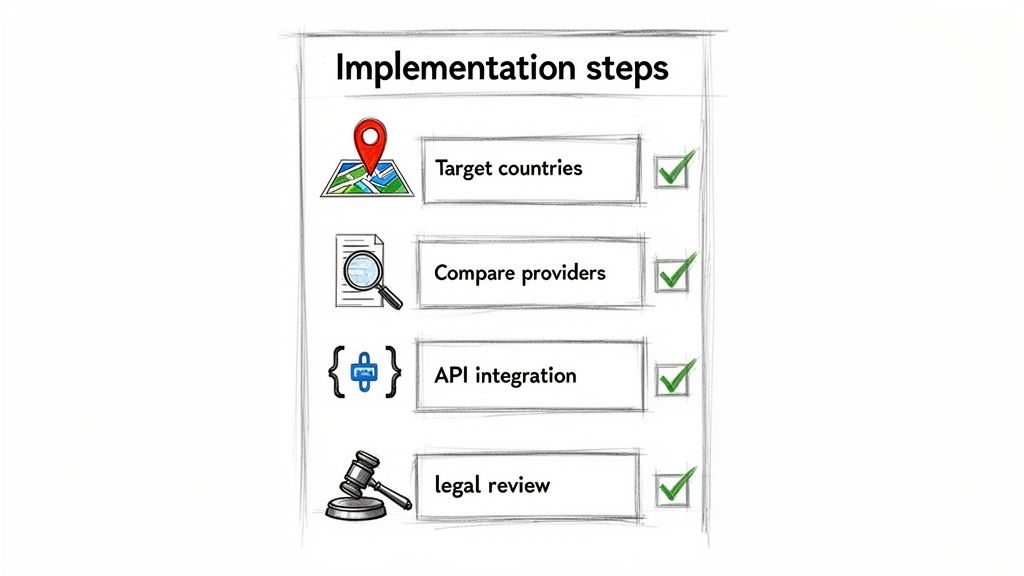
So, you're ready to offload the headaches of global sales and compliance. Great move. Making the switch to a merchant of record isn't nearly as complicated as it sounds, especially when you break it down into a few manageable steps.
Think of this as your roadmap, whether you're starting from scratch or moving away from an existing payment setup. It’s not about getting bogged down in technical details; it’s about making a smart, strategic choice that sets your business up for growth.
First Things First: What Do You Actually Need?
Before you even start looking at providers, take a hard look at your own business. A solution built for a Fortune 500 company will be a terrible fit for a nimble SaaS startup or a creator launching a community. You need to know your own requirements inside and out.
Start with these key questions:
Where in the world are my customers? Make a list of your top countries today and where you plan to expand tomorrow. This immediately narrows your search to providers with real, on-the-ground expertise in those markets.
What am I selling? The needs for selling one-off digital downloads are completely different from a subscription-based software. Be clear about your business model.
What's my sales volume? Have a solid grasp of your current transaction volume and your projections for the next year. This is a huge factor in pricing and the kind of support you'll get.
Time to Compare Providers and Plan the Tech Lift
With a clear picture of your needs, you can start vetting potential MOR partners. This market is booming, it's expected to hit USD 6.46 billion on the back of a 14.71% compound annual growth rate. That growth means you have choices, so you can afford to be picky. You can get a better sense of the expanding MoR software market and its key players through recent industry analysis.
Dive into the specifics. Scrutinize their fee structures, see how flexible their APIs are, and check out their payout options. For businesses operating globally, the ability to get settled in a stablecoin like USDC can be a game-changer, letting you sidestep the slow, expensive world of international bank transfers.
The best MOR partners make life easy. They offer crystal-clear documentation, straightforward APIs, and ready-made integrations for platforms like Discord or Telegram. This drastically reduces the engineering effort required to get up and running.
Finally, do your due diligence. Read the terms of service and have your team review the compliance paperwork. This last check ensures there are no hidden surprises and that their way of doing business aligns with your own legal and financial standards. A little prep work here makes the entire transition to a global-ready payment system feel less like a leap of faith and more like a confident next step.
For a closer look at the technical side of things, our guide on integrating a payment gateway API is a great place to start.
Common Questions About the Merchant of Record Model
As you start digging into the merchant of record model, a few questions always seem to surface. It's totally normal. Figuring out exactly what an MOR does, and more importantly, what it doesn't do, is the key to deciding if it's the right move for your business. Let's tackle some of the most common ones head-on.
Does an MOR Handle All My Customer Support?
This is a great question, and the answer is a clear "no," but they do handle the most painful parts. An MOR's support team is laser-focused on anything and everything related to billing. Think failed payments, refund requests, and chargeback disputes. Since they're the legal entity on the hook for the transaction, they take care of all that financial back-and-forth.
Your team, however, is still the expert on your product. If a customer runs into a technical bug with your software or needs help figuring out a feature, they’ll still come directly to you. This split makes a lot of sense: you focus on making your product great, and the MOR handles the complexities of getting paid for it.
What Is a Seller of Record?
You’ll probably hear the term Seller of Record (SOR) thrown around in the same conversation as Merchant of Record. For the most part, you can think of them as the same thing. Both an MOR and an SOR are the entity that’s legally responsible for a transaction in the eyes of the customer, their bank, and the tax man.
So, for all practical purposes, when a company is your Merchant of Record, they're also your Seller of Record. The main thing to remember is that this single entity shoulders all the liability for the sale, which lifts a massive compliance weight off your shoulders.
Is an MOR a Good Fit for Selling Digital Subscriptions?
Absolutely. In fact, subscriptions are one of the areas where the merchant of record model really shines. Recurring billing brings a whole new level of complexity with global taxes, dunning (managing failed payments), and compliance that changes from country to country. An MOR is built to handle exactly that.
Modern platforms are designed specifically for this. For example, Suby provides the legal MOR framework to help SaaS businesses and online communities on Discord or Telegram easily manage recurring card payments. Our whole system is set up to make selling memberships and paid access a global operation, letting you focus on what you do best, building your community.
Why Are MOR Fees Higher Than a Payment Processor?
It’s easy to get sticker shock when you see MOR fees next to a standard payment processor's rate. But it's a classic apples-to-oranges comparison. That single MOR fee is all-inclusive, covering way more than just the basic transaction.
A single MOR fee bundles payment processing, currency conversion, fraud prevention, chargeback defense, and global sales tax compliance into one predictable cost. If you were to add up the separate costs and time spent managing all those things yourself, the all-in MOR model often comes out ahead.
At the end of the day, that slightly higher fee is the price of offloading immense risk, a ton of administrative work, and the global compliance headaches that come with it.
Suby is a payment gateway and Merchant of Record. Your customers pay with card, bank transfer, Apple Pay, Google Pay, Klarna, and more, or stablecoins, and you get paid out to your bank account, or directly in stablecoins (USDC, EURC) to your wallet, anywhere in the world, no bank account required. As your Merchant of Record, Suby carries the sales tax, VAT, PCI DSS, and chargeback liability for every sale, giving you the legal shield of a traditional MOR with the speed of stablecoin settlement.
