

Gaspard LEZIN
Billing for SaaS: A Guide to Global Payments & Subscriptions
Master billing for SaaS. This guide covers pricing, subscriptions, churn reduction, and global payments with USDC settlement for businesses selling worldwide.
You’ve probably seen this pattern already. A SaaS product starts with a simple monthly plan, a card checkout, and a handful of local customers. Then growth brings a messier reality. A prospect in Germany asks for a VAT-compliant invoice. A customer in Brazil wants to pay, but the payout takes too long and the fees are hard to reconcile. A team in Singapore upgrades mid-cycle, and someone has to calculate the proration by hand.
That’s when billing for SaaS stops being a background task and turns into core infrastructure.
The hard part isn’t only charging customers. It’s keeping pricing aligned to product value, collecting on time, handling failed payments, staying compliant across markets, and making sure revenue lands where the business can use it. For global software companies, that challenge is bigger because the billing system has to bridge product usage, finance, tax, support, and payments.
Most guides still frame this as a fiat-only problem. That misses what many internet-native companies need now. Customers still expect familiar payment methods like cards, but businesses increasingly want faster and more predictable settlement, especially when they operate across borders. A modern setup can support both.
Table of Contents
What global teams actually run into
Start with how customers receive value
Where each model works, and where it breaks
Pricing model choices affect settlement strategy too
SaaS Pricing Model Comparison
Invoices are an operating system not a document
Proration needs rules before you need rescue work
Tax complexity arrives earlier than most teams expect
Failed payments need a different playbook
What smart dunning looks like in practice
Where fiat-only billing breaks down
A more practical model for global billing
What to evaluate in a payment stack
APIs run the billing logic
Webhooks keep downstream systems honest
A practical automation checklist
Your Path to Frictionless Global Billing
How do you bill professional services alongside subscriptions
What is the cleanest way to monetize a Discord or Telegram community
How do refunds work in a card-to-USDC model
Should usage-based billing replace subscriptions entirely
The Hidden Barriers to Global SaaS Growth
A product team launches with good momentum, gets signups from multiple regions, and assumes the hard part is product delivery. Then billing starts exposing all the weak points.
The first problem is usually mismatch. The product is global from day one, but the payment stack isn’t. Checkout might accept a card, yet invoicing, settlement, tax handling, and retries still depend on manual work or local banking assumptions. That slows down revenue even when demand is there.
A common example looks like this. Sales closes an annual contract with onboarding. Finance sends a PDF invoice from one system. The subscription lives in another. Usage data sits inside the app. Customer success tracks entitlements in a spreadsheet. When the customer upgrades seats halfway through the month, nobody fully trusts the number on the invoice.
That friction gets worse across borders.
What global teams actually run into
Currency confusion: Customers want to pay in familiar ways, but finance wants predictable reconciliation and settlement.
Banking delays: Revenue can feel “collected” in the product and still remain unavailable operationally for days.
Compliance drift: Tax rules and invoice expectations vary by market, and manual handling creates risk.
Access gaps: Payment status and product access often fall out of sync, especially for subscriptions tied to digital communities or gated services.
Billing failures rarely start as finance problems. They start as product, ops, and customer experience problems that finance sees last.
The bigger lesson is simple. Great software doesn’t create a great revenue system by itself. If billing for SaaS isn’t designed with international growth in mind, every expansion market adds more exceptions, more manual handling, and more leakage.
A global billing strategy has to do three jobs at once. It has to price correctly, collect reliably, and settle in a way the business can use without extra friction. That’s where the rest of the lifecycle matters.
Choosing Your SaaS Pricing and Subscription Model
A CFO approves a new market launch in Brazil. Product wants self-serve onboarding. Sales wants annual contracts for larger accounts. Finance wants predictable revenue. Then the first customers arrive with different expectations. One wants to pay monthly by card in BRL, another wants a yearly invoice in USD, and a third is comfortable with card billing but asks to settle treasury balances in stablecoins. Pricing is no longer a packaging exercise. It becomes part of how the business sells, bills, collects, and expands globally.
That is why pricing decisions need to survive real billing operations, not just look clean on a pricing page.
The market is large enough that weak pricing design gets expensive fast. Gartner forecasts worldwide public cloud end-user spending will reach $678.8 billion in 2024, with SaaS remaining the largest segment at $247.2 billion (Gartner cloud forecast). BetterCloud reports that organizations now manage a large SaaS footprint, which raises buyer sensitivity to unclear packaging and overlapping spend (BetterCloud SaaS statistics). OpenView also found that SaaS companies with usage-based elements posted higher median NDR than companies without them, a useful signal for teams deciding whether pricing should track consumption more closely (OpenView 2024 SaaS Benchmarks).
Start with how customers receive value
Pricing works when the billing unit matches the value unit.
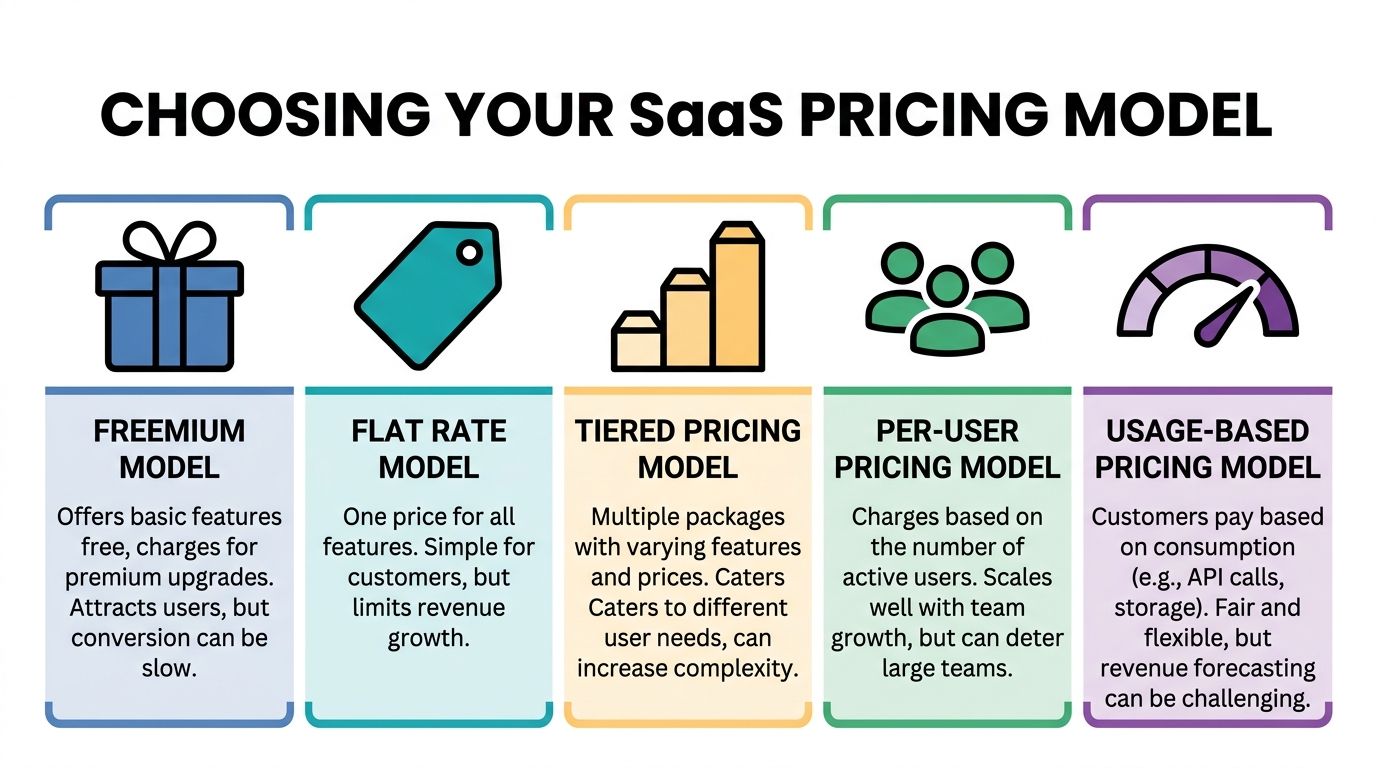
If customers get roughly the same outcome every month, a flat subscription can work. If value rises as more employees collaborate, seat-based pricing usually fits better. If the product consumes measurable resources such as API calls, storage, transactions, or compute time, usage-based billing is often the cleanest model because customers can tie spend to activity inside the product.
For global SaaS companies, there is another layer. The pricing model also has to match how money moves. A card-first monthly subscription is easy for self-serve acquisition, but some international customers still prefer invoice terms, local currency presentation, or stablecoin settlement for cross-border treasury efficiency. The right model is the one your systems can rate accurately, collect with low friction, and reconcile without manual work.
Freemium deserves a hard look too. It lowers entry friction, but it only works when activation is strong and upgrade triggers are clear. Finance teams usually resist freemium for good reason. Free users still create support, infrastructure, and billing edge cases, especially once usage thresholds or regional tax rules enter the picture.
Where each model works, and where it breaks
Flat-rate pricing is easy to explain, quote, and invoice. It works for products with one clear buyer and one clear use case. The downside is margin risk. Heavy users can cost more to serve than they pay, while larger accounts may hit plan limits long before they are ready for an enterprise contract.
Per-user pricing is common because buyers understand it immediately. It also fits internal budgeting at the customer, which helps procurement move faster. The trade-off is adoption friction. If a team starts rationing seats, growth inside the account slows even when the product is delivering value.
Tiered pricing gives commercial flexibility. It can support self-serve, sales-assisted, and enterprise motions in the same catalog. But tiers create operational pressure. Feature gates, usage caps, entitlement logic, proration rules, and upgrade paths all have to stay aligned across product, billing, and support.
Usage-based pricing maps well to products where customers consume metered value. It is often the strongest fit for APIs, infrastructure software, data platforms, and transaction-heavy products. The failure mode is usually internal, not customer-facing. Metering has to be accurate, dispute-ready, and visible before the invoice lands.
Practical rule: If a customer asks why their bill increased, your team should be able to answer from product events, rating logic, and contract terms in minutes.
Pricing model choices affect settlement strategy too
Most SaaS pricing advice stops at plan design. Global operators cannot stop there.
A monthly card subscription may be the best acquisition path for SMB customers, while enterprise accounts may still want invoicing and bank rails. Some international customers will pay by card but prefer stablecoin settlement on the supplier side because it reduces FX delays and gives finance faster access to funds. That does not replace card billing. It changes how collected revenue is settled and used after payment succeeds.
This is one of the more practical ways to combine fiat and stablecoin workflows. Keep the checkout experience familiar for customers. Give finance more flexibility in how funds are settled across entities and markets.
SaaS Pricing Model Comparison
Model | Best For | Pros | Cons |
|---|---|---|---|
Flat-rate | Narrow products with predictable value | Simple messaging, straightforward invoices, easy forecasting | Weak fit across different customer sizes and usage levels |
Per-user | Team software and collaboration tools | Familiar to buyers, aligns with headcount growth | Can suppress adoption if customers limit seats |
Tiered | Companies serving multiple segments | Supports expansion paths and mixed sales motions | More entitlement, billing, and support complexity |
Usage-based | APIs, infrastructure, transaction-heavy products | Aligns spend to consumption, supports expansion with usage | Requires accurate metering, rating, and dispute handling |
A useful test is operational, not theoretical. Can the team explain the model, meter it, invoice it, collect it globally, and reconcile it across currencies and entities without exceptions?
If the answer is no, simplify the model or fix the billing architecture first. Tools that standardize invoice data, such as this SaaS Invoice Extractor, can help teams audit how pricing rules appear on live invoices before disputes and revenue leakage pile up.
Managing Invoices Proration and Tax Compliance
A lot of billing for SaaS breaks down in the unglamorous middle. Not in pricing strategy, and not in payment acceptance, but in the day-to-day mechanics of turning contracts and usage into accurate bills.
Invoices are an operating system not a document
An invoice isn’t just a receipt request. It’s a compressed record of your pricing model, service period, payment terms, tax treatment, and customer status.
When teams handle invoicing manually, they often create timing gaps between contract changes and billing output. Those gaps hit cash flow. In SaaS, Days Sales Outstanding measures the average number of days it takes to collect payment after a sale, and the industry average is 45-55 days while leading companies target under 40 (Monetizely on SaaS billing metrics). That same source notes that automated billing and collection strategies can shrink DSO by 15-20% within quarters.
That matters because invoice delay doesn’t look dramatic at first. It shows up as “we’ll send it tomorrow,” “we need to confirm the upgrade amount,” or “finance is waiting for usage exports.” Across a growing customer base, that turns into inconsistent collections and unreliable forecasting.
Three invoice practices usually make the difference:
Automate invoice generation: Trigger invoices directly from subscription events, contract milestones, or approved usage records.
Standardize payment terms: The fewer exceptions you allow, the easier AR aging becomes to monitor.
Expose invoice state clearly: Sales, support, and finance should all see whether a bill is draft, issued, paid, overdue, or disputed.
If you inherit invoice data in inconsistent formats, a utility like SaaS Invoice Extractor can be useful for pulling structured data out of invoice files during cleanup or migration work.
Proration needs rules before you need rescue work
Proration is where “simple subscriptions” stop being simple.
A customer upgrades from 10 seats to 25 seats on day 18 of the billing cycle. Another downgrades storage before renewal. A sales rep promises a mid-month plan change effective immediately. If you don’t have clear rules, every one of those events becomes a support ticket and a finance exception.
Good proration policy answers four operational questions:
When does the change take effect
What gets credited from the old plan
What gets charged from the new plan
How does that appear on the invoice
Some teams choose immediate proration because it reflects value accurately. Others defer changes to the next cycle to keep invoices cleaner. Neither is universally right. The wrong move is mixing both approaches depending on who approves the deal.
A practical pattern is to prorate upgrades immediately, queue most downgrades for renewal, and log all exceptions with approval context. That keeps revenue capture closer to delivered value without creating endless credit memos.
Customers don’t get frustrated by proration itself. They get frustrated when the bill changes and nobody can explain why.
Tax complexity arrives earlier than most teams expect
Tax and invoice compliance become painful long before a company feels “enterprise.”
The friction usually comes from three places:
Jurisdiction rules: Different regions expect different invoice fields and tax handling.
Customer classification: B2B and B2C treatment often differs, especially in VAT workflows.
Product mix: Subscriptions, one-time setup fees, and services can require different treatment.
Manual tax handling fails because it depends on people remembering edge cases during busy billing cycles. That’s not durable. The right approach is to make tax logic part of the billing system, not part of an internal checklist.
For global companies, the cleanest setup usually includes:
Operational area | What needs to be systemized |
|---|---|
Customer records | Legal entity data, billing address, tax ID status |
Product catalog | Tax category by product or service type |
Invoice templates | Required fields by market |
Audit trail | Versioned record of changes, credits, and reversals |
A finance team can tolerate some mess in the first dozen customers. It can’t tolerate it once pricing changes, annual prepayments, regional tax obligations, and services all stack together. Billing for SaaS becomes easier when invoice logic, proration policy, and tax treatment all live in one controlled workflow instead of across spreadsheets, CRM notes, and support threads.
How to Reduce Churn with Smart Dunning
A customer in Germany logs in on Monday, sees a payment failure banner, updates nothing, and keeps using the product until access is cut off on Thursday. The product team calls it churn. Finance calls it a failed renewal. Support sees an angry ticket from a customer who never meant to cancel. That gap is where a lot of SaaS revenue leaks.
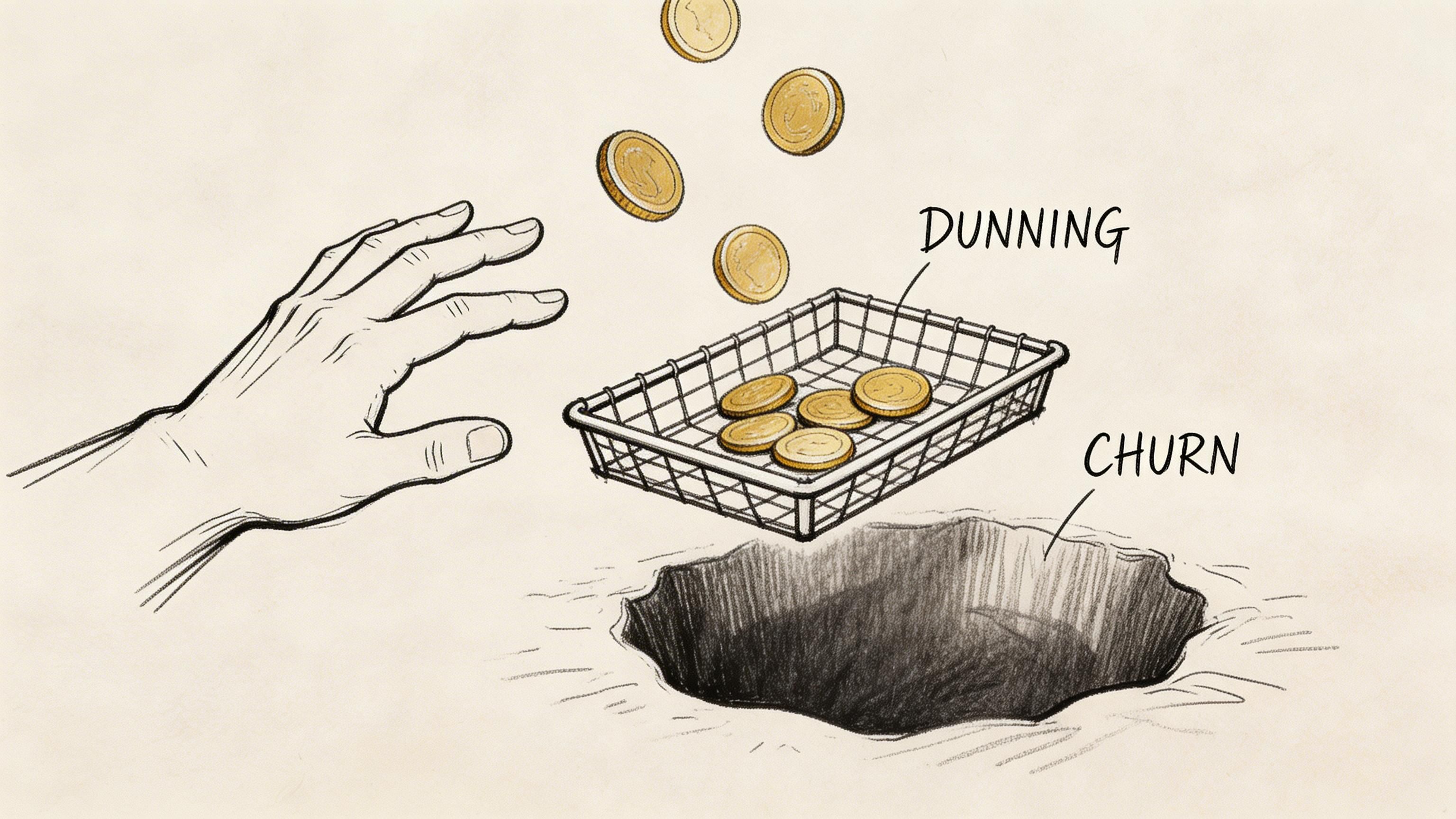
A meaningful share of churn has nothing to do with product value. Cards expire, issuers decline legitimate transactions, 3D Secure interrupts renewals, and cross-border card behavior adds more failure points for global accounts. Recurly’s analysis of subscription billing performance shows why recovery matters. Their data has long pointed to a significant portion of subscriber loss coming from payment failures rather than true cancellations (Recurly research on involuntary churn).
That distinction matters operationally. A failed payment is a recovery problem, not a retention survey problem.
Teams lose revenue when they treat dunning as a batch of reminder emails owned only by finance. Smart dunning is a coordinated workflow across billing logic, customer messaging, account access, and retry rules. If you need a plain-language primer before redesigning that workflow, this overview of the dunning process is a useful reference.
Failed payments need a different playbook
The customer may still want the service. The billing stack just failed to collect.
That changes the response. A card decline should trigger retries, payment method update prompts, event logging, and account-state decisions that match the customer segment. Enterprise accounts on annual contracts need a different path than self-serve monthly users. High-usage products may allow a short grace period. Infrastructure or compliance-sensitive products may need feature restrictions before full suspension.
For global SaaS companies, dunning gets harder because the failure itself is not always local. The subscription might be priced in USD, charged to a card issued in Brazil, taxed through an EU entity, and settled to treasury in another market. If you only optimize for domestic card retries, recovery rates plateau fast.
What smart dunning looks like in practice
Strong dunning systems usually share the same building blocks:
Retry logic based on failure type: Soft declines, insufficient funds, and authentication failures should not follow one generic retry schedule.
Clear customer communication: Messages should explain what failed, what happens next, and the fastest path to update payment details.
Fast recovery UX: The payment update flow should work well on mobile, support wallet or local payment options where relevant, and return the user to an active state quickly.
Account-state rules: Grace periods, read-only access, feature throttling, and full suspension should be explicit product decisions, not ad hoc support exceptions.
Internal visibility: Support, sales, and customer success should see billing status before they talk to the account.
The message sequence matters as much as the retry schedule. One vague “payment failed” email is rarely enough. A better sequence starts with an immediate alert, follows with reminders tied to actual retry attempts, and escalates based on account value and product dependency. The tone should stay factual. Customers respond better to a direct request to update a payment method than to language that sounds accusatory.
A short explainer can help teams align on the recovery flow before they change the system:
Measurement is where many teams get this wrong. If the churn dashboard mixes voluntary cancellations with failed-payment cancellations, product and finance will chase different answers to the same problem. Report them separately. Assign owners separately too.
For companies selling globally, there is another practical layer. Card recovery should not be the only path back to an active subscription. If a customer operates in a market with weaker card acceptance or costly cross-border payment behavior, offering alternative collection paths can improve recovery and lower friction. That can include local payment methods at the invoice stage, or stablecoin settlement options for accounts that already operate that way. Most billing guides stop at card retries. Modern SaaS billing needs to account for how customers pay across regions.
Dunning works best when it is treated like a product surface with revenue consequences. Teams should test timing, copy, retry rules, payment options, and access policies with the same discipline they apply to onboarding and conversion.
Solving the Global Payment and Settlement Puzzle
Cross-border billing problems usually start after the payment is “accepted.”
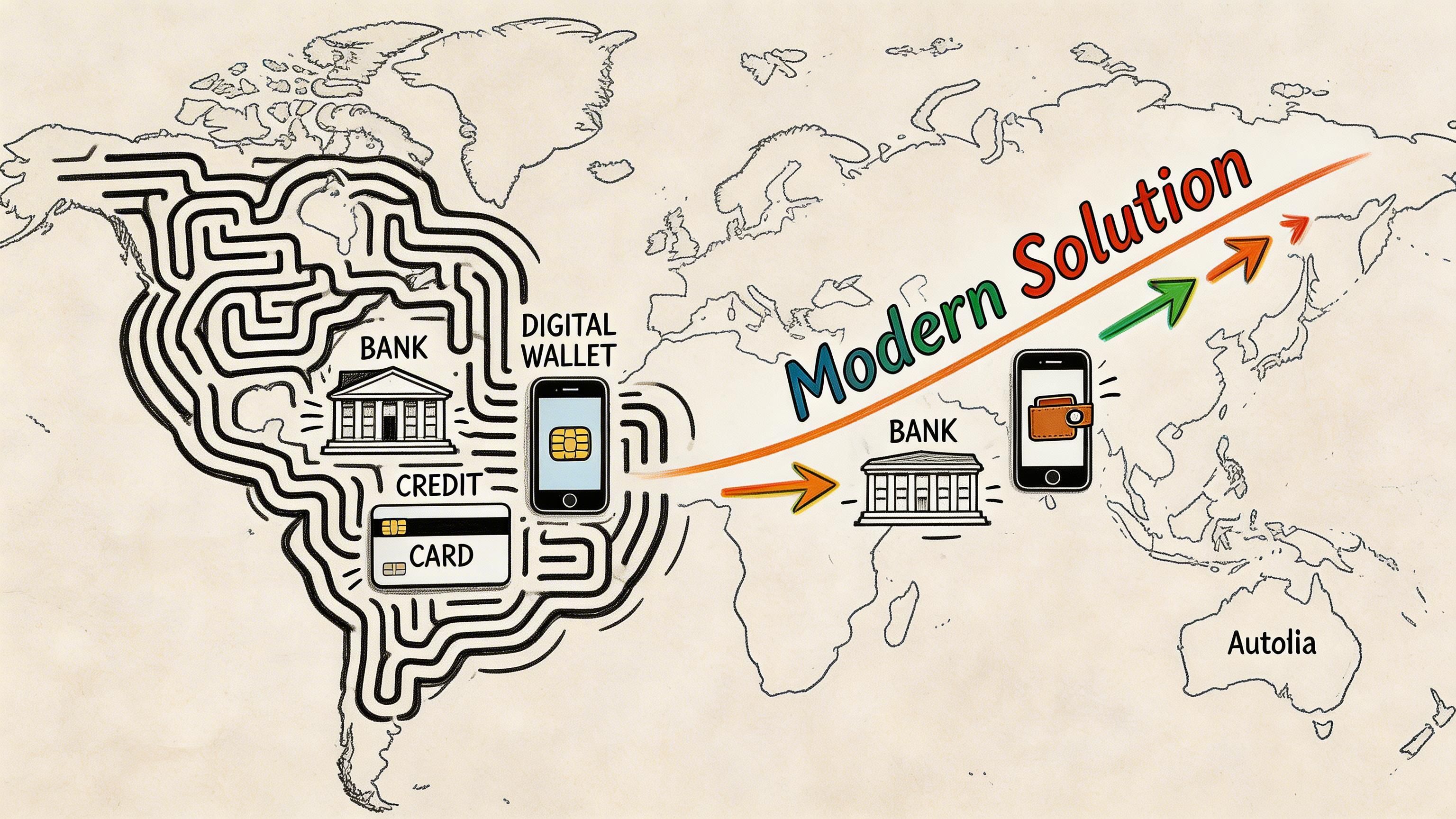
The customer paid. That part looked successful. Then finance sees foreign exchange costs, payout timing uncertainty, fragmented reconciliation, or a settlement route that doesn’t match how the business operates. For internet-native companies, that’s where the old setup starts to feel outdated.
Where fiat-only billing breaks down
Traditional billing stacks were built around local banking assumptions. That works until a company sells globally while operating remotely, paying contractors internationally, or managing treasury outside one domestic currency path.
The result is familiar:
FX spreads distort margins
Banking rails slow down access to funds
Settlement timing becomes hard to predict
Regional payout mechanics create extra ops work
Most billing content still assumes fiat in, fiat out. That leaves out an increasingly practical option. As one industry writeup notes, many guides ignore how stablecoin rails can remove FX fees, banking delays, and payout uncertainty, and it highlights that 40% of creators in emerging markets like LATAM and Asia prefer crypto payouts (Emersion on SaaS billing gaps).
A more practical model for global billing
A modern setup doesn’t require customers to change their habits. In many cases, they can still pay with familiar methods like Visa or Mastercard. The operational shift happens on the merchant side, where settlement becomes faster and more predictable in USDC.
That model is especially useful when a company wants to:
sell worldwide without opening banking relationships in every market
avoid operational noise from currency conversion
unify card acceptance and digital asset acceptance in one billing flow
settle revenue in a format that is easier to move, hold, or allocate globally
This is the undercovered part of billing for SaaS. The customer experience can stay conventional, while backend settlement becomes more internet-native. In practice this turns the billing stack into a platform for selling software worldwide without local entities, since you no longer need a bank account in every market you sell into.
For businesses evaluating tooling, one option in this category is Suby. It provides an API that lets businesses accept payments by card or crypto, supports recurring subscriptions and paylinks, offers native Discord and Telegram integrations for paid access and online communities, and settles merchant revenue in USDC. The core model is simple. Users pay with cards, businesses receive USDC. That’s a materially different operational outcome than a card-only stack that still ends in banking delays.
For teams dealing with international billing pain, this overview of cross-border payment is a useful companion read.
What to evaluate in a payment stack
Not every global payment setup is suitable for recurring software revenue. The checklist should focus on operational fit, not novelty.
Evaluation area | What to ask |
|---|---|
Checkout | Can customers pay with methods they already trust |
Settlement | Does revenue arrive in a predictable format the business wants to hold |
Subscriptions | Are recurring charges and lifecycle events handled natively |
Compliance | Are card security and authentication handled properly |
Access control | Can payment state update product or community access automatically |
The strongest billing systems reduce both payment friction and finance friction. That second part matters more than many teams realize. A checkout that converts well but creates reconciliation problems, payout uncertainty, or manual treasury work is only solving half the job.
Automating Billing Workflows with APIs and Webhooks
Once the billing model is set and the settlement path is clear, the next problem is orchestration. Manual operations don’t hold up when subscriptions, access control, CRM updates, invoicing, and support all depend on billing events.
That’s where APIs and webhooks stop being developer jargon and become business tools.
APIs run the billing logic
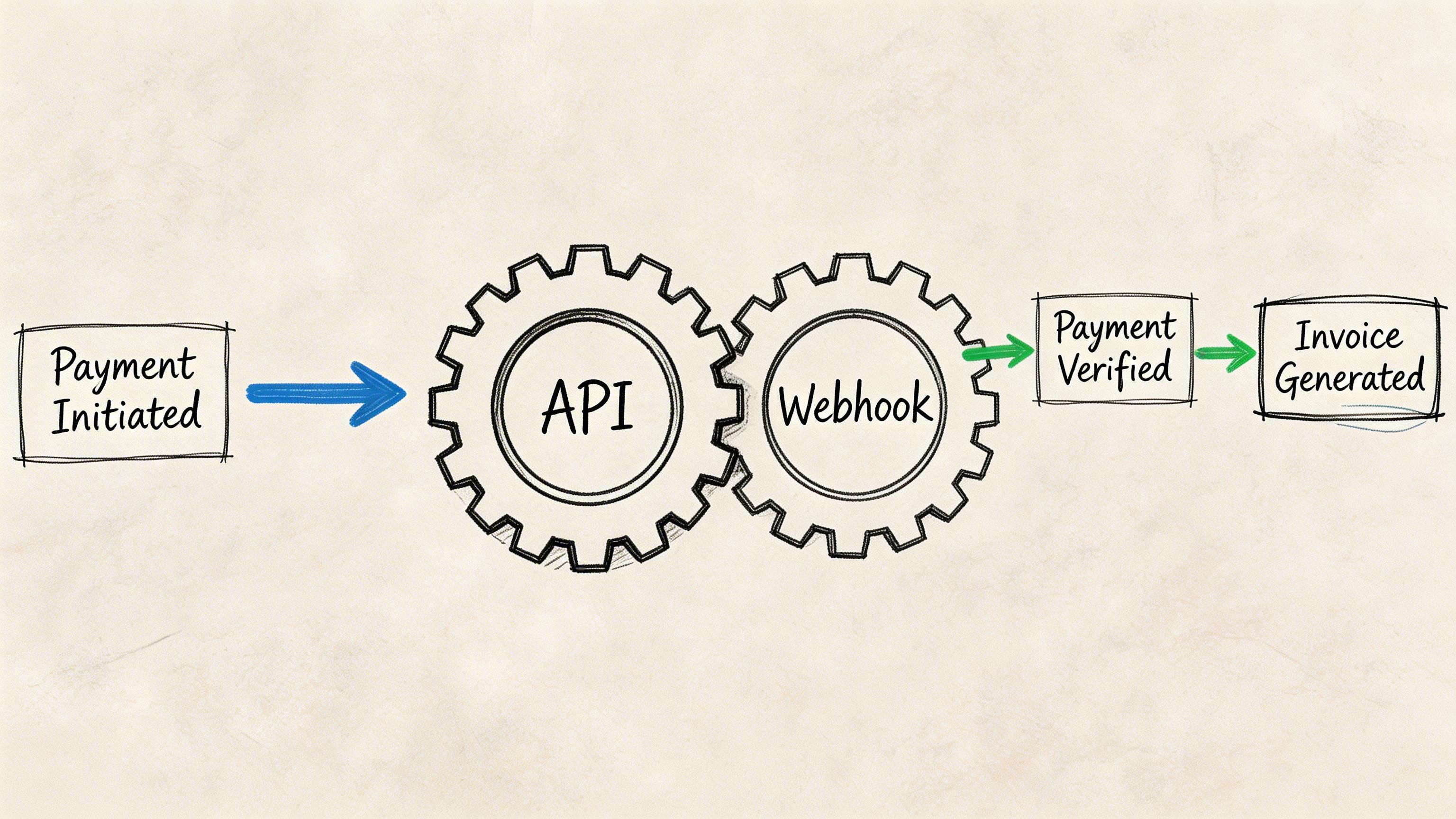
An API lets your product or internal systems create and manage payment actions programmatically. That could mean creating a subscription when a user picks a plan, generating a paylink for a one-time onboarding fee, or checking a payment status before provisioning access.
In billing for SaaS, APIs are most useful when they remove repeated human decisions.
Examples include:
creating subscriptions from product signup flows
syncing plan changes from the app into the billing system
generating payment links for implementation or add-on services
attaching customer metadata for support, finance, or analytics
If you’re evaluating the implementation side, this guide to payment gateway API integration gives a good framing of how payment events connect to application workflows.
Webhooks keep downstream systems honest
Webhooks are the opposite direction. They tell your other systems that something happened.
That matters because billing state changes all the time. A payment succeeds. A renewal fails. A subscription is canceled. A refund is issued. If downstream tools don’t receive those events quickly, your ops team ends up reconciling everything manually.
A practical webhook setup often updates:
Product access, so active subscribers get service and past-due accounts follow the right access policy
CRM records, so sales and support see the current billing state
Internal alerts, so failed high-value renewals don’t disappear into a queue
Community permissions, so paid Discord or Telegram access reflects subscription status automatically
For creators, agencies, and SaaS businesses running paid communities, native integrations matter because access control is often the core product. A webhook-driven model is far cleaner than manually adding and removing members after each payment event.
The best billing automation is boring. It removes decisions that people should never have had to make by hand in the first place.
A practical automation checklist
Use this as a sanity check before calling your billing flow “automated”:
Map every event: Signup, upgrade, downgrade, renewal, failed payment, cancellation, refund.
Define the system of record: One platform should own billing state, not three.
Tie access to payment state: Don’t rely on support tickets to manage entitlement.
Log webhook failures: Silent delivery failures create hidden revenue and access issues.
Keep finance visible: Payment automation still needs dashboards for disputes, churn, and payout tracking.
For technical teams, the goal isn’t complexity. It’s consistency. When APIs and webhooks are designed around the actual subscription lifecycle, billing becomes easier to operate, easier to audit, and much harder to break.
Your Path to Frictionless Global Billing
Good billing for SaaS is less about charging a card and more about building a revenue system that doesn’t fall apart as the business expands.
The durable pattern is clear. Pick a pricing model that matches how customers get value. Automate invoices, proration, and tax logic before manual work becomes normal. Treat failed payments as recoverable workflow problems. Then fix the cross-border layer so settlement is predictable, not an afterthought.
Finance leaders usually care about the same outcome from different angles. Revenue should be collectible, explainable, compliant, and usable. Product leaders care that billing doesn’t interrupt adoption. Operations wants fewer exceptions. All three are looking at the same system.
For a finance-centered perspective that complements the product and payment angle, Resolut’s CFO's guide to billing for SaaS is worth reading.
The broader point is simple. Billing architecture shapes growth quality, and it directly affects how efficiently you can sell software as a service across borders. If the billing layer is fragmented, global expansion feels expensive and slow. If the billing layer is reliable, the company can sell internationally with far less operational drag.
Frequently Asked Questions on SaaS Billing
How do you bill professional services alongside subscriptions
Set them up as separate billing objects, even when the customer signs a single order form.
Subscriptions follow a recurring schedule. Onboarding, implementation, training, and custom work usually depend on milestones, approved hours, or fixed deliverables. Mixing those into one recurring invoice creates reconciliation problems for finance, confusion for buyers, and avoidable revenue recognition issues. As noted by Ordway on billing for SaaS professional services, many SaaS companies now pair software revenue with services, but the billing logic still needs to stay distinct.
The clean setup is straightforward. Run the subscription on its own cadence. Trigger service invoices from project events. Then map both streams back to the same customer account so reporting, collections, and contract history stay usable.
What is the cleanest way to monetize a Discord or Telegram community
Tie access directly to billing status.
A paid community should grant access after payment clears, keep access active through renewal, and remove or limit access when the subscription expires or is refunded. That sounds simple, but manual role changes break quickly once volume increases, especially across time zones and support teams.
The operational risk is bigger than admin overhead. If access is not linked to payment state, customers can lose access after paying, keep access after canceling, or get refunded while still using the product.
How do refunds work in a card-to-USDC model
Handle refunds as a workflow, not a one-off finance action.
The team needs a clear record of who approved the refund, which original payment it maps to, whether the customer receives funds back to the card or through a separate path, and which downstream systems should update. That usually includes subscription state, entitlements, invoice status, revenue reporting, and customer notifications.
This matters more in hybrid payment setups. The customer may pay with a card while the business settles in USDC, so payment acceptance and merchant settlement happen on different rails. If that split is not reflected in the refund process, support tickets increase and month-end reconciliation gets messy fast.
Should usage-based billing replace subscriptions entirely
Usage pricing works when customer value is tightly linked to consumption and the metering system is accurate enough to defend every bill.
Many SaaS companies still keep a platform fee, minimum commit, prepaid credit balance, or tiered subscription around the usage component. That gives finance a more predictable revenue base and gives customers a bill they can understand before usage spikes. For global accounts, that structure also helps when local procurement teams want fixed approval thresholds even if product usage varies month to month.
Suby is a payment gateway and payment processor. Your customers pay with card, bank transfer, Apple Pay, Google Pay, Klarna, and more, or stablecoins, and you get paid out to your bank account, or directly in stablecoins (USDC, EURC) to your wallet, anywhere in the world, no bank account required. It supports recurring subscriptions and paylinks with native Discord and Telegram integrations for paid access, so billing for SaaS runs on one stack from checkout to predictable global settlement.
