

Gaspard LEZIN
The 7 Best Payment Gateways for Global Businesses in 2026
Searching for the best payment gateway? Compare 7 top providers for global e-commerce, SaaS, and creators. Find the right fit for your business today.
Your online business is growing, but the payment stack is starting to crack. Customers in one country see card declines, buyers in another expect wallet options, and your team keeps discovering that the headline processing rate wasn't the full cost after FX, payout delays, and disputes. That's usually the point where founders stop asking for a basic checkout tool and start asking for the best payment gateway for a global business.
That question matters more now because payments sit inside a much larger shift. The global payment gateway market was estimated at USD 31.0 billion in 2023, USD 37.0 billion in 2024, and USD 47.0 billion in 2025, with a projection of USD 161.0 billion by 2032. Digital payment volume was also projected to exceed USD 10 trillion by the end of 2024, up from USD 8.3 trillion in 2023. Checkout is no longer a side tool. It's infrastructure.
If you're comparing providers, don't just compare card acceptance. Compare settlement, currency handling, payout predictability, local payment coverage, and whether the platform fits the way your business sells. If you want a broader framing of processors before you choose, this payment processor comparison guide is a useful companion.
Table of Contents
Why Suby stands out
Best fit and trade-offs
Where Stripe works best
Why larger merchants choose Adyen
Who should skip it
What makes Checkout.com different
Practical downside
Best reason to use Braintree
Where costs need a closer look
Why enterprises still pick Cybersource
The trade-off
Where Authorize.Net still works well
Where it feels dated
Top 7 Payment Gateways Comparison
Your Next Step in Global Payments
1. Suby
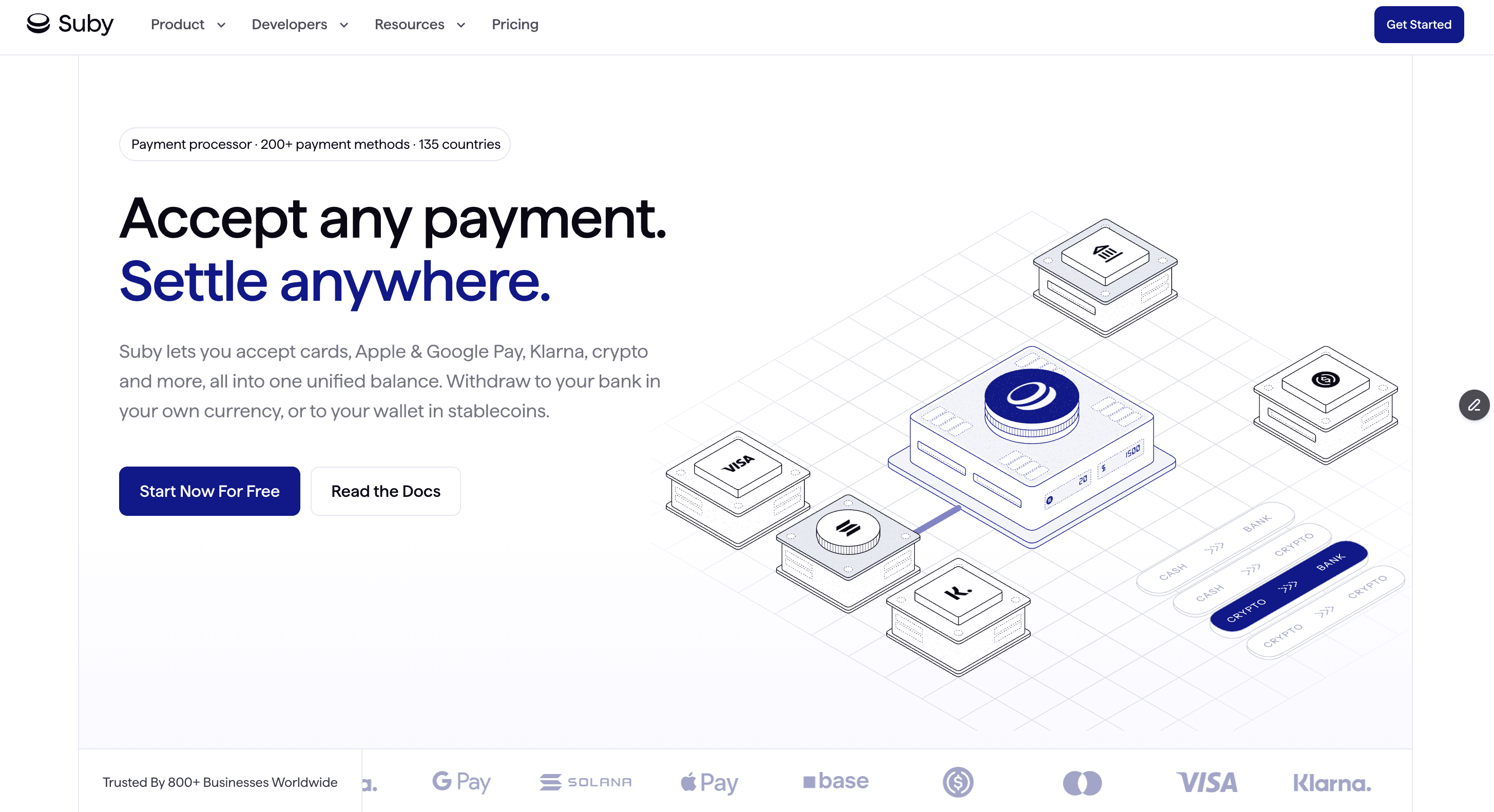
Suby is the most distinctive option on this list because it solves a different problem from most traditional gateways. Instead of treating settlement as an afterthought, Suby is built around the idea that customers can pay with card, bank transfer, Apple Pay, Google Pay, Klarna, and more, or crypto, while the business gets paid out to its bank account, or in stablecoins (USDC, EURC) to its wallet. For global online businesses, that changes the economics and the operational flow.
Many best payment gateway roundups focus on checkout features and supported methods, yet frequently overlook the settlement layer and total cost at scale. That's a real gap in the market, especially for internet-native companies managing cross-border revenue, FX exposure, and payout friction across multiple countries, as noted in this analysis of what gateway lists usually miss.
Why Suby stands out
Suby lets businesses accept Visa, Mastercard, and selected crypto assets, then settles merchant revenue directly in USDC. That means users pay with cards, businesses receive USDC. If you're running a SaaS product, agency, global e-commerce operation, or paid community, that model can remove a lot of banking friction that traditional setups never fully solve.
You can use Suby through shareable paylinks, an embeddable checkout, or a simple API. It supports one-time payments and recurring subscriptions. It also includes native Discord and Telegram integrations, which is unusually useful for memberships, paid access, and community monetization.
Practical rule: If your real pain is not checkout conversion but cross-border settlement, start by evaluating where your money lands after the sale, not just how the card form looks.
Suby also takes a direct approach to mixed-rail commerce. A lot of comparison content still assumes merchants only want card processing, while businesses increasingly need a way to combine card acceptance with crypto acceptance and predictable settlement. That blind spot shows up in mainstream gateway coverage, which rarely addresses card and crypto acceptance together in a serious way, as highlighted in this review of common gateway comparisons.
Best fit and trade-offs
Suby is a strong fit if your business is global by default and you don't want to depend on local bank accounts, long payout cycles, or opaque settlement rules. It also makes sense if you're monetizing access, subscriptions, or online communities and want payment plus access control in one system.
Its strengths are clear:
Unified acceptance: Customers can pay by card or with supported crypto assets, while merchant settlement stays in USDC.
Fast launch paths: You can start with paylinks, use embedded checkout, or connect through the API.
Built-in community workflows: Discord and Telegram access management is native, which removes a lot of manual subscription admin.
Clear positioning: Suby isn't trying to be a generic processor for every offline and enterprise use case. It's built for online businesses that want card acceptance with stablecoin payout.
The trade-off is more about workflow than capability. Suby pays out to your bank account (USD, EUR, or local currencies) or to your wallet in stablecoins (USDC, EURC), so finance teams can choose fiat or crypto. It's also a newer platform, so the surrounding plugin ecosystem isn't as broad as the biggest legacy names.
Pricing starts at 2.9% + $0.30 on Suby's pricing page, but you should confirm the current rate before rollout. If your business wants a payment API that accepts cards and crypto while settling to USDC, Suby is one of the few options designed around that outcome from the start.
2. Stripe
A common scenario looks like this. A software company launches in one market, adds Stripe in a week, and starts taking payments fast. Six months later, it is selling across borders, dealing with international cards, currency conversion, tax complexity, and payout timing across entities. Stripe still handles checkout well, but evaluation shifts from "Can we accept payments?" to "How expensive and operationally messy is global acceptance once volume grows?"
That is why Stripe remains such an important benchmark in any best payment gateway review. It has strong APIs, polished hosted checkout, recurring billing, invoicing, and a large developer ecosystem. For internet-native businesses, especially SaaS, platforms, and marketplaces, it is often the fastest way to get a credible payment stack into production.
Stripe also supports a wide range of currencies and payment methods, which matters if your customer base is spread across regions. Analysts at MarketsandMarkets expect the payment gateway market to keep expanding, with growth tied to sustained digital commerce demand and cross-border payment volume, as noted in its payment gateway market outlook.
Where Stripe works best
Stripe is strongest when speed and flexibility matter more than payment cost optimization on day one. Product teams can launch quickly, finance teams can add invoicing and subscriptions later, and marketplaces can use Connect instead of stitching together multiple providers. Teams that outgrow those native billing tools often move to dedicated subscription management software for cleaner lifecycle and renewal handling. The documentation is clear, the ecosystem is mature, and hiring developers who already know Stripe is usually easy.
It is also a practical fit for companies that want one vendor for checkout, billing, fraud screening, payment links, and basic platform payments.
The trade-off shows up later.
Costs often become harder to model once a business expands internationally. Cross-border cards, FX charges, disputes, and optional products can change the effective rate in ways that are easy to underestimate during early planning. If you are comparing long-term economics, this breakdown of how Stripe fees can add up for growing merchants is useful.
For global internet businesses, there is a second question alongside fees. Where does settlement happen, and in what form? Stripe is still centered on the traditional fiat model: card acceptance, bank-based payouts, and country-specific operating constraints. That is familiar and often appropriate. But it is a different model from providers such as Suby that offer flexible settlement, bank payout, or stablecoins (USDC, EURC) to a wallet, for cross-border online businesses. If treasury friction is the problem, a traditional gateway may solve acceptance while leaving settlement complexity in place.
A few practical pros and cons stand out:
Fast to implement: Stripe is a strong choice for SaaS and app teams that want to ship quickly with reliable APIs and prebuilt checkout.
Good product breadth: Billing, invoicing, fraud tools, and marketplace features are available in one system.
Costs need closer review at scale: International usage can push the effective rate above the headline fee.
Less differentiated on settlement: If your business is trying to reduce cross-border payout friction, bank-based fiat flows may still feel slow or fragmented.
Stripe is still one of the safest choices for digital businesses that want proven infrastructure and broad functionality. Merchants that reach higher volume and want tighter control over acceptance costs should also review how Adyen approaches payment processing and merchant economics before deciding.
Visit Stripe.
3. Adyen
Adyen is built for merchants that process serious volume and want tighter control over payment performance, routing, and costs. It combines gateway, acquiring, risk tools, and omnichannel infrastructure in one platform. That makes it attractive to companies that don't want a patchwork setup across markets.
Where Stripe often wins on developer familiarity, Adyen tends to win with finance and payments teams that care about optimization at scale. Its pricing model and enterprise tooling are designed for operators who want to understand how card costs behave market by market.
Why larger merchants choose Adyen
Adyen's biggest practical advantage is control. Interchange++ pricing can be more transparent for businesses that know their payment mix and want to optimize around it. You also get access to a wide set of local payment methods, risk tooling, and flexible settlement options.
This is the type of platform that makes sense when payments are no longer a plugin decision. They're a margin decision. If your team already reviews authorization patterns, local acceptance, and regional payment preferences, Adyen gives you more levers than many flat-rate providers.
A close look at how Adyen payment processing works is useful before committing, because its value shows up most clearly when transaction volume is already meaningful.
Adyen is usually not the first gateway a business should adopt. It's often the platform businesses move to when they outgrow simpler pricing and need more control.
Who should skip it
Adyen is not the easiest fit for smaller merchants or early-stage SaaS teams. Interchange++ is powerful, but it isn't simple. Forecasting can get harder if you don't already understand your payment mix, and the platform is generally more compelling for mid-market and enterprise businesses.
Its strongest use cases are high-volume retail, established SaaS, marketplaces, and international merchants with dedicated operations or finance support. If that's you, Adyen deserves serious consideration for best payment gateway status.
If that's not you, the complexity can become overhead.
A short version of the trade-off:
Strong for scale: Better suited to businesses that treat payments as an optimization function.
Good international breadth: Local methods and global acquiring depth matter for larger expansions.
Less friendly for lean teams: Smaller companies often prefer a simpler setup and easier forecasting.
Better for operators than beginners: Adyen rewards payment literacy.
Visit Adyen.
4. Checkout.com
Checkout.com tends to appeal to companies that want enterprise-grade payments without defaulting to one rigid pricing model. It supports cards, digital wallets, and a broad set of alternative payment methods through a single API, and it puts a lot of emphasis on data, reporting, and payment performance visibility.
That makes it attractive for cross-border businesses where payment method mix changes by country and where product teams want detailed payment analytics without running a fragmented stack.
What makes Checkout.com different
The platform is highly configurable. You can choose a pricing structure that fits your cost strategy, and the feature set is built for businesses that care about tokenization, account updater services, fraud tools, and detailed reporting. For international businesses, that's often more valuable than a slick dashboard alone.
This direction lines up with broader market growth. Another industry forecast places the payment gateway market at USD 29.0 billion in 2025 and projects USD 110.43 billion by 2035 at a 14.80% CAGR, driven by e-commerce transactions and digital payment adoption. Providers like Checkout.com are positioned around exactly that demand.
If your checkout flow needs to support cards, wallets, and local methods across regions, Checkout.com is one of the more serious infrastructure choices in this list.
Practical downside
The issue isn't feature depth. It's accessibility. Pricing is often not fully public, and smaller merchants may find themselves talking to sales before they can model costs clearly. That's not unusual at the enterprise end of the market, but it does slow evaluation.
Checkout.com also gives you a lot of capability that very small companies may never use. If your business is still validating product-market fit, a simpler provider can be easier to live with.
The practical summary:
Useful for international expansion: Good fit if local methods and payment analytics matter.
Flexible commercial model: Helpful if you want to align pricing with your own payment economics.
Less self-serve than startup-friendly tools: Expect more sales involvement.
Best for teams with payment ops maturity: The value shows up when someone is actively using the controls.
Visit Checkout.com.
5. Braintree by PayPal
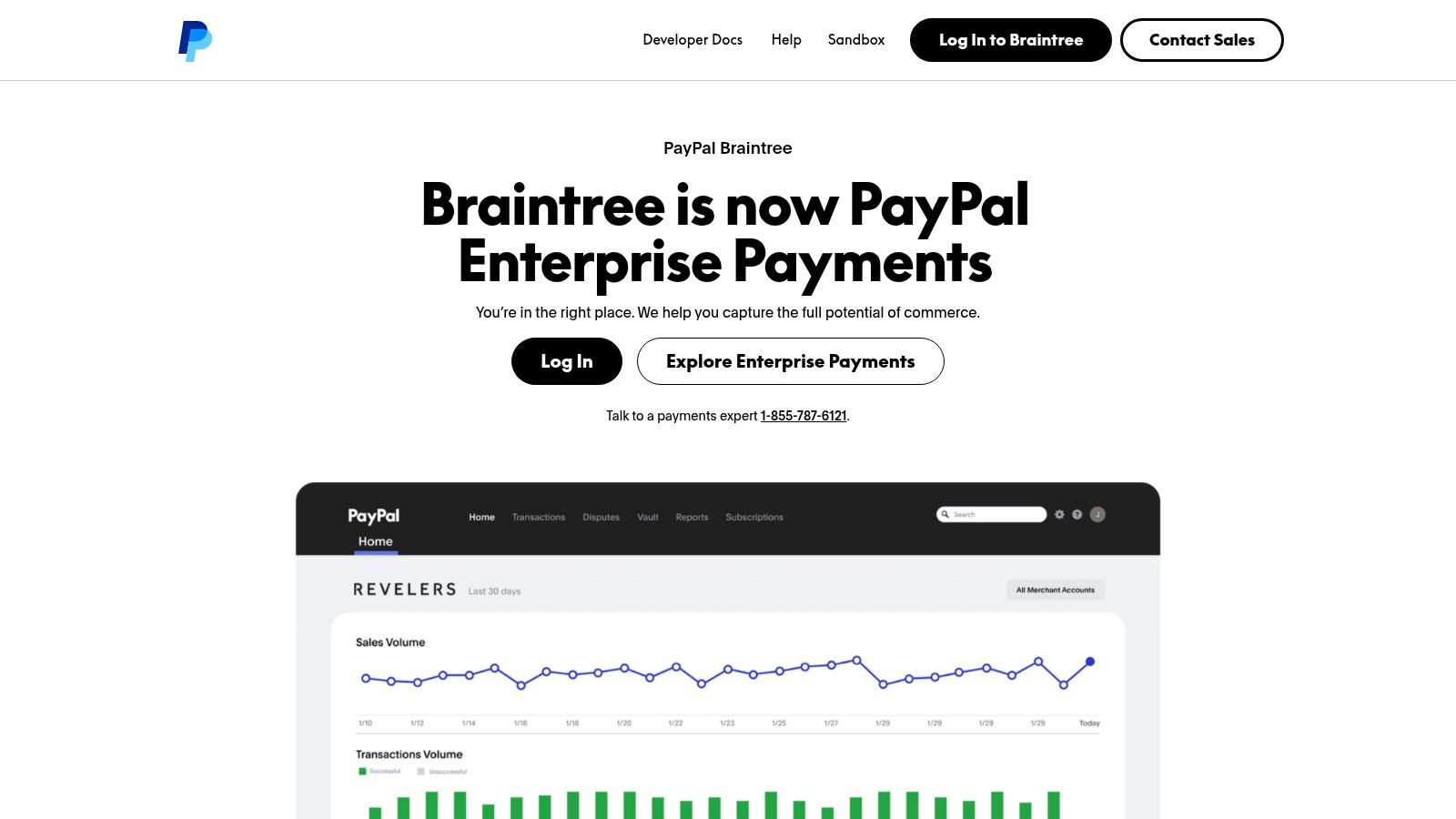
A common Braintree use case is straightforward. A business wants card payments, PayPal, and major wallets in one stack without buying a fully enterprise payment setup.
That makes Braintree relevant for internet-native companies that sell across channels and need familiar checkout options fast. It sits between simple starter tools and heavier enterprise platforms, with enough flexibility for subscriptions, mobile apps, and custom checkout flows.
Best reason to use Braintree
Braintree is strongest at buyer-side acceptance. If your customers prefer PayPal, Apple Pay, Venmo in supported markets, or standard card entry, Braintree lets you offer those options through a single platform. It also supports tokenization, recurring billing, and mobile SDKs, which matters for app businesses and subscription merchants that need payments to work reliably across devices.
For cross-border sellers, that wallet mix can help conversion because customer payment preferences vary by market. A checkout that feels familiar to the buyer usually performs better than one that forces every region into the same card-only flow.
Where costs need a closer look
The trade-off shows up after the payment is accepted. Refund handling, currency conversion, and payout mechanics can change the effective cost of using Braintree, especially for businesses with international sales or thin margins. A checkout team may be happy with wallet coverage while the finance team is still dealing with FX spread, settlement timing, and reconciliation questions.
This is also where the comparison with a flexible-settlement provider like Suby, offering bank payout, or stablecoins (USDC, EURC) to a wallet, becomes useful. Traditional gateways such as Braintree are built first for payment acceptance. Modern cross-border providers are trying to improve what happens after acceptance, including how money is settled, converted, and moved internationally. Those are different jobs, and global digital businesses increasingly need both sides understood clearly.
This explainer on PayPal currency conversion costs is a useful reminder that published processing rates rarely tell the whole story.
Braintree remains a solid option if PayPal brand recognition and wallet support are important to your sales model. Just evaluate it on total payment economics, not checkout convenience alone.
Visit Braintree.
6. Cybersource by Visa
Cybersource is one of the more established enterprise payment platforms on this list. It comes from Visa and is designed for businesses that need multiple integration models, mature fraud tooling, tokenization, recurring billing support, and hosted checkout options that reduce PCI scope.
That profile makes it more relevant for complex organizations than for startups. If your company has internal security requirements, layered compliance reviews, and several systems that need to connect to payments, Cybersource starts to make more sense.
Why enterprises still pick Cybersource
The hosted checkout options are a real advantage for teams that want card data kept off their own infrastructure as much as possible. That can simplify implementation decisions and reduce internal compliance burden. Cybersource also has the kind of reporting, documentation, and risk tooling that larger merchants expect from an enterprise provider.
This is not the platform people choose because it's trendy. They choose it because it fits procurement-heavy environments and complex technical stacks.
A few strengths stand out:
Hosted acceptance options: Helpful when security and PCI scope are central concerns.
Recurring billing support: Useful for subscription and account-based payment models.
Enterprise reporting and controls: Better suited to organizations with multiple stakeholders.
Visa backing: Relevant for teams that value vendor maturity and established risk infrastructure.
The trade-off
Cybersource usually requires a more deliberate implementation process. Pricing is quote-based, setup can be more involved, and smaller businesses often won't use enough of the platform to justify the complexity. It's a sensible enterprise choice, but it's rarely the easiest path.
If you need flexibility, compliance support, and long-term enterprise fit, Cybersource deserves a place on the shortlist for best payment gateway. If you need speed and simplicity, it probably doesn't.
Visit Cybersource.
7. Authorize.Net
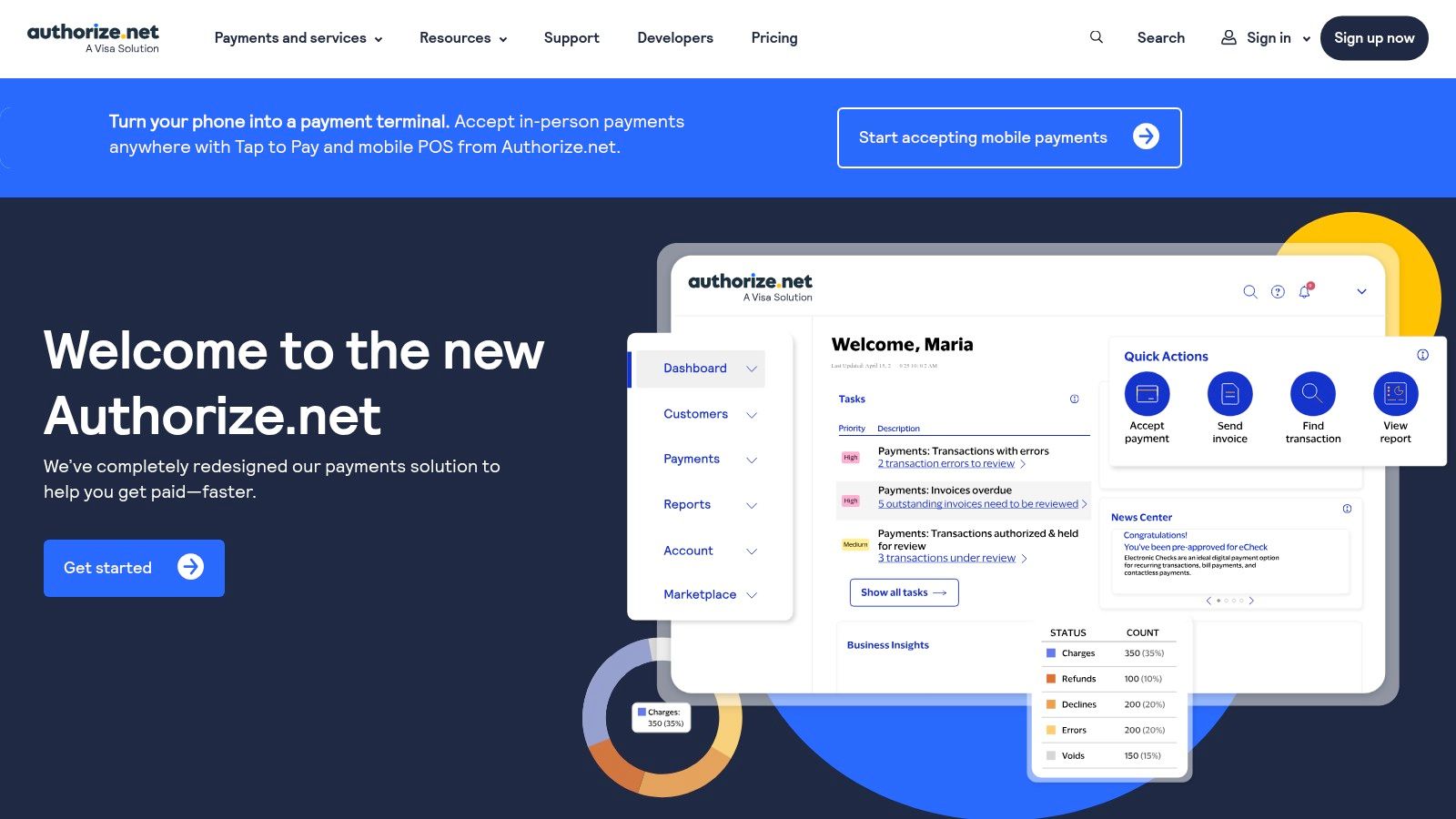
Authorize.Net has been around long enough that many businesses inherit it rather than discover it fresh. That isn't always a bad thing. For companies with an existing merchant account, legacy systems, or a preference for a separate gateway layer, it still solves a real problem cleanly.
It also remains familiar to many agencies, e-commerce implementers, and operations teams. That matters when the goal is reliability and continuity, not a full redesign of the payments stack.
Where Authorize.Net still works well
The gateway-only option is the key feature. If you already have a merchant account and don't want to replace it, Authorize.Net gives you a known path to recurring billing, customer vault features, invoicing, wallet support, and fraud filters. That's useful for merchants with older systems that still need dependable online payments.
It can also be a practical fit for small and mid-sized businesses that want a predictable, established provider and broad platform compatibility. If your store or billing workflow depends on older e-commerce integrations, Authorize.Net is often easier to slot in than newer API-first tools.
Where it feels dated
The main limitation is experience. Compared with more modern platforms, the developer flow can feel older and less elegant. The all-in-one option may also be less competitive than newer providers for businesses optimizing every part of their cost structure.
Still, not every merchant needs the newest payment architecture. Sometimes the best payment gateway is the one that integrates cleanly with the systems you already run and doesn't force unnecessary migration work.
If your business has a stable merchant account setup and a long tail of legacy integrations, Authorize.Net can be the least disruptive option on this list.
The practical read:
Good for legacy compatibility: Especially if you want gateway-only deployment.
Useful for recurring billing basics: Solid if you need subscriptions without rebuilding everything.
Not ideal for modern product teams: Developers often prefer newer API-first stacks.
Best for continuity over novelty: It wins on familiarity more than innovation.
Visit Authorize.Net.
Top 7 Payment Gateways Comparison
Provider | Implementation complexity | Resource requirements | Expected outcomes | Ideal use cases | Key advantages |
|---|---|---|---|---|---|
Suby | Low–Medium, paylinks, embeddable checkout or API | Requires crypto wallet handling and stablecoin operational processes | Fast, predictable settlements in USDC; reduced FX and payout delays | International SaaS, e‑commerce, creators, agencies wanting stablecoin payouts | Direct USDC settlement, unified card+crypto acceptance, built‑in community access tools |
Stripe | Low–Medium, developer‑friendly APIs and prebuilt UIs | Standard banking setup, developer resources for integrations and add‑ons | Wide payment coverage, scalable subscriptions, strong fraud tooling | SaaS, web apps, marketplaces, subscription businesses | Best‑in‑class developer experience, large ecosystem, conversion‑optimized UIs |
Adyen | Medium–High, enterprise integrations and omni‑channel setup | Significant volume expectations, payments team for Interchange++ | Optimized cost at scale, high global acceptance rates | High‑volume international merchants and enterprises | Interchange++ transparency, unified online/in‑store capabilities |
Checkout.com | Medium, flexible, customizable APIs | Integration and analytics resources; sales engagement for pricing | Data‑rich reporting, flexible pricing choices, broad local methods | Platforms and cross‑border merchants needing analytics and customization | Strong reporting/analytics, choice of pricing models, wide local payment coverage |
Braintree (PayPal) | Low–Medium, unified integration for cards, PayPal, Venmo | Standard merchant setup; mobile SDK support for native apps | Unified wallet and card acceptance, tokenization for subscriptions | Merchants needing PayPal/Venmo support, mobile apps, SMBs | Easy PayPal/Venmo integration, vaulting/tokenization, solid mobile SDKs |
Cybersource (Visa) | High, multiple integration models; can be complex | Enterprise compliance, security resources; quote‑based engagement | Secure hosted flows, mature risk and fraud management | Large merchants with complex compliance or technical stacks | Visa backing, flexible secure integrations, enterprise‑grade risk tools |
Authorize.Net | Low–Medium, gateway or all‑in‑one options; straightforward setup | Works with existing merchant accounts; friendly to legacy systems | Predictable gateway fees, reliable US‑centric support | US small and mid‑market businesses and legacy platforms | Gateway‑only option, predictable pricing, broad platform compatibility |
Your Next Step in Global Payments
A customer in Germany pays on Tuesday. Your team is in Singapore. The company is registered in the US. Finance still has to figure out what arrives, when it arrives, what gets converted, and what each intermediary took along the way.
That is a key payment question for many internet-native businesses.
Stripe remains a strong choice for teams that want polished developer tools, broad platform support, and a mature product ecosystem. Adyen, Checkout.com, and Cybersource fit larger merchants that need more control over routing, performance, risk, and commercial terms. Authorize.Net still works well for businesses tied to older merchant account setups. Braintree is a practical option where PayPal, Venmo, and mobile wallet coverage matter.
For cross-border companies, gateway selection usually goes beyond checkout conversion. Settlement speed, FX exposure, payout visibility, reconciliation effort, and treasury workflow often have a larger effect on margins than the payment form a buyer sees.
That is why stablecoin settlement now belongs in the same discussion as traditional fiat gateways. It changes the back half of the payment flow. A business can accept cards or crypto and receive USDC, which can reduce banking friction and make cross-border operations easier to manage. Some finance teams will prefer conventional fiat settlement, especially if accounting policy, banking relationships, or local compliance requirements are already built around it. Others will find that stablecoin settlement removes steps they have been patching with extra providers and manual work.
Suby is relevant here for a practical reason. It was built around that settlement model from the start. Customers can pay with cards or crypto, and the business receives USDC. It also includes tools that fit online operators with global audiences, such as paylinks, subscriptions, API access, embedded checkout, and Discord and Telegram integrations for memberships and paid communities.
Choose a gateway based on the full money movement path. Check where funds settle, how predictable payouts are, how much manual reconciliation your team still handles, and whether the provider fits the countries and channels where you sell. Those details decide whether payments stay a back-office headache or become a cleaner part of growth. For teams working at the intersection of payments and modern internet infrastructure, a broader partner like a web3 fintech development company will often reach the same conclusion. Settlement design affects operations.
Suby is a payment gateway and Merchant of Record. Your customers pay with card, bank transfer, Apple Pay, Google Pay, Klarna, and more, or stablecoins, and you get paid out to your bank account, or directly in stablecoins (USDC, EURC) to your wallet, anywhere in the world, no bank account required. It supports paylinks, embedded checkout, subscriptions, and an API, plus native Discord and Telegram integrations for paid access and communities. If you are choosing the best payment gateway for a global business, that is the model built around settlement from day one, so slow payouts, FX friction, and payment stack sprawl stop creating work for finance and operations.
