

Gaspard LEZIN
The 12 Best Subscription Management Software of 2026
Discover the 12 best subscription management software solutions for SaaS, creators, and online businesses. Compare features, pricing, and find your perfect fit.
Choosing the best subscription management software is a critical decision for any business built on recurring revenue. The right platform automates complex billing cycles, helps reduce customer churn, and provides the foundation to scale globally. A poor choice, however, can lead to revenue leakage, operational bottlenecks, and a frustrating experience for your customers.
The modern subscription market demands flexibility. Your software needs to handle everything from simple monthly plans to more complex usage-based models. For international businesses, the challenges multiply with cross-border payments, currency conversions, and slow payout settlement times. Finding a solution that fits your specific business model is key. When evaluating different platforms, understanding various software pricing strategies is crucial for aligning the software's capabilities with your revenue goals.
This guide is designed to cut through the noise. We will analyze the top 12 subscription management platforms to help you find the perfect fit. Whether you are a SaaS founder needing a developer-friendly API, an e-commerce merchant selling worldwide, or a creator managing a paid community on Discord or Telegram, this list has a solution for you. We provide a straightforward comparison of core features, pricing structures, and ideal use cases for each option, complete with screenshots and direct links, to make your decision process as simple as possible.
1. Suby
Suby earns its top spot by rethinking how internet businesses manage payments and subscriptions, making it an exceptional choice for companies operating on a global scale. It directly addresses the friction points of international commerce, such as foreign exchange costs and banking delays, by building its infrastructure around stablecoin settlements. This payments-first approach makes it one of the most practical and efficient platforms for modern subscription management.
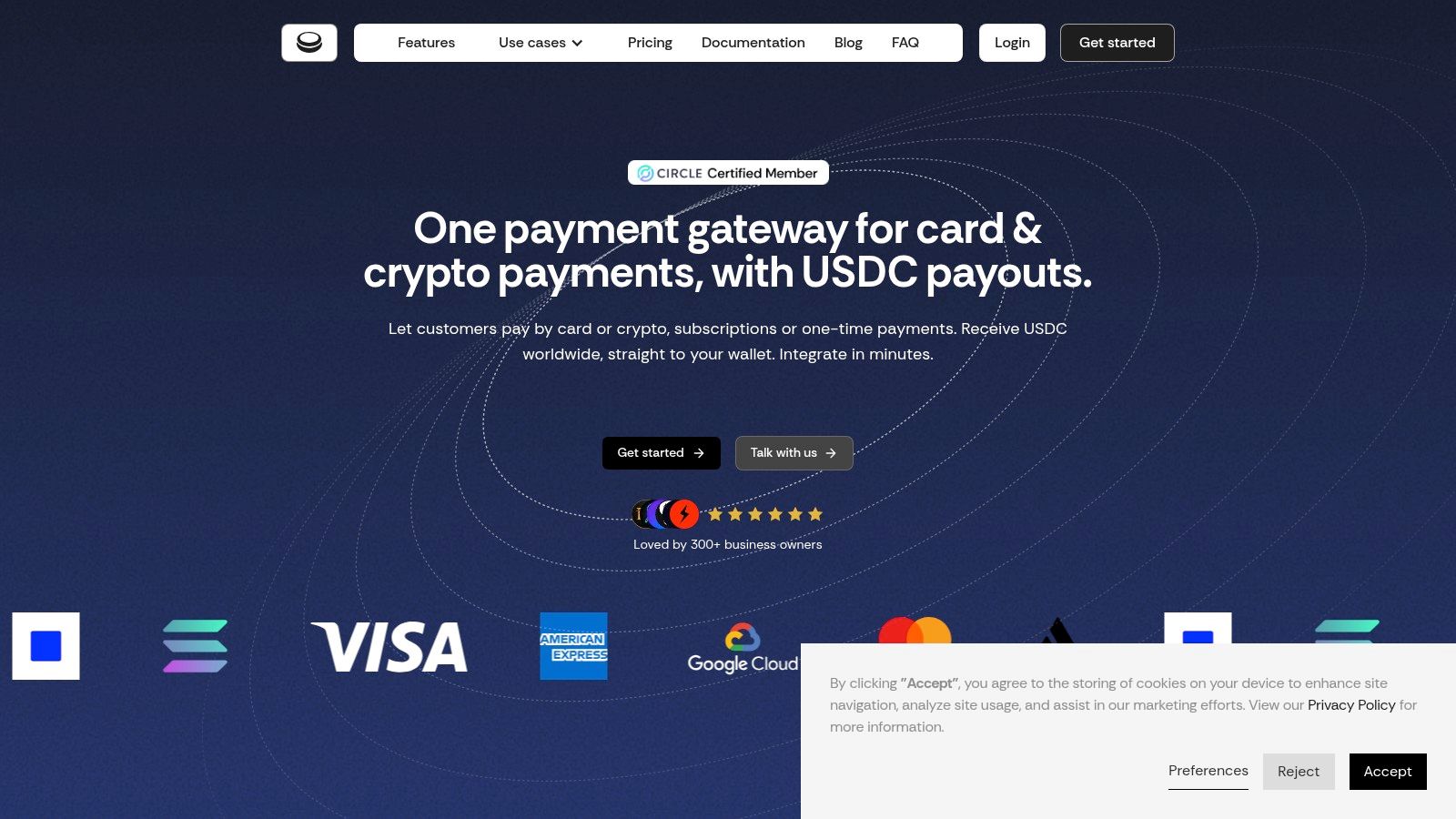
The platform’s core model is simple and powerful: customers can pay using standard credit cards (Visa/Mastercard) or certain cryptocurrencies, while your business receives every payout directly in USDC to your crypto wallet. This bypasses the need for local bank accounts in every market you serve and can eliminate costly delays. For SaaS companies, e-commerce stores, and creators with an international audience, this model provides great speed and financial predictability.
"Suby has simplified our international invoicing and payments completely. We get fast USDC payouts without the headaches of traditional banking. The webhooks for our internal automations are a game-changer." - SaaS Founder
Key Features & Use Cases
Suby's toolkit is built for flexibility and rapid deployment. You can launch in minutes using shareable payment links or an embeddable checkout widget for both one-time and recurring payments. Developers can integrate deeper with a straightforward API and webhook system to automate workflows, such as provisioning user accounts upon payment.
A standout feature is the native integration for Discord and Telegram. This allows community owners and creators to sell memberships and automatically grant or revoke access to private channels based on subscription status. It unifies payments, access control, and subscription lifecycle management into a single platform, removing the need for third-party bots or complex setups.
Practical Considerations
Pricing: Suby advertises a flat, all-inclusive fee structure designed to be more transparent than the layered cross-border and conversion fees of legacy providers. While the website has referenced a 4% card processing fee in some contexts, other materials suggest pricing starts around 5%. It is essential to verify the current rates directly on Suby’s official pricing page.
Settlements: Payouts are exclusively in USDC. Businesses must be prepared to manage a crypto wallet and handle their own fiat conversion and treasury operations. This is a key benefit for crypto-native companies but an important operational point for those new to digital assets.
Security: Security is robust, with card processing managed by a PCI-DSS Level 1 certified partner. The platform also includes modern fraud prevention tools like behavioral anti-bot detection, device fingerprinting, and Strong Customer Authentication (SCA).
Pros:
Accepts global card and crypto payments with direct USDC settlements.
Integrated tools for paylinks, subscriptions, API, and Discord/Telegram access.
Developer-friendly with a simple API, webhooks, and a real-time dashboard.
Strong security measures and zero-fee refunds.
Cons:
Crypto-forward flow: Suby is optimized for stablecoin rails and cross-border payments, so a purely domestic, card-only business might not need everything it offers.
Pricing information should be confirmed on the official site before committing.
Website: https://suby.fi
2. Stripe Billing
For businesses already in the Stripe ecosystem, Stripe Billing is a natural and powerful extension for managing recurring revenue. It's a subscription engine built directly on top of Stripe Payments, making it a go-to choice for SaaS and digital businesses that need deep, developer-first control over their billing logic. It excels at handling complex scenarios like metered usage, tiered pricing, and prorated subscriptions.
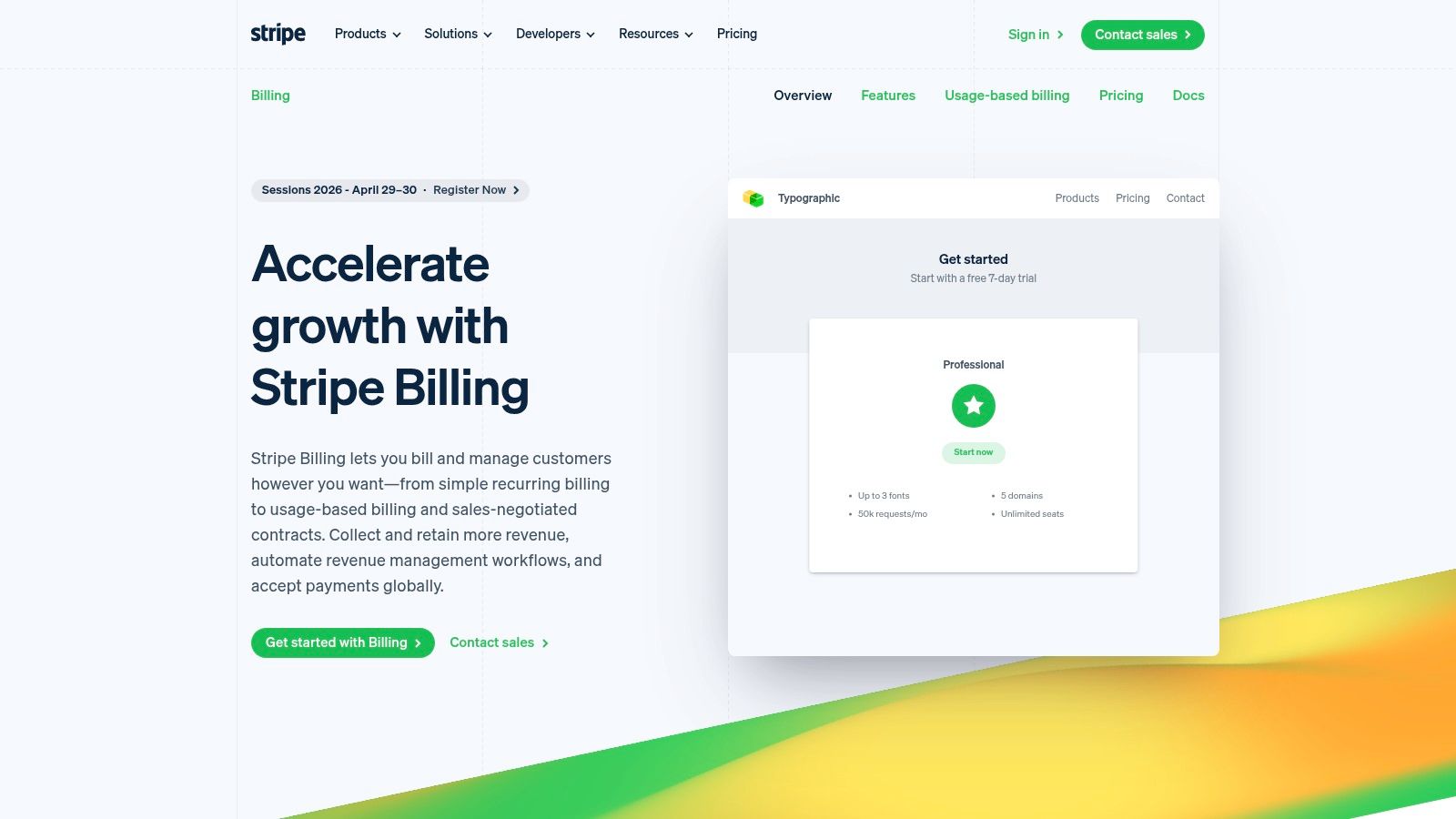
The platform’s strength lies in its composable API and extensive documentation, which developers love. This allows for fine-grained customization of the entire subscription lifecycle, including how a customer can cancel a Stripe subscription without a support ticket. It also includes valuable tools for reducing churn, such as smart dunning and automatic card updaters. For simpler needs, Stripe’s no-code Payment Links and hosted customer portals provide an easy entry point. This makes it a highly scalable solution, fitting both early-stage startups and large enterprises.
Key Details & Pricing
Best For: SaaS companies and developers who need a powerful, API-first subscription solution on an existing payment infrastructure.
Pricing: Starts at 0.5% on recurring payments for the Starter plan. The Scale plan, with more advanced features, is 0.8%. These fees are in addition to Stripe's standard payment processing fees.
Pros: Highly developer-friendly with robust APIs, excellent documentation, and scales effortlessly from small businesses to enterprise-level operations.
Cons: Advanced features for analytics or tax compliance are separate, paid Stripe products. The effective cost can rise when factoring in add-ons for international payments and currency conversion.
Website: https://stripe.com/billing
3. Chargebee
For growing SaaS businesses moving beyond basic billing, Chargebee offers an end-to-end subscription management solution designed to handle complexity at scale. It acts as a dedicated billing layer that integrates with over 30 payment gateways, allowing companies to separate their revenue operations from their payment processor. This makes it an ideal choice for businesses that need to manage a flexible product catalog with hybrid pricing, recognize revenue accurately, and implement tools to retain customers.
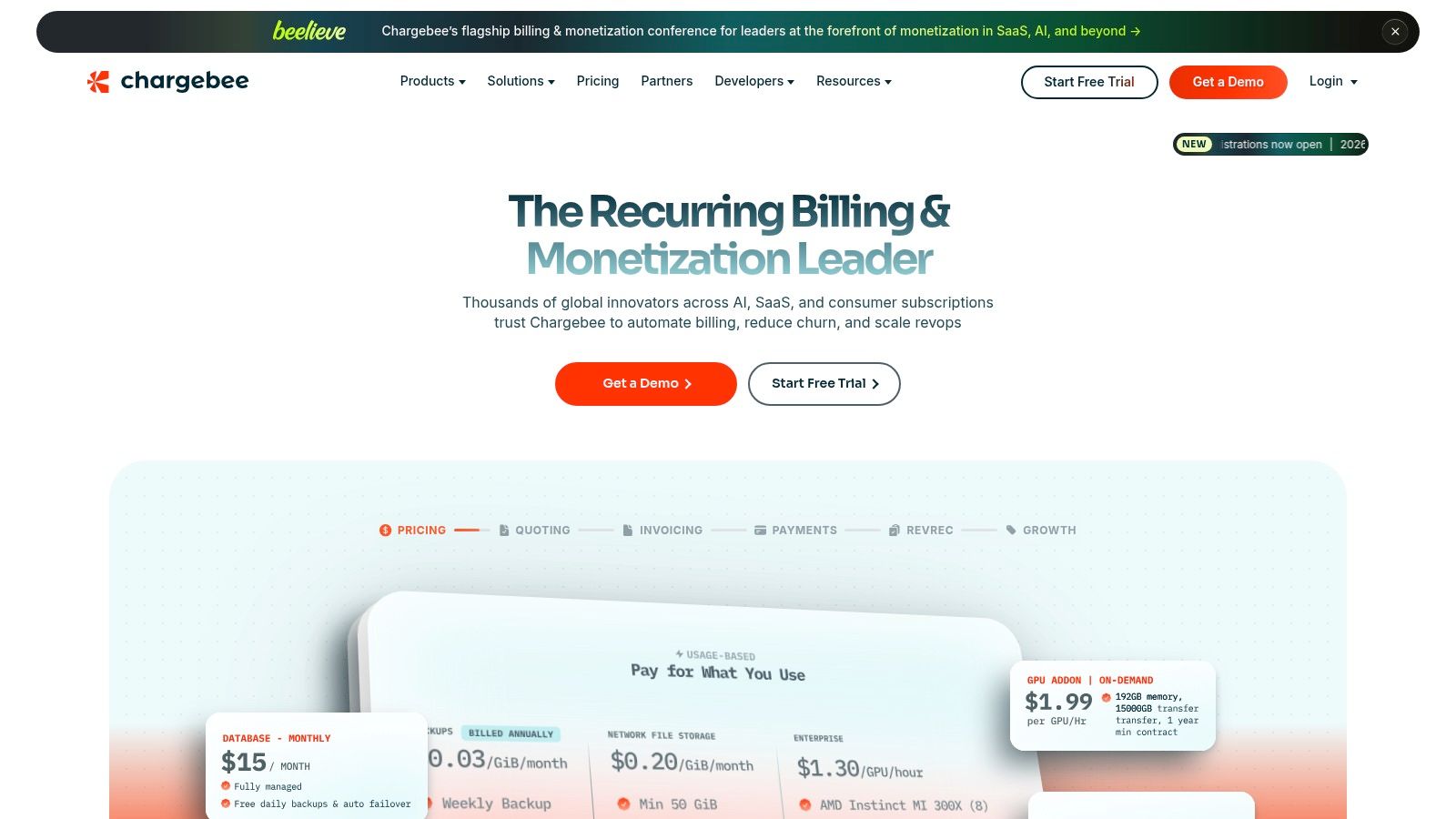
The platform provides a comprehensive feature set including a flexible product catalog, hosted checkout pages, and a self-service customer portal. Its standout features revolve around its ability to support various pricing models, from simple subscriptions to usage-based and hybrid combinations. Chargebee also places a strong emphasis on reducing churn with its Smart Dunning capabilities, a critical function for subscription-based revenue. You can explore a deeper explanation of the dunning process and its importance to better understand this feature. While it requires more initial setup than simpler tools, its broad integration library and migration assistance make it one of the best subscription management software choices for scaling operations.
Key Details & Pricing
Best For: SaaS companies graduating from simpler systems who need a feature-rich, gateway-agnostic platform to manage their entire subscription lifecycle.
Pricing: A free plan is available for the first $100K in cumulative revenue. Paid plans start at $299/month, with overage fees applied as a percentage of billing once a revenue threshold is met.
Pros: Excellent starter economics with a generous free tier, extensive integrations with popular finance and sales stacks, and migration support for a smoother transition.
Cons: The total cost can increase significantly with overage fees and optional add-ons. It requires more configuration and setup time compared to more lightweight solutions.
Website: https://www.chargebee.com/
4. Recurly
Recurly is a mature and established player in the subscription commerce space, trusted by many large-scale digital media, SaaS, and direct-to-consumer brands. It positions itself as an enterprise-grade solution focused squarely on maximizing recurring revenue and minimizing subscriber churn. The platform provides a broad set of tools for creating complex billing logic, including fixed-price, quantity-based, usage-based, and ramp-up pricing models. Its native Shopify integration also supports subscription SKUs directly.
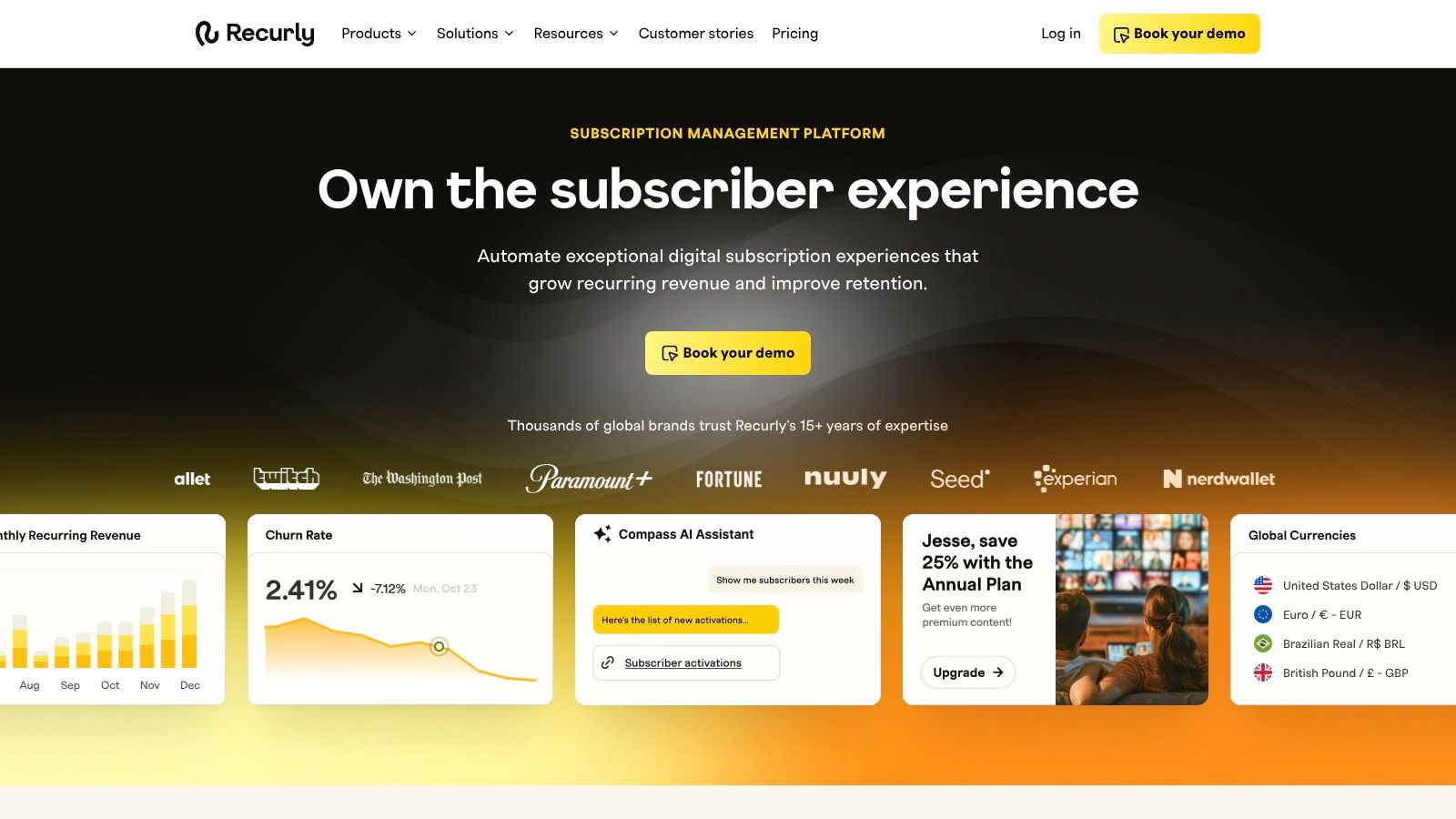
The platform’s most significant differentiator is its advanced churn management engine, "Recurly Recover." This feature set uses machine learning and sophisticated dunning campaigns to intelligently retry failed payments and recover revenue that would otherwise be lost. For businesses operating globally, Recurly’s extensive payment gateway support and multi-currency capabilities are a major asset. It also offers a dedicated revenue recognition module, making it a solid choice for companies needing to maintain GAAP compliance as they scale their subscription offerings.
Key Details & Pricing
Best For: Enterprise SaaS and established digital subscription brands that need powerful churn recovery and global payment processing.
Pricing: The Core plan is contract-based and requires meeting Total Payment Volume (TPV) minimums. The Professional and Elite plans have custom pricing. Shopify plan fees include per-order and percentage-based charges.
Pros: Excellent decline-recovery and multi-campaign dunning features, strong global reach with multi-currency and broad gateway coverage.
Cons: Pricing is not transparent and is geared toward larger businesses with significant TPV. Shopify integration fees can become costly.
Website: https://recurly.com/
5. Paddle
Paddle takes a unique approach by acting as a Merchant of Record (MoR) for software and SaaS businesses. This model means Paddle handles the complexities of global sales tax compliance, payments, and even buyer support on your behalf. Instead of managing your own merchant accounts in different countries, Paddle becomes the legal reseller of your product, completely offloading the liability for calculating, collecting, and remitting sales taxes worldwide. It’s an all-in-one solution for companies that want to sell globally without becoming tax experts.

The platform combines a branded checkout experience, subscription management tools, fraud protection, and dunning into a single package. This integrated system simplifies the tech stack considerably, as everything from payment processing to churn reduction is managed under one roof. While its MoR structure is a huge benefit for tax compliance, it's important to understand how this model differs from a standard payment processor, which you can learn more about on our blog. This makes Paddle an excellent choice for businesses prioritizing compliance simplicity over granular control of their payment stack.
Key Details & Pricing
Best For: SaaS businesses that want to completely offload the burden of global sales tax and VAT compliance.
Pricing: A single, all-in-one fee of 5% + $0.50 per transaction. Custom pricing is available for high-volume businesses.
Pros: Entirely removes the headache of global tax registration, filing, and liability. Offers both no-code and API-driven solutions with extensive global payment and currency support.
Cons: The all-in-one fee is typically higher than a traditional payment processor stack. The MoR settlement schedule can also alter cash flow patterns compared to direct PSP payouts.
Website: https://www.paddle.com/
6. FastSpring
FastSpring operates as a Merchant of Record (MoR) platform, purpose-built for businesses selling software and digital products globally. This approach means FastSpring takes on the responsibility for tax collection, remittance, and compliance, effectively becoming the reseller of your product. This is a significant advantage for SaaS, desktop software, and B2C or B2SMB companies that want to offload the complexities of international sales and focus on their core product. It is a strong solution for managing the entire subscription lifecycle, from initial purchase to renewals.
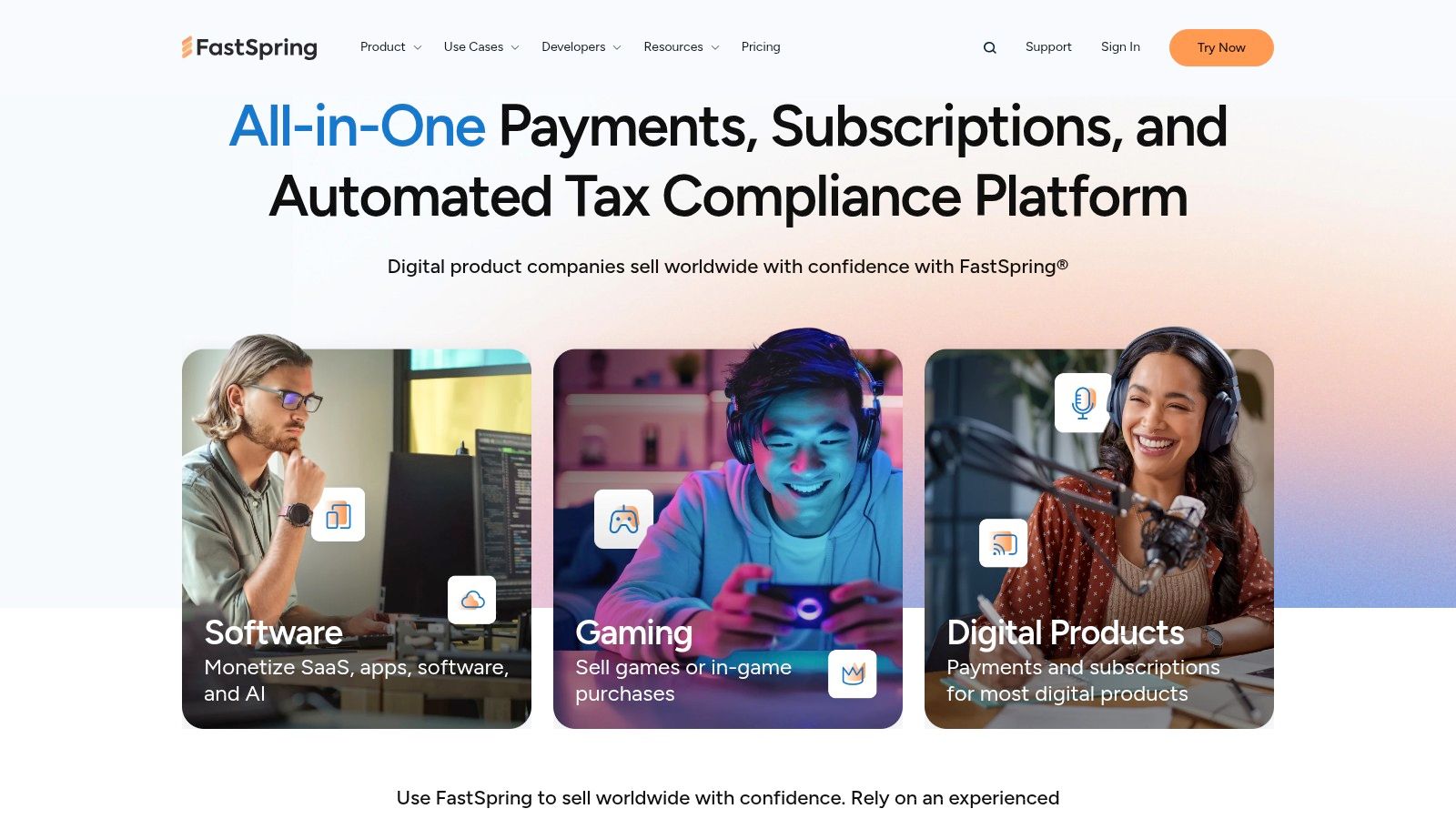
The platform offers flexible subscription tools, including on-demand and usage-based models with proration and automated reminders. While the MoR model simplifies global operations, it can also mean less control over payment processor choices. For developers needing customization, FastSpring provides APIs and documentation to tailor the subscription and checkout experience. This makes it a solid candidate for businesses looking for a hands-off approach to the financial and regulatory side of recurring billing, placing it among the best subscription management software for this specific use case.
Key Details & Pricing
Best For: Software and SaaS companies that need an all-in-one Merchant of Record to handle global sales tax and compliance.
Pricing: Pricing is not publicly listed and is based on a revenue-share model. You must contact their sales team for a custom quote.
Pros: Fully offloads global tax, compliance, and chargeback management. Provides flexible subscription tooling with a focus on digital goods.
Cons: The revenue-share fees are negotiated and not transparent upfront. The MoR approach can restrict your ability to choose a custom payment processor.
Website: https://fastspring.com/
7. Zuora
For large enterprises managing complex monetization strategies, Zuora offers a dedicated platform built for scale and flexibility. It moves beyond simple recurring payments, positioning itself as a complete order-to-cash suite. This makes it a frequent choice for Global 2000 companies, especially in sectors like media, communications, and IoT, where billing logic involves intricate usage-based pricing, multi-entity financial structures, and frequent in-term subscription changes. Zuora is designed to centralize and automate these demanding revenue operations.
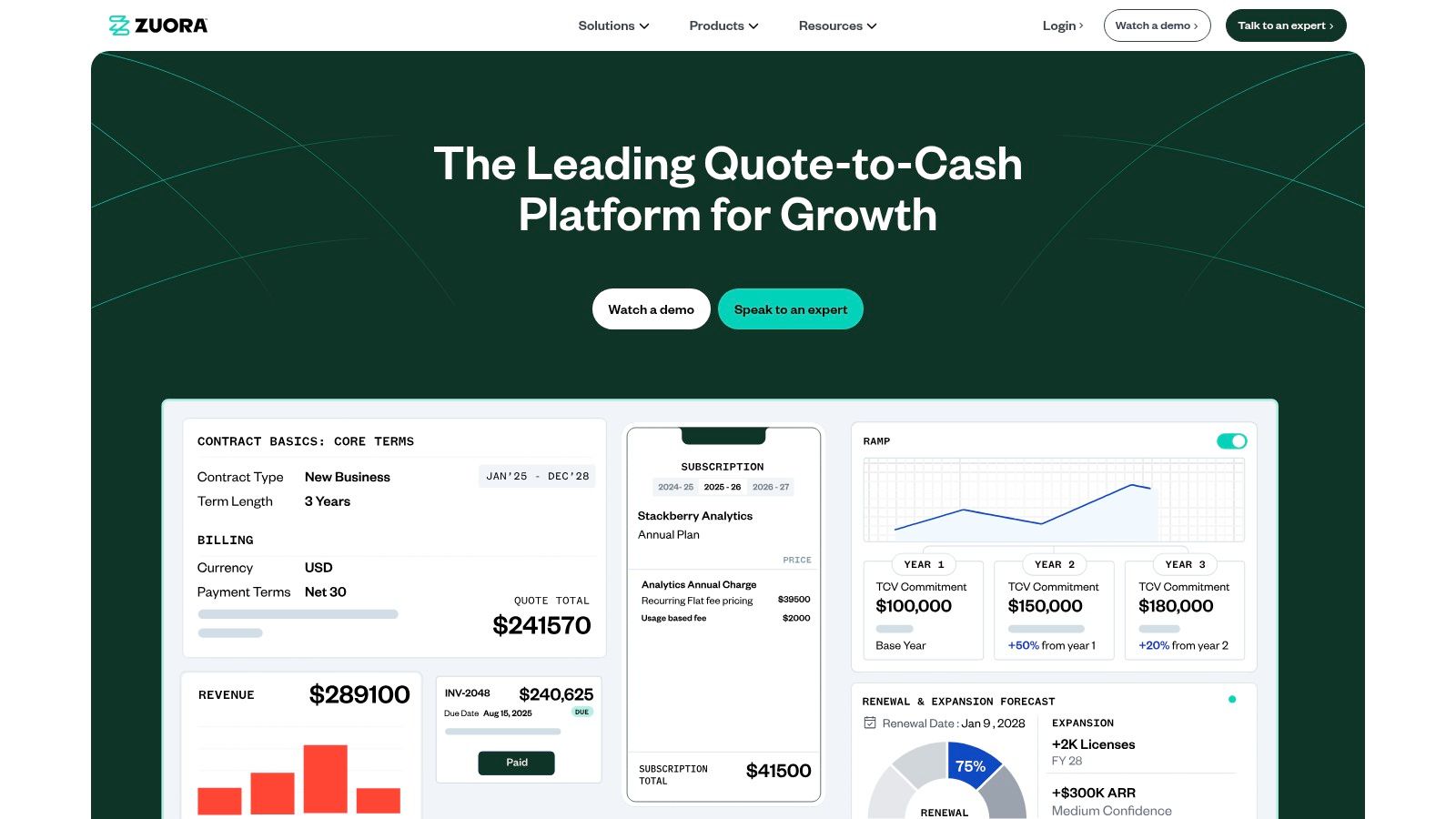
The platform’s core strength is its ability to handle nearly any pricing model imaginable, from consumption-based billing to dynamic price ramps at renewal. Its architecture is built for deep integration with enterprise systems like ERPs, CRMs (like Salesforce), and Configure, Price, Quote (CPQ) tools. This focus on the entire revenue lifecycle, including recognition and reporting, makes it one of the most powerful and compliant options available. However, this power comes at a cost, making Zuora best suited for organizations with significant operational complexity and the budget to match. It is not an entry-level tool for simple subscription needs.
Key Details & Pricing
Best For: Large enterprises in media, IoT, or telecommunications needing a robust, compliant, and highly configurable order-to-cash system for complex subscription models.
Pricing: Custom and quote-based, sold via a direct sales process. Pricing and implementation costs are significant and reflect its enterprise-level positioning.
Pros: Extremely flexible for complex pricing, high-volume transactions, and multi-entity management. An established vendor with strong compliance, security, and a wide ecosystem of integrations.
Cons: The implementation effort and total cost of ownership are substantial. It is definite overkill for businesses with straightforward recurring billing requirements.
Website: https://www.zuora.com/
8. Maxio (formerly Chargify + SaaSOptics)
Formed from the merger of Chargify and SaaSOptics, Maxio is an all-in-one financial operations platform built for B2B SaaS companies. It moves beyond simple subscription billing to tackle complex revenue operations, making it a strong contender in the subscription management software landscape. The platform excels at handling negotiated contracts, intricate pricing models, and the demanding financial reporting requirements typical of mid-market to enterprise-level businesses. It effectively combines a flexible billing engine with deep revenue recognition and analytics.
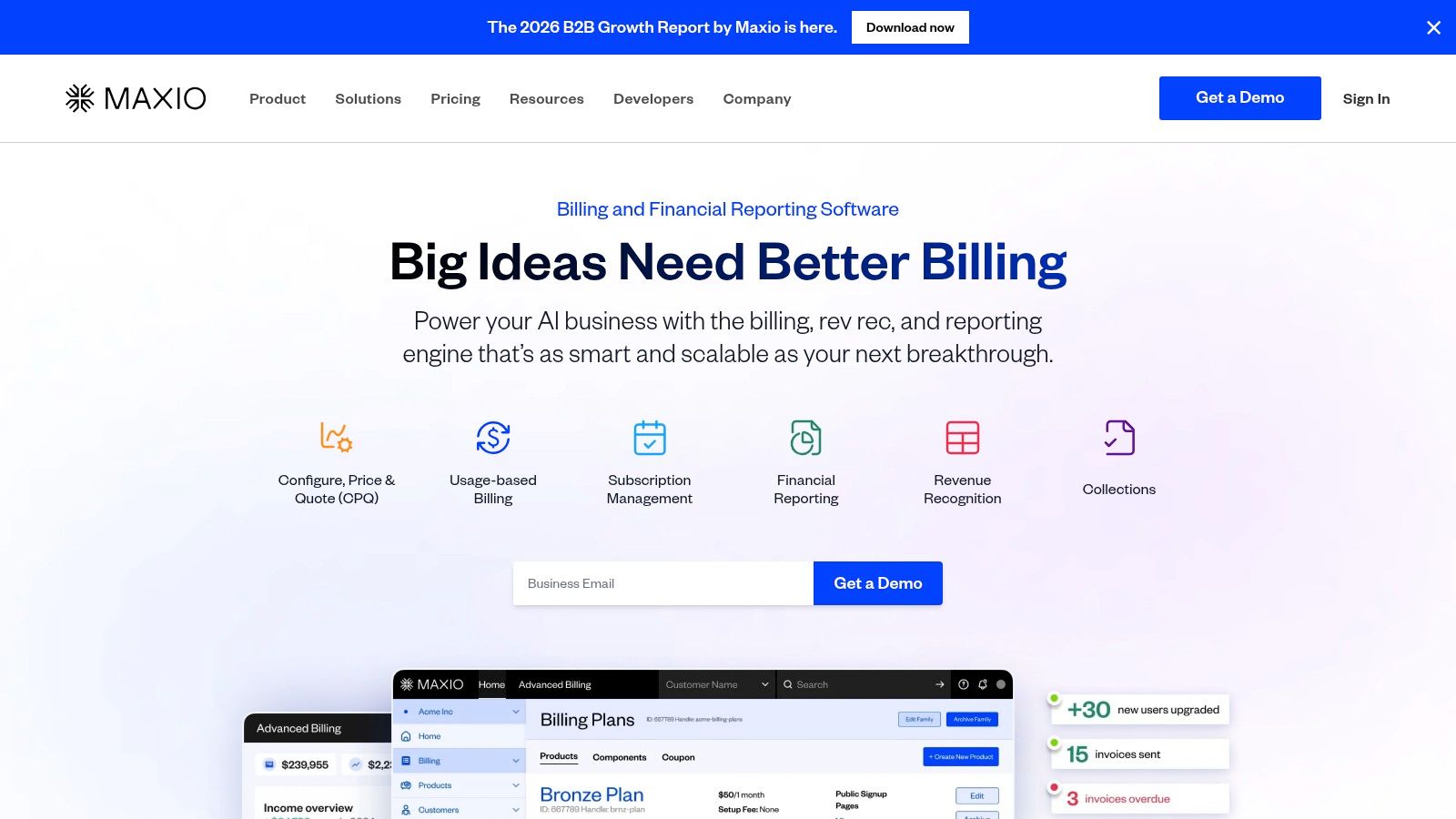
Maxio’s key differentiator is its focus on the entire financial workflow, not just payment collection. It allows finance teams to manage everything from usage-based billing and custom invoicing to ASC 606/IFRS 15 compliant revenue recognition from a single source of truth. Its catalog and contract management tools are designed for high-touch sales processes, supporting custom pricing per account and complex amendments. This makes it an ideal choice for scaling B2B SaaS companies whose financial complexity has outgrown more basic subscription tools. For those just starting, learning about the fundamentals of managing SaaS subscriptions is a great first step.
Key Details & Pricing
Best For: Mid-market B2B SaaS businesses that need to consolidate complex billing, financial reporting, and revenue operations.
Pricing: Pricing is quote-based and requires a conversation with their sales team. It is generally positioned for businesses with significant revenue, making it less accessible for early-stage startups.
Pros: Excellent for finance teams needing to unify billing and RevRec, robust tooling for custom B2B contracts and pricing, and detailed financial analytics.
Cons: Implementation can be more involved compared to lighter solutions, and the cost is often prohibitive for smaller businesses or those with simpler billing needs.
Website: https://www.maxio.com/
9. Braintree (PayPal Braintree)
For merchants looking for a single integration to handle both traditional card payments and PayPal's vast user base, Braintree offers a compelling package. As a full-stack payment service provider owned by PayPal, it’s designed to unify multiple payment methods under one roof, including cards, PayPal, and even Venmo in the US. While its primary function is payment processing, it includes foundational recurring billing tools, making it a practical choice for businesses that want processor-level subscription features without adding another specialized platform.
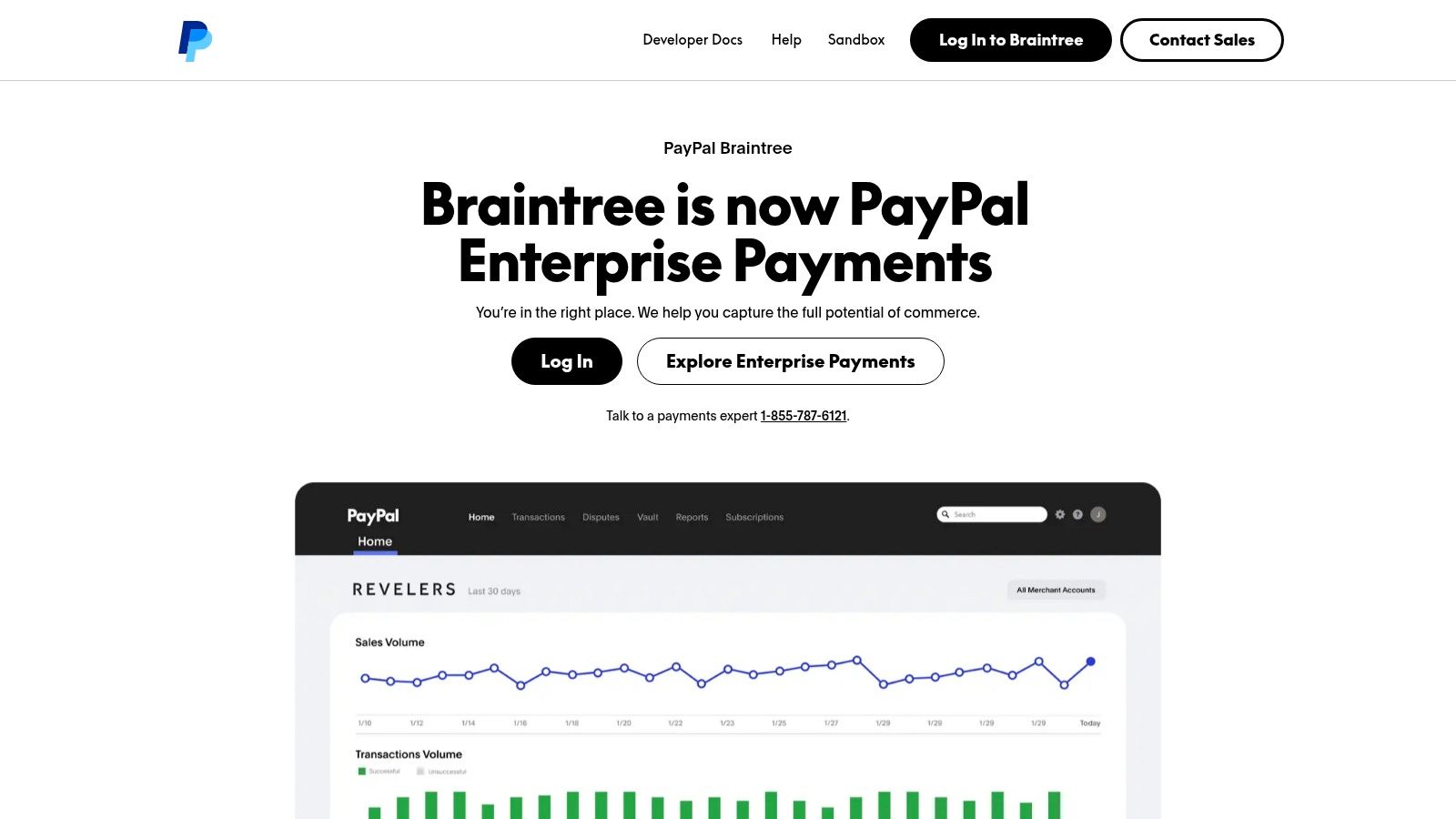
The platform provides developer SDKs and clear documentation for implementing its recurring payment capabilities. This allows businesses to set up subscription plans, manage customer billing cycles, and automate charges directly through the Braintree gateway. It’s a solid solution for companies whose primary need is reliable payment acceptance with basic subscription logic built-in, rather than a full suite of revenue optimization and analytics tools. Its direct access to PayPal rails is a significant advantage for reaching customers who prefer that payment method.
Key Details & Pricing
Best For: Businesses that prioritize unified payment processing for cards and PayPal and need straightforward, processor-based subscription tools.
Pricing: Standard pricing is 2.59% + $0.49 per transaction for cards and digital wallets. Custom and enterprise pricing is available, often with better rates for high-volume merchants.
Pros: Provides a single integration for accepting PayPal, Venmo, and card payments. A good fit if your subscription needs are basic and centered around the payment processor itself.
Cons: The subscription feature set is not as advanced as dedicated billing platforms. The most competitive pricing and terms often require negotiating an enterprise-level quote.
Website: https://www.braintreepayments.com/
10. Zoho Subscriptions (Zoho Billing)
For businesses operating within the Zoho ecosystem, Zoho Subscriptions offers a cost-effective and highly integrated solution for recurring billing. It is part of Zoho's broader finance suite, designed to work seamlessly with other tools like Zoho Books and Zoho CRM. This makes it an ideal choice for small to medium-sized businesses that want to manage subscriptions, invoicing, expenses, and financial reporting from a single, unified platform without the complexity of connecting disparate systems.
The platform provides all the essential tools needed for subscription management, including hosted payment pages, automated dunning for failed payments, proration, and usage-based billing. Its strength is its ability to centralize financial operations. If your sales team uses Zoho CRM to close a deal, it can be converted into a recurring subscription in Zoho Subscriptions with just a few clicks, creating a smooth handoff from sales to finance. This makes it a practical and efficient piece of the best subscription management software puzzle for existing Zoho users.
Key Details & Pricing
Best For: SMBs already using the Zoho suite of products who need an affordable, all-in-one financial management and subscription billing system.
Pricing: A free plan is available for businesses with less than $10,000 in monthly revenue. Paid plans start at $29/organization/month (billed annually) and scale up with additional features and higher revenue or invoice limits.
Pros: Competitive pricing compared to many standalone billing platforms, and it works exceptionally well if you are already invested in other Zoho products.
Cons: Enterprise-grade features and complex usage-based models might require workarounds. Some plans come with strict limits on the number of invoices or total revenue you can process.
Website: https://www.zoho.com/subscriptions/
11. Billsby
Billsby positions itself as a friendly and accessible subscription management platform for small to medium-sized businesses and growing SaaS companies. Its main draw is providing a rich feature set, including complex billing scenarios, without the steep learning curve or high entry price of more enterprise-focused systems. The platform is designed for rapid implementation, allowing businesses to get up and running quickly with features like usage-based billing, prorated charges, and customizable discounts.
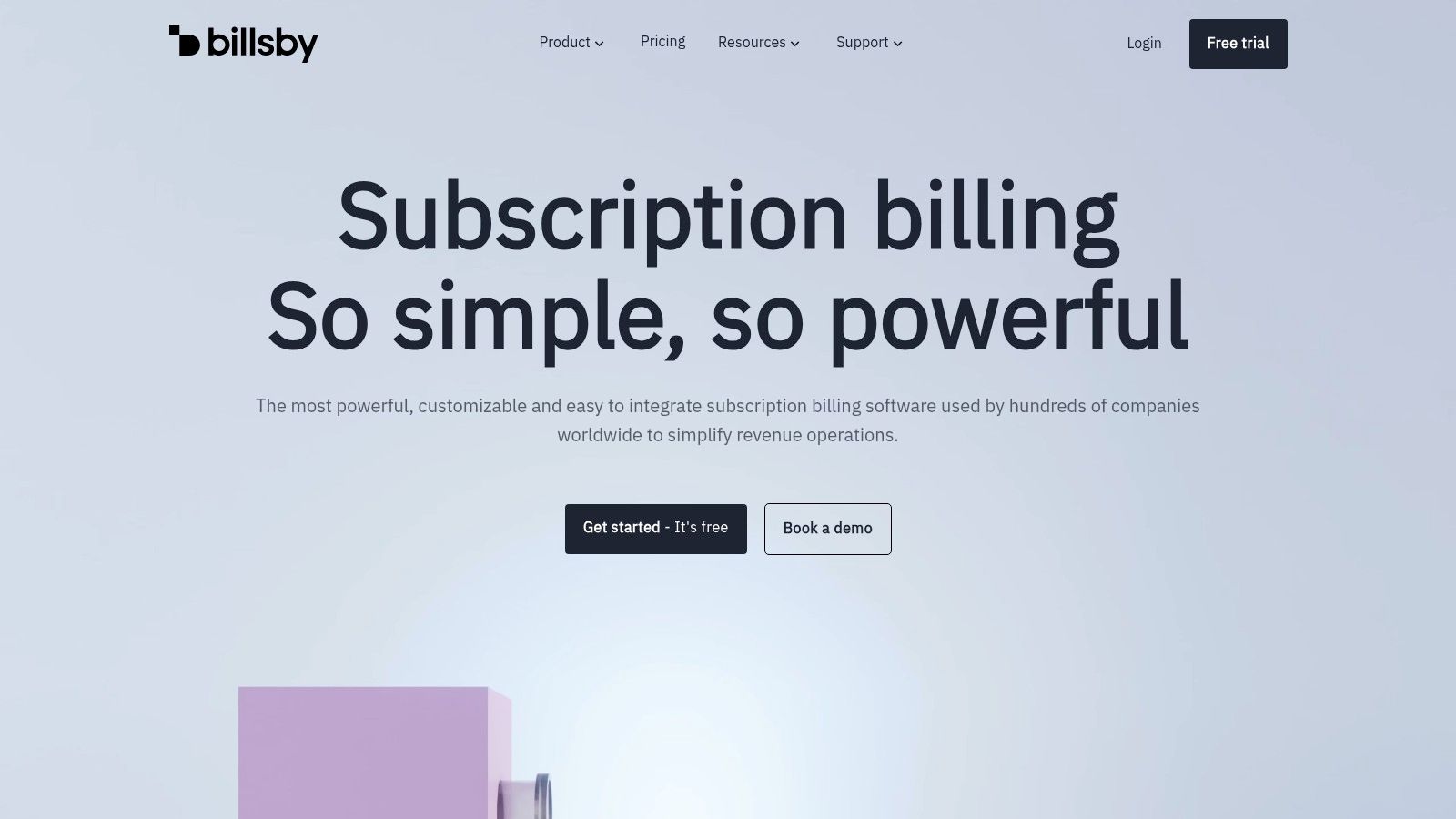
The platform supports multiple payment gateways and ACH, giving businesses flexibility in how they collect payments. It also includes essential tools for revenue retention, like automated dunning sequences to handle failed payments and a branded customer portal where subscribers can manage their own plans. This combination of powerful features packaged in a simple-to-use interface makes Billsby a strong contender for companies that have outgrown basic payment links but are not yet ready for a complex, developer-heavy solution. It is one of the more straightforward options when seeking the best subscription management software for a small team.
Key Details & Pricing
Best For: Small to medium-sized SaaS and subscription businesses that need a full-featured billing system with simple pricing and setup.
Pricing: Starts with a free plan for up to $5,000 in monthly revenue. Paid plans start at $35/month + 0.6% of revenue over the plan's threshold.
Pros: Transparent and affordable pricing, good feature coverage for smaller teams (dunning, proration, usage billing), and supports multiple payment gateways.
Cons: Revenue caps on each plan lead to overage fees, which can make costs less predictable during growth spurts. It has fewer enterprise-grade controls compared to larger platforms.
Website: https://www.billsby.com/
12. Lemon Squeezy
Lemon Squeezy is built for digital creators, indie SaaS developers, and software sellers who want to offload the complexities of global commerce. As a Merchant of Record (MoR), it handles everything from payment processing and subscription billing to global sales tax and VAT compliance. This model simplifies operations significantly, allowing businesses to focus on their product instead of administrative burdens like tax remittance and fraud protection. It's a fantastic solution for those selling digital goods who need an all-in-one system.

The platform supports both one-time purchases and recurring subscriptions with various pricing models, including quantity-based billing accessible via its API. Beyond payments, Lemon Squeezy provides built-in tools for failed payment recovery and abandoned cart emails to help maximize revenue. This comprehensive approach makes it one of the best subscription management software choices for sellers who prioritize simplicity and want to sell globally without becoming tax experts.
Key Details & Pricing
Best For: Digital creators and indie software companies needing a simple, all-in-one Merchant of Record solution.
Pricing: A straightforward fee of 5% + $0.50 per transaction, which covers all services including tax handling and payment processing.
Pros: Extremely simple fee structure and quick setup for digital products, completely offloads tax compliance and buyer billing support as an MoR.
Cons: The all-inclusive fee is higher than using a separate payment processor and subscription tool, and it may not fit complex B2B financial workflows or ERP integrations.
Website: https://www.lemonsqueezy.com/
Top 12 Subscription Management Software Comparison
Product | Settlement & acceptance | Key features | Target audience | Pricing & fees | Unique differentiator / Security |
|---|---|---|---|---|---|
Suby | Cards (Visa/Mastercard) + crypto (USDC, USDT, ETH, SOL, BNB); merchant receives settlements in USDC to wallet (no bank/SWIFT) | Paylinks, embeddable checkout, API + webhooks, one‑time & subscriptions, Discord/Telegram access, real‑time dashboard | International SaaS, creators, cross‑border e‑commerce, freelancers, agencies | All‑inclusive; advertised ~4–5% (verify current rates on pricing page) | Stablecoin‑native USDC rails for fast predictable payouts; PCI‑DSS Level 1 partner, SCA, 2FA, fraud controls, zero‑fee refunds |
Stripe Billing | Card + wallet acceptance via Stripe Payments; fiat settlements to bank accounts | Hosted checkout, usage & hybrid billing, smart retries, customer portal, Payment Links | SaaS and web apps needing composable billing & payments | Pay‑as‑you‑go; regional/FX add‑ons can apply | Developer‑friendly APIs and extensive ecosystem |
Chargebee | Gateway‑agnostic (integrates 30+ gateways); settlement via connected gateway | Product catalog, hybrid/usage pricing, RevRec, smart dunning, hosted checkout | Scaling SaaS transitioning to finance teams | Tiered pricing; costs rise after free thresholds and with add‑ons | End‑to‑end subscription & revenue operations with migration support |
Recurly | Multi‑gateway and multi‑currency support; settles via chosen processors | Advanced dunning, decline recovery, usage/pricing flexibility, RevRec module | Digital media, SaaS, consumer subscriptions | Contract‑based plans; TPV minimums for core tiers | Strong decline‑recovery and multi‑campaign dunning tooling |
Paddle | Merchant‑of‑Record (MoR): handles payments, tax/VAT, and compliance; Paddle pays merchants | Branded checkout, subscription management, tax remittance, buyer support | Software/SaaS companies preferring MoR and compliance offload | MoR fees typically higher than processor‑only; contact sales for rates | Offloads tax/regulatory liability and global filings as MoR |
FastSpring | MoR model with global tax collection and remittance; supports digital product payouts | Subscription lifecycles, global tax, APIs for customization | Software, desktop apps, B2C/B2SMB digital sellers | Revenue‑share / negotiated pricing; not transparent online | MoR focused on digital goods with chargeback & compliance handling |
Zuora | Processor‑agnostic; enterprise‑grade multi‑entity settlements via integrations | Advanced product catalog, dynamic pricing, RevRec, ERP/CPQ integrations | Enterprise / Global 2000 with complex billing & finance needs | Sales‑assisted pricing; significant implementation costs | Extremely flexible for complex, high‑volume monetization |
Maxio (Chargify + SaaSOptics) | Integrates with gateways; billing + revenue ops settle via chosen processors | Multiple pricing schemes, usage aggregation, invoicing, RevRec lineage | Mid‑market / enterprise B2B SaaS finance teams | Sales‑assisted packaging; above SMB budgets for many | Combines billing with revenue operations and financial reporting |
Braintree (PayPal) | Cards, PayPal, Venmo and wallets; settles to merchant bank accounts | Recurring billing basics, SDKs, wallet support, ACH where available | Teams wanting PSP + PayPal/Venmo support | Pricing varies; enterprise quotes often required | Single integration for PayPal rails plus card/wallet acceptance |
Zoho Subscriptions | Gateway‑backed card acceptance; settlement via configured gateway | Hosted pages, dunning, proration, multi‑currency, tax handling | SMBs using Zoho suite (CRM, Books) | Competitive plans; invoice/revenue limits on some tiers | Tight integration with Zoho ecosystem for finance & CRM |
Billsby | Multi‑gateway support, ACH, TaxJar integration; settles via gateways | Metered/usage billing, proration, branded checkout, automated dunning | SMBs and growing SaaS seeking simple setup | Transparent low base pricing; overages above revenue caps | Simple, budget‑friendly subscription feature set for small teams |
Lemon Squeezy | MoR: handles payments, global VAT/sales tax and remittance | Subscriptions, one‑offs, licensing, fraud protection, failed‑payment recovery | Indie SaaS, digital creators, small software sellers | MoR fee ~5% + $0.50/tx (per public information) | Fast setup and MoR convenience for creators and indie sellers |
Making Your Final Decision: Subscriptions Built for Global Scale
Choosing the right subscription management software is a critical decision that directly impacts your revenue, customer experience, and operational efficiency. We have explored a dozen powerful platforms, from enterprise-grade giants like Zuora to developer-focused tools like Paddle and all-in-one solutions like Zoho Subscriptions. Each offers a distinct set of features designed to solve specific billing challenges.
Your final choice hinges on an honest assessment of your business's core needs. Are you a mature SaaS company requiring complex dunning management and revenue recognition? A platform like Chargebee or Recurly might be a great fit. Are you a small e-commerce brand primarily selling digital goods? Lemon Squeezy offers a simple, merchant-of-record model that handles tax compliance for you. These tools are excellent at managing the logic of recurring billing.
However, for a growing segment of modern, internet-native businesses, the biggest obstacle isn't just how to bill, but how to get paid. Traditional payment systems often create friction for global businesses. High cross-border transaction fees, mandatory currency conversions, and settlement delays of several days or even weeks can seriously hinder cash flow and create accounting headaches.
Re-evaluating the Core Problem: Billing vs. Payments
When selecting the best subscription management software, it's vital to distinguish between the billing layer and the payment layer.
The Billing Layer: This is what most traditional platforms excel at. It involves creating subscription plans, managing customer lifecycles, handling upgrades or downgrades, and automating invoices.
The Payment Layer: This is the underlying engine that actually moves money from your customer to you. It involves payment processing, currency settlement, and payouts.
For businesses operating globally, a weak payment layer can undermine even the most advanced billing system. If your revenue is constantly eroded by fees or locked up in slow bank transfers, your growth potential is limited, and staying compliant with taxes for online businesses in every market adds another layer of complexity to manage.
This is precisely the problem Suby was built to solve. We focus on perfecting the payment layer for global commerce. We recognized that for many SaaS companies, creators, and agencies, the real need is a fast, low-cost, and predictable way to receive money from anywhere in the world.
Our approach is direct: your customers pay with their card in their local currency, and you receive the funds settled as USDC. This model bypasses many of the inefficiencies of the legacy banking system. It means you get faster access to your revenue, avoid forced currency conversions, and benefit from the stability and global nature of stablecoins for your payouts.
Making a Decision Based on Your Business Model
To help you make a final choice, consider where your business fits:
For Large Enterprises with Complex Needs: If you require deep integrations with existing ERPs like NetSuite and need advanced revenue recognition features for public reporting, platforms like Zuora or Maxio are purpose-built for your scale.
For Traditional SaaS & E-commerce: If your customer base is primarily within one region (like North America or Europe) and you are comfortable with standard bank payouts, tools like Stripe Billing, Chargebee, and Recurly offer robust and proven solutions.
For Global-First Businesses, Developers, and Creators: If your primary goal is to sell worldwide without friction, minimize cross-border fees, and achieve fast, stablecoin settlements, Suby is your ideal solution. Our simple API allows for quick integration, and our native Discord and Telegram tools let creators monetize communities in minutes. The core value is clear: accept cards globally, get paid in USDC.
Ultimately, the best subscription management software is the one that removes your biggest growth barriers. As you move forward, look beyond feature lists and consider the fundamental mechanics of how you get paid. For the next generation of online businesses, a modern payment infrastructure is not just a nice-to-have, it's the foundation for sustainable global scale.
Suby is a payment gateway and payment processor. Your customers pay with card, bank transfer, Apple Pay, Google Pay, Klarna, and more, or stablecoins, and your business gets paid out to your bank account, or directly in stablecoins (USDC, EURC) to your wallet, anywhere in the world, no bank account required. It runs recurring subscriptions through an API, webhooks, paylinks, and native Discord and Telegram access control, so the best subscription management software for a global business becomes the one where billing and getting paid finally live in the same place.
