

Gaspard LEZIN
Automated Access Control Systems: A Developer's Guide
Learn how automated access control systems work, from auth and provisioning to webhook integration, with practical tips for developers and community managers.
You've probably seen this flow already, even if you didn't call it access control. A customer pays, a webhook fires, a role appears in Discord, and a private channel opens without anyone on your team touching a button. That's automated access control in practice, software deciding who gets in, what they can reach, and when that access should disappear.
The hard part isn't the door. It's the handoff between payment, identity, policy, and entitlement. Teams that get this wrong usually don't fail at the visible moment, they fail earlier, when a webhook retries, a role sync drifts, or a refund doesn't revoke anything. Teams that get it right treat access like a pipeline, not a one-time permission flip.
Table of Contents
What Automated Access Control Systems Actually Do
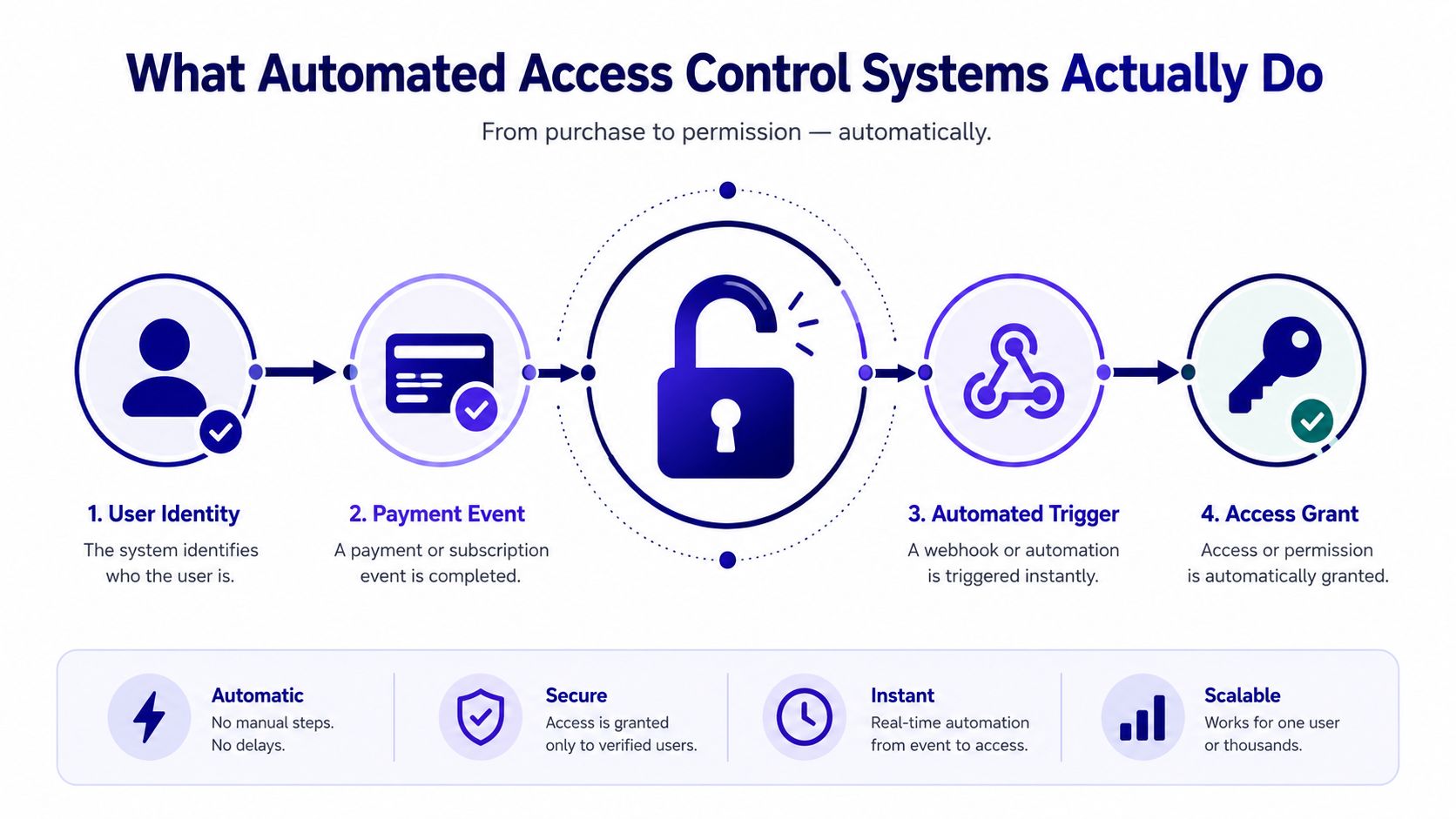
A payment lands, and a second later a Discord role appears. That tiny moment is easy to gloss over, but it's the whole point of the system. The customer paid, the system recognized them, and software decided they now qualify for access.
From lock hardware to software decisions
Traditional access control starts with a physical act, a badge tap, a key turn, or a guard checking a list. Automated access control systems push that decision into software, so identity and entitlement are evaluated by rules instead of by hand. Official UK guidance describes access control as deciding who goes where and when, and it explicitly includes employees, contractors, and visitors in that logic UK guidance on automatic access control systems.
That definition sounds broad because it is broad. A lock on a door, a paid role in Discord, and a gated SaaS dashboard all use the same pattern, an identity is checked against a policy, and the system either grants or denies access. The surface area changes, but the control loop is the same.
Practical rule: if software decides membership, entry, or entitlement, you're doing access control, even when no door is involved.
For developers, the useful mental model is simple. A user shows up, the system figures out who they are, checks the rules, and then grants or revokes access. That's the exact shape you want whether you're managing a private community, a subscription product, or a download library.
A useful adjacent example is any automation offered by Refact, because it shows the same idea in a broader workflow sense. The technical details differ, but the design problem is the same, capture an event, make a decision, and push the result to the right place.
Why the pipeline matters more than the door
The value becomes clear when access needs to change. Someone upgrades, cancels, moves to a new tier, or loses eligibility. A manual process can grant access, but it usually can't keep up with lifecycle changes.
That's why access control is less about opening something once and more about maintaining the right state over time. The system has to know who the person is, what policy applies, and whether the entitlement should still exist. If any of those three drifts, the permission becomes wrong.
The Core Building Blocks of an Access Pipeline
Think of an access pipeline as four stacked checks. First, the system confirms identity. Next, it decides what that identity is allowed to do. Then it creates the entitlement somewhere real. Finally, it keeps that entitlement aligned with changes over time.

Authentication comes first
Authentication answers one question, who is this? In old systems that might mean a password, a badge, or a human checking a list. In web-native systems, it can be a magic link, social login, or a proof tied to a wallet or payment session.
If authentication is weak, everything after it is shaky. A system can't safely grant access to a private channel or a SaaS tenant if it isn't confident about the person making the request. That's why product teams spend so much time on login UX, because identity is the front door to every later decision.
A helpful reference for that trade-off is user auth UX for product teams from RapidNative, especially when you're choosing between simpler sign-in flows and tighter verification. The important part isn't the specific method, it's making sure the login step matches the value of what's being protected.
Authorization decides the rules
Once the user is known, authorization decides what they can touch. A subscriber might get one role, a contractor another, and a one-time buyer a short-lived entitlement. The policy engine is the part that translates business logic into access rules.
Many teams overcomplicate things. They try to bury policy in application code, then discover later that the rule exists in three places and only two of them still match reality. A dedicated authorization layer keeps the logic visible and easier to audit.
Provisioning creates the actual entitlement
Provisioning is the mechanical part, the system creates the access object for real. That could be a database row, a Discord role, a Telegram invite, or a tenant flag in your SaaS app. The decision is abstract, but the outcome has to land in a concrete system.
If the policy says “yes” but the entitlement never gets created, the customer still gets blocked.
Lifecycle management keeps access current
The last layer is lifecycle management. People often encounter challenges here, because access does not remain accurate automatically. Plans expire, users downgrade, staff leave, and contractors finish work.
A good system treats access as something that changes with the customer record. That means revoking old roles, updating current ones, and preventing stale permissions from sticking around after the business relationship changes. The biggest bugs here are rarely dramatic, they're quiet mismatches between what billing says and what access still allows.
How a Payment Webhook Becomes a Permission Grant
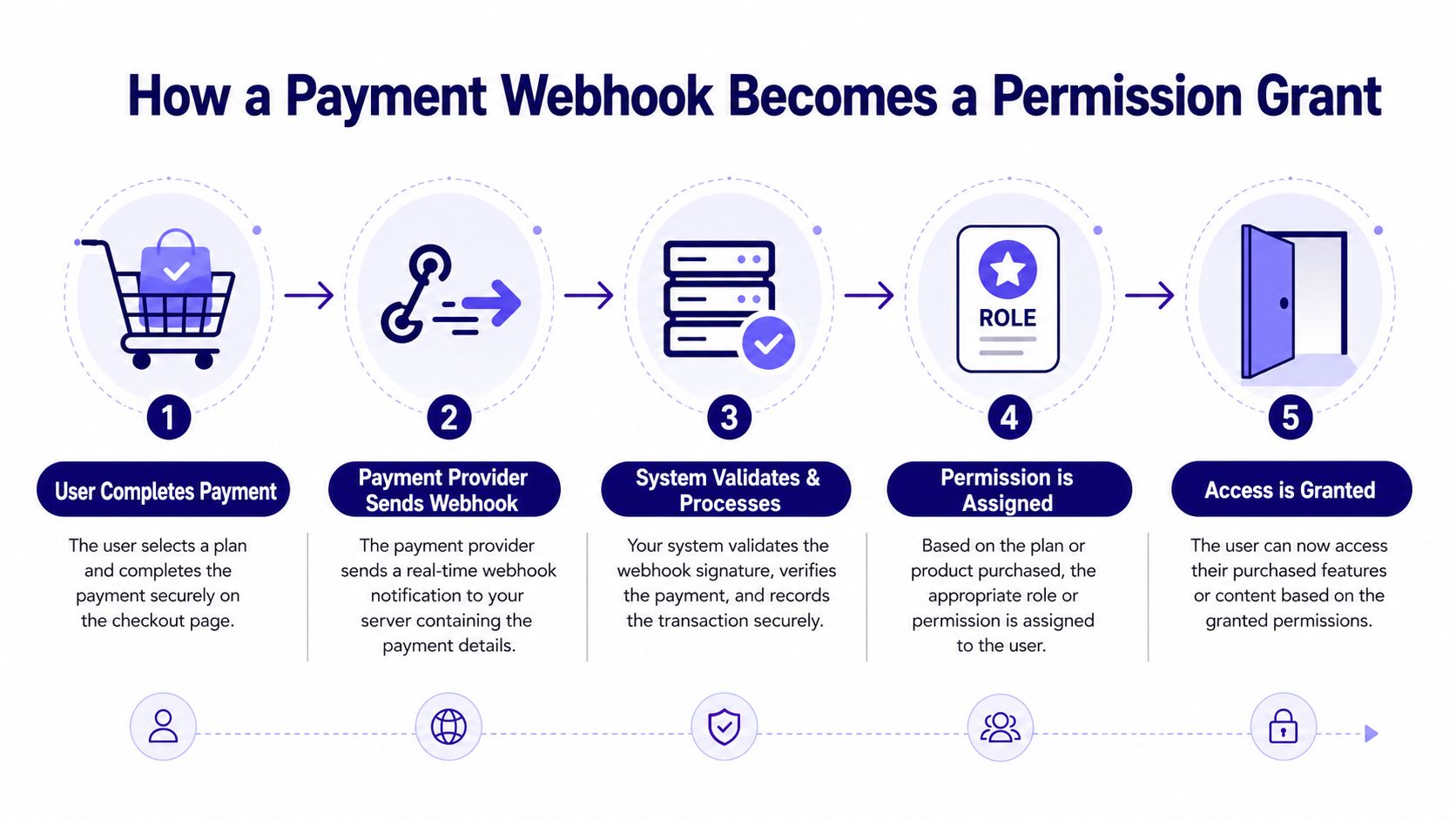
The cleanest version of this flow starts with a hosted paylink. A user pays by card or crypto, the payment provider emits a webhook, and your server uses that event to grant access. The whole sequence can be very small, but each hop has a job, and skipping one usually creates a support ticket later.
The canonical sequence
The flow usually looks like this.
The customer completes checkout on a paylink or embedded checkout.
The payment system sends a webhook to your backend.
Your backend verifies the signature and checks idempotency.
Your app looks up the user and maps the payment to a plan or tier.
Your gating layer grants the entitlement, such as a Discord role or a private invite.
The same shape works whether the customer paid by card or crypto. In Suby Payments, the API-first stack is built for cards and crypto in one checkout, and Suby Gating can then manage access for Discord, Telegram, downloads, and courses. That pairing is useful because the payment event and the permission grant stay separate, which makes the system easier to reason about.
What each hop has to protect
The webhook is the critical boundary. If you don't verify its signature, any caller can pretend a payment happened. If you don't use idempotency keys or a dedupe store, the same payment can trigger two role grants when the provider retries.
Debugging rule: a webhook handler should be safe to run twice and still produce one entitlement.
The access side should also be explicit about what gets granted. A Discord role, for example, is not the same as a full channel invite. A Telegram join flow is not the same as a SaaS tenant flag. Each target has different failure modes, so the code should map payment state to one target at a time.
A practical walkthrough of this provisioning style is in the internal guide on automated provisioning, which helps when you're translating a billing event into a real permission object.
Where currency differences fit in
Sometimes the customer pays one way and the business wants to receive value another way. That's part of the same pipeline, not a separate one. In Suby's model, funds can land in the Suby balance, then be received in the currency the business chooses, including stablecoins like USDC.
That matters because access should key off successful settlement or a confirmed payment state, not off a particular payment rail. If your entitlement logic is tied too tightly to the checkout method, you'll end up rewriting it every time the payment mix changes.
For a secure checkout implementation mindset, building secure checkout flows from WebinOne is a useful companion read, especially if you're thinking about the handoff between front end, webhook, and backend state.
Two Integration Patterns Developers Actually Use
Teams often find themselves in one of two shapes. The first is a hosted paylink with webhooks, which is simple and fast. The second is an embedded API checkout, which gives you more control and more code to own.
Dimension | Hosted Paylink + Webhooks | Embedded API Checkout |
|---|---|---|
Setup speed | Fastest to ship | More engineering work |
UI control | Limited | Full control |
Best fit | Solo creators, paid communities, quick launches | SaaS products, custom funnels, branded experiences |
Access grant logic | Same gating flow after the webhook | Same gating flow after the webhook |
Maintenance | Lower ongoing burden | More frontend and checkout upkeep |
Analytics depth | Basic event visibility | Deeper funnel instrumentation |
The hosted route is good when your real product is the gated content or community itself. You can wire a paylink to a webhook, then let the access system handle the rest. That's often enough for Discord or Telegram memberships, and it keeps the implementation small.
The embedded route makes more sense when checkout is part of your product experience. You own the UX, the analytics, and the surrounding funnel, but you also own more edge cases. A failed card step, a half-finished session, or a webhook delay can all need custom handling.
A practical way to choose is to ask one question. Do you care more about shipping access quickly, or about shaping every step of the checkout journey? If you need speed, start with hosted. If the checkout is a core surface of the app, go embedded.
The access-grant side stays mostly the same either way. That's the useful part. You still verify the event, map it to a user, and call the gating service, which is why a product like Suby Gating can sit behind different front ends without forcing the rest of the logic to change.
Security and Compliance Best Practices
The safest access system is the one that can prove what happened. That means every webhook should be verified, every entitlement change should be traceable, and every manual override should leave a record. If you can't reconstruct the path from payment to permission, you can't really audit the system.
The controls that matter most
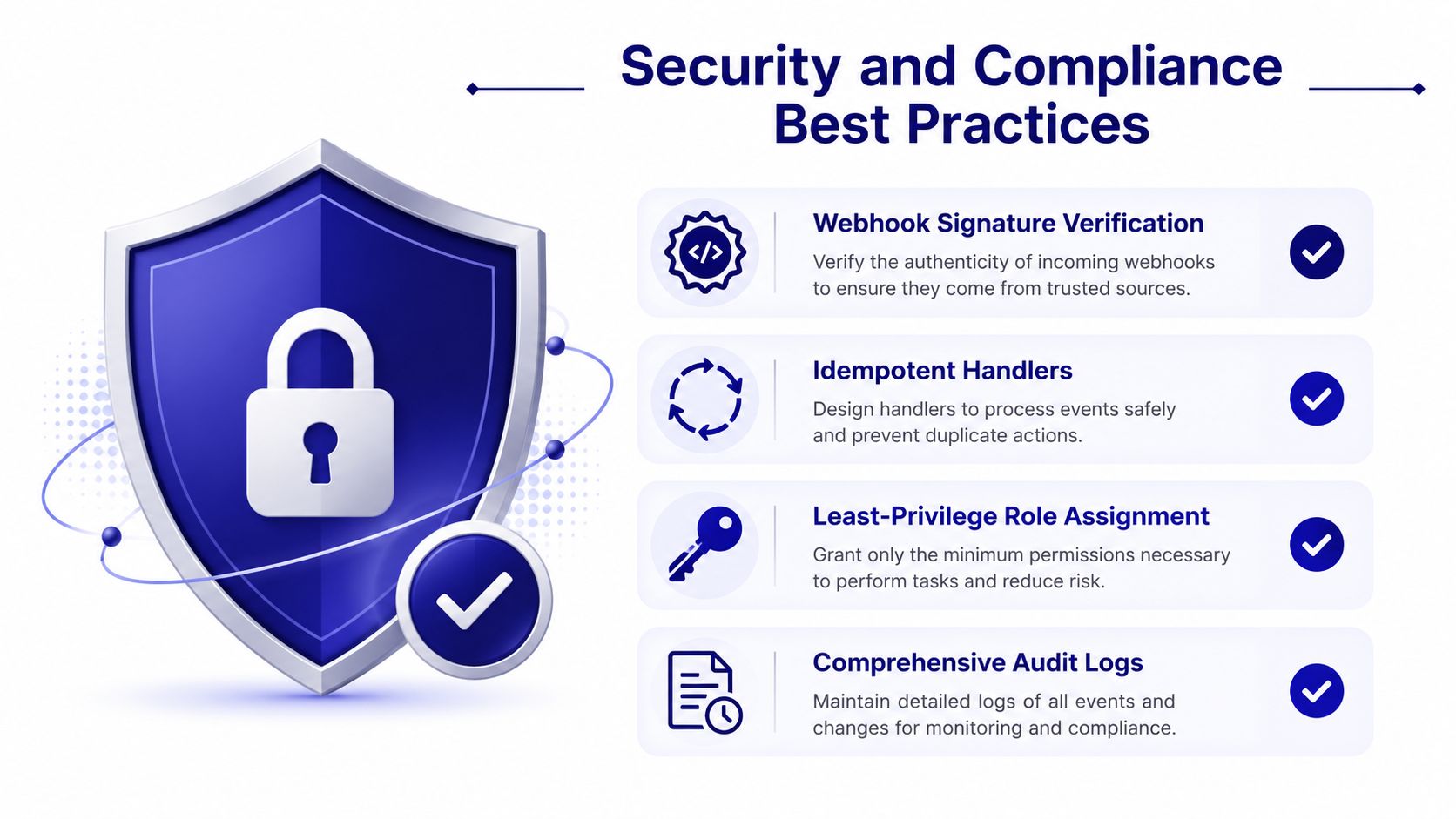
Webhook signature verification is essential. It's the check that says the event came from the payment system, not from a random caller. Idempotent handlers matter just as much, because payment providers retry delivery and your code has to tolerate that without duplicating access.
Least privilege should apply to the access grant itself. If a user bought entry to one private channel, don't give them a broader role than they need. Audit logs should record who got access, when it changed, and what triggered the change, because that trail is what you'll need when billing and support disagree.
A practical compliance anchor is the publisher's documented PCI-DSS compliance guide, which is worth checking before you move from test payments to live ones. Suby also documents PCI-DSS Level 1–certified processing partner, Strong Customer Authentication, and two-factor authentication as confirmed security and compliance capabilities, so don't assume those pieces are optional in your design.
Pre-launch checks you can actually run
Verify signatures: confirm the webhook secret is correct and that your handler rejects unsigned events.
Test retries: replay the same event twice and make sure one payment still creates one grant.
Audit revocation: cancel or refund a test subscription and confirm the entitlement is removed.
Check role scope: inspect the granted role and make sure it matches the exact plan or tier.
Review staff access: keep admin accounts on 2FA and limit who can manually override entitlements.
Access drift is also a security issue. If your billing system says one thing and your permission store says another, the system is no longer trustworthy. That's why lifecycle management and auditability belong in the security conversation, not just the operations conversation.
Common Failure Modes and How to Debug Them
The bugs are usually boring, which is why they survive code review. A webhook path looks fine in staging, then a live event lands with a slightly different shape, or the same event gets delivered twice, and the access state goes sideways.
The failures that show up again and again
“Webhook signature invalid” often means the raw body changed before verification. A trailing slash on the route, a middleware that parses the payload too early, or the wrong secret can all trigger it. The fix is to verify against the untouched request body and confirm the secret matches the environment.
Duplicate roles after one payment usually points to a non-idempotent handler. If the log says role_assigned=true twice for the same event ID, your dedupe check is missing or not persisted early enough. Store the processed event ID before side effects, not after them.
A revoked role never comes back can happen when a sync job dies. The customer renewed, but the recovery job never ran, so the entitlement stayed stale. The fix is a periodic reconciliation process that compares billing state to access state.
Two purchases in the same second create the wrong tier is a race condition problem. One handler reads stale user state before the other commit finishes, then both write conflicting results. Put the entitlement update behind a transaction or a lock keyed on the user or subscription ID.
“User not found for payment” means your identity mapping is too weak. Maybe the checkout email doesn't match the account email, or the user never completed account creation. Add a deterministic join key, not just a best-effort lookup.
Entitlement data drifting away from billing reality is the quietest failure of all. It doesn't break on day one, it breaks after months of refunds, upgrades, and failed retries. The fix is an audit report that compares active access against current subscription state.
Log the payment event ID, the user ID, the requested role, the grant result, and the revocation result. If you can trace one customer from checkout to role assignment in one search, debugging gets much easier.
A Practical Roadmap for Developers and Community Managers
Start with the money flow and the identity source. Decide what payments you'll accept, decide where settlement should land, and choose the system that knows who the user is. Then wire the webhook, define the roles or tiers, and test the grant path end to end.
After that, harden the boring parts. Add signature verification, idempotency, audit logs, and alerts for failed grants or failed revocations. Put a weekly review on role drift, and make refunds or cancellations trigger a revoke path automatically.
The last step is operational discipline. Keep a short runbook for disputes, manual overrides, and account recovery, because those cases will happen. Verify every implementation detail against the current product docs before launch, since payment and access workflows change quickly.
If you want one system that can accept card or crypto payments, settle the way you choose, and connect those events to Discord or Telegram access, take a look at Suby. It's built for payment-triggered permissions, including paid access, subscriptions, and gated communities. If you're wiring this into a real product, start there and compare the current docs to your own access flow before you ship.
