

Gaspard LEZIN
What Is a Merchant of Record and How It Works
Learn what is a merchant of record, what legal and financial duties it carries, and how SaaS, ecommerce, and creators can decide if the model fits them.
A merchant of record is the legally recognized seller in a transaction, and it carries responsibility for tax, compliance, refunds, and chargebacks. In practice, the MoR name is the one the customer may see on a statement, invoice, or dispute notice, not just the storefront brand (Stripe).
Your checkout can look simple on the front end and still hide a messy legal and financial backend. That's why founders usually meet this topic only after they've started selling across borders, where tax, invoicing, and payment liability stop being side issues and become the main event.
Table of Contents
A Familiar Founder Scenario
A small SaaS team launches a $20/month product and starts signing customers in multiple countries. At first, the only question seems to be whether the checkout converts well. Then the main questions arrive, like which entity should issue the invoice, who handles VAT or GST, and what happens when a customer disputes a charge.
That's where the merchant of record idea stops being abstract. Once money crosses borders, someone has to be the legal seller, collect the right tax, and stand behind the transaction if a refund or chargeback lands (Stripe).
Why the founder feels the pain so quickly
A founder can try to handle everything directly, but that means building a process for tax logic, invoices, statements, and dispute workflows in every market. In a cross-border subscription business, that gets old fast because each renewal repeats the same legal and accounting questions.
Practical rule: if your team is asking who owns the payment liability, you're already past the point where “just add a checkout” is enough.
A merchant of record is the cleanest way to move that burden to a third party that becomes the seller in the transaction. The customer still sees your brand at the storefront, but the legal seller role sits elsewhere, which is why MoR setups are common in international software and subscription businesses (Cleeng).
That shift matters because the MoR does more than move money. It also changes who is on the hook for compliance, who has to answer the chargeback, and whose name may show up when the customer checks their card statement (Stripe).
What a Merchant of Record Is
A merchant of record is the entity that is legally the seller in the transaction. The simplest way to understand it is through a storefront-versus-back-office split. The customer may see one brand at checkout, but another company can still be the one carrying the sale on paper.
Start with the receipt, the invoice, and the card statement. If the legal company name on those documents is not the same as the storefront brand, a third party is usually acting as the seller of record. The same company is often the one that issues the invoice and shows up in the billing trail, which is why a merchant of record affects more than payment routing.
The practical difference shows up in liability. The MoR is the party responsible for processing payments, handling disputes, and meeting compliance obligations such as PCI requirements, refunds, and chargebacks. For founders trying to see how tax handling fits into that picture, this overview of internet sales tax helps explain why the seller of record matters once a business crosses borders.
The storefront can be yours, but the seller of record can still be someone else.
That separation is why a payment facilitator is not the same thing. A PayFac helps move money and underwrites merchants under its own umbrella, but it does not become the legal seller in the way a merchant of record does. A PSP is narrower still, because it processes payments and leaves most compliance and tax work with the merchant.
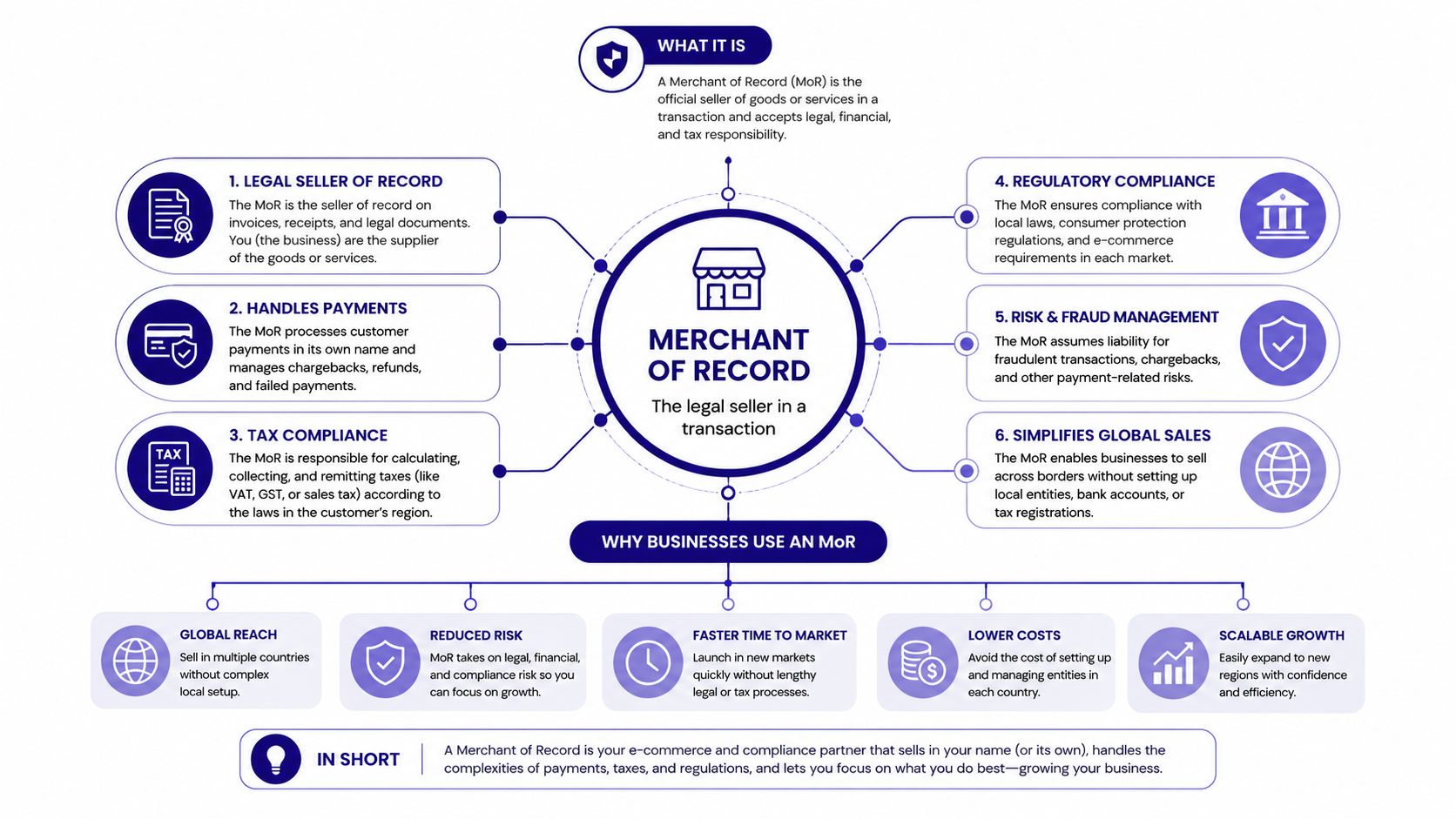
The downstream effects show up in everyday operations. Invoice language, card statements, tax treatment, and settlement all change depending on who is legally selling. That is also why founders comparing vendors should browse auditor software reviews with the legal seller role in mind, since the accounting and compliance trail needs to match the contract.
When people ask what is a merchant of record, the shortest accurate answer is this. It is the legal seller, the party the customer is buying from on paper, and the one that carries the transaction liability.
Core Duties of the Merchant of Record
A merchant of record does more than put its name on the invoice. It takes on the work that sits behind the checkout button, including finance, tax, support, and compliance. In a cross-border setup, the MoR groups tax collection and remittance, currency conversion, and regulatory liability under one legal seller, and that usually creates a two-transaction flow, customer to MoR, then MoR to the business.
The four responsibilities that matter most
Tax comes first because it changes the whole structure. The MoR has to collect and remit the right consumption tax, which is one reason this model exists in cross-border commerce. That becomes even clearer once a founder reads this guide to internet sales tax, since tax rules are often what push teams to separate the seller on paper from the company doing the work.
Compliance comes next, including PCI-related obligations and the broader legal requirements that come with selling in different jurisdictions. The MoR takes that burden on, so the operating business does not have to build every control itself.
Disputes and chargebacks are part of the same package. The MoR handles those on the merchant side, which means the business selling the product does not need to run the full dispute workflow in-house. Settlement is the last piece, and it means paying the business the net amount after fees, taxes, and foreign exchange effects have been separated cleanly.
Step | What happens | Why it matters |
|---|---|---|
Customer payment | The customer pays the MoR | The MoR is the legal seller |
Tax handling | The MoR collects and remits tax | Compliance is centralized |
Settlement | The MoR pays the business net proceeds | Gross receipts stay separate from net payout |
That separation is easy to describe and harder to run. The MoR has to keep gross customer receipts, taxes, fees, and FX effects distinct in the ledger, because those amounts do not belong to the business in the same way.
Subscriptions make the accounting layer even more important. The MoR may also own renewal billing, invoicing, and dispute resolution, so founders need to know where those duties sit before they sign. If you are comparing vendors, it helps to browse auditor software reviews with the legal seller role in mind, since the accounting trail and the contract have to match.
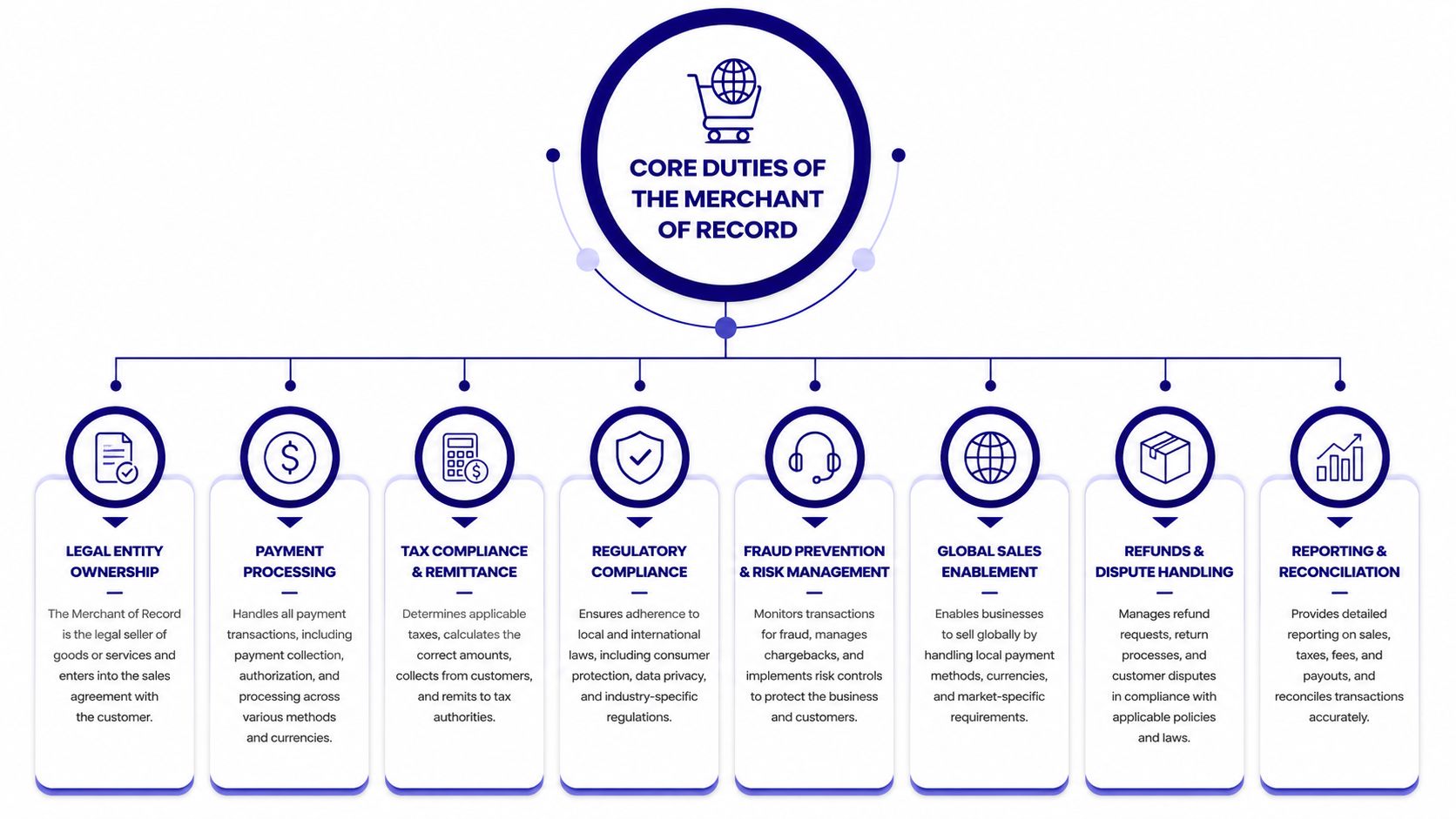
Each of these duties leaves a paper trail. Invoices name the MoR as the seller, card statements usually reflect that role, tax treatment follows the MoR's legal responsibility, and settlement arrives after the MoR has separated the amounts it must keep from the amount it passes on. That is why the merchant of record role affects far more than payment processing, it shapes how the sale is recorded, taxed, and paid out.
How Merchant of Record Pricing and Contracts Work
A Merchant of Record deal usually feels simple on the surface and detailed underneath. The quote may show a percentage fee, a fixed transaction fee, and separate charges for currency conversion, payment method costs, refunds, or chargebacks. Some contracts also add a monthly minimum or fees for specific operational tasks, so founders should read the fee sheet the way they would read a cap table, line by line and with the downstream cash flow in mind.
What to look for in the fee structure
Start with the payment mix. A good proposal should spell out what happens on card payments, what happens on bank transfers or wallet payments, and whether foreign exchange is marked up before the payout reaches you. It should also say whether the provider charges for refunds, dispute handling, international payouts, or account maintenance, because those items can change the actual cost more than the headline rate.
A practical quote usually separates the layers. One line may cover the MoR service itself, another may cover processing, and a third may cover FX or alternative payment methods. If the provider bundles everything into one number, ask for the split, since you need to know whether a higher fee is paying for tax handling, invoicing, settlement, or only payment acceptance.
Contract terms matter just as much as the fee table. You want to know who controls the customer relationship, who can pause service, and what happens if a subscription renews after the agreement ends. If the MoR owns invoicing and renewal billing, the exit clause has to explain who keeps billing rights, how notice is given, and whether unpaid renewals stop immediately or run through the end of the current cycle.
Practical rule: compare MoR contracts like you'd compare payroll vendors, not like you'd compare a checkout plugin. The legal and cash-flow effects are bigger than the sticker price.
A useful way to test the contract is to follow one sale from checkout to payout. Ask where the gross receipt lands, where tax is carved out, when the refund reserve can be held back, and what happens if a chargeback arrives after settlement. Those details tell you whether the MoR is carrying the commercial liability or just collecting money on paper.
If you need a point of contrast, what is a PSP payment service provider shows how a PSP arrangement usually leaves more of the tax and legal burden with the merchant. For teams mapping payment tools into a larger stack, Trackingplan payment integrations can help frame where the payment layer sits alongside the rest of the system.
The main commercial tradeoff is straightforward. You are paying for liability transfer, tax handling, invoicing, and settlement administration, or you are keeping more control and carrying more of that work yourself. In an MoR agreement, the price is not only the fee percentage, it is the contract structure that determines who records the sale, who answers for the tax, and who receives the net payout.
Merchant of Record vs Payment Facilitator vs PSP vs Marketplace
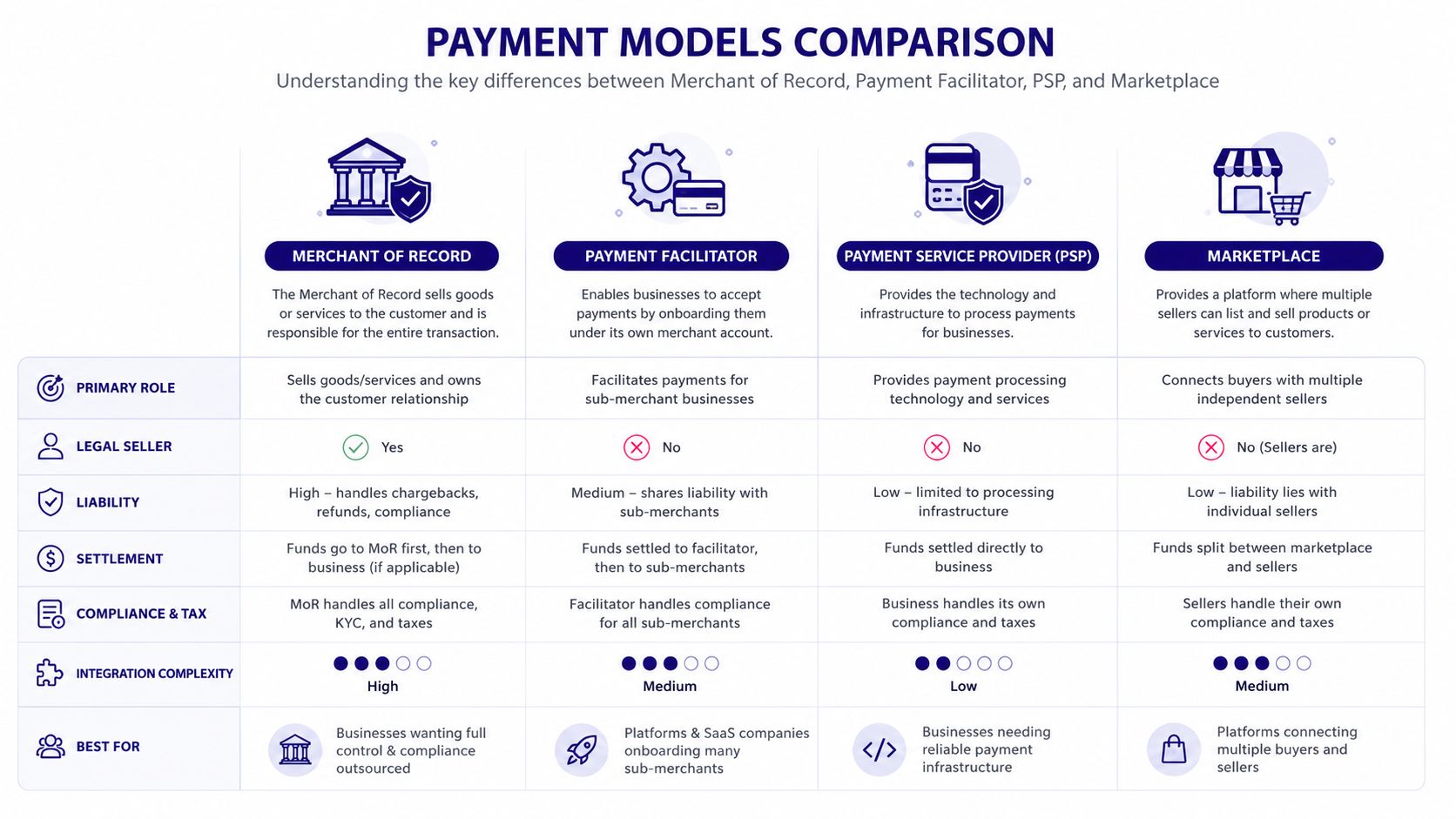
These four models sit close to the same checkout flow, which is why they get blurred together. The difference starts with a simple question. Who is selling to the customer, and who is only moving the money?
A quick way to separate them is to follow one order from checkout to settlement. If the seller name on the invoice changes, the tax treatment changes with it. If chargebacks land on a different party, the risk profile changes too. That is the dividing line, not the payment button on the page.
Comparing the models side by side
Model | Legal seller | Tax handled | Chargebacks | Best fit |
|---|---|---|---|---|
Merchant of Record | The MoR | Yes | MoR | Cross-border sales, subscriptions, and teams that want liability transfer |
Payment Facilitator | The PayFac platform, under its umbrella structure | Usually the merchant still carries much of it | Merchant or sub-merchant, depending on setup | Platforms that need aggregated onboarding |
PSP | The merchant | No, merchant handles it | Merchant | Businesses with in-house finance and compliance capacity |
Marketplace | The marketplace, when it takes title to the goods | Often yes, in that transaction model | Marketplace | Multi-seller commerce where the marketplace controls the sale |
The table helps, but the practical differences show up after the sale. A merchant of record issues the invoice under its own name, collects tax where required, and settles the net amount to the operating business. That can make the customer-facing paperwork cleaner, while also shifting refund and dispute handling to the MoR. For a founder, that means the payment stack and the legal stack are no longer the same thing.
A payment facilitator works more like a host for many sellers. It gives smaller businesses a path to accept payments under a master account, but it does not become the seller in the same way an MoR does. In practice, the PayFac model is often used by platforms that want fast onboarding for many sub-merchants and are prepared to manage more of the downstream risk and compliance work themselves.
A PSP sits one layer lower. It processes payments, but the merchant still stands behind the sale, the tax work, and the chargeback response. If you want a clearer picture of that setup, Suby's PSP guide is a useful point of reference because it shows how the processing layer differs from the seller of record.
Marketplaces can look similar to a merchant of record on the surface, especially when they control checkout and settlement. The key question is whether the marketplace takes title to the goods or otherwise becomes the seller in that transaction. If it does, the marketplace is carrying a merchant-like role for that sale. If it does not, it is usually coordinating multiple sellers rather than replacing them.
A real-world example makes the difference easier to see. A SaaS company selling subscriptions across borders may prefer an MoR because one entity can handle invoicing, tax collection, and renewals without the team registering and operating a tax process in each market. A marketplace with many independent merchants, by contrast, may prefer a PayFac structure because it needs broad onboarding and shared payment infrastructure, while still keeping each sub-merchant visible in the flow. A PSP arrangement suits a business that already has accounting, tax, and dispute operations in place and wants a payment processor.
The trade-off is not abstract. MoR usually reduces the operational burden on the seller, but it also means giving up some control over the billing relationship and accepting the contract structure that comes with liability transfer. PayFacs, PSPs, and marketplaces preserve different parts of that control, but they also leave more of the legal and operational work inside the business or platform. The right model is the one that matches how much of the sale, the tax, and the customer relationship you want to own yourself.
If you are mapping payment tools into a broader stack, Trackingplan payment integrations can help you place the payment layer alongside the rest of the system. The comparative table outlining the differences between Merchant of Record, Payment Facilitator, PSP, and Marketplace business models gives a visual summary of the same distinctions.
Who Uses the Merchant of Record Model Today
SaaS companies use the MoR model because tax and invoicing don't scale neatly across jurisdictions. A product team can ship fast, but it doesn't want to register entities, manage local tax rules, and maintain renewal billing logic in every market it enters.
SaaS and software teams
That's why MoR support matters so much for subscriptions. The provider can own the invoicing, collect tax at checkout, and keep the recurring billing side from becoming a separate compliance project. Suby's best merchant of record overview is a helpful companion if you're comparing this model across software vendors.
Ecommerce brands use the same model for a different reason. Cross-border selling introduces remittance and dispute work that many small teams can't staff internally, especially once orders start coming from multiple tax jurisdictions and currencies.
Creators and community builders have their own version of the problem. If you run paid Discord or Telegram access, sell courses, or manage recurring digital memberships, the billing layer can get messy fast, which is why MoR-style providers often bundle paid access with checkout and subscriptions. Suby, for example, offers an API for card or crypto payments and native integrations with Discord and Telegram for gated access and subscriptions, so the payment layer can sit closer to the community layer.
Quick fit check
Audience | Main reason to use MoR | Trade-off to accept |
|---|---|---|
SaaS | Handles tax and renewal complexity across borders | Less control over the billing relationship |
Ecommerce | Reduces cross-border tax and dispute overhead | Higher per-transaction cost |
Creators and communities | Simplifies paid access and subscriptions | The MoR may appear on statements and invoices |
A useful way to think about it is this. If the business wants to sell globally without building a finance and compliance team for every market, the MoR model fits naturally. If the business already has that machinery in place, it may not need the extra layer.
Weighing the Pros and Cons of a Merchant of Record
A merchant of record can feel like hiring a back office for global sales. The MoR takes on the seller role, so your team does not have to piece together tax, compliance, dispute handling, and settlement logic every time you enter a new market. That matters most when the alternative is several tools and a lot of manual reconciliation.
The invoice and statement trail is where the model becomes very real. In an MoR setup, the MoR usually appears on the customer's card statement and issues the customer-facing receipt or invoice, so the legal seller and the brand your customer sees are not always the same thing. For a founder, that can be a relief on operations, but it can also create support questions when a customer expects the storefront name to match every document.
The trade-offs are real
The biggest upside is less internal work. If your team is selling across borders, the MoR can reduce the amount of tax registration, remittance, and dispute handling you need to manage directly, which is why it often feels lighter than building the stack yourself. A direct PSP may still move money well, but the MoR usually shifts more of the legal and operational burden off your shoulders.
That convenience has a price. The MoR usually owns the billing relationship, so your finance team has to trust its ledger, its refund records, and its settlement reports to reconcile gross sales with net payouts. If those records are messy, the promise of simplicity disappears and accounting turns into a cleanup exercise.
Subscription businesses feel this especially hard. Renewal logic, invoice history, customer records, and entitlement changes all have to line up if you switch providers or move off an MoR, and those details are harder to untangle than a one-time checkout. A founder who has already worked through comment-to-revenue recovery issues will recognize the same pattern, which is why Exerta on recovering revenue from comments is a useful reminder that small operational gaps can leak sales long before finance notices them.
Short decision check: if you sell across borders, run subscriptions, or do not have a deep finance team, the MoR trade-off often favors convenience. If you are a high-volume domestic business with strong operations, a direct PSP may be cheaper and easier to control.
Control is the other major trade-off. An MoR can decide how invoices look, how payouts are timed, and how some billing events are handled, because it sits in the middle of the customer transaction instead of just passing payment data through. That works well if you want the liability transfer, but it is a poor fit if you need your own brand to control every billing touchpoint.
The clearest way to judge the model is to ask a simple question. Are you paying to remove real complexity, or are you paying for a layer you could already manage yourself? If the answer is the first one, the MoR earns its keep. If the answer is the second, the extra layer may just add cost and distance between you and your customer.
Common Questions Founders Ask About Merchant of Record
The first thing founders usually want to know is whose name shows up on the card statement. In an MoR setup, the MoR's name can appear there because the MoR is the legal seller, not just the payment processor, and that often surprises teams that expected their own brand everywhere (Cleeng).
Invoices, refunds, subscriptions, and migrations
Invoices follow the same legal split. The MoR issues the customer-facing receipt or invoice, while your own books should record the settlement you receive, not the full amount the customer paid as if it all belonged to you. That division keeps gross sales, tax, and net proceeds from being blended into one number.
Refunds also need more coordination than a single support click. The MoR handles the customer-facing refund process and the financial reversal, while your team still has to align support, accounting, and product entitlement with that change. If a refund goes out but access stays open, or access is removed before the refund is confirmed, the customer experience gets messy fast.
Subscription migration is usually the part founders underestimate. If you switch providers, you need to check how renewals, customer records, invoice history, and entitlement changes move across, because recurring billing is where hidden gaps show up first. If the MoR owns the billing relationship, you need an exit plan before you sign, not after the first renewal cycle starts.
Statement descriptors deserve the same attention. Customers often see the descriptor before they remember the brand name on the website, so you want to know exactly what they will see when a charge lands on their card statement. A mismatched descriptor can create support tickets that look like fraud reports, even when the payment is legitimate.
Founders also ask who settles what, and where the money lands. An MoR can change how payouts are grouped, how chargebacks are handled, and how much detail you get on the settlement side, so the operational view is different from a straight payment processor relationship. That matters if your finance team expects one clean deposit per day and instead gets bundled settlement logic that needs reconciliation.
There is also a practical question around migration risk. Customer records, renewal logic, tax treatment, and access rules all need to line up if you move off an MoR or change providers, and those details are harder to sort out than a one-time checkout integration. Teams that have already worked through response and revenue leakage issues, like the kind discussed in Exerta's guide to recovering revenue from unanswered ad comments, often recognize the pattern, because small operational gaps can affect sales long before finance notices them.
A simple decision check helps here. If you sell across borders, run subscriptions, or do not have a deep finance team, an MoR often buys you convenience and liability transfer. If you are a high-volume domestic business with strong operations, a direct PSP may give you more control at a lower cost. Before you sign, verify the statement descriptor, invoice owner, refund flow, subscription migration path, and the exact settlement terms.

