

Gaspard LEZIN
Unified Payment Platform Guide for Global Businesses
Learn how a unified payment platform works, what to look for, and how to choose one that fits cross-border, multi-method, and stablecoin payouts
You're probably here because your payment stack looks fine from the customer side, but feels messy everywhere else.
A customer can click pay. The checkout can work. Revenue can still get stuck between processors, currencies, payout rails, and finance workflows. That's the gap many teams underestimate. Accepting more payment methods is only the front door. The harder question is what happens after the customer pays.
A unified payment platform matters because it tries to solve the whole path, not just checkout. It brings pay-ins, balances, and payouts into one operating model so a business can accept the way customers want to pay and receive funds the way the business wants to get paid.
Table of Contents
What a Unified Payment Platform Actually Is
A founder launches in a few new markets. Sales start coming in. Then three unrelated problems hit at once.
A card payment fails for a customer in Brazil. A refund to a customer in the UK drags because the money is moving through a slow bank path. A creator payout sits in review, so support gets the angry message instead of finance. Same business. Same day. Three different payment failures.
That's why people get confused by the term unified payment platform. They assume it means “one checkout with many payment buttons.” That's only part of it.

A better definition is this. A unified payment platform is a single layer that accepts customer payments, manages where value lands, and routes money out again through the right payout path. That can include cards, bank transfers, local payment methods, and stablecoins.
What it is not
A payment gateway is usually the front door. It helps collect payment details and pass payment requests through.
A payment orchestration layer sits above multiple providers and can decide where a transaction should go. That matters because routing can improve approval rates. One developer-focused orchestration guide cites an average 2 to 3% authorization uplift from dynamic routing, and says routing decisions often need to resolve in under 50 milliseconds so checkout latency doesn't get worse, as explained in this piece on payment routing for developers.
A unified payment platform is broader than either one. It includes the customer-facing payment flow, the internal balance or ledger view, and the payout side.
Practical rule: If a vendor only helps you collect money, but you still need separate systems to move, convert, settle, and report it, you don't have unification yet.
The three kinds of unification teams actually need
Founders usually need unification in three places:
Method coverage: cards, wallets, bank methods, and other rails
Currency handling: taking money in one currency and reporting or settling in another
Settlement destination: sending funds to a bank account, internal balance, or stablecoin wallet
If you want a simple way to separate providers from platforms, this short explanation of what a payment provider is is useful.
For teams thinking further ahead about pooled onchain treasury flows, this guide to automatic payment pools in DeFi is also worth reading because it highlights a related issue: money movement doesn't stop at acceptance.
The Mental Model Behind Unified Payments
The cleanest way to understand unified payments is to ignore the checkout for a minute and follow the money.
Think of the system as three building blocks:
Pay-ins, where the customer sends money in
Balance, where the platform records and manages value
Payouts, where the business or recipient gets money out
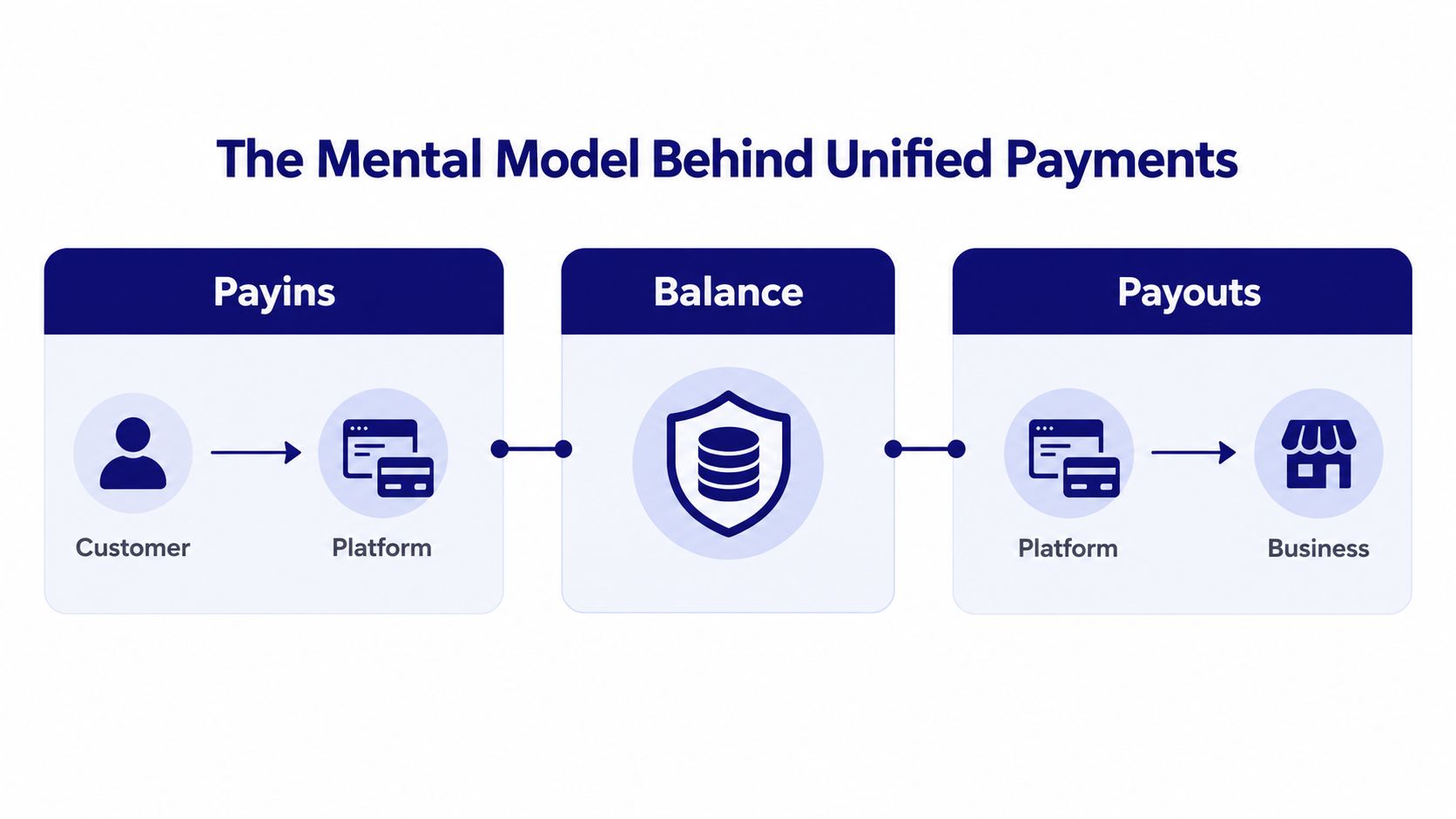
The inbox, ledger, and outbox model
Pay-ins are the inbox. Customers send value using whatever method works for them.
The balance is the ledger. The platform keeps track of what arrived, what was converted, what fees were deducted, and what is available to settle.
Payouts are the outbox. Funds move to the business, a seller, a contractor, or a treasury wallet.
That middle layer is the part many teams miss. The checkout is visible. The balance layer is where unification happens.
A concrete example
Say a customer in Mexico pays by card for a digital product priced in local currency. The business doesn't want to hold that value in the original payment form forever. It may want a different settlement currency. It may want the payout to go through a different rail than the original pay-in.
In a unified model, the platform can accept the card payment, update the business balance, and then trigger payout in the destination format the business selected. The business experience becomes less about “which processor handled this” and more about “what landed in balance and how do we want to receive it.”
That's why a payment API matters. It's the layer that lets product and finance teams control intent creation, payment status, balances, and payout actions from one model instead of stitching different systems together. If you want the technical view, this overview of what a payment API is gives the right framing.
The checkout is where customers pay. The balance is where operators regain control.
Why businesses care about the middle layer
Once value hits a balance, the platform can control:
FX timing: whether to convert right away or later
Fee deductions: where fees are applied and how they appear in reporting
Final rail choice: whether payout leaves through bank rails or a stablecoin path
That's the mental shift. A unified payment platform isn't “many methods on one page.” It's one operator controlling pay-ins, balance, and payouts together.
Core Components That Make a Platform Unified
The phrase sounds abstract until you break it into parts. Most unified platforms are built from a handful of components that work together. If one is missing, teams often end up back in spreadsheet land.
Customer-facing layers
The first component is checkout. That can be an embedded form, a hosted payment page, or a paylink. Its job is to present the right payment choices without forcing the merchant to build a custom flow for every market.
The next piece is tokenization and vaulting. This is what allows payment details to be stored and reused more safely for retries, renewals, or repeat purchases. Without it, recurring billing and multi-step payment journeys get brittle fast.
Money movement and system control
A unified platform also needs settlement rails, APIs, webhooks, and reconciliation. Here's the plain-English version.
Component | What It Does | Why It Matters |
|---|---|---|
Checkout and hosted payment pages | Collects payment details and presents relevant methods | Reduces friction at the point of payment |
Tokenization and vaulting | Stores reusable payment credentials in a safer form | Supports subscriptions, retries, and repeat purchases |
Settlement rails | Moves funds through bank rails or stablecoin paths | Gives the business choice in how it receives money |
APIs and SDKs | Lets developers create payments, query balances, and trigger payouts | Makes the payment layer programmable |
Webhooks | Sends status updates when payment states change | Helps product, ops, and finance react quickly |
Reconciliation tooling | Matches internal records to provider records | Cuts manual finance work and speeds investigations |
Access controls | Limits who can do what inside the system | Reduces operational risk across teams |
Why webhooks and reconciliation matter more than teams expect
A lot of teams focus on checkout first because that's customer-facing. Finance usually feels the pain later.
Webhooks become the operating heartbeat of the system. They tell your product and back office when a payment succeeded, failed, reversed, or paid out. Reconciliation tools then connect those events to statements and internal records so accounting isn't trying to rebuild truth after the fact.
If you can't explain where a payment changed state, you don't have a payment system. You have a mystery.
Access control is the last piece people forget. Finance needs one set of permissions. Engineering needs another. Support may need visibility without payout authority. A unified surface only helps if multiple teams can share it safely.
A practical example here is Suby, which provides an API that lets businesses accept payments by card or crypto, and also offers native integrations with Discord and Telegram for paid access, subscriptions, and online communities. It's one product with four ways to use it: Suby Payments for API-first card and crypto checkout, Suby Crypto for crypto payments with swap handling and gas sponsorship, Suby Gating for paid access to Discord, Telegram, downloads, and courses, and Suby Invoicing so the client can pay how they want while the business receives what it wants. Its own product framing is simple: customers pay any way they want, businesses get paid the way they choose, and settlement can go to a bank account or in stablecoins such as USDC in the chosen currency, as described on the settlement processor overview.
Why Businesses Consolidate Their Payment Stack
Most businesses don't wake up wanting a bigger payments project. They consolidate because the stitched-together version starts wasting time in too many corners at once.
One team owns a card gateway. Another set of local methods sits with a separate provider. Treasury tracks settlements somewhere else. Finance gets multiple export formats. Support sees only fragments of the story. Nothing is fully broken, but everything is slower than it should be.
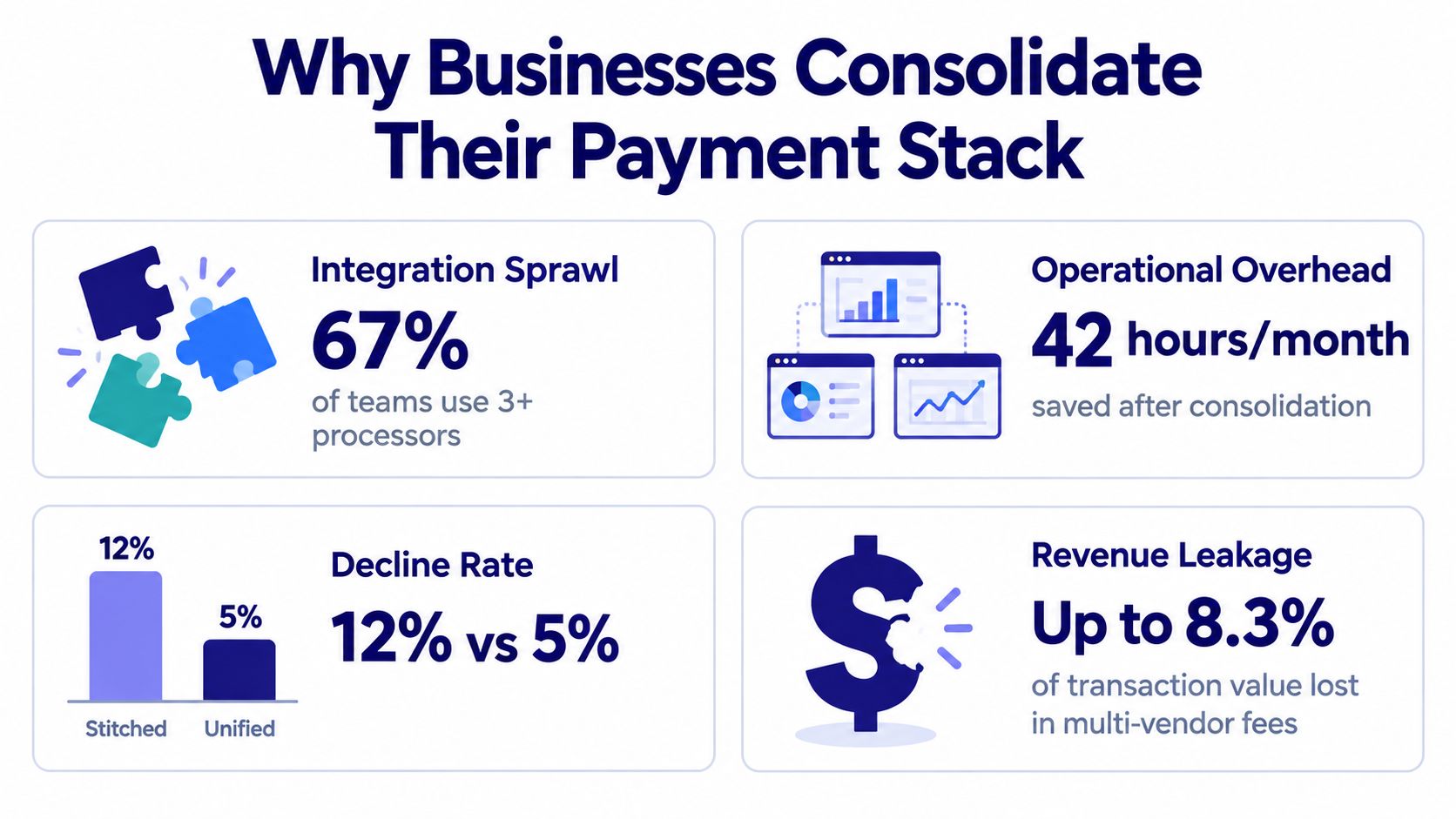
Complexity is the first cost
A single integration can reduce a lot of sprawl. Mastercard Gateway says one integration can provide access to 35+ payment methods and 240+ global acquirer connections through one layer, which is a concrete example of how a unified setup shrinks point-to-point work and supports faster expansion into new markets, according to Mastercard Gateway documentation.
That doesn't just save engineering effort. It also cuts the maintenance surface. Fewer direct connections means fewer things to retest every time a provider changes something.
The category has grown because the pain is real
This isn't just vendor packaging. Payment orchestration has become a visible infrastructure category. One market estimate projects the payment orchestration platform market will grow from USD 2.65 billion in 2025 to USD 3.13 billion in 2026 and USD 7.27 billion by 2031, implying an 18.31% CAGR during 2026 to 2031. Another forecast places it at USD 2.91 billion in 2026 and USD 7.85 billion by 2032. The same market summary ties that growth to the broader move toward digital payments, while the World Bank's Global Findex 2021 found 64% of adults worldwide, or 84% of account owners, made or received at least one digital payment, as summarized in this payment orchestration market report.
That growth tells you something important. Businesses aren't consolidating just to save pennies on fees. They're trying to recover operational control.
For teams building payment evaluation processes, this article on a leaner financial research workflow is useful because the work is comparing systems across product, finance, and risk, not just reading pricing pages.
Why one roof helps
When pay-ins, balances, and payouts sit under one roof, teams usually get three things back:
Engineering time: fewer separate integrations and fewer brittle dependencies
Incident speed: one place to inspect failures and status changes
Revenue visibility: cleaner reporting across collection and settlement
That's the business case in plain terms. Less fragmentation. Better control.
Real World Use Cases Across Industries
A unified payment platform can look like four different products depending on who's using it. The underlying idea is the same. The capability mix changes.
SaaS and subscription software
A global SaaS company usually cares about recurring billing, retries, and multi-currency settlement. The checkout needs to support the methods customers expect. The back office needs event updates for renewals, failures, and cancellations.
The payment team will care most about tokenization, subscription logic, and webhooks. Finance will care about the balance layer and how settlements appear when the company sells in one market and reports in another.
E-commerce and cross-border selling
An e-commerce merchant wants local acceptance at checkout and predictable settlement after the sale.
India is the clearest national-scale example of what happens when one rail becomes embedded. The Unified Payments Interface, launched on 11 April 2016 by the National Payments Corporation of India under Reserve Bank of India oversight, grew from 2 crore transactions in FY 2016-17 to over 24,162 crore transactions in FY 2025-26, while value rose from ₹0.07 lakh crore to about ₹314 lakh crore. In March 2026, UPI reached 2,264 crore monthly transactions and ₹29.53 lakh crore in monthly value, with 703 banks live versus 21 at launch, and it accounted for about 85% of India's digital payments in FY 2025-26, according to this PIB release on UPI growth.
That scale shows why local rails matter. But it also exposes the hidden trade-off. Accepting a dominant local method is one thing. Deciding how, when, and in what form the merchant receives funds is a separate operating problem.
Creators and freelancers
Creators care about speed, simplicity, and payout flexibility.
They may sell access to a Telegram group, a Discord community, a download, or a course. The payment side should be simple for the buyer. The payout side should match the creator's preference, whether that means a bank account or stablecoin settlement. Reporting matters here too, because smaller operators still need a clean trail for revenue and payouts.
Agencies and firms managing client money
Agencies often need separation, not just acceptance.
They want clean reporting per client, limited team permissions, and the ability to keep internal records tidy when many customer payments flow through one system. Reconciliation and access control often matter more here than flashy checkout features.
Business Type | Key Capabilities | Primary Settlement Need |
|---|---|---|
SaaS | Recurring billing, tokenization, webhooks, retries | Multi-currency settlement with clear reporting |
E-commerce | Local payment methods, hosted checkout, refund handling | Predictable post-sale settlement across markets |
Creators and freelancers | Paylinks, community access, wallet or bank payout options | Fast, simple receipt of funds |
Agencies | Access controls, client-level reconciliation, invoicing | Clean separation of balances and payout records |
Selection Checklist and Migration Playbook
Vendor selection goes wrong when teams ask only one question: “Can this platform accept the methods we need?”
That matters, but it's not enough. The harder questions sit behind settlement, controls, and rollout.
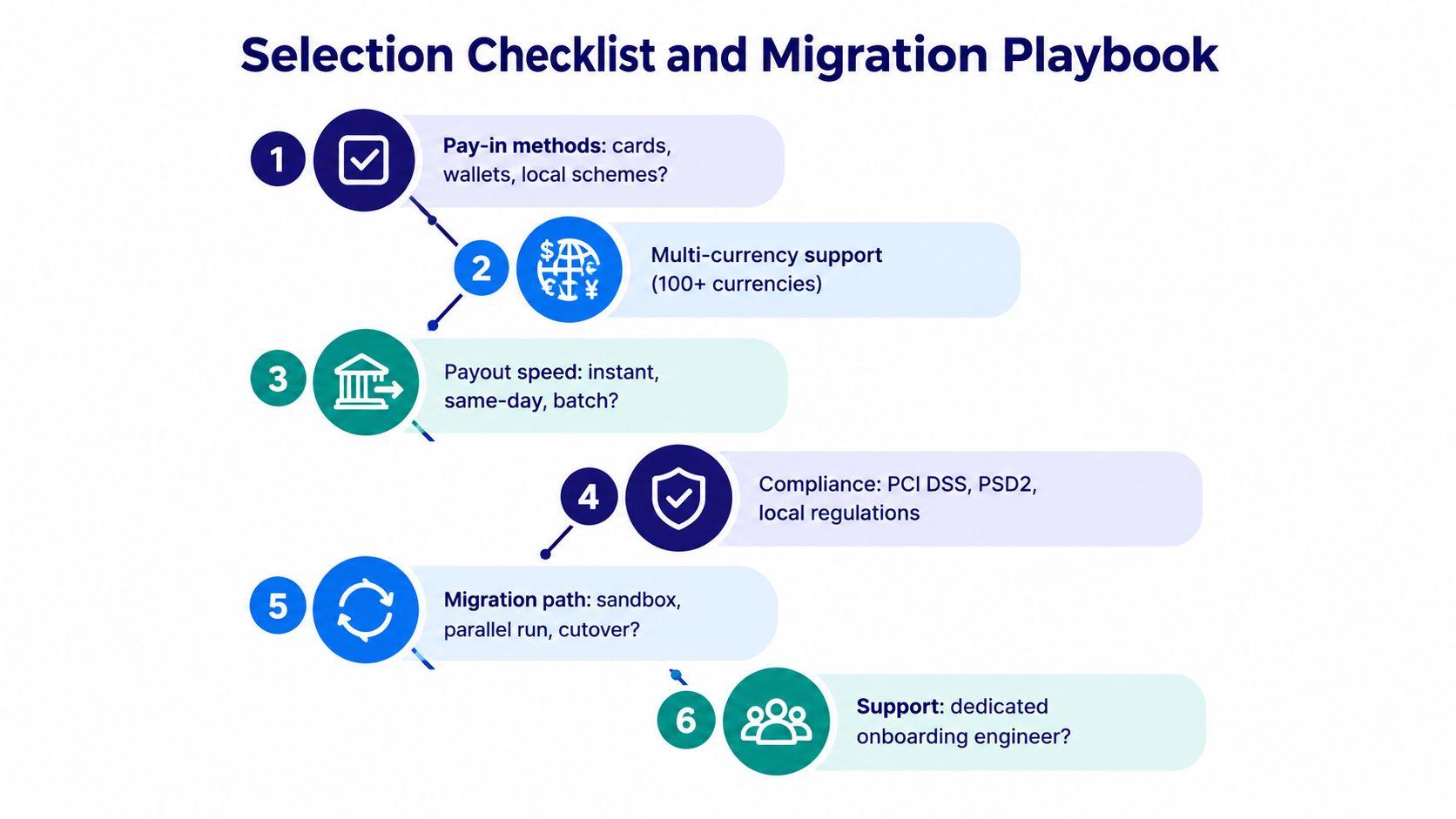
What to check before you sign
Use a shortlist like this during evaluation:
Method coverage: Does it support the pay-in methods your customers use, including cards, wallets, bank methods, and stablecoin-related flows if you need them?
Settlement options: Can you receive funds in the destination you want, such as a bank account or stablecoins, and in the currency you prefer?
Event visibility: Does it expose webhooks for every meaningful state change, and can events be replayed when your system misses one?
Operational controls: Are role-based permissions, API key scopes, and IP restrictions available so finance and engineering can share the system safely?
Compliance handling: How does the vendor handle KYC or KYB, data residency, and payment security scope?
Commercial clarity: Is pricing method-dependent, are FX mechanics explained clearly, and who owns chargeback handling?
Checklist mindset: A payment method you can't reconcile cleanly is not fully supported, even if it appears on the checkout page.
What to ask about pricing and settlement
Flat-rate pricing sounds comforting. It often hides the parts that matter later.
Suby's official pricing page is a good example of the right way to frame this. It states there are no setup fees, no monthly minimums, and no contracts, and also makes clear that pricing is method-dependent rather than one flat rate, with separate categories for cards and wallets, bank transfers, crypto, and payout options, as shown on the Suby pricing page.
That's the question you should ask every vendor. Not “what's your rate?” Ask “how does pricing change by method, FX path, payout type, and exception flow?”
How to migrate without breaking revenue
A careful migration usually works better than a big-bang cutover.
Map current flows first. List every pay-in method, every settlement path, every webhook dependency, and every finance report your current stack produces.
Run in parallel. Keep the old stack live while sending a limited portion of traffic through the new one.
Compare daily. Watch reconciliation deltas, failure reasons, payout timing, and customer support tickets.
Cut over method by method. Move the simplest flows first. Leave the hardest edge cases until last.
Review permissions before launch. Teams often forget access policy until someone has the ability to trigger payouts they shouldn't control.
This is boring work. It's also the work that protects revenue.
Common Misconceptions and Smart Next Steps
The biggest myth is that unification removes complexity. It doesn't. It relocates complexity into one operating layer you can manage.
That's still a big improvement. But teams should go in with clear eyes.
Three myths worth dropping early
Myth one, flat pricing means simple economics. It usually doesn't. Rail-specific pricing, FX handling, payout costs, and dispute flows can all vary.
Myth two, instant settlement is always instant. It depends on bank windows, review states, local rail behavior, and where the recipient sits.
Myth three, one vendor means no operational risk. Downtime, sanctions screening, payout reviews, and reconciliation gaps still exist. You just have one place to observe and manage them.
A good example of hidden trade-offs shows up in India's scale story. UPI reached 55.49 crore users by June 2026 and 24,161.69 crore transactions worth Rs 314.23 lakh crore in FY2025-26, while March 2026 alone hit 2264 crore monthly transactions. At the same time, merchant sentiment remained fee-sensitive, with 17% of merchants willing to bear a 0.4% UPI charge and 41% saying they would not accept any MDR, according to this ANI report on UPI scale and merchant sentiment. Huge adoption doesn't erase settlement economics.
A realistic first 90 days
In the first month, map your current payment flows and define success metrics. Approval rate, settlement timing, support volume, and reconciliation effort are usually better indicators than a generic “payment success” label.
By the second month, run a controlled pilot with a subset of traffic. Include at least one fallback path in case a provider or rail underperforms.
By the third month, review results with finance, product, and ops together. Don't judge the platform on checkout alone. Judge it on whether customers can pay the way they want and whether your business gets paid the way it chooses.
Strong payment infrastructure is rarely the one with the most logos on a slide. It's the one your team can operate without guessing.
The smart next steps are practical. Shortlist platforms based on your real use case. Ask for sandbox access. Test webhook behavior. Review reconciliation outputs. Pressure-test compliance and settlement flows before you move serious volume.
If you want one system that supports this model, Suby provides an API for accepting card or crypto payments, plus native Discord and Telegram integrations for subscriptions, paid access, and online communities. It's built around the core idea that customers can pay by card, wallet, bank, or crypto, while the business chooses how to receive funds, including to a bank account or in stablecoins like USDC.
