

Gaspard LEZIN
What Is Payment Api
What is payment api. Learn what a payment API is, how it works under the hood, and how modern stacks accept cards and crypto and settle
A payment API is a set of HTTP endpoints that lets your software create charges, capture funds, issue refunds, read transactions, and receive webhook events, so your application accepts money without building a card reader or banking relationship. The online payment API market was estimated at about USD 18.4 billion in 2024 and projected to reach USD 42.7 billion by 2033, with another estimate placing the market at USD 15.2 billion in 2024 and USD 45.6 billion by 2033, according to DataHorizzon Research.
You may be staring at a checkout that works for cards but fails for bank payments, subscriptions, or customers who want to pay with crypto. Or perhaps payments arrive successfully, but your finance team still has to untangle balances, refunds, currency conversion, and payouts by hand. That's where the practical meaning of what is payment API matters. It isn't just a button that charges a card. It's the connection between your application, payment methods, transaction state, and the money your business ultimately receives.
Table of Contents
What a Payment API Actually Does
A payment API gives your application a controlled way to ask another system to move money and report what happened. Your server can create a payment, authorize or capture funds, request a refund, query the current transaction state, and listen for webhook events when the provider's state changes.
A kitchen counter is a useful analogy. Your application is the counter, the customer is the person placing an order, and the payment API is the supplier behind you. You don't stock card readers, write fraud rules, or prepare bank settlement files. Your application places an order, such as POST /charges, and the supplier handles authorization, capture, and settlement. When something changes, the supplier sends a notification, which is the webhook.
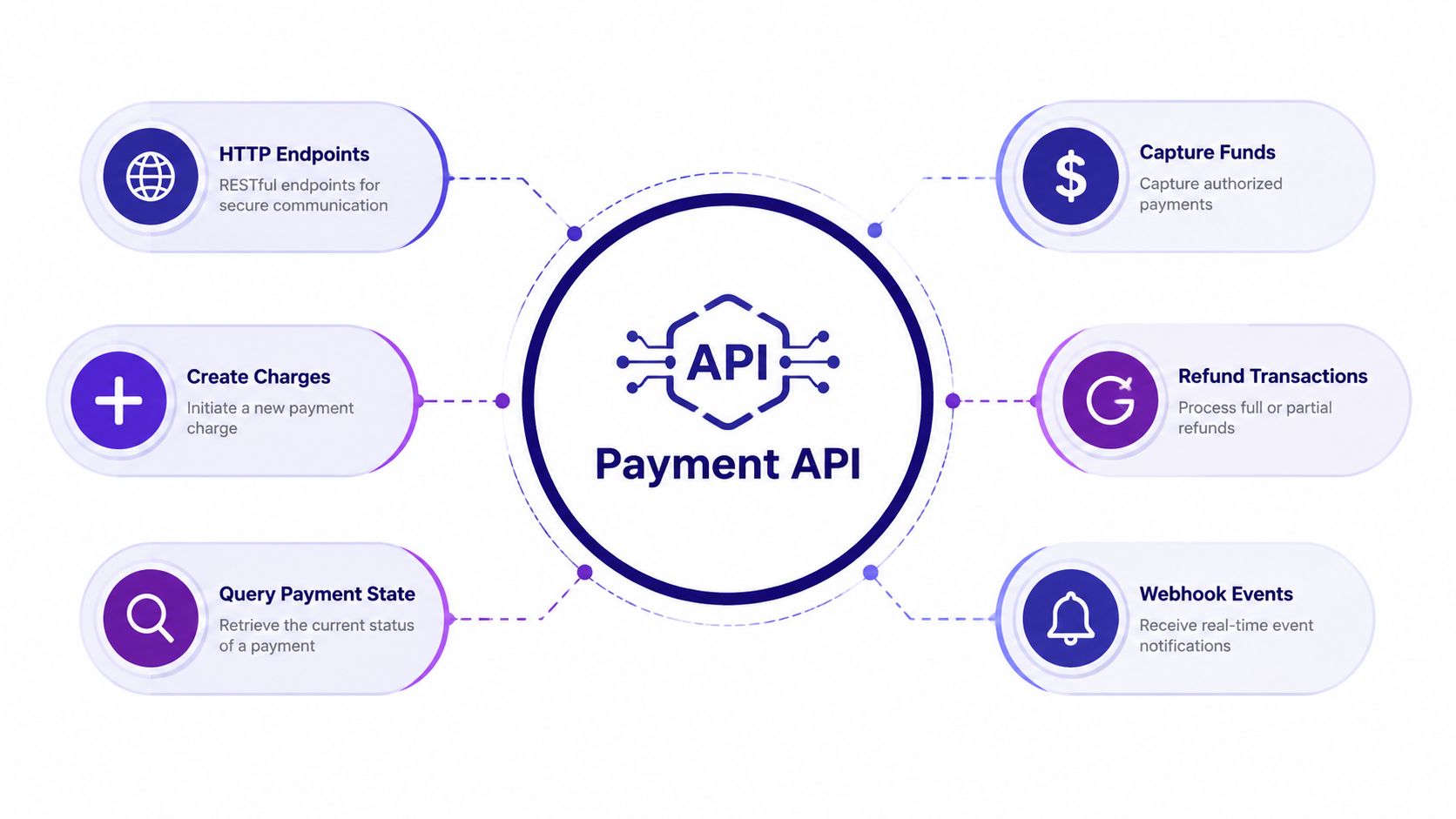
The recurring work behind a payment
A serious payment API usually supports more than the initial charge:
Charge creation: Start a payment attempt and receive a transaction identifier.
Authorization and capture: Reserve funds first, then collect them when your order is ready.
Refunds: Return funds against the original transaction.
Disputes: Track and respond when a customer challenges a payment.
Payouts: Move your available balance to a bank account or wallet.
Subscriptions: Charge customers on a recurring schedule.
Reporting: Give engineering and finance teams a consistent transaction record.
That distinction matters because a payment request can succeed at the card network while your application still fails to update the order. Webhooks give your backend another path to learn what happened, rather than trusting only the browser response.
Practical rule: Treat the payment provider as the source of transaction state, and treat your database as the source of order and entitlement state.
People also use “payment API” loosely. Sometimes they mean gateway-style endpoints that pass checkout information to a processor. Sometimes they mean processor-style endpoints that own more of the money movement, balances, refunds, and payouts. This article uses the broader processor meaning. For a related perspective on how the infrastructure fits together, see Suby's guide to global payment APIs. Businesses that need a broader operational workflow can also review how to manage LLC billing online.
The Three Building Blocks of a Payment Flow
The cleanest way to reason about a payment is to separate payin, balance, and payout. These are three different stages, and they don't have to use the same method or currency.
Payin describes how the customer gives money to the business. That could be a card, a wallet, a bank transfer, a buy now, pay later method, or USDC sent from a wallet. The payin answers one question: how does the customer pay?
Balance is what the processor records after the payment enters its system and before the merchant receives a payout. Funds may be pending, available, reserved, or adjusted by fees, refunds, or disputes. The balance answers a different question: where is the money while the transaction is being processed?
Payout is the final movement to the merchant's bank account, wallet, or stablecoin address. The payout answers: how does the business receive the money?
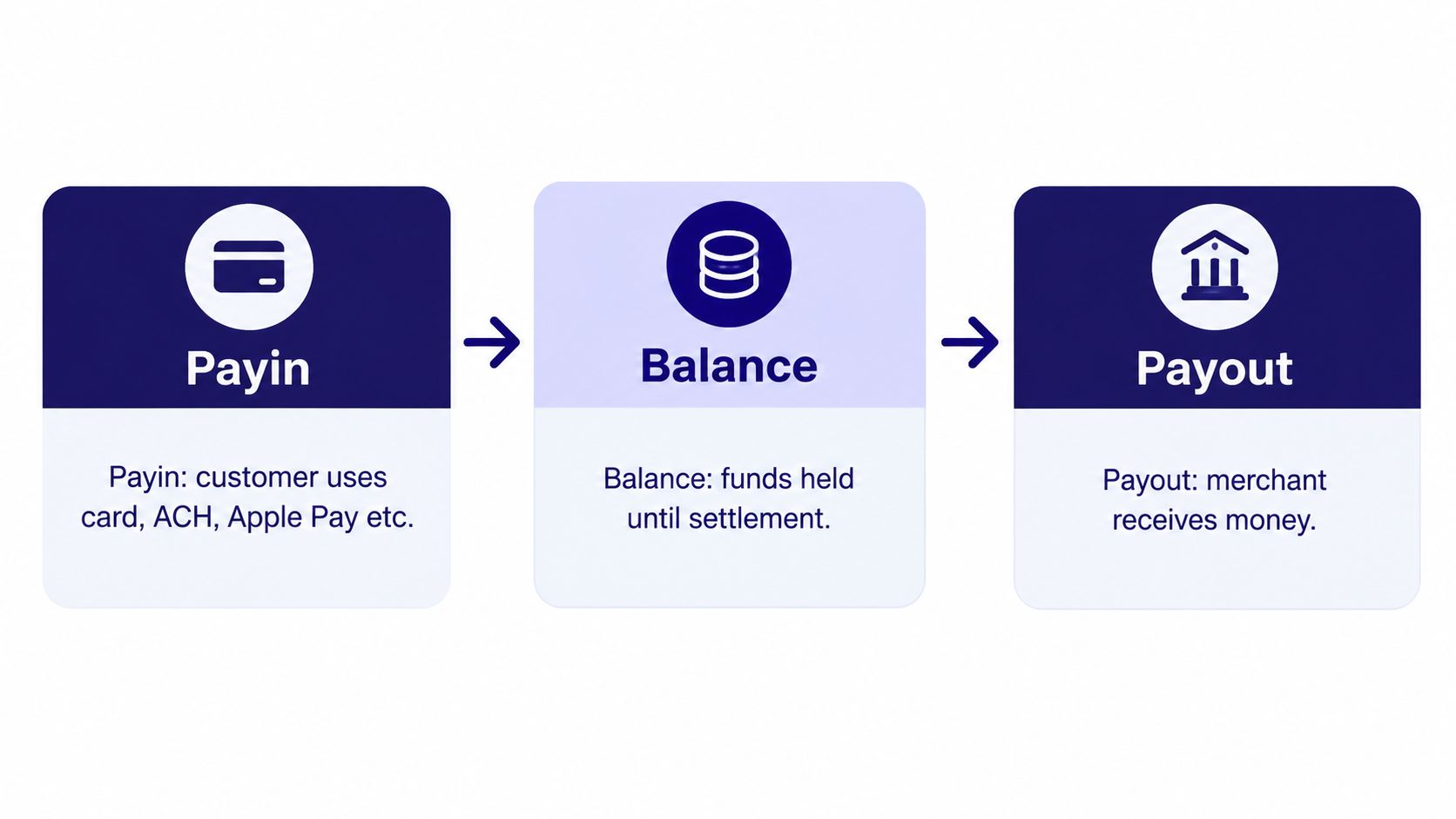
Why the separation matters
Consider a card purchase. The customer pays by card, the processor records a balance in a fiat currency, and the merchant may receive the payout through a bank rail. The customer's payment method and the merchant's payout method are different parts of the flow.
Now consider a crypto payment. A customer can send USDC from a wallet, the balance can remain in USDC, and the merchant can receive it on-chain or choose a bank payout after conversion. Again, the payin and payout aren't required to match.
A refund reverses the payin transaction, not a completed payout in a simplistic one-to-one sense. Your system needs to know which original charge the refund references, whether funds remain available, and how the provider handles the resulting balance adjustment.
This is the architectural mistake I see most often from developers new to payments: treating “payment currency,” “settlement currency,” and “payout currency” as one field. They're separate decisions. A good API makes those states visible instead of hiding them behind a single success response. For another explanation of the provider layer, read Suby's payment gateway overview.
Integration Patterns Developers Actually Use
Teams choose one of three integration patterns. The right starting point depends on how quickly you need to launch and how much checkout control you're prepared to maintain.
Hosted paylinks and invoices
The provider creates a payment URL. Your application redirects the customer to it, embeds it in an email, or sends it through a support workflow. The provider owns the checkout page and sends your backend a webhook after the payment changes state.
This is usually the fastest option and the easiest to operate. You get less control over layout, copy, and interaction details. It fits early products, invoices, presales, and teams validating demand before investing in a custom checkout.
Embedded checkout
An iframe, hosted field, or prebuilt SDK sits inside your application. Customers feel like they're staying on your site, while the payment provider controls sensitive card inputs and much of the checkout behavior.
You gain more control over the customer experience without putting raw card data directly into your own servers. You still need to understand browser security, event handling, failed payments, and how the embedded component communicates with your backend.
Direct API and webhooks
Your server creates the payment and your application owns more of the interface and data model. Card details should be tokenized through a compliant component before your backend uses the resulting token. Your backend then reconciles payment state from signed webhook events and API queries.
This pattern offers the most flexibility, but it also creates the most responsibility. You'll maintain more code, handle more edge cases, and carry a larger compliance and operational burden. Developers building financial automation may also find the background on a crypto exchange with API for trading bots useful when thinking about authenticated machine-to-machine workflows.
Pattern | Time to integrate | PCI scope | Customization | Best fit |
|---|---|---|---|---|
Hosted paylink or invoice | Fastest | Lowest when card entry stays hosted | Limited | Early launches, invoices, simple sales |
Embedded checkout | Moderate | Reduced when sensitive fields remain hosted | Medium | Branded checkout with less infrastructure |
Direct API plus webhooks | Longest | Highest when your systems handle card data | Highest | Complex products and full workflow control |
A practical decision rule is simple: start with paylinks when speed matters, use embedded checkout when the experience needs to feel native, and choose the direct API when your data model and payment logic require complete control. Suby documents these API-first, paylink, and webhook-based approaches in its payment gateway API integration guide.
Security, Compliance, and Reliability Essentials
Payment integrations fail in predictable ways. A request times out, the client retries, the first request succeeded, and the customer gets charged twice. Or the browser says “success,” but the webhook arrives later with a different state. Your design needs to assume unreliable networks and delayed events.
Three controls deserve attention before you write the checkout screen:
Idempotency keys: Every mutating request, including capture, refund, and void, should carry a key tied to one logical operation. If a timeout causes a retry, the provider can return the original result instead of performing the financial action twice. Purse's API best practices describes this approach and the need to retain keys through the expected retry window.
Signed webhooks: Your application should verify that an event came from the provider before marking an order paid, granting access, or shipping goods. A webhook is an input to your system, not proof that can be accepted without authentication.
Reduced card-data exposure: Redirects, hosted fields, and tokenization can keep primary account numbers outside your servers. Direct integrations that collect or transmit cardholder data can bring the merchant environment into PCI DSS scope and may lead to the SAQ D path, as explained by PCI Compliance's API integration guidance.
Architecture changes the liability
Integration pattern | Typical PCI scope | Webhook handling | Your responsibility |
|---|---|---|---|
Hosted redirect | Lower scope when card data stays with the provider | Verify signatures and process retries | Orders, entitlements, reconciliation |
Embedded hosted fields | Reduced scope, depending on implementation | Validate events and preserve event history | Frontend state, backend state, access control |
Direct card-data API | More comprehensive scope, potentially SAQ D | Secure delivery, verification, replay, reconciliation | Card-data controls, encryption, logging, incident response |
Reliability work continues after launch. Use a dead-letter queue for webhook deliveries that keep failing, a replay path that can refetch event history, exponential backoff with a retry budget, and separate handling for authorization and capture. More control can produce a better product, but it also creates more liability. For a wider checklist on protecting API endpoints, consult GitDocAI's API security overview.
How a Card Payment Becomes a USDC Settlement
The card-to-USDC flow feels strange until you separate the stages. The customer doesn't need to know that the merchant wants a stablecoin payout. They complete a normal card checkout.
Start with the customer tapping Pay. The frontend uses a PCI-compliant fields component to tokenize the card. Your application receives a token, not a card number to store in its own database.
The backend sends the token and order details to the Payments API. The API returns a transaction identifier, often with a pending state while external payment systems complete their work. Authorization and capture are separate concepts. Your application can authorize funds first and capture later when the order is ready, depending on the provider's flow.
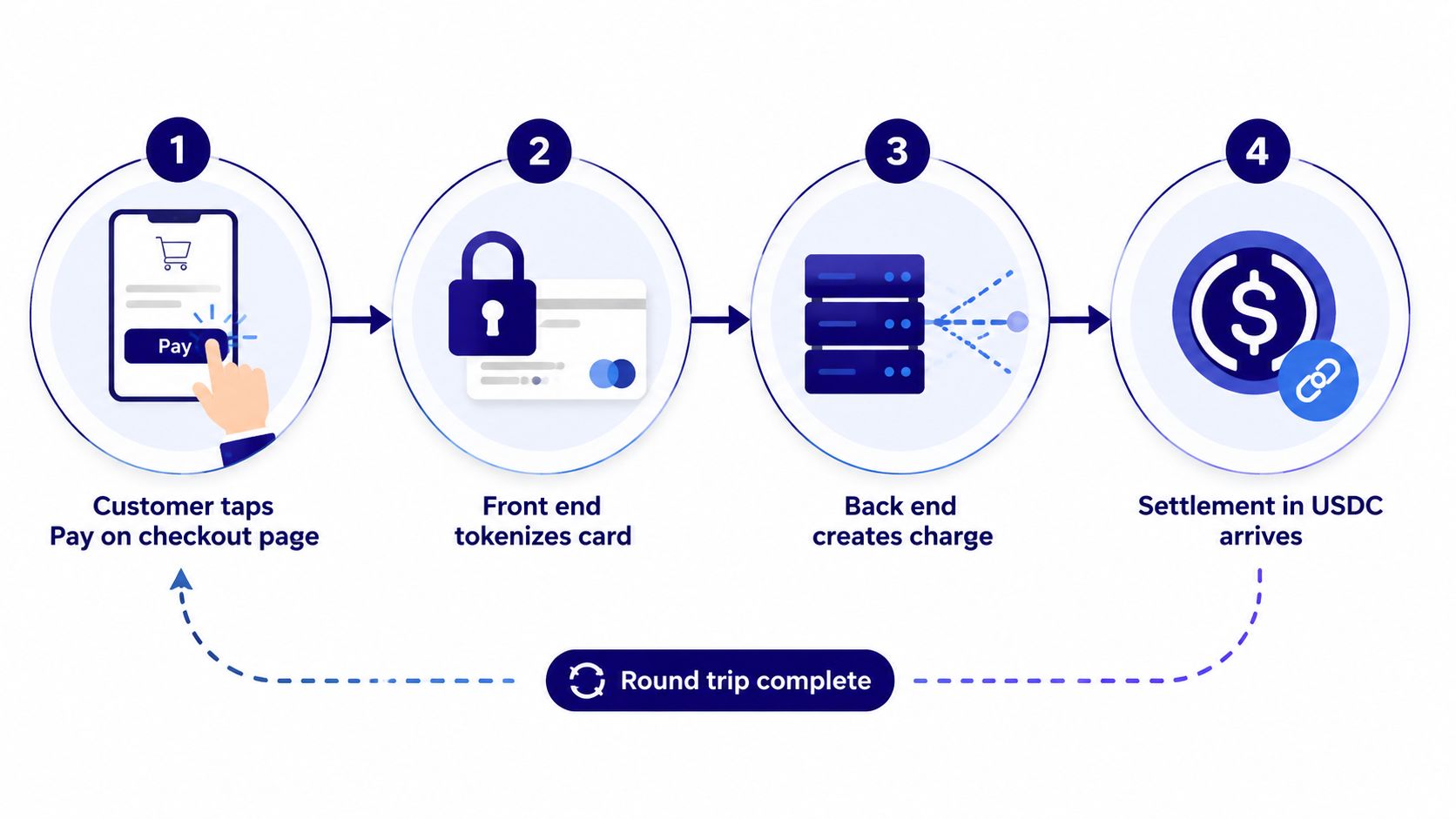
The balance and conversion stage
After authorization and capture, the acquirer and card networks move the funds toward the processor's settlement account. Your merchant balance reflects the resulting payment state. A dashboard or background job can then initiate the conversion from the settled balance into USDC at the available quoted rate.
The resulting USDC goes to the configured wallet or treasury destination. The merchant's application doesn't need to handle card data at rest, and it shouldn't try to infer final payout status from the customer's browser alone.
Refunds reference the original charge identifier. Currency conversion happens on the server side, where your system can record the source amount, destination currency, transaction identifier, and resulting payout event. Webhooks can report authorization, capture, and payout changes so your reconciliation job reacts to events instead of repeatedly polling.
The customer chooses the payin method. The merchant chooses the settlement path. Those decisions can be independent.
This is the round trip most introductory explanations skip. A card payin can produce a fiat balance, then become a USDC payout. A crypto payin can follow a different route. The payment API connects the stages, but it doesn't make them identical.
Four Ways to Use the Same Payment Stack
A payment product has to serve more than a checkout page. A SaaS company may need subscriptions, a creator may need paid access, and a consultant may need an invoice that works outside the product.
Suby is one product with four ways to use it. It provides an API that lets any business accept payments by card or crypto, and it offers native integrations with Discord and Telegram for subscriptions, paid access, and online communities. The common model is straightforward: customers pay any way they want, and businesses get paid the way they choose.
Suby Payments
Use Suby Payments when your application controls the customer interface and needs API-driven payment creation. It supports card and crypto acceptance through one checkout, with payment and subscription flows exposed through the product's API and hosted checkout options. This is the natural fit for a web app that needs automated order creation, recurring billing, refunds, and webhook-driven status updates.
Suby Crypto
Use Suby Crypto for crypto-native checkout and settlement. The gateway handles the swap, sponsors the gas, and can settle to a non-custodial wallet or to the Suby balance. That removes the need for your product to build every wallet and transaction-handling step itself.

Suby Gating
Suby Gating is for paid access rather than a conventional product checkout. It can place Discord, Telegram, downloads, or courses behind a paywall, then automate access management for communities after payment. Choose this shape when the thing you're selling is membership, content, or entry to a private community.
Suby Invoicing
Suby Invoicing suits situations where the person paying isn't sitting inside your application. You send an invoice or payment link, the client chooses a card, bank, or crypto method, and the business receives the selected settlement outcome. It's useful for agencies, freelancers, and business-to-business work where payment begins with a request rather than a product screen.
Pricing depends on the payment method, not one universal flat rate. The official pricing page lists separate structures for cards and wallets, bank transfers, and crypto or stablecoin payments, with no setup fees, no monthly minimums, and no contracts. The documentation lists card payments at 4% + $0.40 per transaction, with an additional 1% for payout to a bank or USDC, while crypto payments are listed at 1.5% per transaction with no payout fee for wallet-to-wallet settlement. Review the official Suby pricing page and fees documentation for the applicable method before making a decision.
Choosing a Payment API and What to Verify
The central tradeoffs are easy to state and harder to evaluate. More payin coverage may mean more operational complexity. Faster integration may limit customization. A polished SDK may speed up launch while creating switching costs later if your transaction data and tokens can't move with you.
Run every vendor through a practical checklist:
Documentation: Look for self-service onboarding, sandbox access, SDKs, clear versioning, and maintained changelogs. Developers increasingly treat these signals as part of product trust, as discussed in coverage of payment gateway API trends.
Sandbox parity: Confirm that test flows represent live behavior, including declines, refunds, delayed events, and subscription changes.
Webhook operations: Verify signatures, retry behavior, event identifiers, replay tools, and an audit-friendly event history.
Mutation safety: Confirm that charge, capture, refund, and void endpoints support idempotency keys.
Fees and conversion: Require clear disclosure for each payment method, currency conversion, and payout route. Don't compare providers using a single headline rate.
Payout choice: Check whether the platform supports the bank rails and currencies your business needs, including bank settlement and USDC where relevant.
Refunds and disputes: Understand who owns the workflow, what your application must store, and how adjustments appear in the balance.
Migration: Ask how you'll export customers, transactions, invoices, subscriptions, and reporting data if your needs change.
Suby is one option to verify against this list. Its public materials describe card and crypto acceptance, REST-based payment creation, subscriptions, hosted checkouts, paylinks, invoicing, gating, and webhook-oriented integrations. Its official payments page describes a Payments API and Gateway for Card & Stablecoins, while the Suby documentation provides the implementation details you should test in the sandbox before committing.
Open banking and instant payments show why this checklist needs to extend beyond checkout. The Bank for International Settlements reported in 2026 that ISO 20022 adoption exceeded 94% across global payment infrastructure, and that more than 97% of cross-border payment instruction traffic had shifted from FIN to ISO 20022 across 220 countries and territories. The same report describes established API use for transaction-data access and liquidity management. A payment API is increasingly an operational interface, not just a way to display a card form.
If you're evaluating Suby for that broader model, it offers one API for card or crypto acceptance, four operating paths through Payments, Crypto, Gating, and Invoicing, and settlement options that can lead to a bank account or stablecoins such as USDC. Visit Suby to review the payment, payout, subscription, and access-control workflows, then test the exact flow your business needs before going live.
