

Gaspard LEZIN
Settlement Processor Explained: How Funds Move
Learn how a settlement processor moves funds from card payments to merchant accounts. Covers timing, FX, stablecoin options, and how platforms like Suby
A customer completes checkout, the authorization succeeds, and your dashboard still shows the transaction as pending. Finance sees revenue on the books, operations sees inventory moving, but the cash hasn't reached the account that pays suppliers, contractors, or ad platforms. That gap is where settlement becomes a working-capital issue, not just a payments detail.
A settlement processor determines how cleared payment obligations are finalized, reconciled, converted, and delivered to the merchant. Legacy card systems often make the customer's payment method easy to choose while leaving the business with limited control over the timing and currency of the payout. Modern infrastructure changes that balance by separating how customers pay from how the business receives funds.
Table of Contents
Why Your Funds Sit in Limbo After a Sale
The familiar scene is a merchant refreshing a payments dashboard after a strong sales day. The order is confirmed, the customer has received a receipt, and the card issuer has approved the transaction. Yet the money remains in a pending balance, unavailable for payroll or replenishment.
The payment hasn't failed. It hasn't reached the final stage. In a card transaction, the customer's issuing bank approves the payment first. After the card network and participating institutions exchange clearing records, the settlement processor helps finalize the movement of funds from the issuer to the acquiring bank, which then makes the merchant's funds available according to its payout rules.
The component that finishes the movement
A gateway is usually the customer-facing entry point. It collects payment details, sends an authorization request, and returns the result to the checkout. An acquirer provides the merchant account relationship and receives funds on the merchant's side of the card network. The settlement processor operates later, after the transaction has been captured and cleared.
That distinction matters because a successful authorization isn't the same as a completed payout. The gateway can make checkout feel instant while the settlement process still depends on batch windows, network schedules, risk controls, currency conversion, and the receiving bank's operating timetable.
Practical rule: Treat “paid,” “cleared,” “settled,” and “available for payout” as different states in your reporting and customer support workflows.
The design of the settlement layer also affects currency. A merchant may accept a card payment in one currency and receive funds in another, but the processor or acquiring arrangement determines where conversion occurs, which rate applies, and when the converted amount becomes usable. If the business has no choice, it inherits the default rail and currency selected by the legacy stack.
That's why settlement processor selection belongs in both the finance and engineering discussions. The engineering team owns the integration and event handling. Finance owns reconciliation, liquidity, reserves, and foreign-exchange exposure. A processor that gives the business control over payout currency and rail can change the cash-flow outcome without changing the customer's checkout experience.
The Three Stages of a Card Payment
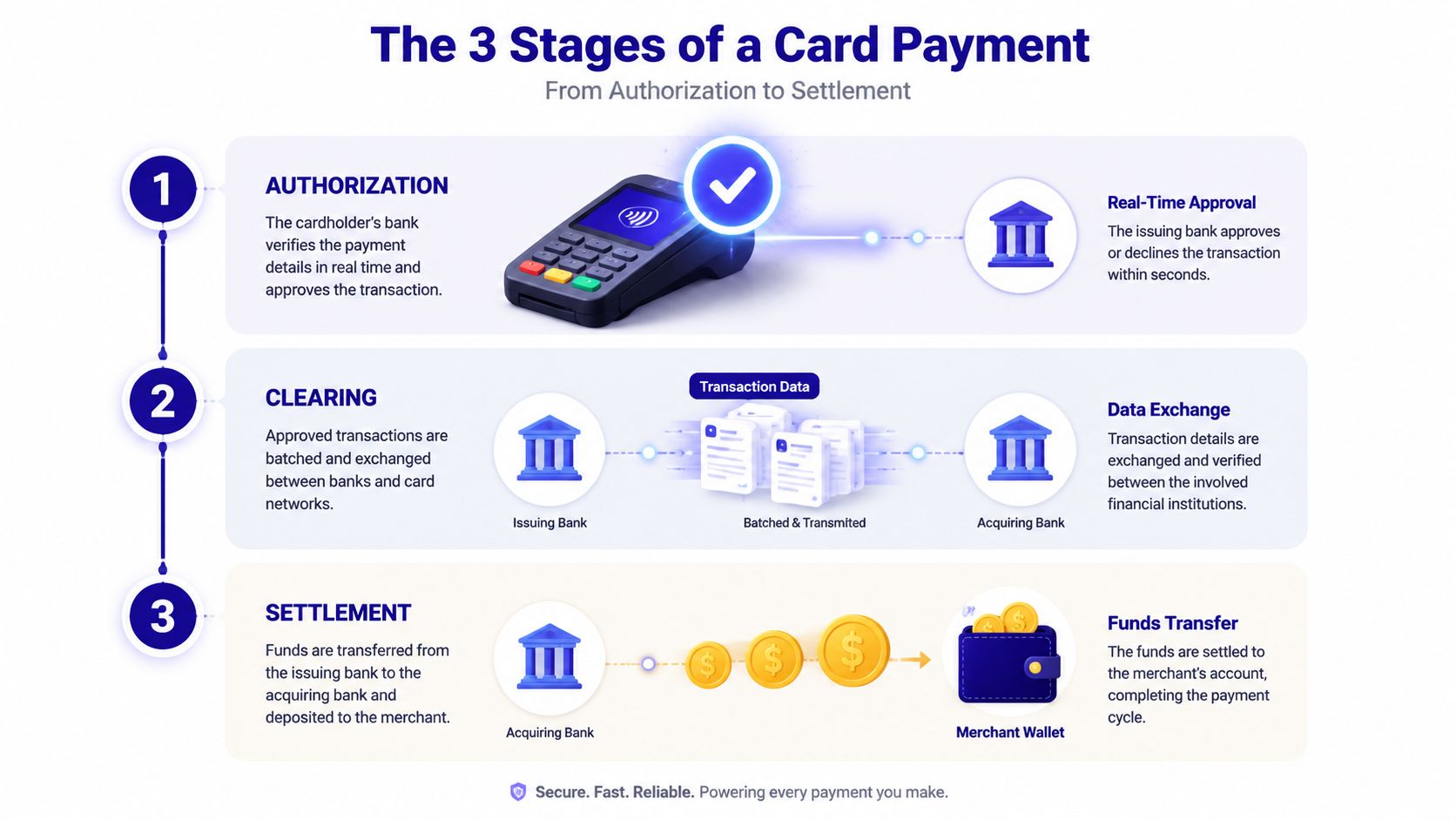
A standard card purchase has three separate stages. Treating them as one event creates misleading dashboards and unrealistic payout expectations.
Authorization reserves the customer's funds
At checkout, the merchant sends an authorization request through its gateway and acquiring path. The issuer checks the card, available funds, and applicable controls, then approves or declines the request. Authorization is instantaneous in a typical credit-card flow, but approval only reserves the amount. It doesn't transfer the money to the merchant.
The merchant must then capture the transaction. Capture confirms the amount that should enter the clearing process. In retail, capture may follow the sale immediately. In other businesses, the merchant may authorize first and capture later when the final amount is known.
Clearing creates the obligation
During clearing, the card network routes transaction records between the issuer and the acquirer. The merchant batches captured transactions, and the network uses those records to establish what each participant owes. In a typical card flow, clearing completes overnight.
Batching is the main source of the merchant funding lag. Transactions captured after the daily cutoff don't join the current file. They roll into the next settlement cycle, even though the customer saw a successful checkout immediately.
Settlement moves the money
Settlement is the final transfer. The issuer's side sends funds through the network to the acquiring bank, and the acquirer credits the merchant under its payout schedule. In a typical credit-card flow, settlement usually finishes within 1 to 3 business days, as described by Optimus Tech's explanation of the settlement process.
The timeline can stretch when a cutoff is missed, a currency requires additional handling, or a risk review places a reserve or hold on the funds. The merchant's internal status should therefore distinguish authorization from clearing and settlement, rather than displaying all three as “paid.”
Why real-time settlement changes the design
Real-time settlement architectures move money immediately after authorization instead of waiting for a later batch. That can reduce the period in which a merchant carries receivables, but it creates a different operating requirement. The settlement institution needs more intraday liquidity, stronger controls, and reliable exception handling because errors and participant failures must be managed while funds are moving continuously.
The trade-off is straightforward. Batch settlement is easier to aggregate and reconcile, but it delays access to cash. Real-time settlement improves immediacy, but it demands tighter treasury and operational discipline.
Settlement Processor vs Gateway vs Acquirer
Payment teams often use “processor” as a catch-all term, but the flow includes several distinct responsibilities. Mapping them correctly helps a finance lead identify where fees, delays, and conversion decisions originate.
Component | Primary job | Typical merchant question |
|---|---|---|
Payment gateway | Presents checkout and transmits payment data | Did the payment request reach the right rail? |
Payment processor | Handles transaction processing and network communication | Was the payment authorized and recorded correctly? |
Acquirer | Provides the merchant-side banking relationship | Where will the merchant's funds be credited? |
Clearing network | Exchanges records and calculates obligations between participants | Which institutions owe and receive funds? |
Settlement processor | Finalizes fund movement, netting, reconciliation, and payout handling | When and in what currency can the business use its money? |
A useful operating analogy
Think of the gateway as the front door. It gives the customer a secure way to submit payment. The processor is the engine room that handles instructions and responses. The acquirer is the merchant's bank-side relationship. The clearing network is the postal service that routes transaction records between institutions.
The settlement processor is the final courier. It delivers the financial result after the records have been exchanged and obligations calculated. A vendor may perform several of these jobs, which is why product comparisons can be confusing. The labels matter less than the actual responsibilities in the contract and API.
Suby brings several payment functions behind one API, including card and crypto acceptance, a shared balance, and payout choices. Its explanation of what a payment provider does is useful when mapping a current stack before replacing or consolidating vendors.
Where merchants have leverage
A merchant can't negotiate every part of a card network's operating model. It can, however, ask a provider precise questions:
Which party sets the cutoff time?
When does capture enter clearing?
Which party performs foreign-exchange conversion?
Are reserves visible as a separate balance?
What events signal cleared, settled, paid out, and failed?
Can the merchant choose a bank payout, stablecoin payout, or another supported currency?
Finance teams evaluating funding options can also review revenue based financing payment tips alongside the payment stack. The key is to separate financing decisions from settlement mechanics. Borrowing can cover a timing gap, but it doesn't fix a processor that gives poor visibility or forces unnecessary conversion.
Why Cross-Border Settlement Still Takes Days
International checkout creates a misleading contrast. The customer receives an approval almost instantly, while the merchant waits for several institutions to complete their part of the transfer. The processor may shorten some steps, but it can't erase every dependency in a cross-border chain.
A payment can pass through the merchant's acquirer, a card network, an issuer, correspondent institutions, local clearing systems, and the merchant's receiving bank. Each participant may operate with its own cutoff window, currency rules, compliance process, and business hours. A transaction that arrives after one institution's cutoff can wait for the next operating window.
The structural sources of delay
Timezone mismatches create a basic scheduling problem. The merchant may submit a transaction while the receiving market is outside its settlement window. Misaligned RTGS operating hours can increase delays, liquidity costs, and settlement risk, as discussed by the Bank for International Settlements.
Foreign exchange adds another decision point. The system must determine when to convert, which institution performs the conversion, and whether the converted funds can move directly to the merchant's account. Compliance reviews can add further time when institutions need to verify parties, payment purpose, or transaction details.
Independent coverage reports that one-third of retail cross-border payments took more than one business day to settle in 2024, a figure cited in Antom's overview of cross-border settlement risks. That experience is consistent with the mechanics. Instant authorization confirms the customer's ability to pay, not the completion of every downstream transfer.

What a modern processor can and can't fix
A well-designed settlement processor can reduce avoidable waiting by routing payment records efficiently, exposing status changes, supporting more direct payout paths, and letting the merchant choose an appropriate settlement currency. It can also make conversion and reconciliation clearer.
It can't guarantee immediate finality when a correspondent bank, local clearing rail, or receiving institution still controls the last step. The right question isn't “Can this provider make every cross-border payment instant?” It's “Which parts of the delay does this provider control, and which remain structural?”
For a deeper treatment of the customer and merchant side of international flows, see this guide to cross-border payment mechanics.
The following video provides additional context on how cross-border payment movement can differ from the checkout experience:
How Settlement Timing Affects Your Cash Flow
Settlement delay becomes expensive when a business must spend before it can access revenue. An e-commerce merchant may need to reorder inventory, a SaaS company may pay infrastructure costs, and an agency may fund contractors before an international invoice becomes available. The accounting system can recognize the sale while the treasury team still can't deploy the cash.
Reserve holds make that gap harder to forecast. Currency conversion can reduce the amount received, while intermediary institutions can add another layer of friction. The problem isn't only the number of days. It's the combination of timing uncertainty, restricted liquidity, and a payout currency that may not match the business's obligations.
Cash flow has two separate levers
The first lever is when funds become available. Faster rails and clearer payout schedules can reduce the receivables period. The second is what the business receives. If a merchant sells in USD but pays suppliers in another currency, the payout structure affects both treasury planning and conversion exposure.
A merchant may choose to receive a supported payout in a stablecoin such as USDC, or select a preferred fiat currency where the infrastructure supports it. Suby documents payout options that include bank accounts and stablecoins, with an optimized FX rail described as having no markup. The business still needs to assess its accounting, custody, tax, and regulatory requirements before selecting a payout route.
Finance test: Model the full path from customer payment to usable operating cash, not just the card fee shown at checkout.
A payment accepted in USD can be settled in USDC or another supported currency instead of following the legacy processor's default conversion path. That doesn't remove every cross-border dependency, but it can reduce the number of conversion and banking steps between collection and treasury use. For merchants considering AED receipts, the payout option for AED provides a concrete route to evaluate.
Teams that want a broader explanation of immediate payment rails can review Visbanking's resource on real-time payments. The important distinction is between faster movement and faster access. A rail may move funds quickly, but the merchant still needs usable reporting, reconciliation, and a payout account that supports the chosen currency.
What to Look for When Choosing a Settlement Processor
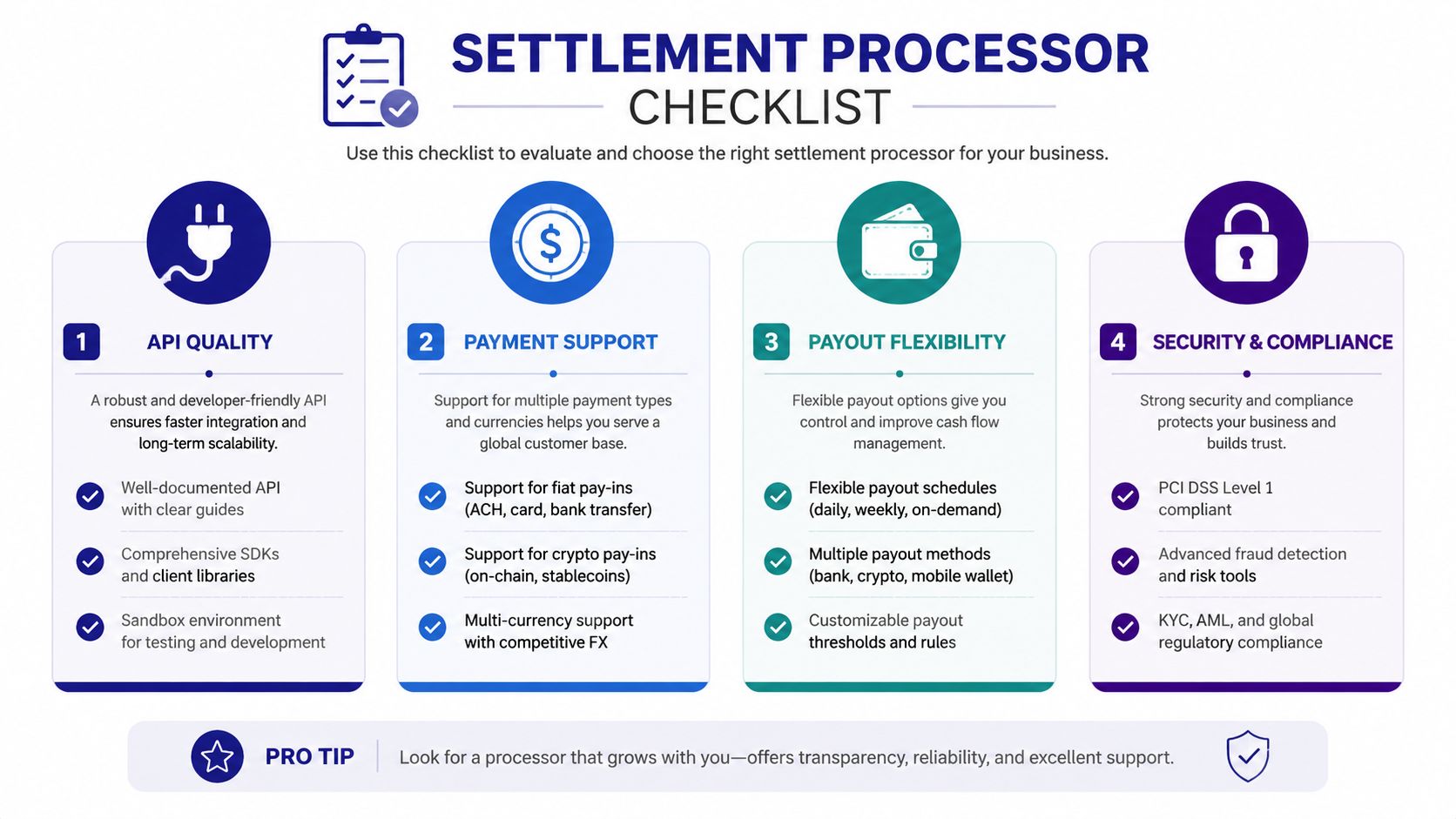
A settlement processor should pass a technical review and a treasury review. A polished checkout doesn't compensate for weak event data, unclear reserves, or payout rules that finance can't forecast.
Start with the integration surface
Engineering should inspect the API reference, webhook model, sandbox, authentication, idempotency behavior, and error responses. Documentation should make it possible to distinguish authorization, capture, refund, dispute, clearing, settlement, payout, and failure states.
The dashboard matters too. Finance and operations need visibility into payments, subscriptions, churn, payouts, and balances without asking engineers to reconstruct every event from logs. A shared balance that aggregates payment methods can simplify reconciliation, especially when the team can switch between supported currency views rather than maintaining disconnected ledgers.
Score the payment and payout model
Use a checklist that reflects the actual business model:
Payin coverage: Confirm whether the provider supports the cards, wallets, bank methods, BNPL, and crypto flows your customers use.
Payout choice: Check bank payouts, stablecoin options, supported currencies, schedules, thresholds, holds, and conversion steps.
Operational controls: Review dispute handling, refund behavior, reserve visibility, fraud controls, and audit exports.
Compliance posture: Verify relevant certifications and controls, including PCI-DSS Level 1 processing where applicable.
Reconciliation quality: Ask whether every payment can be traced from checkout through balance movement and final payout.
Suby documents an API that lets businesses accept payments by card or crypto, alongside native Discord and Telegram integrations for subscriptions, paid access, and online communities. Its four product modes are Suby Payments, Suby Crypto, Suby Gating, and Suby Invoicing, all using the same underlying API and infrastructure.
Pricing needs its own review. There isn't a single flat rate, because pricing depends on the payment method used. Finance should verify exact per-method figures on the Suby pricing page, then model refunds, disputes, conversion, payout, and reserve effects separately.
Real-World Use Cases Across SaaS and E-Commerce
A useful settlement processor adapts to the business model rather than forcing every company into the same payout pattern. The customer-facing payment can vary by market, while the merchant's preferred settlement route can remain consistent.
SaaS subscriptions
A SaaS company may need recurring subscriptions and one-time payments in the same checkout. Suby Payments provides an API-first payment stack for accepting cards and crypto through one checkout, with subscriptions and one-time payments supported through the same API. That lets the product team keep payment creation and event handling inside the application while finance monitors balances and payouts through the operating dashboard.
The treasury decision comes afterward. The company might accept a customer's card payment and receive funds in its bank account, or choose a supported stablecoin payout when that better fits its operating structure. The customer's payment preference doesn't have to dictate the company's settlement preference.
Cross-border e-commerce
An international merchant has a different concern. Local customers may want cards, wallets, bank methods, or crypto, while the merchant wants a consistent currency for inventory and supplier payments. A single balance can reduce reconciliation fragmentation, and a selected payout currency can make cash planning more predictable.
Suby Crypto handles the swap, sponsors the gas, and can settle to a non-custodial wallet or the Suby balance. That flow suits a merchant whose customers already use wallet-native payment, while a card customer can still use the regular checkout path.
Agencies and international invoicing
An agency may invoice a client who wants to pay by card or bank transfer, while the agency prefers to receive a stablecoin or another supported currency. Suby Invoicing is designed around that separation. The client chooses how to pay, and the business chooses what it wants to receive and where it wants the funds delivered.
That flexibility is most useful when the agency has repeatable treasury rules. It should still document conversion, accounting, tax, and reconciliation treatment before switching payout currencies.
Paid communities and digital products
A creator selling access to a Discord or Telegram community has a different operational requirement. The key event isn't only a successful payment. The system must grant access automatically, remove access when entitlement ends, and support the product's chosen billing model.
Suby Gating supports paid access for Discord, Telegram, downloads, and courses, with access granted automatically after payment. This maps the payment event to the customer entitlement instead of leaving the creator to reconcile access manually.
Making Settlement a Strategic Advantage
Settlement is a business decision with direct effects on cash flow, customer support, reconciliation, and international expansion. Authorization determines whether a customer can complete checkout. Settlement determines when the merchant can use the revenue and whether that revenue arrives in a useful currency.
The practical levers are clear:
Accept the payment methods customers use, including card and crypto options where relevant.
Choose payout currencies and rails that match treasury obligations.
Keep payment activity in a balance that finance can reconcile.
Review per-method pricing instead of assuming one universal rate.
Test status events, refunds, disputes, reserves, and failed payouts before launch.
Suby offers an API that lets any business accept payments by card or crypto, plus native Discord and Telegram integrations for subscriptions, paid access, and online communities. Its model separates customer choice from merchant payout choice, so customers can pay the way they want while the business receives funds through a selected bank or stablecoin route.
Review your current processor's cutoff times and payout states first. Then test an API-first checkout, confirm the exact per-method pricing, and evaluate whether stablecoin settlement or a different fiat payout better fits your cross-border cash flow.
Suby provides card and crypto acceptance through one API, shared balance and payout options, plus native Discord and Telegram integrations for paid access and subscriptions. Visit Suby to review the available payment and settlement paths, then test the route that best matches your customers and treasury strategy.
