

Gaspard LEZIN
Recurring Crypto Payments: A Practical Guide
Learn how recurring crypto payments work, how to set them up, and how to handle failed renewals, gas, and accounting without surprises.
You're probably here because the first crypto payment looked easy, then the second one exposed the mess.
A customer signs up for your $29 analytics plan, pays in USDC, gets access, and everything looks fine. Then renewal day hits. Their wallet balance is short, nobody built retry logic, support has no idea whether the invoice is unpaid or pending, and finance can't tell what settled. That's the core challenge of recurring crypto payments.
Most articles get this wrong. They talk about wallet automation like it's the product. It isn't. The product is the billing loop. Authorization, renewal timing, retries, settlement, cancellation, and reconciliation. If those parts are weak, you don't have recurring billing. You have a one-time crypto checkout pretending to be a subscription.
Table of Contents
What Recurring Crypto Payments Actually Are
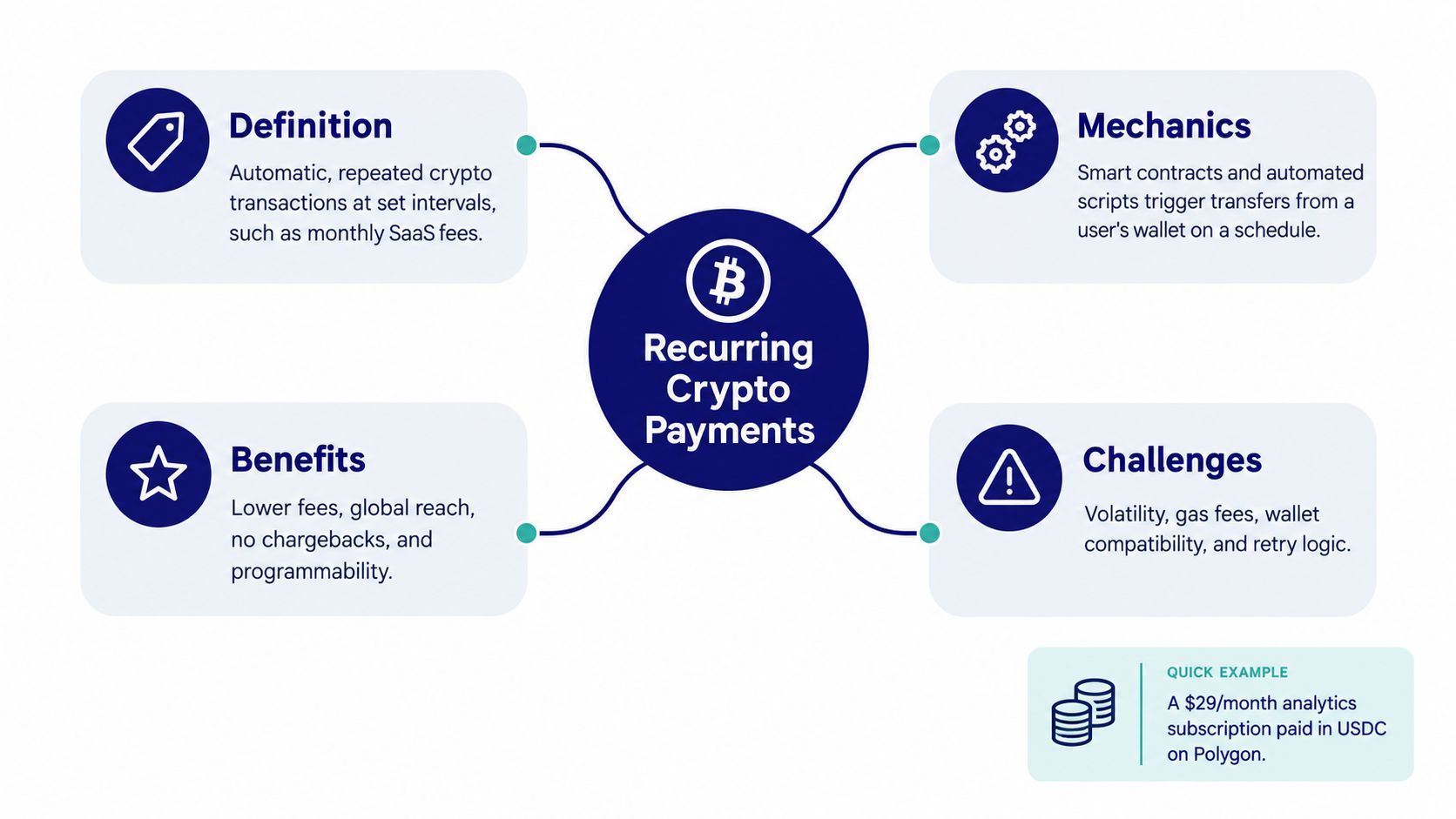
Recurring crypto payments are scheduled payments made in crypto or stablecoins on a repeating cycle. Monthly, weekly, annual, usage-based top-ups, membership renewals, retainer invoices. The common trait is simple. The buyer pays more than once, and your system has to keep state between those payments.
That sounds obvious, but teams still confuse it with a one-time on-chain payment. A one-time checkout ends when the transaction confirms. A recurring setup has to survive the next billing date, and the one after that.
The three parts that matter
Every real implementation needs three moving parts:
A billing schedule that says when renewal should happen.
A payment instrument such as a wallet, custodial account, or signed authorization flow.
A settlement target where the merchant receives usable funds.
If one of those is vague, the system breaks. I've seen teams obsess over chain selection while ignoring where revenue lands. That's backwards. A customer can pay successfully and you can still have a broken billing system if the merchant can't reconcile or access the funds cleanly.
It's not one product category
The term covers several different models. Stablecoin subscriptions on account-based chains, wallet-authorized renewals, exchange-hosted recurring purchases, and invoice-style recurring collection all sit under the same umbrella. They are not the same operationally.
Practical rule: treat recurring crypto payments as a billing operations problem first, and a chain mechanics problem second.
That's also why the category matters now. Stablecoin payment activity is still small relative to global payments, but one 2026 analysis said B2B stablecoin payments grew 733% year over year in 2025 to an estimated $226 billion, accounting for roughly 60% of genuine stablecoin payment activity, while stablecoins still represented only about 1% of global payment flows according to this analysis of recurring payments in stablecoins. That's the right context. Real adoption, limited penetration, strongest fit in repeatable business payments.
The Subscription Lifecycle From Sign-Up to Renewal
The subscription doesn't fail at checkout. It fails in the handoff between steps.
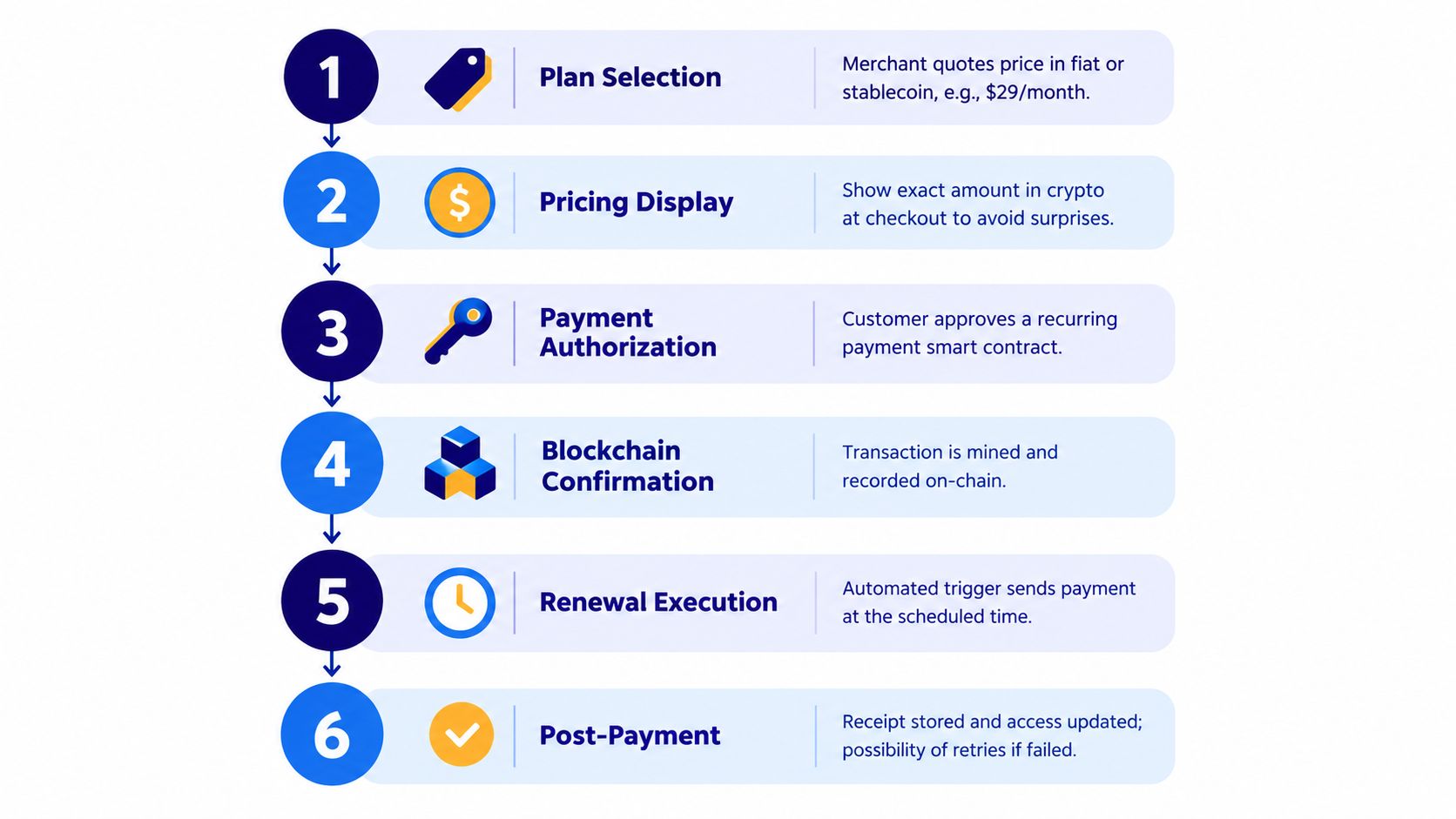
You need to think through the entire lifecycle before launch, because each stage creates a different kind of support ticket, accounting issue, or revenue leak.
Start with pricing and authorization
At sign-up, decide what the customer sees. If your plans are priced in fiat, keep them priced in fiat and convert at checkout. If they're priced in stablecoins, say that clearly. Don't make the buyer do mental math while approving a subscription.
Authorization is the first dangerous step. Wallet connect by itself is not a billing mandate. A signed message by itself is not enough if it doesn't define amount, timing, and scope. You need a clear approval model and a clear revocation model. Expert coverage of on-chain subscription systems describes recurring billing as a mix of account model, authorization primitive, execution mode, off-chain billing scheduler, and ledger records in this breakdown of recurring crypto payment mechanics.
Renewal is where revenue leaks
Your first invoice usually works because the customer is present. Renewal is where reality starts. Someone or something has to trigger the payment. That might be an off-chain scheduler, a smart contract flow, or an invoicing system that sends a pay request on schedule.
The biggest weakness is failed renewal handling. Build a proper dunning loop:
Retry with intent. Don't blindly hammer the wallet. Retry based on likely balance replenishment windows.
Add a grace period so access doesn't vanish the minute one renewal fails.
Define downgrade behavior. Suspension, reduced access, or invoice-past-due status should be explicit.
If you need a good example of recurring collections outside the crypto bubble, recurring billing for crowdfunding is worth studying because it focuses on lifecycle management, not novelty.
For a practical implementation path, this guide on how to set up recurring payments is useful because it frames the flow around setup, billing cadence, and renewal handling instead of pretending the first payment solves the system.
Failed renewals are not an edge case. They are the main event.
End states matter too
Cancellation, refund handling, and access revocation should happen on a defined timeline. End-of-period access is usually easier to explain and easier to audit than instant cutoff. If your cancellation logic and payment logic live in separate systems, expect customer confusion and support overhead.
On-Chain Versus Off-Chain Approaches
Teams should stop asking, “Should we do subscriptions on-chain?” and ask a better question. Who authorizes the payment, who executes it, and who handles the ugly parts when renewal fails?
That's the split between on-chain and off-chain recurring billing.
The practical difference
On-chain recurring billing puts more of the subscription logic into contracts and wallet-native flows. Off-chain recurring billing keeps the schedule and retry logic inside a processor or your own server, while settlement can still happen on-chain.
The distinction is not whether crypto is involved. The distinction is who runs the billing engine.
Dimension | On-Chain (Smart Contract) | Off-Chain (Processor / Server) |
|---|---|---|
Authorization | User approves contract-level or wallet-level permissions | User approves a processor or payment flow with defined scope |
Execution | Contract or protocol logic triggers collection or stream behavior | Server, processor, or invoicing system triggers renewal |
Fund location | Usually remains closer to the user wallet until execution | Often coordinated through managed payment infrastructure |
Gas responsibility | Merchant, user, or protocol design must account for it | Processor or platform can front or abstract it |
Retry control | Harder to tune around failed renewals | Easier to run retries, grace periods, and suspension logic |
Reconciliation | Transparent on-chain, but often more engineering-heavy | Easier for finance if status and invoice state are managed together |
Support load | Higher wallet UX burden | Lower if customer state and payment state stay in one system |
Refund flow | Can be operationally rigid | Easier to tie into existing billing and support workflows |
What I'd recommend
For SaaS and most e-commerce, start off-chain. You want predictable retries, cleaner customer support, and invoice state that maps to your product entitlements. You can still settle in crypto. You don't need to force the whole billing brain on-chain just because the money ends there.
There's also a hard economic reason to be selective. Analysis of crypto subscription infrastructure notes that Layer 2 networks such as Arbitrum, Base, and Optimism can bring Ethereum transaction costs from roughly $5 to $15 on mainnet in the 2021-era down to under $0.01 per transaction, which changes whether smaller subscriptions make sense at all in this guide to accepting crypto subscriptions.
If you want a stablecoin-first view of how SaaS billing can be structured, this piece on stablecoin subscription payments for SaaS customers is aligned with that approach.
When on-chain makes sense
Use on-chain logic when transparency and user custody are part of the product itself. Think protocol memberships, community access, or products where users expect wallet-native permissions. If you're just trying to collect a monthly software fee reliably, complexity is not a feature.
Integration Options for SaaS and E-Commerce
There are three sane ways to integrate recurring crypto payments. Pick based on how much billing logic you already own, not based on what sounds technically impressive.
API and webhooks
This is the right path for SaaS companies with an existing billing model, customer records, plan IDs, invoice objects, and entitlement logic. You keep the subscription brain in your app and let the payment layer report status back through webhooks.
What you need:
A renewal trigger that creates or requests the next payment on schedule.
A webhook handler that updates subscription state when payment status changes.
A mapping layer between customer, plan, invoice, and settlement record.
This gives you the most control. It also gives you the most responsibility. If your webhook handling is sloppy, you'll grant access on pending states or suspend active users by mistake.
Hosted checkout
Hosted checkout is the right answer when you want recurring crypto payments without building wallet confirmation handling, payment status UX, and settlement views yourself. The customer completes payment on a managed page, and your team works from the resulting records.
This is the safer route for e-commerce, digital products, and lean software teams that don't want to own crypto-specific payment plumbing. It also reduces the odds that your product team ends up debugging payment edge cases at midnight.
Paylinks and invoices
This path is underrated. It works well for B2B retainers, agencies, service contracts, treasury-driven buyers, and any workflow where the invoice is the center of the relationship.
Recurring invoices are often better than “auto-charge” stories because they preserve review, approval, and payment routing on the buyer side. That matters when procurement or finance is involved.
Dimension | API + Webhooks | Hosted Checkout | Paylinks / Invoices |
|---|---|---|---|
Best for | SaaS products with existing subscription logic | E-commerce and lean teams | B2B billing and service-based recurring collection |
Engineering effort | Highest | Moderate to low | Low |
Control over billing states | Highest | Shared with provider | Moderate |
Wallet UX ownership | Merchant owns more | Provider owns more | Mostly provider-owned |
Reconciliation effort | Lower if your billing stack is mature | Moderate | Usually straightforward per invoice |
Refund exposure handling | Flexible, but custom | Depends on provider workflow | Clearer when tied to invoice records |
Don't choose the deepest integration by default. Choose the one your support and finance teams can actually operate.
Gas, Failed Payments, and UX Pitfalls
Recurring crypto payments stop being a product demo and become an operations system.
Most failures after launch aren't cryptographic. They're predictable billing failures with chain-specific consequences.
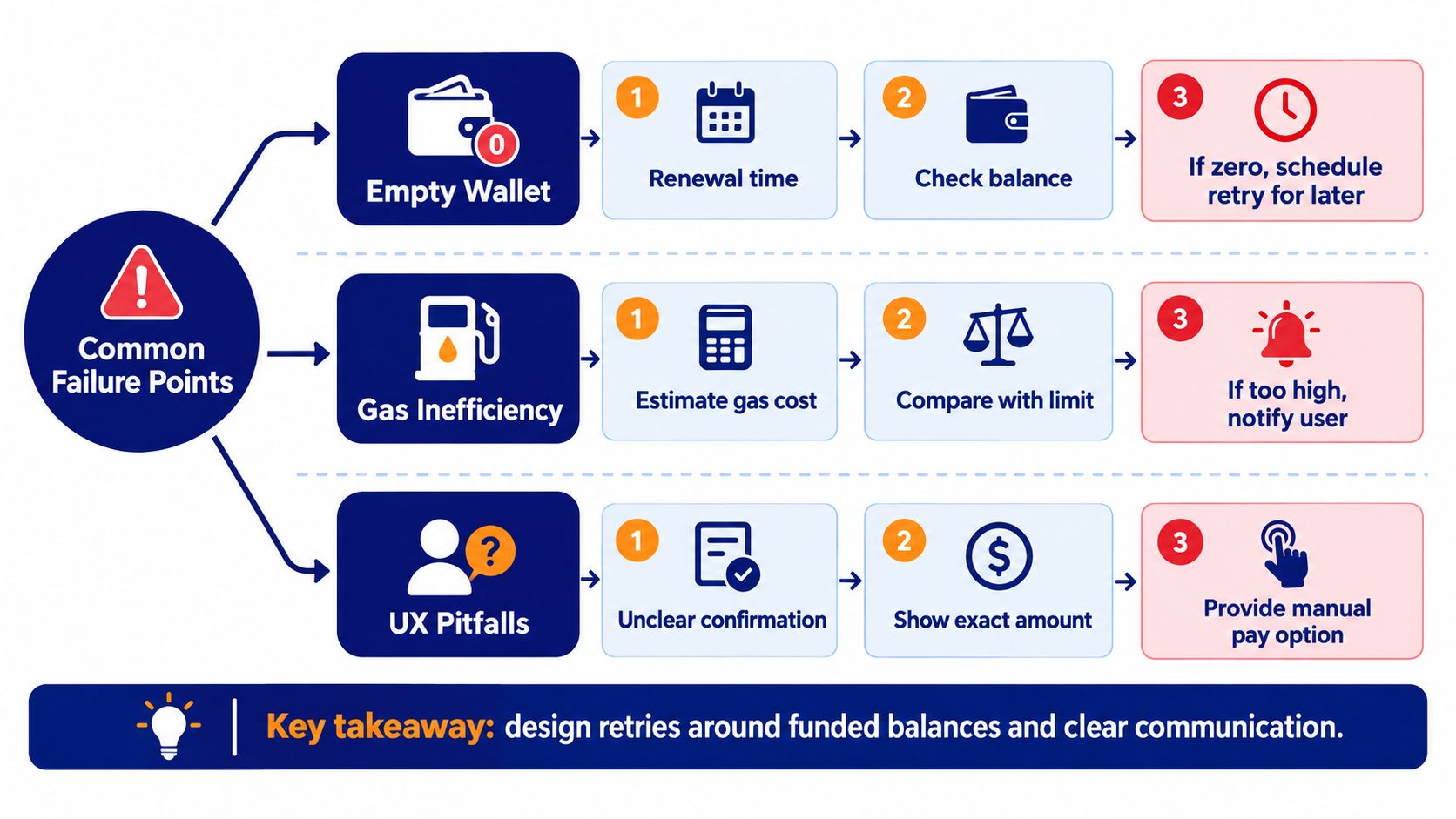
Empty wallets break more renewals than anything else
A subscription record is not a funded balance. If the customer wallet is empty at renewal time, your mandate doesn't matter. The right response is not endless retries. The right response is a state machine that treats “authorized but unfunded” differently from “payment attempt failed” and “payment confirmed.”
Your dunning flow should answer four questions:
Was there enough balance at the time of attempted collection?
Who needs to act next, the customer or the merchant?
When should the next retry happen based on likely funding behavior?
What happens to access during that window?
Gas belongs in product design
If gas can make the renewal uneconomic, you have a product problem, not an accounting problem. Decide early whether the user pays, the merchant pays, or the gateway abstracts it. Don't bolt this on later.
Recent product coverage of recurring crypto billing points toward more practical workflows, including per-subscriber deposit addresses, confirmed-deposit webhooks, and settlement to a preferred asset or chain in this overview of recurring crypto payment operations. That shift matters because merchants don't need a magical auto-debit story. They need a billing loop that survives funding gaps, state transitions, and reconciliation.
UX still kills conversion
Manual approval prompts can ruin the whole point of recurring billing. If users don't understand what they're signing, they'll abandon. If the approval is too broad, they won't trust it. If the renewal requires surprise interaction, it isn't really automated.
For teams working on recovery flows, this article on failed payment recovery is the part worth borrowing. The recovery logic matters more than the first successful transaction.
Clear payment copy beats clever wallet UX every time. Tell users what renews, when it renews, what asset is used, and how they can cancel.
Compliance and Accounting Considerations
Your finance team doesn't care that the payment was “on-chain.” They care whether it can be booked, refunded, matched to an invoice, and defended in an audit.
That's the standard to use.
The questions that come up immediately
Compliance and Accounting Question | Answer |
|---|---|
How should we treat tax on recurring crypto payments? | That depends on jurisdiction and asset treatment. Many teams simplify operations by treating stablecoin receipts as fiat-equivalent for internal reporting, but your legal and tax treatment still has to match local rules. |
Should refunds go back in the same asset? | Usually yes, if you want a policy customers can understand and finance can document cleanly. Put the policy in onboarding and order confirmation. |
What replaces card chargebacks? | On-chain transfers don't give you a card-style chargeback layer. You need a documented refund process, credits policy, and off-chain dispute handling procedure. |
What records should we store? | Keep transaction hash, chain, counterparty address, asset, invoice reference, confirmation time, and fiat value at the point you recognize payment. |
How do we handle multi-chain receipts? | Normalize them into one accounting schema before they hit the ledger. Different chains should not produce different bookkeeping logic. |
Who approves cancellations and refund exceptions? | Define that internally before launch. Customer support improvisation becomes finance cleanup later. |
Consumer protection and cancellation need more attention
This area is still under-discussed. Merchants want to know who can cancel, how revocation works, what happens if the wallet is emptied, and how recurring stablecoin instructions are treated across jurisdictions. Those are the questions, and they're exactly where current infrastructure is still maturing according to this research on recurring stablecoin payment infrastructure.
That's why I'd keep the compliance model boring. Clear disclosures, explicit cancellation terms, refund rules written in plain language, and accounting records that don't depend on one engineer remembering how a smart contract event maps to an invoice.
A Practical Setup With Suby
If you want recurring crypto payments to behave like normal billing, use infrastructure that treats this as a payment operations problem, not a chain demo.
Suby is one example that fits that model. It's a single product with four ways to use it: Suby Payments, Suby Crypto, Suby Gating, and Suby Invoicing, as described in Suby's stablecoin payment infrastructure overview. The important part is not the naming. The important part is the operating model. Customers can pay by card, wallet, bank, or crypto, and the business chooses how to receive funds, either to a bank account or in stablecoins such as USDC. One especially practical setup is when the customer pays by card and the merchant receives USDC, though that's only one option.
What this looks like in SaaS
For SaaS, I'd structure the stack around plan IDs, invoice references, webhooks, and a single settlement view.
Layer | SaaS Setup | E-Commerce Setup |
|---|---|---|
Checkout | Present one recurring plan with supported payment methods | Use hosted checkout or paylink tied to cart or order ID |
Payment method | Let the customer choose card or crypto | Let the customer choose the most convenient method at purchase time |
Renewal handling | Use subscription events and webhook-driven state updates | Use scheduled collection or repeat invoice logic per customer/order relationship |
Settlement | Choose bank payout or stablecoin settlement based on treasury preference | Same, but map payouts back to order batches |
Recovery flow | Grace period, retry windows, then suspension | Retry, customer reminder, then order or access hold |
Finance output | Export per-customer and per-invoice history | Export order-linked payment history and refund records |
Why this setup is practical
Suby provides an API that lets businesses accept payments by card or crypto, and it also has native integrations for Discord and Telegram for subscriptions, paid access, and online communities. The Discord integration is explicitly documented to grant and revoke roles automatically based on payment status in Suby's Discord integration documentation. That matters if your recurring product is access, not just software.
For crypto-specific flows, Suby Crypto is documented as a crypto payment gateway that handles the swap, sponsors the gas, and settles to a non-custodial wallet or to the Suby balance in Suby Crypto product documentation. That's the kind of detail that removes a lot of operational pain in recurring billing, because “who handles gas?” is not a small implementation detail. It determines whether low-value renewals stay viable.
One more practical note. Pricing depends on the payment method used, so check Suby pricing for the current per-method figures instead of assuming a flat rate.
Decision Checklist and Where This Is Going
Before you launch, run through the decisions that determine whether recurring crypto payments will stay operational after the first month.
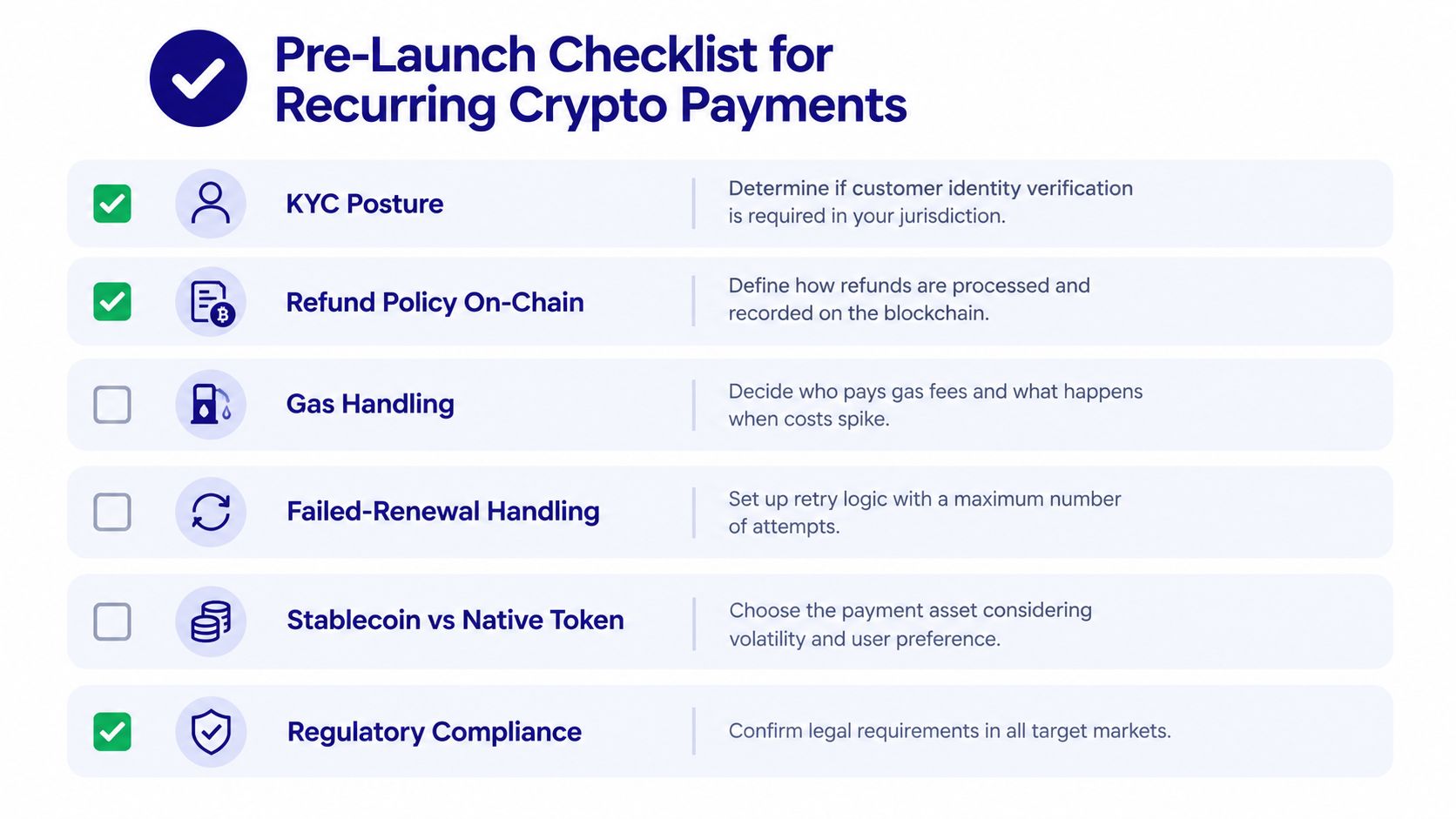
Launch checklist
KYC posture. Know whether your customer base, jurisdictions, or payment mix require identity checks.
Refund policy. Decide which asset refunds use, who can approve exceptions, and how that policy appears to customers.
Gas handling. Be explicit about who pays, and what your system does when execution becomes uneconomic.
Failed-renewal logic. Set retry windows, grace periods, and suspension rules before support writes them ad hoc.
Asset choice. Stablecoins are usually the cleaner fit for recurring billing than volatile assets.
Custody model. Decide whether funds settle to your own wallet, a managed balance, or a bank account.
Accounting evidence. Make sure every invoice can be tied back to payment confirmation and settlement records.
Where this is heading
The category is moving toward better billing infrastructure, not just better wallet demos. Product coverage and market activity suggest the direction is clearer support for scheduled stablecoin billing across major chains, stronger cancellation and revocation handling, and more practical treasury settlement options. One 2026 report also said the subscription economy was worth over $600 billion, with more than two thirds of digital-first businesses operating on recurring models, which helps explain why providers are building crypto-native billing rails into an already established subscription pattern in this comparison of subscription billing infrastructure.
The risks aren't gone. Gateway concentration, wallet outages, weak retry handling, and brittle reconciliation still break launches. But the opportunity is real in cross-border, self-custodial, and stablecoin-settlement use cases where card rails are awkward or expensive.
The winning teams won't be the ones with the fanciest wallet flow. They'll be the ones whose billing loop survives failure cleanly.
Recurring crypto payments are not magic. They're recurring billing with different settlement rails. If you build them that way, they work.
If you want to offer recurring billing without stitching together card flows, wallet logic, settlement handling, and community access tooling yourself, Suby gives you one payment infrastructure layer for card, bank, wallet, and crypto payments. Your customers can pay the way they want, and your business can receive funds to a bank account or in stablecoins like USDC, which is exactly what makes recurring crypto payments workable in production.
