

Gaspard LEZIN
Mastering Subscription Tiers for Global Growth
Master subscription tiers! Design, price & optimize for global growth with our 2026 step-by-step guide covering segmentation, implementation, and churn.
You're probably dealing with a familiar problem right now. One customer says your product is too expensive, another says they'd gladly pay more if it included a few extra capabilities, and a third wants a completely different setup because they operate across several markets. If you force all of them into one plan, you usually get the worst outcome. Price-sensitive buyers hesitate, power users feel under-served, and your team starts patching the gap with custom exceptions.
That's where subscription tiers stop being a pricing-page detail and become a growth decision. Good tiers help different customers buy confidently, upgrade naturally, and stay longer. Bad tiers create confusion, support overhead, and silent churn.
For global businesses, the challenge gets harder. Customers may prefer different payment methods, operate with different budgets, and expect a checkout flow that feels local. A clean tier model has to account for those differences without turning your billing setup into a mess.
Table of Contents
The pricing page is really a product decision
Segment by job and pain level
Map each segment to a real upgrade trigger
Use three tiers unless your data says otherwise
Choose one value metric and defend it
Create distance between adjacent plans
Price around value, not your internal costs
Monthly and annual should serve different buyer moods
Global billing changes the pricing conversation
Model plans as products with states and events
Use webhooks for access and lifecycle changes
Read metrics by tier, not only in aggregate
Run small tests that change buyer behavior
Your Blueprint for Recurring Revenue
Why Your Subscription Tiers Are Your Growth Engine
A single price works only when your customers are unusually similar. Most aren't. A solo consultant, a growing SaaS team, and a community operator managing paid access all use the same product differently, reach value at different speeds, and tolerate different levels of complexity.
That's why subscription tiers matter so much. They let you match pricing to customer maturity, usage intensity, and expected outcomes. In practice, they shape who converts, who upgrades, and who sticks around long enough to become a durable revenue source.
Subscription businesses have had strong momentum for years. Over the past decade, they achieved approximately 17.5% annual revenue growth, compared with 3.8% for the S&P 500, which represents roughly a 4.6× growth advantage, according to NetSuite's overview of subscription pricing models. That gap is one reason so many companies have moved toward multi-tier offers instead of flat pricing.
The pricing page is really a product decision
Tier design affects more than revenue. It affects onboarding, sales conversations, packaging, support load, and retention. If your entry plan promises too much, power users won't upgrade. If your premium plan solves problems basic users don't even have, that's fine. It should. Premium only works when it serves a more advanced use case.
Practical rule: A strong tier structure gives each customer a clear “this is for me” moment.
For global products, subscription tiers also become an operating model. You're not just deciding which features go where. You're deciding how users in different regions encounter limits, payment methods, and commitment levels. The cleanest systems feel simple to the customer, even when the back end is doing much more work.
Start with Who Not What
Teams often start by listing features and then trying to split them into plans. That usually leads to arbitrary packaging. The stronger path is to start with the customer groups you serve, then build plans around the problems they need solved.
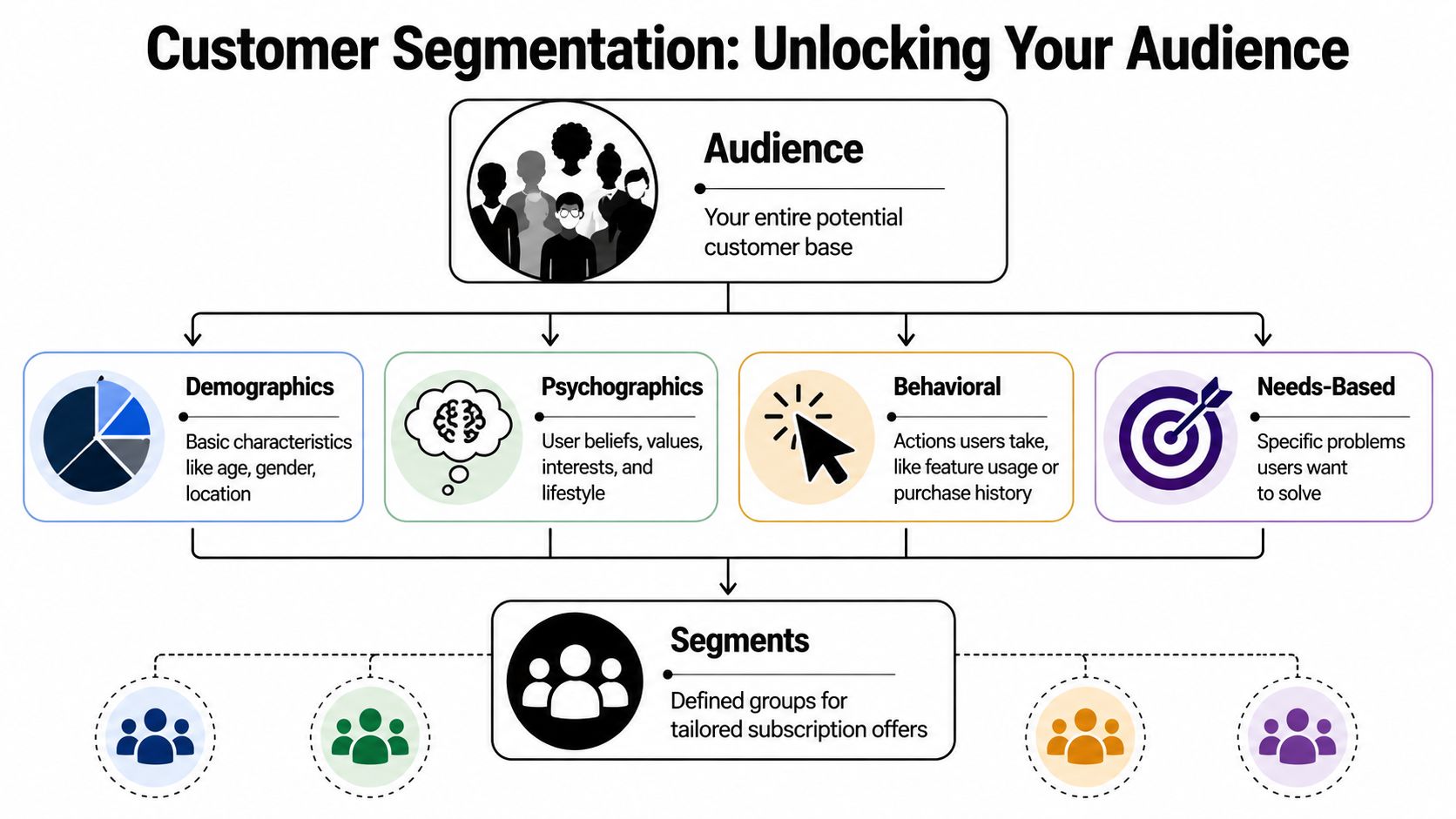
A technically effective subscription-tier design process starts with customer segmentation and then maps each segment to a distinct value proposition. A commonly cited benchmark says tiered models can improve revenue by about 25-40% versus single-tier pricing, as noted in Adapty's guide to tiered pricing.
Segment by job and pain level
Demographics can help, but they rarely tell you how to package a subscription. Better segmentation comes from the job the customer is trying to get done, the urgency of that job, and the operational pain they feel when they can't solve it.
A simple working model looks like this:
Segment | What they need most | What they usually resist |
|---|---|---|
Individual operator | Fast setup, clear value, low commitment | Administrative complexity |
Small team | Collaboration, reporting, smoother workflows | Paying for enterprise controls too early |
Advanced business | Reliability, permissions, automation, service depth | Hard limits and manual workarounds |
If you work with commerce brands, community products, or creator memberships, it helps to borrow a few patterns from proven DTC customer segmentation strategies from Arlo Inc.. The useful takeaway isn't the labels themselves. It's the discipline of tying each segment to buying behavior and offer fit.
Map each segment to a real upgrade trigger
Once segments are clear, define the moment each one outgrows its current plan. That's the backbone of your pricing ladder.
Entry users: They need a plan that helps them start without overcommitting. Give them the core outcome, not every capability.
Growing customers: They upgrade when coordination gets harder. That often means more seats, more usage, better controls, or better support.
Advanced customers: They pay for risk reduction and efficiency. Automation, access management, and operational flexibility matter more than extra cosmetic features.
For creators selling access in Discord or Telegram, the same logic applies even if the product isn't classic SaaS. One tier might include a private channel, another might add member-only sessions, and a higher one might include closer interaction or premium content archives. The point isn't to hide random perks. The point is to package increasing value around increasing commitment.
If a feature sits in Premium, ask a blunt question. Does it solve a problem that Basic users genuinely don't have yet?
That question prevents one of the most common mistakes in subscription tiers. Teams often put their best features behind the top plan even when those features are foundational to initial success. If users need that capability to experience the product properly, it probably belongs lower.
Designing Tiers That Sell Themselves
Most pricing pages fail in one of two ways. They either present too many options, or they create plans that are so similar that buyers default to the cheapest one. Clear packaging beats clever packaging almost every time.
A useful warning comes from Long Angle's discussion of membership design. More tiers can hurt conversion if the middle option is poorly differentiated, even when the top tier lifts average revenue per user. That's especially relevant when you're selling recurring access, not just software features.
Use three tiers unless your data says otherwise
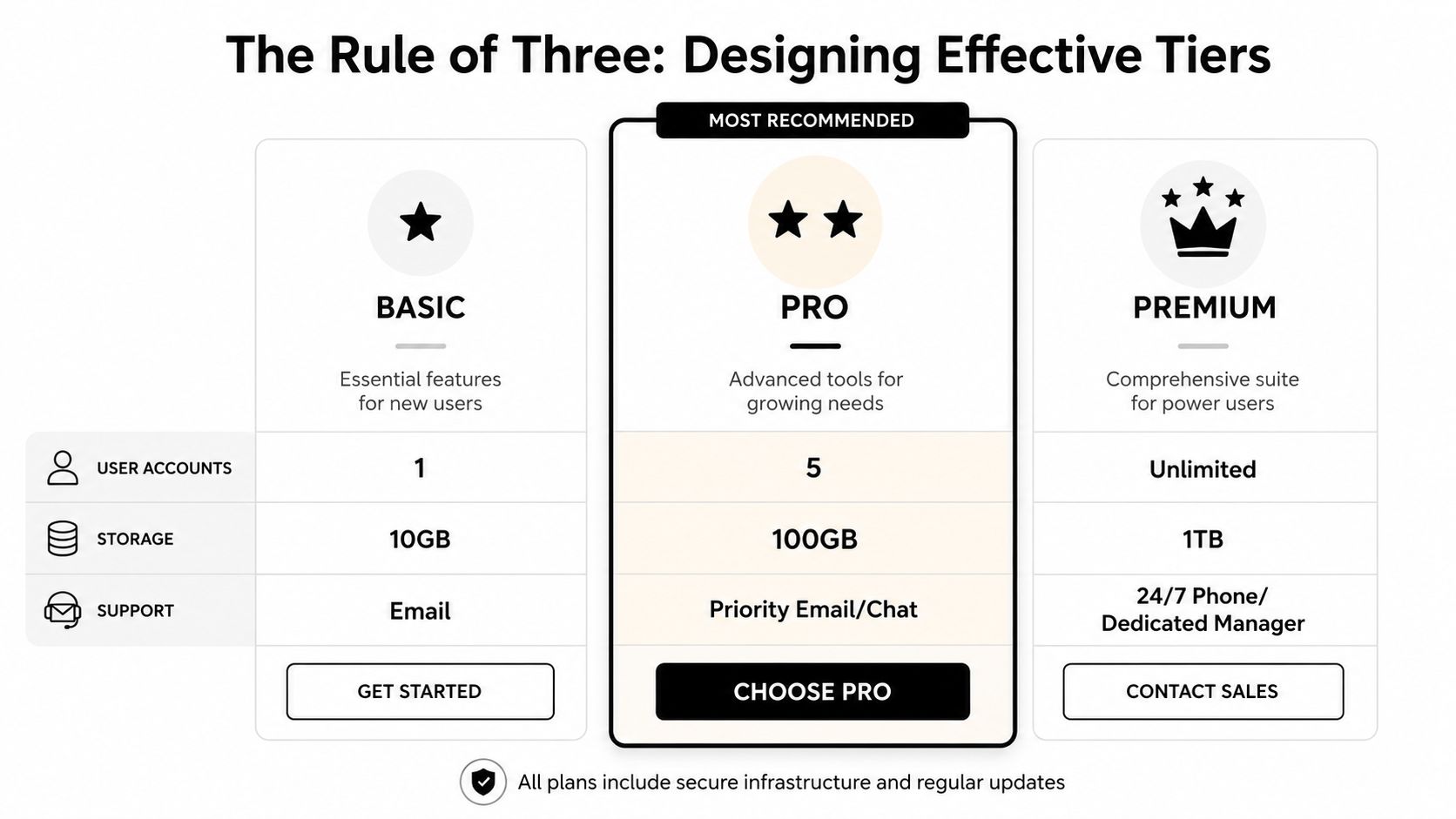
Three tiers work because they create contrast without overwhelming the buyer. You can support a starter audience, a mainstream growth audience, and a more demanding customer without asking people to parse a five-way matrix.
The structure often looks something like this:
Basic: The shortest path to core value
Pro: The practical plan for customers with active, ongoing use
Premium: The plan for customers who need depth, flexibility, or operational support
The visual comparison matters too. Keep the differences obvious.
Choose one value metric and defend it
Your value metric is the unit that scales with customer success. If you pick the wrong one, your plans feel unfair. If you pick the right one, upgrades feel natural.
Common value metrics include:
Per seat: Good when collaboration is the main source of value
Per project or workspace: Useful when teams organize around distinct initiatives
By usage volume: Works when customers consume a measurable resource
By access level: Effective for memberships, communities, and gated content
A few practical examples help:
Business type | Usually strong metric | Usually weak metric |
|---|---|---|
Team SaaS | Seats or workspaces | Random feature bundles with no usage logic |
Media or creator membership | Access level | Per-seat pricing for solo consumers |
Infrastructure or API product | Usage band | Flat tiers disconnected from consumption |
A good value metric does two things. It matches how customers think about value, and it gives you a credible reason for charging more as they grow.
Here's a useful walkthrough before you finalize a plan matrix:
Create distance between adjacent plans
Adjacent plans need real separation. Not just one extra checkbox. Not just “priority support” added to a nearly identical bundle.
Use at least one of these upgrade levers:
Capacity jump
More seats, more projects, more transactions, or broader access.Workflow jump
The customer can do something materially better, not just more of the same thing.Control jump
Better permissions, automation, reporting, or administrative visibility.Service jump
Faster support, dedicated help, or more hands-on onboarding.
Poorly differentiated middle plans create doubt. Doubt pushes buyers either downward to the cheapest option or out of the funnel entirely.
When subscription tiers sell themselves, the buyer doesn't need a long explanation. They can recognize their own situation in the plan description and move forward without a sales call, especially when clear check out buttons make the next step obvious.
Setting Your Prices and Billing Cycles
Once your structure is solid, pricing becomes much easier. Not easy, but easier. The mistake is treating price as a math exercise based on your internal costs. Buyers don't care what your tool stack costs. They care whether the plan feels fair relative to the outcome.
Price around value, not your internal costs
Cost-plus pricing creates weak subscription tiers because it starts from the wrong question. Instead of asking what the product changes for the customer, it asks what margin you want on top of delivery.
A better approach is to position your plans so the middle option feels like the practical choice for customers who expect ongoing use. That's where anchoring helps. The entry tier keeps the door open, the premium tier shows the upper bound of value, and the middle tier becomes the “makes sense” option for most buyers.
If you want a broader comparison of models, this guide to membership pricing strategies from GroupOS is a useful companion read because it shows how packaging and commitment level affect perceived value.
Monthly and annual should serve different buyer moods
Monthly billing helps with adoption. It lowers commitment and works well when customers are still validating fit. Annual billing speaks to confidence. It appeals to buyers who already understand the value and want administrative simplicity.
A practical pattern is to use:
Monthly plans for testing and lower-friction entry
Annual plans for established use and stronger commitment
A clear annual comparison so the buyer can quickly see the trade-off
Your annual option should feel simpler, not confusing. If annual billing introduces different features, exceptions, or odd contract logic, it creates hesitation instead of confidence.
For a deeper look at packaging choices, Suby's article on subscription pricing models is relevant if you're comparing fixed, usage-based, and tiered approaches in one decision process.
Global billing changes the pricing conversation
Cross-border subscriptions add a layer most pricing guides ignore. A plan that looks simple in one market can become messy when customers are paying from different countries, using different cards, and facing different settlement expectations.
That's why many international teams prefer to define plan value in a stable reference currency and keep the customer payment experience as familiar as possible. If users can pay with their card while the business receives predictable settlement in USDC, pricing becomes easier to manage operationally. You're not constantly redesigning plans around banking friction.
The same logic matters if you also accept crypto for checkout. The customer's preferred payment method shouldn't force you to redesign your packaging model. Good subscription tiers keep the offer stable while the payment layer handles variation behind the scenes.
Implementing Tiers with a Modern Payment API
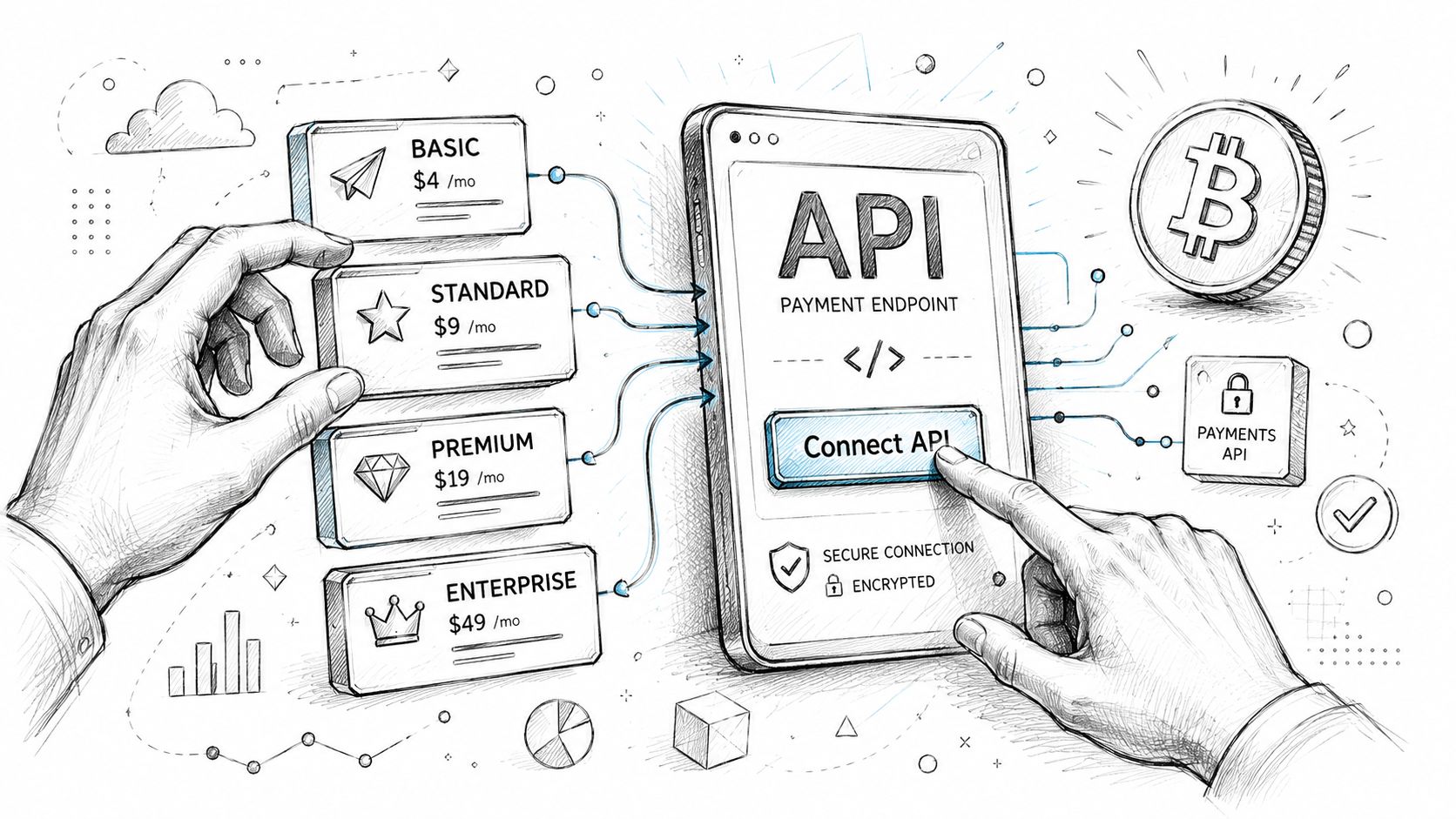
A pricing strategy only works if your billing system can enforce it cleanly. That means your plans need to exist as structured objects, not hand-maintained spreadsheet logic or support-team exceptions.
Most advice on subscription tiers assumes card-only billing and local bank payouts. But this underexplored angle on cross-border tiering and payment preference points to a more practical reality. International merchants increasingly need subscription logic that works across card and crypto rails while settling in USDC.
Model plans as products with states and events
At implementation level, each tier should be defined by a few core attributes:
Plan identity: Name, billing interval, and entitlement set
Access rules: What a subscriber can use while active
Lifecycle rules: What happens on signup, renewal, failed payment, cancellation, or downgrade
Migration rules: How upgrades and downgrades take effect
A payment API saves real time. Instead of rebuilding billing logic internally, you can create plans, attach recurring charges, and react to lifecycle events programmatically. For teams evaluating tooling, subscription billing software options for recurring payments are worth comparing based on API coverage, webhook support, and global payment flexibility.
One option in that category is Suby, which provides an API that lets businesses accept payments by card or crypto, supports recurring subscriptions, and settles merchant revenue in USDC. It also offers native integrations with Discord and Telegram for paid access and online communities. The operational point is simple. Users pay with cards, businesses receive USDC.
Use webhooks for access and lifecycle changes
Webhooks are what turn a paid subscription into an automated product experience. When billing status changes, your systems should react immediately.
Typical webhook-driven actions include:
Granting access: Add the user to the correct plan, group, or role after successful payment
Changing permissions: Upgrade entitlements when a customer moves to a higher tier
Pausing access: Restrict premium features if a renewal fails or a plan is canceled
Cleaning up manually assigned exceptions: Remove one-off access that no longer matches the paid tier
For community businesses, this matters a lot. If someone subscribes to a premium Discord or Telegram membership, the billing system and the access system need to stay synchronized. Manual reconciliation doesn't scale, and it creates trust problems when access lags behind payment.
Build your entitlement logic once, then let payment events trigger it consistently.
That's the difference between a tiered model that looks good on a pricing page and one that operates cleanly.
How to Measure and Optimize Your Tiers for Growth
Most pricing mistakes don't show up immediately. A plan can convert well at launch and still create weak retention later. That's why tier optimization needs plan-level measurement, not just an overall revenue graph.
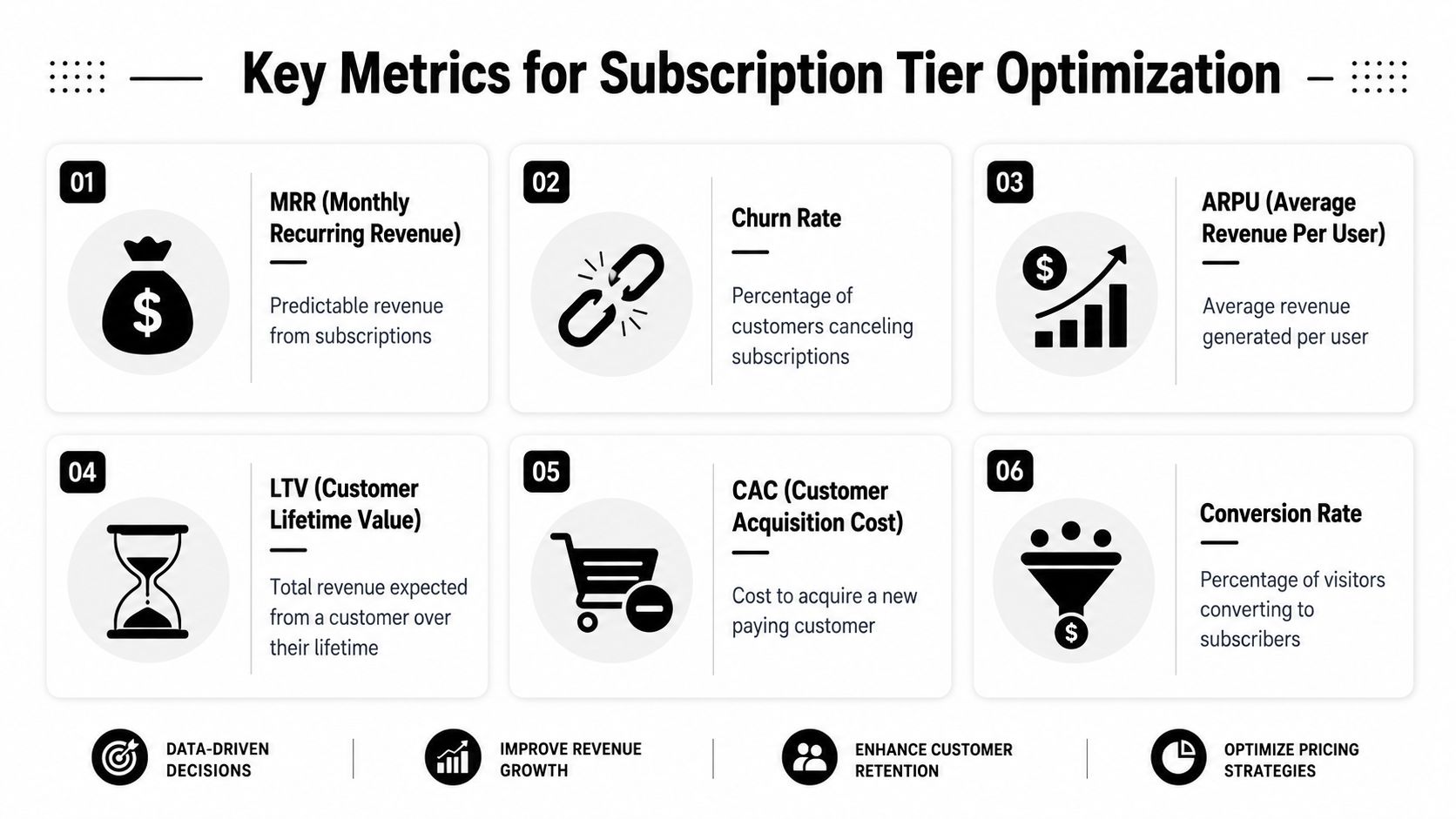
In subscription businesses, MRR is calculated as the number of active accounts multiplied by average revenue per account (ARPA), which makes tier mix a direct revenue lever. The same source notes that 59% of companies highlight customer friction when billing, packaging, and upgrade paths are poorly designed, according to Wall Street Prep's subscription pricing overview.
Read metrics by tier, not only in aggregate
Looking at blended numbers hides problems. One tier may be healthy while another leaks good customers.
Focus on these by plan:
Metric | What it tells you | Common warning sign |
|---|---|---|
MRR | Revenue contribution by tier | Growth comes from signups, but not from upgrades |
Churn | Whether the plan keeps users | One plan loses customers much faster than the rest |
Upgrade rate | Whether the ladder works | Entry plan users stall and never move up |
Downgrade rate | Whether premium value holds | Customers buy up, then retreat quickly |
ARPU | Revenue quality by segment | Too many customers cluster in the cheapest plan |
CLTV | Long-term value of each tier | High-acquisition segments don't stay long enough |
If your top-level dashboard looks fine but a single plan has poor retention, the packaging is probably off. The issue may be pricing, but it could just as easily be entitlement mismatch or weak onboarding for that segment.
For teams trying to interpret cancellations more clearly, this breakdown of churn in SaaS is useful because it separates churn as a product issue from churn as a packaging issue.
Run small tests that change buyer behavior
Not every pricing test should be a full redesign. Smaller tests are safer and often more informative.
A practical testing queue:
Adjust one plan description
Change the wording so the target customer is clearer.Move a single feature boundary
If users don't see enough separation between plans, shift one meaningful capability.Change which plan is visually emphasized
Many teams label one plan as “most popular” or otherwise highlight it. That can change buyer distribution.Test upgrade timing
Offer expansion prompts at the moment a customer hits a real limit, not at random.
The most useful pricing data often comes from movement between tiers, not from top-of-funnel clicks.
Treat subscription tiers as a living system. Launching is only the first pass. The durable gains usually come from tightening one confusing boundary, clarifying one audience mismatch, or removing one bit of billing friction that slows upgrades down.
Your Blueprint for Recurring Revenue
Strong subscription tiers don't start with features. They start with customer differences that matter. Once you know who the plans are for, the rest of the work becomes more disciplined: choose a clear value metric, create meaningful separation between plans, set billing options that fit buyer behavior, implement the logic through API and webhooks, and review plan-level metrics often enough to catch problems early.
The biggest mistake is searching for the perfect structure. There isn't one. Good tier design is iterative. Markets shift, customer expectations change, and your best-fit segment often becomes clearer after launch.
If you want to study how subscription thinking translates into broader retention and revenue work, these DTC wine brand revenue insights from Ecommerce Boost are a useful example of how offer design and recurring relationships shape growth over time.
A global business needs more than a neat pricing table. It needs subscription tiers that hold up across borders, payment preferences, and operational realities. When users can pay with cards or crypto and the business can receive USDC predictably, pricing becomes easier to manage and easier to scale.
Suby is a payment gateway. Your customers pay with card, bank transfer, Apple Pay, Google Pay, Klarna, and more, or stablecoins, and you get paid out to your bank account, or directly in stablecoins (USDC, EURC) to your wallet, anywhere in the world, no bank account required. It gives you an API, recurring billing, and native Discord and Telegram integrations for paid access and online memberships. For subscription tiers, that keeps your packaging stable across borders while the payment layer handles the variation behind the scenes.
