

Gaspard LEZIN
Cash App Payment Processing: Complete Guide for Merchants
Learn how Cash App payment processing works for merchants, including integration, fees, and settlement flows.
Cash App Pay had about 6 million monthly active users in 2025, while Block reported 57 million monthly transacting actives across the broader Cash App ecosystem by mid-2025, including card and banking activity. That scale changes the question for merchants. Cash App payment processing isn't just about sending money between friends anymore. It's a consumer checkout rail with its own authorization flow, settlement model, and dispute risks.
For developers, the important work starts after the button is added. You need to understand how customers authorize payments, when funds are merely held, how daily activity reaches your bank account, and who handles a transaction when the customer says it wasn't authorized. Cash App Pay can be useful, but it should be integrated as a payment method with operational consequences, not treated as a frictionless shortcut.
Table of Contents
Why Merchants Are Evaluating Cash App Payment Processing
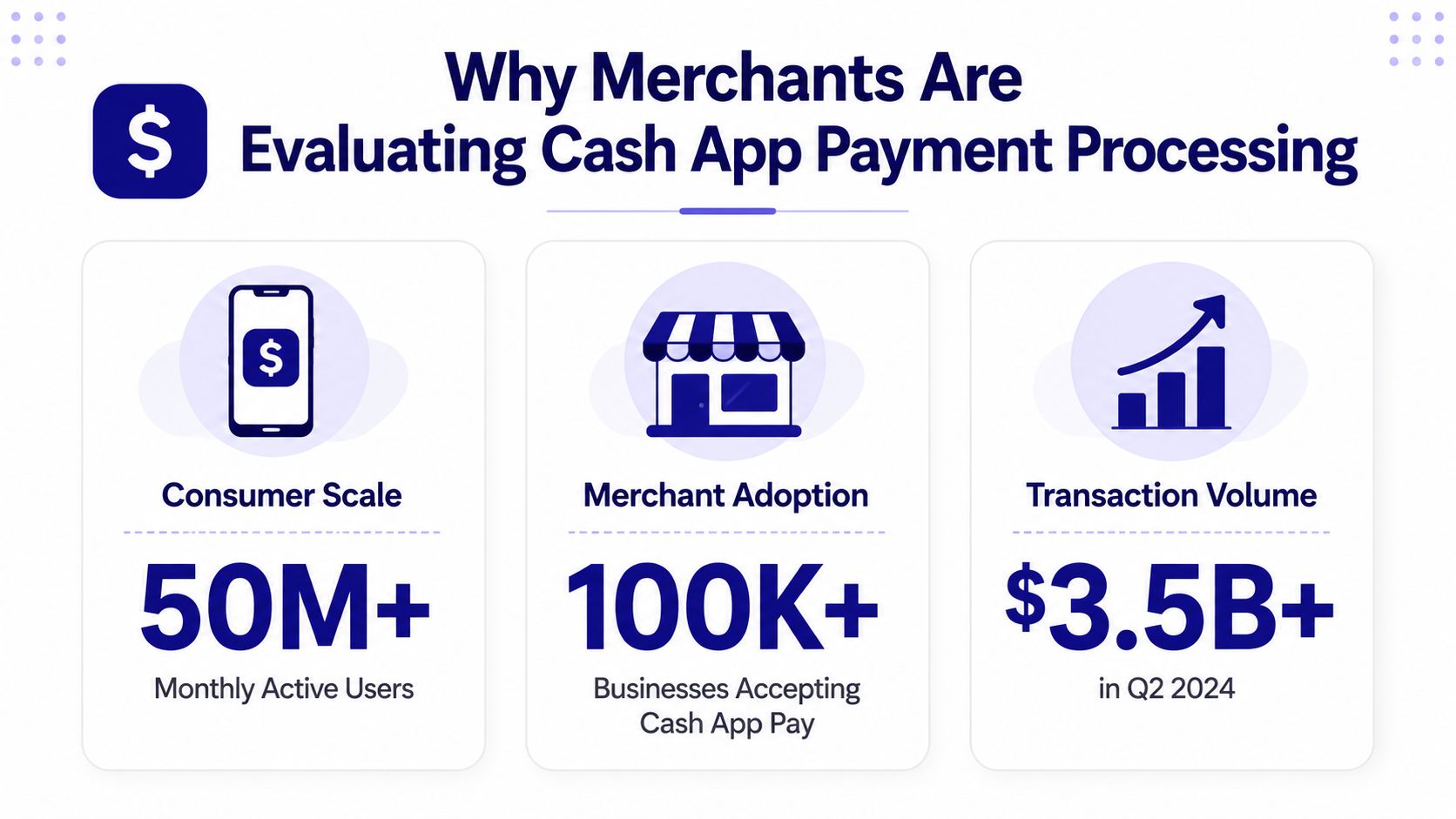
Cash App has moved well beyond its original person-to-person use case. Block reported 56 million monthly transacting actives in early 2024, and the broader figure reached 57 million by mid-2025, while annual inflows increased from $248 billion in 2023 to $282.9 billion in 2024. The figures are documented in Block's SEC filing and show a platform operating at a substantial consumer payments scale.
Cash App Pay is the merchant-facing part of that expansion. Customers can use their Cash App balance or a linked debit card, and Cash App positions the service for online and in-person purchases at select merchants. Customers don't need a Cash App Card or card numbers for the checkout experience, according to Cash App's payment guide.
A payment channel, not just another wallet
The strategic appeal is familiar. A merchant can add a payment option that may already be present in a customer's financial routine, instead of asking that customer to enter card details or create another account. That can make sense for mobile-first audiences, recurring digital purchases, and businesses that already see Cash App in their customer requests.
The trade-off is that Cash App Pay doesn't replace a card strategy, bank payments, or other wallets. It serves a defined customer segment and introduces a distinct redirect or QR flow. The right question is whether the method adds useful choice without creating an awkward checkout branch that your support and reconciliation teams can't manage.
Block's broader ecosystem also included 26 million Cash App Card actives and 8 million banking actives in mid-2025, according to coverage of Block's 2025 growth priorities. That combination matters because it shows why Cash App Pay is relevant to more than peer-to-peer transfers. The platform connects wallet balances with card-linked and banking usage, giving merchants a larger payment environment to consider.
Practical rule: Add Cash App Pay when you can measure its checkout contribution separately. Don't assume that a large wallet audience automatically means a better conversion path for every buyer.
How the Cash App Pay Transaction Flow Works
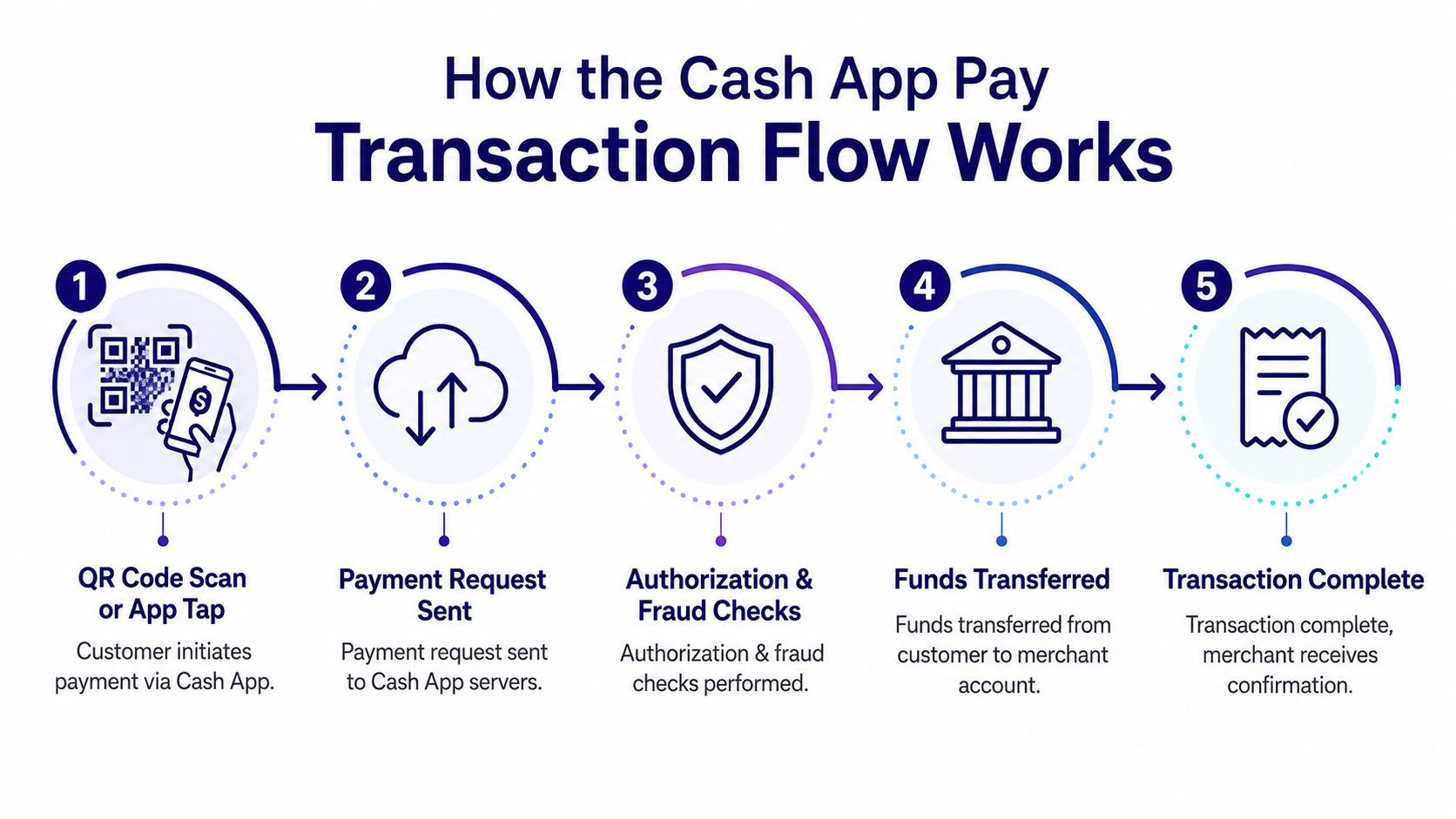
Cash App Pay uses a dual-message authorization-capture model. The customer first requests the payment, the system authorizes it, and the merchant then captures the authorized amount. The merchant's backend sends that grant through the server-side Network API, rather than allowing the browser to perform the sensitive payment action directly, as described in Cash App's payment flow documentation.
That separation affects both implementation and failure handling. Your frontend starts the customer interaction, but your server should own the payment state, authorization result, capture request, and event handling. A browser redirect or QR scan isn't proof that the order is paid.
The customer experience
On mobile, the customer selects Cash App Pay and is redirected into Cash App. On desktop, the merchant site displays a QR code, which the customer scans and completes in the app. Cash App's checkout instructions describe both paths.
After the customer approves the request, your integration should treat the authorization and capture as separate operational events. Store your own order identifier alongside the Cash App payment identifier, and make capture idempotent so a retry can't create an accidental duplicate.
Cash App Pay exposes three customer-facing transaction phases:
Pending: A temporary hold is placed on the customer's funds.
Canceled: The hold is released and the payment doesn't complete.
Completed: The amount is finalized and transferred to the merchant.
Those phases are defined in Cash App's transaction phase reference. They should map cleanly to your order states. Pending should not trigger fulfillment, canceled should release inventory or restore the cart, and completed should produce the confirmation your customer sees.
The payment flow ends with settlement later the same day after capture, but settlement isn't the same thing as an individual bank payout. Treasury treatment depends on the batching process described below. Your application should also handle refunds, chargebacks, timeouts, and a customer abandoning the app before authorization completes.
Integration Options for Accepting Cash App Payments
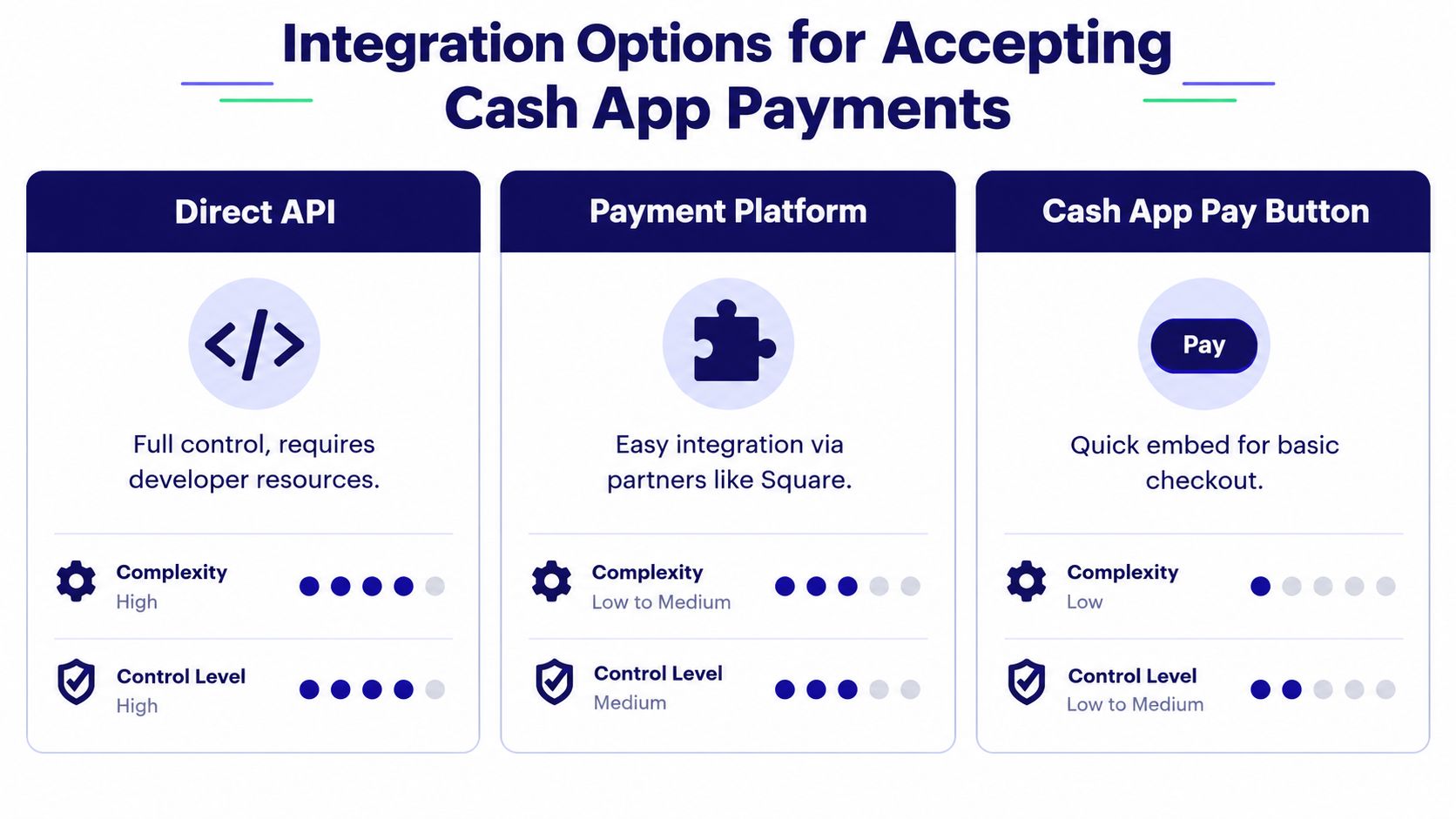
There are three practical integration paths: direct API work, a payment platform that already supports Cash App Pay, and a simpler hosted button or checkout component. They differ less in the customer's choice than in who owns the payment state, error handling, and long-term maintenance.
Direct API integration
A direct integration gives your engineering team control over order creation, authorization, capture, webhooks, refund logic, and dispute workflows. That control is valuable when Cash App Pay must fit a complex checkout, marketplace ledger, or internal risk engine.
It also creates more responsibility. You need server-side credentials, reliable state management, retry behavior, observability, and a clear response when the customer authorizes in the app but your browser session has expired. The API route makes sense when your team already operates payment integrations and needs precise control over the checkout lifecycle.
Payment platform support
A payment service provider can reduce implementation work if Cash App Pay already fits your existing payment orchestration layer. This approach can be faster, but you need to verify how the provider exposes authorization, capture, refunds, settlement reports, and disputes. An abstracted checkout is only useful if the underlying events remain visible to your finance and support teams.
For teams comparing API architecture more broadly, this payment gateway API integration guide offers a useful reference point for evaluating control, webhooks, and payment-method coverage.
Button or hosted checkout
A hosted option is usually the quickest path for a basic checkout. It can work well for a small catalog, a payment link, or a straightforward purchase where you don't need elaborate order orchestration.
The limitation is reduced control over the edge cases. Before choosing it, confirm how the component reports pending payments, canceled authorizations, completed captures, refunds, and customer returns from the Cash App app. Mobile redirects and desktop QR codes are simple for customers, but they still need strong server-side confirmation on the merchant side.
Settlement Mechanics and Reconciliation Requirements
Cash App Pay settlement is ACH-based and batched for payment service provider clients. Daily eligible CAPTURE, REFUND, and CHARGEBACK activity is aggregated into a single ACH transfer to the configured bank account, rather than paid out as one bank transfer per transaction. The official settlement documentation also describes reconciliation files uploaded through SFTP.
That design is manageable if your finance workflow expects batch settlement. It becomes painful when your accounting system assumes every order produces a matching bank credit immediately. The bank statement shows the net batch, while your order database contains individual captures, refunds, and chargebacks. Your reconciliation layer has to connect those two views.
Build around the batch
The correct accounting model is not “payment completed equals money in the bank.” A completed payment is a customer transaction state. The ACH transfer is a later treasury event, and the two need separate records.
A workable process should include:
Capture ledger: Store each captured payment with the merchant order ID, transaction ID, amount, and timestamp.
Adjustment ledger: Record refunds and chargebacks as separate entries, not as edits to the original order.
Settlement matching: Match the net ACH amount to the settlement report and then allocate the batch back to individual transactions.
Exception queue: Flag records that are missing, duplicated, reversed, or unmatched instead of forcing a false balance.
Each reconciliation report can contain up to 9,999 transaction records, according to the same Cash App documentation. High-volume merchants should therefore design file ingestion and validation around the report structure, not rely on a manual spreadsheet process.
Finance teams shouldn't reconcile a wallet by looking only at the bank statement. The bank statement tells you the batch arrived. The settlement file tells you why the batch has that value.
The SFTP file also creates an operational dependency. Your system needs secure retrieval, checksum or file-integrity validation, duplicate-file protection, and an audit trail showing when a report was received and processed. Batch cutoffs, net settlement timing, and report availability should be documented for treasury, accounting, and customer support.
For a broader framework on matching processor activity to bank movements, see this guide to payment reconciliation. The principle applies here even though the Cash App-specific report and ACH process have their own details.
Dispute Handling and Fraud Protection Considerations
The most underestimated part of Cash App payment processing is what happens when the payment is wrong. Merchants often focus on authorization success, but customers care about unauthorized transfers, missing refunds, duplicate charges, and the ability to reach a real support channel.
Cash App Card disputes and peer-to-peer disputes follow different paths. Cash App's help material gives both routes a 60-day window tied to the monthly statement, while peer-to-peer disputes are investigated with an update promised within 10 business days, as described in Cash App's dispute guidance. Those rules don't map neatly onto a traditional card chargeback assumption.
Liability needs a written answer
Before launch, ask your provider or Cash App contact who owns each stage of a dispute:
Customer intake: Does the customer contact Cash App, the merchant, or both?
Evidence collection: Who supplies order records, delivery evidence, authorization details, and refund history?
Funds movement: Can a chargeback reduce a later settlement batch?
Support escalation: What does the merchant do when the customer says the payment was unauthorized but the order was fulfilled?
Status visibility: Which webhook, report, or dashboard state tells your team the dispute is open or resolved?
These questions matter because Block faced serious regulatory scrutiny. In January 2025, the CFPB ordered Block to pay $175 million, including $120 million in consumer redress, after finding failures related to unauthorized transfer investigations, refunds, and live support. Reuters also reported a separate $45 million multistate settlement in July 2026 concerning fraud protections. The CFPB announcement documents the federal action, while the Reuters report is identified in the supplied source material.
Those events don't prove that every Cash App Pay transaction will fail. They do show why merchants shouldn't outsource their entire risk posture to a payment button. Keep detailed authorization and fulfillment records, make refund rules explicit, monitor unusual order behavior, and give support staff a documented escalation path.
For practical policy design, this guide to chargebacks and disputes is relevant beyond card networks. A wallet transaction still needs evidence, ownership, and a process when the customer challenges it.
When to Use Cash App Versus Broader Payment Infrastructure
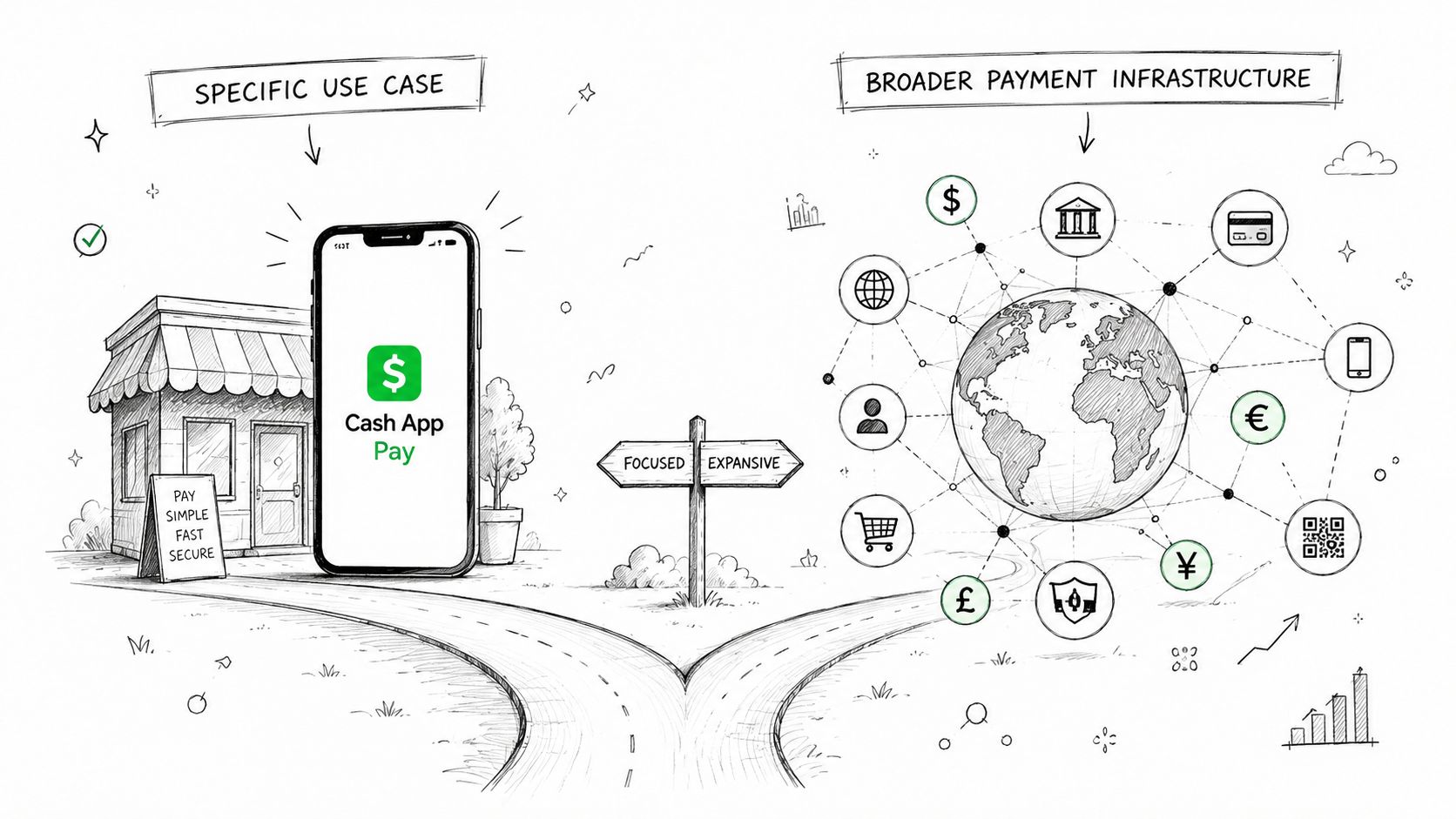
Cash App Pay makes sense when your customers already use Cash App, your business mainly serves the United States, and your team can support its app redirect, QR checkout, settlement batches, and dispute process. It can be a sensible addition to cards and other wallets when the payment method reflects real customer demand.
It's a weaker foundation when you need one system for international acceptance, multiple currencies, bank payments, card wallets, and crypto. A single-wallet integration can solve one checkout preference while leaving your payout, foreign exchange, subscriptions, invoicing, or community-access requirements in separate systems.
Use Cash App Pay when the channel is specific
Choose Cash App Pay as an additional method when:
Your audience already requests it: The method can meet an existing customer preference rather than adding an untested checkout option.
Your operating model is domestic: You can accept the geographic and currency constraints of the rail.
Your finance team can process batches: ACH settlement and SFTP reconciliation fit your accounting workflow.
Your support team owns exceptions: You have clear procedures for pending payments, refunds, and disputes.
Choose broader infrastructure when the business needs customers to pay by card, wallet, bank, or crypto, while the business chooses whether to receive funds in a bank account or in stablecoins such as USDC. Suby provides an API that lets any business accept payments by card or crypto, and it offers native integrations with Discord and Telegram for subscriptions, paid access, and online communities.
Suby is one product with four ways to use it. Suby Payments provides an API-first payment stack for cards and crypto through one checkout. Suby Crypto handles the swap, sponsors gas, and settles to a non-custodial wallet or the Suby balance. Suby Gating supports paid access for Discord, Telegram, downloads, and courses, while Suby Invoicing lets the client choose how to pay and the business choose what it receives.
Pricing depends on the payment method used, so review the Suby pricing page for exact figures rather than assuming a flat rate.
Suby gives merchants an API for card and crypto payments, plus native Discord and Telegram integrations for subscriptions, paid access, and online communities. If Cash App Pay is only one part of your checkout and you want customers to pay any way they want while your business settles to a bank account or in USDC, visit Suby to evaluate the available payment flows.
