

Gaspard LEZIN
Lemon Squeezy Alternative: A Practical 2026 Guide
Looking for a Lemon Squeezy alternative in 2026? Compare fees, payment methods, tax handling, and crypto options to pick the right platform.
The most important Lemon Squeezy alternative decision in 2026 is whether you need a full Merchant of Record to handle taxes, or a payment stack where you keep that responsibility. Lemon Squeezy's baseline is 5% + 50¢ per transaction, while a flexible alternative can change how you accept payments, manage compliance, and receive payouts.
You're probably not shopping because your checkout suddenly stopped working. You're shopping because your product has outgrown a narrow payment setup, or because Stripe's acquisition of Lemon Squeezy made the long-term roadmap feel less certain. The right replacement isn't automatically the cheapest one. It's the platform that matches your tax obligations, customer payment habits, and preferred settlement currency.
Table of Contents
Why Founders Are Looking for a Lemon Squeezy Alternative
Stripe announced its acquisition of Lemon Squeezy on July 26, 2024, for an undisclosed amount. At the time, Lemon Squeezy was described as a payments-processing startup that had been operating for about four years, making the deal a visible example of consolidation in software billing and merchant-of-record infrastructure. Lemon Squeezy's acquisition announcement places the transaction in the wider shift toward platforms that help digital businesses sell internationally.
That change matters because founders don't just buy checkout buttons. They buy a dependency. If your subscriptions, customer records, refunds, tax treatment, and product access all sit inside one provider, switching later becomes an operational project even when the code change looks small.
The common triggers are familiar:
Roadmap uncertainty: An acquired product may change direction, pricing, support priorities, or integration strategy.
Payment-method gaps: Customers increasingly expect wallets, bank payments, local methods, and alternatives to cards.
Settlement constraints: Some businesses want bank payouts, while others need stablecoin settlement or a particular currency.
Operational sprawl: A lower processing fee can require separate tax software, compliance workflows, refund handling, and dispute management.
Founders who sell software, templates, courses, or creator products often have a second revenue stream to manage as well. If sponsorships are part of your business, a focused guide to creator sponsorships with taap.bio can help you evaluate that workflow separately instead of forcing payment infrastructure to solve every monetization problem.
The key question isn't “Which Lemon Squeezy alternative charges less?” It's “Who owns the difficult work after a customer pays?”
Read why founders prefer Lemon Squeezy over Stripe if you're still deciding whether the original MoR model fits your business. Then make the choice explicitly:
Practical rule: Choose a full MoR when tax ownership is the priority. Choose a flexible payment stack when you already have, or deliberately want to build, your own tax and compliance operation.
The Market You Are Actually Choosing In
This category is large enough that small differences in checkout architecture have strategic consequences. Worldpay reported that global e-commerce spend reached over $6.8 trillion in 2024, compared with $1.2 trillion in 2014. The same report says total digital payment spending across e-commerce and in-person channels rose from $1.7 trillion to $18.7 trillion over that period. Worldpay's global payments report shows why payment infrastructure has become a board-level concern even for small software companies.
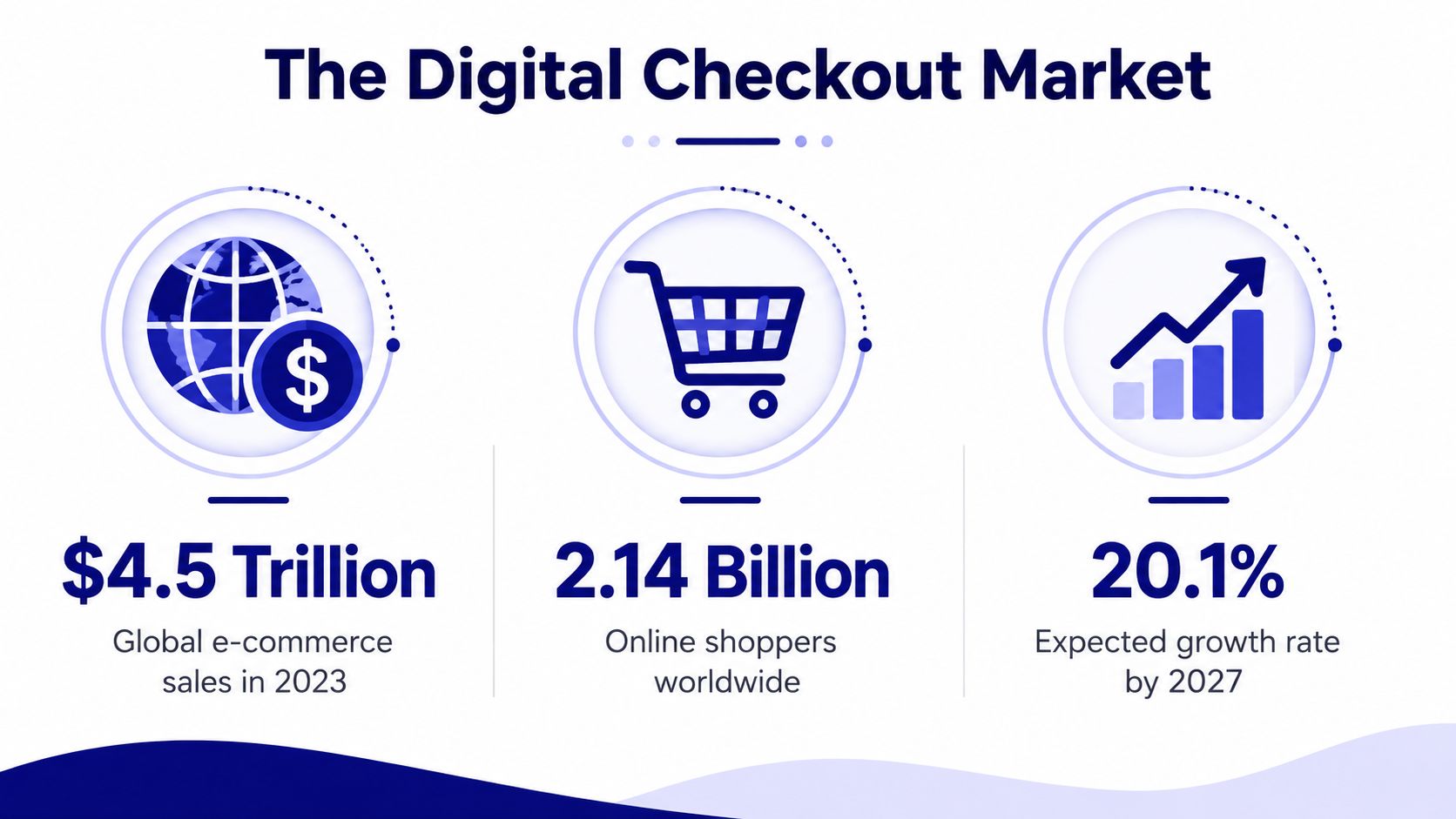
The payment method mix is changing just as quickly. Digital wallets represented 53% of e-commerce spend in 2024, according to Worldpay, and wallets grew ten-fold online and in stores over the decade covered by the report. A checkout that only performs well for cards can still function, but it leaves part of the buyer's preferred payment behavior outside the product experience.
Digital goods add another reason to take the category seriously. Juniper Research projected that eCommerce payments for digital goods would rise from 87 billion in 2024 to 188 billion by 2029. Juniper's projection, reported in the same market coverage, points to a widening market for platforms that combine subscriptions, software delivery, tax handling, and international payment acceptance.
Why the numbers affect your platform choice
A growing market attracts more providers, but more choice doesn't make the decision simpler. It creates more ways to optimize one part of the stack while increasing the workload somewhere else.
A platform may offer a lower visible transaction cost but leave you responsible for registrations, tax collection, remittance, refunds, disputes, and payment compliance. Another may charge more per transaction while consolidating those tasks as part of a merchant-of-record service.
The useful comparison therefore has three layers:
How customers pay, including cards, wallets, bank payments, local methods, and crypto.
Who owns the legal and tax obligations, especially across the EU, UK, and other tax-heavy markets.
How you receive the proceeds, including bank payouts, currency conversion, and stablecoin settlement.
Checkout speed is still relevant, but it isn't the deciding metric for most founders. Payment reach and operational ownership usually matter more.
What Lemon Squeezy Does Well and Where Alternatives Diverge
Lemon Squeezy earned its position by making global digital sales feel manageable for small teams. Its merchant-of-record model gives sellers a simpler path through VAT, sales tax, compliance, and customer billing. For an indie SaaS product or digital download business, that reduction in administrative work can matter more than a small difference in checkout customization.
Its baseline pricing is 5% + 50¢ per transaction, as shown in independent comparison tables such as this review of Lemon Squeezy alternatives. Treat that figure as a starting point, not the complete cost of ownership. The bill also includes the work you avoid, or recreate, after moving platforms.
The five criteria that change the economics
Transaction fees are the easiest metric to compare because they appear on a pricing page. They're also the least complete. A cheaper processor can require tax tooling, compliance reviews, reconciliation work, and separate refund or dispute processes.
Payment-method coverage determines whether customers can use the method they already prefer. Cards remain important, but wallets, bank payments, local methods, and crypto can change conversion and geographic reach. The right question is not whether a provider supports “global payments.” Ask which methods are available in the markets where your customers live.
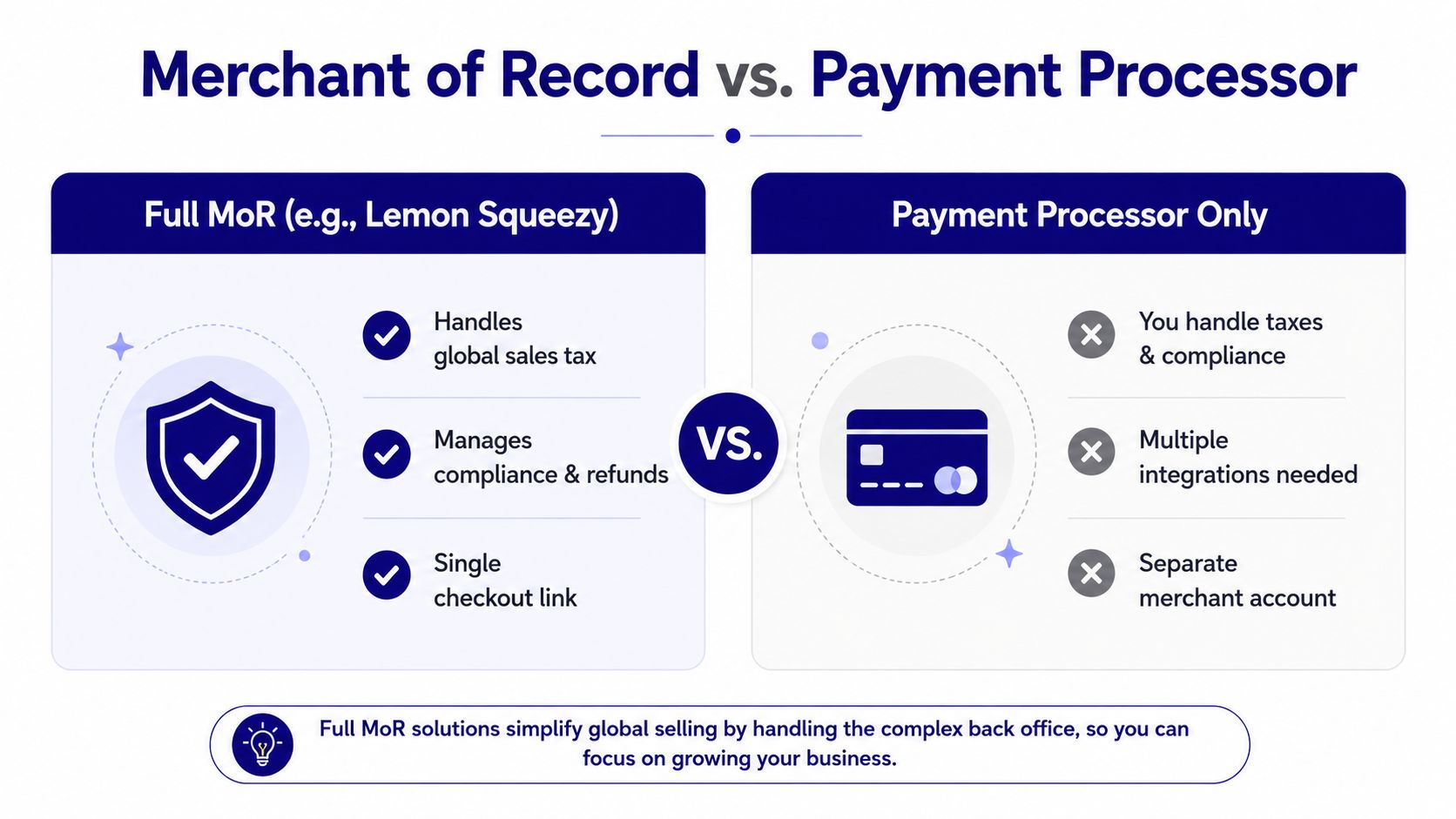
Tax and compliance ownership separates a full MoR from a standard processor. A MoR becomes the legal seller and handles the relevant sales-tax workflow. A processor generally moves money while the merchant remains responsible for the legal obligations.
Settlement flexibility matters when your business operates across currencies or wants to hold proceeds differently from the customer's payment method. Bank settlement may be enough for one company. Another may need stablecoin settlement, multi-currency payouts, or a single balance for different payins.
Integrations and APIs decide how much custom work you'll maintain. Developer APIs and webhooks matter for SaaS billing. Native Discord and Telegram integrations matter for paid communities. Hosted checkout and paylinks matter when you want to launch without building every screen yourself.
A platform isn't cheap if it saves processing fees but adds a second tax system, a third reconciliation workflow, and a manual refund queue.
The practical split is clear. Lemon Squeezy remains attractive when hands-off MoR coverage is the central requirement. Alternatives diverge when they offer broader payment reach, different settlement options, more control, or a pricing model that better fits an existing tax stack.
The Tax and Compliance Question Most Comparisons Skip
The biggest switching mistake is treating merchant-of-record status as a checkout feature. It isn't. It determines who is legally responsible for selling the product and managing the associated tax and compliance work.
A full MoR acts as the legal seller. That structure can include handling VAT, sales tax, remittance, compliance, and related customer operations. A standard payment processor facilitates the transaction, but the merchant typically remains responsible for the tax stack, registrations, filings, refund rules, and dispute processes. Suby's merchant-of-record explanation lays out why this distinction should be evaluated before comparing headline fees.
What changes after you leave the MoR model
Consider a creator selling templates into the EU. Under a full MoR arrangement, the platform handles the seller-side tax process within its service. With a non-MoR stack, the creator may need separate tax tooling, market-specific registrations, reporting processes, and a way to keep transaction records aligned with those obligations.
A SaaS team selling B2B subscriptions into the UK faces a different version of the same problem. It may need to distinguish customer types, preserve evidence for tax treatment, issue compliant invoices, and coordinate refunds or disputes with its billing system. The payment processor doesn't automatically remove those responsibilities.
A small studio selling courses across multiple regions has to think about customer location, tax rates, digital-product rules, refund policies, and payout reconciliation. The engineering integration may be straightforward, but the operational ownership has moved from the platform to the studio.
That's why a vendor review should include more than a pricing spreadsheet. Grumspot's vendor selection process is useful context for assessing operational fit, ownership, and risk alongside feature coverage.
Make the decision based on your existing capacity
Choose a full MoR when:
Your team lacks a tax operation: You don't want to manage registrations, remittance, and regional compliance.
You sell broadly across borders: The administrative burden grows as your customer base expands into tax-heavy markets.
You value one accountable provider: Refunds, disputes, billing, and tax treatment sit within a more consolidated operating model.
Choose a non-MoR payment stack when:
You already have tax infrastructure: Your accountant, tax tool, and internal workflows can handle the responsibility.
You need settlement control: Bank payouts, stablecoins, and currency choices matter more than hands-off tax administration.
You want payment flexibility: You're prepared to own the compliance layer in exchange for broader control.
The “cheaper” option is only cheaper after you add every required tool and the time your team spends operating it.
Suby as a Single-Product Alternative With Four Ways to Use It
Suby is positioned as one payment product with four distinct ways to use it. The common model is straightforward: customers can pay by card, wallet, bank transfer, BNPL, or crypto, while the business chooses whether to receive funds in a bank account or stablecoins such as USDC, in the currency it wants. The official Suby documentation describes those payment and settlement options.
Suby provides an API that lets any business accept payments by card or crypto. It also offers native integrations with Discord and Telegram for subscriptions, paid access, and online communities. The core operating choice is simple: customers pay the way they prefer, and the business receives the proceeds in the way it has selected.
Four operating modes in one product
Suby Payments is the API-first payment stack. It supports card and crypto checkout through one integration, which suits SaaS teams and developers that want payment controls through an API, dashboard, or checkout flow.
Suby Crypto is the crypto-native gateway. Suby handles the swap, sponsors the gas, and settles either to a non-custodial wallet or to the Suby balance. That keeps crypto payment handling separate from the customer's checkout decision, instead of requiring every merchant to manage the underlying transaction mechanics.
Suby Gating handles paid access for Discord, Telegram, downloads, and courses. This is the direct fit for a creator or community operator whose product is access rather than a traditional software license.
Suby Invoicing lets a client choose how to pay while the business chooses what it wants to receive. That can fit agencies and freelancers billing internationally, especially when card, bank, and crypto payments need to land in one operating balance.

The card-to-USDC flow is useful, but it isn't the whole product
A customer can pay by card, while the merchant receives proceeds in USDC or through a bank payout. Suby's documentation says crypto payments are converted automatically using real-time oracle rates, while card payments are charged in the product currency. Its website lists payout paths including USD to USDC, USD to AED, and EUR to EURC. The API introduction describes the payment and settlement flow.
That matters for businesses that sell in familiar fiat methods but prefer to manage treasury in stablecoins. It isn't the only use case. A merchant can also accept crypto, collect bank payments, use wallets or BNPL, and settle through a bank account.
Pricing depends on the payin method used. There isn't one flat rate across cards, wallets, crypto, and bank transfers, and payout pricing is shown separately. Check the official Suby product page and its pricing details before making a cost comparison.
How to Migrate From Lemon Squeezy Without Losing Customers
Migration risk usually comes from incomplete operational planning, not from writing the new checkout call. A small SaaS team needs to preserve product access, subscription status, customer communication, refunds, and tax continuity while the payment endpoint changes underneath them.
Start by mapping what Lemon Squeezy currently owns. Separate customer records, product definitions, subscription states, renewal dates, checkout links, webhooks, refund records, and tax-related reporting. Don't assume the new provider will import these objects with identical names or behavior.
Use a controlled migration sequence
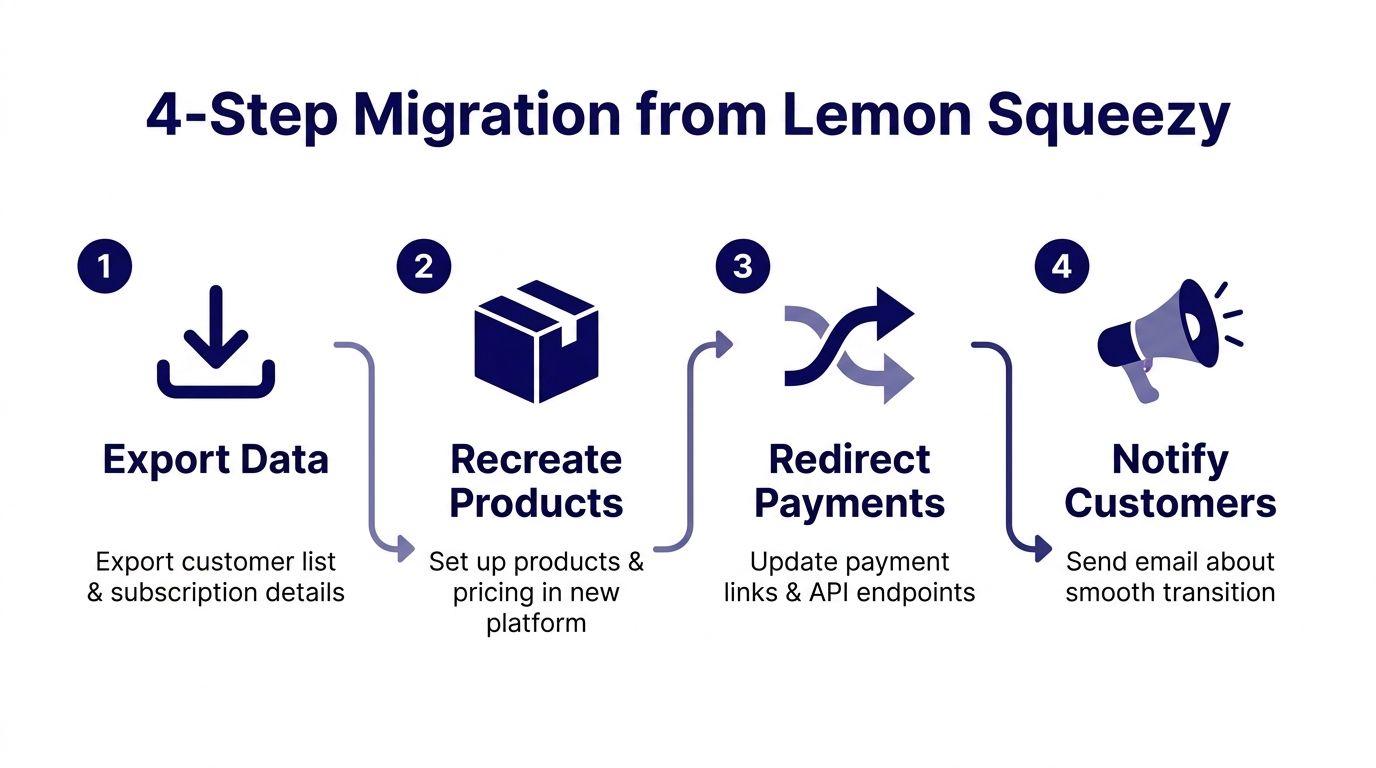
Export and reconcile records. Preserve your customer list, active subscriptions, product catalog, payment history, and refund information. Reconcile the export against your application database before creating new products.
Recreate products and billing rules. Match product names, prices, billing intervals, trial behavior, access rules, and cancellation handling. A visually identical checkout is not enough if renewal events trigger different application behavior.
Build the new payment path in parallel. Test paylinks, API calls, webhooks, subscription events, failed payments, refunds, and access removal before redirecting live traffic. Keep a clear record of which system is authoritative during the transition.
Communicate the change before it affects billing. Tell customers what is changing, what isn't changing, and how they'll handle payment-method updates. A short, specific message is better than silence followed by a failed renewal.
Tax continuity needs its own review. Moving to another full MoR may transfer seller-side handling to the new provider. Moving to a flexible payment stack can give you more control over payment methods and settlement, but you may retain responsibility for tax and compliance.
Suby supports the card-to-crypto settlement flow described above. Customers can pay by card or crypto, and merchants can receive proceeds in USDC or through a bank payout. The documented payout paths include USD to USDC, USD to AED, and EUR to EURC, so confirm the exact route and operational requirements before scheduling the cutover.
Watch for three failure points:
Webhook mismatches: Subscription renewal, cancellation, refund, and dispute events may use different names or payload structures.
Duplicate billing: Running old and new recurring billing logic without a clear ownership boundary can charge customers twice.
Refund confusion: Customers need to know which provider handles purchases made before and after the migration.
Which Alternative to Pick by Use Case
The best Lemon Squeezy alternative depends on what you refuse to operate yourself. Don't choose from a generic ranking. Choose according to the part of the payment stack that would cause the most damage if it failed.
Criterion | Lemon Squeezy | Suby |
|---|---|---|
Operating model | Merchant-of-record model for digital products and software | Payment infrastructure with multiple payment and settlement paths |
Customer payment methods | Compare against the methods your customers require | Cards, wallets, bank transfers, BNPL, and crypto |
Merchant settlement | Review available payout currencies and timing | Bank payout or stablecoin settlement, including USDC |
Integrations | Hosted checkout, subscriptions, and developer tooling | API, checkout, paylinks, plus native Discord and Telegram integrations |
Tax ownership | MoR model can reduce seller-side tax administration | Confirm the tax and compliance responsibilities for your intended setup |
Pricing | Baseline pricing is 5% + 50¢ per transaction | Fees depend on the payin method, with payout pricing shown separately |
SaaS teams that want hands-off tax handling
Stay in the MoR category if your primary requirement is removing tax administration. A full MoR is the cleaner choice for a SaaS team that sells across the EU, UK, and other markets where registrations, remittance, refunds, and compliance create ongoing work.
If your team already operates a tax stack and needs more payment or settlement control, a payment infrastructure provider can make sense. But document ownership before signing. The cheaper quote won't protect you from an obligation your team still has to perform.
Cross-border merchants accepting card and crypto
Choose a platform that supports both in one checkout if your customers use both. Suby's API accepts card or crypto payments, and its broader documented payment coverage includes wallets, bank transfers, and BNPL. The value is less about adding a crypto badge and more about giving customers multiple ways to complete the same purchase.
Creators and community managers
For paid Discord or Telegram communities, Suby Gating is the most direct fit among the options discussed here. It supports paid access for Discord and Telegram, along with downloads and courses, so the payment event can connect to the access use case rather than forcing a creator to assemble separate payment and community tools.
Agencies and freelancers who prefer USDC payouts
Suby Invoicing fits this profile when clients need to choose among card, bank, or crypto payments while the agency wants a selected settlement method. Confirm the exact payout route and fees before quoting clients.
Use this checklist before switching:
Do you need a full MoR to own tax and compliance?
Which payment methods do your customers use?
Do you need bank payouts, stablecoin settlement, or both?
Are Discord, Telegram, API, webhooks, or paylinks essential?
Have you reviewed the official Suby pricing page for the applicable per-method and payout fees?
Suby's pricing isn't a single flat rate. Its documentation states that fees depend on the payin method, with separate structures for cards and wallets, crypto, bank transfers, and payouts. Use the current pricing page for the exact comparison.
Common Questions About Switching From Lemon Squeezy
How long does a migration take?
There isn't a universal timeline. The work depends on customer records, recurring subscriptions, product access, webhooks, refunds, and tax ownership. The engineering change may be small, but reconciliation and customer communication determine whether the switch is safe.
Do crypto payments cost more?
Suby pricing depends on the payin method, so crypto fees shouldn't be assumed to match card or bank fees. Check the current payment-method pricing documentation before publishing or modeling margins.
How do refunds and disputes work?
Confirm the new provider's workflow before moving live traffic. Refund ownership and dispute handling can differ between a full MoR and a payment infrastructure stack, so update customer support procedures and webhook logic.
Does Suby offer a no-code option?
Suby supports checkout and paylink-based use cases alongside its API. Confirm the exact setup for your product and preferred integration before migration. If you're evaluating the wider software stack as well, this comparison of best AI visibility tools compared is a useful example of how to assess tools by operating needs rather than headline features.
Suby gives businesses one product for card, wallet, bank, BNPL, and crypto payments, with settlement to a bank account or stablecoins such as USDC. If that flexibility fits your customers and you're ready to make tax ownership explicit, visit Suby and review the payment methods, integrations, and current per-method pricing before planning your migration.
