
Gaspard LEZIN
What Is Dunning Process A Guide to Recovering Failed Payments
What is dunning process? Learn how an automated dunning process helps businesses recover failed payments, reduce involuntary churn, and protect revenue.
Let's talk about one of the most overlooked, yet critical, parts of running a subscription business: the dunning process.
Think of it as your automated safety net. It's the system that kicks in the moment a customer's recurring payment fails, working behind the scenes to collect that payment without you lifting a finger. It’s like having a polite, persistent accounts receivable specialist who never sleeps and never forgets to follow up.
Understanding the Dunning Process
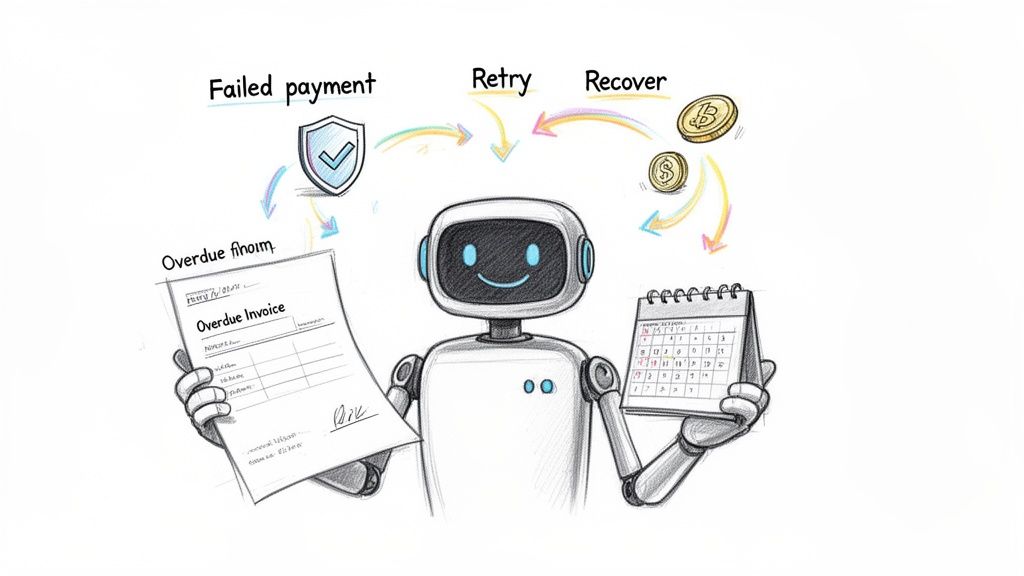
At its heart, a good dunning process is much more than a simple collections tool. It's a powerful mechanism for customer retention. Its main job is to recover revenue that would otherwise vanish due to common, completely solvable problems, like an expired credit card, a temporary lack of funds, or a random network glitch during a transaction.
For any company dealing with payments from around the globe, having a solid way to handle these hiccups is non-negotiable for maintaining a predictable revenue stream. This is especially true if you accept card payments but receive your payouts in a stablecoin like USDC. A robust dunning system ensures that cash flow stays consistent.
Why Dunning Is Not Just a 'Nice-to-Have'
So, what happens if you ignore dunning? The financial hit can be surprisingly large. The whole point of this process is to fight involuntary churn, which is when a customer unintentionally loses their subscription because of a failed payment. This isn't a customer who chose to leave, it's a preventable loss.
An effective dunning strategy does more than just recover payments. It protects customer relationships by resolving billing issues smoothly and preventing unexpected service disruptions.
The scale of this problem is massive. In 2023 alone, the payment ecosystem saw over 238 million chargebacks. Industry forecasts predict that cumulative losses from these kinds of payment failures will soar past $362 billion by 2028. The good news is that businesses that put a solid dunning process in place often see an 18% drop in overdue accounts and a 39% reduction in invoices that are more than 30 days late.
Putting Dunning into Practice
A modern dunning system is all about proactive automation. It springs into action the second a transaction fails and follows a carefully planned sequence to get the issue resolved.
Here are the key stages in a typical dunning process, designed to recover the payment while keeping the customer happy.
Key Stages of a Typical Dunning Process
Stage | Primary Action | Goal |
|---|---|---|
1. Failure Detection | The payment processor flags a failed transaction in real-time. | Instantly identify the problem so the recovery process can begin. |
2. Smart Retries | The system automatically retries the payment card at strategic intervals. | Capture the payment if the initial failure was temporary (e.g., insufficient funds). |
3. Customer Outreach | A sequence of automated emails or notifications is sent to the customer. | Inform the customer of the issue and guide them to update their payment details. |
4. Final Resolution | The subscription is either recovered or, as a last resort, suspended or canceled. | Resolve the overdue account to either retain the customer or prevent further service liability. |
This automated, multi-step approach is what makes dunning so effective.
For businesses using an API to handle card or crypto payments, the dunning process can be woven directly into your existing infrastructure. This integration ensures every customer gets the right notification at the right time, minimizing friction and protecting your valuable USDC revenue. To get a deeper dive, this guide does a great job explaining what is the dunning process and its role in protecting SaaS revenue.
The Four Core Stages of an Effective Dunning Strategy
Think of a good dunning process not as a single action, but as a journey. It’s a carefully planned sequence that kicks off the second a payment fails, with the goal of recovering that revenue while keeping your customer happy. Getting this flow right is the key to turning a failed payment into a retained customer.
This journey is really a series of automated steps that balances a firm hand with a great customer experience. Let’s walk through what happens at each stage.
Stage 1: Failed Charge Detection
It all starts with a single point of failure. Your payment processor tries to charge a customer's card for their monthly or annual renewal, and the transaction gets declined. This is ground zero.
An automated system needs to catch this instantly. But it's not enough to just know it failed, the system has to grab the reason why. Was it "Insufficient Funds"? An "Expired Card"? Or a vague "Do Not Honor" message from the bank? This little piece of data is the fuel for everything that comes next.
Stage 2: Smart Retry Logic
Once the failure is flagged, the system doesn't just hammer the card again. That’s a rookie mistake. Instead, it kicks off a smart retry logic that uses the failure reason to decide the next move.
For instance, a temporary network glitch might be worth retrying in a few minutes. But if the card was declined for insufficient funds, a smarter move is to wait a few days. Why? You might catch them right after their payday. This kind of intelligent timing massively boosts your odds of success.
It’s the difference between a reactive panic and a proactive strategy. You're not just hoping for the best, you're using data to make an educated guess about the best time to try again, all without annoying the customer or the bank.
Stage 3: Customer Notifications
While the smart retries are working quietly in the background, it’s time to talk to your customer. This is probably the most delicate part of the whole process. You have to be transparent and give them the power to fix the problem themselves.
This usually plays out as a series of automated emails or in-app messages.
The Gentle Nudge: The first message is always friendly. It's a simple heads-up that their payment didn't go through, with a clear, one-click link to update their card information. No blame, just a helpful alert.
A Few Reminders: If the card still isn't updated after a couple of days, the tone gets a little more direct. The messages might mention that their service could be at risk if the issue isn't resolved soon.
The Final Warning: Before you take any serious action, a last notification lays it all out. It clearly explains what will happen next, like a service suspension, if they don't update their payment details.
Throughout this entire cadence, the goal is to be a helpful guide, not an aggressive bill collector. You’re trying to lead them to a solution because you want to keep them as a customer.
Stage 4: Account Resolution
This is the end of the line. After all the retries have been attempted and the notifications have gone out, the account has to land somewhere.
There are really only three ways this can end:
Payment Recovered: Success! The customer updates their card or one of the smart retries works. Their subscription continues, and it’s business as usual.
Grace Period: Some companies will put the account into a temporary grace period. The customer might have limited access for a few more days, giving them one last chance to sort things out.
Subscription Churned: If nothing works, the fight is over. The account is marked as churned due to non-payment, and their service is officially suspended or cancelled.
This final stage brings closure. It ensures every failed payment is followed through to a definitive conclusion, squeezing every last drop out of potential revenue recovery and keeping involuntary churn to an absolute minimum.
Crafting Your Dunning Messages and Cadence
Knowing the theory behind dunning is one thing, but actually putting it into practice is where you start protecting your revenue. The real magic happens when you get two things right: the timing of your actions (your cadence) and the quality of your communication (your messages).
A smart cadence ensures you’re stepping in at just the right moments. Meanwhile, clear and helpful messaging nudges customers to fix the problem without feeling defensive.
This timeline gives you a bird's-eye view of how a typical dunning sequence plays out, from the moment a payment fails to its final resolution.
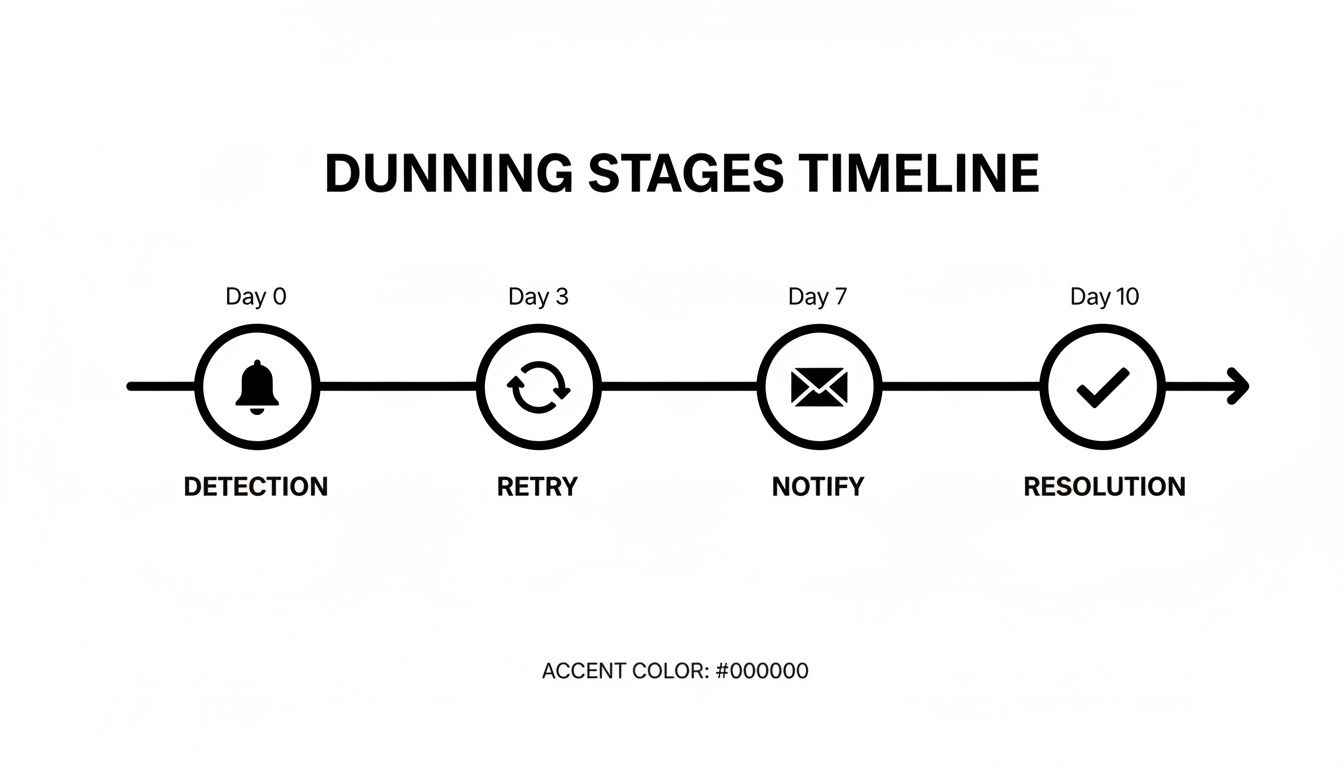
As you can see, it’s a coordinated dance between automated payment retries and customer notifications, all designed to maximize the odds of getting that payment back.
Building a Sample 30-Day Cadence
Think of your cadence as an automated playbook that kicks in the second a payment fails. It’s typically a 30-day process that balances smart retries with increasingly direct customer notifications. The goal here is to recover the payment without burning a bridge with the customer.
Here’s a practical example of what that playbook might look like.
Sample 30-Day Dunning Cadence
This table shows a simple, effective timeline for retrying payments and communicating with customers after a failed charge.
Day | Action | Customer Communication |
|---|---|---|
Day 1 | Payment fails. Retry #1 is attempted immediately. | Email #1 is sent, a friendly heads-up with a link to update their payment info. |
Day 5 | Still no payment. Retry #2 is attempted. | Email #2 is sent. The tone is still helpful but a bit more urgent, mentioning potential service interruption. |
Day 14 | Payment is still outstanding. Retry #3 is attempted. | Email #3 goes out. This message is direct, stating their account is at risk of suspension. |
Day 30 | Final attempt. If still unpaid, subscription is canceled. | Final Notification is sent to confirm the cancellation. |
This structured approach gives the customer multiple chances to resolve the issue before you have to make the tough decision to cancel their account.
Writing Dunning Messages That Work
The words you use in your dunning emails are just as critical as when you send them. A good message is clear, empathetic, and most importantly, action-oriented. You want to make it incredibly easy for the customer to solve the problem, not make them feel like they're in trouble.
Subject: We've had a problem with your recent payment
Hi [Customer Name],
It looks like we were unable to process the latest payment for your subscription. This can happen for a number of reasons, like an expired card.
You can easily update your payment information here to keep your account active: [Link to Update Payment]
If you have any questions, just let us know.
This kind of message puts the customer back in the driver's seat. If you're managing payments with an API, these communications can be completely automated. This ensures every customer, whether they pay by card or crypto, gets the same helpful experience, protecting your revenue without manual follow-up.
Of course, even the best-written emails can fail to reach their destination. Understanding what is a bounced email and how to fix it is a crucial skill for making sure your recovery efforts aren't lost in the digital void.
By 2023, Gartner projected that 75% of direct-to-consumer brands would offer subscriptions, but keeping those subscribers is the real challenge. Many stumble because they lack solid security and recovery protocols. For example, data shows only 45% of merchants have fully implemented Strong Customer Authentication (SCA), a major vulnerability.
For any business that depends on recurring revenue, having an automated dunning system isn't just a nice-to-have, it's essential for stopping preventable losses.
How Do You Know If Your Dunning Process Is Actually Working?
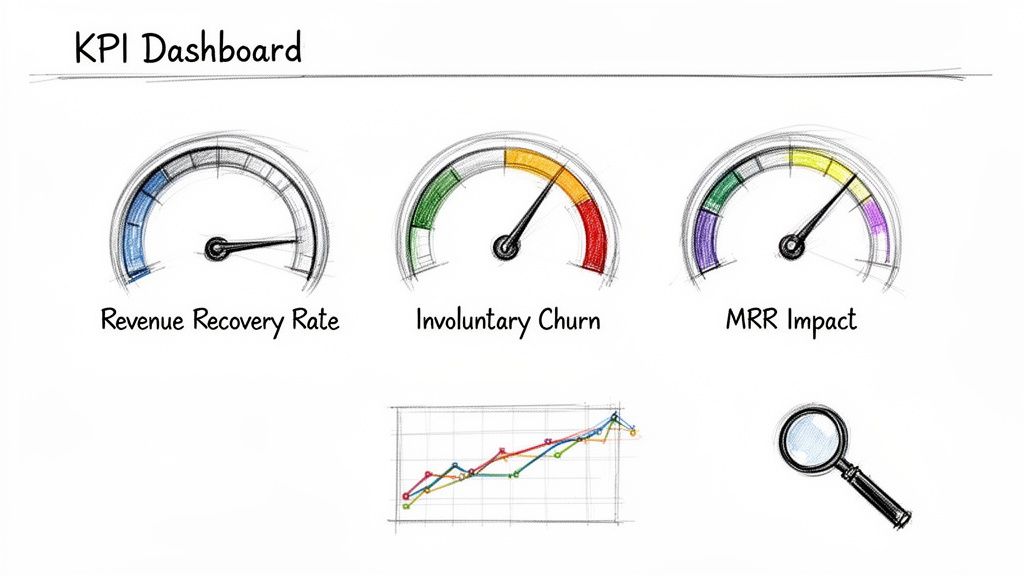
You can send all the reminder emails in the world, but if you aren't tracking the right numbers, you're just guessing. A truly effective dunning strategy is built on data, not hope. To see if your efforts are paying off, you need to zero in on a few key performance indicators (KPIs).
These metrics tell the real story. They show you exactly how much money you're clawing back and what that means for your business's health.
Revenue Recovery Rate
Let's start with the big one: your Revenue Recovery Rate. If you only track one thing, make it this. It's the clearest measure of your dunning success, telling you what percentage of failed payments you managed to collect after they entered the dunning cycle.
The calculation is simple: divide the total revenue you recovered through dunning by the total revenue that initially failed. A healthy rate typically hovers between 20-30%. If you're in that zone, it's a great sign your system is successfully turning those failed payments around.
Involuntary Churn Rate
Next up is the Involuntary Churn Rate. This is a crucial metric because it measures how many customers you lose for a completely preventable reason: a failed payment. These aren't people who decided to leave, they're customers who slipped through the cracks.
A high involuntary churn rate is a serious red flag. It’s a direct signal that your dunning messages aren't getting through or your retry logic isn't smart enough. Since it’s always cheaper to keep a customer than find a new one, getting this number as low as possible is vital for growth.
The goal of dunning isn't just to collect money, it's to reduce involuntary churn. Every recovered payment represents a customer relationship you've successfully saved from a simple billing issue.
Impact on Monthly Recurring Revenue (MRR)
Finally, you have to look at the direct Impact on Monthly Recurring Revenue (MRR). While the recovery rate tells you how efficient you are, this KPI puts it in dollars and cents. It answers the most important question: "How much actual money did our dunning process save our MRR this month?"
Tracking this ties your efforts directly to the bottom line, showing how every recovered payment stabilizes your income and your USDC payouts. For anyone running a subscription business or a paid community, understanding this is non-negotiable. We dive deeper into this concept in our guide on building a renewal engine for paid groups.
The best way to keep an eye on all this is with a real-time dashboard. When you can see the immediate financial impact of your dunning strategy on your revenue, you can make much smarter decisions to protect and grow your income.
The Nuts and Bolts: Technical and Compliance Details
A modern dunning process isn't just a series of emails. It's a finely tuned machine running in the background, balancing smart technology with a keen awareness of legal and regulatory rules. If you get these details wrong, you're not just looking at failed payments, you're risking frustrated customers and serious compliance headaches.
Getting the Tech Right
The engine of any good dunning system is built on smart, automated rules.
Intelligent Retry Rules: This is all about deciding when and how often to try a failed payment again. A "soft decline" (like insufficient funds) is a temporary problem, so maybe you try again in a few days. But a "hard decline" (like a stolen card) is a dead end. Your system needs to know the difference and stop retrying immediately to avoid extra fees and potential penalties.
Automatic Card Updater: So many payments fail for a simple, frustrating reason: an expired card. An automatic card updater service is a game-changer here. It talks directly to the card networks (like Visa and Mastercard) to proactively update saved card details before they cause a payment to fail. Problem solved before it even happens.
Webhooks: Think of webhooks as the nervous system connecting all your tools. They are automated messages your payment processor sends out when something important happens, like a payment failing, a card being updated, or a subscription being canceled. Your developers can use these signals to trigger actions elsewhere, like updating your CRM or even sending a Slack alert to your team.
Navigating a World of Payment Rules
As you grow, you'll inevitably run into different payment regulations around the globe. Strong Customer Authentication (SCA) in Europe is a perfect example. It requires customers to provide a second form of verification for many online payments.
Your dunning flow has to be smart enough to handle this. A payment might fail not because of the card, but because the customer didn't complete the SCA step. The system needs to recognize this specific failure and prompt the customer to re-authenticate, rather than just sending a generic "update your card" email.
Why Compliance Can't Be an Afterthought
Finally, let's talk about compliance. This part is non-negotiable. Your dunning process must follow the rules set by payment networks and consumer protection laws, which often dictate how and when you can contact customers about overdue payments.
This is where a dedicated payment layer becomes invaluable. Instead of building everything from scratch, a robust API can handle the heavy lifting of retry logic, SCA flows, and global compliance. If you're curious how a well-designed API can streamline this, our guide on payment gateway API integration breaks it down.
This approach lets you focus on your customers, knowing your recovery process is both effective and fully compliant. The cost of getting this wrong is staggering, as merchant losses from online fraud are on track to surpass a cumulative $362 billion by 2028. You can dig into the full research on global online payment fraud to see just how high the stakes are.
How to Automate Your Dunning Process
Alright, let's talk about putting your dunning strategy on autopilot. This is really the end goal: protecting your revenue without having to chase down every failed payment yourself. A smart payment platform can handle the entire process for you, from intelligent retries to the customer emails.
For businesses using a payment layer API, you can essentially set up your dunning rules once and let the system run. This means when a recurring payment fails, the recovery process kicks off automatically. It’s a huge relief, especially if you're dealing with stablecoin revenue streams like USDC and can’t afford to manually track every single transaction.
Automation in Action
Let’s make this real. Imagine you're a community manager running a paid group on a platform with a native Telegram integration. A member's monthly card payment fails. Instead of you having to notice, find their contact info, and send an awkward message, the system just handles it.
It automatically triggers the dunning sequence, sending friendly notifications and retrying the charge based on the schedule you defined.
This hands-off approach is a game-changer. Your members keep their access as long as the payment is eventually recovered, and you get a much more stable, predictable income stream. The system does the heavy lifting, so you don't have to.
Ultimately, automation creates a better experience on both sides. Your customers can pay how they want, and you have a reliable safety net to catch and recover failed payments before they turn into lost revenue. It highlights the massive gap between old-school manual processing and a truly automated system. To see just how different it is, check out our guide on manual payments vs Suby automation.
Got Questions About Dunning? We've Got Answers.
As we wrap up, let's tackle a few of the most common questions that pop up when businesses first dive into recovering failed payments.
What’s a Good Dunning Recovery Rate to Aim For?
If you're wondering what "good" looks like, industry benchmarks point to recovering 20% to 30% of failed payments. Think of it this way: for every 100 payments that fail, a solid dunning process can bring 20 to 30 of them back from the brink.
Of course, this isn't a hard and fast rule. Your specific rate will depend on factors like who your customers are, how much they value your service, and most importantly, how clear and helpful your dunning messages are. Hitting that 20-30% range is a great sign that you're turning potential losses back into revenue.
How Many Times Should We Actually Retry a Failed Card?
This is a classic question, and the answer is not too many. Pinging a card over and over can actually get you flagged by payment processors.
A smart approach is to schedule three to four retry attempts over a couple of weeks. But the real key isn't the number, it's the timing. You have to be strategic. For an "insufficient funds" error, retrying immediately is pointless. Waiting a few days for payday makes a lot more sense.
Is There a Risk of Annoying Customers with Dunning?
Absolutely, if it's done poorly. A dunning process that feels aggressive or accusatory can definitely damage customer relationships.
But when you approach it with empathy and a helpful tone, it does the exact opposite. A well-managed dunning flow actually prevents an unwanted service interruption for a loyal customer who simply had a card expire. You're not chasing them for money, you're proactively helping them fix a small billing hiccup, which builds trust and improves their experience.
For any business juggling payments from around the globe, a solid dunning system is non-negotiable. It’s your safety net, protecting your revenue, whether customers pay by card or crypto, and ensuring you get your USDC payouts without the headache.
Suby is a payment gateway and payment processor. Your customers pay with card, bank transfer, Apple Pay, Google Pay, Klarna, and more, or stablecoins, and you get paid out to your bank account, or directly in stablecoins (USDC, EURC) to your wallet, anywhere in the world, no bank account required. A powerful API and native Discord and Telegram integrations come with automated dunning built in, so smart retries and reminders recover failed payments and cut involuntary churn without you chasing a single overdue account.
