

Gaspard LEZIN
Payment Provider UAE: A Practical Comparison Guide for 2026
Compare payment provider UAE options for 2026. Explore methods, fees, licensing, and integration choices, and see how Suby maps to UAE use cases.
If you're a Dubai founder staring at three tabs, one for a global gateway, one for a regional processor, one for a crypto-native stack, you're already in the right problem. The wrong move is picking the name you recognize and hoping AED settlement, KYC, wallets, and refund handling sort themselves out later. In the UAE, they don't.
Provider Tier | Settlement | Currencies | API Uptime | Best Fit |
|---|---|---|---|---|
Global API-first stack | T+1 to T+3 business days | 135+ currencies for one documented example | 99%+ for mature providers | Teams that want a clean API and broad global acceptance |
Regional gateway | T+1 to T+3 business days | 100+ currencies for one documented example | 99%+ for mature providers | UAE merchants that want familiar local support and plugins |
Hybrid or crypto-native stack | Varies by rail and payout choice | Multi-currency plus crypto support | Depends on implementation | Merchants that need card, wallet, bank, and crypto in one flow |
The core question isn't which logo looks safest. It's whether the provider can handle local licensing, supported payment methods, settlement currencies, FX, integration effort, and dispute handling without forcing your team into a patchwork of tools.
Table of Contents
Why Picking a Payment Provider in the UAE Is Different
A SaaS founder in Dubai often starts with a simple shortlist, Stripe-class global stack, Telr, PayTabs, and a crypto-native option. A week later, the shortlist is messier. One provider is easy on API ergonomics but weak on local nuance, another looks familiar but feels narrow on payout options, and the crypto-native stack solves treasury flexibility but needs a different view of compliance and onboarding.
The six questions that matter
The first filter is licensing. If the provider can't lawfully do what you need in the UAE, the rest of the conversation is cosmetic. The second is supported methods, because the market is not card-only, and the third is settlement currency, because many founders care more about where money lands than which card network touched it.
Then come FX, integration ergonomics, and dispute handling. Those last three decide whether your finance team is calm or constantly reconciling edge cases. A gateway that settles fast but creates operational drag can still be the wrong choice.
Practical rule: ask every provider how it handles cards, wallets, bank transfers, and local rails, then ask where the money lands and who owns refunds.
A lot of merchant teams get stuck comparing MDR before they understand whether the provider can support their actual checkout mix. That's backwards. In the UAE, the better question is whether the stack can serve both high-volume card traffic and the customers who want alternative rails.
The right demo agenda is blunt. Ask what's licensed locally, what payment methods are supported, how many currencies you can accept and settle in, how routing and FX are handled, and what happens when a chargeback or failed transfer hits operations. If the provider can't answer those questions cleanly, keep moving.
UAE Licensing and KYC Rules You Need to Know
The legal layer isn't optional in the UAE. The Central Bank of the UAE's Retail Payment Services and Card Schemes Regulation, issued in July 2021, created a licensing regime for retail payment providers and set out nine regulated categories that include merchant acquiring, payment aggregation, domestic and cross-border fund transfers, payment initiation, and payment account information services. The framework is on the CBUAE regulation PDF.
What that means in practice
If a global PSP isn't locally licensed for the activity you need, it often routes the UAE merchant through a partner acquirer or another licensed entity. That isn't necessarily bad, but it changes the actual relationship. The brand on the website may not be the entity carrying the regulated activity, and that matters for onboarding, liability, and support.
Article 12 of the CBUAE framework makes the compliance burden explicit. Payment service providers must comply with UAE AML/CFT laws, perform business-relationship-specific risk assessments, maintain periodic risk profiling and assessment of users, and report suspicious transactions to the UAE FIU. A merchant should assume the provider will ask for documents, verify use case, and continue monitoring rather than treating onboarding as a one-time formality.
If you want a clean operational checklist, keep your compliance documents organized before the demo. The internal Suby compliance documentation guide is a useful model for the kinds of artifacts a merchant team usually needs to assemble, and the broader Technioz compliance software solutions piece is a decent reference point for how teams think about KYC and AML workflows in software.
A provider that can't explain its onboarding flow in plain English is usually hiding operational complexity behind sales language.
The headline takeaway is simple. Filter every payment provider UAE shortlist through licensing reality first, then ask whether the KYC process fits your business model, not just your paperwork.

How UAE Consumers Actually Pay in 2026
The UAE market is still card-heavy, but it's not card-only. One 2026 market guide estimates cards at about 65% of consumer payment volume, digital wallets at about 15%, and real-time account-to-account payments at about 10%. It also puts card penetration around 80%, which is why card acceptance remains foundational even as other rails grow.
What the numbers mean for your checkout
If your provider only does cards, you're missing a meaningful wallet audience and the customers who lean into newer rails. If it only does wallets, you'll frustrate users who still expect card acceptance to work everywhere. The market is mixed, so the stack has to be mixed too. The same guide places typical merchant discount rates at roughly 1.5%–2.8% for credit cards, 0.8%–1.5% for debit cards, and 0.5%–1.5% for e-wallets, which is one reason merchants often keep multiple methods live in parallel. See the UAE payment market guide for the market mix and MDR ranges.
Historical behavior confirms the shift. APEXX Global reports that more than 37% of Emirati consumers used BNPL in 2022, up from 24% in 2021, while Thunes says 46% of the population used mobile wallets in 2024 and projects the mobile-wallet market to reach $7.18 billion by 2028 as the country advances toward a cashless economy by 2030. Visa also reported in early 2026 that 68% of UAE consumers were largely non-cash users and only 16% used cash for everyday purchases. Those figures come from APEXX Global's UAE country report.
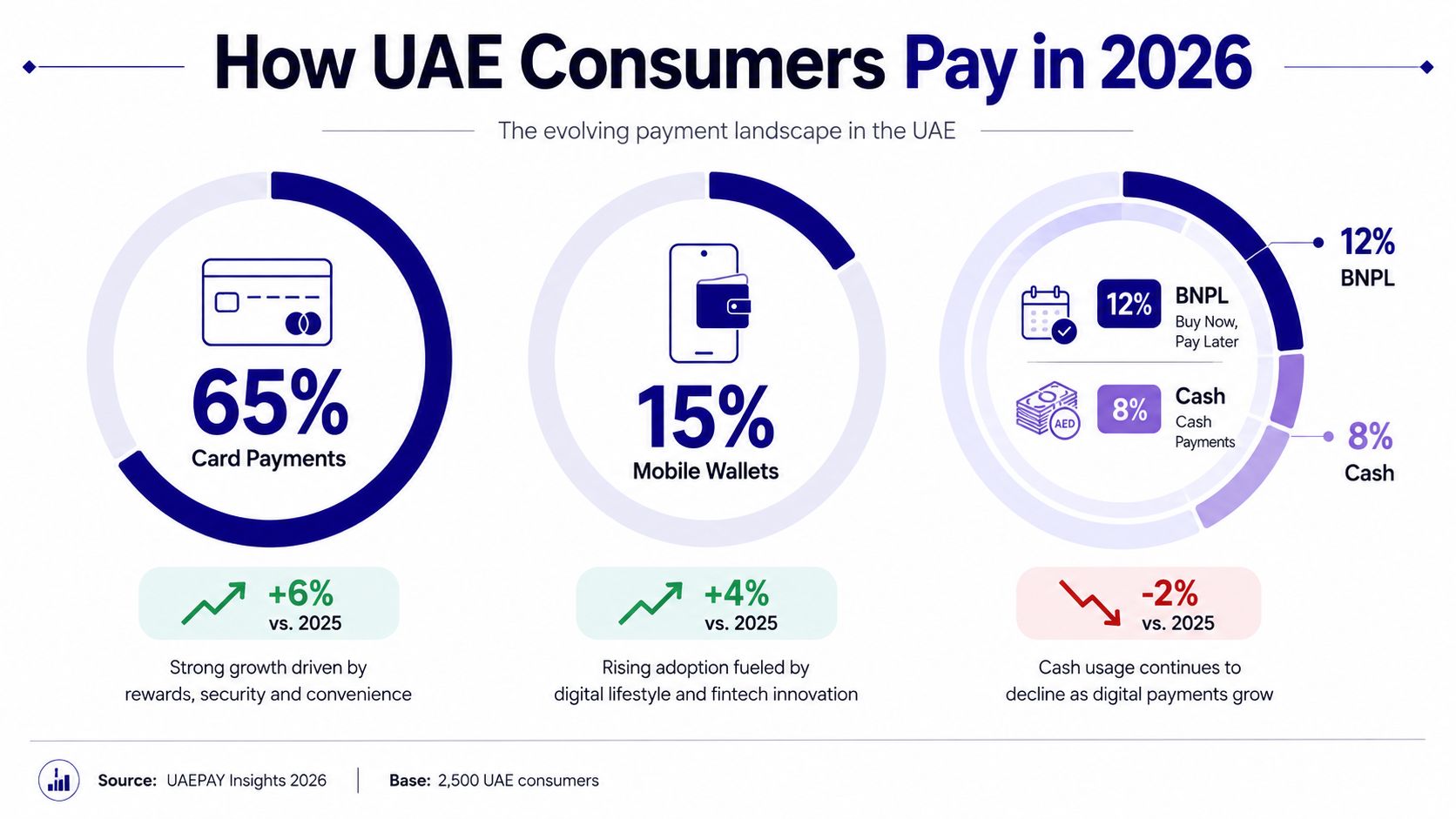
The engineering implication is obvious. Your checkout should not be designed around one rail and one customer type. The merchant that wins in the UAE is usually the one that respects how mixed the payment behavior really is, instead of forcing everyone into a single path.
Comparing UAE Payment Providers Side by Side
The mistake most comparison pages make is obsessing over authorization rate in isolation. The better framework is the one used in a 2025 benchmark model, which looks at payment success rate, fraud detection rate, settlement time, and API uptime together. That's the right way to compare throughput, reliability, and global acceptance in one view, not as separate marketing claims. The benchmark framing is outlined in the UAE payment gateway benchmarking framework.
Where each tier actually fits
Global API-first stacks usually win on developer experience and multi-currency reach. One public comparison guide lists Stripe at roughly 135+ currencies with T+1 to T+3 business day settlement and API-first integration. Regional gateways such as Telr and PayTabs are positioned around 100+ currencies and 120+ currencies respectively, with PCI DSS Level 1 or equivalent security positioning and plugin/API support. That same guide is the basis for the side-by-side snapshot in best payment solutions for UAE businesses.
Provider Tier | Settlement | Currencies | API Uptime | Best Fit |
|---|---|---|---|---|
Global API-first stack | T+1 to T+3 business days | 135+ currencies for one documented example | 99%+ for mature providers | International SaaS and platform businesses |
Regional gateway | T+1 to T+3 business days | 100+ currencies for one documented example | 99%+ for mature providers | UAE merchants wanting local support and plugins |
Crypto-native or hybrid stack | Depends on rail and payout choice | Multi-currency plus crypto support | Depends on implementation | Businesses that need flexible settlement and alternative rails |
The uncomfortable trade-off
A card-first gateway can look cheap on paper and still cost more operationally once you add failed payouts, limited settlement options, or manual refund handling. That's why I don't rank providers by fee alone. I rank them by how few exceptions they create for finance, support, and engineering.
For merchants dealing with invoices, milestones, or supplier payments, the documentation trail matters too. The payment voucher form guide UAE is a practical reminder that payment operations often bleed into back-office paperwork, not just checkout code.
The New Domestic Rails That Change the Game
The biggest UAE payment story is not another card comparison. It is the domestic rail shift. Recent reporting says the UAE's domestic scheme is taking shape through Jaywan cards under the Central Bank-backed Al Etihad Payments infrastructure, while a 2026 infrastructure guide describes three layers in the market, Aani, Jaywan, and CBUAE regulation. The provider that understands those layers will be more useful than the one that only sells card acceptance. See the domestic payment scheme update.
Why merchants should care
Aani matters because instant bank-to-bank acceptance can reduce dependence on cards in some flows. Jaywan matters because domestic cards point to a more localized payment stack. For a merchant, the question is whether the provider can support the rail that fits the use case, not whether it can merely process the swipe.
High-ticket and cash-flow-sensitive businesses need to be ruthless here. If you sell expensive services, handle supplier invoices, or work with customers who dislike card friction, bank-to-bank acceptance can fit better than forcing everything through cards and absorbing the delay and fee profile that comes with them. A card-first PSP rarely explains that trade-off clearly.
The underserved angle matters just as much. Independent coverage has described fintechs targeting the underbanked across the GCC and South Asia, and other analysis says the Gulf is ripe for fintechs to serve the underserved. A UAE-focused explainer also notes that underserved users often rely on digital wallets or prepaid cards when they cannot use full bank-account-based payments. A provider that can support those users without making onboarding painful will reach customers a card-first stack misses.
A checkout that only works for fully banked buyers leaves money on the table. If your audience includes lightly banked buyers, the cheapest card MDR is not the win. Reach matters more than a small pricing advantage.
Merchants should also look at settlement, not just acceptance. If your finance team wants AED, your treasury team wants USD, or you want to route value into stablecoins after checkout, the provider needs to make that path clear. Suby's AED payout flow is a useful example of how settlement logic can be wired into the product, instead of treated as an afterthought.
How Suby Maps to UAE Use Cases
Suby is one product with four clear uses. Suby Payments is an API-first payment stack for cards and crypto through one checkout. Suby Crypto is a crypto payment gateway that handles the swap, sponsors the gas, and settles to a non-custodial wallet or to the Suby balance. Suby Gating gives paid access for Discord, Telegram, downloads, and courses. Suby Invoicing lets the client choose how to pay while the business receives what it wants. That structure is documented on Suby's site.
Where each mode fits in the UAE
A SaaS company selling subscriptions in AED usually needs a clean API, recurring billing, and a checkout that does not force a separate crypto stack. That is where Suby Payments fits. A Dubai agency billing overseas clients may want the client to choose how to pay while the business receives value in the currency and treasury format it prefers. Suby Invoicing is built for that exact setup.
Creators and community operators are a different case. If you run a paid Telegram group, an educational cohort, or a gated Discord community, the job is not only to collect money. You also need access control that members understand and that you can manage without constant manual work. Suby Gating covers that use case directly.
A single checkout only works if it matches the business model behind it, not just the payment method.
For merchants that need alternative settlement logic, Suby's documentation says it accepts 300+ payment methods, including cards, wallets, bank, BNPL, and crypto on major chains, with payouts to bank or in stablecoins in the currency of choice. That matters for UAE merchants selling into a mixed customer base, because one checkout can serve card users, wallet users, bank-transfer buyers, and crypto-native customers without splitting the front end into separate payment flows.
I would put Suby in the shortlist for UAE founders who want card, wallet, bank, and crypto support under one roof. It is not a magic answer, and it should not be treated like one. It does fit SaaS billing, creator access, agency invoicing, and cross-border checkout without forcing a merchant to split the stack too early.
A UAE Flow That Pays in Dirham and Settles in Stablecoin
A UAE checkout can work in two directions at once. The customer pays by card or wallet in AED, and the merchant ends up with treasury in USDC. That setup matters for founders who want the front end to stay local while the back office follows a different currency policy.
The mechanics that matter
The checkout can accept cards, wallets, bank, BNPL, and crypto. On the merchant side, funds can land in a bank or in stablecoins in the currency of choice, as noted earlier in Suby's documentation. That lets you keep payment method choice at checkout without forcing treasury into one payout path.
The payout shape matters just as much as the acceptance side. If your finance team wants AED in a UAE bank account, that works. If you want USD in a USD-denominated account, that works too. If your treasury policy prefers stablecoins, that is the third path. A merchant should not have to redesign checkout every time treasury policy changes.
Suby's pricing page says pricing varies by payment method, so there is no single flat rate to assume. That is the right way to think about payment economics, because costs change by rail and by flow. Review the pricing page before you put any estimate into a board deck.
For merchants evaluating AED payout operations, the practical breakdown is clearer in this AED payout guide for UAE merchants. It helps separate what belongs in checkout from what belongs in treasury, which is where many payment plans get confused.
The other practical issue is the payment voucher form guide UAE, because some merchants still need a cleaner paper trail for finance, reconciliation, or internal approvals. payment voucher form guide UAE is relevant if your process still depends on documenting the flow outside the checkout itself.
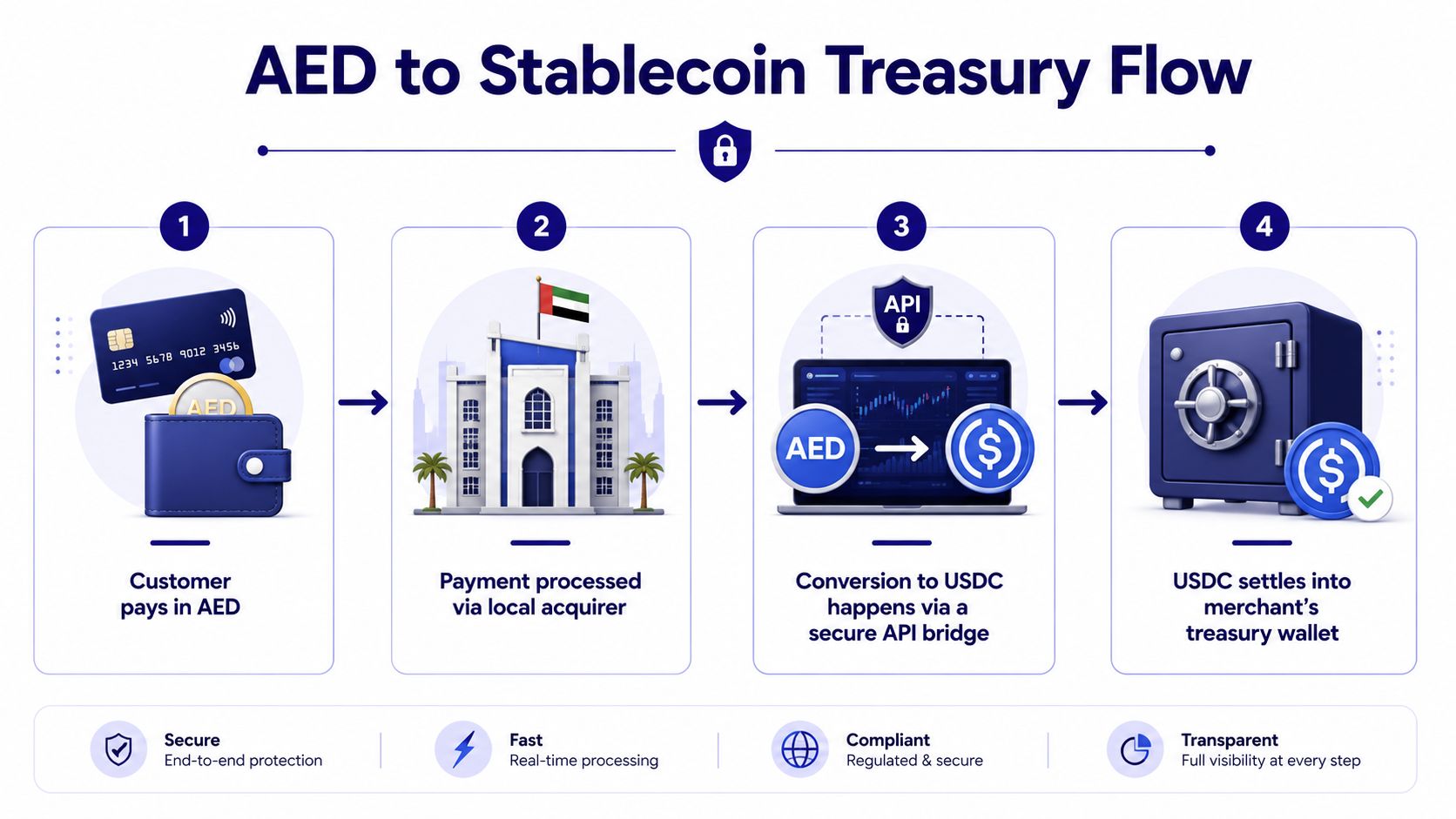
Treasury flexibility is the key benefit. One checkout can serve customers in one format and finance in another, which is exactly what many UAE merchants need when they sell across borders, invoice in different currencies, or prefer stablecoin treasury management.
Decision Checklist and Common Mistakes to Avoid
The fastest way to choose a payment provider UAE merchants can live with is to run a hard checklist. Start with licensing coverage. Then confirm AED and USD settlement, FX and stablecoin payout options, integration effort, dispute and refund flow, and onboarding time. If a provider can't answer those clearly, it's not ready for your business.
Use this before you sign anything
Check the license path: Ask which regulated activity the provider performs directly and which parts are routed through a partner.
Match methods to customers: Confirm it supports the rails your buyers use, not just the ones the sales deck highlights.
Verify settlement destinations: Make sure you can settle into the currency and treasury format your finance team wants.
Test dispute handling: Ask who owns chargebacks, refunds, and evidence collection.
Pressure-test onboarding: If onboarding is slow or vague, your launch will be slow or vague too.
The biggest mistake I see is merchants chasing the lowest card MDR and calling it strategy. That's a narrow way to buy payments. For many UAE businesses, the more valuable capability is access to alternative rails, wallet-friendly onboarding, and flexible settlement. A provider that helps you reach underserved or lightly banked users can be more valuable than one that only looks cheap on a fee sheet.
The second mistake is ignoring operational fit. A gateway can be technically solid and still create pain if it doesn't fit your refund policy, treasury rules, or cross-border customer base. The third is not checking exact pricing and settlement details on the provider's own site before the contract gets drafted.
If you want a clean benchmark, keep this rule in mind: the right provider reduces exceptions. The wrong one adds them.
If you're comparing payment infrastructure for a UAE business, Suby gives you one checkout that can accept cards or crypto and lets you decide how to settle. It also supports native use cases like Discord and Telegram access, plus invoicing flows where the client pays one way and you receive another. Visit Suby to review the product, then compare it against your current gateway on licensing, settlement, and treasury fit.
