

Gaspard LEZIN
Payment Processor vs Payment Gateway Explained Clearly
Payment processor vs payment gateway explained in plain English. Learn the real difference, how fees and security work, and how Suby fits into both roles.
A customer reaches your checkout, enters card details, and clicks Pay. The screen shows a spinning loader, then either a confirmation or a decline. Behind that simple moment, a payment gateway and a payment processor handle different jobs. Knowing which job belongs to whom helps you choose vendors, investigate failed payments, understand compliance work, and avoid paying for tools your business doesn't need.
The easiest mental model is this: the gateway is the customer-facing route into a payment, while the processor handles authorization and settlement behind the scenes. Online merchants commonly need both functions, although one provider can package them together. In-store, a point-of-sale terminal may perform much of the gateway-like work, while the processor still handles the banking flow.
The category has grown from online card acceptance in the late 1990s and 2000s into a major infrastructure layer for digital commerce. One 2026 estimate valued the global payment gateway market at USD 42.68 billion in 2024, projected USD 52.40 billion in 2025 and USD 146.28 billion by 2030, implying a 22.79% CAGR from 2025 to 2030. Another estimate placed it at USD 48.17 billion in 2025 and projected USD 245.71 billion by 2033, with a 22.7% CAGR from 2026 to 2033. These are market estimates, not guarantees, but they show why the distinction matters as gateways bundle checkout, application programming interfaces, fraud tools, and local payment connections. (Mordor Intelligence payment gateway market estimate)
Table of Contents
What a Payment Processor and Payment Gateway Actually Do
A shopper enters card details on your website and clicks Pay. Two separate functions begin working at that point.
The payment gateway is the digital cashier's window. It displays or supports the checkout form, checks that the submitted details are usable, encrypts sensitive payment data, and passes that data to the next system. It may also support tokenization, fraud screening, and an extra authentication challenge when the transaction needs one. The customer and merchant usually see the gateway's response first, whether the payment is approved or declined.
The payment processor is the back-office transaction engine. It sends the authorization request through the relevant card network to the customer's issuing bank, receives the decision, and supports clearing and settlement. In plain English, the gateway gets the payment data safely into the payment system, while the processor coordinates the financial decision and the movement of funds.

The simplest distinction
Role | Main responsibility | What the merchant notices |
|---|---|---|
Payment gateway | Captures, protects, and routes payment information at checkout | Checkout experience, errors, authentication, and payment-method display |
Payment processor | Routes authorization requests and supports clearing and settlement | Approval rates, declines, settlement timing, and transaction records |
Neither layer is optional in a typical online card payment. A gateway can't complete a payment by itself, and a processor doesn't replace the checkout interface in every setup. The exact product boundary changes because providers increasingly combine both functions under one brand.
For a broader introduction to the companies and systems involved, see this explanation of what a payment provider is. If you're comparing the wider payments stack for an online store, this guide can also help you compare payment providers for e-commerce.
The practical question isn't only “which one do I need?” It's “which part of the payment is failing, and which supplier owns that part?” The next transaction walkthrough makes that answer concrete.
How a Transaction Moves Through Both Layers
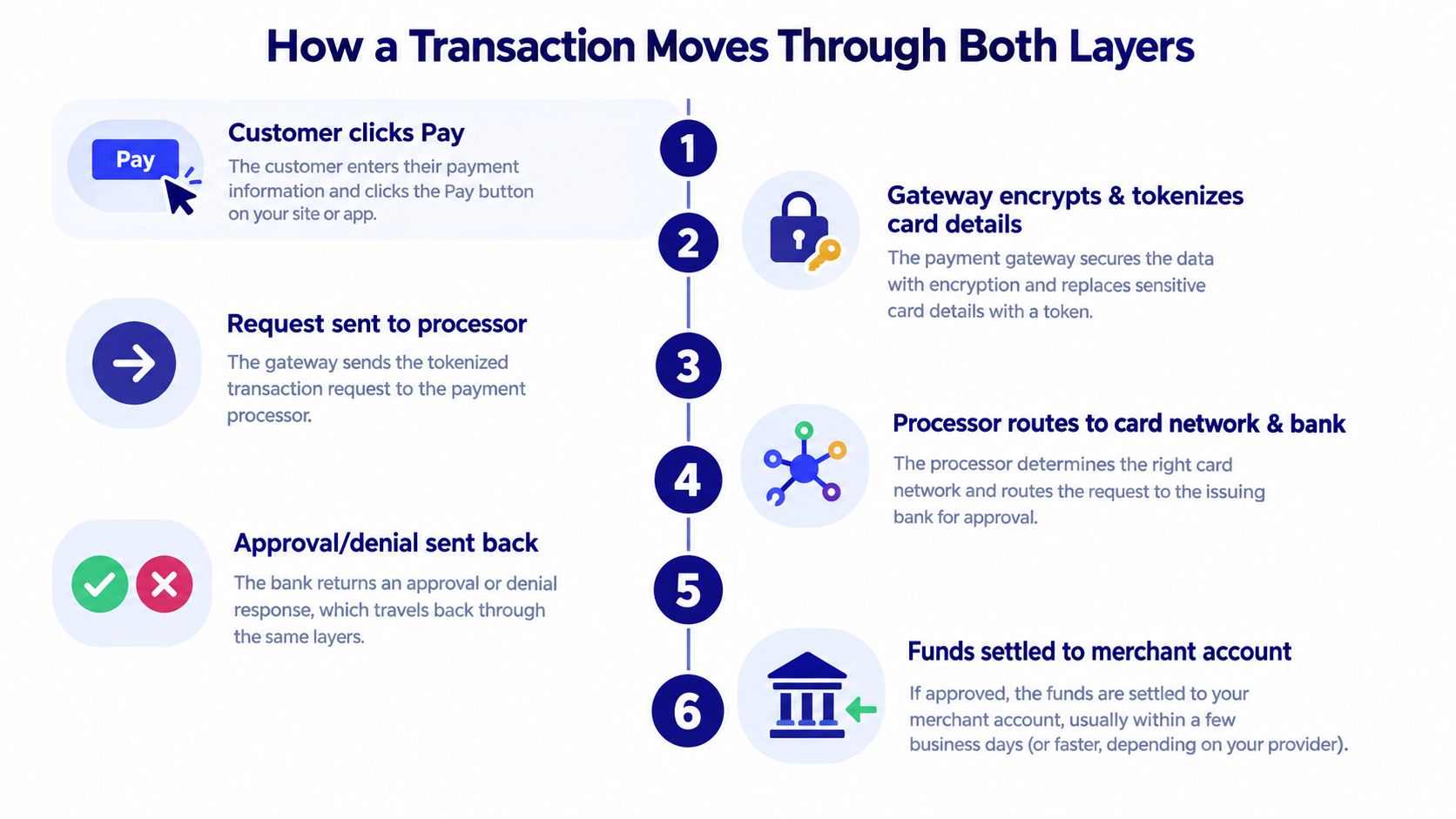
A card payment follows a chain. Each participant has a defined role, even though the customer experiences the whole process as one click.
From checkout to authorization
The customer clicks Pay. Your checkout collects the order amount, currency, customer details, and payment information. The gateway receives the request from the browser or app.
The gateway protects the card details. It encrypts the information and can replace the raw card number with a token. Tokenization lets later payment actions refer to a protected payment reference instead of repeatedly passing the original details through your systems.
The gateway sends an authorization request. The request contains the transaction data needed for a decision. Gateway-side checks can include address verification, often called AVS, and fraud rules. If Strong Customer Authentication is required, the customer may complete a 3-D Secure challenge before the payment continues.
The processor routes the request. The processor communicates with the card network and the customer's issuing bank. The issuing bank checks the account and transaction details, then approves or declines the authorization.
The response returns through the same path. The processor sends the bank's response back to the gateway. Your checkout then displays a success or failure message, while your order system marks the order according to the response.
Settlement happens later. Approval isn't the same as final funding. After the relevant processing cycle closes, the processor supports clearing and settlement, moving the funds through the payment system toward your merchant bank account.
Where to look when something fails
A checkout error doesn't always mean the customer's bank rejected the payment. A gateway can reject malformed data, a fraud rule can stop the request, a 3-D Secure challenge can fail, or a webhook can arrive late after the bank has already approved the payment. Processor or issuer declines are a different class of problem.
Practical rule: Match the error to the owner. Checkout and tokenization problems usually point toward the gateway or your integration. Authorization and settlement problems usually require the processor, acquirer, or bank to investigate.
For technical reliability, useful payment metrics include authorization rate, decline rate, false-decline rate, 3DS success, chargeback rate, authorization latency, and webhook latency. One 2026 benchmark source cites 96% to 98% authorization rates for best-in-class software-as-a-service providers, compared with a card-not-present industry average near 87%. Those figures are benchmarks, not a promise for any particular merchant or provider. (Payment system testing and reliability benchmarks)
Side-by-Side Comparison of Processors and Gateways
Definitions help, but merchants usually need a decision they can apply to a vendor shortlist. The table below separates the two layers by the areas that affect implementation, risk, and operations.
Payment Processor vs Payment Gateway Core Differences
Dimension | Payment Gateway | Payment Processor |
|---|---|---|
Primary function | Presents or supports checkout, captures payment data, protects it, and sends it for authorization. | Routes authorization through payment networks and banks, then supports clearing and settlement. |
Position in the flow | Sits between the customer-facing checkout and the processing infrastructure. | Sits deeper in the payment chain between the gateway, networks, issuing bank, and acquiring bank. |
Customer interaction | Directly affects the form, payment-method selection, authentication prompts, and error messages. | Usually stays invisible while it communicates authorization results and settlement information. |
Integration method | Commonly uses hosted checkout, embedded fields, software development kits, application programming interfaces, or payment links. | Usually connects through gateway, acquirer, platform, or direct processing integrations. |
Security role | Encrypts or tokenizes payment data and may support fraud checks and 3-D Secure. | Protects processing connections and manages the authorization, clearing, and settlement path. |
PCI scope impact | Hosted and embedded gateway experiences can reduce how much card data your systems handle. | A deeper, direct integration can place more payment-data responsibility on the merchant. |
Fee structure | May charge transaction or platform fees, with extra charges for optional tools. | May use percentage-based processing economics, network-related costs, and other transaction charges. |
Settlement ownership | Usually routes the data and reports the result rather than owning the settlement movement. | Handles or coordinates the financial movement toward the merchant's acquiring account. |
Failure diagnosis | Look here for checkout validation, tokenization, browser, authentication, and routing issues. | Look here for authorization routing, network responses, clearing, funding, and settlement issues. |
Typical merchant choice | Select based on checkout control, payment methods, security design, and integration experience. | Select based on acceptance coverage, reliability, settlement terms, risk controls, and reporting. |
The distinction becomes less obvious when a provider sells both services as one product. The merchant may see one dashboard and sign one agreement, even though gateway and processor responsibilities still exist inside the underlying architecture.
That bundling can simplify operations, but it doesn't remove the need for careful questions. Ask which entity processes the transaction, who controls settlement, where disputes are managed, which payment methods are native, and whether you can export transaction and customer records if you change providers. A familiar brand name doesn't answer those questions by itself.
The right comparison is therefore functional, not merely commercial. Two providers may both call themselves payment platforms while assigning gateway, processing, acquiring, and settlement responsibilities differently.
Technical Integration and PCI Scope Differences
Your integration choice changes what your team builds and what payment data touches your systems. Four patterns appear often, from the lightest merchant involvement to the most controlled.
Four ways to connect the layers
Hosted checkout sends the customer to a payment page operated by the gateway. Your application creates the payment session, receives the result, and returns the customer to your site. This is usually the simplest path for a small team.
Drop-in fields or an iframe keep the checkout visually closer to your website while allowing the gateway to collect sensitive card details inside its own protected component. Your page controls the surrounding experience, but the payment field remains separated from your server.
Direct API calls give developers more control over the checkout and payment lifecycle. They can support custom interfaces and complex routing, but your systems may handle more sensitive data and therefore demand stronger security controls.
Webhook listeners receive server-to-server events for successful payments, refunds, subscription changes, disputes, or settlement updates. A redirect tells a browser what happened. A webhook gives your backend a more dependable event to reconcile.

PCI scope is an architecture decision
The Payment Card Industry Data Security Standard, commonly called PCI DSS, applies to systems involved in handling card data. A hosted page or gateway-controlled iframe can reduce the systems that directly touch that data. A fully embedded approach can increase your responsibilities, and the exact self-assessment category depends on your implementation and provider arrangement. Don't assume a particular questionnaire without confirming it with your acquiring or compliance contact.
Mobile teams face a similar choice. A software development kit can provide payment components inside an app, while a headless API approach gives the product team more control over the interface and payment state. Both require careful handling of authentication, retries, idempotency, and event reconciliation.
Subscription businesses should pay special attention to webhooks. If your application misses a payment-success event, it may fail to grant access. If it processes the same event twice, it may create duplicate fulfillment or billing records. The gateway displays the customer-facing outcome, but your backend still needs a reliable record of what the processor ultimately accepted and settled.
For a practical implementation checklist, review this actionable PCI compliance guide. You can also read the guidance on PCI compliance requirements before choosing between hosted, embedded, and direct approaches.
Real Merchant Use Cases for Each Role
The difference becomes easier to remember when tied to actual operating problems. The same payment stack can feel very different depending on whether you sell subscriptions, physical products, professional services, or community access.
A software-as-a-service founder
A software-as-a-service company selling monthly plans needs more than a card form. The team must create recurring charges, update payment methods, respond to failed renewals, and keep access aligned with payment status. The processor-side capabilities matter most after the first authorization, especially billing state, retries, disputes, and settlement visibility.
The gateway still matters because the initial signup needs a clear checkout. But a beautiful form won't solve a renewal that fails or a customer who can't replace an expired card.
A cross-border online store
An online store selling physical goods across borders leans heavily on the gateway during checkout. Customers may expect cards, wallets, bank methods, or local options, and the store needs fraud checks that don't block legitimate shoppers unnecessarily.
The processor then carries the request through the network and bank chain. The merchant should compare currency support, settlement currencies, decline reporting, dispute workflows, and how the provider handles different payment methods. Payment terminals add another wrinkle. In a physical shop, the terminal often performs the gateway-like capture function, while the processor still handles the authorization and settlement path.
A freelance agency
An agency sending occasional invoices may not need a complex custom checkout. A hosted payment link or invoice page can collect the client's preferred payment method and provide a clear payment record. The agency's main concern is often whether the client can pay easily and whether the money reaches the expected account without manual reconciliation.
A full direct processor integration could add work without solving a real problem. Start with the smallest setup that supports the agency's payment volume, currencies, refund process, and accounting workflow.
A creator or community manager
A creator selling memberships, tips, downloads, or course access needs the payment layer and the access layer to agree. A successful charge should grant access, while an expired subscription or dispute should update that access.
A unified platform can be useful here because it can connect payment events with the product experience. Suby's native integrations with Discord and Telegram support use cases such as subscriptions, paid access, and online communities. Suby also provides an API that lets any business accept payments by card or crypto, so community payments don't have to be limited to one checkout channel.
How Fees and Pricing Models Really Differ
Payment pricing rarely fits into one clean headline. The gateway and processor may each contribute costs, and the final amount depends on the payment method, geography, card type, risk profile, refunds, disputes, and negotiated terms.
A gateway commonly charges for access to checkout, routing, reporting, or additional tools. That charge may be attached to a transaction, a platform plan, or both. The processor's economics usually relate more directly to authorization, network processing, acquiring, and settlement. Some providers combine these charges so the merchant sees one blended price.
Gateway vs Processor Fee Models at a Glance
Cost component | Payment Gateway | Payment Processor |
|---|---|---|
Transaction charge | May apply when the gateway creates or routes a payment request. | Usually reflects processing and network economics attached to the transaction. |
Platform or account fee | May cover hosted checkout, reporting, routing, or additional features. | May cover account services, support, risk operations, or other processing arrangements. |
Payment method | Different methods can require different gateway capabilities and charges. | Cards, wallets, bank payments, and crypto can carry different processing costs. |
International payments | May involve method, currency, or routing-related charges. | May involve network, conversion, acquiring, or cross-border costs. |
Refunds and disputes | May charge for gateway operations or dispute tooling, depending on the agreement. | May charge for processing reversals, dispute handling, or related financial operations. |
Settlement | Usually reports settlement information rather than setting the underlying processing economics. | Controls or coordinates the movement and timing of funds under the merchant agreement. |
Per-method pricing is normal. A card payment, wallet payment, bank payment, and crypto payment don't necessarily cost the provider the same amount to support. A merchant should therefore evaluate the effective cost of the actual payment mix, not a single advertised rate.
Suby's pricing follows that principle. Pricing depends on the payment method used, so there isn't one flat rate to apply to every transaction. Check the Suby pricing page for exact figures before making a comparison.
Ask each provider these questions:
What will I pay by method? Request the full cost for the payment methods your customers use.
What happens with refunds? Confirm whether processing fees are returned and whether any operational fee remains.
Who handles disputes? Ask about the workflow, evidence requirements, notifications, and charges.
How are currencies settled? Clarify the conversion rate, settlement currency, and payout costs.
Can I export records? Make sure transaction, refund, dispute, and payout data can reach your accounting systems.
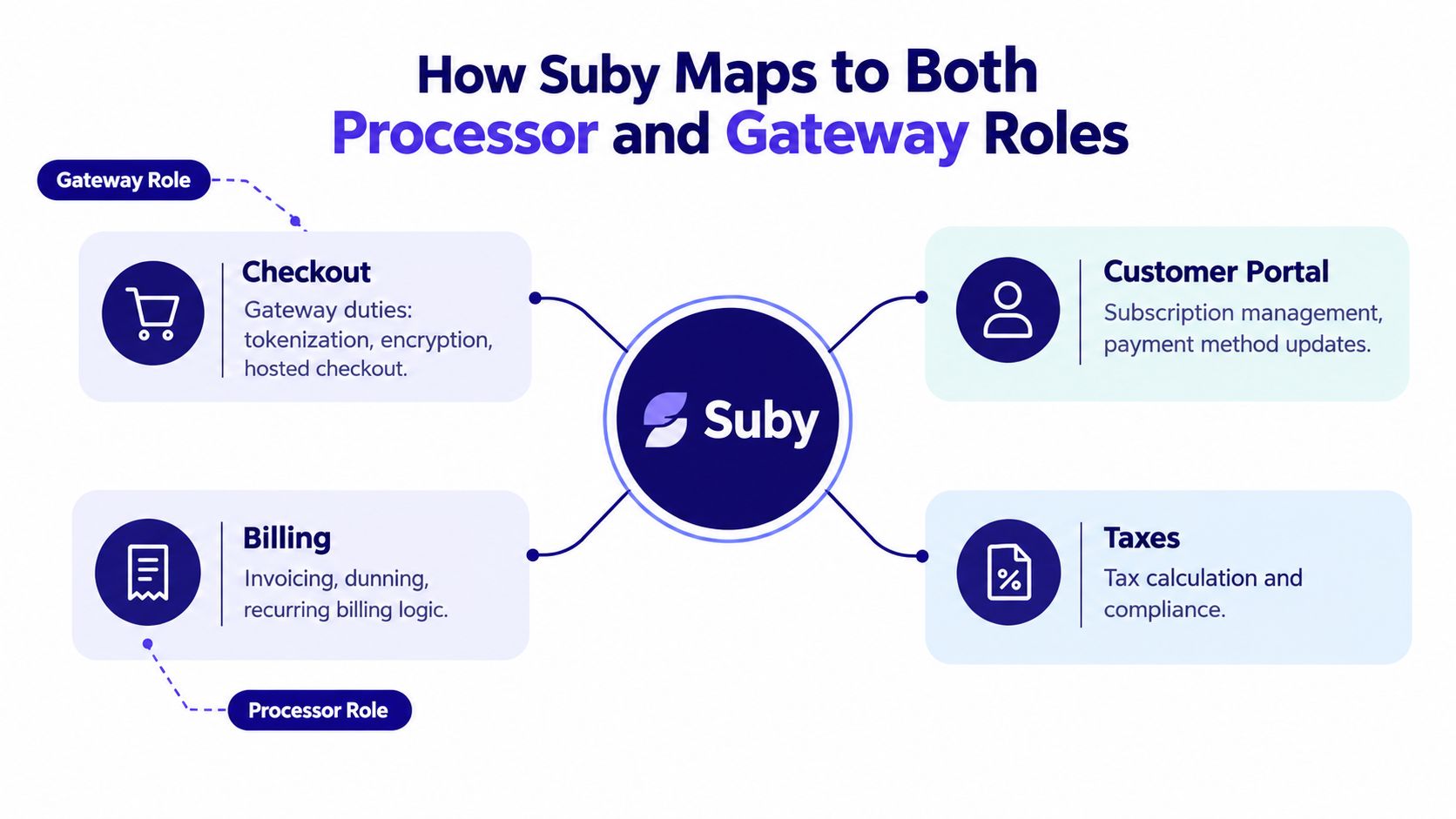
How Suby Maps to Both Processor and Gateway Roles
Suby is one product with four ways to use it, rather than four separate companies or unrelated tools. The four surfaces are Suby Payments, Suby Crypto, Suby Gating, and Suby Invoicing.
Suby Payments is an API-first payment stack for accepting cards and crypto through one checkout. It provides the integration layer developers use to create payment experiences, while the merchant can operate payments through the product's dashboard.
Suby Crypto is a crypto payment gateway. It handles the swap and sponsors the gas, then settles either to a non-custodial wallet or into the Suby balance. That gives the merchant a defined crypto flow without treating crypto as the only way customers can pay.
One product, several payment paths
Suby Gating connects paid access with destinations such as Discord, Telegram, downloads, and courses. Suby Invoicing lets a client choose how to pay while the business chooses what it receives. In both cases, the central idea remains practical: customers pay any way they want, and businesses get paid the way they choose.
The core API is important here. Suby provides an API that lets any business accept payments by card or crypto, and it also offers native integrations with Discord and Telegram for subscriptions, paid access, and online communities. A card-to-USDC flow is one possible example. A customer can pay by card, while the business settles in USDC, but merchants can choose other supported payment and settlement paths as well.
The four surfaces map to the earlier gateway and processor model in different ways:
Suby surface | Merchant-facing role |
|---|---|
Suby Payments | Checkout and API infrastructure for card and crypto acceptance |
Suby Crypto | Crypto checkout, swap handling, gas sponsorship, and wallet or balance settlement |
Suby Gating | Payment-linked access for communities and digital products |
Suby Invoicing | Flexible client payment methods with merchant-selected settlement |
A single integration can reduce the number of separate payment contracts and dashboards a team manages, although merchants should still verify the underlying processing, settlement, and compliance arrangements for their business. Explore the Suby payments product to see how its payment API and checkout fit into your architecture.
Choosing the Right Setup for Your Business
The right answer depends on the way customers pay, not on whether one label sounds more advanced.
Solo creators and small software companies
If you sell subscriptions, digital products, or paid community access, a unified platform can reduce the work of connecting checkout, recurring billing, invoices, and access rules. Suby is one option for this profile. It supports card and crypto acceptance through an API, native Discord and Telegram integrations, and settlement to a bank account or stablecoins such as USDC.
Mid-market online stores
A store with one-time purchases, cross-border card traffic, and several payment methods may need a dedicated gateway and processor combination. Focus on checkout performance, fraud controls, local method coverage, settlement currencies, dispute handling, and transparent pricing. Make sure the provider can explain which party owns each layer.
Agencies and business-to-business services
An agency invoicing larger projects may value payment links, invoice records, bank payments, cards, crypto, and predictable settlement more than a heavily customized checkout. Processor arrangements become more important as payment values, reconciliation requirements, and client-specific payment terms become more complex.
Marketplaces and platforms
Marketplaces need a modular setup because they may route payments among multiple sellers, manage onboarding, handle identity checks, and apply reserve rules. Don't choose a provider only because it offers a polished checkout. Confirm how it supports merchant onboarding, split payouts, reporting, disputes, and regulatory responsibilities.
Use this checklist before signing:
Map the payment journey: Identify every step from checkout to settlement.
List customer methods: Include cards, wallets, bank payments, and crypto only where they fit your audience.
Choose your settlement outcome: Decide whether you need a bank account, stablecoins like USDC, or multiple currencies.
Test failure handling: Review declines, 3-D Secure, refunds, disputes, retries, and webhook delivery.
Calculate real cost: Compare method-specific pricing against your expected payment mix.
Confirm ownership: Ask who provides the gateway, processor, acquiring relationship, compliance support, and settlement.
Suby gives businesses an API for accepting card or crypto payments, plus Suby Payments, Suby Crypto, Suby Gating, and Suby Invoicing for different payment and access needs. Visit Suby to review the available checkout, payment-method, settlement, and Discord or Telegram options for your business.
