

Gaspard LEZIN
Cross Border Payment API: A Practical Guide for Builders
Learn how a cross border payment API works, what to look for in cards, crypto and stablecoin rails, and how to ship a global checkout without a banking stack.
You're halfway through a checkout build. A customer in the United States is ready to pay by card in USD, but your business needs the funds in a EUR bank account in Berlin. The card form is easy. The difficult part begins after authorization, when currency conversion, compliance checks, payout routing, settlement timing, and reconciliation all have to agree.
That's the job of a cross border payment API. It connects the customer's preferred pay-in method to the merchant's preferred settlement method, without forcing your application to understand every local rail and currency rule. The reliable design treats cards, bank payments, and stablecoin settlement as endpoints of one payment flow, not as separate products.
Table of Contents
The Problem a Cross Border Payment API Solves
A customer pays by card in USD, while your business needs EUR in a Berlin bank account. The checkout form may finish in seconds, but the payment still has to pass through currency conversion, settlement, payout routing, compliance checks, and reconciliation. Each stage can produce a different status or reference.
The integration must account for several failure points:
Currency conversion: The customer-facing rate may differ from the rate applied at settlement.
Intermediary routing: A bank payout can pass through correspondent institutions and local settlement systems before reaching the beneficiary.
Timing: Authorization, capture, settlement, and bank credit are separate events.
Compliance: Customer, business, beneficiary, or transaction screening may be required before funds are released.
Reconciliation: Your application ledger records the payment, while the bank statement records the payout, often under a different reference.
A cross border payment API coordinates these stages through one programmable interface. Your application provides the payment intent, source currency, destination currency, and payout preference. The provider connects the appropriate card, bank, wallet, or on-chain path, applies the conversion and routing rules, and reports status changes. Your code can then respond to consistent events instead of maintaining separate logic for every card scheme, bank corridor, and stablecoin settlement route.
The same decision applies across fiat and crypto. Card rails may suit a customer-facing checkout, bank rails may fit account-based transfers, and stablecoin settlement may suit a wallet destination or a corridor with limited banking access. They are two endpoints of one API surface, so the practical question is which rail best matches the source, destination, compliance requirements, cost, and settlement timing.
Practical rule: Keep payment creation, conversion, and payout as linked states in one ledger. If you model them as unrelated transactions, finance must join the records later.
The result could be a card, wallet, bank, or crypto payment that ends as EUR in a bank account or USDC in a wallet. Fees, exchange rates, expected timing, and possible holds should be visible before capture, rather than discovered after a failed payout or chargeback.
The G20 cross-border payments roadmap tracked by the BIS documents why international payments remain fragmented across corridors, intermediaries, and local settlement systems. The BIS 2024 progress report on the G20 cross-border payments roadmap recorded that retail cross-border payments completed within one hour improved by 1.1 percentage points to 55.6%. That is progress, not a finished system. API connectivity gives developers a consistent way to work with the infrastructure underneath.
What a Cross Border Payment API Is and How It Fits Together
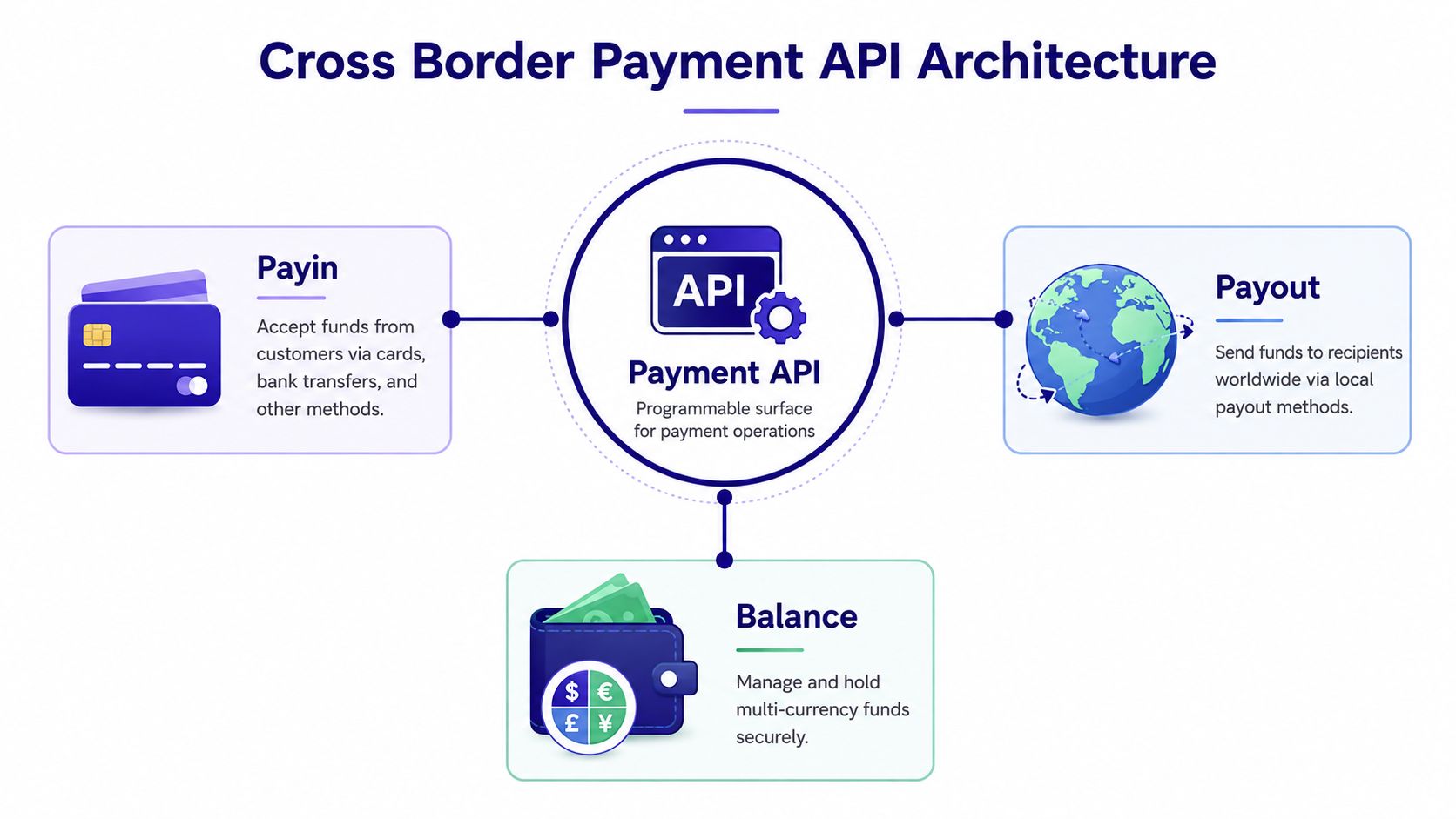
A useful mental model has three blocks: pay-in, balance, and payout. The API is the programmable surface that coordinates them.
Pay-in is how money enters the system. Depending on the corridor and customer, that could be a card, a local bank method, or an on-chain transfer. The provider converts the result into a normalized balance, while preserving the original payment method, currency, reference, and status.
Balance is the accounting layer between collection and settlement. It lets the merchant see what has arrived, what remains pending, what has been reserved, and what can be paid out. A multi-currency balance is especially important when the customer pays in one currency and the business settles in another.
Payout sends available funds to the destination the merchant selected. That destination might be a bank account, a wallet, or a blockchain address. The payout request should state the destination currency and the required beneficiary information, rather than leaving those decisions hidden inside application code.
For a broader explanation of the underlying pattern, see this guide to what a payment API does.
The primitives that keep money movement safe
A production API needs more than a create-payment endpoint.
Idempotency: A retry after a timeout must not create a duplicate charge or payout.
Quotes: The API should return the conversion rate, applicable fees, and expected settlement window before capture.
Rate locking: A locked quote gives the customer and merchant the same economic terms during the permitted quote window.
Refunds and reversals: A failed payout or returned payment needs a defined path back through the ledger.
Webhooks: Your system should receive state changes asynchronously instead of repeatedly guessing whether a payment succeeded.
A quote object should carry the FX rate, fees for each relevant leg, destination amount, and expected settlement window. That lets your checkout display a firm price and lets finance calculate the actual cost of the corridor before the transaction is committed.
The Mastercard Endpoint Guide illustrates why corridor metadata belongs in the design. Required and conditional fields can vary by destination country, currency, payment instrument, and payment type. Validate identifiers such as IBAN, BIC, local clearing details, and compliance fields before submission, then use the same rule set for quoting and execution.
The Main Payment Rails Compared
No payment rail wins in every corridor. The right choice depends on who is paying, how much operational certainty the merchant needs, where the beneficiary is located, and whether speed matters more than familiar customer experience.
Rail | Best For | Settlement Speed | Cost Profile | Key Trade-off |
|---|---|---|---|---|
Card | Consumer checkout and broad international acceptance | Often slower from authorization to merchant settlement | Scheme, acquiring, FX, and dispute costs may apply | Familiar UX, but refunds and disputes need careful handling |
Bank | B2B collections, supplier payments, and larger payouts | Depends on local and cross-border banking rails | Often more economical for bank-led transfers, with corridor-specific fees | Requires accurate beneficiary and purpose data |
Stablecoin | Always-on treasury movement and selected payout corridors | Can settle quickly when liquidity and off-ramps are available | Network, conversion, custody, and provider costs must be modeled | Wallet operations and regulation vary by market |
Cards are usually the easiest way to reach consumers. The customer already understands the flow, and the merchant can use familiar authentication and dispute processes. The trade-off is that card economics include more than the visible processing fee. Foreign exchange, scheme rules, refunds, and delayed settlement all affect the effective result.
Bank rails are often a better fit for business payments. SEPA, SWIFT, ACH, and local instant systems can support account-based transfers and detailed beneficiary information. They also demand more data. A missing local identifier, incorrect account name, or unsuitable purpose code can turn an otherwise valid payout into a repair case.
Stablecoins add a different settlement option. They can operate outside traditional banking hours and can be useful where the merchant has a compliant wallet, dependable liquidity, and a practical off-ramp. They aren't automatically cheaper or simpler. The total cost includes conversion, network selection, custody, screening, and the process for turning the asset into local spending money.
The SWIFT alternative overview is useful when comparing bank-led international transfers with API-connected local and digital settlement paths. The practical rule is to choose by corridor, ticket size, and urgency, not to standardize on one rail globally.
Compliance, FX, and Settlement Behind the API
Compliance isn't a final approval screen that can be added after the payment flow works. It changes which customers can pay, which beneficiaries can receive funds, and whether a corridor remains available.
At onboarding, the provider may need business verification, beneficial-owner checks, and document review. At transaction level, the flow can involve sanctions screening against lists maintained by authorities such as OFAC, the European Union, and the United Nations. Ongoing monitoring then looks for activity that requires review under the provider's risk policy.
Your integration should know what happens when a check pauses a payment. A pending state isn't the same as a failure, and a rejected payout isn't the same as a reversed card transaction. Store the provider's reason codes and preserve the relationship between the original payment, compliance decision, conversion, and payout.
FX belongs in the transaction model
Currency conversion usually starts with a reference or mid-market rate and applies a spread or fee. The exact commercial model differs by provider, so your system should record the quoted rate, source amount, destination amount, fees, and quote expiration rather than calculating a second rate independently.
Use minor-unit integers for ledger amounts where the currency supports them, and define precision rules for currencies with different decimal conventions. Otherwise, repeated conversions and partial refunds can create rounding drift between your payment ledger and settlement records.
Settlement also needs explicit states. Model gross versus net availability, first-payout holds, expected release times, returned funds, and reconciliation files. A merchant may see a successful customer payment while the payout remains pending because the provider has not yet released funds.

Skipping these inputs has concrete consequences. Funds can be held, a transaction can be reversed, or a corridor can be suspended when the provider can't satisfy its compliance or settlement requirements. Build the relevant states, alerts, and reconciliation fields before the first live transaction.
ISO 20022 provides an important data model for this work. The BIS consultative report on harmonized ISO 20022 data requirements describes the standard as a global, open way to exchange financial information and explains how harmonized requirements can improve data quality across jurisdictions. The same report shows that APIs were used by 78% of FPS systems and 31% of RTGS systems in 2024, so a practical architecture often combines API orchestration at the front with ISO 20022 normalization behind it.
Integration Patterns Developers Use
A software service selling across borders may begin with a single invoice and later need subscriptions, entitlement checks, and its own ledger. The integration should grow with those requirements. A paylink fits a manual invoice or quick pilot. Hosted checkout suits a product team that needs several payment methods without building every frontend state. A direct API fits an application that must connect payment status to its own orders, subscriptions, and accounting.
Paylinks and hosted checkout
A paylink flow creates the payment on your server, receives a customer-facing URL, and sends it by email, chat, or invoice. The customer pays on the hosted page. Your backend then receives a webhook and decides whether to grant access or start fulfillment.
Hosted checkout follows the same pattern through a redirect or provider component. It can present available payment methods, handle authentication, and collect payment details. Your team still owns the business decision after payment, such as activating a subscription or releasing digital goods.

Direct API and webhook handling
A direct integration usually follows this sequence:
Create the product or payment: Send the amount, currency, customer context, and return details from your server.
Authenticate safely: With Suby's documented API flow, send the key in the
X-Suby-Api-Keyheader. Keep it on the server.Redirect the customer: Use the returned
paymentUrl. The initial API response only creates the payment and does not prove that it succeeded.Verify the webhook: Check the signature according to the provider's documentation before changing the order state.
Persist the event: Store the event identifier, payload, received time, and processing result so the event can be audited or replayed.
Retry carefully: Apply exponential backoff to temporary failures. Make the handler idempotent so a repeated event cannot grant access twice.
Your state machine should separate payment.created, payment.processing, payment.succeeded, and payment.failed. Grant a product, subscription, or community access only after the authoritative success event. A customer returning from checkout is not that event.
For a documented implementation, follow the Suby API introduction, which covers product creation, API-key authentication, payment initiation, the returned payment URL, and webhook-based access decisions.
Use the sandbox to exercise successful, failed, delayed, refunded, and duplicate-event paths. Test with sandbox credentials and rail-specific test values, then switch deliberately to production keys and production webhook endpoints.
Accepting Card and Settling in Stablecoins in Practice
Consider a merchant selling a digital service to a US customer. The customer enters card details and pays in USD. The merchant, however, wants the proceeds delivered as USDC to a configured wallet.
The API flow should make the settlement choice explicit:
Collect the source payment: Create a card payment with USD as the source currency.
Create or retrieve the quote: Confirm the USD-to-USDC conversion, destination amount, fees, and quote validity.
Run the required checks: The provider evaluates the merchant, transaction, destination, and corridor requirements.
Settle the result: Deliver USDC to the configured wallet and report the payout status through the webhook flow.
Reconcile: Store the card payment, conversion record, wallet destination, network transaction reference, and final settled amount together.
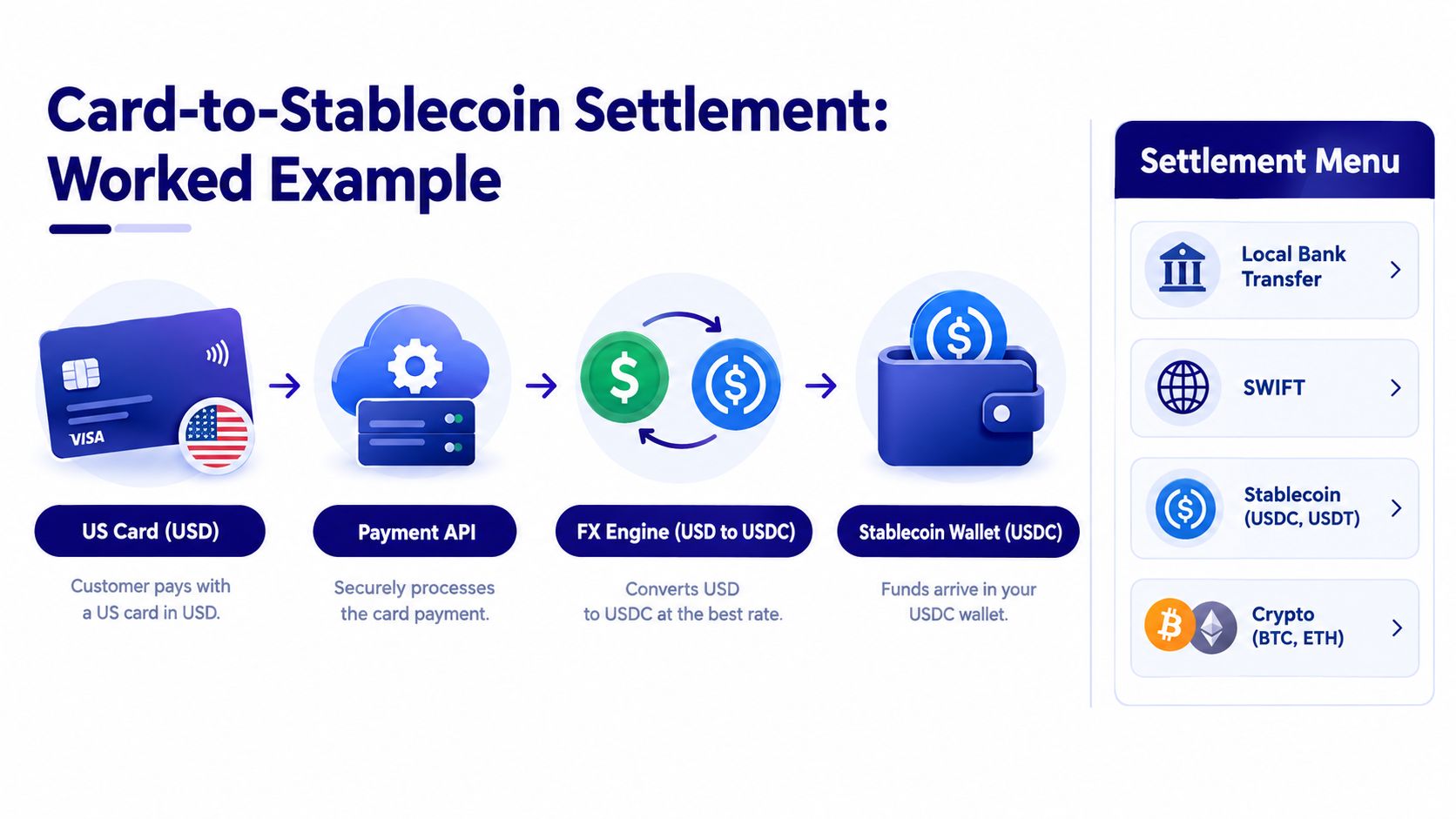
The key engineering decision isn't just “card or crypto.” It has four parts: source rail, destination asset, destination network, and custody model. A merchant may choose USDC in a wallet it controls, aggregation in a provider balance, or a bank payout in a local currency such as EUR. Each option changes reconciliation, access control, operational risk, and the steps required when a payout fails.
With a non-custodial wallet, the merchant controls the destination keys and is responsible for wallet operations. With a provider balance, the merchant gets a simpler operational surface but must understand the provider's balance and withdrawal process. A bank payout to a SEPA account in EUR removes wallet management, but it adds bank beneficiary validation and local settlement timing.
stablecoin support requires a corridor decision, not just a headline feature. The stablecoin settlement guide explains the mechanics, but production teams must still verify local off-ramps, liquidity, screening obligations, and the customer's actual use case.
The card leg can remain the same while the destination changes. That separation is the value of the API design: the checkout contract stays stable, while the back-end settlement route is selected for the merchant's currency, treasury policy, and corridor.
Choosing a Cross Border Payment API Vendor
A vendor can look excellent in a demo and still fail your first difficult corridor. Build the shortlist around evidence from the exact payment paths you need, not around the number of logos on a sales page.
Start by checking actual coverage. Ask whether the provider supports the source methods, destination currencies, beneficiary types, and settlement destinations your product needs today. “Global” doesn't tell you whether a specific card-to-bank or card-to-stablecoin route is available in the market where your customers and business operate.
A production-focused scorecard
Criterion | What to Verify | Suggested Weight |
|---|---|---|
Corridor coverage | Supported countries, currencies, pay-in methods, payout destinations, and restrictions | Highest |
Pricing clarity | Per-method fees, FX spread, network costs, refunds, disputes, and payout charges | High |
Settlement behavior | Availability, release conditions, holds, returns, and expected timing by rail | High |
Webhooks | Delivery guarantees, retry policy, replay tools, signatures, and event ordering | High |
Compliance split | Which KYC, sanctions, monitoring, and reporting tasks belong to each party | High |
Reconciliation | Stable identifiers, exports, conversion records, payout references, and ledger detail | Medium |
Developer experience | API references, SDKs, typed schemas, sandbox behavior, and error messages | Medium |
Operational performance | Rate limits, latency expectations, status pages, and support escalation | Medium |
Give each criterion a score based on test results, then apply the weight. A vendor that supports your preferred payment method but can't explain webhook replay or payout reconciliation shouldn't pass the same review as a provider with a slightly different fee structure and stronger operational controls.
Pricing must be modeled by method. Suby's public pricing documentation states that there isn't one flat rate. It lists a transaction fee of 4% plus $0.40 per successful transaction, no monthly fees or setup costs, and an additional 1% for bank and stablecoin payouts; Venmo and PayPal use their standard rates. Check the Suby pricing documentation for the exact applicable figures before modeling a corridor.
Suby is one option that provides an API for accepting card or crypto payments, with customers paying through the checkout and businesses choosing settlement to a bank account or stablecoins such as USDC. Its single product also includes Suby Payments, Suby Crypto, Suby Gating, and Suby Invoicing. The native Discord and Telegram integrations support paid access, subscriptions, and online communities, while the API and webhooks support custom applications.
Next Steps for Evaluating and Integrating a Provider
Turn the evaluation into a narrow pilot. Choose two or three real corridors and settlement currencies tied to an actual revenue path, such as customer collections into a bank payout or card acceptance into stablecoin settlement. Don't begin with every market and every payment method. A focused flow exposes data, compliance, and reconciliation problems sooner.
Run the complete path in the sandbox:
Create the payment: Test the source rail, currency, customer return, and idempotent retry.
Process the status: Confirm your handler distinguishes pending, successful, failed, refunded, and reversed states.
Test webhook failure: Return an error from your endpoint, observe provider retries, and verify that replaying an event doesn't duplicate fulfillment.
Verify settlement: Compare the quoted amount, fees, destination amount, and final ledger entry.
Export reconciliation: Confirm that your finance team can join payment, conversion, payout, and refund records without manual guesswork.
Write down the compliance split before launch. Your team should know who verifies the business, screens transactions, reviews alerts, handles beneficiary information, and responds when a corridor is paused. Confirm the export fields and retention process with the provider, then run a load test that reflects your expected traffic and webhook concurrency.
Before production, check:
Test and production keys: The application uses the right credentials in each environment.
Webhook endpoint: Production events point to a monitored, authenticated endpoint.
Signed payloads: Your handler verifies signatures before changing payment or access state.
Idempotent processing: Duplicate requests and duplicate events produce one business outcome.
Status monitoring: Alerts cover delayed, failed, and
payment.status updatedevents.Operational ownership: Someone on your team owns settlement exceptions and reconciliation breaks.
The design principle stays simple. Let customers pay by card, wallet, bank, or crypto, then let the business receive funds through the destination that fits its corridor and treasury needs. A good cross border payment API makes those choices explicit while keeping your application's payment contract stable.
Suby provides an API for accepting card or crypto payments, plus native Discord and Telegram integrations for paid access, subscriptions, and online communities. Visit Suby to evaluate its payment, crypto, gating, and invoicing options for a flow where customers pay how they want and your business settles how it chooses.
