

Gaspard LEZIN
International Payment Settlement: A 2026 Guide for Firms
Learn how international payment settlement works for global businesses in 2026. Simplify cross-border transactions and reduce costs with this clear guide.
A Berlin SaaS team can do everything right on the sales side and still miss payroll on the operations side. The customer in Singapore approves the card payment on Tuesday afternoon, the invoice looks fine, and the subscription is sold, but the money still has to cross currencies, banking windows, compliance checks, and payout rails before the German account can use it. International payment settlement is the part of the flow that decides whether the business receives the right amount, in the right currency, on the right day.
That's why payments teams talk about settlement differently from checkout. Checkout is the moment of approval. Settlement is the chain behind it, where money gets held, converted, moved, and finally released in a form the business can spend. For cross-border SaaS, ecommerce, agencies, and creator businesses, that chain usually has four moving parts, payins, balance, FX, and payouts, and the rail choice, bank or stablecoin, changes how each piece behaves.
If you already think in terms of "customer pays" and "merchant gets paid," the missing layer is the bridge between those two events. A useful starting point is this cross-border payments overview, because the key questions are rarely about whether money can move at all. They're about when it lands, what it lands in, and how much value survives the trip.
Table of Contents
What International Payment Settlement Really Means for Your Business
A SaaS company in Berlin sends a $2,400 annual invoice to a customer in Singapore. The customer pays in SGD by card on a Tuesday afternoon. On paper, the sale is done, but the Berlin team still has to wait for the payment to travel through authorization, clearing, currency conversion, banking cutoffs, and finally into a usable business account balance by Friday payroll.
That gap is where international payment settlement lives. It's not just the movement of money across borders, it's the operational layer that decides whether the business gets the right amount, in the right currency, on the right day. If the flow breaks anywhere in that path, the merchant can still show “paid” on the customer side and yet be short of spendable funds on the business side.
Why the operational layer matters
For a finance lead, the hard part is rarely the invoice itself. The hard part is what happens after authorization, when value has to cross currencies, banks, and time zones before it becomes usable cash. That's why settlement has to be designed with the rest of the business in mind, not just with the checkout page.
Practical rule: if you can't explain where the money sits between payment and payout, you don't really control the flow yet.
A clean way to think about the process is to break it into payins, balance, FX, and payouts. Payins bring money into the system, balance holds it, FX converts it if needed, and payouts release it where the business wants it. The rail choice changes each of those steps. A bank rail and a stablecoin rail can both move value, but they don't behave the same when the counterparty is offline, the corridor is slow, or the receiving account needs a specific currency.
The Four Building Blocks of Every Cross-Border Flow
Think of cross-border settlement like a container moving through ports. The cargo doesn't magically appear at the destination, it passes through distinct checkpoints. Payins are the loading dock, balance is the warehouse, FX is the customs conversion, and payouts are the last-mile truck.
Payins, balance, FX, and payouts in plain English
Payins are how money enters the system. That can be a card, bank transfer, or crypto deposit, depending on the product and corridor. In a payments operation, this is the point where the customer's intent becomes actual value inside your infrastructure.
Balance is the holding layer in between. Funds land there before they're converted or moved again, and working capital can get trapped if the business has to wait too long to release or convert it.
FX is the currency conversion step. The rate, the spread, and the timing all matter, because a payment that looks complete on the frontend can still change value at the conversion layer.
Payouts are the final leg. That may mean local currency into a bank account through domestic rails, or stablecoins to a wallet if that's the settlement destination the business wants.

A simple way to keep the flow straight
The container analogy helps because each step has a different operational risk. Loading errors are not the same as warehouse delays, and customs issues are not the same as the truck not showing up. In payments, the same logic applies, the card can clear, the balance can sit idle, FX can move at the wrong time, and the payout can still fail because the receiving rail isn't ready.
That's why teams should separate the vocabulary early. A payin problem is not a payout problem. A payout problem is not always an FX problem. Once those words stay distinct, it becomes much easier to spot where money is getting stuck.
Why Cross-Border Settlement Is Harder Than It Looks
Cross-border settlement usually has two layers that people blur together. The first is the messaging layer, where systems like SWIFT, SEPA Instant, FedNow, or FPS send instructions. The second is the actual settlement layer, where value finally moves between accounts and becomes usable.
A domestic payment can feel simple because the instruction and the value transfer are tightly coupled. Cross-border flows are different. The instruction may leave quickly, but the money can still sit inside correspondent chains, wait for local clearing windows, or miss a banking cutoff before it arrives in a form the business can spend.
Where the friction shows up
The main delays come from familiar operational places. Intermediary banks can add cost, cut-off times can push a payout to the next window, and pre-funded nostro balances can lock up liquidity that a finance team would rather use elsewhere. FX can also be confirmed at one moment and executed at another, which is why the settlement outcome can differ from the rate shown at approval.
Stage | Domestic Flow | Cross-Border Flow |
|---|---|---|
Instruction | Sent and settled inside one local market | Sent across multiple systems and rules |
Clearing | Usually one domestic rail | Often a chain of correspondent steps |
Timing | Narrower operational path | Cutoffs and local banking hours matter |
Liquidity | Usually less trapped capital | Pre-funding and timing can lock up cash |
A useful contrast is domestic ACH versus a cross-border EUR to SGD payout. The domestic flow usually has one market, one clearing logic, and one local timing framework. The cross-border flow has to cross more than one banking environment, which is exactly where hidden fees and delays multiply.
Bank Rails vs Stablecoin Rails for International Settlement
Bank rails and stablecoin rails solve the same business problem in different ways. Both can move value across borders, but they trade off speed, operating hours, compliance fit, and liquidity control in different ways.
How the two rail families differ
Bank rails work through messaging and banking relationships. They're the right fit when auditability matters, when the destination bank expects standard payment messages, or when the corridor is heavily regulated and the business wants a familiar trail. The downside is that these rails still depend on operating hours, cutoffs, and intermediary institutions.
Stablecoin rails move value on a public ledger and can keep operating continuously. They're especially useful when the goal is to move the international leg without waiting for a traditional banking window, then convert at the payout leg. That can reduce trapped liquidity and intermediary dependence, but it also shifts attention to wallet operations, on-chain custody, and regulatory acceptance.
If you need a practical licensing reference while evaluating this setup, PSD2 payment agent vs institution is a useful guide for understanding how payment roles can differ in regulated environments.
Dimension | Bank Rails | Stablecoin Rails |
|---|---|---|
Operating hours | Banking hours and cutoffs apply | Continuous operation |
FX handling | FX can happen earlier in the chain | FX can be delayed until payout |
Intermediaries | Multiple institutions may sit in the path | Fewer banking intermediaries in the transfer leg |
Compliance fit | Strong for regulated fiat destinations | Stronger where wallet-based settlement is accepted |
For the same reason, hybrid stacks are common. A vendor payment in a regulated market may fit bank rails better, while a 24/7 creator payout or a dollar-pegged inflow from a digital business may fit stablecoin rails better. The operational question isn't “which rail is universal,” it's “which rail matches this corridor and this business event?”
If you want a deeper product-level view of the stablecoin side, this stablecoin settlement explainer fits neatly beside the operational view here.
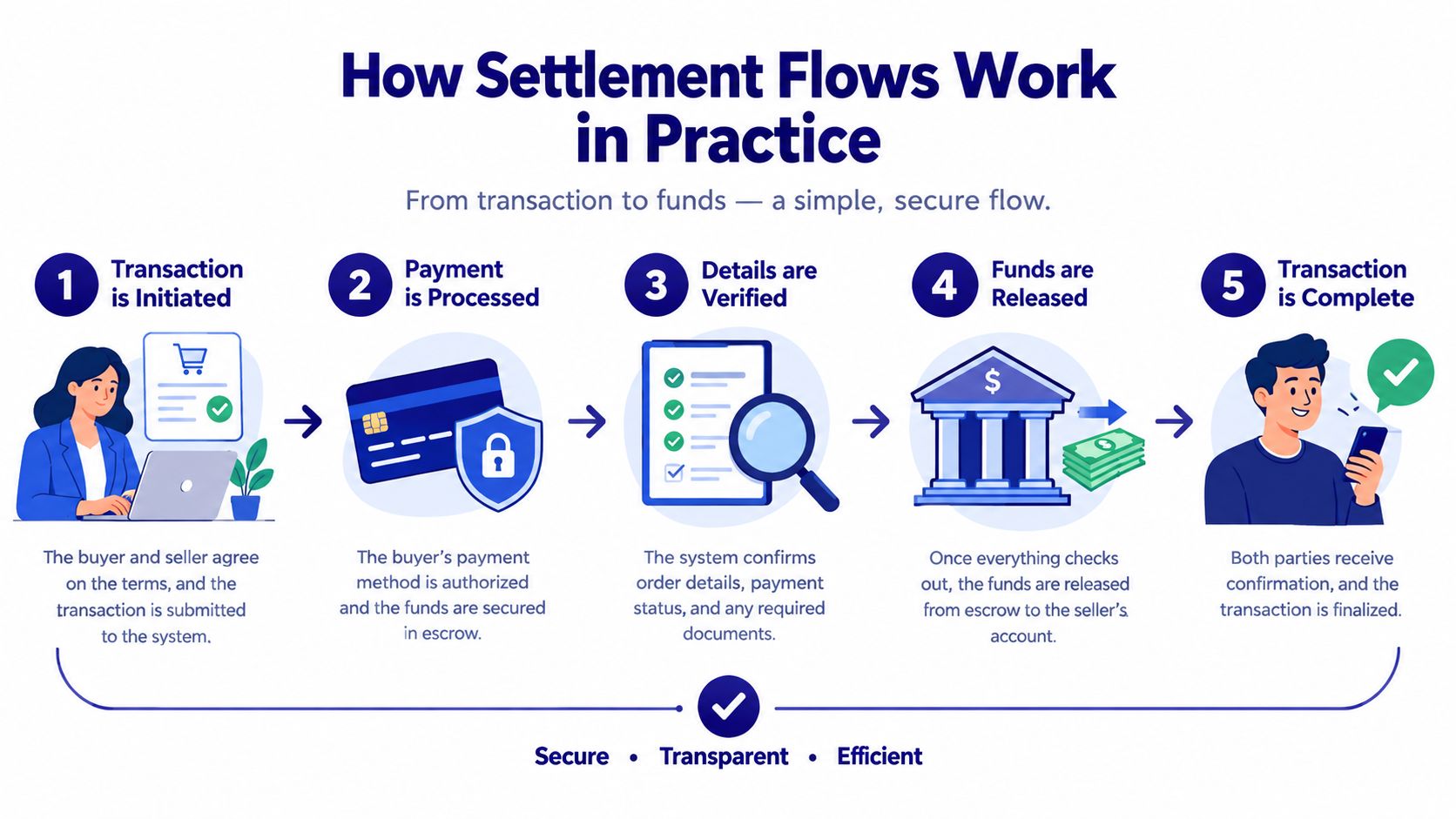
How Settlement Flows Work in Practice
The most useful example is the one operations teams run. A customer pays by card in local currency, the processor captures the funds, the money sits in balance, it's converted to a stablecoin, transferred on-chain, and then converted again at the destination if the business wants fiat.
A card to USDC payout flow
Customer pays in local currency. The checkout happens in the currency the buyer already uses, which lowers friction at the front end.
The payment processor captures the funds. This is the entry point into the settlement chain, not the final destination.
The balance holds and converts the value. The merchant doesn't necessarily need to wait for a conventional bank payout before deciding what to do next.
The transfer moves to the business wallet. If the chosen route is stablecoin settlement, value can move directly to the wallet destination.
The payout leg converts to fiat if needed. Some businesses stop at the wallet. Others want local currency in a bank account, so the final leg handles that conversion.
Operational insight: the same payment can be “settled” in more than one way, depending on whether the business wants to end in a wallet, a bank account, or a treasury balance.
The same building blocks also support other shapes. Crypto in and fiat out works well for exchanges and on-ramps. Fiat in and fiat out in a different currency fits marketplaces paying global sellers. Hybrid flows let a business keep part of the balance in stablecoins for treasury and pay the rest out locally. A flexible settlement layer matters because the order of the pieces changes, even when the pieces themselves stay the same.
For a more detailed view of the control layer, this settlement processor overview is a useful companion piece.
Where Suby Fits in the Settlement Stack
Suby sits above the rails, not instead of them. It's a single product with four ways to use it, and the same underlying settlement logic shows up in each one. The business chooses how customers pay, then chooses how it wants to receive the money.
One API, several settlement outcomes
Suby Payments is the API-first payment stack. It lets a business accept cards and crypto through one checkout, while the settlement side can end in the merchant's preferred currency. That matters when the front-end experience has to stay simple but the back office needs a specific payout result.
Suby Crypto handles crypto-native payment flow, including the swap and gas sponsorship, then settles to a non-custodial wallet or to the Suby balance. That makes it a fit for businesses that want the crypto leg to move cleanly without bolting together separate tools.
Suby Gating provides native integrations with Discord and Telegram for paid access, subscriptions, downloads, and online communities. In practice, that means the settlement layer has to support verification and access control, not just the transfer itself.
Suby Invoicing lets the client pay how they want while the business receives what it wants. For agencies and freelancers, that's often the most direct way to separate the customer's payment method from the business's final settlement preference.
Simple rule: customers pay any way they want, businesses get paid the way they choose.
Suby also offers an API that lets any business accept payments by card or crypto, and it supports native Discord and Telegram integrations for paid access and community use cases. If you're mapping settlement across different business models, that combination is what turns a single rails problem into an orchestration problem.
Choosing the Right Settlement Rail for Each Scenario
The right rail depends on the corridor, the timing, and the recipient's systems. A finance lead usually needs to ask a few blunt questions before choosing.
Scenario | Best Rail | Key Reason |
|---|---|---|
Creator payouts that need to land continuously | Stablecoin rails | Wallet-based settlement can work outside banking windows |
Large vendor payment to a regulated supplier | Bank rails | Audit trails and familiar payment messages matter |
Marketplace paying sellers in different countries | Mixed rails | Different corridors often need different payout logic |
Treasury transfer where part of the value stays in digital form | Stablecoin rails | Keeps the settlement leg aligned with the balance strategy |
The questions that matter
Does the payout have to land on a Sunday in Manila, or can it wait for Monday banking hours? Does the receiving bank want a standard message trail, or is a regulated e-money payout acceptable? Is the destination corridor stablecoin-friendly, or is local bank transfer the only realistic option? Those answers usually matter more than a generic “faster” label.
Ticket size matters too. A small payout to a creator and a large contractor payment don't carry the same operational risk, so the rail choice shouldn't be forced to look the same. Many businesses end up using both rails in parallel, splitting by corridor or use case instead of trying to force one global policy everywhere.
Common Misconceptions About International Settlement
The first myth is that international payments are real time. Instruction messages can move quickly, but end-customer settlement still depends on intermediary screening, local clearing windows, and banking cutoffs, so the usable funds often arrive much later than the message.
The second myth is that there's a single global settlement rail. In practice, businesses are stitching together correspondent banking chains, card networks, regional instant payment schemes, and blockchain networks behind the scenes. The third myth is that the fee is one flat percentage. The actual cost usually includes FX, intermediary charges, network fees, and receiving bank fees, each sitting in a different part of the stack.
Operational takeaway: settlement is a configuration problem, not a single product choice.
That's why the better question is never “can money move internationally?” It's “which rails, which timing, and which destination make the flow usable for this business?”
If you're mapping international payment settlement for SaaS, ecommerce, or creator payouts, visit Suby to see how card, crypto, balance, FX, and payouts can be arranged in one flow. It's useful when you want customers to pay any way they want, but still control whether the business receives bank funds or stablecoins on the back end.
