

Gaspard LEZIN
Cross Border Payments Explained: A Practical Guide
Learn how cross border payments work, why fees and FX drain margins, and how global businesses can optimize collections and payouts with modern rails.
A customer in another country has paid for your product. The money has left their card or bank account, but it hasn't reached yours yet. Before you see the funds, someone must decide how the payment is collected, which currency is used for settlement, which rail carries the value across the border, and where the final payout lands.
That sounds like one transaction. Operationally, it's a chain of decisions involving FX conversion, compliance checks, intermediary institutions, settlement windows, and reconciliation. The global market is estimated at about $194.6 trillion in 2024, with one projection putting it at $320 trillion by 2032, so even small improvements in fees, exchange rates, or settlement speed matter at economy-wide scale. J.P. Morgan describes the size and strategic importance of the cross-border payments market.
Table of Contents
A Founder's First Cross Border Payment
A founder ships a small batch of goods to a buyer in Mexico. The order arrived through a marketplace, the customer paid successfully, and the sale appears complete. Then the founder clicks withdraw and discovers that the amount available for payout is smaller than the original sale price.
The marketplace has its own payout schedule. The payment provider used one exchange rate, the bank will use another, and an intermediary may deduct a fee before the funds reach the local account. The Mexican delivery cost is separate again. What looked like one sale has exposed several different money movement decisions.
Practical rule: Treat the customer payment, currency conversion, and final payout as separate stages, even when one provider presents them on a single screen.
That withdrawal moment forces four questions:
Which collection method should the business accept? Cards may be familiar to customers, while bank payments, wallets, or stablecoins may suit other markets.
Which currency should the business receive? The founder might want USD, EUR, MXN, or stablecoins such as USDC, depending on suppliers, payroll, and treasury needs.
Which rail should carry the value? A card network, correspondent bank, local clearing system, API-based payment platform, or blockchain can each handle a different part of the journey.
Where should the payout land? The destination could be a bank account, local wallet, business balance, or non-custodial wallet.
The right choice depends on the corridor and use case. A high-value supplier payment doesn't have the same requirements as a marketplace payout, a subscription charge, or a freelancer invoice. This guide focuses on those four decisions, so you can evaluate cross border payments as an operating system for collections and payouts rather than as a mysterious bank transfer.
How Money Actually Moves Across Borders
Start with four actors. The originator is the person or business sending value. The originating bank or wallet debits the sender and submits the instruction. One or more intermediary institutions route the payment between jurisdictions. The beneficiary's bank or wallet receives the funds and credits the recipient.
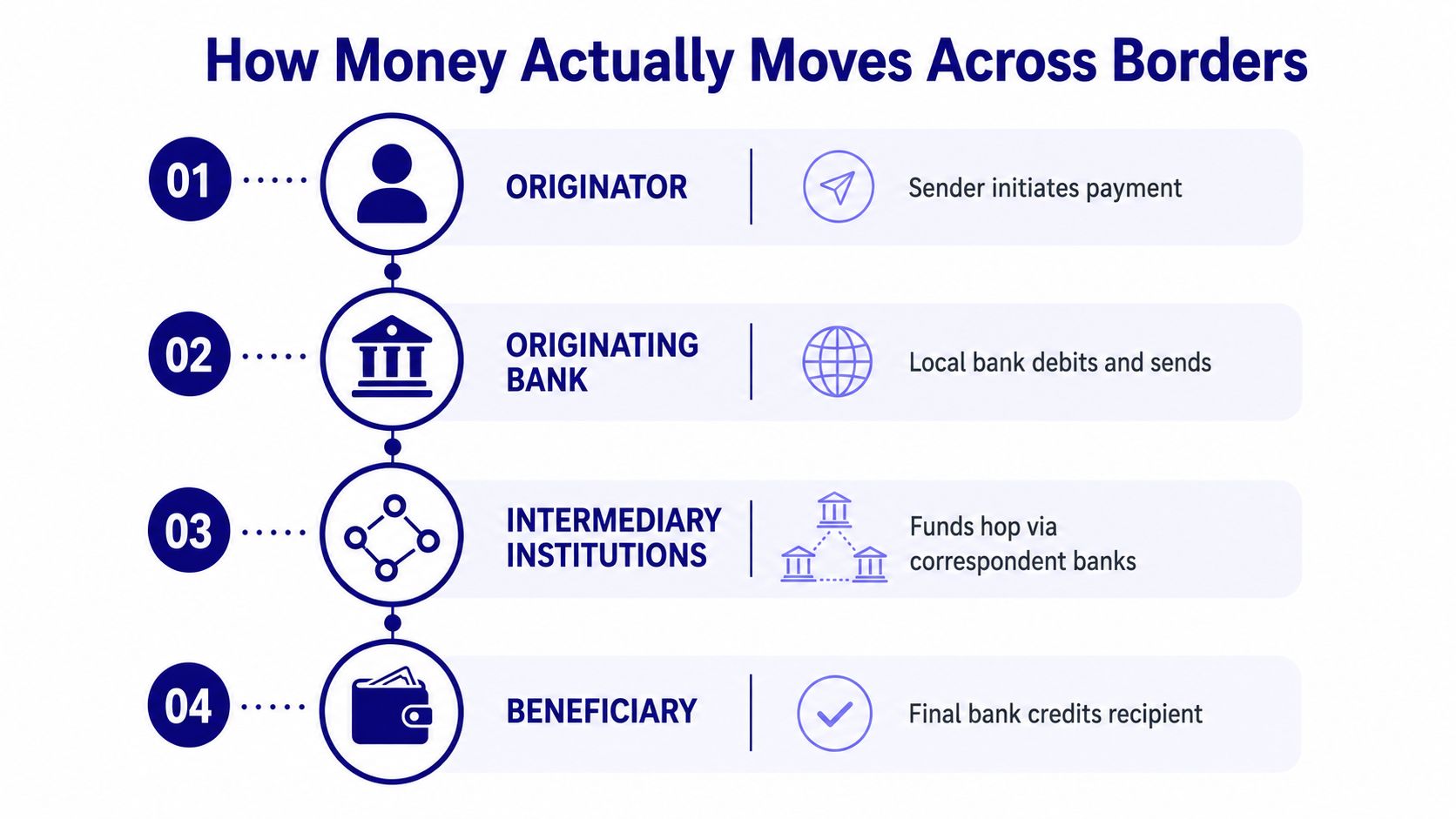
The correspondent banking path
Suppose a customer sends USD to a beneficiary who wants EUR in Germany. The sender's bank may debit the USD account and send a payment instruction. A correspondent bank in New York can handle the USD leg, another correspondent in Frankfurt can support the EUR leg, and the German beneficiary bank can finally credit the recipient.
The message and the money aren't always traveling through the same system. SWIFT provides messaging, while correspondent banks and local clearing systems handle settlement. Each institution must identify the parties, screen the transaction, manage liquidity, and report the payment using its own operational systems. Every additional hop can create room for a fee, an FX spread, a compliance hold, or a reconciliation mismatch.
The settlement processor explained by Suby is useful background because it separates the visible checkout from the behind-the-scenes process that moves funds into a merchant balance.
Local rails and modern APIs
A payment can also use a local clearing rail on each side of the border. The sender may pay through a domestic bank system, while a connected provider converts the currency and delivers the recipient's funds through a local rail in the destination country. This can reduce reliance on a long correspondent chain, but availability depends on the corridor, account type, operating rules, and compliance coverage.
Cards solve the collection problem differently. The customer authorizes a card transaction through the card network, an acquirer processes it, and the merchant receives settlement under the acquirer's schedule. A modern API layer can combine card, bank, wallet, and crypto collection methods, then expose a common balance and payout workflow. The interface looks unified, but the underlying rails still have different refund, risk, currency, and timing rules.
The Real Pain Points in Global Money Movement
The largest operational problems usually come from how the pieces interact. A business may see one total fee, but that fee can contain an exchange-rate margin, explicit conversion charges, intermediary deductions, provider costs, and the internal expense of investigating exceptions.
FX is more than the displayed exchange rate
The mid-market rate is a useful reference, not necessarily the rate applied to a customer payment or supplier payout. A provider can include a margin in the quoted rate and add a separate conversion fee. If the payment changes currency at collection and again before payout, the business may pay for two conversions.
The effect is particularly difficult to spot when a platform shows only the final amount. Finance teams should record the source currency, applied rate, reference rate, explicit fee, and destination amount for every corridor. That makes the actual cost visible instead of hiding it inside a settlement total.
Intermediaries charge for work and create delay
Correspondent institutions maintain accounts, provide liquidity, screen names and transactions, and support settlement across markets. Those activities help a payment move, but they also introduce deductions and operational queues. A fixed charge can consume a much larger share of a small payment than of a large one, which makes corridor design important for small and mid-sized businesses.
Compliance adds another layer. Screening may pause a payment for manual review, a bank may request documents, and local rules may require additional information about the sender or beneficiary. Cut-off times, weekends, holidays, time zones, and batch processing can turn a payment submitted late in the day into a next-window transaction.
Reconciliation breaks at the handoffs
One provider may identify a transaction with an order ID, another with a bank reference, and another with a blockchain transaction identifier. The currency and amount can also change at each leg. Without a shared reconciliation ID, a finance team may need to match payment records manually.
Pain Point | Underlying Mechanic | Where the Cost Lands |
|---|---|---|
FX spread | The applied rate differs from a reference rate, sometimes with an additional conversion fee | Merchant margin, supplier cost, or customer price |
Intermediary deductions | Banks and payment institutions route, screen, and settle the transaction | Recipient amount or sender balance |
Compliance latency | Screening queues, document requests, and jurisdictional checks pause release | Working capital and customer support time |
Cut-off windows | Local operating hours and batch cycles control when the next processing step starts | Settlement timing and cash forecasting |
Broken reconciliation | Different providers use different currencies, references, and reports | Finance team time and exception handling |
The G20 and Financial Stability Board have set a goal for wholesale, retail, and remittance cross-border payments to meet an important speed threshold within one hour by the end of 2027, with retail payments expected to cost no more than 1% globally. Industry summaries of the policy targets and World Bank remittance data show why the target remains difficult, especially when the average cost of sending $200 in Q3 2025 was 6.36%.
Common Rails From Cards to Crypto
No rail wins every category. The useful question is which system fits the customer experience, destination, amount, risk profile, and payout requirement.
Card networks, including Visa and Mastercard, work well for consumer checkout and card-not-present business purchases. They offer familiar authorization and refund processes, but merchants face payment processing costs, fraud controls, and chargeback exposure. The business receives a card settlement rather than a direct bank transfer from the customer.
SWIFT correspondent banking remains useful for large-value business transfers and broad international reach. The payment instruction can travel through several institutions, and the beneficiary may not know the full deduction path before funds arrive. Timing depends heavily on the corridor and the final beneficiary bank.
ACH, SEPA, and Faster Payments are domestic or regional systems. They can be efficient when both sides are eligible and connected to the relevant scheme, but a local rail doesn't automatically solve the cross-border conversion and payout problem. A provider still needs to connect the two jurisdictions.
Local instant systems such as UPI, PIX, and Faster Payments can move funds quickly within their respective markets. Their strength is local reach and domestic settlement. Their limitation is that the business needs a compliant way to enter and exit the local system.
Stablecoin rails use a different settlement layer. A sender converts fiat into a stablecoin, transfers it on a blockchain such as Ethereum, Solana, or a Layer 2 network, and the recipient converts it back into local fiat or keeps the stablecoin. The model can operate around the clock, but custody, compliance, wallet management, conversion, and off-ramp access still matter. The stablecoin settlement overview from Suby provides a focused explanation of that structure.
Rail | Typical speed | Cost ceiling | Best fit |
|---|---|---|---|
Cards | Authorization is quick, settlement follows provider timing | Processing, FX, and dispute costs vary | Consumer checkout and card-not-present sales |
SWIFT | Corridor-dependent, from fast routes to multi-day paths | Intermediary and FX deductions can be opaque | Large-value B2B transfers |
ACH or SEPA | Depends on local scheme and processing window | Often suited to domestic or regional payments | Bank collection and recurring business flows |
Local instant rails | Fast within supported markets | Local fees and provider costs apply | Domestic payouts and account transfers |
Stablecoins | Onchain transfers can occur within seconds or minutes | Network, conversion, provider, and off-ramp costs vary | Always-on treasury movement and selected cross-border corridors |
SWIFT gpi data illustrates the path dependency clearly. Median processing time is less than two hours overall, while route-level performance ranges from under five minutes on the fastest corridors to more than two days on the slowest. The beneficiary bank stage is often where delays accumulate. The Bank for International Settlements discusses SWIFT gpi processing and corridor performance.
Three End to End Payment Scenarios
Consider the same US to Philippines freelancer invoice for $1,500. The objective is unchanged, but the collection method and settlement route alter the operational result.
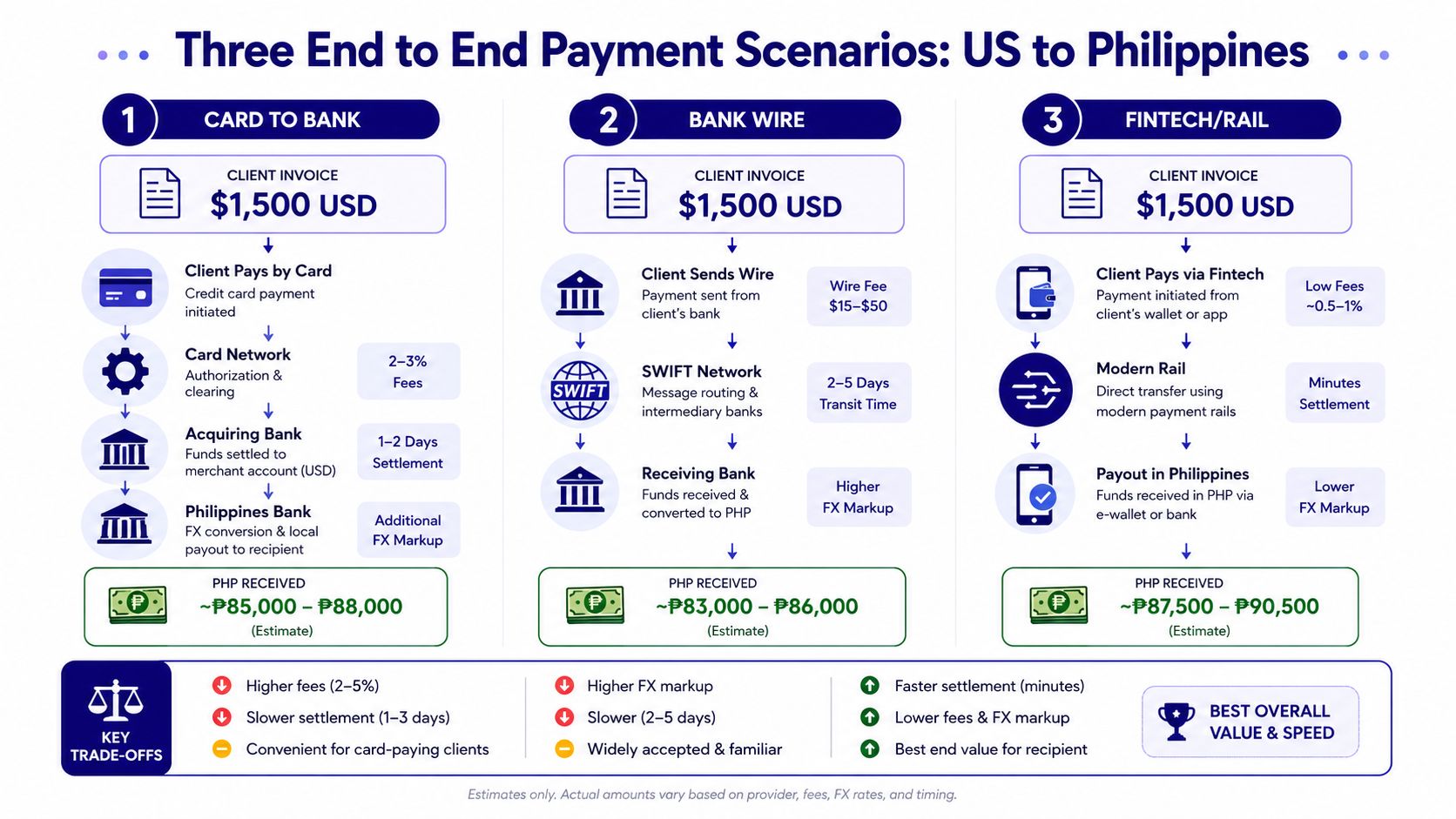
Card to bank
The client pays with a Visa Business card. The processor charges roughly 2.9% plus $0.30, and funds reach the US acquiring account in about two days. The business then sends a SWIFT wire, which converts USD to PHP through one or two correspondent banks.
The FX margin in this scenario can be $150 to $350, built into the exchange rate, followed by another three to five days of travel. The client gets a familiar payment experience, but the freelancer waits through two settlement stages and may receive less than expected.
Bank to bank through an API platform
The client pays through a local rail such as ACH or Open Banking. A modern API platform pools the funds, converts at mid-market plus a transparent 30 to 60 basis point spread, and delivers PHP to a local account in under an hour.
This route can improve visibility because the platform controls the collection, conversion, and payout instruction in one workflow. It still depends on account eligibility, compliance approval, local payout coverage, and the provider's actual quote for that corridor.
Stablecoin settlement
The payment settles as USDC on a low-fee network. Conversion occurs near the relevant spot rate, and the freelancer receives PHP or USDC in minutes. The trade-off is operational rather than purely technical, including custody setup, wallet screening, conversion controls, and regulatory paperwork on both ends.
Stablecoin arrangements commonly follow a fiat to stablecoin, onchain transfer, stablecoin to fiat sandwich. Research on the structure of stablecoin cross-border payments helps explain why the blockchain leg can be fast without removing the two FX and off-ramp decisions.
The comparison isn't about declaring one route superior. A card may maximize customer acceptance, a local bank route may simplify accounting, and a stablecoin may help when the recipient wants always-on settlement. The right choice is the one whose full journey fits the business.
Why Collections and Payouts Belong in One Stack
Treating collections and payouts as unrelated vendor decisions can create costs that don't appear on either provider's price sheet. The business may keep money in transit accounts, convert currency once on the way in and again on the way out, reconcile two settlement files, and lose sight of the transaction's total margin.
A unified stack changes the operating question. Instead of asking which provider collects and which provider pays, the finance team can ask how one balance should move from customer payment to final recipient.
A marketplace example
A marketplace pays 200 contractors monthly. If collections sit with one provider and payouts with another, the team must transfer balances, monitor funding gaps, compare separate FX calculations, and match incoming orders to outgoing contractor payments. Exceptions become a spreadsheet problem.
With one multi-currency balance, every inflow can remain available for treasury decisions. The business can hold funds, convert them when a payout obligation is due, or route the payout in another currency. A common ledger reference also gives finance a clearer link between the original customer payment and the contractor disbursement.
Operator's view: The best stack isn't the one with the fewest logos. It's the one that gives finance a complete answer for each dollar collected and each dollar paid out.
A stablecoin balance can be useful for a business whose recipients prefer digital settlement, but it isn't a universal replacement for local fiat rails. The BIS notes that stablecoin arrangements don't settle in central bank money, because they don't use central bank liabilities for final settlement. This comparison of stablecoin payouts via Zerohash offers additional context on how stablecoin payout infrastructure can connect with established payment environments.
The practical design is a shared balance and ledger, not necessarily one rail. A business might collect by card, retain USD, convert to EUR for a supplier, and send USDC to another recipient. The multi-currency payout model from Suby is relevant to this way of thinking, where the received and paid currencies don't have to match.
Building a Modern Cross Border Setup
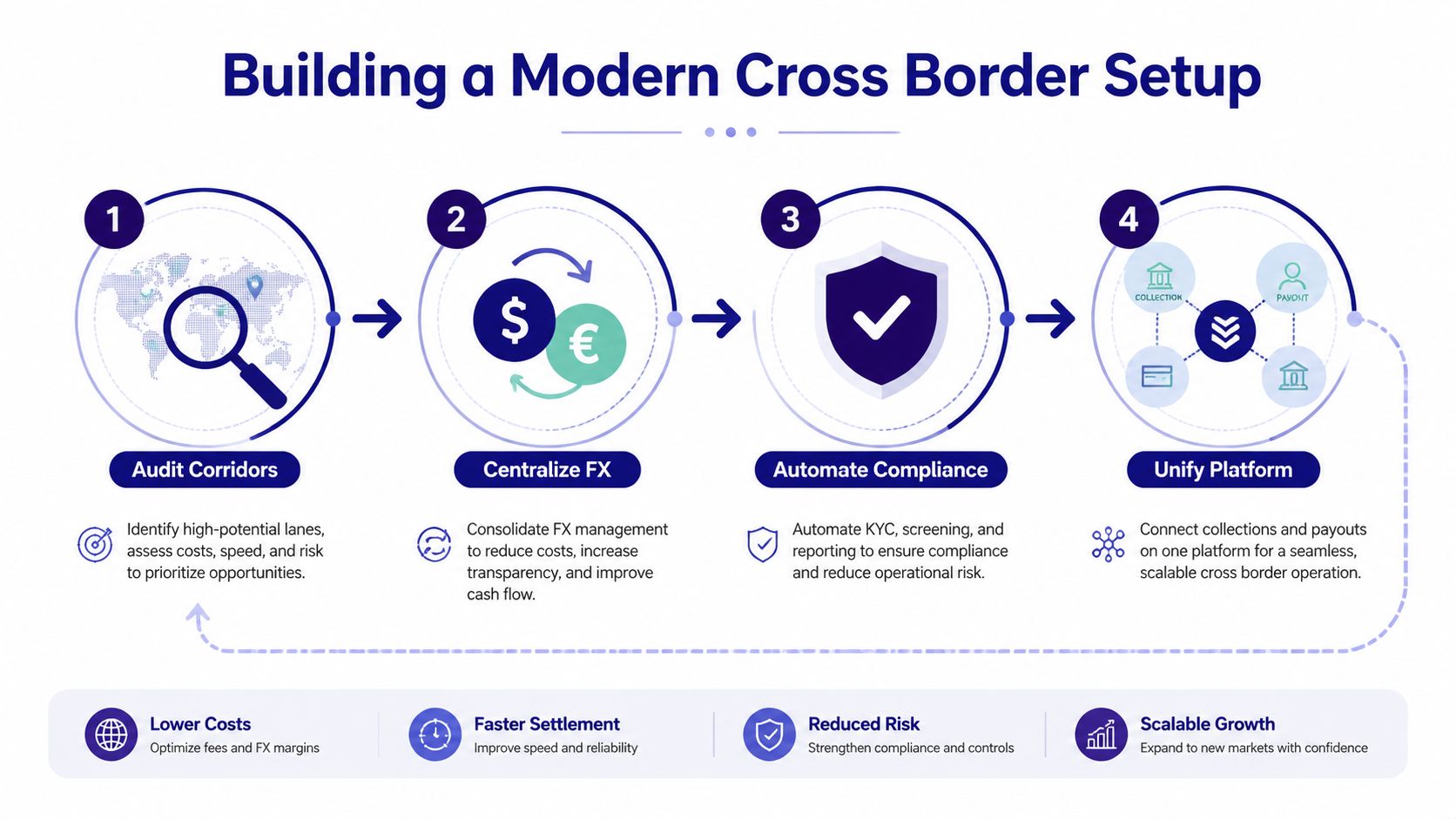
A workable setup starts with the corridors that affect cash flow, not with a fashionable rail. Audit where customers pay, where suppliers and contractors live, which currencies arrive, which currencies leave, and where delays create support tickets or working-capital pressure.
Four actions for the next operating cycle
Audit corridors by volume and friction. Separate customer collections from supplier, contractor, and marketplace payouts. Mark the routes where FX, rejection rates, manual reviews, or slow beneficiary crediting create the most operational work.
Centralize the FX decision. Compare the cost of converting at collection with the cost of converting at payout. Keep the rate, source currency, destination currency, and applied spread in the transaction record.
Batch where the economics support it. Batching can reduce repeated operational handling and may lower the effect of per-transaction charges, but it can conflict with recipient expectations for immediate payout.
Carry one reconciliation ID through every leg. Pass the same order, invoice, or contractor reference into the collection record, conversion event, payout instruction, and final settlement report.
A reference architecture might include one collections partner, an FX layer, and a payout partner connected through a single API or reconciliation ledger. A balance could arrive through US ACH, convert into the required currency, and fund a local Mexican payout or a stablecoin wallet without forcing the finance team to reconstruct the journey from separate dashboards.
Where Suby fits
Suby is one practical option for wiring these pieces together. It provides an API that lets any business accept payments by card or crypto, with settlement to a bank account or in stablecoins such as USDC, in the currency the business chooses. Its four uses are Suby Payments, an API-first stack for cards and crypto through one checkout, Suby Crypto, a gateway that handles the swap and sponsors gas, Suby Gating for paid access to Discord, Telegram, downloads, and courses, and Suby Invoicing, where the client chooses how to pay while the business chooses what to receive.
Suby also offers native integrations with Discord and Telegram for subscriptions, paid access, and online communities. Pricing depends on the payment method, so teams should check the official Suby pricing page for exact figures rather than assume a flat rate.
For European founders comparing incorporation and payments together, it can also be useful to compare the 28th regime option from The EU Inc. by renn. The cheapest way to test any proposed setup is a live pilot using the business's actual corridors, currencies, payout destinations, and reconciliation data.
Choosing the Right Stack for Your Business
You can narrow the decision quickly if you evaluate the transaction instead of the vendor's headline feature list. Take one representative collection and one representative payout, then apply four filters.
Corridor coverage comes first. A provider that supports cards globally may not support the local payout method your contractor or supplier needs. Map the countries, currencies, account types, and fallback routes that your business uses.
All-in cost matters more than the advertised processing fee. Include the payment method charge, FX spread, intermediary deduction, network cost, payout fee, refund treatment, and the internal cost of reconciliation. For card-heavy businesses, review risk controls and dispute workflows, including background on Stripe merchant protection from Disputely.
Payout speed should be measured at the destination account, not when the provider marks the instruction as sent. SWIFT gpi data shows why this distinction matters, since the beneficiary bank can be the slowest stage on a route. The FSB's cross-border payments progress work also highlights uneven performance by use case, with fewer than 45% of B2B and B2P payments settled within one business day.
Compliance and API depth determine whether the setup scales. Look for webhooks, transaction status events, screening workflows, document handling, refund support, payout references, and reports that your finance system can consume.
Stack Option | Corridor Coverage | All-In Cost | Payout Speed | Compliance & API |
|---|---|---|---|---|
Card-led provider | Strong where cards are widely used | Processing, FX, and dispute exposure | Collection is quick, payout timing varies | Mature checkout tools, but payout depth differs |
Bank and local-rail platform | Strong on supported account corridors | Bank, FX, and payout costs need a live quote | Fast on connected local routes | Useful when local payout and reconciliation APIs are available |
Crypto-enabled stack | Broad digital reach, local off-ramp dependent | Conversion, network, provider, and payout costs vary | Onchain leg can be rapid, final fiat payout depends on destination | Requires wallet, screening, and regulatory controls |
Published pricing is only a starting point. Before signing, run your own transaction data through two or three candidates, request a live quote, and confirm the amount, currency, timing, refund path, and final beneficiary credit.
Suby provides an API that lets businesses accept payments by card or crypto, then settle to a bank account or in stablecoins such as USDC, in the currency they choose. It also offers native Discord and Telegram integrations for subscriptions, paid access, and online communities. Visit Suby to review the available payment flows and test whether one balance can simplify your collections and payouts.
