

Gaspard LEZIN
How to Handle Chargebacks: The Complete Operational Playbook
Learn how to handle chargebacks effectively. A practical guide to dispute workflows, evidence collection, and prevention strategies for your business.
Merchant deadlines typically range from 20 to 45 days after notification, so immediate case review is the single most critical factor in winning a chargeback dispute. Missing that window can make a legitimate transaction unchallengeable, while a fast response gives your team time to match evidence to the actual dispute reason.
A chargeback notification rarely arrives at a convenient moment. Your support team may be handling a delivery complaint, finance may be closing the month, and the transaction may sit across several systems. Then someone notices that the response deadline is approaching, the order record is incomplete, and the only available attachment is a generic payment receipt.
That situation is avoidable. How to handle chargebacks effectively starts before the dispute arrives, with deadline tracking, recognizable billing information, reliable fulfillment records, and a transaction file that lets a reviewer reconstruct what happened without guessing.
Table of Contents
Why Most Merchants Lose Chargebacks
A customer buys a digital subscription, uses the service, and later disputes the payment as unauthorized. The merchant receives the notification, finds the authorization result, and submits it with a receipt. The response looks organized, but it answers only one question, whether the payment was processed. It doesn't address account access, usage, device information, renewal terms, or the specific reason code.
The acquirer rejects the response, or the merchant misses the deadline while searching for supporting records. The business loses the transaction by default, not necessarily because the customer was right, but because the merchant failed to produce relevant evidence in time.
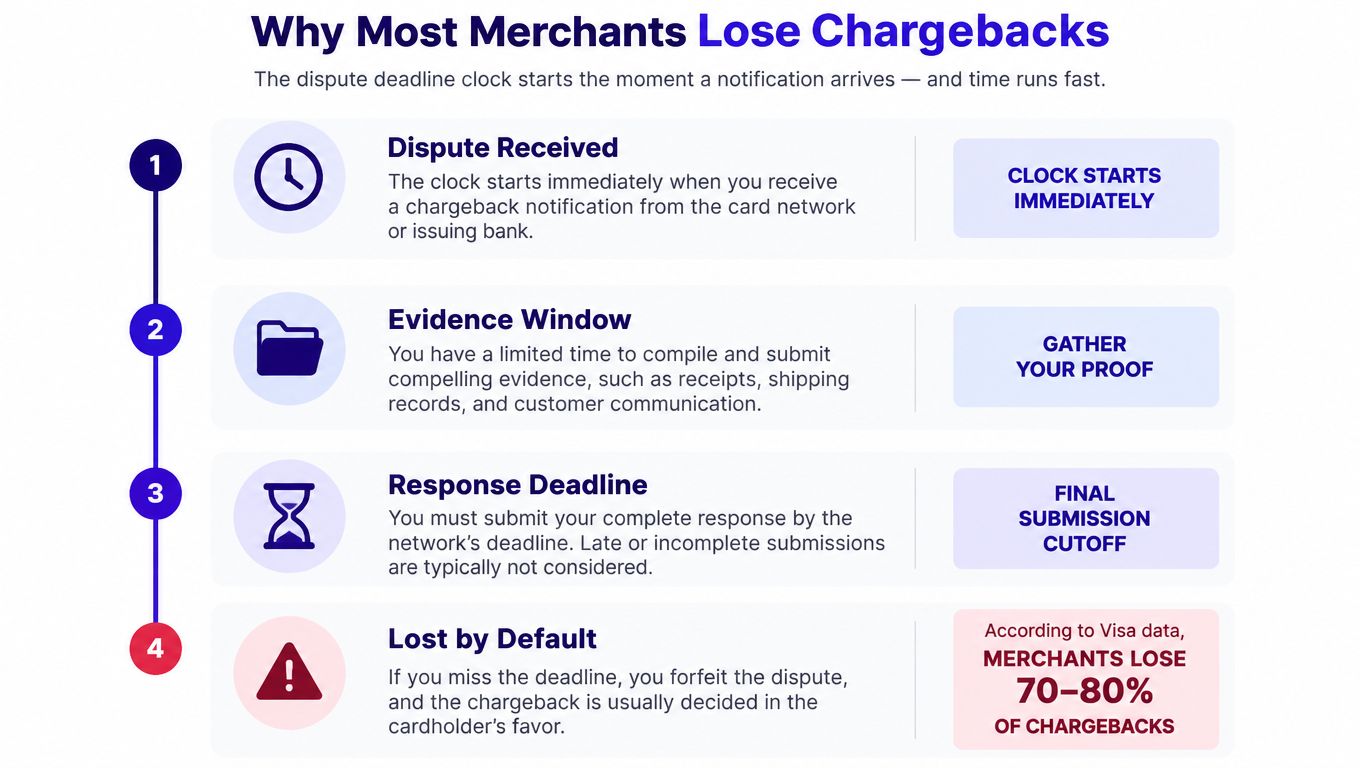
The clock starts with notification
The merchant's practical deadline comes from the acquirer. Mastercard explains that merchants typically receive 20 to 45 days after notification to decide whether to dispute a chargeback and submit evidence, while the complete process can take up to 120 days. Missing the acquirer's deadline generally means losing by default. See the Mastercard explanation of chargeback deadlines for the operational distinction between the merchant response window and the wider dispute process.
Visa's merchant guidance makes the same operational point from a different angle. Merchants should provide all relevant information promptly at the initial notification, including transaction records, refund details, and documentation that directly addresses the claim. Evidence should be legible and in English, or accompanied by an English translation, according to Visa's merchant dispute management guidelines.
A useful internal rule is simple:
Log immediately: Record the notification date, transaction identifier, reason code, acquirer deadline, and assigned owner.
Review before collecting: Decide whether the claim concerns fraud, non-receipt, cancellation, duplicate processing, or credit not processed.
Submit deliberately: Send a chronological packet that explains what each document proves, rather than uploading every record your systems can find.
Practical rule: The deadline is not the day your finance team gets around to opening the case. It starts when the dispute notification reaches your operation.
Generic proof doesn't answer a specific claim
A receipt proves that a transaction exists. It doesn't prove delivery, customer authorization, cancellation terms, account usage, or a processed refund. Visa describes a reason-code-led process involving receipts, shipping records, customer communications, submission through the acquiring bank, and issuer review. Its chargeback guidance for merchants also warns against relying on broad proof of sale when the reviewer needs evidence tied to the disputed question.
The same problem appears in internal reporting. A merchant may track total disputes but not separate them by reason, product, geography, or season. That hides whether disputes come from confusing descriptors, fulfillment gaps, recurring billing, or genuine payment fraud.
Teams that need a closer look at acquirer oversight can also review Visa's acquirer monitoring program information. The point isn't to treat every dispute as a compliance emergency. It's to make chargebacks visible early enough for operations, support, and payments teams to correct the underlying cause.
Understanding the Two Types of Chargeback Disputes
Not every chargeback represents the same risk. A customer may have no connection to a payment because payment credentials were used without authorization. Another customer may have made the purchase, received the service, and disputed it after forgetting the subscription or failing to recognize the billing descriptor. Both cases can appear as disputes, but the response should be different.
The 2024 State of Chargebacks report cited Mastercard's projection that global chargeback transaction volumes could reach 337 million by 2026, a 42% increase from the then-current level. The report estimated that friendly fraud represented 79.03% of chargebacks, or approximately eight in ten cases, and 38% of total recorded dispute value. Those figures make classification an operating requirement, not a semantic exercise. See the 2024 State of Chargebacks report for the reported distinction between friendly fraud and true fraud.
Genuine unauthorized transactions
A true fraud dispute alleges that the cardholder didn't authorize the payment. The useful evidence is technical and transactional:
Authentication outcome: Preserve the authorization result and any available authentication record.
Account linkage: Connect the transaction to the customer account, verified email, device, IP address, or access history where appropriate.
Service fulfillment: For digital products, retain download timestamps, login events, usage records, device ID, and account-access evidence.
Transaction integrity: Keep the exact descriptor, transaction identifier, payment instrument metadata, and relevant timestamps.
Visa's compelling-evidence guidance recognizes evidence linking the recipient or service user to the cardholder, including historical undisputed transactions that connect the same customer with the same device, IP address, account, or other identifying data. The evidence still needs an explanation, and issuer review remains part of the process. Read the Visa guidance on compelling evidence before designing a fraud-response template.
First-party misuse and confusion
First-party misuse, often called friendly fraud, occurs when the customer or someone in the customer's household made the purchase but later disputes it. The cause may be a confusing descriptor, forgotten renewal, dissatisfaction, buyer's remorse, or an attempt to obtain a refund through the bank instead of the merchant.
The 2024 report recorded merchant win rates of 43.82% for friendly-fraud cases and 9.27% for true-fraud cases. Those are reported figures from that report, not a universal benchmark. They illustrate why a single “fraud proof” packet performs poorly. For friendly-fraud cases, delivery, customer use, prior communications, cancellation terms, and refund history may matter more than a technical authorization result alone.
When a dispute involves marketplace policies, fulfillment disagreements, or complex commercial facts, a merchant may also need legal guidance. A resource such as consult LA Law Group APLC can help frame the issue without confusing a commercial dispute with an unauthorized-payment claim.
For a plain explanation of the mechanics, review what a chargeback is. The operational decision remains yours: refund genuine friction, contest documented misuse, and use account-level controls when repeated behavior shows abuse.
A Step-by-Step Workflow for Dispute Resolution
A reliable workflow prevents two expensive mistakes, responding too late and responding with the wrong evidence. Assign one owner for each case, but make the records accessible to payments, support, fulfillment, and finance.
1. Preserve the notice and deadline
Save the original dispute notification, transaction identifier, reason code, authorization result, descriptor, customer or account ID, and applicable deadline. Don't rely on a portal view that may change or disappear. Store the notice with the transaction file and record when the case entered your queue.
If the reason code isn't clear, ask the acquirer for clarification immediately. A vague internal label such as “fraud issue” isn't enough to determine what the issuer is evaluating.
2. Map the complaint to the network question
Write the disputed question in one sentence:
Fraud: Did the cardholder authorize or use the payment?
Non-receipt: Can the merchant show delivery, access, or fulfillment?
Cancellation: Did the customer cancel under the applicable policy?
Duplicate processing: Was the same payment submitted more than once?
Credit not processed: Was a promised refund issued, and can the merchant prove it?
This step stops teams from submitting the same packet for every case. A delivery record may be useful for non-receipt, but it won't answer a credit-not-processed claim. A login record may support a digital-service case, but it won't fix an incorrectly duplicated transaction.
3. Build a chronological evidence packet
Start with the order and payment, then move through fulfillment and customer contact. Separate the packet into clearly labeled groups:
Receipts and payment records, including the transaction date, amount, descriptor, authorization result, and identifier.
Policies, showing the terms accepted at checkout, refund rules, cancellation process, and relevant subscription information.
Fulfillment evidence, such as tracking, delivery location, service activation, downloads, logins, or usage timestamps.
Communications, including support tickets, cancellation requests, refund offers, and the customer's responses.
System logs, with consistent timestamps, account identifiers, device data, and access events.
Add a short explanation beside each artifact. “Delivery record” is weak. “Carrier record shows delivery to the address entered at checkout and links the order to customer account 1842” is useful because it tells the reviewer what to notice.
4. Avoid evidence that looks stronger than it is
A delivery signature isn't always required, and Visa notes that a signature alone isn't necessary evidence of delivery. Tracking, delivery location, and customer-account linkage may be more probative. For digital goods and SaaS, usage and access records can show fulfillment more clearly than a generic invoice.
A customer-service team may need language support when reviewing communications across markets. A bilingual customer service representative can help preserve the meaning of relevant exchanges, but the final packet should still present the evidence in a clear format suitable for issuer review.
5. Submit, monitor, and learn
Send the packet through the acquirer before its deadline, then record the submission time and expected next decision. Monitor whether the issuer accepts, rejects, or escalates the response. A dispute management system should keep the notice, evidence, submission, and outcome together, which is the operating principle behind a centralized dispute management system.
Preventing Chargebacks Before They Happen
Reactive handling recovers some transactions after the customer has already contacted the issuer. Prevention addresses the moment before that call, when the customer is deciding whether the charge looks familiar and whether the merchant is easy to reach.
The most overlooked control is the billing descriptor. In a 2025 survey of more than 1,200 cardholders in the United States and United Kingdom, 40% said they often fail to recognize purchases because descriptors are confusing or incomplete, according to the 2025 Cardholder Dispute Index. A recognizable statement name can prevent a dispute without changing fraud rules or adding a review step.
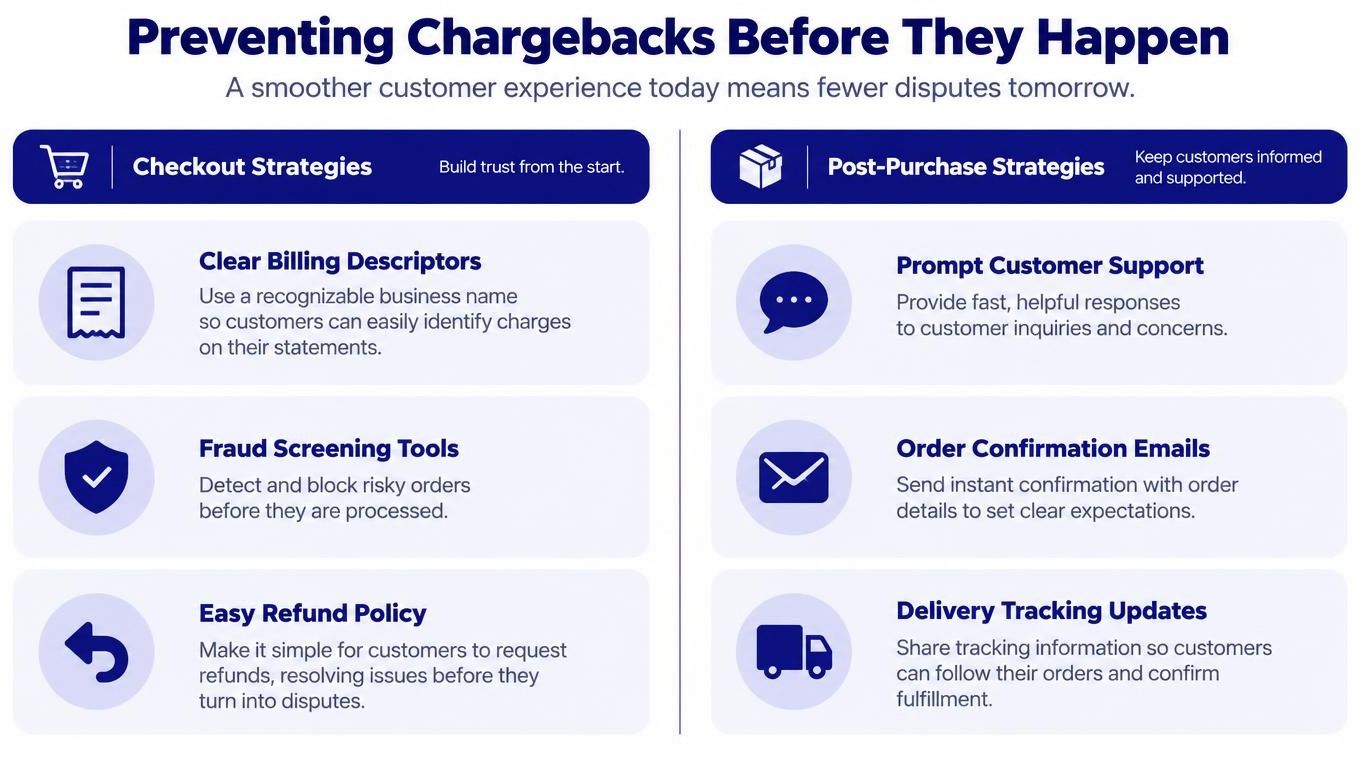
Compare the customer paths
A reactive path usually looks like this: the customer sees an unfamiliar charge, searches for help, can't find the merchant quickly, contacts the bank, and the merchant begins evidence collection after the issuer has opened the case. The business then spends operational time defending a transaction that might have been resolved with a clear descriptor or fast refund.
A preventive path gives the customer several ways to resolve confusion before escalation:
Recognizable checkout information: Show the business name, renewal terms, and support route before payment.
Useful confirmation messages: State what was purchased, when access begins, how recurring billing works, and what descriptor will appear.
Visible cancellation and refund controls: Make the policy easy to find and provide a straightforward request path.
Fast support escalation: Route payment complaints to people who can identify the transaction and issue or explain a refund.
Fulfillment updates: Send delivery, activation, access, or download information so the customer knows what happened after payment.
The survey found that 41.2% of respondents disputed a transaction after unsuccessfully trying to contact the merchant, while 48.2% disputed a transaction with their bank without contacting the merchant first. The same research reported that 76% prefer resolving disputes through their bank and 89% trust their bank to handle them. Those results mean the merchant shouldn't assume a customer will ask for help first. Support must be visible before the statement review becomes a bank dispute.
Subscriptions need special handling
Recurring billing creates a predictable confusion point. A technically valid renewal can still look unauthorized when the customer has forgotten the service name, doesn't recognize the descriptor, or can't find cancellation instructions. Renewal reminders, account billing history, and a clear cancellation confirmation reduce that friction.
Customer service visibility may outperform another layer of fraud screening when the problem is recognition rather than authorization. Fraud controls still matter for genuine unauthorized activity, but they won't explain a legitimate recurring charge to a customer who can't identify it.
A short explanation of the operational balance is useful before teams choose a tool:
Prevention isn't the same as refusing more orders. Excessive friction can block legitimate customers, while weak communication creates avoidable disputes. Test the descriptor, cancellation route, confirmation email, and support response from the customer's point of view, then connect the results to the reason codes appearing in your dispute queue.
Building a Long-Term Chargeback Management System
Chargeback operations work best as a data-governance system, not a shared inbox. The checkout creates the first records, fulfillment adds the next events, support explains the customer relationship, and the dispute process tests whether the business can retrieve the complete timeline.
At checkout, retain the exact billing descriptor, accepted terms and refund policy, authentication outcome, device and IP signals, payment instrument metadata, and customer communications. After purchase, append fulfillment, login, download, renewal, cancellation, refund, and support events to an immutable timeline.
Make the evidence trustworthy
A reviewer needs to connect every record to the disputed transaction. That requires consistent identifiers, synchronized timestamps, controlled access, and clear retention rules.
Use automated controls that:
Identify records uniquely: Hash or uniquely identify event records so a later reviewer can see whether data was changed.
Synchronize timestamps: Store event times in UTC and preserve the original event context.
Limit sensitive data: Restrict evidence access and redact information that isn't needed for the dispute.
Join customer records carefully: Keep account, order, payment, fulfillment, and support identifiers aligned.
Create evidence packets automatically: Pull only the records relevant to the reason code and arrange them chronologically.
Privacy is a real trade-off. Collecting every possible signal may create unnecessary exposure and make the packet harder to understand. Collect the evidence categories that answer the dispute, retain them for an appropriate period, and document why each category exists.
Measure causes, not just outcomes
A dashboard that shows total chargebacks is too shallow for operational decisions. Track:
Chargeback rate, by market and reason code.
Representment submission rate, including cases accepted, contested, and abandoned.
Overturn rate, split by reason code, product type, issuer, and evidence completeness.
Time to submit, from notification to acquirer submission.
Repeat-dispute rate, tied to customer, account, product, or payment pattern.
False-positive prevention rate, where fraud controls block legitimate customers.
Don't promise a universal win rate. The cited network materials describe procedures and evidence categories, but they don't establish a globally reliable success benchmark. Use controlled internal cohorts instead. Compare cases with complete evidence against cases with missing records, and compare outcomes by dispute reason rather than mixing true fraud with first-party misuse.
Connect payments to settlement operations
Suby is one payment infrastructure option for businesses that need an API allowing customers to pay by card or crypto. It also supports native Discord and Telegram integrations for use cases such as subscriptions, paid access, and online communities. Its four ways to use the product are Suby Payments, an API-first payment stack for cards and crypto through one checkout; Suby Crypto, a crypto payment gateway that handles the swap, sponsors gas, and settles to a non-custodial wallet or Suby balance; Suby Gating, for paid access to Discord, Telegram, downloads, and courses; and Suby Invoicing, where the client chooses how to pay while the business chooses how to receive funds.
That model supports a broader operational choice. Customers can pay by card, wallet, bank, or crypto, while the business can receive funds in its bank account or in stablecoins such as USDC, in the currency it chooses. A card payment settling to USDC is one possible flow, not the only one. Pricing depends on the payment method, so check the Suby pricing page for current figures rather than assuming a flat rate.
The system still needs human judgment. Refund genuine service failures, contest documented first-party misuse, accept unsupported true-fraud claims when appropriate, and suspend access only when account history and evidence justify it. Winning an individual case doesn't prevent the next one. The durable advantage comes from connecting checkout clarity, customer support, fulfillment records, reason-code decisions, and product-level reporting.
Use Suby to give customers card and crypto payment options through an API, while supporting settlement to the destination and currency your business chooses. Review the payment, subscription, gating, and invoicing workflows, then build your dispute evidence process around the records they create.
