

Gaspard LEZIN
How to Pay Your Invoice: A Global Guide for Clients
Learn how to pay your invoice securely using card, bank, crypto, or paylink. A practical guide for clients seeking fast, frictionless payment options.
You've received an invoice, the due date is approaching, and the obvious question is simple: how should you pay it? A card may be fastest, a bank transfer may fit your accounting process, and a crypto payment may make more sense for an international supplier. The right answer depends on more than convenience. It also depends on fees, currency, documentation, settlement speed, and what the recipient specifically needs to receive.
Paying an invoice is no longer limited to sending money from one bank account to another. Modern payment infrastructure separates the customer's payment choice from the business's receipt choice. That means you can pay in a familiar way while the supplier receives funds in a preferred currency or stablecoin, provided the invoice and payment system support it.
Table of Contents
Why Payment Timing Matters More Than You Think
“Pay your invoice” sounds like an administrative instruction. In practice, the timing and method of payment can affect payroll, supplier relationships, tax records, inventory purchases, and a company's ability to keep operating smoothly.
The European Commission's 2025 payment report found that 64% of companies experienced problems caused by late payments in 2024. Average payment periods reached 60.3 days for business-to-business transactions and 69.8 days for government-to-business transactions. Public authorities therefore paid suppliers 9.5 days more slowly than private businesses.
Those delays create a chain reaction. A supplier waiting for payment may postpone its own vendor payments, delay hiring, reduce purchasing, or rely on expensive short-term financing. For a freelancer or small agency, one late international invoice can also create exposure to currency movements, intermediary-bank deductions, and tax administration problems.
Practical rule: Treat every invoice as a cash-flow event, not just a document to clear from your inbox.
The report found that government-to-business payment periods exceeded 60 days in every EU Member State, while 7 of the 14 surveyed economic sectors reported average payment periods above 60 days. The movement was mixed. Government-to-business payment periods increased by 0.8 days in 2024, while business-to-business periods fell by 1.5 days, according to the same European Commission payment data.
Your responsibility as a client is straightforward. Confirm the invoice is valid, use the agreed payment channel, include the correct reference, and pay by the due date. If the transaction crosses borders, confirm who bears conversion costs and whether the recipient needs a specific currency or settlement method. Even the difference between a regular bank transfer and a faster digital route can affect when the supplier can use the money, as explained in this guide to how long an ACH transfer takes.
The Modern Invoice Collection Framework
A reliable invoice workflow has three connected parts: payins, balance, and payouts. Separating these stages makes it easier to understand where payment friction occurs and who controls each step.
Payins are the ways money enters the system. A customer might use a card, digital wallet, bank payment, or crypto wallet. The important point is choice. If the invoice only supports one payment method, a customer may postpone payment because the available route is inconvenient, unavailable in their country, or poorly suited to the transaction.
Balance is the central record of funds received. Instead of tracking separate payment streams across different providers, a business can use one balance to view incoming funds and organize accounting. This helps finance teams match the payment to the correct invoice, identify incomplete settlements, and distinguish available funds from money still being processed.
Payouts determine how the business receives the money. The customer may pay by card, while the business receives a bank settlement or stablecoin. This separation is particularly useful for international businesses that invoice in one currency but manage expenses in another.
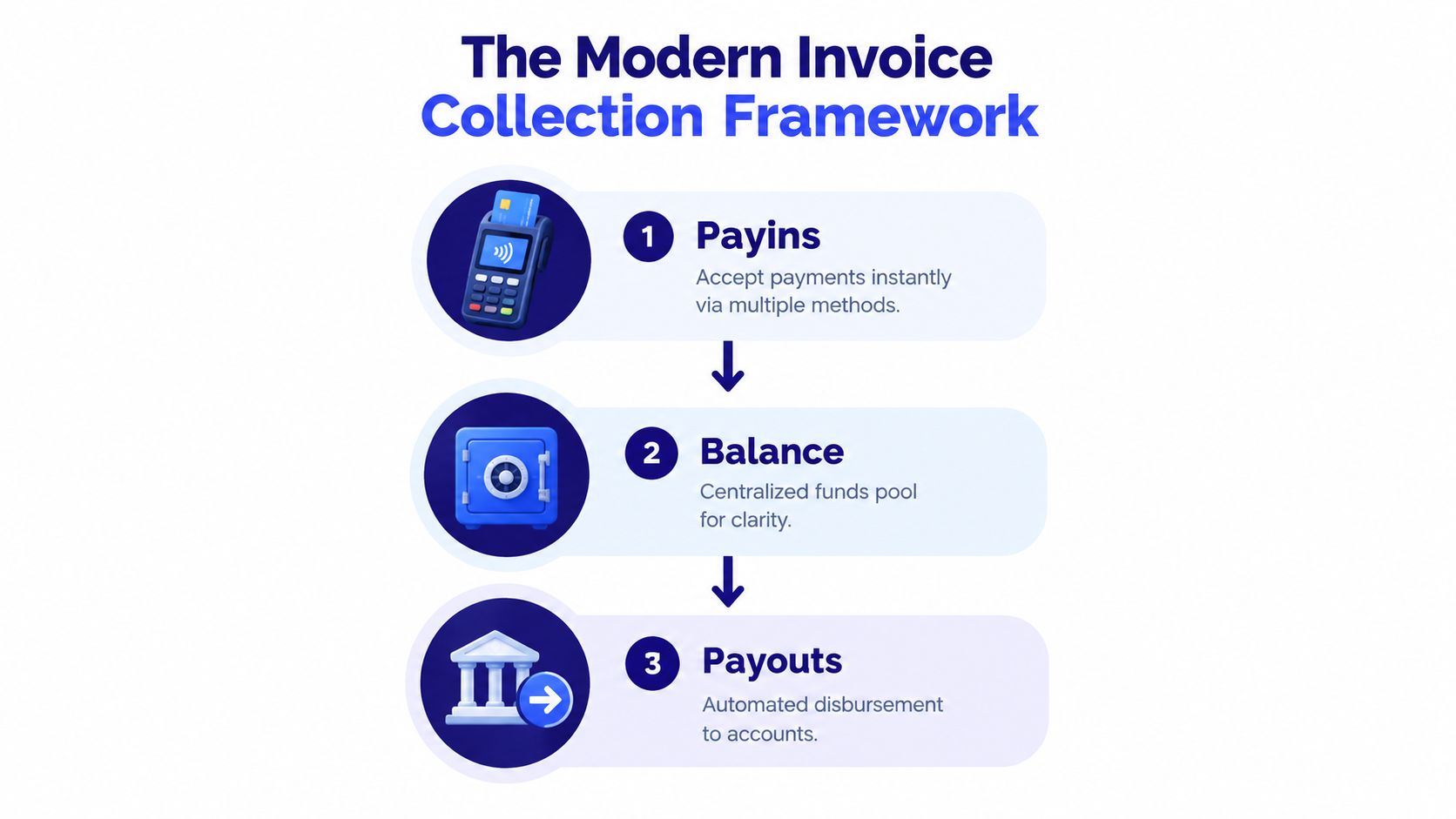
Suby brings these three building blocks into one product with four ways to use it:
Suby Payments is an API-first payment stack for accepting cards and crypto through one checkout.
Suby Crypto is a crypto payment gateway that handles the swap, sponsors the gas, and settles to a non-custodial wallet or the Suby balance.
Suby Gating provides paid access for Discord, Telegram, downloads, and courses, with native Discord and Telegram integrations for subscriptions, paid access, and online communities.
Suby Invoicing lets the client choose how to pay while the business chooses how to receive the funds.
The API lets businesses accept payments by card or crypto, and the documented configuration supports card only, crypto only, or both methods on the same product. Products can be priced in USD or EUR, with crypto conversion handled through real-time oracle rates powered by Pyth, as described in the Suby API documentation.
Operational controls matter just as much as payment choice. A sound workflow verifies the supplier, invoice number, purchase order, tax details, currency, due date, and destination account before approval. It then matches the invoice with delivery evidence, routes exceptions to an approver, releases the payment, and reconciles the settlement against the ledger. For teams evaluating broader automation, this practical resource on automate invoice processing UK offers useful process context.
How to Pay Your Invoice with Confidence
Start with the invoice itself. Don't click a payment link or send funds until you've checked the supplier name, invoice number, total, currency, due date, tax details, and payment destination. If the invoice references a purchase order or contract, compare those records before approving anything.
Choose the payment route
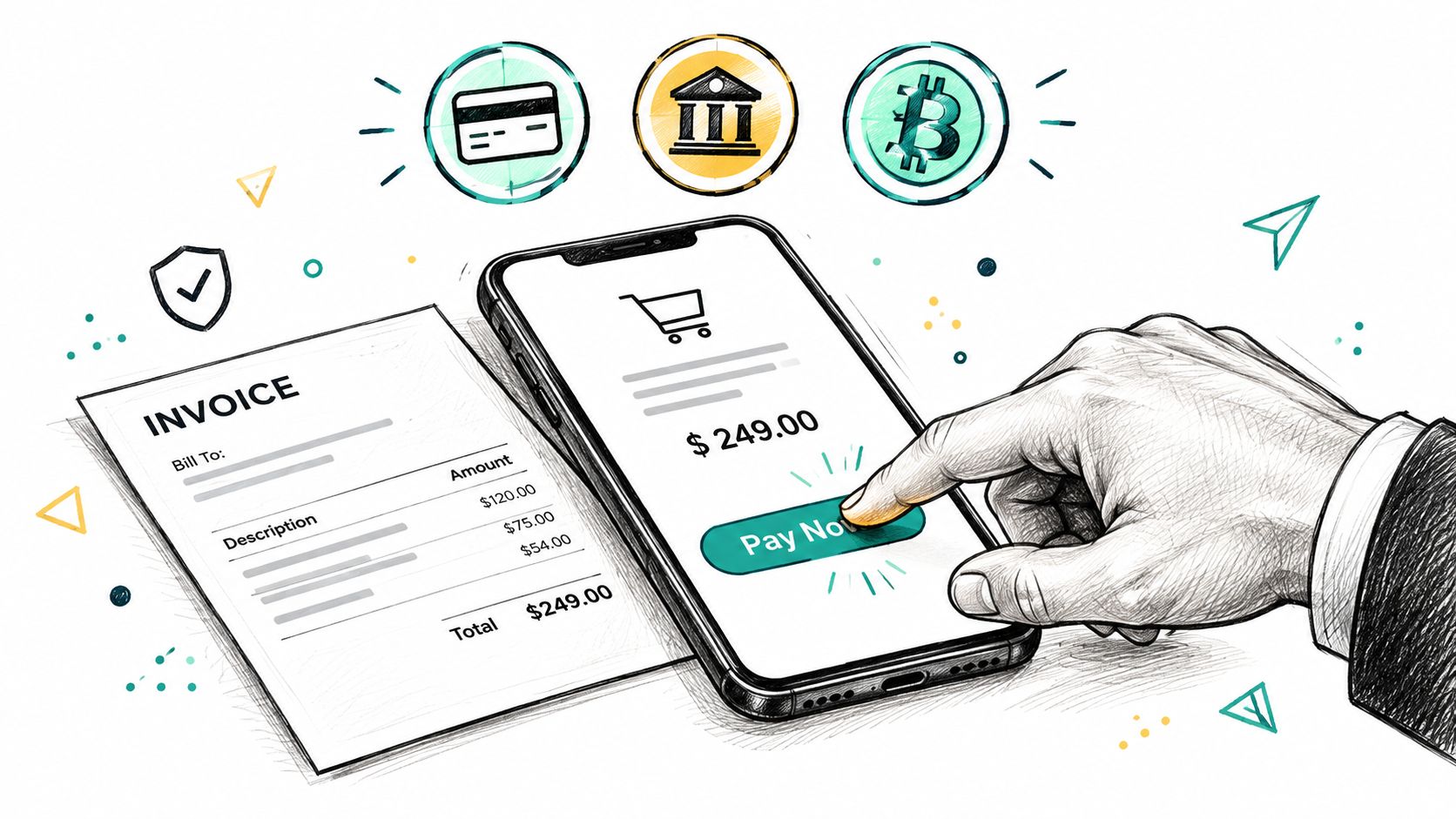
Card payment is usually the simplest option when the invoice offers a secure hosted checkout. Enter the card details, verify the total, complete any authentication request, and save the receipt. A card can be practical when you need a clear transaction record or don't want to set up a new beneficiary in your banking portal.
Bank transfer suits businesses with procurement controls, approval workflows, or restrictions on card payments. Copy the beneficiary details exactly, include the invoice number in the reference field, and check whether the recipient needs a specific transfer format or currency. Don't assume that sending the money means the invoice is already marked paid. The supplier may still need to match the transfer manually.
Crypto payment can be useful when the invoice supports stablecoins or when both parties operate across borders. Confirm the network, asset, exact amount, wallet address, and any payment deadline shown at checkout. Sending the right asset on the wrong network can create a recovery problem, so this is the step where careful verification matters most.
Suby's crypto documentation lists Ethereum, Base, Arbitrum, BNB Chain, and Solana, with assets such as USDC, USDT, ETH, BNB, and SOL supported depending on the network. Customers can connect wallets including MetaMask, Phantom, Rabby, Coinbase Wallet, or Binance Wallet, or send funds from a centralized exchange without connecting a wallet. The checkout locks the conversion rate when payment begins and displays the exact amount due, as explained in the Suby stablecoin payment documentation.
Use the invoice link correctly
A shareable paylink should take you to a payment page that identifies the invoice, amount, currency, and available methods. Before paying, check that the page uses the expected business identity and that the invoice number matches the document you received.
A conversion-optimized checkout reduces unnecessary steps, but it shouldn't remove financial clarity. You should still see what you're paying, which method you're using, and whether the payment is complete. If you leave the page before confirmation, check your bank, card, or wallet activity before trying again. Duplicate payments are harder to resolve than a short delay.
Save proof of settlement
After payment, keep the receipt, transaction identifier, invoice copy, and any exchange-rate information shown at checkout. If you paid in a different currency, record the amount sent, the amount received if available, the payment date, and any fee or conversion deduction.
For a straightforward card workflow, this guide to paying an invoice by card shows the type of hosted payment experience businesses can provide. If the invoice remains marked as unpaid, send the receipt to the supplier rather than making a second payment immediately. The supplier can then investigate whether the payment is pending, misidentified, or affected by a mismatch in amount or reference.
Choosing Your Payout Destination
The customer's payment method and the business's payout destination are separate decisions. This distinction is the most important change in modern invoice payment.
A client might pay by card because it's familiar and immediately available. The business could then settle the proceeds to a bank account or receive USDC, depending on its operating model. Alternatively, the client could pay by bank transfer while the business receives funds in a selected bank currency. The invoice is paid once, but the two sides don't need to use the same financial rail.
Bank settlement
Bank settlement is the conventional choice for businesses that need funds in an operating account. Suby's invoicing materials list bank-account settlement in USD, EUR, GBP, AED, or MXN. This can simplify payroll, supplier payments, tax administration, and accounting when the business already works in one of those currencies.
The trade-off is that bank transfers can involve intermediary institutions, local banking rules, processing windows, and beneficiary checks. Businesses that rely heavily on account-to-account payments should compare settlement timing, supported currencies, reconciliation features, and the cost structure before selecting a provider. This guide on how to choose an ACH processor for SaaS is useful for teams assessing that type of payment infrastructure.
Stablecoin settlement
Stablecoin settlement can suit businesses that want to receive digital funds without requiring the client to hold or send crypto. A customer can pay by card, while the business receives USDC, or the customer can pay with a supported stablecoin directly.
The main advantage is control over the destination. Suby documents non-custodial-wallet settlement in USDC or EURC, while its official site describes receiving crypto at checkout and settling in USDC or fiat. A non-custodial wallet gives the business direct control over the wallet destination, while a platform balance can offer a more centralized view of incoming payments and payouts.
The choice should follow the business's treasury and accounting needs, not fashion. A bank account may be better for regular local expenses. A stablecoin wallet may be more useful for international operations or digital-asset-native suppliers. Review the mechanics of multi-currency payout options before deciding how a cross-border invoice should be settled.
Pricing also depends on the payment method and payout category, so don't use one flat rate in your calculations. Suby's published materials list card payments at 4% plus $0.40 per successful transaction, crypto payments at 1.5% per transaction, and a possible additional 1% payout fee for bank and stablecoin payouts. Check the official pricing information for the applicable figures before issuing an invoice or comparing received value.
Best Practices for Faster Settlement
Fast payment starts before the invoice reaches the customer. Use a unique invoice number, legal entity name, billing address, tax details, currency, total, due date, purchase order reference, and clear payment instructions. If the client needs a beneficiary name, routing format, wallet address, or network selection, include it directly in the payment instructions.
A structured workflow also prevents avoidable approval delays. Validate the supplier and invoice, detect duplicates, match the invoice to the purchase order and delivery evidence where applicable, and route exceptions to the right approver. Manual invoicing has an annual invoice-error rate of about 2%, compared with approximately 0.8% for automated processes, while 20% to 30% of invoices may generate an exception requiring investigation, according to accounts-payable process data from Stampli.
Use this operating checklist:
Send before the due date: Give the customer a clear payment path and enough time to resolve missing information.
Include the invoice identifier: Ask the payer to use the invoice number in the transfer reference or payment form.
Offer a direct paylink: Reduce the number of steps between opening the invoice and completing payment.
Automate reminders: Send a reminder before or immediately after the due date, then follow up at 7 and 14 days overdue, based on the time-based collection framework reported by Chaser's 2026 accounts receivable report.
Escalate by cause: Treat a dispute, missing purchase order, approval bottleneck, cash-preservation delay, and payment-method failure as different problems.
Follow-up should be consistent, not hostile. The same Chaser research reported that businesses following up on 100% of overdue invoices were 76% more likely to be paid within one week than businesses that didn't follow up consistently. Firms using accounts-receivable automation were 52% more likely to be paid within two weeks, according to that source.
Track more than the invoice status. Measure due-date-to-settlement time, reminder coverage, response rate, exception rate, and the share collected within seven and fourteen days. Those figures show whether the problem is customer intent, internal approval, payment friction, or weak follow-up.
Conclusion - Taking Control of Your Cash Flow
Paying an invoice on time remains the basic obligation, but the payment method now affects more than the date money leaves your account. It affects the supplier's cash flow, the quality of the transaction record, the cost of currency conversion, and the speed at which both sides can reconcile the payment.
The practical process is clear. Verify the invoice, choose a payment method that fits your controls, check the currency and destination, complete the transaction through a trusted payment page or bank channel, and keep proof of settlement. For international invoices, compare the total value received rather than judging a payment route only by speed.
Businesses should apply the same discipline on the collection side. Clear invoice fields, direct paylinks, automated reminders, exception handling, and measurable settlement tracking remove the avoidable reasons invoices remain unpaid. Clients get a simpler payment experience, while suppliers gain more control over when and how funds become usable.
The strongest model separates how customers pay from how businesses receive money. A card, bank payment, wallet, or crypto transaction can all lead to a settlement that matches the recipient's currency and operating needs. That flexibility doesn't eliminate the need for timely payment, but it removes unnecessary friction from the path.
If you're about to pay an invoice, check the details and use the method that gives both sides a clean record. If you issue invoices, give customers real choice while protecting your own cash-flow preferences. Global commerce works better when payment is timely, visible, and designed around the needs of both parties.
Suby provides an API for accepting card or crypto payments, plus native Discord and Telegram integrations for subscriptions, paid access, and online communities. Visit Suby to explore payment collection, invoicing, and settlement options that let customers pay their preferred way while your business receives funds where and how you choose.
