

Gaspard LEZIN
Crypto Payment API Guide for Modern Business
Master crypto payment APIs with this practical guide. Learn architecture, integrations, security, and how to choose the right solution for your business.
A customer wants to pay for your software with crypto, but your finance team needs predictable settlement in a bank account or stablecoin balance. The checkout can accept the payment, yet your internal systems still need to identify the order, verify the transaction, account for fees, handle confirmation time, and record where the funds finally landed. That gap is why a crypto payment API is more than a wallet address generator.
The useful question isn't only whether your business can accept crypto. It's whether your payment stack can route each payment, manage conversion and network details, trigger reliable fulfillment, and produce records your finance team can reconcile. Suby positions this problem as payment infrastructure for the global internet economy, where customers can pay by card, wallet, bank, or crypto, while the business chooses how to receive the money.
Table of Contents
What Is a Crypto Payment API and Why Your Business Needs One
Suppose a customer in Europe wants to buy a SaaS subscription and prefers cryptocurrency. A basic checkout may give them an address and wait for a transfer. Your team then has to watch the transaction, determine whether the amount is sufficient, account for price movement, confirm the network status, and decide how the funds should reach the business. That process becomes harder when customers and suppliers use different currencies or when a payment crosses borders.
A crypto payment API acts as middleware between your checkout, payment provider, and blockchain networks. In plain terms, it's a payment router that understands both traditional payment systems and crypto transactions. Your application sends a payment request, the provider presents payment options, monitors the transaction, and returns structured events that your order and finance systems can use.
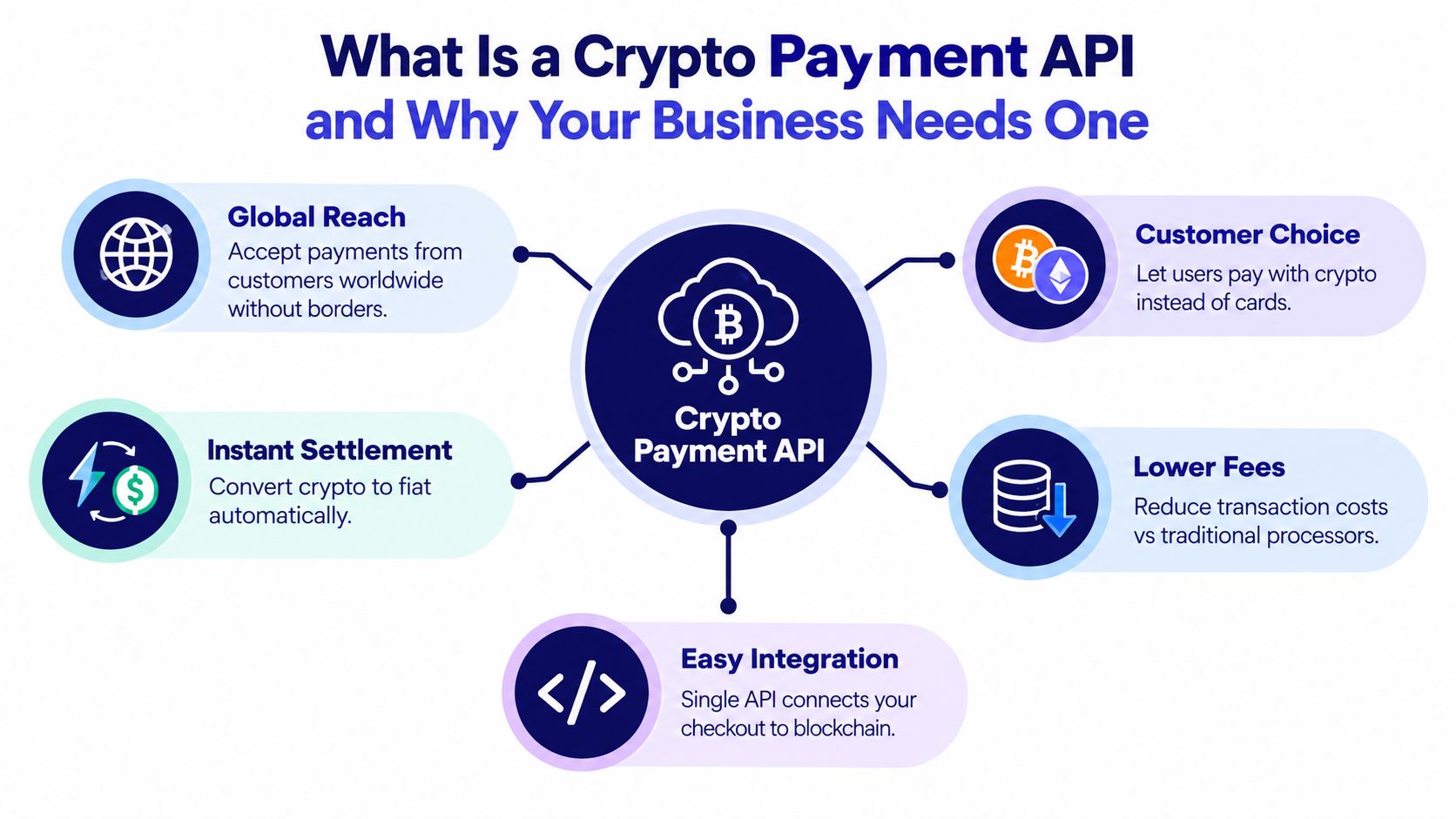
The commercial case is no longer limited to trading activity. McKinsey estimated that annualized actual stablecoin payments reached about $390 billion in 2025, based on December activity, while describing that figure as roughly 0.02% of global payments. Its analysis also placed observable bilateral payments for goods and services at approximately $350 billion to $550 billion in 2025. These figures show why payment infrastructure matters, particularly for settlement speed and cross-border commerce. McKinsey-related crypto payment data
A provider can also help you combine payment methods instead of forcing customers into separate card and crypto checkouts. Suby provides an API that lets any business accept payments by card or crypto, alongside native integrations with Discord and Telegram for subscriptions, paid access, and online communities. The operating principle is simple: customers pay any way they want, and businesses get paid the way they choose.
Practical rule: Treat crypto acceptance as an accounting and settlement workflow, not just a checkout feature.
Core Architecture and Payment Flows Explained
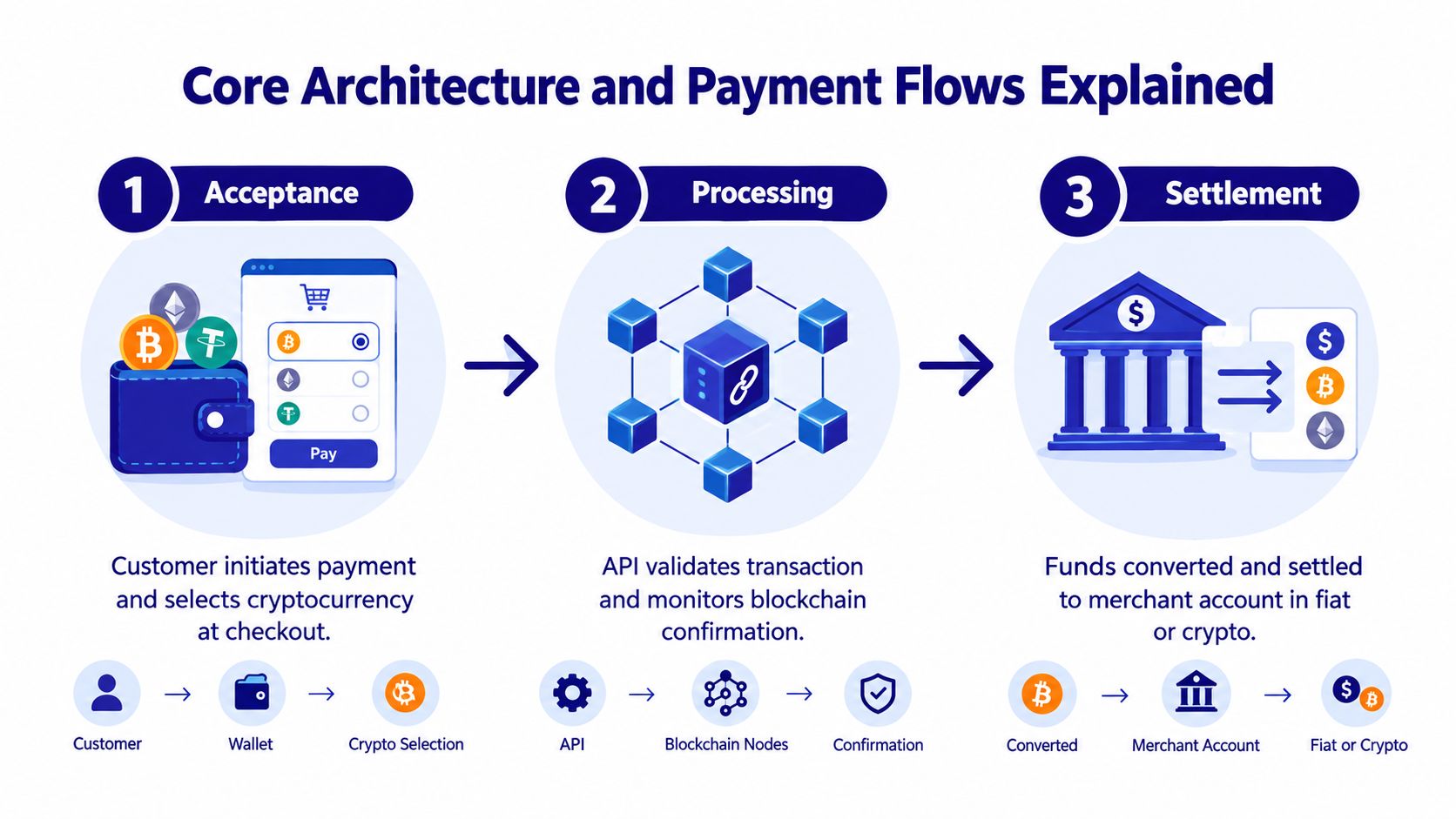
A payment API usually performs three jobs: acceptance, processing, and settlement. Keeping those phases separate makes implementation easier to reason about.
Acceptance starts at checkout
The customer begins with a hosted checkout, embedded payment form, paylink, or your own application. They might choose a card, wallet, bank method, or crypto asset, depending on the methods your provider supports. Your application should create a payment record before sending the customer to the payment screen, including the internal order ID, customer ID, amount, pricing currency, expiry time, redirect URLs, webhook URL, and metadata.
That record becomes the reference point for everything that follows. A SaaS company can use it for a subscription invoice, an online store can attach it to an order, and an agency can place it inside a shareable invoice link.
Processing verifies what happened
The provider monitors the selected network, checks the received amount, tracks confirmations, and updates the payment state. Network fees and gas handling are part of this operational layer. Suby Crypto is documented as handling the swap and sponsoring gas, with settlement available to a non-custodial wallet or the Suby balance. That means the business can choose between direct crypto settlement and aggregation into a managed balance, rather than building each routing step itself.
A one-time ecommerce checkout needs a final payment status. A subscription flow also needs events that update access, renewals, failed payments, refunds, and cancellations. The API should expose these outcomes through webhooks rather than requiring your backend to repeatedly ask whether anything changed.
For a practical view of how cross-border payment routing affects product design, see this guide to cross-border payment APIs.
Settlement decides where the money goes
Settlement is the destination step. A business may receive funds in its bank account, in a stablecoin such as USDC, or in another supported balance depending on the provider and configuration. Suby Payments brings cards and crypto into one API-first checkout, while Suby Crypto focuses on crypto-native payment handling. Suby Invoicing lets a client select a payment method while the business chooses the desired receipt method.
Common integration patterns include:
One-time checkout: Useful for ecommerce, digital goods, and single purchases.
Paylinks: Useful when an agency or freelancer needs to send an invoice without building a custom checkout.
Webhook automation: Useful when payment events must update orders, accounts, or access immediately.
Recurring billing: Useful for SaaS products and memberships that need subscription state managed alongside payment status.
Hybrid checkout: Useful when customers can choose cards or crypto while the merchant controls the settlement currency.
The architecture stays consistent. Your application creates the payment, the provider processes it, webhooks report the lifecycle, and settlement moves value into the destination your business has selected.
Webhook Integration and Settlement Timing Rules
A reliable backend shouldn't keep asking a payment provider whether a transaction has changed. Webhooks let the provider send an event to your application when the payment lifecycle advances. Your server can then verify the signed message, record the event, update the order, and trigger the appropriate customer action.
A useful event model includes:
Checkout initiated: The customer has started the payment process.
Payment success: The provider has identified a successful payment according to its rules.
Payment failed: The payment could not complete or didn't satisfy the payment conditions.
Refunds and chargebacks: The financial result changed after the original payment.
Settlement: The funds reached the configured settlement stage.
Your database should preserve both business and network context. The crypto payment API checklist identifies fields such as amount, pricing currency, payment currency, network, internal order ID, customer ID, invoice expiry, redirect and cancel URLs, webhook URL, and metadata. Webhook records should also retain the provider payment ID, transaction hash, received amount, confirmation count, fee and network-fee information, timestamp, and current status.
Those fields matter because “transaction sent” and “money settled” aren't interchangeable. A transaction may be broadcast, waiting in the mempool, or confirmed. Your fulfillment system needs to distinguish those states before it releases a product, credits an account, or marks an invoice paid. Suby documents signed webhooks for events including checkout initiated, payment success, payment failed, refunds, chargebacks, and settlement. Transaction history design considerations can help finance and engineering teams align on the records they need.
Confirmation rules should match risk
Settlement timing depends on the network. The documented examples are approximately 60 minutes for six-block confirmation depth on Bitcoin, three minutes for 12 blocks on Ethereum, and 12 seconds for Solana finality. Developer guidance on crypto payment confirmation timing
A merchant selling a low-value digital download might release it after one confirmation if the provider's risk policy permits. A higher-value order should use a deeper threshold or wait for the provider's settled status. The right rule belongs in your order logic, not in a manual spreadsheet.
Integration Patterns for Different Business Models
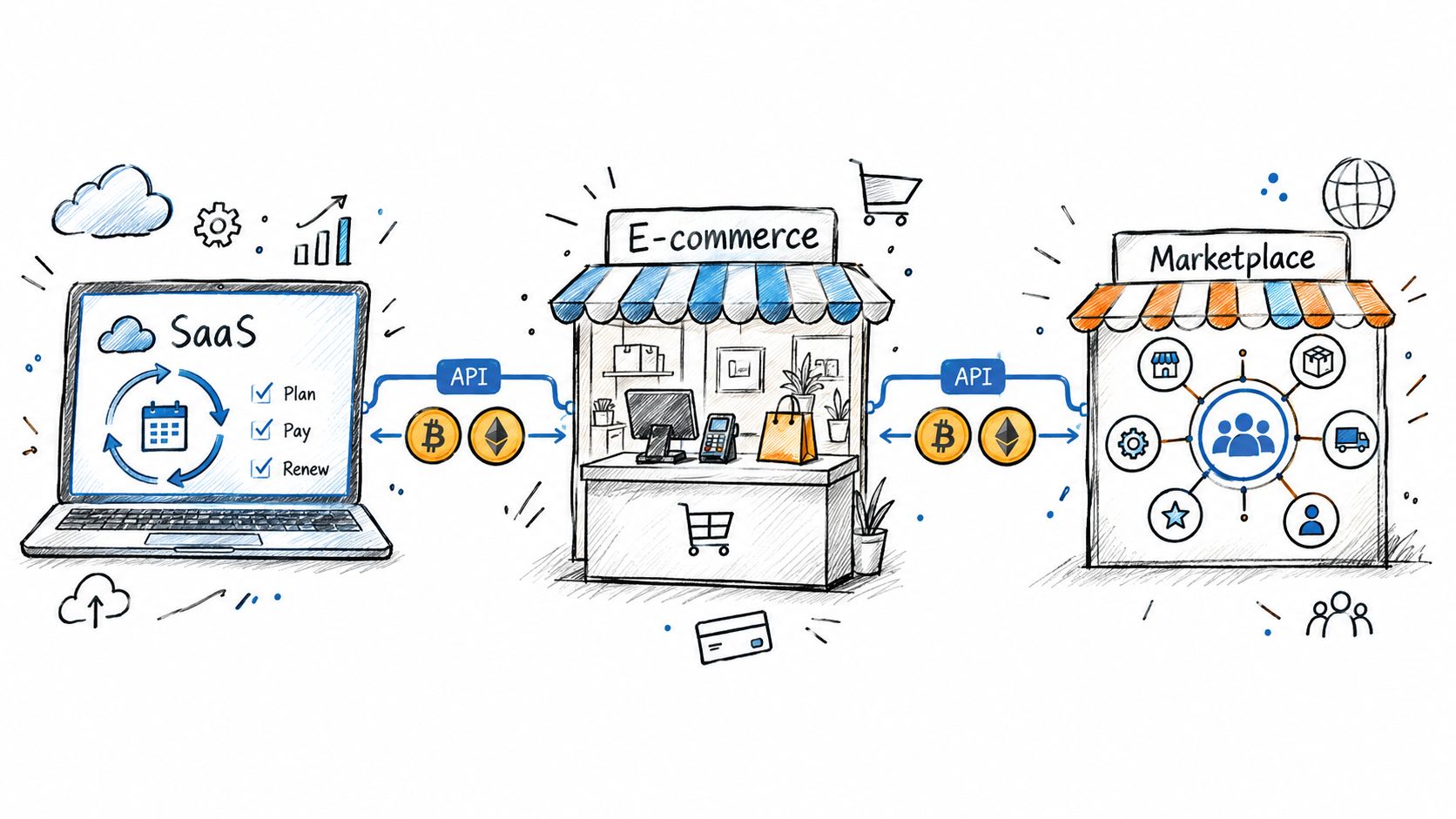
The best integration depends on where payment status affects revenue operations. A SaaS company, an online shop, and a paid community may all use a crypto payment API, but they need different events, access rules, and settlement records.
SaaS and recurring services
A SaaS integration should connect payment state to account state. When a subscription succeeds, your system grants or extends access. When a payment fails, it can notify the customer and move the account into a controlled grace period. When a refund or chargeback arrives, the access record needs an explicit policy rather than an accidental result.
Recurring billing also creates a reconciliation requirement. Store the provider subscription ID, your internal customer ID, plan, price currency, next billing state, and the latest payment event. This makes support conversations easier because the team can see whether a customer failed at checkout, paid but is waiting for settlement, or received a refund.
Ecommerce and digital products
An online store generally benefits from one checkout where customers can select cards or crypto. The order should remain pending until the provider reports the status your fulfillment rules require. For a digital download, that might be a confirmed event. For a physical shipment, the business may also wait for internal fraud or inventory checks.
Agencies and freelancers
Invoicing is less about a polished checkout and more about flexibility. The client may want to pay by card or crypto, while the agency wants the proceeds in a bank account or stablecoin balance. A paylink or hosted invoice keeps the payment interface separate from the work-management system, while webhooks update the invoice record automatically.
Creators and community operators
Paid access requires payment and identity to connect. Suby documentation confirms support for card and cryptocurrency payments, signed payment lifecycle webhooks, and Discord and Telegram subscription use cases. Its Gating product is designed for paid access to Discord, Telegram, downloads, and courses, so the payment event can sit alongside membership or content-access logic. Suby payment documentation
The decision is practical:
Business model | Useful pattern | Main operational concern |
|---|---|---|
SaaS | Recurring billing and webhooks | Subscription state |
Ecommerce | Unified checkout | Order release and reconciliation |
Agency | Paylinks or invoicing | Client payment choice and settlement |
Community | Gating with platform integration | Access activation and removal |
Digital products | Hosted checkout and confirmation rules | Delivery after verified payment |
Security Requirements and Compliance Standards
Payment security has two sides. The provider must protect the payment infrastructure, and your team must implement the integration so that forged events, exposed credentials, and incomplete records don't create losses.
Suby operates with PCI-DSS Level 1-certified processing partners, implements Strong Customer Authentication and two-factor authentication, provides dispute handling, and offers zero-fee refunds, according to its official site. These capabilities address important card-payment and merchant-account controls, but they don't remove your responsibility for application security.
Verify the provider before launch
Ask for clear documentation covering:
Payment processing: Confirm which regulated or certified partners process card payments.
Authentication: Check how Strong Customer Authentication and two-factor authentication are handled.
Disputes and refunds: Understand who manages disputes and how refunds affect settlement records.
Crypto operations: Identify how swaps, gas sponsorship, wallet settlement, and balances are represented.
Compliance responsibilities: Establish which checks belong to the provider and which remain with your business.
Money laundering controls can affect onboarding, transaction monitoring, record keeping, and escalation procedures. For additional legal context, review Kons Law on money laundering rules with your legal or compliance adviser.
Secure the integration itself
Verify webhook signatures before processing any event. Store API keys outside source code, restrict production credentials, and record an audit trail for payment creation, status changes, refunds, and settlement. Your system should also handle duplicate webhook delivery safely, because a repeated success event must not grant access or ship the same order twice.
Read the practical implications of card security in Suby's PCI compliance requirements guide. Compliance isn't a badge to review once. It's part of the operating model your finance, engineering, and support teams use every day.
How to Choose the Right Crypto Payment API Provider
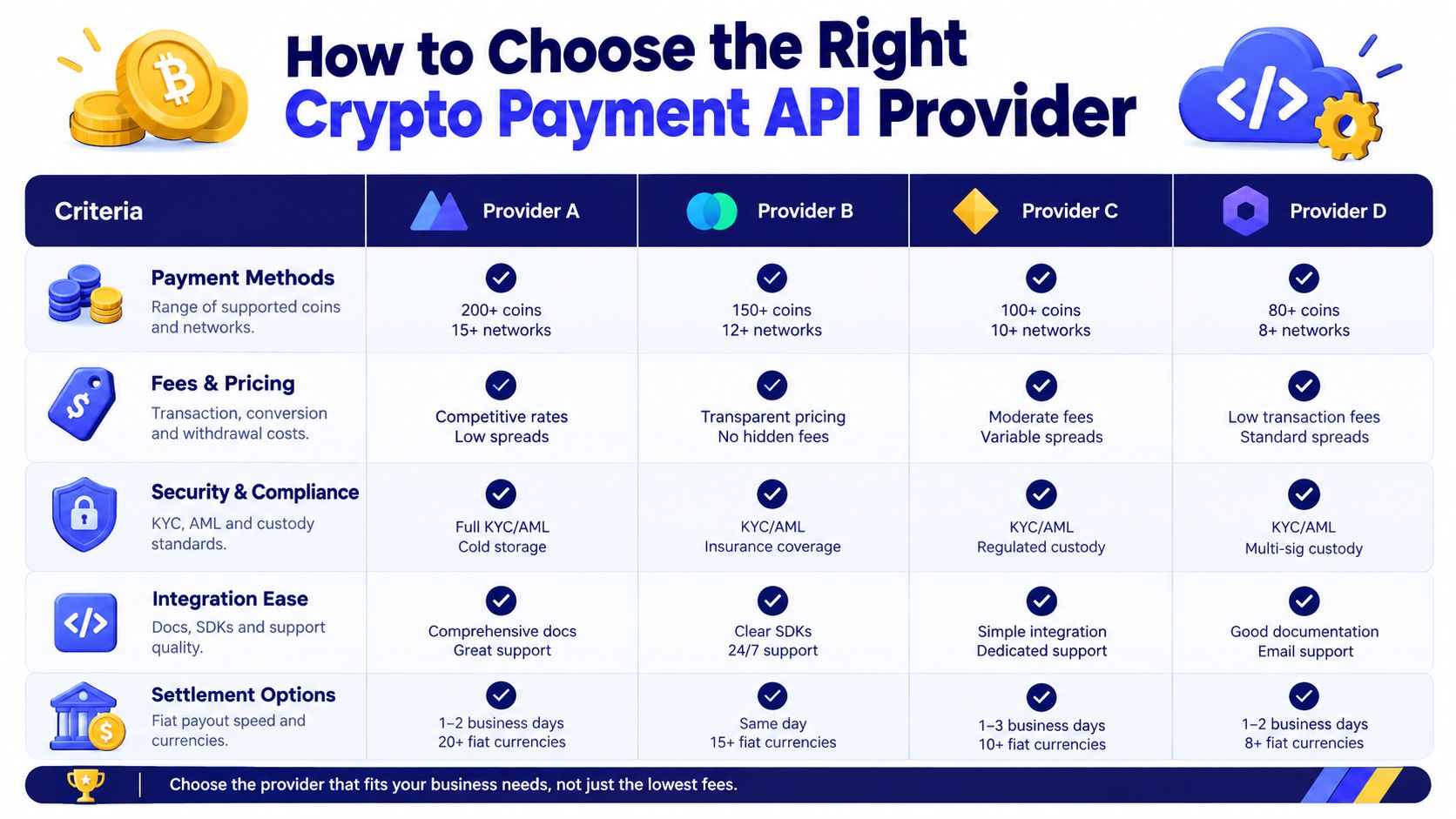
The provider with the lowest advertised transaction fee may not produce the lowest total cost. A proper comparison includes the gateway fee, network fee, conversion fee, offramp fee, settlement method, reconciliation effort, and engineering time. Independent coverage makes the same point, noting that direct acceptance can reduce some fees but requires more integration and responsibility, while processor-mediated settlement can be easier to operate. Stablecoin merchant transaction economics
Compare the complete operating model
Start with five questions:
Payment methods: Can customers use the cards, wallets, bank methods, and crypto assets that matter to your audience?
Settlement options: Can your business receive funds in a bank account, stablecoins, or another required destination?
Integration effort: Are the API, webhooks, hosted checkout, and paylinks documented clearly enough for your team?
Security and compliance: Does the provider document authentication, processing partners, dispute handling, and refunds?
Total cost: What will conversion, network, payout, reconciliation, and support work add to the headline fee?
Pricing depends on the payment method used, so there isn't one universal rate. Suby's official pricing page lists category-specific charges, including a $0.30 per-transaction charge, a 1% Merchant of Record mode fee, a $1 per-transaction fee for one category, and free standard payouts with an extra cost for instant payouts. Its pricing page also states there are no setup fees, no monthly minimums, and no contracts, but businesses should check the page for the exact fee that applies to their payment category. Suby pricing details
Use one product across related workflows
Suby is a concrete example of a single product with four ways to use it. Suby Payments is an API-first stack for cards and crypto through one checkout. Suby Crypto handles crypto payment routing, the swap, gas sponsorship, and settlement to a non-custodial wallet or Suby balance. Suby Gating supports paid access for Discord, Telegram, downloads, and courses. Suby Invoicing lets clients choose how to pay while the business chooses what to receive.
Suby's documentation states that card payments cost 4% plus $0.40 per transaction, while crypto payments cost 1.5% per transaction. The same documentation says card fees are deducted at payout time, crypto fees are applied on-chain through a smart contract at execution, and crypto payouts have no fee with instant wallet-to-wallet settlement. Suby payment fee documentation
Suby provides an API for accepting payments by card or crypto, plus native Discord and Telegram integrations for subscriptions and paid access. If your business needs customers to pay any way they want while you settle to a bank account or stablecoin balance, visit Suby to review the available payment flows and pricing for your payment method.
