

Gaspard LEZIN
Compliance Automation for Global Payments: A Practical Guide
Learn how compliance automation works in global payments and subscriptions, the KPIs that matter, common pitfalls, and how to fit it into your stack.
A 50-person SaaS company expands into Brazil and the Philippines. Within weeks, the finance queue holds hundreds of cross-border KYC reviews. Two analysts spend their days opening PDF bank statements, copying fields into spreadsheets, checking names against sanctions lists, and chasing missing documents. Customers wait, legitimate applications pile up, and nobody can explain the exact status of every case without searching through several systems.
That isn't a policy problem. It's a payment-operations problem. Compliance automation works when it turns repeatable checks into controlled workflows, enriches decisions with reliable payment data, and sends only genuine exceptions to a trained reviewer. It fails when a company treats automation as a dashboard, installs disconnected tools, or lets an opaque rule make decisions nobody can reconstruct later.
For international SaaS, subscription, and commerce teams, the practical question is simple: which compliance tasks should run automatically, and where must human judgment remain in charge?
Table of Contents
What Compliance Automation Really Means
The finance team in the opening example doesn't need another place to upload documents. It needs a workflow that can request the right evidence, validate it, compare the applicant against relevant screening data, assign a risk context, and show a reviewer why the case was routed for attention.
Compliance automation is the practice of encoding regulatory requirements, KYC and KYB checks, sanctions screening, transaction monitoring, and reporting into repeatable software-driven workflows. The system performs the routine work, records what happened, and routes exceptions to people. A reviewer should spend time on ambiguity, not on retyping an address from a bank statement.
That distinction matters. Uploading PDFs is digitization. A rule-based alert that creates a queue for manual triage is only partial automation. Automation becomes operationally useful when policy logic, data enrichment, workflow orchestration, evidence collection, and human review work as one system.
The operating layers
A reliable stack usually contains four connected layers:
Policy logic: Rules translate a regulatory clause, payment-method requirement, or internal risk policy into an action.
Data enrichment: The workflow combines identity records, business information, payment events, sanctions results, and relevant account signals.
Orchestration: A rules engine or workflow platform decides whether to approve, request more evidence, pause a payout, or create a case.
Human review: Analysts handle exceptions, enhanced due diligence, sanctions escalations, and decisions that require context.
The last layer isn't a failure of automation. It's a control. A good system makes the human decision visible, attributable, and easy to audit.
For teams designing an enterprise compliance monitoring implementation, the important design choice is to automate the path, not just the individual check. That means defining entry conditions, decision rules, escalation paths, evidence requirements, and retention rules before selecting vendors.
In payments, this model should connect directly to the checkout and settlement workflow. Suby's payment compliance capabilities can sit alongside dedicated KYC, AML, sanctions, and case-management systems, but a payment layer shouldn't be mistaken for a complete compliance program. The definition matters because the business outcome comes from coordinated controls: faster onboarding, clearer exceptions, stronger records, and fewer manual handoffs.
Why Global Payments Teams Automate Compliance
Global payment teams automate because manual work creates delays at exactly the point where growth creates volume. A new market adds identity formats, payment methods, currencies, payout routes, and regulatory obligations. A spreadsheet can record those variables, but it can't reliably coordinate them across checkout, review, settlement, and reporting.
The evidence shows broad adoption with shallow coverage. A 2026 benchmark reported that 95% of organizations had implemented some automation in GRC processes, while only 4% had achieved full automation. The same benchmark found that 83% attributed major compliance delays to manual work, and only 28% had real-time control monitoring. The 2026 GRC Automation Benchmark therefore points to a practical conclusion: buying software is common, but integrating it fully is still unusual.
The return is clearest when automation removes repetitive assembly and routing. High-automation programs in that benchmark cut package-assembly time by 74% and avoided a median of $47.6k in annual labor costs, according to the same GRC automation research. Those gains don't come from replacing every analyst. They come from reducing the number of cases that need slow, repetitive handling.
Who benefits first
Finance gets faster onboarding, clearer payout holds, and more consistent documentation. Engineering gets structured events from payment and compliance systems instead of fragile email instructions. Product teams can activate subscriptions with fewer avoidable interruptions, while compliance teams get a case record that shows the evidence, rule, decision, and reviewer.
The gains aren't uniform. Basic onboarding checks, repetitive evidence collection, and straightforward transaction rules are good early candidates. Beneficial-ownership analysis, sanctions escalations, and high-risk investigations need more context and continue to require human review. A 2025 benchmark tested six advanced models across 120 real-world compliance and ethics tasks, including risk assessments, policy reviews, internal investigations, and speak-up analysis, and found that performance varied sharply by use case. The EQS AI performance benchmark supports a task-level evaluation rather than a blanket assumption that AI is ready for every decision.
Team | Primary Benefit | Typical Quantified Gain | Where It Falls Short |
|---|---|---|---|
Finance | Faster onboarding and cleaner payout controls | High-automation programs cut package assembly time by 74% (benchmark) | Exceptions still require investigation |
Engineering | Reliable events and consistent routing | Most organizations remain hybrid, with only 4% fully automated (benchmark) | Integrations and data contracts take real work |
Product | Smoother activation across markets | Adoption is mainstream, but uneven, with 42.9% reporting compliance technology adoption in a 2025 survey (survey roundup) | Jurisdiction-specific decisions can't be hidden inside checkout logic |
Compliance | Better evidence and control visibility | Only 28% reported real-time control monitoring (benchmark) | Black-box decisions create audit risk |
Teams exploring AI should focus on keeping compliant with AI without confusing assistance with accountability. Automation pays when the underlying stack is coherent, the ownership is explicit, and the exception queue is designed before launch.
Building the Automation Stack
Start with policy mapping, not vendor demos. Every rule should trace to a regulatory clause, a payment-method requirement, a jurisdictional obligation, or an internal risk policy. If nobody can explain why a rule exists, don't automate it yet. An undocumented rule becomes an undocumented liability when customer volume rises.
Connect the data before the workflow
The data layer should assemble a single case object from the systems that already know different parts of the customer and transaction:
Identity data: KYC and KYB vendor responses, verification status, documents, and ownership information.
Payment data: Gateway events, card authorization outcomes, refunds, disputes, subscriptions, and payout status.
Crypto data: Relevant on-chain activity and settlement information supplied by the payment workflow.
Business context: CRM records, account history, product usage, support signals, and prior review outcomes.
This case object gives reviewers one timeline instead of a collection of disconnected tabs. It also lets the rules engine evaluate more than a name match. A transaction can be assessed in context, including jurisdiction, payment method, customer status, and prior behavior.
Orchestrate actions, not alerts
Use workflow rules to route cases by risk score, jurisdiction, and payment method. A low-risk recurring payment might pass through automated monitoring. A new merchant requesting a stablecoin payout might require additional evidence. A potential sanctions match should pause the relevant action and create a case with the source data attached.
The tooling categories are familiar, but the connections matter more than the labels. A practical stack may include KYC and AML vendors, sanctions-list providers, transaction monitoring, case management, evidence storage, and regulatory reporting. For card environments, teams should map the relevant controls against a PCI DSS compliance framework, then document which control is enforced by the payment provider and which remains the merchant's responsibility.
Real-time transaction signals should feed the review process rather than sit in a separate dashboard. A dedicated real-time transaction monitoring workflow can help teams define event ownership, escalation behavior, and evidence requirements before they tune thresholds.
Finish with measurement. Track the automated decision rate, time to onboard, false-positive ratio, and regulatory finding cycle time. Add operational measures such as exception age and reviewer rework. If a workflow moves faster but produces more unexplained decisions, it isn't improving the control environment.
Where You Sit on the Automation Curve
Many teams misclassify themselves. They call a spreadsheet-backed queue “automated” because a vendor returns a screening result through an API. That setup may remove data entry, but the operating model remains manual if an analyst still opens every case, copies results between systems, and decides what evidence belongs in the file.
The useful comparison is between three operating models.
Dimension | Manual | Partially Automated | Fully Automated |
|---|---|---|---|
Decision latency | Delayed by queues and handoffs | Fast for standard cases, slower for exceptions | Near-continuous for rules that are well defined |
Reviewer workload | Reviewers touch most cases | Reviewers handle routed exceptions | Reviewers focus on high-risk judgment calls |
False positives | Often inconsistent because triage varies by person | Tunable through rules and feedback | Can spread quickly when a flawed rule runs at scale |
Audit traceability | Depends on notes, files, and analyst discipline | Events, evidence, and overrides can be recorded centrally | Strong only if policy versions, inputs, and decisions remain reconstructable |
Cost per screened payment | Labor-heavy and difficult to scale | Lower for routine volume, with integration costs | Lowest for stable, high-volume rules, but expensive to govern |
Control ownership | Mostly held by analysts | Shared by compliance, operations, and engineering | Must be explicitly assigned across policy, systems, and review |
The 2026 benchmark's 4% full-automation figure is a useful reality check, not a target to chase blindly. The benchmark report shows that most organizations are in a hybrid stage. That's often the correct position for a cross-border payments company because the routine path can be automated while ambiguous cases remain visible to people.
Diagnose the actual level
You're probably at level one if teams manage spreadsheet queues, depend on a single reviewer, and can't produce a complete decision history without manual reconstruction.
Level two usually has API-based KYC and sanctions checks, a rules engine, automated evidence capture, and a manual exception queue. Many growing companies should operate there first.
Level three has continuous monitoring, policy-as-code enforcement, structured escalation, and automated preparation of regulatory filing material, with human approval where the decision carries serious legal or customer impact. Don't claim level three because a vendor offers an API. Claim it only when the whole path, from event to decision to audit record, works consistently.
The Honest Tradeoffs of Compliance Automation
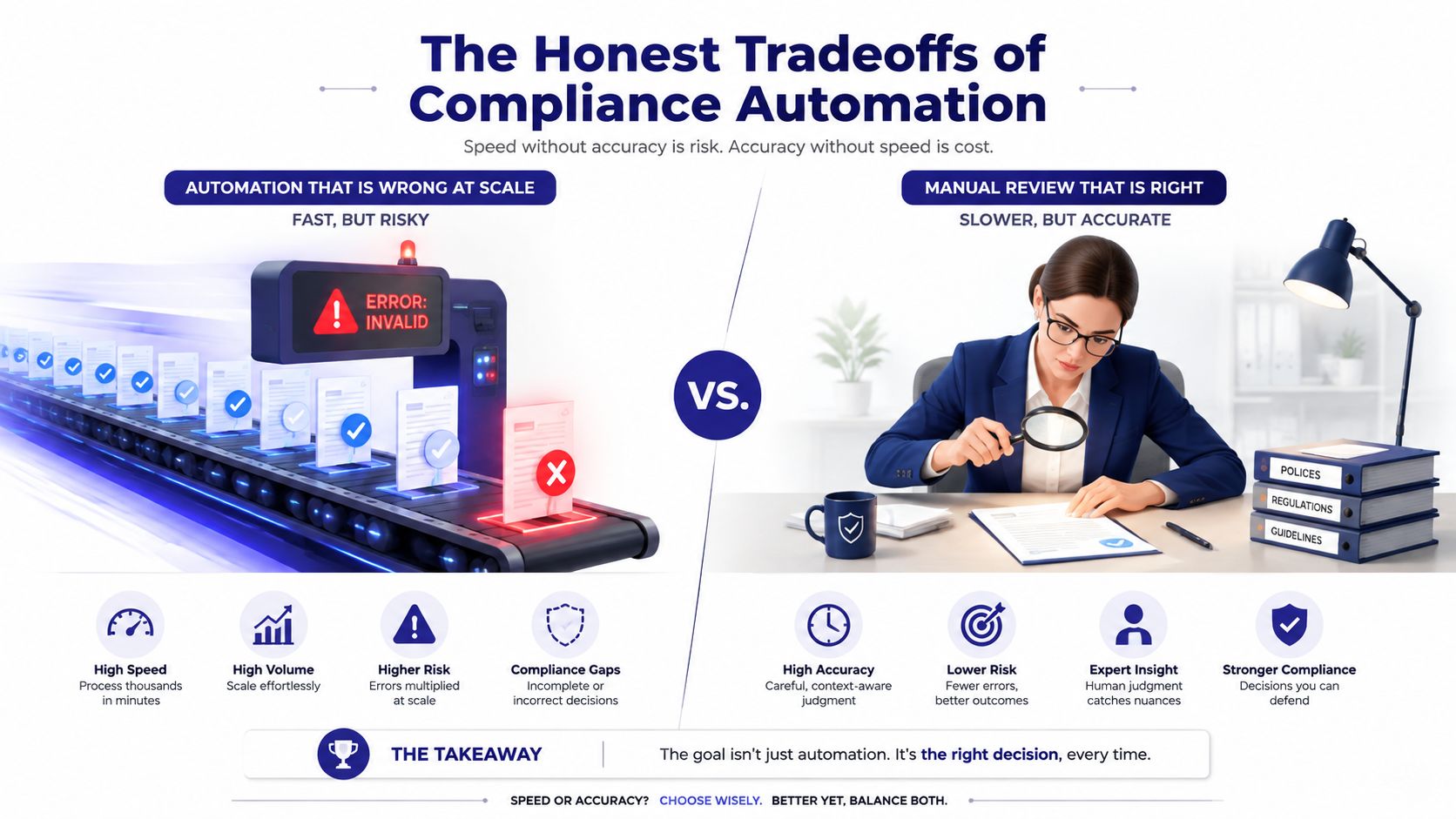
More automation isn't automatically safer, faster, or cheaper. A slow manual review is frustrating. An incorrect automated decision can block legitimate customers across multiple corridors before anyone notices the rule is wrong.
A misconfigured sanctions condition is the obvious example. It may match common names too broadly, stop valid cross-border activity, and create a customer-service problem at checkout or payout. Transaction-monitoring models create a different risk. Their patterns can drift as customer behavior, products, corridors, and payment methods change. A threshold that looked sensible at launch may later generate noise or miss a new pattern.
What automation can quietly damage
False positives cost more than analyst time. They delay good customers, create unnecessary support contacts, and teach reviewers to dismiss alerts. If a team removes experienced reviewers too quickly, it also loses institutional memory, including the practical context behind past decisions and recurring corridor-specific risks.
Black-box decisions create the most serious audit problem. A regulator may need to know which data the system used, which policy version applied, what threshold fired, who approved an override, and how the record was retained. “The model decided” isn't an adequate reconstruction.
The adoption gap reinforces the point. Only 4% of organizations reported full automation, while the benchmark found that most firms remain hybrid (2026 GRC Automation Benchmark). The 2025 compliance-and-ethics benchmark also found sharp variation across tasks, which is why high-stakes decisions still need human oversight (EQS benchmark).
Operating principle: Automate the routine. Keep humans on the judgment calls.
Enhanced due diligence, sanctions escalations, suspicious-activity decisions, and regulatory filings deserve accountable review. Automation should make those decisions better documented and faster to prepare, not remove the person responsible for making them.
Cross-Border Rules You Cannot Ignore
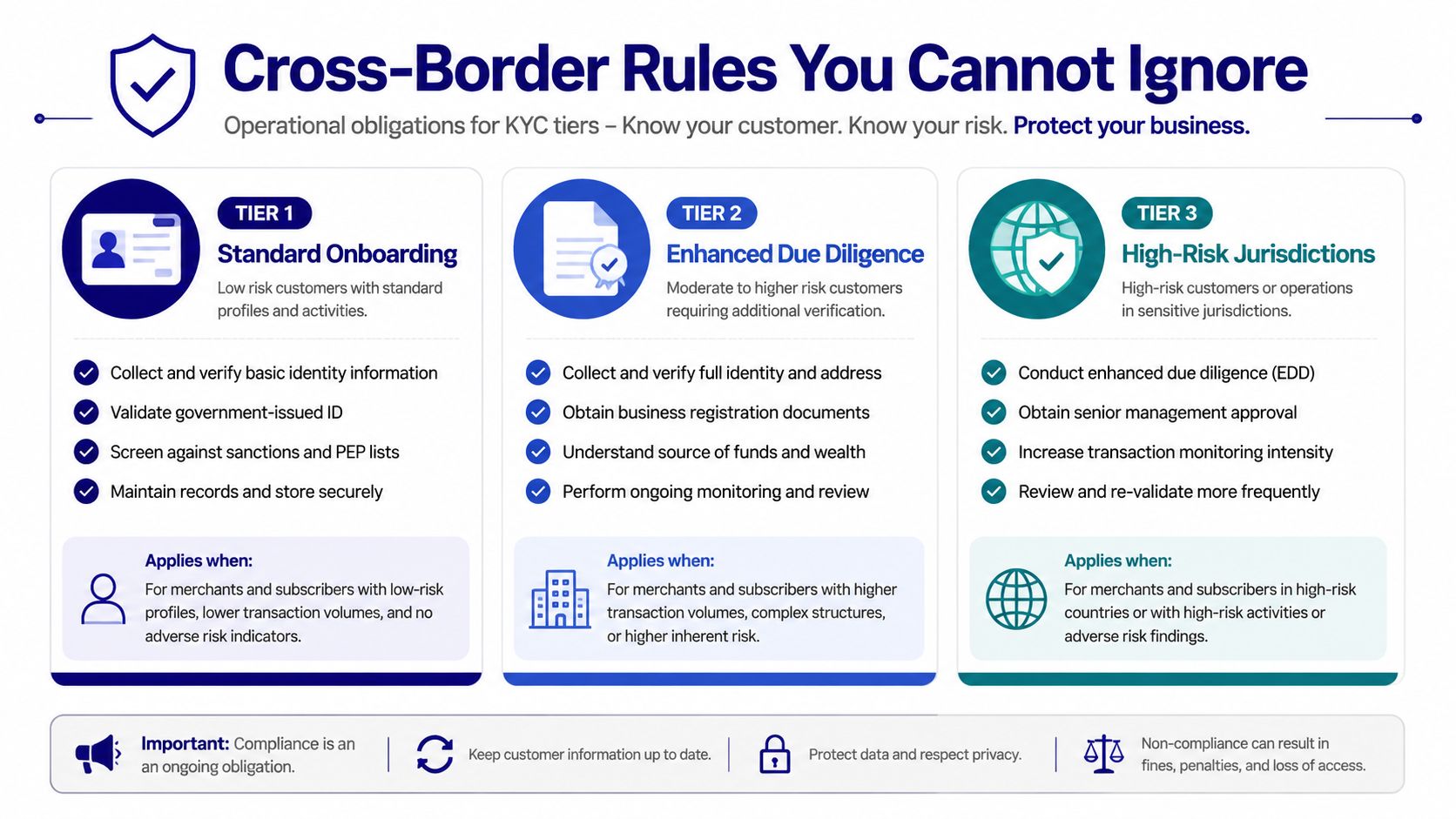
Cross-border compliance becomes manageable when you translate legal requirements into operational controls. Start with customer and merchant identity. A standard onboarding tier may support ordinary customers with ordinary risk. Enhanced due diligence should apply when the customer, ownership structure, activity, or corridor creates additional concern. Higher-risk jurisdictions and relationships need stronger evidence, clearer approval authority, and ongoing review.
KYC isn't a single checkbox. Your workflow should decide which tier applies, request only the evidence required for that tier, and record the reason for escalation. The same logic should apply to merchants and subscribers, while the evidence and approval thresholds reflect the risk of the product and payment flow.
Convert rules into payment controls
AML monitoring needs to examine activity after onboarding, not just the initial application. Define which transaction patterns create an alert, who reviews them, what evidence is required, and when a case must move toward suspicious-activity reporting. Don't hard-code a threshold without documenting the policy behind it and the jurisdiction where it applies.
European card payments add Strong Customer Authentication obligations under PSD2. Your checkout logic should distinguish transactions that need additional authentication from transactions that may qualify for a permitted exemption, then preserve the decision and the relevant evidence. A missed exemption can add avoidable friction. An incorrect exemption can create exposure.
Sanctions screening must run at the points your policy and applicable obligations require, including before a cross-border payout where the recipient, beneficiary, or transaction data can change. Screen against the relevant United States and European lists, manage potential matches as cases, and prevent an analyst from clearing an alert without a recorded rationale.
Practical rule: Automate the screening layer, but tie policy decisions to the licenses, products, and corridors your business actually operates.
A missed sanctions hit on a dollar payout can trigger serious consequences. Weak KYC in one corridor can also damage acquiring relationships elsewhere. The workflow should therefore connect onboarding, payment authorization, settlement, payout, and reporting rather than treating each as a separate compliance event.
Fitting a Payment Layer Into the Workflow
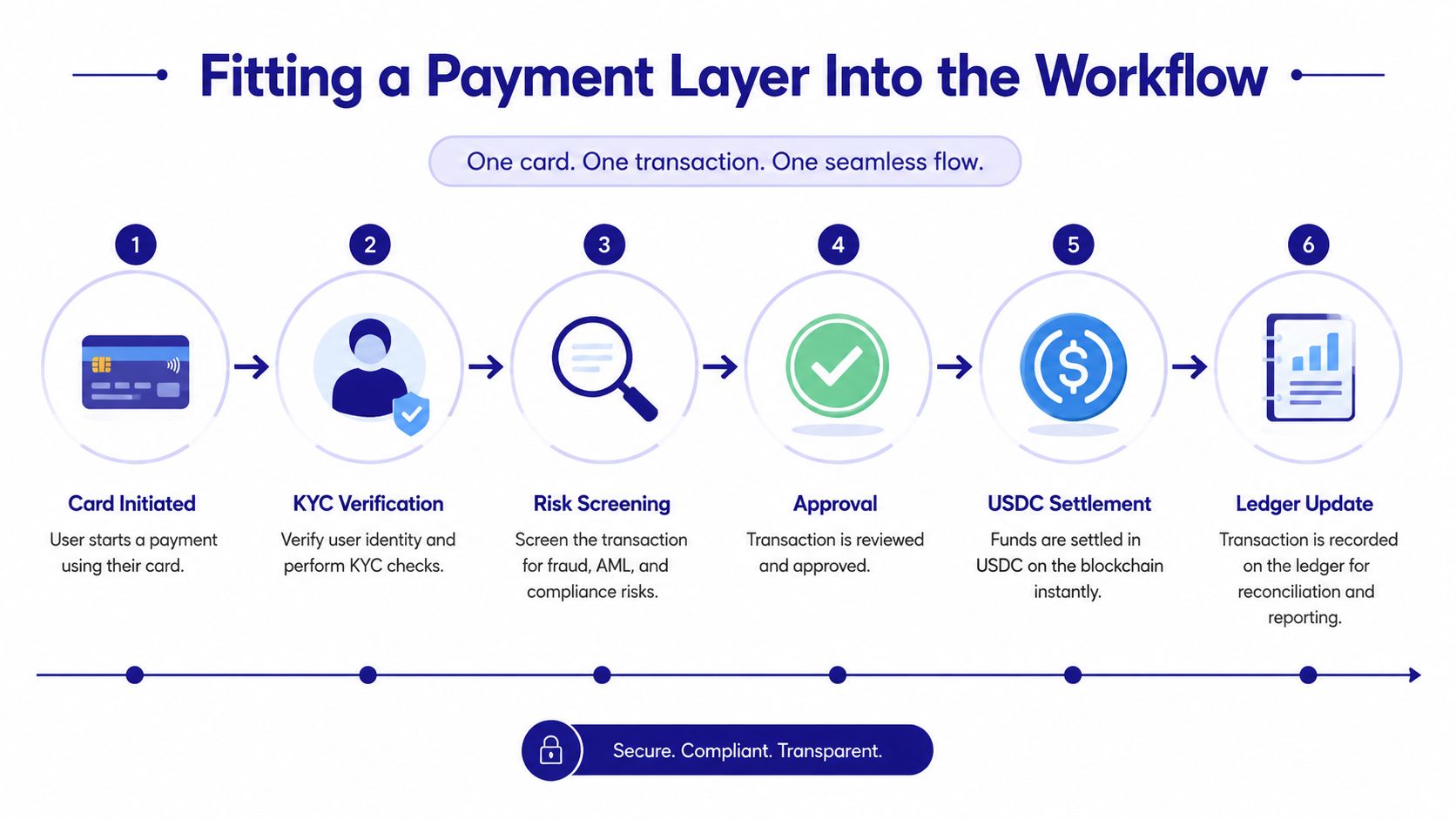
Consider a customer paying by card while the business chooses to receive USDC. The payment layer handles the payment mechanics, but the merchant still needs a compliance workflow around the customer, transaction, and settlement decision.
A practical flow looks like this:
Checkout: The customer selects the available card payment method.
Identity: The merchant's KYC provider verifies the customer or business according to the merchant's policy.
Screening: The transaction and relevant parties pass through the merchant's sanctions and AML controls.
Approval: The workflow either approves the payment or routes an exception for review.
Settlement: The payment is converted and settled in the merchant's chosen method, such as USDC, when that route is available to the business.
Recordkeeping: The merchant stores the payment event, screening result, decision, settlement record, and any reviewer action in its compliance systems.
Suby is a single product with four ways to use it. Suby Payments provides an API-first payment stack for accepting cards and crypto through one checkout. Suby Crypto acts as a crypto payment gateway that handles the swap, sponsors the gas, and supports settlement to a non-custodial wallet or the Suby balance. Suby Gating supports paid access for Discord, Telegram, downloads, and courses, while Suby Invoicing lets a client pay by the method they prefer while the business receives its chosen settlement method. These documented use cases are described in the Suby API introduction and its payments documentation.
Suby provides an API that lets any business accept payments by card or crypto. It also offers native integrations with Discord and Telegram for use cases such as subscriptions, paid access, and online communities. Customers pay any way they want, while businesses get paid the way they choose, either through a bank account or in stablecoins like USDC, subject to the applicable product and payout terms.
The compliance boundary matters. A payment layer can provide payment events, checkout behavior, settlement data, and documented product controls. The merchant still owns onboarding decisions, applicable KYC and AML obligations, recordkeeping, investigation procedures, and audit trails unless a separate agreement clearly assigns a responsibility elsewhere. Suby complements dedicated compliance tools. It isn't a RegTech platform and shouldn't replace a KYC vendor, sanctions provider, transaction-monitoring system, or case-management process.
Pricing depends on the payment method. The published fee documentation lists 4% plus $0.40 per card transaction and 1.5% per crypto transaction, with additional payout fees for bank and stablecoin payouts, and no setup fees or monthly costs. Verify the current Suby payment fees before modeling unit economics.
Your First 30 Days of Automation
Treat the first month as a controlled operating change, not a software installation. Start by mapping the current workflow and timing every meaningful action, including document requests, vendor responses, analyst review, escalation, payout release, and evidence storage.
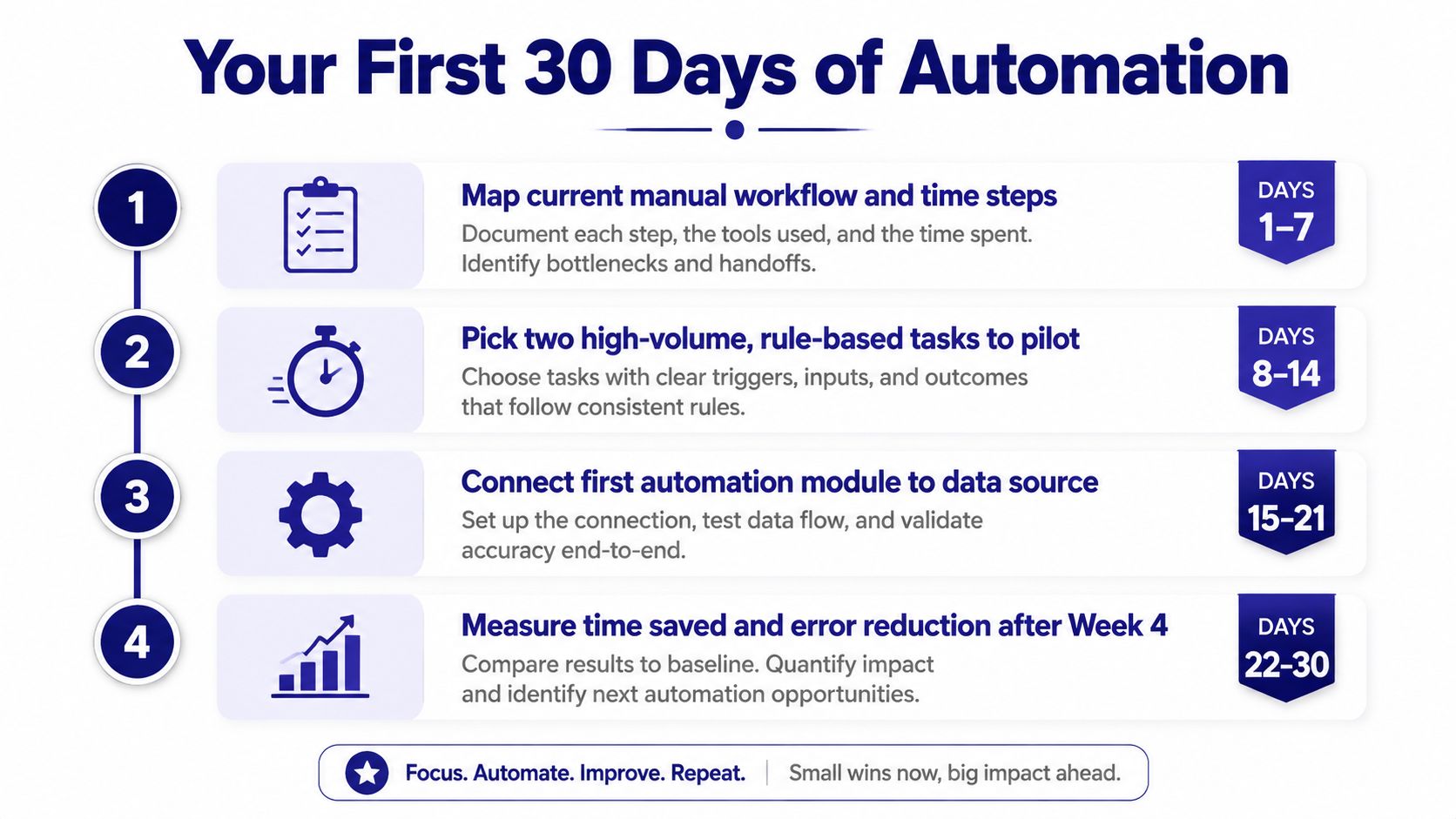
Use this rollout order:
Map the baseline: Document the manual path, owners, systems, elapsed time, and rework.
Choose two tasks: Pick high-volume, rule-based tasks with clear inputs and outputs, such as evidence collection or standard screening.
Connect the controls: Integrate KYC and sanctions APIs, then wire approval thresholds for edge cases.
Measure weekly: Build a dashboard for cycle time, exception rate, false positives, audit findings, and reviewer overrides.
Run in parallel: Compare the automated workflow with the old process for 30 days before switching the default path, using the compliance documentation guide to keep the evidence model consistent.
Don't flip the workflow because the automation looks fast. Flip it when the decision records are complete, exception ownership is clear, false positives are understood, and reviewers can reproduce the result from the stored inputs and policy version. If the pilot can't meet those conditions, narrow the scope and fix the data or rule design first.
The first action belongs with your payments lead and one compliance owner today: select a single queue, map its current path, and record the baseline before anyone changes the tooling.
Suby provides one API for accepting card or crypto payments, plus native Discord and Telegram integrations for subscriptions, paid access, and online communities. Visit Suby to evaluate how its payment, gating, crypto, and invoicing modes could fit into your automated cross-border payments workflow.
