
Gaspard LEZIN
Prorated Charge Meaning: A Guide to Subscription Billing
Understand the prorated charge meaning with clear examples. Learn how proration works for subscriptions, upgrades, and cancellations to ensure fair billing.
You launch a subscription, membership, or paid community. Then the first customer email arrives.
“Why is my bill a weird amount?”
That question usually appears when someone starts mid-month, upgrades halfway through a billing cycle, or cancels before the next renewal. The amount on the invoice doesn't look like your normal plan price, so the customer assumes something went wrong.
In many cases, nothing is wrong. The bill is prorated.
The basic idea is simple. A prorated charge means the customer pays only for the portion of the billing period they used. Instead of charging the full recurring price for a partial month, you adjust the amount to match the time used. That's why the number often looks unusual. It reflects a partial period, not a full one.
For a business owner, this matters far beyond invoice math. If you handle proration well, customers see your billing as fair. If you handle it badly, support tickets pile up, people ask for refunds, and trust drops fast.
The biggest confusion usually isn't the formula. It's what customers think should happen when they change plans. They want to know whether they're being charged more, getting a credit back, or both. That's where a lot of basic explainers stop too early.
Table of Contents
Introduction What Is This Unexpected Charge on My Bill
A simple way to think about it
The formula behind the billing logic
Fairness protects the customer relationship
Accuracy protects your revenue
Three steps you can use on any subscription
Example one, a new customer joins partway through the month
Example two, a partial period can also lead to a credit
Upgrade charges and downgrade credits are not the same thing
Proration for Plan Changes
What customers need to see on the invoice
Global billing makes clarity even more important
Manual proration breaks down quickly
Why a unified billing flow matters
Introduction What Is This Unexpected Charge on My Bill
A customer signs up on the middle of the month for your software, paid newsletter, or members-only Discord. They expect to see your standard plan price. Instead, the invoice shows a smaller amount with odd cents, or a combination of a charge and a credit.
From the customer's side, that can feel suspicious. They don't know whether they were charged incorrectly, taxed twice, or put on the wrong plan. From your side, it may be completely normal billing behavior.
That gap between what the system does and what the customer expects is where most proration confusion begins.
A prorated charge exists so people don't pay for time they never received. If someone uses only part of a billing period, the invoice reflects only that share of the period. That's the practical meaning behind the term.
A strange-looking invoice total often signals fairness, not an error.
Business owners usually see this in a few familiar moments:
Mid-cycle signup: A customer joins after the billing period has already started.
Plan upgrade: A customer moves to a higher-priced plan before the cycle ends.
Plan downgrade or cancellation: A customer stops using part of what they already paid for.
Seat changes: A team adds or removes access during an active term.
The customer doesn't care what your billing system calls these events. They care about whether the invoice feels fair and understandable.
If you can explain the prorated charge meaning in plain language, you'll prevent a lot of friction. You'll also make your revenue more predictable, because clear billing reduces disputes and back-and-forth support.
Understanding the Core Concept of a Prorated Charge
A prorated charge is just a partial-period fee. It's based on the share of the service period the customer used, rather than charging the full recurring amount.
A simple way to think about it
Paying for a hotel only for the nights you stayed is an apt comparison. You wouldn't expect to pay for a full week if you checked in for only part of it. Subscription billing uses the same logic.
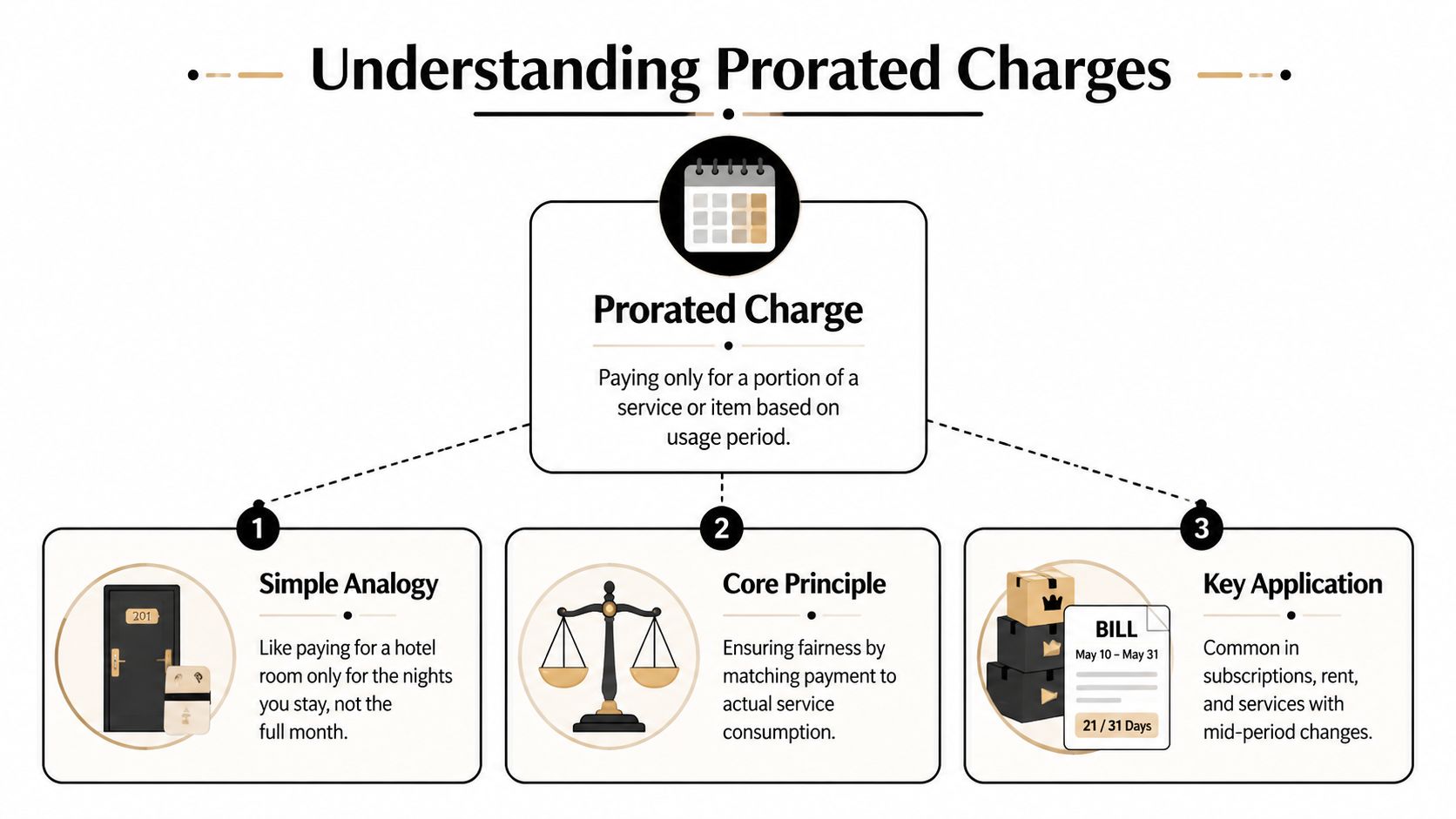
This approach shows up anywhere recurring charges meet partial usage. It's common in software, telecom, utilities, and rental arrangements. If you work with recurring payments, proration is part of normal operations.
It also helps to think of proration as proportional billing. You're not inventing a special fee. You're taking an existing fee and assigning only the portion that matches actual use. That same proportional idea shows up in other financial contexts too, such as the Australian PAYG instalment system, where payment obligations can be understood in structured portions rather than as one flat amount detached from timing.
The formula behind the billing logic
The standard formula is straightforward. A prorated charge is calculated by converting the full plan price into a unit rate, usually a daily rate, and multiplying it by the number of days used. Stripe's billing explainer gives a simple example: a $30 monthly plan started on day 15 of a 30-day month results in a $15 first charge because only half the period was used, as described in Stripe's overview of prorated billing.
That's the heart of the prorated charge meaning. You pay for a fraction of a billing period because you received a fraction of the service period.
Practical rule: If the customer used only part of the period, the invoice should show only part of the full recurring price.
Once you see proration as proportional billing rather than a mysterious extra fee, the rest of the billing behavior starts to make sense.
Why Prorated Charges Are Essential for Modern Businesses
Proration isn't a niche accounting trick. It's one of the basic tools that makes recurring billing workable in real businesses.
Fairness protects the customer relationship
Customers rarely start, upgrade, downgrade, or cancel on the exact day your billing cycle resets. Real usage is messy. Billing has to match that reality.
Proration became a core billing practice because subscription businesses needed to handle mid-cycle signups, upgrades, downgrades, cancellations, and seat changes without overcharging customers. Industry guidance now treats it as standard across sectors such as telecom, utilities, subscription software, and landlords, as explained in Recurly's guide to prorated billing.
If you skip proration, you force a bad choice. You either charge customers for time they didn't use, or you give away service for free until the next full cycle begins. Neither option is healthy.
Accuracy protects your revenue
Proration also protects your side of the ledger. It lets you collect revenue that matches what you delivered.
That matters when someone joins late in the month, adds seats after onboarding, or upgrades to access features immediately. Without a clear proration policy, your team ends up making one-off decisions, and those decisions can become inconsistent fast.
A good proration setup helps in practical ways:
It reduces bill shock: Customers can see why an amount is lower or higher than the standard plan price.
It creates cleaner internal rules: Finance, support, and product teams use the same billing logic.
It supports self-serve changes: Customers can switch plans without waiting for manual intervention.
It keeps invoices defensible: If a customer asks why they paid a certain amount, you can explain it clearly.
When billing matches service timing, customers usually see the invoice as fair, even when the amount is unfamiliar.
Businesses often treat proration as a backend detail. Customers treat it as proof that your billing can be trusted. Both views are right.
How to Calculate Prorated Charges Step by Step
The math is simpler than it appears. Once you break it into a few steps, you can check almost any prorated invoice yourself.
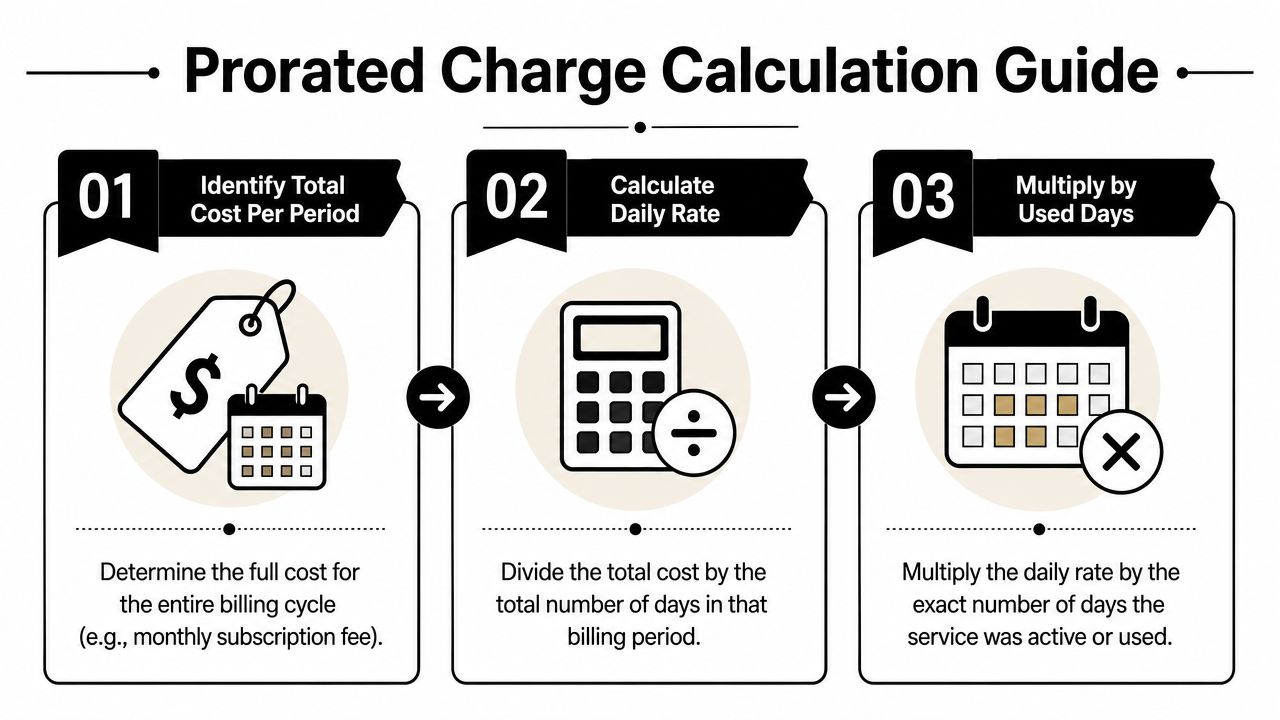
Three steps you can use on any subscription
Use this sequence:
Find the full price for the billing period.
Divide by the number of days in that billing period to get the daily rate.
Multiply the daily rate by the number of days used.
That's the same logic Orb describes with the formula (total subscription cost / total days in billing cycle) × number of days used, and Orb gives a sample where a $60 per month subscription used for 10 of 30 days produces a $20 prorated charge in its explanation of how prorated charges work.
If your team also has to line up billing with accounting treatment, this overview of revenue recognition for subscriptions is useful background reading.
A short walkthrough can help if you want to see the flow in action:
Example one, a new customer joins partway through the month
Take the Orb example because it's easy to follow.
Full monthly subscription price: $60
Total days in billing cycle: 30
Days used: 10
Now apply the formula:
Daily rate = $60 / 30
Prorated charge = daily rate × 10
Final amount = $20
That first invoice is not discounted in a promotional sense. It is adjusted to reflect the actual service period used.
Example two, a partial period can also lead to a credit
Readers often get stuck here. The same proportional logic can work in reverse.
Suppose a customer has already paid for a full period and then changes to a lower plan or cancels access before the period ends. In many billing setups, the business calculates the unused portion and turns that amount into a prorated credit. That credit may appear immediately, reduce the next invoice, or be handled according to the vendor's refund policy.
The math for a charge and the math for a credit are often the same. What changes is the direction of the adjustment.
A few checks keep your calculations sane:
Check the service dates: Make sure the active period is correct before doing any math.
Confirm the day-count method: Some systems use actual calendar days, while others standardize the period.
Look for invoice labels: “Prorated charge” and “credit for unused time” should be separate if both appear.
The formula is the easy part. The harder part is deciding how those amounts appear on the invoice and when the customer sees them.
Handling Upgrades Downgrades and Plan Changes
Most proration confusion doesn't happen on first signup. It happens when a customer changes plans while their billing cycle is still active.
Upgrade charges and downgrade credits are not the same thing
A common problem with proration explainers is that they talk only about a prorated charge. Customers, however, also want to know about a prorated credit.
That distinction matters. As noted in Turnstile's discussion of prorated billing meaning, many explainers don't answer the main question customers ask: if they downgrade or cancel, do they get a cash refund, an account credit, or just a lower next bill? The answer depends on vendor policy, and that directly affects trust.
An upgrade usually means the customer gets more value right away. In many systems, the invoice may show two moving parts:
a credit for the unused portion of the old plan
a prorated charge for the remaining portion of the new plan
A downgrade often works differently. The business may calculate the unused value of the old, higher-priced plan and apply that amount as an account credit rather than sending cash back immediately.
If you run a subscription business, retention depends partly on how predictable these transitions feel. Teams working on ways to optimize subscription store retention often discover that billing clarity is just as important as pricing itself.
For teams managing recurring plan logic, this guide to subscription management workflows can help frame the operational side.
Proration for Plan Changes
Scenario | What Happens | Result on Invoice |
|---|---|---|
Upgrade mid-cycle | Unused time on the old plan may be credited, and remaining time on the new plan may be charged | Customer may see both a credit and a new prorated charge |
Downgrade mid-cycle | Unused value from the higher plan may be preserved for the customer | Customer may see an account credit or a reduced future bill |
Cancellation before period end | Remaining unused time is evaluated under the vendor's billing policy | Customer may receive a refund, a credit, or no cash return |
Seat reduction or feature removal | The business adjusts value for the remainder of the term | Invoice may show a partial credit or future adjustment |
If customers can't tell whether a line item is a charge or a credit, they assume the worst.
The practical lesson is simple. A prorated charge increases what the customer owes for added value during the remaining term. A prorated credit reduces what they owe because they stopped using part of what they had already paid for. Those are related ideas, but they should never be presented as if they are the same thing.
How to Communicate Prorated Charges to Your Customers
Most billing complaints start as communication problems, not math problems.
What customers need to see on the invoice
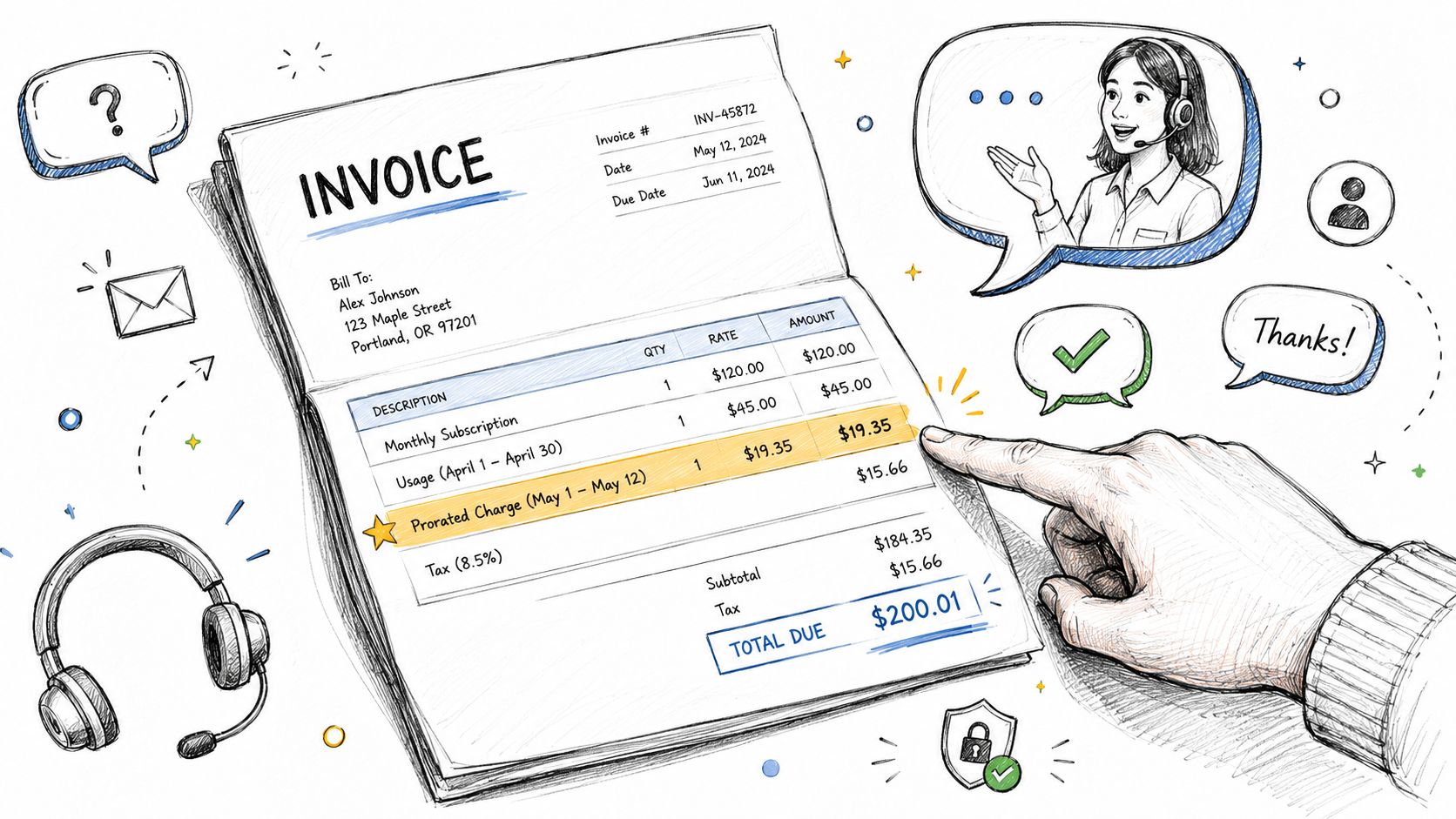
If a customer opens an invoice and sees a non-round amount with no explanation, they won't stop to admire your billing precision. They'll contact support.
Clear invoice wording fixes a lot of that. Good line items usually state what changed, the service dates involved, and whether the amount is a charge or a credit.
Useful labels include:
Prorated charge for current plan: Helps the customer connect the amount to the active subscription
Credit for unused time on previous plan: Makes a downgrade or upgrade adjustment easier to understand
Service period shown on the line item: Gives the customer a visible date range to verify
Global billing makes clarity even more important
Multi-country billing adds another layer of confusion. According to BillingPlatform's overview of prorated charges, many explainers ignore what happens when rounding, FX rates, and tax application affect invoice totals. For global businesses, failing to explain these small differences can create billing disputes and more support work.
That means your invoice copy has to do more than name the charge. It should make room for small differences caused by currency conversion, tax treatment, or rounding rules.
A customer will usually accept a complicated invoice if the logic is visible.
If your business sells across borders, clear billing language isn't a nice extra. It's part of customer service.
Automate Proration with a Modern Payment Layer
Proration is fair in theory and messy in practice.
Manual proration breaks down quickly
A founder can calculate a few partial-month invoices by hand. That works until customers start changing plans in real time, adding team members, canceling before renewal, or paying from different regions.
Then the operational costs show up. Support has to explain invoices. Finance has to reconcile credits. Product teams have to decide when changes take effect. Small inconsistencies become visible to customers fast.
This is why many businesses move proration out of spreadsheets and into their billing system. If you want a wider view of tools built for recurring revenue operations, this roundup of subscription billing software options is a useful starting point.
Why a unified billing flow matters
The strongest setup is one where payment collection, subscription logic, and customer access all work together. Businesses in verticals with recurring memberships, including operators researching gym payment software for 2026, often run into the same lesson. Billing isn't just about taking payment. It's about handling changes cleanly after the first checkout.
For global businesses, the payment layer also affects payout predictability. If your customers pay in different ways and from different places, you still need a stable settlement flow on the business side.
That's where a modern platform can remove friction. The ideal system should automate recurring subscriptions, plan changes, credits, and renewals without forcing your team to manually interpret every odd-looking invoice.
Suby is a payment gateway and payment processor. Your customers pay with card, bank transfer, Apple Pay, Google Pay, Klarna, and more, or stablecoins, and you get paid out to your bank account, or directly in stablecoins (USDC, EURC) to your wallet, anywhere in the world, no bank account required. It provides an API for one-time payments and recurring subscriptions, plus native Discord and Telegram integrations for paid access. That handles the messy part of proration: recurring subscriptions, plan changes, prorated charges, and credits run in one flow, so your team doesn't have to interpret every odd-looking invoice by hand.
