
Gaspard LEZIN
Understanding SaaS Churn Rates to Boost Retention and Growth
A practical guide to understanding saas churn rates. Learn how to measure, benchmark, and reduce churn with actionable strategies for sustainable growth.
In simple terms, the SaaS churn rate is the percentage of customers who decide to stop paying for your service over a set period. Think of your business as a bucket you're trying to fill with water (customers). Churn is the hole in the bottom of that bucket.
No matter how fast you pour water in, you'll never fill it up if you don't plug the leaks. That’s why getting a handle on churn is absolutely fundamental to building a sustainable SaaS business. Letting it run unchecked can silently sabotage all your hard work on the acquisition front.
Why Churn Is So Much More Than Just a Number
Imagine pouring your heart and soul into building a fantastic product, spending a small fortune on marketing, and then watching new customers walk out the back door almost as quickly as they come in the front. That's the painful reality of high churn. It's not just a metric on a KPI dashboard, it's a direct pulse on the health of your company.
When you ignore churn, you're essentially trying to fill that leaky bucket with a firehose. You're forced into a frantic, expensive cycle of acquiring more and more customers just to stand still. High churn rates erode your recurring revenue, skyrocket your customer acquisition costs (CAC), and often point to bigger underlying issues with your product, pricing, or the customer experience you're providing.
The Two Sides of the Churn Coin
To really get to the bottom of what's happening, you need to look at churn from two different angles: customer churn and revenue churn. They sound related, and they are, but they tell two very different stories about your business's health.
Let's break down the core difference with a quick comparison.
Customer Churn vs Revenue Churn at a Glance
Metric | What It Measures | Primary Use Case |
|---|---|---|
Customer Churn | The percentage of customers or logos that cancel their subscriptions. | Understanding overall customer satisfaction and product-market fit. Answers: "How many users are we losing?" |
Revenue Churn | The percentage of monthly recurring revenue (MRR) lost from cancellations and downgrades. | Assessing the direct financial impact of churn. Answers: "How much money are we losing?" |
So, why does this distinction matter so much?
Losing ten startups on your $19/month plan is a bummer, but it might not significantly dent your overall revenue. Losing a single enterprise customer paying $5,000/month, however, could be a financial catastrophe. Looking at both customer and revenue churn gives you the complete story of who is leaving and exactly how much it’s costing you.
You simply can't afford to ignore either side of the churn equation. One tells you about the general happiness of your user base, while the other hits you with the cold, hard financial facts.
This isn't just a theoretical exercise. Recent market volatility has made churn a top-of-mind issue for every SaaS leader. In 2023, B2B SaaS companies experienced record-high churn as economic uncertainty led to tighter budgets. Monthly MRR churn hit an average of -1.85% in December, a startling 25% increase from just two years earlier. You can dig into the data in the full report on the 2023 B2B SaaS market on Paddle.com.
In today's climate, mastering churn isn't just about optimizing for growth, it's about ensuring survival.
How to Accurately Calculate Your Churn Rates
Okay, let's get down to brass tacks. Moving from talking about churn to actually measuring it is where the real work begins. The good news is you don't need a Ph.D. in data science to figure this out. It's all about applying a couple of simple, consistent formulas to get a clear picture of your business's health.
Think of your customer lifecycle as a constant flow. You work hard to acquire customers, and from that moment on, the clock is ticking. They either stick around or they eventually churn.
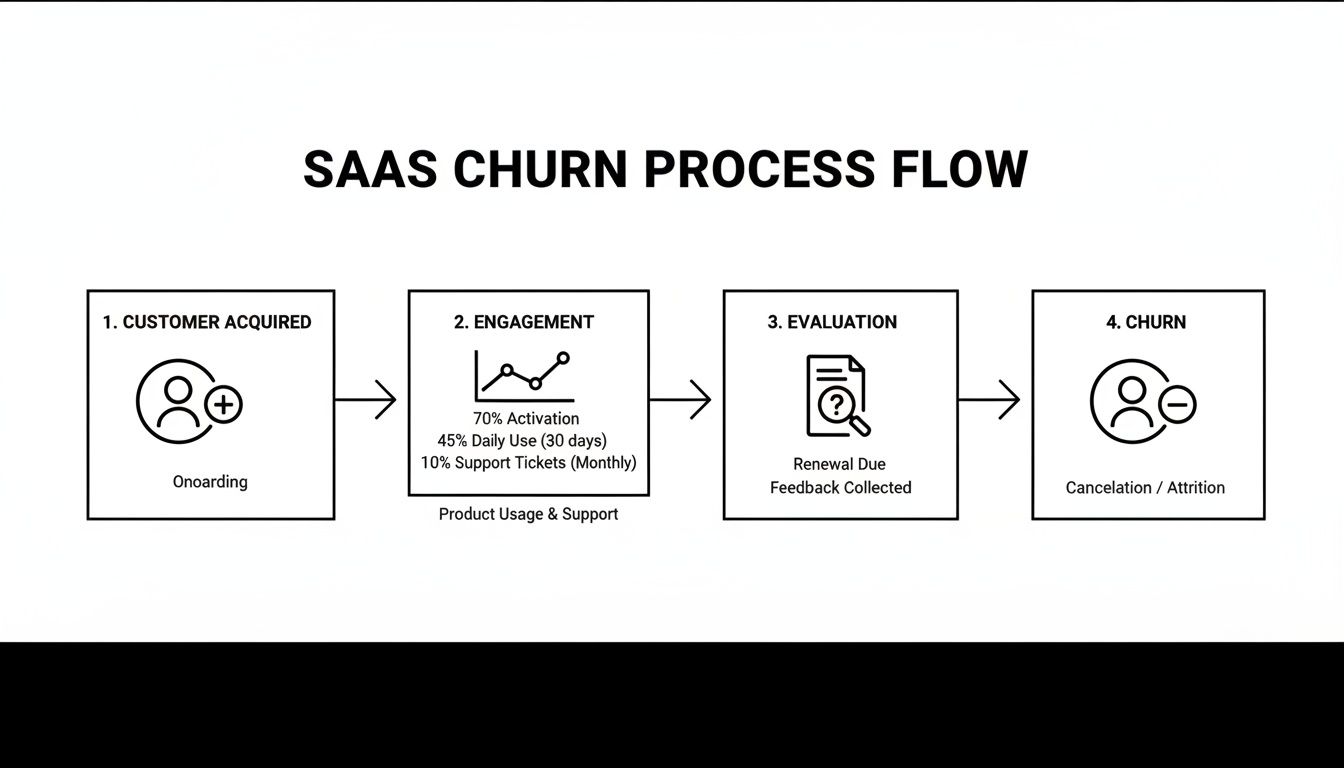
This journey is something every subscription business grapples with. Your job is to keep as many people as possible from reaching that final "churn" stage. So, how do we measure it?
Calculating Customer Churn
First up is customer churn, sometimes called logo churn. This one is straightforward: it tells you the percentage of your customers who headed for the exit during a specific period. It’s the most direct pulse check on customer attrition you can get.
Here’s the formula:
(Lost Customers During Period / Total Customers at Start of Period) x 100 = Customer Churn Rate (%)
Let's walk through a quick example.
Imagine your SaaS business starts April with 1,000 paying customers. Over the course of the month, 50 of them cancel their subscriptions.
Plugging that into the formula:
(50 Lost Customers / 1,000 Starting Customers) x 100 = 5% Monthly Customer Churn
Just like that, you have a clear signal. A 5% churn rate tells you exactly how many customers you’re losing, which is a critical starting point for understanding customer satisfaction and product-market fit.
Calculating Revenue Churn
While losing customers is never great, revenue churn often paints a much more vivid, and sometimes scarier, picture of your financial stability. This metric measures the percentage of monthly recurring revenue (MRR) you lost from those cancellations.
The formula looks very similar:
(Lost MRR During Period / Total MRR at Start of Period) x 100 = Revenue Churn Rate (%)
Let's stick with our example from before.
At the beginning of April, your 1,000 customers were generating a total of $50,000 in MRR. The 50 customers who churned weren't all on the same plan; the total MRR you lost from their cancellations came out to $7,500.
Now, let's run the numbers:
($7,500 Lost MRR / $50,000 Starting MRR) x 100 = 15% Monthly Revenue Churn
See the difference? Your customer churn was only 5%, but your revenue churn was a gut-punching 15%. This huge gap tells a crucial story: the customers you lost were your higher-value accounts. Their departure hurts your bottom line far more than the raw customer count suggests.
A Sample Monthly Calculation
To make this crystal clear, let's put both calculations side-by-side in a simple cohort analysis table for our hypothetical company for the month of April.
Sample Monthly Churn Calculation for a SaaS Business
This table provides a clean snapshot of both customer and revenue attrition over a single month.
Metric | Start of Month | Lost During Month | End of Month | Monthly Churn Rate |
|---|---|---|---|---|
Customer Count | 1,000 | 50 | 950 | 5.0% |
Monthly Recurring Revenue (MRR) | $50,000 | $7,500 | $42,500 | 15.0% |
Seeing the data this way makes it impossible to ignore the story the numbers are telling. If you were only tracking customer churn, you might think you have a minor leak. The revenue churn, however, shows you have a gaping hole in the boat that needs immediate attention.
Accurately calculating these SaaS churn rates is your first step toward diagnosing the why. For many businesses, a surprising amount of churn comes from totally preventable issues like failed payments. Things like cross-border payment friction and outdated card details can lead to involuntary churn that has nothing to do with your product.
Using a robust payment infrastructure is a direct lever you can pull to lower these numbers. For instance, a reliable payment API lets customers pay by card while the business receives USDC. This can eliminate the friction that causes failed transactions. Platforms like Suby, which also offer native integrations for communities on Discord and Telegram, help streamline the entire subscription journey. By removing payment roadblocks, you can directly attack a major source of churn and keep more of your hard-earned revenue.
What’s a “Good” Churn Rate, Anyway?
So you’ve run the numbers and have your churn rate. Now for the million-dollar question: is it any good?
Honestly, there’s no magic number. A “good” SaaS churn rate is completely relative. What looks healthy for a company selling to startups could spell disaster for one focused on enterprise giants.
Think about it this way: if you sell a simple project management tool to small businesses, a 5% monthly churn might be totally fine. SMBs are nimble, more sensitive to price, and often switch tools as their needs change. But if you’re selling a complex CRM to Fortune 500 companies, that same 5% monthly churn would be a five-alarm fire.
Churn Benchmarks: It All Depends on Who You Serve
To get a real feel for your performance, you need to compare apples to apples. Let's break down typical churn rates by the type of customer you're targeting, because each market plays by different rules.
Enterprise: Big-league players serving massive corporations usually have the lowest churn, often just 1-2% annually. This makes sense because enterprise contracts are long, switching is a massive headache, and the software becomes deeply woven into their daily operations.
Mid-Market: Companies focused on mid-sized businesses tend to see annual churn in the 2-4% range. These customers are more established than small businesses but not as locked-in as enterprise clients.
SMBs: This is where things get volatile. Churn for small and medium-sized businesses can easily hit 3-5% monthly. That can add up to a staggering 30-50% churn over a year. Smaller companies just have less friction when it comes to jumping ship.
While churn rates saw some turbulence in recent years, things are starting to level out. As of early 2024, the average monthly B2B SaaS churn rate has settled down a bit, but most companies still land somewhere in the 5-7% annual range. If you want to dig deeper into the numbers, you can explore more SaaS industry insights on Semrush.com.
The Holy Grail: Negative MRR Churn
Holding onto customers is one thing, but the true endgame for any SaaS leader is achieving negative MRR churn. This is the gold standard, the ultimate sign of a healthy, thriving subscription business.
Negative churn happens when the revenue you gain from existing customers is greater than the revenue you lose from customers who cancel. It's proof that your product isn't just useful, it's becoming more valuable to your customers over time.
How is that even possible? It all comes down to expansion revenue. This is the extra cash generated from your happy, loyal customers through things like:
Upgrades: A customer on your "Starter" plan moves up to the "Pro" tier.
Add-ons: They buy a new feature or module to enhance their experience.
More Seats: They add more users from their team to the platform.
When this expansion revenue outpaces the MRR you lose from cancellations, your churn rate goes negative. You're not just patching a leaky bucket; you're discovering a spring of fresh water inside it.
Achieving this means your business can grow its revenue without signing up a single new customer. It's the clearest signal of incredible product-market fit. This is especially powerful for global businesses, where reducing friction is key. For instance, using a payment API that lets users pay by card while you receive USDC can eliminate the payment failures that cause involuntary churn, making it far easier to keep and grow your customer accounts worldwide.
The Hidden Reasons Customers Really Leave
A high churn rate is a symptom, not the disease. Once you’ve calculated your SaaS churn rates, the real work begins: figuring out why customers are actually walking away. When you look past the raw numbers, you'll almost always find a tangled web of product gaps, service failures, and operational friction that silently nudges users toward the exit.
Think of yourself as a detective. Your churn rate is the evidence left at the scene, but your job is to uncover the motive. Was it one big, obvious problem? Or was it a death-by-a-thousand-cuts scenario that finally eroded their trust?
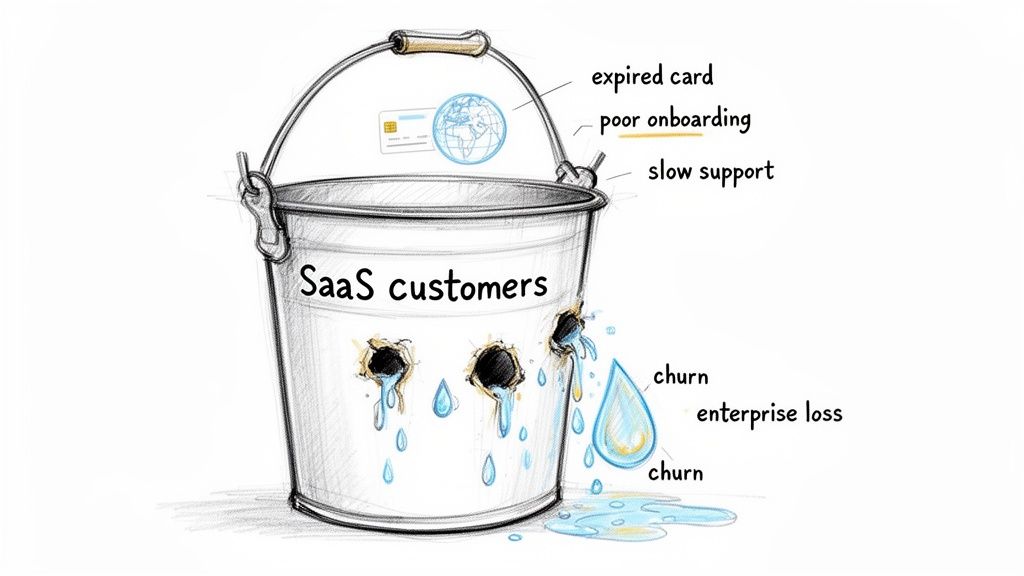
Getting to the root cause is the only path to building a solution that actually sticks. Let’s investigate the usual suspects behind a leaky customer bucket.
Unpacking the Drivers of Voluntary Churn
Voluntary churn is an active decision. A customer makes a conscious choice, clicks the "cancel" button, and ends their subscription. This kind of churn is a direct report card on their experience with your product and your company.
Here are some of the most common reasons people decide to leave:
Poor Product-Market Fit: They signed up with high hopes, but your software just doesn't solve their problem or fit into their daily workflow. The promise didn't match reality.
A Confusing Onboarding Experience: First impressions are everything. If a new user feels lost, overwhelmed, or can't get that first "aha!" moment quickly, they'll likely bail before they ever see the true value.
Slow or Ineffective Customer Support: When something goes wrong, people expect fast, helpful support. Long waits and unresolved tickets create frustration and make customers feel like you don't care about their business.
Perceived Lack of Value or High Price: If customers don't feel they're getting a strong return on their investment, they’ll start shopping for cheaper alternatives or just cut the expense. Sometimes, major service outages caused by poor incident management best practices can be the final straw.
The Silent Killer: Involuntary Churn
While most founders focus on why customers choose to leave, a huge chunk of your churn might be completely unintentional. This is involuntary churn, and it happens when a customer's payment fails for a technical reason, not because they wanted to cancel.
Involuntary churn from failed payments can account for 20-40% of total churn. It's a silent killer because these are often happy customers who are lost due to fixable payment processing issues.
This is where the biggest leaks in your revenue bucket are often hiding.
Picture this: a loyal customer in Europe is trying to pay for your US-based service. Their recurring payment is due, but their bank flags and declines the card for an unfamiliar international transaction. After another failed attempt, your system automatically cancels their subscription. You just lost a good customer who never even thought about leaving.
Common causes of involuntary churn include:
Expired or Outdated Credit Cards: This is the number one culprit behind failed recurring payments.
Hard Declines from Banks: Issuing banks might block payments due to suspected fraud, insufficient funds, or strict cross-border transaction rules.
Lack of Local Payment Options: Forcing everyone in the world to pay with one card type in one currency creates massive friction. A customer in Brazil might want to use a local payment method you simply don't offer.
This is a critical area where your payment infrastructure can either save or sink your retention efforts. For global businesses, using a flexible API that allows customers to pay by card while you receive USDC can eliminate these cross-border headaches entirely. It removes the currency conversion friction that leads to so many declines.
If you want to go deeper, we wrote a guide that also covers the hidden costs in traditional payment processing fees. By providing a seamless and reliable checkout experience, you can plug one of the biggest, and most preventable, causes of churn.
Actionable Strategies to Reduce SaaS Churn
Alright, you've diagnosed the causes of your high SaaS churn rates. Now it’s time for the cure.
Fighting churn isn't a single action, it's a deliberate, multi-front strategy. You need to address everything from failed payments to wobbly customer engagement. By putting a solid playbook in place, you can start plugging the leaks in your revenue bucket and build a much more sustainable business.
The real goal isn't just to stop customers from leaving. It's to create an experience so seamless and valuable that they wouldn't dream of it. This means refining your product, stepping up your support game, and, crucially, getting rid of the payment friction that accidentally pushes good customers away.
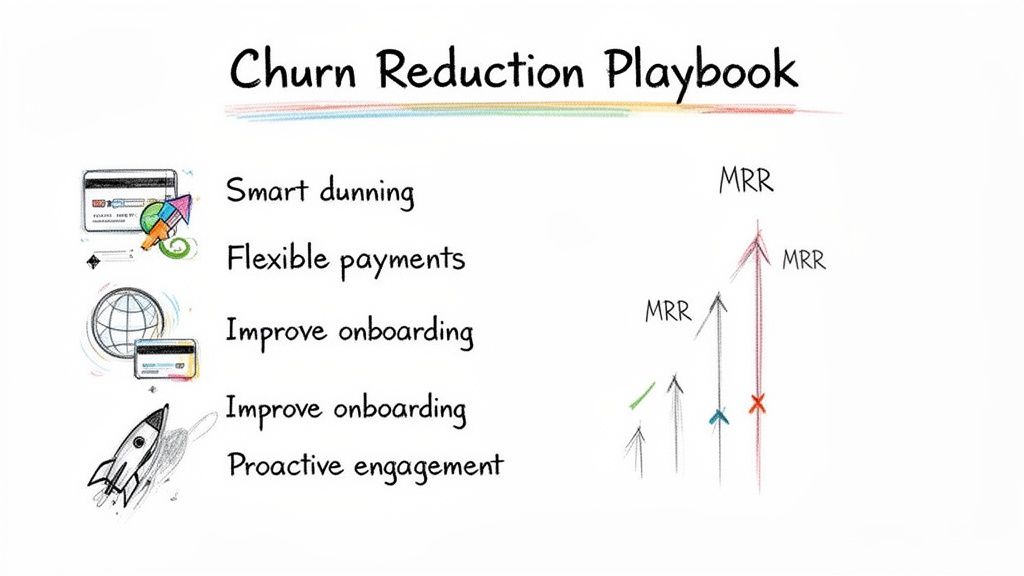
A proactive plan to cut churn is really about mixing smart tech with a genuine customer-first mindset.
Tackle Involuntary Churn at the Source
Involuntary churn is some of the lowest-hanging fruit you can pick. Why? Because it usually involves customers who are perfectly happy with your service. You're not trying to win them back, you're just fixing the technical glitch that's about to kick them out.
A huge chunk of this churn comes from failed payments. An expired card, a bank declining a cross-border transaction, or just insufficient funds can all trigger an automatic subscription cancellation. This is where a smart payment recovery process, known as dunning, is your best friend.
A well-implemented dunning strategy can recover up to 50% of failed recurring payments. Instead of immediately canceling a subscription, an automated system can retry the payment at intelligent intervals and send friendly notifications to the customer, giving them a chance to update their details.
If you’re interested in the mechanics, you can learn more about how the dunning process works in our detailed guide. It’s a seriously powerful tool for stopping revenue leaks.
Make Global Payments Effortless
For any SaaS business with customers around the world, payment friction is a massive churn driver. A customer in Germany trying to pay a business in the U.S. often runs into roadblocks. Their card might be declined by an overly cautious bank, or they might get hit with confusing currency conversion fees.
The solution is to make paying you as easy as possible, no matter where your customers are. This means you need a payment infrastructure built for a world without borders. A modern payment API that lets customers pay with their local card while your business receives a stable currency like USDC removes all that friction. It stops declines caused by cross-border flags and gives you a predictable revenue stream.
Here's how a modern payment system helps:
Accepts Global Cards: Ensures that major card networks are accepted without a hitch, regardless of the customer's location.
Simplifies Currency: Customers see a price they understand, and you receive funds without worrying about exchange rate volatility.
Reduces Declines: By processing payments through a global-native system, you bypass many of the legacy banking rules that cause international transactions to fail.
Refine Your Customer Onboarding and Support
Beyond payments, a customer's first few moments with your product are a huge factor in whether they stick around. A confusing or overwhelming onboarding process is a fast track to churn. New users need to hit that "aha!" moment quickly to really get the value your product delivers.
Keep refining your onboarding flow. Guide users to key features and celebrate their first small wins inside the platform. Make it intuitive, helpful, and focused on solving their core problem from day one.
And don't forget, your customer support is a critical retention tool. When users hit a snag, they expect fast, effective help. Slow response times or unresolved issues create frustration and completely erode trust. To get ahead of churn, implementing actionable SaaS customer support best practices is essential for keeping users in a competitive market. A great support system turns frustrated users into your most loyal advocates.
Proactively Engage and Gather Feedback
The final piece of the puzzle is to just listen. Don't wait for the cancellation email to find out a customer is unhappy.
Use your analytics to keep an eye on product usage and spot users whose activity has dropped off. A sudden decline in logins or feature usage is a huge red flag and an early warning sign of churn risk.
Reach out to these at-risk users proactively. A simple, personal email asking for feedback or offering help can often reignite their interest. By creating a continuous feedback loop through surveys, interviews, and support chats, you’ll gather the insights you need to build a product that customers can't imagine leaving. This approach turns churn analysis into a powerful engine for improving your entire product.
How Suby Helps You Fight Churn and Scale Globally
Knowing what causes your SaaS churn rates is one thing. Actually fixing it requires the right tools. It turns out, many of the most frustrating churn problems, especially involuntary churn, come from simple payment friction. That’s precisely where Suby comes in.
We built a straightforward, powerful solution to protect your revenue and help you scale internationally.
It all starts with a simple API and native integrations for platforms like Discord and Telegram that simplify your entire payment infrastructure. The system is built to erase the cross-border headaches that cause so many subscriptions to fail. Your customers can pay with their card or crypto, and you get stable USDC.
This unified flow is a direct attack on the root causes of payment-related churn.
Eliminating Cross-Border Payment Friction
Ever had a customer's payment fail for no good reason? It’s often because of old-school banking rules that automatically flag international transactions. A customer in Germany trying to buy from a US-based SaaS company might have their card declined, even with plenty of funds.
Suby was built to bypass this broken, outdated system.
Our payment layer is designed from the ground up for global, internet-native businesses. By handling transactions seamlessly across borders, we make sure your customers’ payments go through on the first try. This immediately cuts down on the involuntary churn that slowly bleeds your MRR. You can dive deeper into how modern payment models work in our post on being a Merchant of Record.
A Unified System for Predictable Revenue
Suby does more than just process payments. We give you a complete toolkit to manage subscriptions and community access all in one place. Whether you're selling a traditional SaaS plan or monetizing a private community while sidestepping the common mistakes that kill paid crypto communities, our system handles the entire subscription lifecycle.
The screenshot below from our documentation shows just how easy it is to create and manage subscriptions using our API.
This integrated approach lets you automate access, keep an eye on subscription health, and track revenue from a single, real-time dashboard. By simplifying the nuts and bolts of your operations, you get a much more predictable revenue stream.
This frees you up to focus on what you do best, improving your product and growing your user base, instead of chasing failed payments or wrestling with manual access lists.
Suby is engineered to give you a stable financial foundation. When you don't have to worry about payment declines, currency conversion, or payout delays, you can dedicate your resources to what matters most: building a product customers love and can't live without.
Common Questions About SaaS Churn
As you start digging into churn, a few common questions always seem to pop up. Let's tackle them head-on with some practical, no-fluff answers.
What Is a Good SaaS Churn Rate?
Everyone wants a single magic number, but the truth is, "good" depends entirely on who you're selling to.
For most B2B SaaS companies, an annual customer churn rate below 7% is a healthy target. But if your sweet spot is large enterprise clients, you should be aiming much lower, think 1-2% annually. Those contracts are gold. On the flip side, if you're serving the SMB market, a monthly churn of 3-5% is far more realistic and nothing to panic about.
The holy grail, of course, is negative MRR churn. This is the point where the extra revenue you're earning from existing customers (through upgrades, add-ons, etc.) is greater than the revenue you're losing from cancellations. When you hit that, your business isn't just surviving, it's thriving on its own momentum.
How Do I Know if Churn Is Voluntary or Involuntary?
The difference comes down to intent. Voluntary churn is an active decision. A customer isn't happy with the price, found a better tool, or just isn't getting value, so they deliberately cancel their subscription.
Involuntary churn is completely passive. The customer likely wanted to stay, but their payment failed. This could be anything from an expired credit card, insufficient funds, or a random bank decline. It’s a technical problem, not a satisfaction problem.
You can usually spot the difference by looking at how the subscription ended. Did the user log in and click the "cancel" button? That's voluntary. Did the subscription get suspended after a series of "payment failed" emails? That's involuntary.
A smart payment system is your best friend here. It can automatically tag cancellations as voluntary or involuntary, giving you a crystal-clear picture of why you're losing customers. That data is the foundation of any good retention plan.
Can a Better Payment System Really Lower My Churn Rate?
Yes, and it’s not even a small impact. It’s huge.
Industry data consistently shows that involuntary churn, all those pesky failed payments, accounts for a staggering 20-40% of a company's total churn. Think about that. You could be losing nearly half your customers to simple payment friction.
By switching to a modern payment system that automatically retries failed cards, offers local payment methods, and makes global transactions seamless, you can claw back a massive chunk of that otherwise lost revenue.
For any SaaS business selling internationally, this is non-negotiable. A system that lets your customers pay by card, while you get settled in a stable currency like USDC, is one of the most powerful levers you can pull to reduce churn. It quietly removes the cross-border friction that kills good customer relationships.
Suby is a payment gateway. Your customers pay with card, bank transfer, Apple Pay, Google Pay, Klarna, and more, or stablecoins. You get paid out to your bank account, or directly in stablecoins (USDC, EURC) to your wallet, anywhere in the world, no bank account required. Because those pay-ins clear on the first try and settle in a currency you control, Suby quietly kills the involuntary churn from failed and cross-border payments that silently drains your SaaS MRR.
