
Gaspard LEZIN
Unlock Global Sales: Payment Gateway International India
Simplify global sales with a payment gateway international India. Accept card payments & receive USDC settlements to grow your business effortlessly.
For Indian entrepreneurs and creators, going global feels like the ultimate goal. But once you start making sales, a frustrating reality hits: finding a payment gateway for international transactions in India that doesn’t silently drain your profits is incredibly difficult. The right setup can help you sidestep the old-school banking headaches and get paid from anywhere without the drama.
The Hidden Costs of Selling Globally From India
Taking your business to a worldwide audience is thrilling. You've nailed your product, your marketing is humming, but then you hit the biggest roadblock of all: actually getting your money. Accepting international payments from India is a whole different ballgame compared to simple domestic sales. Many founders learn this the hard way, finding themselves in a maze of costly and confusing obstacles.
Think about it, the traditional banking system, with networks like SWIFT, was designed decades ago. It just wasn't built for the speed of the internet economy. This mismatch often leads to maddening delays where your money vanishes into a black hole for days, making it impossible to manage your cash flow. A customer in the US might pay you on a Monday, but you might not see a single rupee in your account until the following week.
High Fees and Unpredictable Revenue
The real gut punch comes from the hidden fees that eat away at your revenue. Many traditional payment gateways lure you in with low advertised rates, but the true costs are buried in the fine print. These often include:
Currency Conversion Fees: When a customer pays in dollars and you need rupees, banks and processors take a hefty cut. These foreign exchange (FX) markups can easily slice 3-5% off your revenue on every single sale.
Wire Transfer Costs: Each international transfer can get hit with fixed fees from several intermediary banks along the way, shaving even more off your final payout.
Sudden Holds on Funds: It's not uncommon for these systems to freeze your funds for "risk assessment," cutting off access to your own money with no warning.
This toxic mix of fees and delays makes it nearly impossible to know how much you’ll actually pocket from a sale. You can learn more about how to avoid currency conversion fees in our detailed guide.
The biggest issue for global Indian businesses isn't just the fees you see, but the ones you don't. FX markups and settlement delays create a constant drag on growth, turning what should be simple transactions into complex operational burdens.
Ultimately, these challenges just create friction. Instead of focusing on your customers and growing your business, you're stuck wrestling with currency charts, chasing down missing payments, and trying to make sense of confusing bank statements. This is exactly the problem that modern payment solutions are designed to fix, giving you a clearer, more direct path to your hard-earned global revenue.
How Modern International Payments Actually Work
To get a real handle on how a modern payment gateway for international transactions in India cuts through the old frustrations, picture it as a universal adapter for money. Instead of the tangled, slow-moving chain of traditional banks, it carves out a direct, clean path from your customer’s wallet to yours.
Let's walk through what this actually looks like. The journey begins when your customer, sitting anywhere in the world, decides to buy your product or service. They hit your checkout, pull out their Visa or Mastercard, and pay just like they would on any other site. From their end, it's a completely normal, secure, and familiar experience. That's the first, and most critical, piece of the puzzle: keeping the customer's side of the transaction simple and trustworthy.
But behind the curtain, a completely different process kicks off. This is where the old, creaky banking system gets left behind.
The Shift from Banking Rails to Stablecoin Rails
Once that card payment gets the green light, a modern gateway doesn't send the money on a world tour through a maze of correspondent banks. Instead, it instantly converts the payment amount into a stablecoin like USDC, a digital currency pegged to the US dollar. This one move sidesteps nearly all the headaches of cross-border finance.
The common problems that this modern approach solves are exactly what holds so many businesses back.
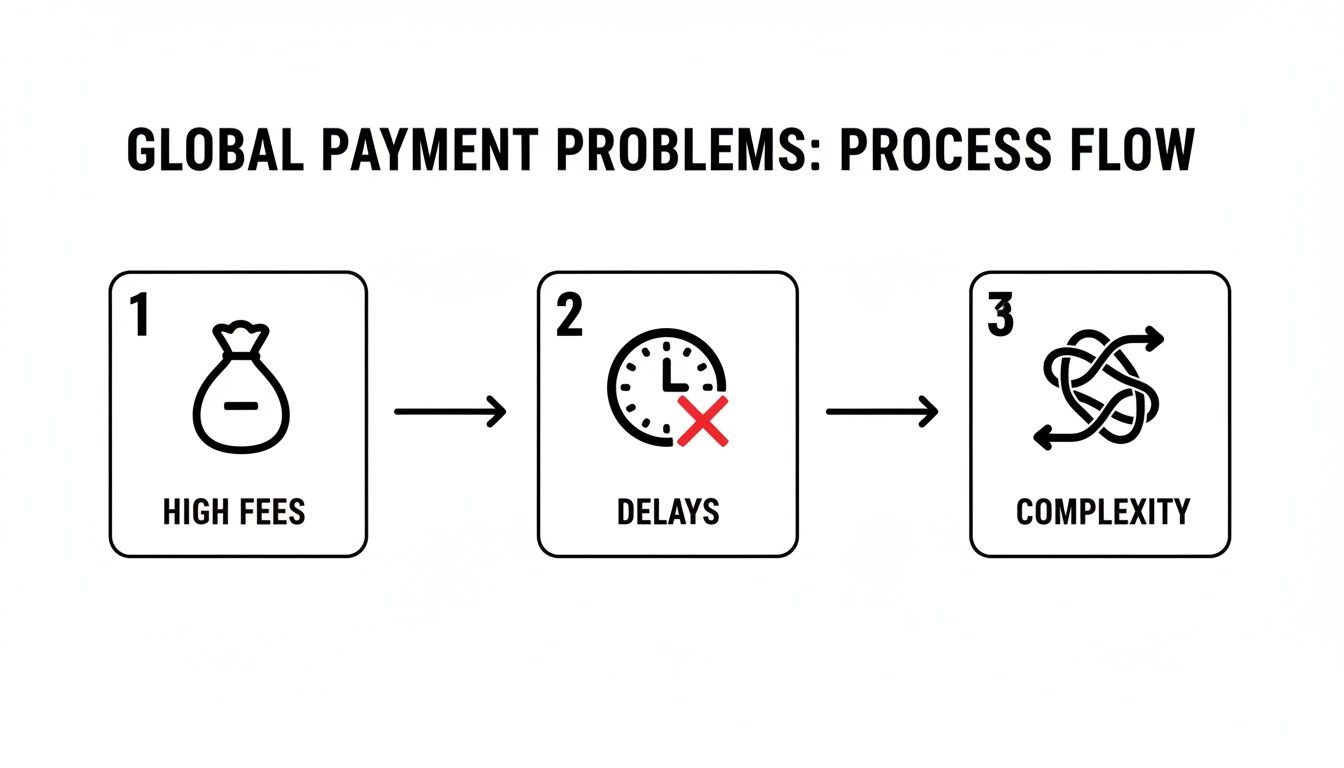
By moving the value on these new "stablecoin rails," the system bypasses the high fees, agonizing delays, and confusing complexity that have defined international payments for decades.
From there, the USDC settles directly into your business’s digital wallet. For Indian merchants, this is a game-changer. You receive funds pegged 1:1 to the US dollar, which shields your hard-earned revenue from unpredictable currency swings. The money is in your account almost instantly, not in a week.
Think of it this way: traditional payments send your money on a slow, winding road trip with multiple, expensive toll booths. A modern gateway puts your money on a high-speed bullet train, getting it straight to its destination on time and for a fraction of the cost.
The Power of Direct Settlement
The real beauty of this model is its simplicity. Platforms like Suby essentially act as that "universal adapter." Your customers pay with their cards, but the outcome for you is always the same: a lightning-fast, predictable settlement, paid out to your bank account, or in stablecoins (USDC, EURC) right to your wallet. Suby provides an API that allows any business to accept payments by card or crypto and receive USDC payouts.
This isn't just a niche solution; it's becoming essential. In 2024-25 alone, India recorded 9.7 million international tourist arrivals, generating over ₹3 trillion in spending. For the thousands of SaaS firms, agencies, and creators using a payment gateway for international transactions in India, those numbers represent a massive amount of revenue getting eaten up by legacy banking fees and delays. Suby’s model offers a direct fix, where users pay with cards and businesses receive funds instantly, to their bank account, or in stablecoins (USDC, EURC) to their wallet.
A modern payment system brings several massive advantages to the table:
Speed: Settlements are completed in minutes, not the typical 3-7 business days.
Transparency: You skip the hidden FX markups and intermediary bank fees that chip away at your bottom line.
Predictability: Getting paid in USDC means your revenue is stable and not at the mercy of a volatile currency market.
Of course, getting paid is only half the battle. You also need to manage that financial data. For example, knowing about connecting payment gateways like Stripe to accounting software can save you hours of reconciliation work. Suby streamlines this even further with a unified API for accepting payments and managing subscriptions, and even offers native integrations with Discord and Telegram for community monetization. To dive deeper, you can read more about what defines a modern payment gateway in our comprehensive article.
Navigating Indian Regulations for Global Payments
If you're an Indian business looking to accept payments from customers around the world, you've probably realized it's not as simple as just setting up a checkout page. The Indian government keeps a close eye on money flowing across its borders, and understanding these rules is the first, most critical step.
At the center of it all is the Foreign Exchange Management Act (FEMA), which is enforced by the Reserve Bank of India (RBI). Think of FEMA as the rulebook for all foreign currency transactions. It requires every international payment to pass through an Authorized Dealer (AD) Bank, which then reports the details to the authorities.
While these controls are in place for good reason, like national security and economic stability, they often create a lot of headaches for modern digital businesses. The paperwork, reporting, and multiple handoffs through the banking system are exactly what cause the delays and high fees you’re trying to escape.
The Problem with OPGSP Rules
To keep up with the boom in e-commerce, the RBI created specific guidelines for Online Payment Gateway Service Providers (OPGSP). These rules were meant to help Indian businesses get paid for their exports.
There's one rule in particular that causes a major bottleneck: any money you receive from abroad must be settled into your Indian bank account within a set period. This forces you right back into the traditional banking system, complete with its high currency conversion fees and frustrating settlement delays. It basically negates the benefits of using a modern payment solution in the first place.
The core challenge for every Indian merchant is this: How do you stay compliant with RBI rules without sacrificing the speed and cost-efficiency your global business needs to thrive? It feels like a forced trade-off.
A Modern, Compliant Way Forward
Thankfully, you don't have to choose between compliance and efficiency. A truly modern payment gateway for international transactions in India can give you the best of both worlds by rethinking how final settlement works.
Instead of navigating a maze of intermediary banks, a platform like Suby streamlines everything. Your customers pay with their credit or debit cards through a standard, secure checkout. That payment is then settled directly to your business wallet as USDC, a stablecoin pegged to the US dollar. This creates a clean, fully auditable transaction trail that satisfies reporting requirements without any of the usual banking friction. You can see how this stacks up against other models in our breakdown of choosing a Merchant of Record.
This approach also doubles down on security. Processing card payments means following the strict Payment Card Industry Data Security Standard (PCI-DSS). Suby is PCI-DSS Level 1 compliant, the highest level possible. This focus on security, combined with zero-fee refunds, fits perfectly with the RBI's own push toward tokenization by 2026. As the Indian payment gateway ecosystem evolves, this ensures you get the speed of stablecoin settlement while keeping customer data locked down tight.
Key Features Your Global Payment Gateway Must Have
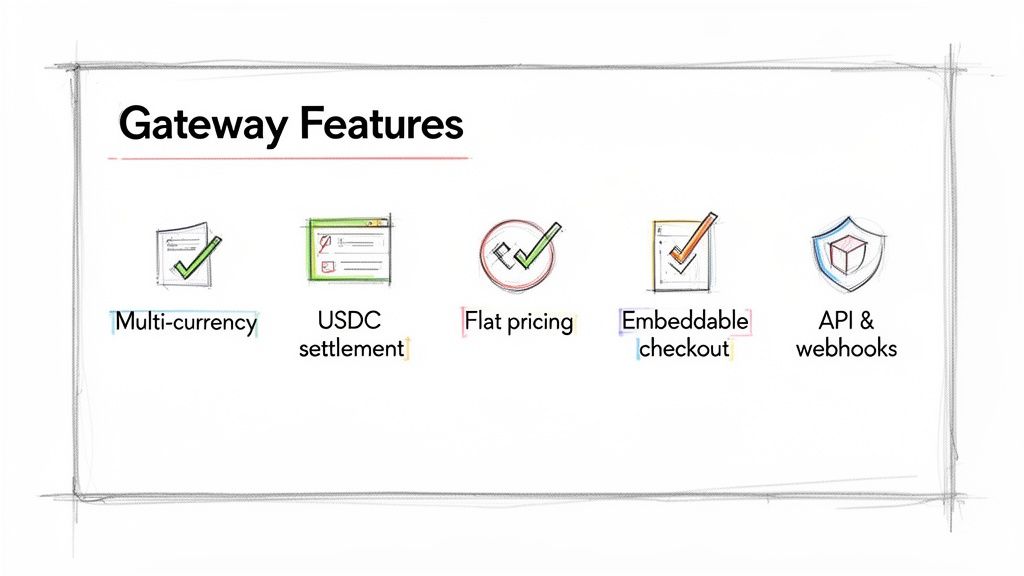
Picking the right payment gateway for international transactions in India is a make-or-break decision for your business. The right partner can open up a world of customers, while the wrong one can bury you in operational headaches and hidden fees. To cut through the noise, let's look at the features that genuinely move the needle.
Think of it this way: a gateway’s main job is getting you paid, but how it does that is what separates the good from the great. You need a solution that simplifies your finances, gives you control, and ensures your revenue is predictable. These aren't just nice-to-haves; they're essential for any Indian business looking to compete on the world stage.
Multi-Currency Support With Predictable Settlement
It's a given that your customers want to pay in their own currency, whether that's USD, Euros, or Pounds. Any gateway worth its salt can handle that. The real question is what happens after the customer clicks "pay." Traditional systems will convert that foreign currency into rupees, but often skim a hefty amount off the top through opaque foreign exchange (FX) markups.
This is where modern gateways completely change the game. Instead of leaving you at the mercy of fluctuating bank rates, a platform like Suby settles every single transaction into USDC, a stablecoin pegged 1:1 with the US dollar. This means you receive a stable, predictable digital dollar amount, no matter how the customer paid. Suddenly, currency volatility is no longer a factor in your revenue planning.
Simple, Transparent Pricing
Let's be honest, traditional gateway pricing is notoriously confusing. You'll see a low headline rate, but then get hit with extra charges for setup, international cards, currency conversions, and even dispute handling. This makes it nearly impossible to figure out your actual cost of accepting payments.
Your goal should be to find a provider with a dead-simple, flat-rate model. For instance, Suby offers a clear percentage that covers everything, with no setup fees or hidden charges. This kind of transparency means you know exactly what you’ll pay on every transaction, making your financial forecasting a whole lot easier.
A seamless checkout experience is crucial; it helps to reduce cart abandonment and turn visitors into paying customers. Surprise fees at the final step are a huge reason people click away.
Flexible Integration Methods for Every Business
Not every business has a team of developers on call. A top-tier payment gateway for international transactions in India should meet you where you are, offering multiple ways to get started, regardless of your technical expertise.
Here are the key integration options to look for:
Payment Links: This is the fastest way to get paid. You create a simple, shareable link that directs customers to a secure payment page. It’s perfect for freelancers, agencies, or anyone selling through social media or email.
Embeddable Checkouts: With just a few lines of code, you can place a pre-built, secure checkout form directly on your website. This gives your site a professional, native feel without needing a custom development project.
Full API and Webhooks: For businesses that need complete control, a powerful API is non-negotiable. It lets you build fully custom payment flows, integrate deeply with your CRM or other software, and automate everything from billing to account access.
Suby, for example, offers all three. You can begin with a simple paylink today and scale up to a full API integration as your business grows, all on the same platform.
Built-in Subscription and Community Management
For SaaS companies, creators, and service-based businesses, recurring revenue is the holy grail. Your payment gateway shouldn't just process payments; it should help you manage subscriptions. This means handling recurring billing cycles, managing trial periods, and automatically chasing down failed payments so you don't have to.
A truly forward-thinking platform also understands the creator economy. For instance, Suby comes with native integrations for Discord and Telegram. This powerful feature automatically grants or revokes access to your private groups based on a member's subscription status. It’s a huge time-saver that eliminates manual admin work and helps you monetize your audience with ease.
To really see the difference, let's compare the old way with the new way side-by-side.
Traditional vs Modern Payment Gateway Comparison for Indian Businesses
This table breaks down the key operational differences between a standard bank-based gateway and a modern solution like Suby that uses stablecoin settlement.
Feature | Traditional Gateway | Modern Gateway (e.g., Suby) |
|---|---|---|
Settlement Currency | Mandatory INR settlement | USDC (stablecoin) settlement, giving you a stable USD-pegged asset |
FX Conversion | Forced conversion with opaque bank markups (often 2-4% loss) | No forced FX conversion; you hold stable digital dollars |
Pricing Model | Complex tiered pricing with many hidden fees | Simple, transparent flat-rate pricing |
Integration | Often requires significant developer effort; limited no-code options | Flexible options: Payment Links, Embeddable Checkout, and full API |
Payout Speed | Typically T+3 to T+7 business days | Near-instant settlement to your digital wallet |
Recurring Billing | Basic subscription features, often as a paid add-on | Advanced subscription management with native community integrations |
As you can see, the choice impacts everything from your final take-home revenue to your team's day-to-day workload.
How to Start Accepting Global Payments in Minutes
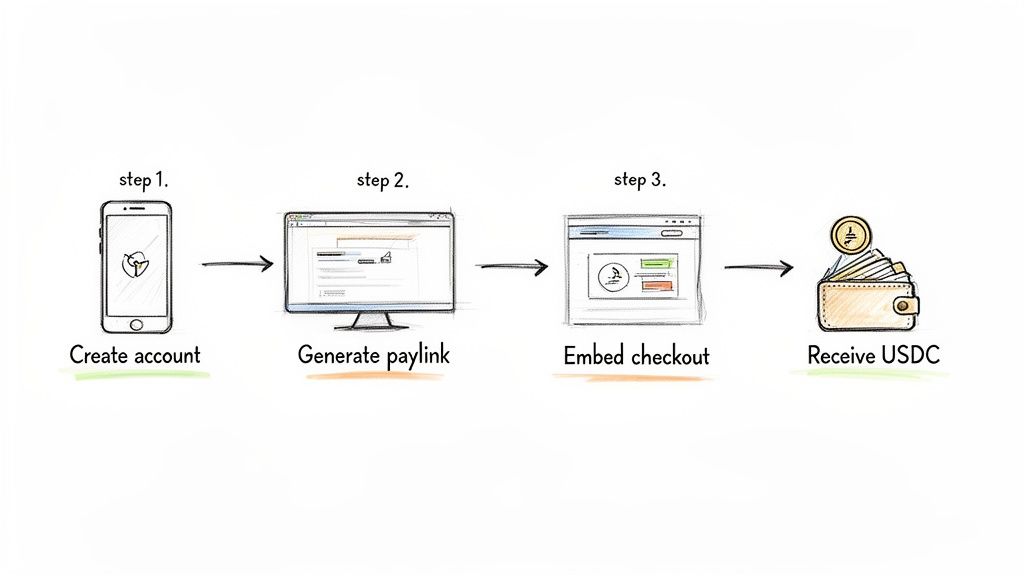
It’s one thing to understand how global payments work in theory, but putting it into practice is surprisingly simple. With a modern payment gateway for international transactions in India, you can go from sign-up to your first sale in just a few minutes. Gone are the days of needing complex banking relationships or a team of developers just to get your foot in the door.
Today's tools are built for speed and ease of use. The idea is to remove the friction, letting you concentrate on your business while the tech handles the heavy lifting of global finance. This means you can launch fast and start with simple, no-code solutions, then scale up to more advanced integrations when you're ready.
Your Fastest Path to Global Sales
For businesses eager to start selling right away, the process is incredibly straightforward. It boils down to a few quick steps that anyone can follow, no matter how technical they are. This is a huge shift from the old way of doing things.
Here’s the quickest way to get up and running:
Create Your Account: The first step is a quick sign-up. This gets you into your dashboard, which is your command center for everything.
Generate a Payment Link: Once you're in, you can create your first payment link in seconds. Just set an amount, give it a description, and the platform generates a unique, shareable URL.
Share and Get Paid: You can now send this link to clients in an email, on an invoice, or through a chat message. When they click, they land on a secure checkout page to pay with their card. The funds arrive in your wallet as USDC almost instantly.
This simple workflow is a lifesaver for freelancers, agencies, and creators who need a fast, reliable way to bill international clients without any hassle.
Scaling Up With Embedded Checkouts and an API
As your business grows, your payment needs will get more sophisticated. A good payment gateway should grow with you, offering more powerful tools to create a polished customer experience and automate your workflows.
The real power of a modern platform lies in its flexibility. You can start with a simple payment link today and implement a full API-driven subscription system tomorrow, all within the same ecosystem.
If you have a website, an embedded checkout is the natural next step. By copying and pasting just a few lines of code, you can add a sleek, high-converting payment form directly onto your site. This keeps customers on your domain, building trust and leading to more completed sales.
For those with development resources, the sky's the limit. A flexible solution with a clean API and webhooks lets you build completely custom payment flows, automate recurring subscriptions, or even manage access for digital communities. For example, Suby can automatically grant access to Discord and Telegram groups upon payment, which is perfect for monetizing memberships globally. You can see how all these features come together in the Suby payment layer.
The Future of Cross-Border Commerce in India
For any Indian business with customers abroad, getting paid has always been a source of frustration. The creator economy is booming, and Indian software and e-commerce brands are going global, yet the way money moves across borders feels stuck in the past. The future isn't just about making small tweaks; it's about a fundamental overhaul of how value travels internationally.
The solution lies in a clever combination of old and new. The next generation of payment systems is creating a hybrid model, one that pairs the payment methods everyone knows with the speed and efficiency of modern settlement technology. It’s a simple idea with powerful implications.
A Hybrid System for a Global Audience
Imagine this: your customer in New York or London pays you with their credit card, a process they know and trust. But instead of that money slowly making its way through a maze of correspondent banks, the payment is settled almost instantly using stablecoins.
This is a huge win for the Indian merchant. You receive the funds directly into your business wallet as USDC, a digital dollar. Here’s why that matters:
Your customer’s experience is seamless. They use their card just like any other online purchase.
You get paid faster and cheaper. Payouts are direct, cutting out the slow, expensive intermediaries and their hidden currency conversion fees.
Your revenue becomes predictable. By receiving a stable, dollar-pegged asset, you’re no longer at the mercy of day-to-day currency fluctuations.
The UPI Moment for International Trade
Think about how UPI completely changed the game for domestic payments in India. It created a single, incredibly simple standard that made sending money instant and virtually free. This shift was so profound that digital payments became the default for millions of people almost overnight. We're on the cusp of a similar revolution for international trade.
What Indian businesses need now is a UPI-like experience for cross-border commerce, a system that brings the same speed, low cost, and transparency to international payments that they've come to expect at home.
The market is already heading in this direction. India's payment gateway market was valued at USD 2.31 billion in 2026 and is on track to hit USD 4.01 billion by 2031. A big driver of this growth is the consumer expectation for instant, digital transactions, a standard set by UPI's success. You can dive deeper into these numbers in the India payment gateway market report.
This is exactly the problem platforms like Suby are built to solve. Suby gives businesses a powerful API to accept payments via card or crypto, but the merchant always gets settled in USDC. With integrations for communities on Discord and Telegram, it also directly serves the growing creator economy by automating things like subscriptions and access management. The tools for direct, fast, and honest value transfer are no longer just a concept, they're here and ready to use.
Frequently Asked Questions
If you're selling to customers outside of India, you've probably run into some questions about how to get paid efficiently. Let's tackle the most common ones and demystify how a modern payment gateway for international transactions in India really works.
What Is a Stablecoin Settlement and Why Should I Care?
Think of a stablecoin settlement as a modern-day wire transfer, but without the delays and high fees. When your customer pays with their card, a platform like Suby instantly converts that payment into USDC, a digital currency whose value is pegged 1:1 to the US dollar.
This matters for a couple of huge reasons. For one, it sidesteps the 3-5% currency conversion fees and poor exchange rates that traditional banks notoriously charge. It also means payouts are nearly instant, you get your money in minutes, not waiting for days on end.
Is It Safe to Accept Card Payments This Way?
This is a big one, and the short answer is yes, it's incredibly secure. Any company processing card payments must meet the strict Payment Card Industry Data Security Standard (PCI-DSS). This isn't optional; it's the global standard for protecting card data.
For example, Suby’s infrastructure is handled by a PCI-DSS Level 1 certified partner, which is the highest level of security available. This means every transaction is protected by the same rigorous standards used by major banks, so you can accept global payments with complete peace of mind.
Do I Need to Understand Crypto to Use This?
Not at all. In fact, you don't need to know a thing about crypto to use this system.
The entire process is designed to be seamless for you, the business owner. All the technical complexity happens behind the scenes. Your customer sees a familiar card checkout page, and you see USDC appear in your business wallet moments later. You get all the benefits of speed and low costs without any of the technical headaches.
The goal of a modern gateway is simple: make global commerce easy. Your customers pay with cards, and you receive stable, dollar-equivalent funds. It's built to be direct and straightforward, cutting out the usual friction.
How Does This Work With Indian Regulations?
This approach is built to be both efficient and compliant. Every card transaction leaves a clear, auditable digital trail, just like any other online payment. When you receive funds as USDC, you're holding a stable, dollar-denominated asset in your business wallet.
What this really does is bypass the slow, expensive traditional banking route, which often involves multiple intermediary banks and forced currency conversions at unfavorable rates. It gives you a direct, transparent way to manage your international revenue and puts you back in control of your funds.
What Is the Easiest Way to Get Started?
By far, the fastest way to start accepting international payments is with a simple payment link. With a platform like Suby, you can generate a unique, shareable link for any product or service in less than a minute.
Just send this link to your clients through email, a chat message, or on your invoice. When they click it, they land on a secure page to pay with their card. It’s a completely no-code solution that lets you start selling globally almost instantly. As you grow, you can easily move to an embeddable checkout or a full API for deeper integration.
Ready to accept global payments without the usual friction? Suby is a payment gateway and Merchant of Record. Your customers pay with card, bank transfer, Apple Pay, Google Pay, Klarna, and more, or stablecoins, and you get paid out to your bank account, or directly in stablecoins (USDC, EURC) to your wallet, anywhere in the world, no bank account required. For Indian businesses selling internationally, that means predictable, near-instant settlement without SWIFT delays, FX markups, or forced INR conversion.
