

Gaspard LEZIN
Why Do Founders Prefer Lemon Squeezy Over Stripe in 2026
Why do founders prefer lemon squeezy over stripe - Explore why do founders prefer Lemon Squeezy over Stripe for SaaS. Learn how they handle global tax
You've finished the product. The landing page is live, the trial flow works, and a few early users are ready to pay. Then you hit the decision every SaaS founder eventually hits. Do you use Stripe because it's the default, or do you choose Lemon Squeezy because it promises less operational drag?
That choice matters more than most founders expect. On paper, this looks like a fee comparison. In practice, it's a decision about how much time you want to spend building billing systems, dealing with tax obligations, and patching together tools that aren't core to your product.
The reason people keep searching why do founders prefer lemon squeezy over stripe isn't that Stripe is bad. It's that many small teams and solo founders don't need maximum flexibility on day one. They need to start charging customers quickly, sell internationally without getting buried in compliance work, and keep the business simple enough to run.
Table of Contents
What founders are really optimizing for
Why this comparison keeps coming up
What changes when you are the seller
Why Merchant of Record matters so much to founders
The hidden cost is cognitive load
The surface-level pricing
Where the effective cost changes
The founder math that usually matters more
When Stripe still wins on cost
What founders get without assembling a stack
A simple product-fit comparison
What works well, and what doesn't
Why onboarding speed affects more than convenience
Payouts and expansion are linked
What founders usually discover after launch
Where this approach differs
When a founder would consider this route
Is Lemon Squeezy still independent after the Stripe acquisition
Can you migrate from Stripe to Lemon Squeezy
When is Stripe still the better choice
Why do founders prefer Lemon Squeezy over Stripe
Is Lemon Squeezy always cheaper
The Founder's Crossroads Choosing a Payment Partner
A lot of founders arrive at this decision with the same mental model. Stripe is the serious option. Lemon Squeezy is the simpler option. That framing is incomplete.
For a bootstrapped SaaS, the primary question is usually this: do you want to assemble a payments stack, or do you want a system that already reflects how small software businesses sell? If your product is a subscription app, a digital download, a template library, or a lightweight B2B tool, that distinction changes everything.

Here's the side-by-side most founders care about early on:
Decision factor | Stripe | Lemon Squeezy |
|---|---|---|
Core model | Payment service provider | Merchant of Record |
Default posture | Build and configure | Launch and operate |
Tax responsibility | Stays with you | Shifted to Lemon Squeezy |
Best fit | Teams needing custom billing control | Founders selling digital products and SaaS fast |
Trade-off | More flexibility, more setup | Less flexibility, less admin |
The founders I've seen choose Lemon Squeezy usually aren't looking for abstract convenience. They're trying to avoid work that doesn't create customer value. Tax handling, dispute workflows, billing edge cases, receipts, and international compliance all matter. But none of those tasks improve the product.
What founders are really optimizing for
Early-stage teams rarely optimize for the lowest visible fee alone. They optimize for a mix of:
Speed to first revenue, because weeks spent on billing are weeks not spent improving activation.
Operational simplicity, because every extra tool means another failure point.
Lower legal and tax exposure, especially if customers can buy from different countries on day one.
Predictable effort, because small teams can absorb higher transaction costs more easily than recurring admin chaos.
Practical rule: If payments become a side project, they're already costing more than the dashboard fee suggests.
Why this comparison keeps coming up
Stripe still makes sense for many companies. It's powerful, mature, and customizable. But a lot of founders don't need a payments infrastructure company at the start. They need something closer to a business operations shortcut.
That's why Lemon Squeezy keeps winning this comparison for indies and smaller SaaS teams. It narrows the surface area of problems you need to own.
Merchant of Record vs Payment Processor Explained
The biggest difference between these platforms isn't the checkout design or even the pricing. It's the business model underneath.
Stripe is a payment service provider. Lemon Squeezy is a Merchant of Record. That sounds technical, but the practical meaning is simple. With Stripe, you're still the seller and the responsible party. With Lemon Squeezy, Lemon Squeezy takes on that seller role for the transaction.
What changes when you are the seller
When you use a payment processor, the platform helps move money. It doesn't remove the core responsibility from your business. If you sell software internationally, you still need to think about tax collection, tax remittance, jurisdiction rules, and the records that support all of that.
That's why this choice can't be reduced to “which checkout has lower fees.” It affects your legal and operational burden from day one.
A simple analogy helps. Using Stripe is like renting a strong cash register for your store. It's excellent at taking payments, but the store is still yours. The pricing, tax receipts, reporting, and compliance remain your problem. Using Lemon Squeezy is closer to having a retail partner sell the product on your behalf and send you the proceeds.
Why Merchant of Record matters so much to founders
Lemon Squeezy's Merchant of Record model covers 100+ countries and handles VAT, GST, and sales tax collection and remittance, which sharply reduces compliance overhead for SaaS founders selling globally, according to this Stripe vs Lemon Squeezy analysis from Design Revision. The same analysis notes a 1 to 2 day path to revenue for Lemon Squeezy versus weeks or months for Stripe compliance work in some setups.
That difference is easy to underestimate when you're reading feature pages. It becomes obvious when you're launching in public and customers come from countries you didn't initially plan for.
If you want a deeper conceptual breakdown of the legal model, this explanation of merchant of record for SaaS businesses is worth reading.
Most founders don't regret paying for less compliance work. They regret discovering too late that they owned more compliance than they thought.
The hidden cost is cognitive load
This is what often gets missed. The burden isn't just filing or integrations. It's context switching.
You might spend a morning improving onboarding, then an afternoon figuring out how taxes should appear on invoices for international buyers. That's not just annoying. It slows product learning. It makes launches feel heavier. It pushes growth tasks into the background.
For teams with in-house finance, legal support, or dedicated engineers, that may be acceptable. For a solo founder, it usually isn't.
Comparing Pricing and Effective Business Costs
The fee comparison is where most articles stop. That's also where most founders get misled.
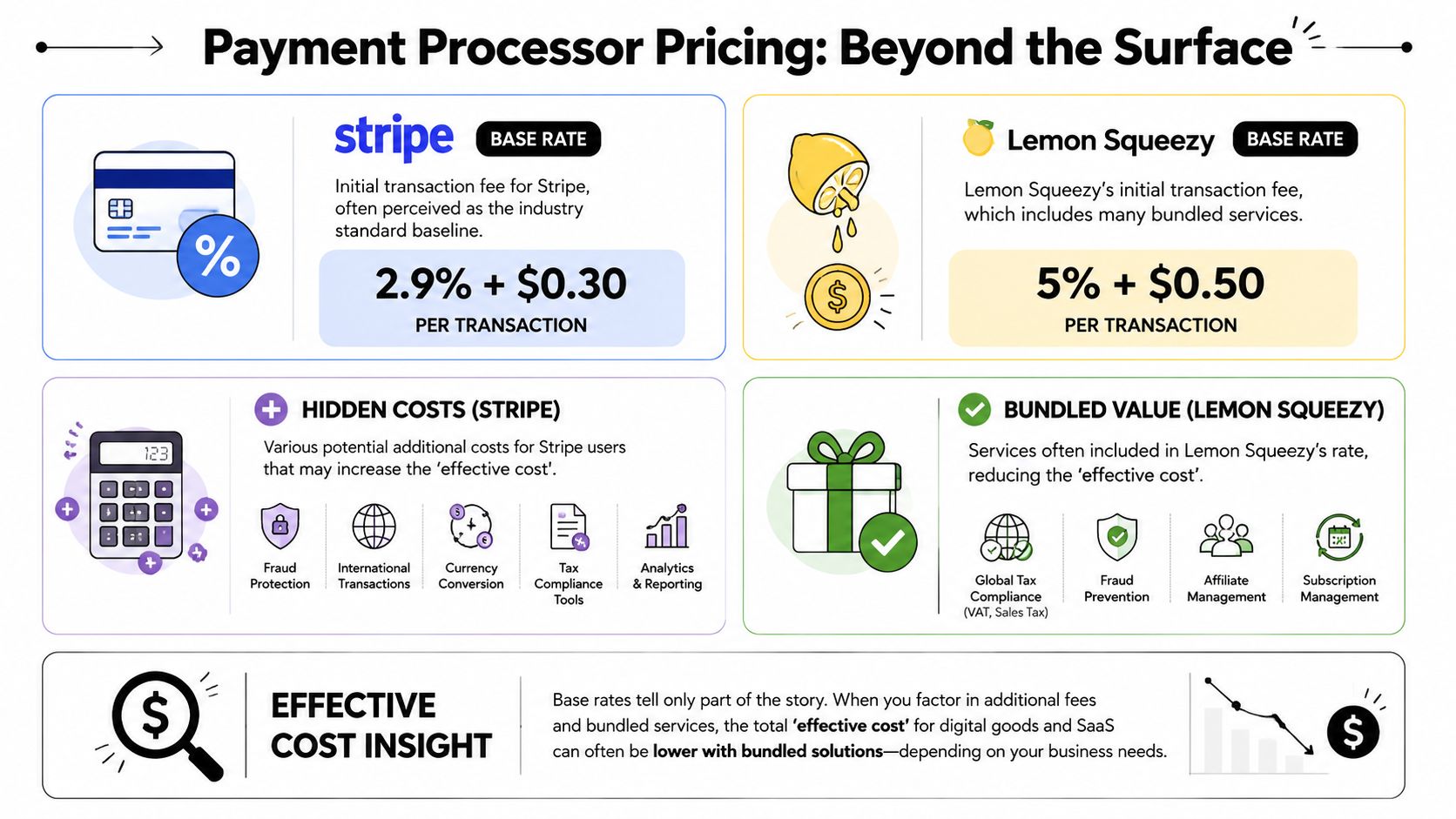
Stripe's base rate looks cheaper. Lemon Squeezy's rate looks more expensive. But the number on the pricing page isn't the same as the effective business cost of operating the system.
The surface-level pricing
Here's the visible pricing most founders compare first:
Platform | Published base pricing |
|---|---|
Stripe | 2.9% + $0.30 per transaction |
Lemon Squeezy | 5% + $0.50 per transaction |
On that view alone, Stripe looks like the obvious winner. But a global SaaS business doesn't run on base card processing alone.
Where the effective cost changes
According to 13Labs' Stripe vs Lemon Squeezy comparison, a SaaS business doing $10K monthly revenue across the US, EU, and APAC would pay around $550 with Lemon Squeezy versus about $320 on Stripe's base setup. On its own, that still favors Stripe.
The shift happens when you include the rest of the operating picture. The same comparison estimates Lemon Squeezy can save $800 to $1,200 per month in tax software, accountant fees, and audit risk, which can produce net savings of 20% to 40% for low-volume global sellers.
That's the part founders care about once they've run the numbers. The question stops being “which fee is lower?” and becomes “which system creates less total drag?”
The founder math that usually matters more
When I look at payment systems for an early SaaS, I care about three cost layers:
Visible transaction fees, the number everybody sees first
Tooling and admin overhead, the software and service stack needed to make the setup usable
Opportunity cost, the product work delayed because billing and compliance keep stealing attention
If your pricing model is still evolving, it also helps to think carefully about revenue structure before you choose tooling. This guide on pay-per-use versus subscription explained is useful because billing complexity often starts with the business model itself, not the payment provider.
For founders evaluating broader options beyond Stripe, this overview of an alternative to Stripe for recurring payments is also relevant because it frames the decision around operational fit, not just card processing.
Key takeaway: A platform with a higher listed fee can still be cheaper to run if it removes enough compliance work, third-party tools, and engineering time.
When Stripe still wins on cost
Stripe can absolutely be cheaper in the right context. If you sell mostly in one market, already have tax processes in place, or need deep billing customization, the lower base rate can translate into lower real cost.
But if you're small, global, and trying to stay lean, founders often choose Lemon Squeezy because the all-in structure is easier to budget and much easier to live with.
Product Fit for Digital Goods and SaaS Tooling
Stripe is infrastructure first. Lemon Squeezy is productized billing first. That distinction shapes the everyday experience more than most feature checklists show.
If you're building a marketplace, a layered platform, or a custom finance workflow, Stripe's flexibility is valuable. If you're selling software subscriptions, digital products, or simple access-based memberships, Lemon Squeezy often feels closer to what you wanted out of the box.

What founders get without assembling a stack
Lemon Squeezy is attractive because several SaaS-specific needs show up as built-in product features instead of separate implementation projects. That includes things like affiliate management and dunning.
Founders using Lemon Squeezy often report 3x faster time-to-revenue, specifically 1 day versus 1 week for Stripe Billing plus Zapier for affiliates and taxes, and they avoid an extra $200 to $500 per month in third-party tools because those SaaS-oriented features are already included, based on this PlanetNoCode benchmark and summary.
That matters because stacks grow gradually. A founder starts with Stripe, then adds billing logic, then affiliate tooling, then automation, then customer email flows. Each tool can be reasonable on its own. The overall system becomes harder to maintain than expected.
A simple product-fit comparison
Need | Stripe approach | Lemon Squeezy approach |
|---|---|---|
Subscription billing | Powerful but modular | Built for straightforward SaaS setups |
Affiliate workflows | Usually added through other tools | Native support |
Dunning and recovery | Available, but often part of a broader stack | Included in the product flow |
MVP speed | Slower if you need multiple integrations | Faster if your needs are standard |
What works well, and what doesn't
Lemon Squeezy works well when your commercial model is recognizable. Monthly or annual plans, digital goods, licenses, and light SaaS billing are where it feels natural.
It works less well if your billing logic is unusual. If you need highly custom invoice behavior, complex internal accounting flows, or payment experiences tightly integrated into a bespoke product UI, Stripe gives you more room to shape the system.
For founders trying to keep their financial records clean as the business matures, this accounting for SaaS guide is useful because payment setup and accounting quality tend to drift apart unless you design them together.
If you're specifically evaluating tools built around the same lightweight operator mindset, this list of Lemon Squeezy alternatives for SaaS founders gives a broader view of what “simple by default” can look like.
The strongest argument for Lemon Squeezy isn't that it has every feature. It's that many founders never need to build the missing ones.
Onboarding Payouts and Global Expansion Readiness
This is the part founders feel immediately, before they've even processed enough volume to care about optimization. How fast can you get live, and how much operational friction shows up in the first week?
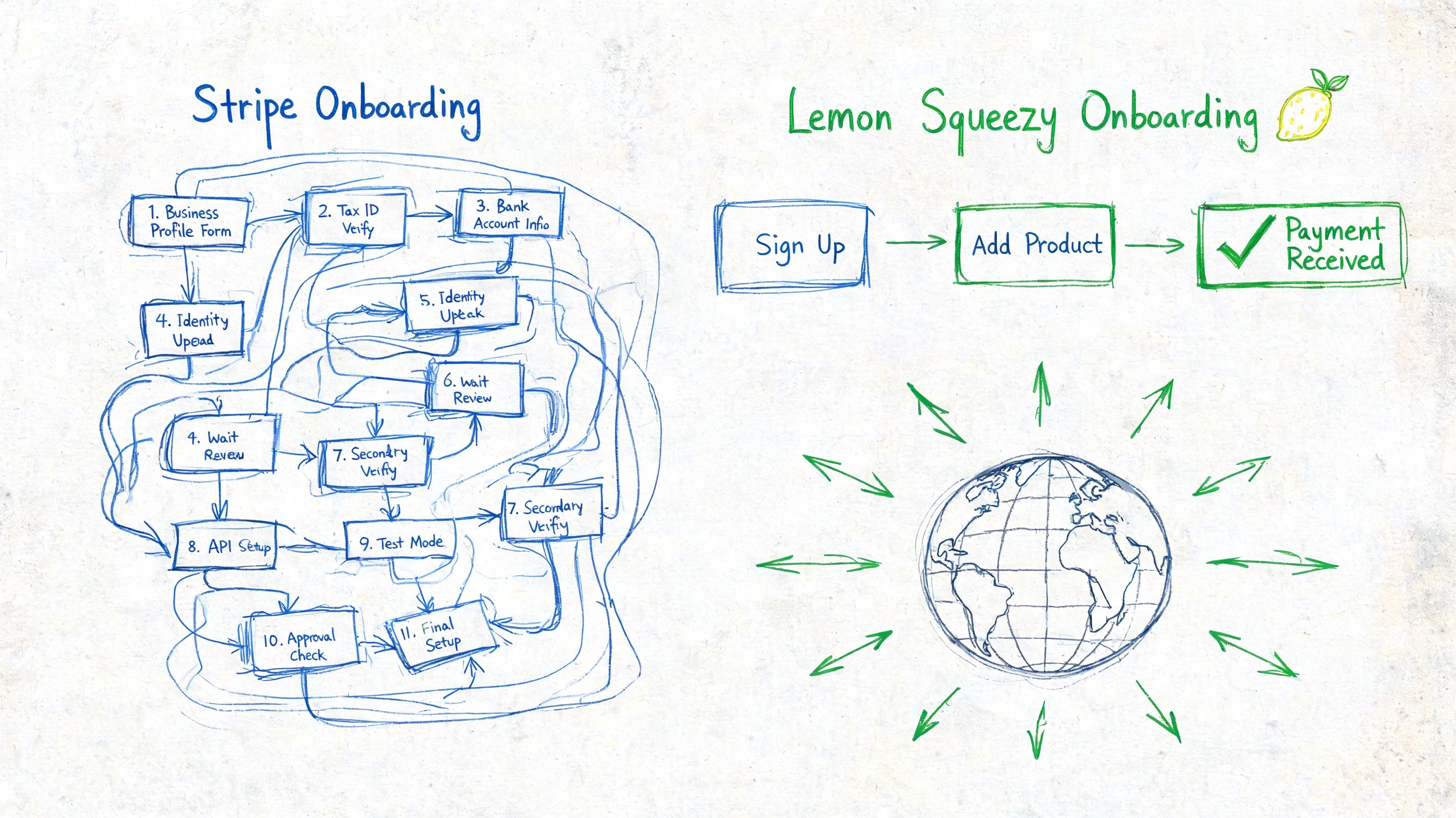
Lemon Squeezy tends to feel lighter during onboarding because the setup is closer to a packaged business workflow than a raw payments toolkit. That matters when you're launching a product with limited time, limited legal support, and customers spread across multiple regions.
Why onboarding speed affects more than convenience
Founders often treat onboarding as a minor setup detail. It's not. Faster setup changes how quickly you can test positioning, price points, activation flows, and retention.
With Lemon Squeezy, the practical promise is simple. You can start selling without first building out the support systems around global tax handling. Stripe can absolutely support businesses with complex operations, but getting from account creation to a globally comfortable setup usually asks more from the founder.
That extra work hits hardest when you're trying to validate demand. If billing setup stretches out, launch momentum fades. Product decisions wait on payment decisions. International expansion gets delayed by operations rather than customer demand.
Payouts and expansion are linked
Payouts are another area where founders make trade-offs, even if they don't phrase it that way. Some businesses care most about tight control and direct ownership of the flow. Others care more about reducing the administrative burden around cross-border sales.
A few practical questions help:
Where are your first customers located? If the answer is “all over the place,” simplicity matters more.
How custom is your billing logic? Standard SaaS plans benefit more from an all-in setup.
How much cash-flow predictability do you need? Founders should check payout timing carefully before committing.
Who owns compliance work internally? If the answer is “probably me,” that's a warning sign.
What founders usually discover after launch
The first international customer often exposes whether the system matches the business. If your stack works only as long as sales stay local and simple, it's not really launch-ready.
That's one reason founders lean toward Lemon Squeezy. It lowers the number of things that need to be figured out later, under pressure, when revenue is already flowing and changing the system gets harder.
Suby A Modern Alternative for Global Payments
Some founders look at Stripe and Lemon Squeezy and decide neither model fully matches how they want to run a global internet business. One is flexible but operationally heavier. The other is simpler but still follows a more traditional payout structure.
That's where newer options enter the conversation. Suby provides an API that lets businesses accept payments by card or crypto, while merchants receive USDC. It also offers native integrations with Discord and Telegram for subscriptions, paid access, and online communities. The core model is straightforward: users pay with cards, businesses receive USDC.
Where this approach differs
The practical distinction isn't just the checkout. It's settlement.
For founders who care about global access and predictable payouts, receiving revenue directly in USDC changes the operational picture. It reduces reliance on the usual mix of banking delays, payout uncertainty, and conversion friction that often shows up in cross-border payments.
This model fits internet-native businesses particularly well:
Creators and community businesses can charge members and automate access in Discord or Telegram.
SaaS teams can integrate payments through an API and webhooks without building around bank-based payout assumptions.
Global operators can accept card payments while standardizing settlement on USDC.
When a founder would consider this route
A founder usually looks at an option like this when the biggest frustration isn't just checkout setup. It's what happens after the payment clears.
If your buyers want to pay with familiar methods, but your business wants faster, clearer settlement in a single digital dollar balance, this is a different answer to the same underlying problem. It's not a direct replacement for every Stripe or Lemon Squeezy use case, but it is a relevant option for businesses that want card acceptance and USDC payouts in one system.
Frequently Asked Questions about Stripe and Lemon Squeezy
Is Lemon Squeezy still independent after the Stripe acquisition
Yes. The commonly cited position is that Stripe acquired Lemon Squeezy in 2024, while Lemon Squeezy continues operating independently and keeps its simpler Merchant of Record approach. For founders, the practical takeaway is that the core reason people choose it hasn't disappeared.
Can you migrate from Stripe to Lemon Squeezy
Yes, but the real question is how painful the migration will be for your specific billing setup. If you have a simple product catalog and straightforward subscriptions, migration is manageable. If you've built a lot of custom billing logic around Stripe, the migration becomes more of a product and operations project than a simple switch.
When is Stripe still the better choice
Stripe is still the stronger option when you need deep customization, highly specific billing behavior, or infrastructure flexibility that goes beyond standard SaaS subscriptions and digital product sales.
That usually applies to teams building complex platforms, custom financial workflows, or payment experiences that need to be tightly embedded into the product.
Choose Stripe when custom control is a competitive advantage. Choose Lemon Squeezy when operational simplicity is.
Why do founders prefer Lemon Squeezy over Stripe
In plain terms, founders prefer Lemon Squeezy when they want fewer moving parts. The attraction is not ideology. It's workload reduction.
They want to sell internationally without taking on tax complexity. They want built-in SaaS tooling instead of assembling it themselves. They want to reach first revenue quickly and spend their best hours on product, not payment operations.
Is Lemon Squeezy always cheaper
Not always. If you only compare the base transaction fee, no. If you compare the total cost of running a global, lean SaaS setup, often yes. The answer depends on where your customers are, how custom your billing needs are, and whether your team can absorb compliance and integration work internally.
If you're comparing payment systems because you want less operational drag, it's worth looking beyond the standard Stripe versus Lemon Squeezy framing. Suby is a payment gateway and payment processor. Your customers pay with card, bank transfer, Apple Pay, Google Pay, Klarna, and more, or stablecoins, and you get paid out to your bank account, or directly in stablecoins (USDC, EURC) to your wallet, anywhere in the world, no bank account required. It supports paylinks, embedded checkout, an API, and native Discord and Telegram integrations for subscriptions and paid access. For a founder whose real frustration is what happens after checkout, that settlement model answers a question neither Stripe nor Lemon Squeezy fully solves.
