

Gaspard LEZIN
Invoicing a Client: Steps, Templates, and Best Practices
Practical invoicing a client guide with ready-to-use templates, payment options, and follow-up tips for freelancers and small businesses worldwide.
You finished the work on Friday, sent a cheerful completion message, and the client replied with three words that stall everything. "Send the invoice." You open last month's file, change the date and total, export a PDF, and hope accounts payable in another country can use it. That hope is where late payments, rejected documents, and awkward follow-up emails usually begin.
Table of Contents
What a Client Invoice Actually Has to Do
A freelancer in Lisbon finishes a brand project for a company in Toronto. She emails a neat PDF with her logo, the total, and bank details in euros. The client likes the work, but finance needs a purchase order reference, a different legal entity name, and tax treatment she hasn't shown. She resends it twice, misses a payment run, and gets paid long after the deadline on the document.
Nothing dramatic went wrong. The invoice failed at one of its two separate jobs, so the other job couldn't happen either.
The legal record comes first
An invoice is a tax and accounting record. It identifies who supplied what, to whom, when, and for how much, including tax and currency. If a client's system can't accept that record, the payment process may never start, however willing the client is.
That record also protects you. If a client later questions scope, price, or delivery, the invoice connects the amount to a contract, milestone, and dated itemized description.
The payment request comes second
The second job is cash collection. Due dates, payment methods, account details, and payment links belong here. A client might accept your legal document and still pay late because the only payment route you offered requires an unfamiliar international transfer, manual data entry, or approval from someone else.
Treat format, tax details, and payment rails as three separate decisions. Getting one right doesn't fix the others.
Late payment isn't a rare administrative annoyance. The European Commission reported that 5 out of every 10 invoices were paid late, with small and medium-sized enterprises affected more than large companies, in its European Commission late payment analysis. The same analysis estimated that in 2017, 10% of commercial invoices worldwide were not paid on time or were written off as bad debt, based on that same Commission analysis.
Those figures explain why invoicing a client is a cash-flow control, not clerical cleanup after the work. You need a document the client can book, and a route the client can pay through, without either side improvising the missing details.
There's also a timing trap. For international work, the client can pay on the stated date while usable funds reach you later because of the payment method or settlement currency. Your invoice should therefore make three things unmistakable: what is owed, when it's owed, and how payment can be completed.
Anatomy of a Professional Invoice
Audit your template field by field. If accounts payable has to email you for any item below, your invoice isn't finished yet, even if it looks beautifully designed.
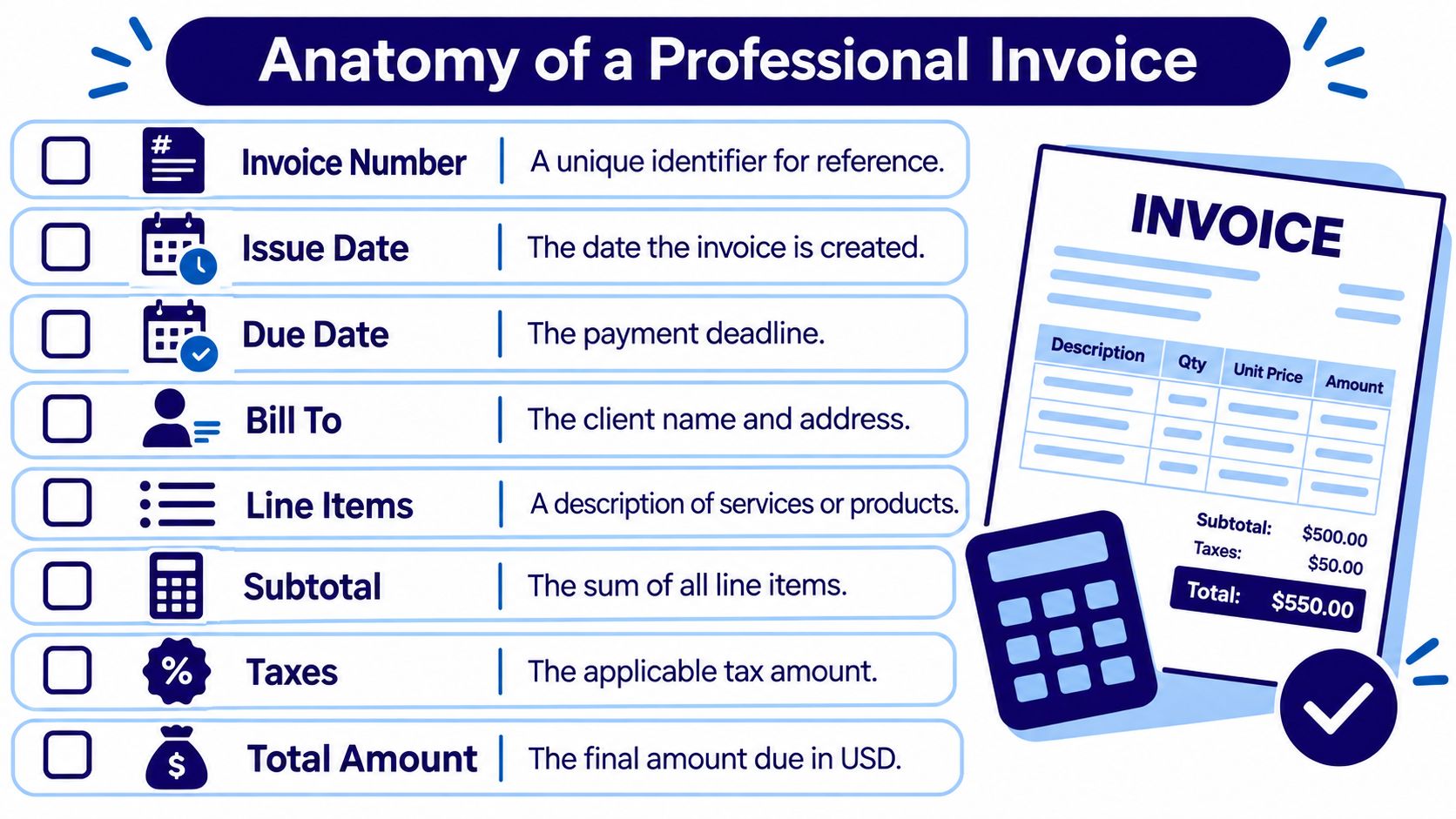
Identification and parties
Invoice number: Use one unique, sequential number that you never reuse, even for a corrected invoice.
Issue date and due date: Show both dates in full. Don't make the client calculate the deadline.
Supplier details: Include your legal name, address, tax or registration number where required, email, and billing contact.
Client details: Use the client's exact legal entity, billing address, tax number where required, and named accounts payable contact.
Contract reference: Add the purchase order, contract, project, or milestone reference exactly as the client supplied it.
Small errors here cause disproportionate delays. A trading name instead of the registered company name, or an invoice sent to your project contact instead of accounts payable, can sit untouched for weeks. Regional requirements also vary, so local guidance such as these invoice best practices for Irish companies is useful when you're checking an Irish client's expectations against your own template.
Line items, tax, and totals
Describe each item so a finance person who never attended a project meeting can understand it. "Consulting" is too vague. "Onboarding flow redesign, milestone 2, 12 hours at the agreed hourly rate" gives them something they can match to the agreement.
Show quantity or hours, unit price, line total, subtotal, tax, discounts if any, currency, and total due. If tax isn't charged, state the treatment your situation requires rather than leaving a silent blank. Validate the recipient and tax treatment before sending, because correcting tax after issuance is slower than confirming it during onboarding.
For cross-border work, put the currency beside every total, not only in small print. Write an explicit calendar deadline such as "Due 15 June 2026" instead of relying only on "Net 30," and clarify the date convention or time zone when that could affect payment processing.
Payment instructions and disputed items
End with accepted payment methods, the payment link or account details, the reference the client must include, and any late payment terms already agreed in the contract. Don't introduce new penalties for the first time on the invoice.
Practical rule: Separate disputed line items from undisputed amounts so the client can pay the agreed portion while you resolve the disputed portion.
That separation matters. One questioned expense shouldn't block payment for an entire month of undisputed work.
Payment Options and Currencies to Offer Clients
Clients don't delay every invoice because they can't afford it. Sometimes your only payment option asks them to leave their normal workflow, pay unfamiliar fees, or get approval for a new supplier payment route. Convenience isn't cosmetic. It's part of your collection system.
Compare the trade-offs honestly
Method | Typical settlement | Main trade-off | Best fit |
|---|---|---|---|
Card | Fast authorization, settlement depends on provider | Fees and possible disputes or chargebacks | Clients who need a simple one-click route |
Apple Pay or Google Pay | Card-based settlement | Depends on device and wallet support | Mobile approvals and smaller invoices |
SEPA or ACH bank transfer | Bank processing times vary by route | Less instant, more manual reference matching | Domestic or regional clients with established bank workflows |
International wire | Can involve intermediary processing | Fees, exchange conversion, and incomplete references | Larger clients whose finance teams require bank payment |
USDC or USDT | Wallet settlement after network confirmation | Client needs crypto capability and correct wallet details | Crypto-native clients and suppliers who want stablecoin settlement |
EURC settlement | Wallet settlement after network confirmation | Availability depends on the client's payment setup | Businesses that prefer euro-linked stablecoin receipts |
Don't present every option with equal weight if one creates reconciliation work for you. Offer a short, tested set that covers your clients' normal habits. For many international service businesses, card and bank transfer cover conventional finance teams, while stablecoins serve clients that already operate with wallets.
Separate the pay rail from settlement
The client's payment method doesn't have to dictate what lands in your account. A client can pay by card while you settle to a bank account, or pay through a conventional route while you receive USDC. That's the practical logic behind paying an invoice by card with flexible settlement: customers pay any way they want, businesses get paid the way they choose.
Choose the invoice currency in the contract, not at the moment you're desperate to issue the bill. Invoice in the currency used to price the work, unless you've agreed who carries conversion costs and exchange-rate movement. If you price in USD but spend in EUR, decide whether you'll receive USD, convert on settlement, or settle in a stablecoin and convert later according to your own treasury routine.
Ask these questions before work begins:
Who pays transfer or conversion fees: State it plainly so the received amount matches the invoice.
Which entity pays: Match payer identity to the client named on the invoice for reconciliation.
What reference is required: Give one short reference and repeat it in the payment instructions.
What counts as paid: Define whether payment is complete when sent, authorized, or received as usable funds.
Fees also belong in this decision, and they vary by method. Current published figures list cards and wallets at 2.9% plus $0.30 per transaction and crypto at 1.5%, so check the current per-method pricing page before you quote an all-in price or decide who absorbs payment costs.
How to Create and Send the Invoice
Build the invoice from the agreement, not from memory. Pull the client legal name, billing contact, tax details, purchase order, milestone, agreed rate, and currency into one record before you touch the template. Most "client problems" I've seen were really source-data problems created during onboarding.

A controlled invoice-to-cash workflow
Issue the invoice immediately after the contractual milestone, delivery, or billing date. Waiting until month end may suit your admin schedule, but it can push you past the client's payment run and add needless aging.
Check the arithmetic and tax lines, then confirm you're sending it to the right person or accounts payable mailbox. Attach or link any required supporting evidence, such as a timesheet, delivery note, acceptance message, or expense receipt, based on what the client agreed to require.
Use a subject line that survives inbox search, such as "Invoice 1042, project name, amount, due date." In the message, name the milestone, restate the total and deadline, and point to the payment route. Ask for confirmation of receipt, then record that confirmation in the invoice record.
Pick the delivery channel for the client
One client may need a branded PDF for its procurement file. Another may pay fastest from a hosted payment link. A SaaS business may prefer an embedded flow. Those are delivery choices, not reasons to rebuild your billing record each time, and reusable formats from a set of practical invoicing templates can keep the underlying fields consistent.
Specialized billing shows why context matters. Landlords and property operators, for example, have different documentation duties, as illustrated by these Ontario tenant utility invoicing rules. The lesson transfers to services: the document must fit the transaction, not just your preferred software.
Send the invoice through the channel the payer actually processes, then keep your own record in one consistent system.
Suby fits as one option. It's a single product with four uses: Suby Payments is an API-first payment stack for accepting cards and crypto through one checkout, Suby Crypto is a crypto payment gateway that handles the swap, sponsors the gas, and settles to a non-custodial wallet or the balance, Suby Gating provides paid access for Discord, Telegram, downloads, and courses, and Suby Invoicing lets a client choose how to pay while the business chooses how to receive funds. It provides an API for accepting card or crypto payments, plus native Discord and Telegram integrations for subscriptions, paid access, and online communities.
In an invoicing flow, that means one client can pay by Visa, Mastercard, Apple Pay, Google Pay, SEPA, ACH, USDC, or USDT, while you settle to a bank account in USD, EUR, GBP, AED, or MXN, or to a non-custodial wallet in USDC or EURC, as described in the invoicing product documentation. The useful example is ordinary: your client pays by card, and you receive USDC because that's where you want the funds.
After sending, don't mark the job done. Store the issued invoice, receipt confirmation, supporting documents, and later deposit record together so reconciliation doesn't depend on searching old email threads.
Tracking Payment and Following Up on Overdue Invoices
"Sent" is the weakest status in accounts receivable. It tells you a file left your outbox. It doesn't tell you the invoice was accepted, scheduled, disputed, or paid, and those distinctions decide your next action.
The sequence below turns follow-up into a record-driven process rather than a series of apologetic emails you draft from scratch.

Build the reminder sequence before you need it
At issuance: Confirm the correct recipient received and can process the invoice.
Several days before the deadline: Send a courtesy reminder with the invoice number, amount, due date, and payment options.
On the due date: Confirm whether payment has been scheduled and ask for the expected settlement date.
Immediately after delinquency: Escalate with the outstanding amount, original terms, and one specific resolution date.
After a promise: Record the named person, promised date, and amount. A verbal "soon" isn't a commitment.
Every message should make payment easy to complete. Reattach or relink the invoice, repeat the reference, and separate any disputed amount from the amount that can be paid now. If the client says a detail is wrong, log the dispute, issue any correction through your proper process, and restart the clock transparently.
The cost of leaving this unstructured is measurable. The EU Payment Observatory found that 52% of European companies reported problems caused by late payments in 2024 and companies spent an average of 9.85 hours per week chasing late payments, according to the EU Payment Observatory 2025 summary. Longer terms don't solve that burden by themselves, especially when longer contractual terms are associated with longer actual payment periods.
Before offering generous terms, assess creditworthiness and cash-flow impact. Use deposits or milestone billing for high-value work, set an overdue exposure limit, and decide in advance when you'll pause additional work. It's easier to enforce a limit you documented at signing than to invent one during a tense call.
For a visual walkthrough of payment follow-up habits, this video adds another practical view before you set your own cadence.
Measure whether collection is improving
Track invoice aging, days sales outstanding, percentage paid on time, dispute rate, average days to resolve disputes, and overdue value as a percentage of receivables. Review them on a fixed cadence, not only when cash feels tight. Broader practices in these Allied Tax Advisors AR management tips can help you connect invoice follow-up with the rest of your receivables process.
Close the loop by matching each receipt to the invoice and investigating short payments, bank deductions, or currency differences immediately. A disciplined approach to payment reconciliation and invoice matching keeps a client from being chased for money they've already sent.
Retain the full audit trail. The IRS identifies invoices, paid bills, receipts, deposit slips, and canceled checks as supporting business records in its IRS recordkeeping guidance for supporting documents.
International Clients, Compliance, and E-Invoicing
A readable PDF isn't always a legally usable invoice. That's the uncomfortable gap in many templates: they show a human the right fields, but they don't provide the structured data a tax authority, procurement platform, or accounting system may require.
Germany required all businesses to be able to receive compliant structured e-invoices from January 1, 2025, with sending obligations phased in through 2027 to 2028, according to the EY e-invoicing update for August 2025. Malaysia also expanded its mandate during 2025 and requires central validation, including for exports, based on that same update.
A client being able to pay you doesn't prove their system can legally accept your invoice.
Before issuing, confirm the buyer's jurisdiction, transaction type, VAT or GST status, required invoice format, validation route, correction process, and retention requirements. Ask directly whether an ordinary PDF is acceptable or whether they need a structured e-invoice generated or transmitted in a specific format.
Keep a cross-border checklist with the client record:
Currency and exchange-rate treatment: Record what was agreed before delivery.
Bank fees and payer identity: Prevent unexplained short payments and mismatched receipts.
Exact settlement route: Confirm account or wallet destination through a trusted channel.
Correction workflow: Know whether you cancel, credit, or reissue when a field is wrong.
Retention period: Keep the invoice and supporting evidence where both finance and tax reviewers can find them.
This takes minutes during onboarding. It can save weeks after delivery, when the work is complete and your negotiating power is weaker.
Putting It All Together
Use one checklist for every client. Confirm the legal entity, tax treatment, required format, purchase order, itemized scope, currency, explicit due date, payment reference, and accepted payment methods before the first invoice goes out.
Record the agreed terms, deposit or milestone structure, overdue limit, and reminder sequence in the contract and invoice record. Then measure acceptance, on-time payment, disputes, and reconciliation, not just whether you clicked send.
Make one decision today: choose your default client payment options and your preferred settlement destinations. Check method-specific fees before pricing the work, because there's no single rate that fits every rail.
If your clients are spread across countries, Suby lets them pay invoices by card, bank transfer, wallet, or crypto while you choose bank or stablecoin settlement in the currency that fits your business. Set up your next invoice with clear fields, an explicit due date, and a payment route your client can complete without another round of emails.
