
Gaspard LEZIN
Top 12 Digital Products to Sell Online in 2026
Discover the 12 best digital products to sell online. This guide covers courses, SaaS, templates, and more for global creators and businesses.
The creator and entrepreneur economy is expanding globally, but traditional payment systems often create unnecessary friction. Selling digital products online allows you to reach a worldwide audience without managing physical inventory or complex shipping logistics. However, accepting payments from international customers can be complicated, involving high currency conversion fees, banking delays, and payout uncertainty.
This guide explores 12 powerful digital products to sell online, providing a clear roadmap for creating, marketing, and monetizing your ideas. We will focus on practical models that work for a global customer base, especially when paired with modern payment solutions. Each item in this listicle includes specific details on monetization, pricing strategies, and distribution channels.
For businesses looking to operate internationally, accepting payments should not be a bottleneck. This article will show you how to structure your product offerings for a worldwide audience. We will also cover how an API-driven payment layer can simplify your operations. With the right tools, you can accept card payments from customers anywhere in the world and receive settlements directly in USDC. This removes the friction of traditional banking, allowing you to focus on building great products.
Furthermore, we will discuss how to automate access for your customers. For example, native integrations with platforms like Discord and Telegram can automatically grant access to private communities or channels upon successful payment for a subscription. This guide is built to be an actionable resource, giving you the specific strategies needed to build and scale your digital business across borders. Let’s explore the products that can unlock your global potential.
1. Online Courses and Educational Content
Creating and selling online courses is one of the most effective digital products to sell online because it packages your expertise into a scalable asset. These structured learning programs can range from short video tutorials on a specific skill to complete certification courses, offering immense value to students worldwide. Platforms like Udemy and MasterClass have shown the massive demand for accessible, high-quality education.
This model allows you to generate revenue from knowledge you already possess. For example, a graphic designer can create a course on logo design, or a financial consultant can build a program about personal budgeting. The initial time investment in content creation pays off as the course can be sold repeatedly with minimal ongoing effort.
Monetization and Distribution
Pricing: Offer tiered access, such as a Basic tier for core video content, a Premium tier with downloadable resources and community access, and a Lifetime Access option for a higher one-time fee. This strategy caters to different budget levels.
Payment: Use simple paylinks to sell access directly through social media or your website, bypassing the need for a complex platform. You can accept traditional card payments from customers, and you receive your earnings settled in USDC for stability.
Community: Enhance your course by integrating a paid Discord or Telegram community. This builds a cohort-based experience where students can interact, ask questions, and learn together, which you can automate with subscription management tools.
2. Software-as-a-Service (SaaS) Applications
Building a Software-as-a-Service (SaaS) application is a powerful way to create a scalable digital product that solves a specific business or consumer problem. These cloud-based tools are delivered via a subscription model, generating predictable recurring revenue from monthly or annual fees. Because they are entirely digital, SaaS products can serve a global customer base without the complexities of physical inventory or shipping.
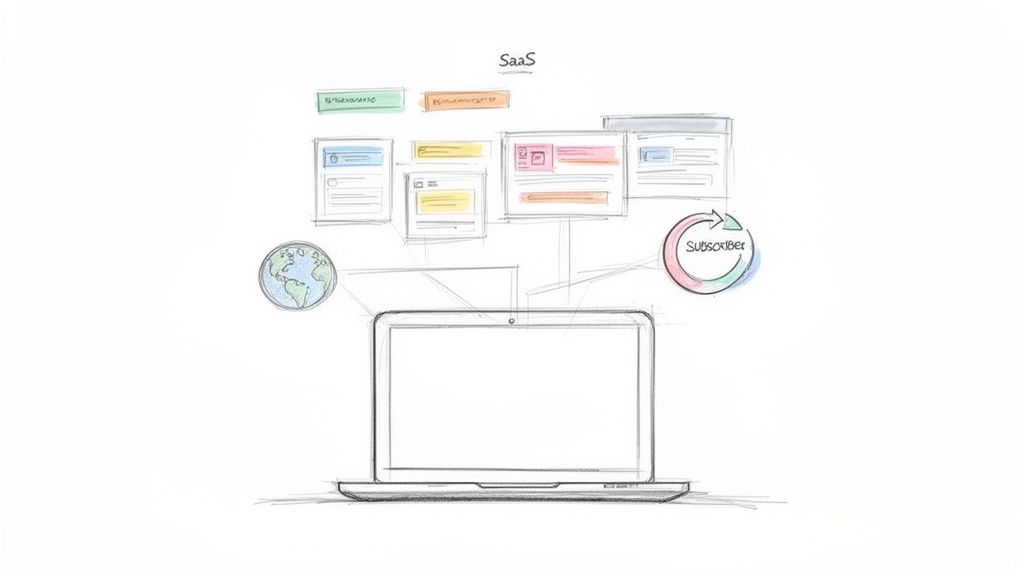
The key to a successful SaaS is starting with a focused solution for a niche audience before expanding. For example, a simple scheduling tool like Calendly or a productivity workspace like Notion both started by addressing a clear pain point. This approach makes SaaS one of the most sustainable digital products to sell online, as customer value grows over time.
Monetization and Distribution
Pricing: Structure your pricing with distinct tiers. A Starter tier could offer core features for individuals, a Pro tier might add collaboration tools for teams, and an Enterprise plan can provide advanced security and support. Offering a free trial is a proven way to lower the barrier for new users to try your software.
Payment: Our payment API allows you to accept global card payments for your subscriptions, with funds settled directly to you in USDC. This model simplifies international sales and financial management.
Automation: Integrate a webhook system to automate the entire subscription lifecycle, from activation and renewals to cancellations and failed payment notifications. This reduces manual overhead and ensures a smooth user experience as your customer base grows.
3. Digital Templates and Design Assets
Selling digital templates and design assets is a powerful way to monetize creative skills without the need for custom client work. These pre-designed, customizable files, such as Notion templates, Canva designs, or Figma UI kits, offer immediate value to customers looking for a professional look without the high cost or time investment of hiring a designer. Marketplaces like Creative Market and ThemeForest have proven the strong demand for these types of digital products to sell online.

This business model is ideal for designers, developers, and productivity experts. A web designer, for instance, can sell WordPress themes, while a marketing specialist can offer a bundle of social media graphic templates. Once created, these assets can be sold infinitely, generating passive income with minimal upkeep. Validating your ideas on platforms like Etsy or Gumroad first can help confirm demand before you invest heavily in production.
Monetization and Distribution
Pricing: Structure your pricing to maximize value. Sell individual templates as a One-Time Purchase, create a Bundle Offer with multiple assets at a discounted price to increase average order value, or launch a Subscription for monthly access to new template drops.
Payment: Use a simple paylink to sell your templates directly from your social media bio or website. This lets customers pay with their credit or debit card, while you receive the funds settled directly in USDC for faster, more stable earnings.
Community: Build a loyal following by gating exclusive templates within a paid Discord or Telegram community. You can automate access and manage subscriptions, providing a premium space for your most dedicated customers to get early releases and special content.
4. Membership Communities and Exclusive Content
Creating subscription-based communities is a powerful way to generate recurring revenue by offering exclusive access to content, discussions, and resources. These membership models build a loyal audience that pays regularly for sustained value. Platforms like Patreon and Circle have demonstrated the high demand for curated spaces where people can connect with creators and peers. This is one of the most sustainable digital products to sell online because it focuses on long-term relationships over one-time transactions.
This approach turns your audience into a community, providing a predictable income stream. For instance, a productivity coach can offer a private group with weekly Q&A sessions, or a stock market analyst can provide daily insights to paying members. The initial effort to build the community foundation leads to consistent monthly revenue, as members remain subscribed for ongoing access and updates.
Monetization and Distribution
Pricing: Structure your offering with multiple tiers to cater to different levels of commitment. A Basic tier could offer access to the community chat, a Pro tier might add exclusive weekly content, and a VIP tier could include one-on-one coaching sessions.
Payment: Use simple paylinks to share membership sign-up links on social media, in newsletters, or on your website. This allows you to accept traditional card payments from a global audience, with your earnings settled directly in USDC for stability and low fees.
Community: We offer native integrations for Discord and Telegram that automate access to your paid channels. When a member subscribes, they are automatically added, and if they cancel, their access is revoked, eliminating manual onboarding.
5. E-books and Digital Publications
E-books and other digital publications are excellent digital products to sell online, offering a direct way to package and monetize written expertise. These can range from long-form guides and self-help books to fiction novels and technical manuals, all delivered instantly as a PDF or EPUB file. The success of self-publishing platforms like Amazon KDP and independent creators on Gumroad shows a strong market for valuable, well-written content.
This model is ideal for authors, experts, and thought leaders who want to share their knowledge without the barriers of traditional publishing. For instance, a marketing strategist can write an e-book on SEO tactics, or a life coach can publish a guide on building healthy habits. The primary effort is in the writing and editing, after which the e-book can be sold indefinitely to a global audience with minimal overhead.
Monetization and Distribution
Pricing: Structure your pricing to attract different readers. Offer a Standard E-book for a one-time purchase, typically between $9 and $29. You could also create a Premium Bundle that includes the e-book along with bonus materials like checklists, worksheets, or an audio version for a higher price.
Payment: Use a simple paylink to sell your e-book directly from your website, social media bio, or email newsletter. This allows customers to pay easily with their credit cards, while you can receive your earnings settled in USDC, simplifying international sales.
Promotion: Build an audience before you launch. You can validate interest by publishing excerpts on platforms like Medium or Substack. Offer a free, shorter guide as a lead magnet to build an email list, which becomes your most powerful tool for promoting the final e-book release.
6. Stock Photography, Graphics, and Creative Assets
Selling high-quality creative assets is an excellent way for photographers, designers, and musicians to generate passive income. This model involves creating a library of royalty-free images, videos, music, or design elements and selling licenses for their use. From major platforms like Shutterstock to independent creators on Etsy, this is a proven market for digital products to sell online.
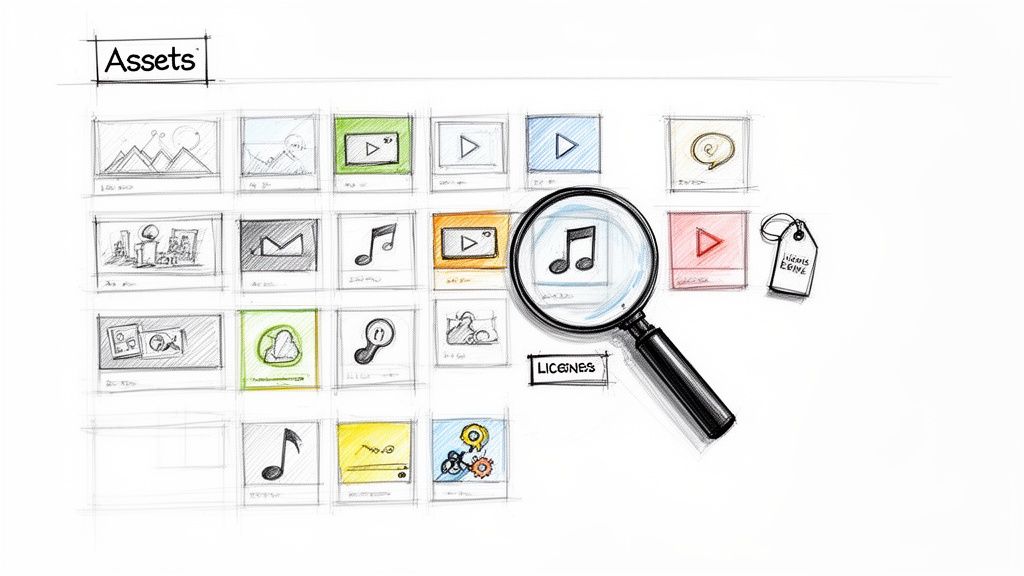
The key to success is building a portfolio that can be sold repeatedly. Instead of competing on generic content, focus on underserved niches like diverse representation in business or specific industry visuals. This targeted approach helps your assets stand out and attract dedicated buyers. By uploading your portfolio to multiple marketplaces, you maximize discoverability and potential earnings.
Monetization and Distribution
Pricing: Offer flexible licensing models. A Standard License could cover basic web use for a one-time fee, while an Extended License allows for use in merchandise or larger campaigns at a higher price. Creating Asset Bundles (e.g., 50 social media graphics) encourages larger purchases.
Payment: Sell directly from your own website using simple paylinks. Customers can easily pay with their credit or debit cards, and you receive the funds settled in USDC. This provides a direct-to-consumer channel without marketplace fees.
Subscriptions: Build a recurring revenue stream by offering a subscription for unlimited downloads. For instance, a monthly fee could grant access to your entire library of video clips or Lightroom presets. This model increases customer lifetime value and creates a predictable income source.
7. Coaching and Consulting Services (Packaged Digital Programs)
Packaging your expertise into coaching or consulting services is a powerful way to sell high-value digital products online. Instead of hourly billing, you create structured programs that offer personalized guidance, accountability, and actionable plans. This model transforms your advice into a scalable asset, allowing you to serve clients globally through video consultations, group sessions, and direct support.
This approach is ideal for experts who can deliver tangible results, like a business coach helping a founder scale, or a career consultant guiding a professional through a transition. By productizing your service, you provide clients with a clear roadmap and predictable outcomes, justifying a premium price. The initial work of defining your program pays off as you can deliver it repeatedly with a consistent, high-quality framework.
Monetization and Distribution
Pricing: Structure your offerings in tiers to cater to different client needs and budgets. For example, offer a Group Program for a one-time fee, a 1-on-1 Monthly Retainer for personalized attention, and a premium Done-For-You Service for a high-ticket project fee.
Payment: Use simple paylinks to make it easy for clients to purchase high-ticket packages directly from your website or social media profile. You can accept traditional card payments, with your earnings settled in USDC for stability. For clients who need more flexibility, you can offer payment plans using a recurring subscription feature.
Community: Add value to group coaching programs by creating an exclusive Discord or Telegram channel. This fosters a supportive environment where clients can connect, share progress, and receive peer feedback. You can automate access and manage member subscriptions with our integrated payment tools.
8. Software Tools and Plugins
Developing and selling software tools and plugins are excellent ways to create valuable digital products to sell online. These products solve specific, often niche, problems for users, making them highly desirable. Examples range from powerful WordPress plugins that add e-commerce functionality to browser extensions like Grammarly that improve writing, or even specialized Figma plugins that speed up design workflows.
By focusing on a distinct pain point, you can build a dedicated user base. For instance, instead of a broad project management tool, you could create a plugin that syncs Trello cards with Google Calendar. The key is to start with a Minimum Viable Product (MVP) to test market demand before investing heavily in development. This approach allows you to build an asset that generates recurring revenue through licenses or subscriptions.
Monetization and Distribution
Pricing: Structure your pricing with multiple tiers. A Freemium model can attract a large user base, while a Pro subscription unlocks advanced features. For teams or agencies, offer a Business license that includes premium support and multi-user access. Perpetual licenses for a one-time fee are also a popular option.
Payment: Integrate payment solutions directly into your site or application. With our API, you can manage license key generation and subscription validation seamlessly. This lets you accept card payments from customers globally, while your earnings are settled in USDC for stability.
Automation: Use webhooks to automate the activation of subscriptions or licenses upon successful payment. This ensures a smooth user experience, automatically granting access to your plugin or software tool without manual intervention, which is crucial for scaling your operations.
9. Webinars, Workshops, and Live Events (Recordings and Access)
Live digital events like webinars and workshops are excellent digital products to sell online, offering direct engagement and creating a sense of urgency. These can be one-time paid training sessions, interactive Q&A discussions, or even multi-day virtual summits. By recording these live events, you also create a second asset, an on-demand version, that can be sold indefinitely to those who missed the live session. This dual approach maximizes your revenue potential from a single content creation effort.
Industry leaders like Russell Brunson and B2B software companies have long used webinars to educate audiences and drive sales. The format is ideal for showcasing expertise and building trust. For instance, an SEO expert can host a live workshop on keyword research, then sell the recording as a standalone product. To elevate the attendee experience, you might consider professional webinar production services to ensure high-quality audio, video, and overall presentation.
Monetization and Distribution
Pricing: Structure your pricing with clear value propositions. Sell a Live Access ticket for a set price. Afterward, offer the Recording Only for a slightly lower price and a Bundle that includes the recording, slides, and bonus resources for a premium. This strategy caters to different levels of interest and availability.
Payment: Use simple paylinks to sell tickets and recordings directly on your social media profiles, in emails, or on a landing page. This allows customers to pay with their credit or debit card, while you receive the funds settled in USDC, providing stability and simplifying cross-border transactions.
Community: For recurring workshops or a series of events, you can sell a membership pass. This grants access to all future live events and a library of past recordings. You can manage this through a private Discord or Telegram channel, automating access for paying subscribers.
10. API Access and Data Products
Selling programmatic access to proprietary data or services is a powerful business model for developers and data-driven companies. This involves offering an Application Programming Interface (API) that customers can integrate into their own applications. Companies like Twilio and OpenWeather have demonstrated the high demand for reliable, well-documented APIs that solve specific problems, from communications to weather forecasting.
This approach turns your software or data into a scalable asset. For example, a fintech company could offer an API for real-time stock market data, or a marketing analytics firm could sell access to its consumer trend algorithms. The initial development effort creates a product that generates recurring revenue through subscriptions or usage-based billing with minimal ongoing intervention, making it one of the most efficient digital products to sell online.
Monetization and Distribution
Pricing: Structure your pricing with distinct tiers. Offer a Free Tier with limited requests to encourage experimentation, a Pro Tier for higher usage limits and standard features, and an Enterprise Tier with custom integrations, premium support, and volume discounts. Offering annual prepay discounts of 20-30% can secure long-term commitment.
Payment: Implement a simple and robust payment system. You can sell subscription plans directly from your developer portal using embeddable checkouts or simple paylinks. This allows you to accept global card payments while receiving your funds settled in USDC for financial stability.
Automation: Our API allows you to automate user management. You can use webhooks to instantly provision or revoke API keys based on a customer's subscription status, ensuring access is always synchronized with payments. This also allows you to send automated alerts when customers approach their usage limits, prompting them to upgrade.
11. Personal Branding and Content Monetization (Creator Kits and Tools)
Selling your expertise on how to build a personal brand and monetize content is a powerful way to offer digital products to sell online. This approach involves packaging your successful strategies into creator kits, which can include content calendars, growth playbooks, personal branding guides, and monetization blueprints. Successful creators like Ali Abdaal and Amy Landino have built empires teaching others the methods they used to grow their own audiences and revenue.
This model is based on authenticity and proven results. For instance, a creator who has built a large YouTube following can sell a kit on video production and audience growth, while a blogger can offer a guide to SEO and affiliate marketing. You are essentially creating a scalable product from your own success story, offering immense value to aspiring creators who want to follow in your footsteps.
Monetization and Distribution
Pricing: Structure your offerings in tiers to capture a wide audience. You could offer a free branding checklist to generate leads, a $49 Content Calendar Template for immediate value, and a $299 Creator Masterclass that bundles video lessons, templates, and community access for a complete solution.
Payment: Use simple paylinks to sell your kits and courses directly from your social media bios or website. This allows your followers to purchase instantly with their card, while you receive the funds settled in USDC for stable, global access to your earnings.
Community: Offer bundled products that combine your guides with access to a private Discord or Telegram group. This fosters a supportive environment where creators can network, share wins, and get direct feedback, adding significant value and justifying a higher price point.
12. Niche Print-on-Demand and Merchandise Design
Creating digital designs for physical merchandise is an excellent way to sell digital products online, especially for those with a creative flair but no interest in managing inventory. With print-on-demand (POD), you simply upload your designs for products like t-shirts, mugs, and stickers. When a customer makes a purchase, a third-party service like Printful or Redbubble handles the printing, packaging, and shipping automatically.
This model is ideal for tapping into passionate niche communities, from gaming and specific hobbies to podcasts. Creators with an existing audience can launch merchandise to deepen fan connection and open a new revenue stream. The key is creating the digital asset once, which can then be sold countless times without any further logistical effort, making it a highly scalable business.
Monetization and Distribution
Pricing: You can sell individual designs on marketplaces like Etsy, or create themed design bundles for a higher price. Alternatively, offer exclusive designs only available to paying members of a private community, creating scarcity and value.
Payment: While POD platforms handle their own payments, you can increase your margins by selling directly. Use a simple paylink to sell limited-edition merchandise designs or pre-orders via social media. Customers can pay with their cards, and you can receive your earnings directly in USDC.
Community: Offer special access to exclusive merchandise designs as a perk for joining your paid Discord or Telegram group. Automating this with subscription tools ensures that only active members can access the special download links or purchase pages for unique community apparel.
12 Digital Product Types Comparison
Item | Implementation complexity | Resource requirements | Expected outcomes | Ideal use cases | Key advantages |
|---|---|---|---|---|---|
Online Courses and Educational Content | Medium–High, curriculum, video production and platform setup | Significant upfront time, recording/editing tools, LMS or delivery channel, student support | Scalable recurring or passive revenue; authority-building | Experts teaching skills to cohorts or broad audiences | High margins after launch; predictable subscription revenue |
Software-as-a-Service (SaaS) Applications | High, engineering, architecture, ongoing ops | Development team, hosting, security, customer support, sales/marketing | Predictable recurring ARR with scale potential | Solving business workflows or developer tools for global users | Strong retention and high lifetime value when product-market fit achieved |
Digital Templates and Design Assets | Low, create files and distribution workflow | Design skills, file hosting, minimal support | Fast, scalable sales with low marginal cost per sale | Designers selling reusable assets to creators and businesses | Quick to launch, high profit margins, instant delivery |
Membership Communities and Exclusive Content | Medium, platform setup plus continuous engagement | Community managers, content cadence, moderation tools, onboarding flow | Stable recurring revenue driven by retention and engagement | Creators monetizing tight-knit audiences or niche networks | Network effects, upsell-friendly, high member loyalty |
E-books and Digital Publications | Low–Medium, writing, editing, formatting | Author time, editing/design, distribution channels | Scalable one-time sales or gated subscription content; authority building | Authors, bloggers, and experts monetizing content libraries | Low production cost, easy bundling and lead-generation asset |
Stock Photography, Graphics, and Creative Assets | Medium, consistent content production and curation | Camera/design tools, editing workflow, portfolio management | Passive income per asset with steady long-tail sales | Photographers and designers building asset libraries | Passive scaling, multiple marketplaces increase reach |
Coaching and Consulting Services (Packaged Programs) | Medium–High, bespoke delivery and client management | Expert time, scheduling, materials, client support | High-ticket revenue per client; lower scalability without packaging | Professionals offering personalized results and accountability | Premium pricing, strong testimonials, referral-driven growth |
Software Tools and Plugins | High, product development, compatibility and updates | Engineering, QA, documentation, hosting, integrations | Recurring revenue if retention is strong; potential for large scale | Niche functionality integrations (CMS, browsers, platforms) | Freemium conversion, upsells, sticky integrations |
Webinars, Workshops, and Live Events | Low–Medium, event prep and live delivery | Presentation materials, webinar platform, marketing to drive attendance | Lead generation, one-off sales, and on-demand replay revenue | Market testing, launching courses, converting audiences | Fast to launch, high engagement, effective upsell channel |
API Access and Data Products | High, reliable infra, metering and billing systems | Engineering, scalable hosting, monitoring, documentation, sales | Usage-based or tiered recurring revenue; enterprise contracts possible | Developer and enterprise customers needing programmatic access | High ARPU, scalable with technical moat, attractive to enterprises |
Personal Branding and Content Monetization (Creator Kits) | Low–Medium, package proven processes and templates | Content creation, audience, marketing channels, occasional updates | Multiple small-to-medium revenue streams and audience growth | Established creators selling playbooks, templates, and toolkits | Leverages personal credibility, diverse monetization paths |
Niche Print-on-Demand and Merchandise Design | Low, design and POD integration | Design work, POD platform integration, marketing and customer service | Modest margins, passive fulfillment, income tied to fan demand | Creators and small brands selling branded merchandise | No inventory, automated fulfillment, easy brand extension |
From Idea to Income: Building Your Global Digital Business
The journey from a promising idea to a profitable online venture is about more than just choosing from a list of digital products to sell online. As we have seen, the opportunities are abundant, spanning everything from high-value online courses and scalable SaaS applications to niche template bundles and exclusive membership communities. Each model offers a unique path to building a business, yet they all share a common destination: the need for a simple, reliable, and global system for getting paid.
The true challenge for modern entrepreneurs is not a lack of ideas, but the operational friction that slows growth. Traditional payment systems often create roadblocks with currency conversion fees, settlement delays, and regional restrictions. This is precisely where a strategic shift in your payment infrastructure can make all the difference. By adopting a system where customers can pay with their cards and you receive funds directly as USDC, you effectively sidestep these legacy issues. This approach provides the predictability of stablecoin settlements without forcing your customers into a crypto-only checkout experience.
Key Takeaways for Your Digital Product Strategy
As you move forward, keep these core principles in mind. They are the building blocks of a resilient and scalable digital business that can operate without borders.
Product-Market-Payment Fit: It is not enough to find a great product for a specific market. You must also align it with a payment solution that serves both you and your customer. For subscription models like SaaS or memberships, an API that manages recurring billing is essential. For one-off sales like e-books or templates, a simple paylink can be your most powerful tool.
Automation is Your Ally: Success with digital products depends on your ability to scale efficiently. Automating access and delivery is non-negotiable. Whether it is a webhook that triggers an email with a download link or an integration that automatically grants access to a Discord or Telegram channel upon payment, automation frees you up to focus on creating value, not manual administration.
Global from Day One: Do not limit your potential customer base by thinking locally. The beauty of selling digital products online is the global reach. By implementing a payment system that accepts international card payments and settles in USDC, you are equipped to serve customers anywhere from the moment you launch. This removes a significant barrier to international expansion, though you should still get familiar with taxes for online businesses as you start selling across borders.
Pricing with Precision: Your pricing strategy directly impacts your revenue and perceived value. For authors and creators venturing into digital publications, understanding how to price ebooks for maximum sales and readership is a critical step in building a profitable online business. The same principle applies to all digital goods, test different price points and monetization models to find what resonates with your audience.
Ultimately, the most successful digital entrepreneurs are those who build their business on a foundation of operational excellence. They combine a great product with a frictionless customer experience, powered by a payment backend that just works. Whether you are a developer integrating a payment API, a creator selling access to a community, or a freelancer invoicing clients globally, the goal is the same. You want to make it easy for people to pay you and even easier for you to receive your money.
By focusing on these practical steps and selecting the right tools, you can turn your concept into a sustainable source of income. The ideas are here, the technology is available, and the global market is waiting. Your next move is to connect them all into a cohesive, efficient, and profitable digital business.
Suby is a payment gateway and payment processor. Your customers pay with card, bank transfer, Apple Pay, Google Pay, Klarna, and more, or stablecoins, and you get paid out to your bank account, or directly in stablecoins (USDC, EURC) to your wallet, anywhere in the world, no bank account required. Whichever digital products you sell online, from courses and templates to SaaS and gated communities, Suby handles paylinks, embedded checkout, subscriptions, and native Discord and Telegram access so you can collect from buyers anywhere without banking friction.
