

Gaspard LEZIN
Credit Card Fees for Businesses Explained
Understand credit card fees for businesses. Compare interchange, scheme, and processor costs, and learn how modern payment stacks help you minimize expenses.
Card payments are no longer a minor line item. U.S. businesses incurred about $187.2 billion in card processing fees in 2024, with interchange representing roughly 70% to 90% of those costs, according to Stripe's breakdown of interchange fees. The right question for a founder isn't “Who has the lowest advertised rate?” It's which customers are paying, through which method, in which region, and where do you want the money to settle?
That distinction matters because a card sale can involve several pricing layers, regional rules, card types, and settlement choices. A business that accepts cards, wallets, bank payments, and crypto through one payment stack can make a better decision than a business optimizing one blended card rate in isolation.
Table of Contents
Understanding Credit Card Fees for Businesses
A card transaction looks simple to the customer. They tap, enter details, or confirm a wallet payment. Behind that action, the issuing bank, card network, acquiring institution, and processor each perform a different job, and the merchant's total cost reflects those layers.
Industry reporting places average merchant processing costs for Visa and Mastercard at about 2.35% of transaction value. That means a business with $1 million in annual card sales can face roughly $23,500 in fees before processor markups or per-transaction charges, as outlined in Stripe's merchant fee analysis. The precise bill depends on card mix, transaction type, location, and the provider's commercial terms.
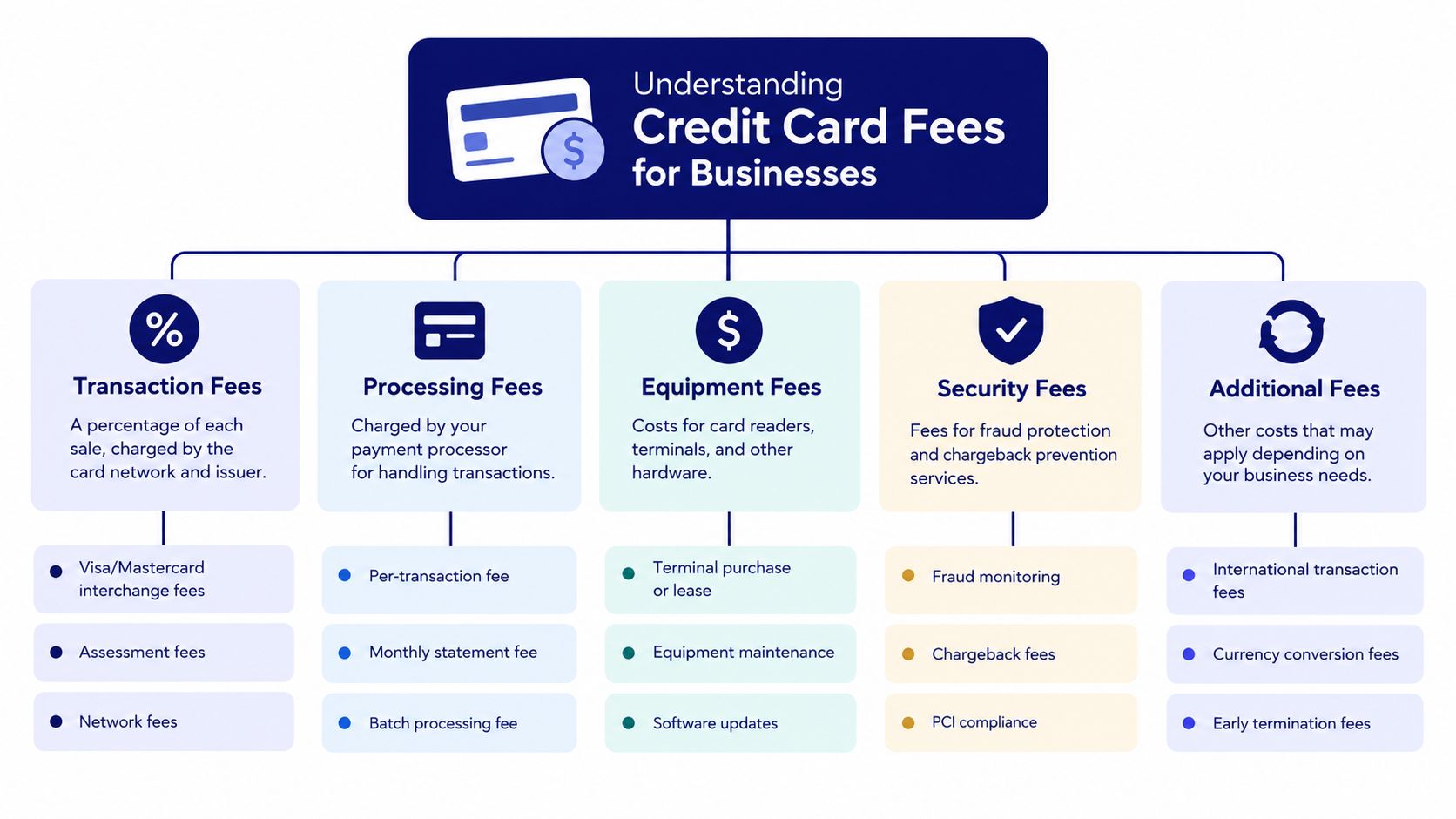
The three layers on a card payment
Interchange goes to the customer's issuing bank. It compensates the bank for issuing the card, authorizing transactions, and carrying part of the payment risk. Credit cards generally cost more than debit cards because their pricing reflects different products and risk structures.
Network assessments go to the card network that routes the transaction and operates the payment rules and infrastructure. These assessments sit alongside interchange rather than replacing it.
Processor markup is the provider's commercial charge for routing transactions, supplying payment software, managing settlement, supporting the account, and sometimes providing fraud and reporting tools. This is the part most likely to be negotiated, but it isn't always the largest part of the bill.
Visa explains that merchants don't pay interchange reimbursement fees directly. Instead, the merchant negotiates a merchant discount with its financial institution, and that discount is typically calculated as a percentage per transaction. The distinction is useful because the rate on a merchant statement may combine several underlying costs into one visible figure.
Practical rule: Ask for the effective cost by payment method, not just the headline percentage.
A processor statement should let you connect each charge to a transaction category. If it doesn't, you can't tell whether costs rose because the processor changed its markup or because more customers used premium cards, card-not-present checkout, or cross-border cards. For a plain-language explanation of how a payment provider may structure a customer-facing charge, read how Resolut handles card fees.
The same discipline applies when comparing gateway and processor proposals. This explanation of payment gateway fees is useful for separating the technology layer from the broader cost of accepting and settling a payment.
How Fees Vary by Region and Card Type
Regional rules and card categories can change payment costs more than a processor's advertised rate. A consumer debit payment in the European Economic Area has different economics from an online purchase made with a U.S. corporate card, and neither matches a local in-person transaction.
Within the EU and EEA, regulated consumer-card interchange is capped at 0.20% for debit cards and 0.30% for credit cards, when the transaction falls within the regulated scope. Corporate and business cards are outside that consumer cap and may carry materially higher interchange, as explained in Stripe's EU interchange guidance.
Region | Debit Cap | Credit Cap | Corporate Cards |
|---|---|---|---|
EU/EEA regulated consumer transactions | 0.20% | 0.30% | Not covered by the consumer cap and may cost materially more |
United States | No broad equivalent cap across ordinary credit card interchange | No broad equivalent cap across ordinary credit card interchange | Often priced higher than basic consumer cards |
The United States has a less uniform pricing structure. One industry report cited average interchange of 1.80% for credit cards versus 0.73% for debit cards, with credit cards producing about 74% of total interchange revenue. It also described network fee schedules ranging from roughly 1.15% to 2.50% plus a fixed transaction amount, before additional assessment fees. The applicable cost depends on the card brand, product, and transaction route. These figures come from the Common Sense Institute analysis of interchange restrictions.
Card type changes the economics
Rewards, premium, corporate, and purchasing cards can produce a higher effective rate than basic consumer debit cards. Card-not-present payments may also price differently from in-person transactions because they involve a different risk profile and authorization data.
For a typical U.S. small business, all-in card acceptance commonly costs 2.5% to 3.5% of revenue, and that cost can exceed 4% for e-commerce or higher-risk merchants. Interchange commonly represents 70% to 80% of processing cost, according to merchant payment cost research from Spark.
Report costs by region, card type, channel, and customer profile. A blended rate can remain stable while premium cards, online payments, or cross-border volume make the underlying mix more expensive. High-value B2B businesses should isolate corporate-card costs instead of applying consumer-card assumptions.
Cross-border settlement adds currency conversion and payout choices beyond the visible card rate. Review cross-border payments as a complete flow, then use API-first payment infrastructure to route methods and settlement options by market. That approach often matters more than chasing a marginally lower advertised processor rate.
Strategies to Minimize Processing Costs
Negotiating the processor's markup is useful, but it's rarely the first lever I'd pull. If interchange makes up most of the processing bill, shaving a small amount from the processor layer won't fix a customer mix dominated by premium cards, card-not-present payments, or expensive regional routes.
Start by measuring the effective rate by segment. Separate online and in-person sales, consumer and corporate cards, domestic and cross-border payments, and card sales from bank, wallet, or crypto payments. Then decide whether the commercial objective is to absorb the cost, steer customers toward another method, or pass part of the cost through transparently.
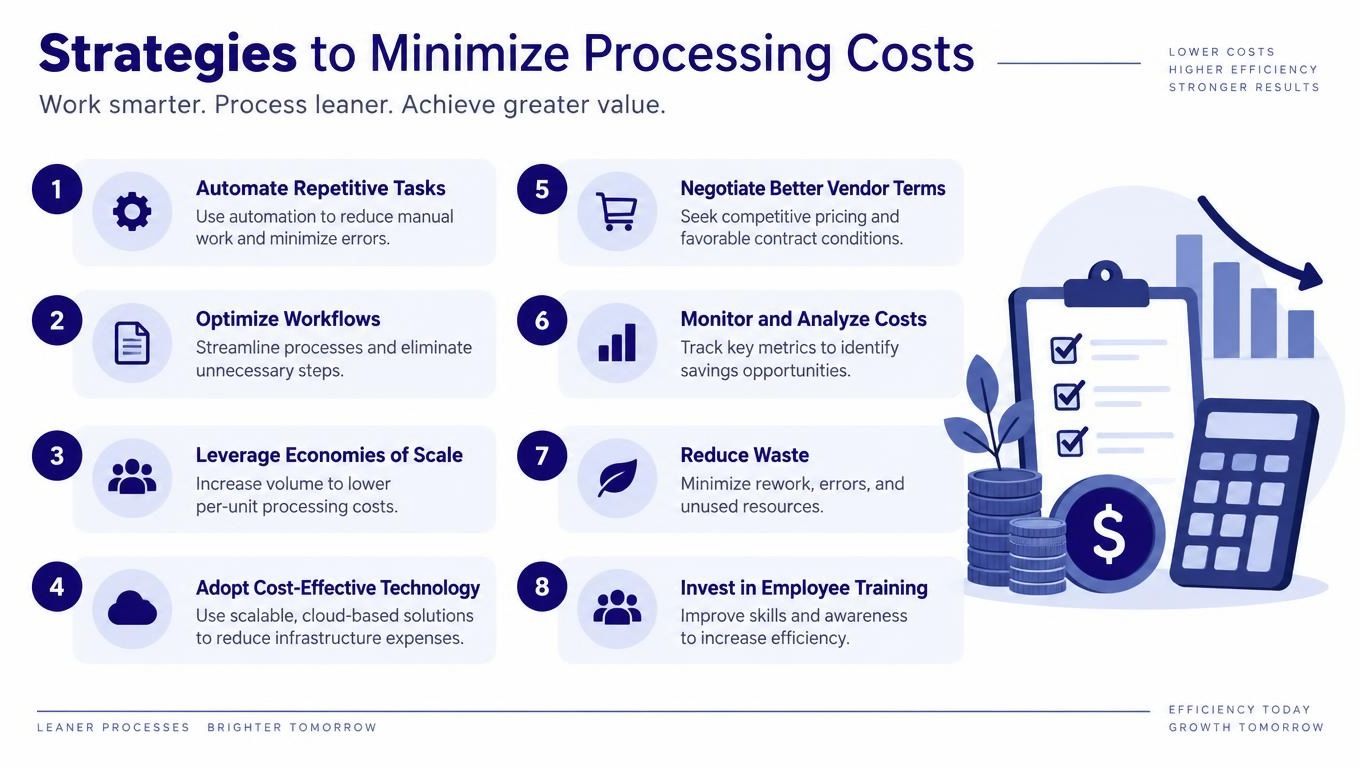
Choose the right pricing response
Payment mix comes first. If customers can pay by bank, wallet, debit, card, or crypto, you can measure which options protect margin while preserving conversion. Don't force every customer into one method just because it simplifies your statement.
Pricing design matters. A cash discount, bank-payment incentive, or channel-specific offer can steer behavior without adding a surprise fee at checkout. The offer must be clearly disclosed and economically sensible for your customer base.
Surcharging requires discipline. Visa's U.S. merchant guidance says its surcharge FAQ applies only to purchases made in the United States and U.S. territories. Visa also states that surcharging remains prohibited outside the U.S. unless local law or a network variation permits it, as described in its merchant surcharge FAQ.
Mastercard's U.S. rules allow merchants to surcharge Mastercard-branded credit cards, either at the brand level or the product level, under the conditions described in its U.S. merchant surcharge rules. That permission doesn't create a worldwide right to add a fee. Local law, network rules, notice requirements, receipt disclosures, and restrictions on debit and prepaid cards still matter.
Compliance beats cleverness. A surcharge that creates disputes, confuses buyers, or violates a local rule can cost more than the processing expense it was meant to recover.
Before implementing a fee, confirm the rule in every jurisdiction where you sell, notify the relevant network when required, display the charge before payment, and keep the treatment consistent. For smaller businesses, a clear discount for a lower-cost payment method may produce a better customer experience than a visible surcharge.
The strongest cost program combines payment routing, pricing, fraud controls, and settlement. This guide to transparent pricing for small business payments is a useful reference when comparing providers.
Real-World Use Cases for Modern Payment Stacks
Payment infrastructure should reflect the business model. A subscription software company, a cross-border store, a paid community, and a consulting agency don't have the same customer journey or settlement preference.
An international SaaS company should begin with a checkout that accepts cards and recurring payments, then add wallets, bank methods, or crypto where customer demand justifies them. The business can use payment-level reporting to compare approval, refunds, churn, and effective cost by market rather than judging the entire business by one average.
For an online retailer, the decision is broader than “card or no card.” Card payments may remain the default, while crypto checkout gives customers another route. A modern gateway can handle the swap, sponsor the gas, and settle the resulting funds to a non-custodial wallet or into a platform balance. That lets the merchant decide whether to hold the asset or convert according to its treasury policy.
Match the tool to the workflow
Suby is one product with four ways to use it. Suby Payments is an API-first payment stack for accepting cards and crypto through one checkout. Suby Crypto is a crypto payment gateway that handles the swap, sponsors the gas, and settles to a non-custodial wallet or the Suby balance. Suby Gating provides paid access for Discord, Telegram, downloads, and courses. Suby Invoicing lets a client pay by card, bank, or crypto while the business receives its chosen settlement method.
The important operating principle is simple: customers pay any way they want, while the business chooses how to receive the money. The API lets any business accept payments by card or crypto, and native Discord and Telegram integrations support subscriptions, paid access, and online communities.
An agency invoicing international clients can send one invoice rather than maintaining separate instructions for cards, bank transfers, and crypto. The client chooses the method that works for them. The agency can then settle to its bank account or in a stablecoin such as USDC, subject to the provider's available terms and payout configuration.
Creators and community managers have a different problem. They need to connect payment status with access. A gating workflow can charge for a subscription or one-time product, then manage access to Discord, Telegram, downloads, or courses without building those entitlement rules from scratch.
The right architecture doesn't eliminate payment costs. It makes the payment method, customer, fee, and settlement outcome visible enough to manage.
Choosing Per-Method Pricing Over Blended Rates
Blended pricing is easy to read and hard to interrogate. One rate appears on the proposal, but it may combine low-cost debit, higher-cost credit, card-not-present transactions, cross-border payments, and the provider's markup. As your mix changes, the same advertised rate can become a poor deal.
Interchange-plus pricing improves visibility by separating underlying card costs from the processor's markup. It's more useful for a growing merchant, but the effective rate still moves when customers choose different cards or payment channels.
Per-method pricing goes one step further. It gives each payment method its own commercial treatment, which makes it easier to compare card, wallet, bank, and crypto acceptance on an equivalent basis.
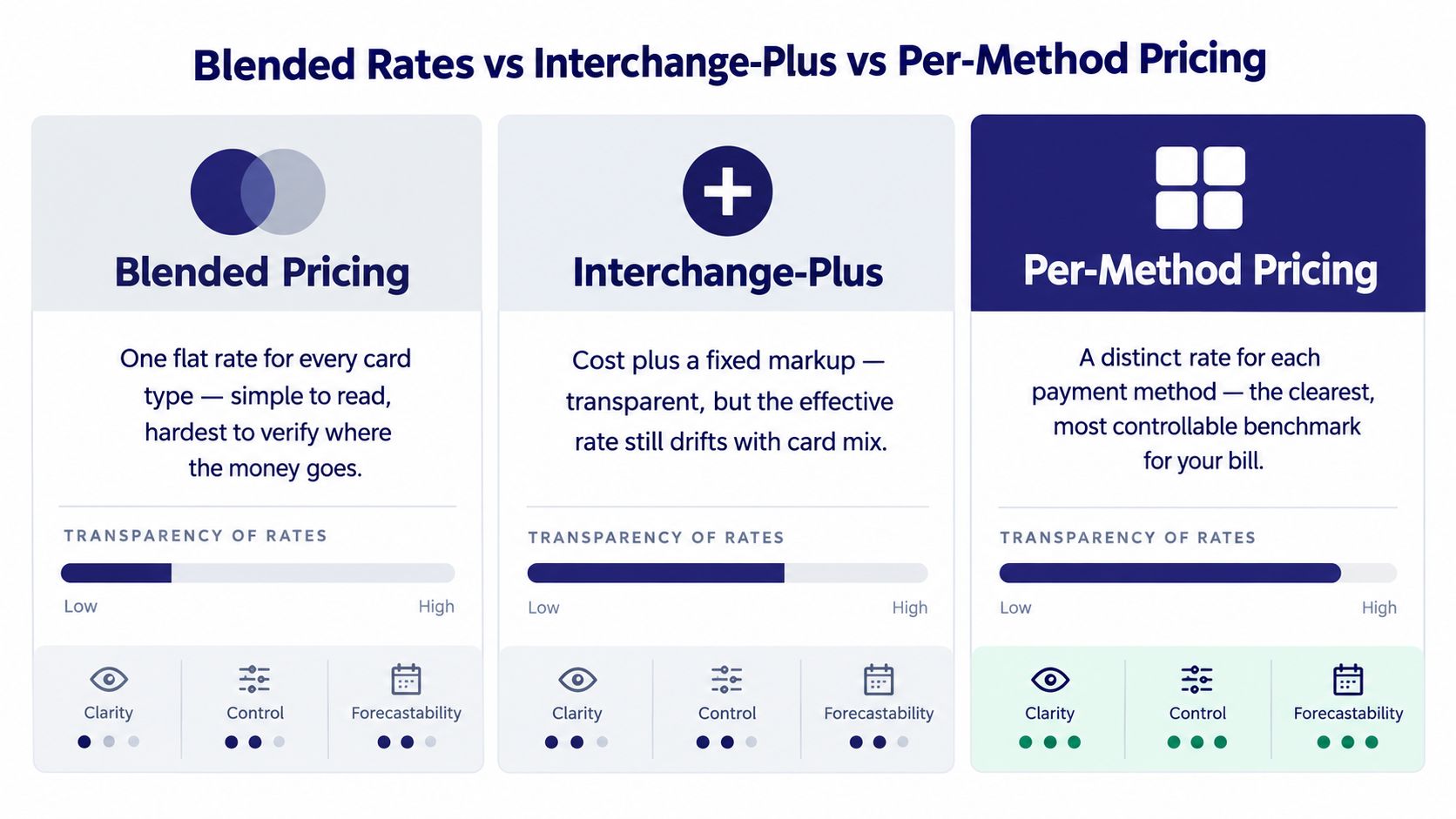
What to inspect on a pricing page
Look for the following before you sign:
Payment-method definitions: Confirm whether card, wallet, bank, and crypto costs are listed separately.
Fixed charges: Check whether a percentage is accompanied by a per-transaction amount, payout charge, refund charge, or account fee.
Settlement terms: Verify where funds land, which currencies are available, and whether conversion is automatic or optional.
Reporting detail: Make sure the dashboard identifies the method, currency, fee, refund, payout, and net amount for each payment.
Contract flexibility: Review minimums, termination terms, reserve policies, and any fees that appear only in the agreement.
The provider's price should be evaluated against your actual payment mix, not an imagined average. A low rate for one method may be irrelevant if your customers predominantly use another. Conversely, a provider with several method-specific rates may produce a clearer and more controllable total even when its card rate isn't the lowest visible number.
Pricing for Suby depends on the payment method used, so there isn't one flat rate to apply to every transaction. Check the official Suby pricing page for exact figures before making a comparison.
Settlement deserves equal attention. Some businesses want bank deposits in local currency. Others prefer stablecoin settlement, including USDC, because it fits their treasury or contractor-payment workflow. A provider should let you verify that choice in its documentation and commercial terms rather than treating settlement as an afterthought.
Action Plan for Optimizing Your Payment Infrastructure
Start with evidence from your own statements. Pull a representative period of card sales and record gross volume, total fees, refunds, chargebacks, payout deductions, currencies, and payment methods. Don't compare only the percentage shown in a sales presentation.
Audit the current arrangement
Calculate the effective rate. Divide total processing fees by total card sales, then examine the result by channel and card category where the data is available.
Find mix changes. Check whether more sales moved online, across borders, or toward corporate and premium cards. Those shifts can raise costs without a processor changing its markup.
Separate controllable charges. Identify processor markup, gateway charges, recurring fees, payout costs, and currency conversion charges. These are easier to challenge than network-set costs.
Review customer impact. Measure failed payments, refunds, disputes, and checkout friction alongside fees. A cheaper route that loses good sales isn't cheaper.
Map settlement needs. Decide whether each business unit needs a bank payout, local currency, or stablecoin settlement.
Build the replacement carefully
Choose an API-first checkout that supports the payment methods your customers use. Use webhooks to send payment, refund, subscription, and payout events into your accounting, customer, and entitlement systems. Reconciliation should match the original payment to the fee deduction and final settlement without manual spreadsheet work.
Run the new flow alongside the existing one before changing every customer. Test successful payments, declines, refunds, recurring charges, access removal, payout reporting, and currency handling. Your finance team should be able to answer three questions for any transaction: what did the customer pay, what did the provider deduct, and what did the business receive?
The target isn't the lowest visible rate. It's a payment system that makes cost and settlement decisions controllable.
Use a monthly review to compare the agreed pricing with the actual mix. If card-not-present sales grow, assess them separately. If a new region introduces corporate cards or cross-border volume, update the forecast. If customers adopt bank or crypto payments, measure the resulting settlement cost rather than assuming the change is automatically favorable.
A modern payment stack should also support operational resilience. Keep clear ownership for disputes, refunds, payout reconciliation, customer access, and compliance checks. When those responsibilities are hidden across several vendors, a small pricing change can create a large administrative problem.
The practical recommendation is direct: stop managing credit card fees for businesses as one blended expense. Segment the payment mix, publish the actual cost of each method, choose compliant pricing and steering options, and select settlement routes that fit your cash flow.
Suby provides an API for businesses to accept payments by card or crypto, plus native Discord and Telegram integrations for subscriptions, paid access, and online communities. Visit Suby to review how customers can pay their preferred way while your business settles to its chosen bank account or stablecoin method.
