

Gaspard LEZIN
Card Payment Provider Venezuela Guide
Explore the card payment provider Venezuela landscape. Learn about local rails, cross-border acceptance, FX settlement, and how Suby simplifies global payouts.
A merchant can launch a checkout that accepts Visa and Mastercard almost everywhere, then discover that Venezuelan customers still see declines, delayed confirmation, or no practical way for the business to access the proceeds. The problem isn't whether a card is accepted. It's the connection between international authorization, local connectivity, domestic clearing, foreign exchange, and settlement.
That's why choosing a card payment provider in Venezuela requires more than comparing processing fees. You need to understand which payment rails customers use, where foreign cards fail, how local infrastructure handles settlement, and whether your provider can separate the customer's payment method from the currency and destination you choose for receiving funds.
Table of Contents
The Reality of Accepting Cards in Venezuela
A merchant can receive an approval from Caracas and still face a failed customer journey elsewhere. The customer enters a Visa or Mastercard number, the gateway requests authorization, and the merchant expects confirmation and settlement. That sequence depends on issuer access, acquiring coverage, network routing, fraud controls, and a bank relationship that can carry funds across borders.
Venezuela can interrupt the flow at any of those points. A foreign card may be valid, yet decline because international connectivity is inconsistent, banking restrictions disrupt the route, or local acceptance infrastructure cannot support every cross-border transaction. Travel reporting describes sharply different outcomes: cards may work in Caracas but prove unreliable elsewhere, while other accounts report broad problems linked to sanctions, restrictions, and infrastructure gaps. Against the Compass documents the conflicting practical experience.
Why a standard gateway may underperform
A software, travel, or online-product merchant may see authorizations succeed for customers in one city and fail for customers in another. The checkout is not necessarily the cause. The issuer, acquirer, network route, fraud decision, or settlement relationship may be responsible.
“Visa and Mastercard supported” says too little. Evaluate the operating path behind that statement:
Where does authorization occur? Establish whether the provider uses an international acquirer, a domestic partner, or several fallback routes.
What happens after approval? Authorization does not guarantee final settlement when domestic clearing and international card rails remain separate.
Which fallback methods are available? Bank transfers and local mobile-payment options can preserve conversion when a foreign card fails, consistent with payment-methods guidance for Venezuela.
Practical rule: Treat card acceptance as a corridor-specific operating question, not a global feature checkbox.
The central challenge is connecting international authorization to domestic clearing and usable merchant settlement. Modern providers may separate the customer's card transaction from the currency and destination used for payout, including stablecoin settlement where the merchant's treasury process supports it. That can reduce dependence on a single local banking route, but it adds compliance, conversion, custody, and reconciliation work.
Ask a provider to show its routing logic, decline handling, reconciliation records, payout timing, and stablecoin controls before launch. For regional comparison, Suby's Latin America payment-provider analysis offers relevant operating context.
Understanding the Domestic Payment Mix
A global merchant can see strong card usage at one Venezuelan checkout and a very different result elsewhere. The reason is not customer preference. Venezuela has long-standing card infrastructure, but domestic payment behavior is shaped by debit access, bank-linked mobile payments, local clearing, and the practical limits of each acceptance route.
Seven banks created the Interbank Payment System, or Sistema de Pagos Interbancarios, in May 2002 to automate credit-card clearing and settlement. Venezuela had 13.2 million credit cards in circulation by the end of 2014, alongside about 16.7 million debit cards in circulation by the end of 2010. These historical figures are documented in local reporting on Venezuela's card and mobile-payment infrastructure.
Current checkout behavior matters more than historical card totals. A 2025 survey found that 78% of payments were made either by card at a point of sale or through mobile payment applications. Debit or credit cards at bank POS terminals accounted for 44%, while bank mobile-payment applications accounted for 34%. The survey places bank-linked payments at the center of everyday commerce, rather than treating cards as the only relevant instrument.

Cards are important, but debit leads
Separate transaction-level research ranked Venezuela first among 17 Latin American countries for the share of transactions conducted digitally, at 28.6%. Cards alone represented 10.7% of transactions, compared with 1.3% in Panama, the next-highest country in that comparison. Rest of World reports the transaction-level findings.
For a card payment provider venezuela strategy, the operational priority is debit authorization, local issuer behavior, and account-linked alternatives. Industry reporting describes Venezuela as primarily a debit market and identifies Mastercard as a market leader. Credit-card features still matter for international visitors and selected customer groups, but they should not define the entire acceptance plan.
Mobile payments require equal attention. Local reporting in 2026 said Pago Móvil represented 63% of electronic transactions in the first half of 2026, with card terminals processing most of the remainder. The 2026 market discussion and the role of local transfer rails are covered by The Rio Times.
Segment the checkout by customer and use case. Formal merchants, tourism, and higher-income urban customers may favor cards, while everyday retail often depends on bank-linked mobile payments and other domestic rails. Dollarized cash and crypto also affect how customers hold and transfer value. A practical design therefore combines card acceptance with local payment options and a clear fallback path.
Cross-Border Rails Versus Local Clearing Networks
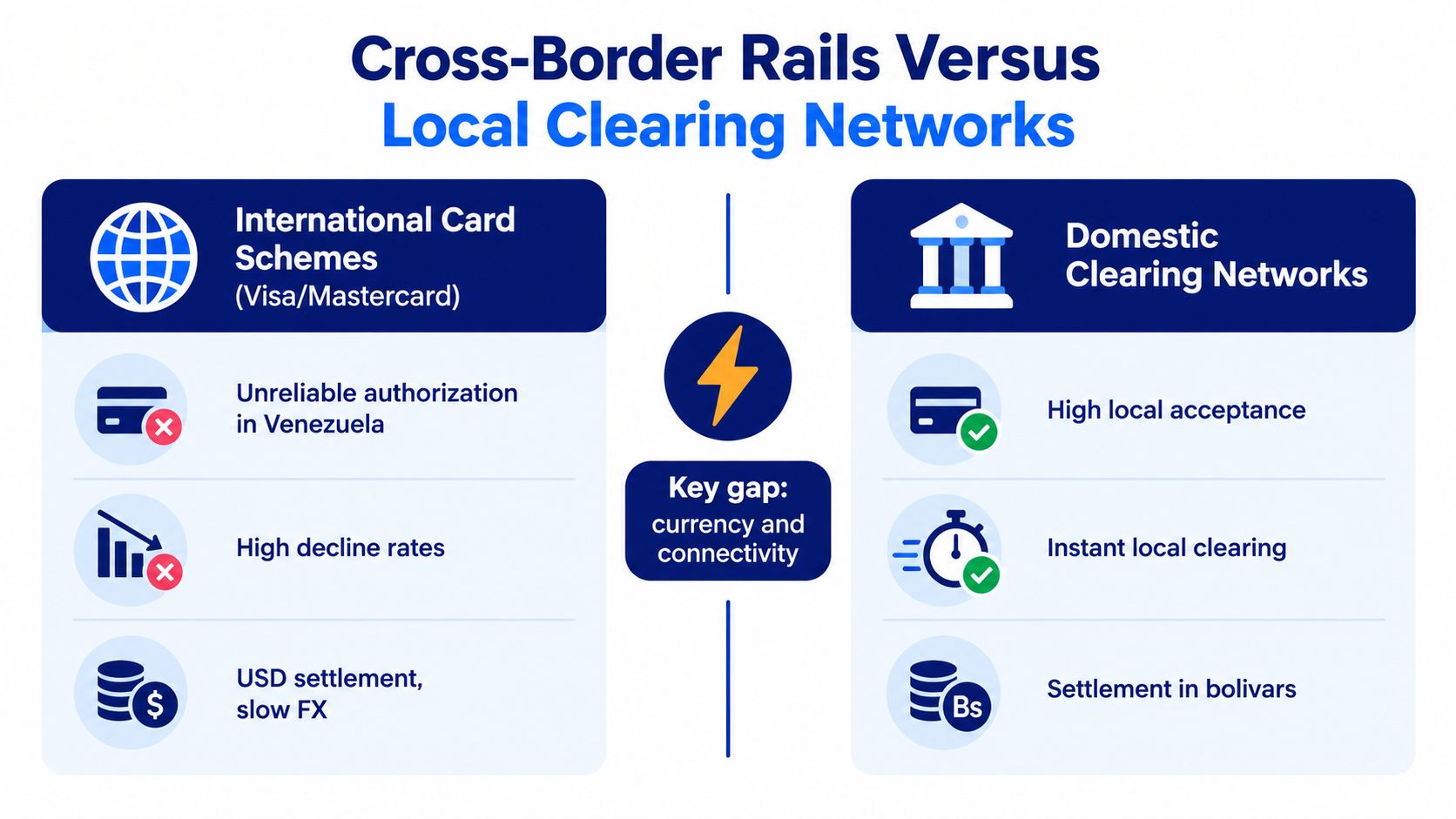
A foreign card can succeed at one Venezuelan merchant and fail at another on the same day. The difference may be the acquirer, terminal, issuer route, connectivity path, or settlement arrangement, not the cardholder's available balance. International schemes and domestic clearing networks solve different operational problems, so a provider must manage both rather than treat acceptance as a single switch.
Visa, Mastercard, and American Express offer recognizable card acceptance and cross-border authorization paths. Local debit and interbank systems connect Venezuelan banks and merchants through flows aligned with domestic accounts, local currency, and local operating conditions.
Market coverage rarely gives a provider the corridor-level evidence needed to configure routing. Approval rates by region, settlement delays by rail, and failure patterns by device or customer nationality often remain unknown until transactions are processed.
What the international route offers
International schemes give merchants a familiar checkout for foreign cardholders and cross-border buyers. They can support card-not-present authentication, and payment directories report common use of Visa, Mastercard, and American Express for Venezuelan e-commerce. 3D Secure can reduce card-not-present fraud, but authentication does not resolve connectivity or settlement failures.
The main weakness is dependency. Sanctions, banking restrictions, and interruptions in international network connectivity can produce declines that neither the merchant nor the customer can correct at checkout. Foreign-currency settlement may also be slow or difficult to operate, especially when a provider depends on one route or correspondent relationship.
What domestic clearing offers
Domestic infrastructure is more closely connected to local bank accounts and local acceptance. Venezuela's payment architecture has historically combined the Central Bank's large-value settlement system with a private interbank network for card clearing and settlement. Earlier assessments also described limited electronic-clearance capacity for retail card instruments, creating a delay between authorization and final settlement compared with markets that support fully real-time retail card clearing. The Association for Financial Professionals' country report describes this infrastructure distinction.
That difference creates two operating paths:
Question | International rail | Domestic rail |
|---|---|---|
Customer reach | Foreign cardholders and cross-border buyers | Customers using local bank accounts |
Connectivity | Exposed to international restrictions and network dependencies | Dependent on domestic banks and local infrastructure |
Settlement | Foreign-currency and correspondent-bank complexity | Tied more closely to local clearing and bolivar settlement |
Fallback need | Benefits from local transfer or mobile options | May need an international route for foreign customers |
A practical design combines routes. For merchants assessing cross-border payment solutions from Suby, the provider should manage the gap between authorization, clearing, and usable settlement. Stablecoin settlement can add another bridge where supported, allowing a provider to separate customer payment acceptance from the merchant's final settlement route. The merchant should still verify liquidity, conversion controls, reconciliation, and compliance before relying on it.
The right provider measures each route separately, then assigns fallbacks by customer, location, and transaction type.
Navigating Regulatory and Compliance Requirements
Payment access in Venezuela is permissioned. Venezuela's central bank requires non-bank payment service providers that aren't integrated into banking infrastructure to obtain prior authorization from the Banco Central de Venezuela before operating in the country. The BCV resolution sets out this authorization requirement.
That requirement changes the provider-selection process. A merchant shouldn't ask only whether an API accepts cards. It should ask which regulated entities sit behind the service, how funds move through banking infrastructure, which party performs screening, and how the provider documents its authorization and compliance responsibilities.
Start with the operating model
Before signing a contract, request a written description of the payment flow. It should identify the payin provider, acquiring relationships, settlement accounts, currency conversion points, payout destinations, and the party responsible for transaction monitoring.
The provider should also explain how it handles:
Local authorization. Identify the issuer and acquirer paths used for domestic and foreign cards.
Cross-border screening. Confirm how the provider checks customers, merchants, counterparties, and restricted activities.
Settlement permissions. Understand whether the provider is integrated into banking infrastructure or requires separate BCV authorization.
Record retention. Establish how transaction, refund, dispute, and payout records are stored and exported.
Change management. Ask how the provider communicates regulatory or banking-route changes that could affect service.
A 2019 BCV resolution set a two-phase national card-processing rollout. Debit-card processing had to be operational before 30 November 2019, and credit-card processing before 30 January 2020. Research and Markets summarizes these domestic processing deadlines. The deadlines show that the country's card acceptance environment has been shaped by explicit infrastructure mandates, not just merchant integration choices.
Track charges and governance
A 2026 Venezuela payments-regulation monitor reports that BCV rules cap commissions for interbank Pago Móvil and instant transfers. It describes P2P deposit fees of up to Bs.0.30 per Bs.100 and C2P payout fees of up to 2%, while also reporting that Venezuela has no dedicated non-bank payment-institution or e-money licensing regime. The Venezuela jurisdiction monitor explains the current bank-channel structure and tariff caps.
For internal controls, a governance framework such as DevArmor governance framework can help teams organize ownership, evidence, approvals, and monitoring across a regulated payment operation. Pair that governance work with a documented PCI compliance requirements review, but don't treat PCI controls as a substitute for local authorization or sanctions analysis.
Solving the FX and Settlement Bottleneck
Accepting the payment is only half the operating problem. A merchant may receive a successful card authorization while still facing uncertainty about when the funds become available, which currency arrives, which bank can receive the payout, and how much value is lost during conversion.
The practical solution is to decouple the payin method from the payout rail. The customer can pay by card, bank transfer, wallet, or crypto, while the business chooses whether proceeds arrive in a bank account or stablecoins such as USDC, subject to the provider's supported routes and compliance controls.

Separate the customer experience from merchant settlement
A Venezuelan customer shouldn't have to understand the merchant's preferred settlement currency. They should see a familiar checkout and receive a clear result. The merchant, meanwhile, may want the proceeds in a foreign bank account or stablecoins rather than holding operational balances in a volatile local-currency environment.
Suby is one example of this model. It provides an API that lets any business accept payments by card or crypto, and customers can pay by card, wallet, bank, BNPL, or supported crypto methods while the business chooses how to receive the money. One available flow is card payment with settlement in USDC, but the same product also supports other combinations, including bank payouts and different currency preferences.
The product is a single platform with four ways to use it:
Suby Payments provides an API-first payment stack for accepting cards and crypto through one checkout.
Suby Crypto operates as a crypto payment gateway, handling the swap, sponsoring gas, and settling to a non-custodial wallet or the Suby balance.
Suby Gating provides paid access for Discord, Telegram, downloads, and courses, including subscription-style community use cases.
Suby Invoicing lets the client choose how to pay while the business chooses what it receives.
Suby also offers native Discord and Telegram integrations for subscriptions, paid access, and online communities. The core operating model is straightforward: customers pay any way they want, and businesses get paid the way they choose.
Make reconciliation part of the design
Stablecoin settlement doesn't remove the need for controls. The merchant still needs to match the original order, authorization result, fees, conversion, payout, refund, and dispute status. A deterministic reconciliation workflow is useful because it gives finance teams a repeatable method for matching every payment event to a ledger entry and a customer account.
Don't promise “instant settlement” unless the provider defines exactly what it means. Ask whether it refers to authorization, balance availability, blockchain confirmation, bank payout initiation, or final receipt. Those are different events, and each can have its own timing, risk, and reporting requirements.
Integration Options and Security Checklists
The integration choice should follow the merchant's operating model. A custom SaaS product may need API calls, webhooks, recurring billing, and a dashboard. A consultant may need an invoice or paylink. A community operator may need paid access in Discord or Telegram without building a checkout from scratch.

Match the interface to the business
API-first checkout gives a product team control over the payment flow, payment-method presentation, webhooks, and subscription logic. It suits custom applications where the checkout is part of the product experience.
Hosted checkout is usually faster to launch because the provider manages more of the customer-facing interface. It can reduce the amount of sensitive payment handling in the merchant's application, but the team still needs to test localization, foreign-card authentication, error messages, and fallback presentation.
No-code paylinks and invoicing work well for sales-led commerce, agencies, freelancers, and businesses selling through chat, email, or social channels. The merchant should still connect each payment to an order or client record so a successful payment doesn't become an orphaned finance event. The payment processing integration guide from WebInOne provides useful implementation context for comparing these approaches.
Review security before launch
Use the following checklist during technical and compliance review:
PCI DSS scope: Confirm which party stores, transmits, and processes card data, and request the provider's current compliance documentation.
3DS authentication: Check how Strong Customer Authentication and 3D Secure are triggered for foreign cards and higher-risk transactions.
Tokenization: Verify that stored credentials are represented by tokens rather than retained as raw card data in the merchant environment.
Fraud controls: Configure rules for velocity, geography, device behavior, repeated declines, and unusual subscription activity.
Disputes and refunds: Confirm who receives dispute notices, how evidence is submitted, and how refunds affect the merchant balance.
Webhook reliability: Require signed events, idempotent processing, retry behavior, and clear status transitions for payment, refund, and payout events.
Suby's documented security capabilities include a PCI-DSS Level 1-certified processing partner, Strong Customer Authentication, two-factor authentication, dispute handling, and zero-fee refunds. Pricing depends on the payment method used, so merchants should review the official pricing page for exact figures rather than rely on a single flat rate.
Decision Criteria for Choosing Your Provider
A suitable card payment provider in Venezuela should solve more than card acceptance. It should give you a credible answer for local reliability, international routing, regulatory permission, reconciliation, foreign-exchange handling, and payout access.
Start with transaction coverage. Can the provider accept local and foreign cards, and can it present bank or mobile-payment alternatives when a card route fails? Next, examine settlement. Does the merchant receive local currency, a foreign bank payout, stablecoins such as USDC, or a choice among those destinations?
Evaluate the whole operating surface
A practical decision matrix should include:
Criterion | Questions to ask |
|---|---|
Routing | Which acquirers and fallback rails serve Venezuelan customers? |
Settlement | When does an authorized payment become available, and in what currency? |
Compliance | Which regulated entities and authorizations support the flow? |
Operations | Can finance export payment, refund, dispute, and payout records? |
Product fit | Does the platform support one-time payments, subscriptions, invoices, and paylinks? |
Distribution | Are Discord and Telegram integrations available for paid access and communities? |
Visibility | Does the dashboard show payments, subscriptions, churn, and payouts in real time? |
Don't choose on the headline transaction fee alone. Pricing depends on the payment method, and a cheaper card route can become expensive if it creates declines, manual reconciliation, trapped balances, or a second integration for fallback payments.
The stronger architecture is usually one platform that lets customers pay by card or crypto, supports bank and wallet methods where available, and lets the business choose its settlement destination. That flexibility matters more than a generic “cards accepted” badge because Venezuelan payment behavior and cross-border connectivity don't fit a single rail.
Suby provides an API that lets any business accept payments by card or crypto, with native Discord and Telegram integrations for subscriptions, paid access, and online communities. If you need customers to pay any way they want while your business receives funds in the currency and destination it chooses, visit Suby to review the available payment, crypto, gating, and invoicing options.
