

Gaspard LEZIN
Your Guide to Managing SaaS Subscription Payments
Master managing SaaS subscription payments globally. This guide covers billing models, churn reduction, and receiving USDC settlements for card payments.
Managing SaaS subscriptions is about so much more than just hitting "charge" on a credit card every month. It’s the entire lifecycle of a customer relationship, from billing and upgrades to handling cancellations and ensuring you’re compliant worldwide. Getting this right isn't just an administrative task; it's a core strategy for tracking your real costs and building predictable revenue.
The True Cost of Managing SaaS Subscriptions
The incredible ease of signing up for a new SaaS tool can be a double-edged sword. It’s fantastic for letting teams grab the software they need, but it often creates a tangled mess of operational and financial headaches that sneak up on you. For a growing number of businesses, wrestling with this complexity has become a top priority.
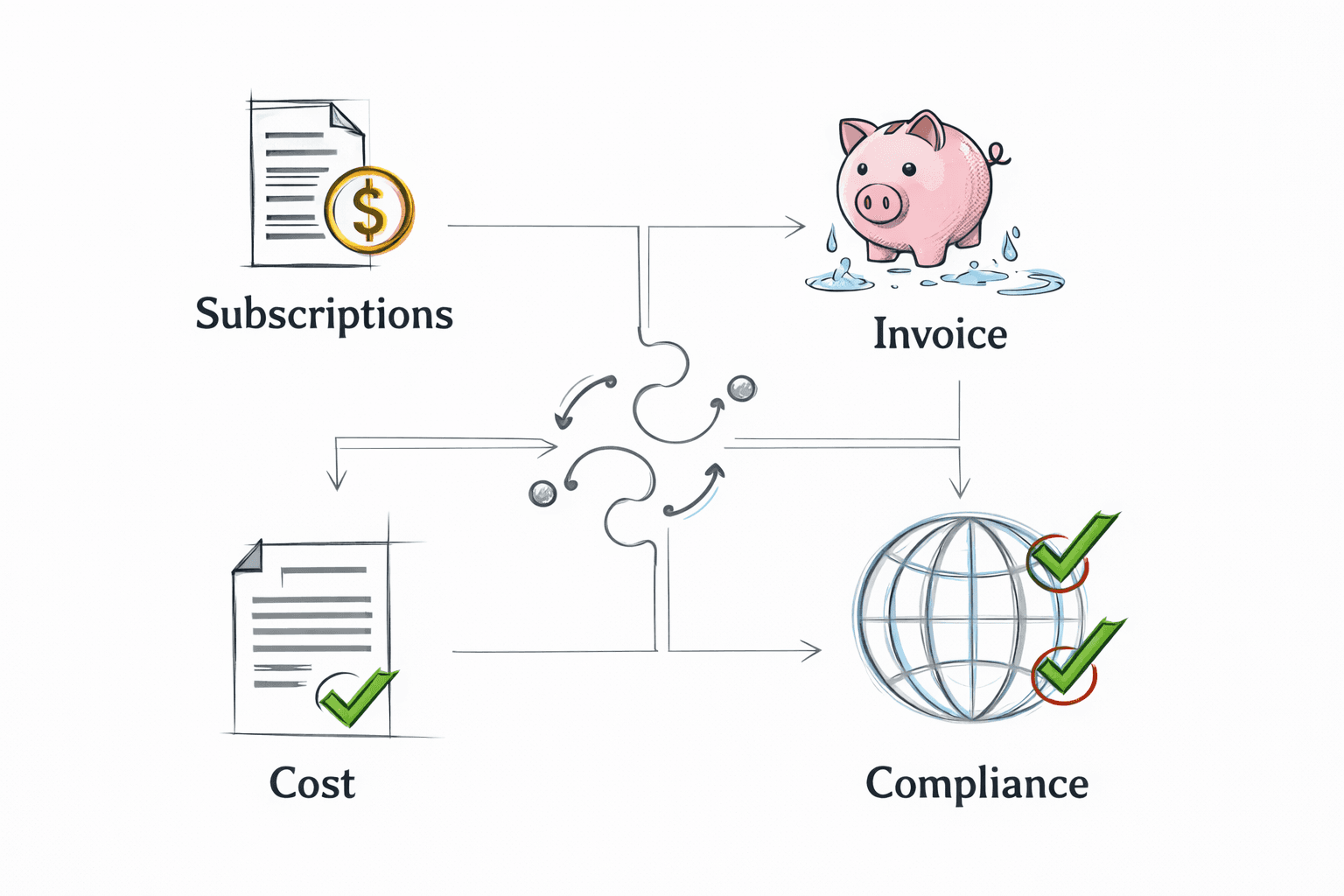
This operational drag is almost always fueled by what we call "app sprawl." This happens when you have dozens, or even hundreds, of different apps running across the company. Many of them have overlapping features or, worse, inactive user accounts you're still paying for. The financial leakage from this is a direct hit to your bottom line.
To get a handle on this, it's helpful to see the core pieces of a subscription management system.
Here's a breakdown of the essential pillars for a successful subscription management system, from billing logic to customer lifecycle events.
Key Components of SaaS Subscription Management
ComponentKey FunctionBusiness ImpactBilling ModelsDefines how customers are charged (e.g., flat-rate, tiered, usage-based).Directly impacts revenue, customer acquisition, and scalability.Recurring Billing EngineAutomates the process of invoicing and charging customers on a set schedule.Reduces manual work, ensures timely payments, and improves cash flow.Proration & AdjustmentsCalculates charges for mid-cycle upgrades, downgrades, or cancellations.Ensures fair billing, prevents revenue loss, and improves customer satisfaction.Dunning ManagementManages the process of communicating with customers about failed payments.Recovers failed payments automatically, reducing involuntary churn.Subscription LifecycleHandles customer actions like pausing, resuming, or canceling subscriptions.Provides flexibility for customers, reducing permanent churn.Global Payments & ComplianceManages currency conversion, local payment methods, and sales tax.Expands market reach and minimizes financial and legal risks.
Each of these components plays a critical role. Without a cohesive system, you're left patching together solutions, which is where the real costs start to add up.
The Problem of App Sprawl and Budget Pressure
Recent data shows just how big this problem has become. Companies are finally trying to get their software stacks under control, with the average number of SaaS apps dropping from 371 in 2023 to 220 in 2024. The reason is simple: a staggering 63% of organizations admit that having too many unused apps is a major issue.
If this trend continues, projections show companies could overspend by as much as 25% on software they don't need by 2027.
This inefficiency is a constant drain. Finance and IT teams burn hours just trying to figure out who owns which subscription, when it renews, and if anyone is even using it. Without a central source of truth, this manual chase leads to missed renewal deadlines, surprise price hikes, and a complete black hole where your money is going.
Effective subscription management transforms this chaos into a predictable, strategic function. It’s about moving from a reactive state of fighting fires to proactively controlling costs and maximizing the value of your software investments.
The Hidden Costs of Global Payments
For any business with an international footprint, the complexity just keeps multiplying. Taking payments from customers all over the world introduces a whole new layer of operational pain.
With traditional payment processors, you’re constantly dealing with:
Currency conversion fees that eat into your margins.
Settlement delays that mess with your cash flow.
A patchwork of different banking rules for each country.
These friction points make it nearly impossible to forecast revenue accurately. If you're managing global payments, it's crucial to understand all the charges involved, which you can learn more about in our guide covering common payment processing fees.
A modern payment layer cuts through all of this. By letting customers pay with their local cards while settling your funds in a stablecoin like USDC, you can sidestep these legacy hurdles entirely. We provide an API that lets you build a unified system to accept card or crypto payments globally, manage subscriptions, and get your funds predictably without worrying about currency swings. We also offer native integrations for Discord and Telegram, perfect for automating access to paid communities.
How to Choose Your SaaS Billing and Pricing Model
Picking your billing and pricing model is one of those foundational decisions that will echo through the life of your SaaS business. Get it right, and you create a smooth runway for growth. Get it wrong, and it’s like trying to take off with the brakes on. This isn't just about slapping a price on your product; it's about defining and communicating its value.
The real goal is to find that perfect balance where customers feel they're getting a great deal for the value you provide, while your business stays profitable and competitive. To do that, you have to get intimately familiar with your product, your ideal customer, and where you want to be in five years.
Understanding the Core Pricing Models
Most SaaS pricing strategies are built on a few battle-tested SaaS subscription models. Each one has its own personality, its own pros and cons. The best fit for you really depends on what your product does and who you're selling it to.
Let's break down the usual suspects:
Flat-Rate Pricing: This is the "what you see is what you get" model. One product, one set of features, one price. It's brilliantly simple for customers to understand and a breeze for you to manage. This approach shines for tools with a very specific function and a uniform customer base.
Tiered Pricing: Probably the model you see most often. You create several packages, like Bronze, Silver, and Gold, at different price points. Each tier unlocks more features, higher usage limits, or better support. Structuring your subscription tiers well is a fantastic way to serve a diverse market, from solo founders to massive enterprise teams.
Usage-Based Pricing: You might know this as "pay-as-you-go." Here, the bill is tied directly to consumption, just like your electric bill. It's the go-to model for infrastructure platforms (Amazon Web Services), API-first products (Twilio), and any tool where "how much you use it" is the clearest measure of value.
Per-User Pricing: Simple and predictable. The price scales with the number of "seats" or users on an account. It’s a natural fit for collaboration software where the value grows as more people join the team. The only catch? It can get expensive for large, growing teams, sometimes causing them to hesitate before adding new members.
Factors to Consider When Choosing Your Model
There’s no magic formula here. A model that’s perfect for a project management tool could spell disaster for a data storage platform. The secret is to anchor your pricing to your value metric, the specific unit of value your customer gets from your product.
Is your value metric the number of contacts in a CRM? The amount of data processed? The number of team members collaborating on a design? Once you nail that down, you can build a pricing model that scales logically with the value delivered.
You also have to run the numbers. The financial reality of SaaS can be harsh. Poor subscription management isn't just about a bloated software budget; it ripples across the entire organization. For B2B SaaS, the average Customer Acquisition Cost (CAC) is a hefty $239. But that number varies wildly by industry, as fintech companies are looking at a CAC of $1,450, while legaltech is closer to $299.
Your pricing has to be robust enough to recover those acquisition costs and deliver a strong lifetime value, all while weathering a typical annual churn rate of 5-7%. You can discover more insights about these SaaS marketing statistics to help ground your strategy in real-world data.
Evolving Your Pricing with Hybrid Models
As your product matures, you might find that a single, rigid pricing model starts to feel restrictive. That's when it's time to think about hybrid models. The most successful SaaS companies don't just "set it and forget it," they blend elements from different models to create something more flexible.
For example, a company might offer a tiered plan that includes 10 users, but then charge on a per-user basis for every additional seat. Another common hybrid is a subscription that includes a generous amount of usage, with simple overage fees for customers who need more.
Your pricing strategy should never be set in stone. The companies that win are the ones that constantly revisit their pricing. They test new models, tweak their tiers, and listen to customer feedback. It's a living part of your product.
Juggling this kind of billing complexity, especially as you expand globally, is nearly impossible without the right payment infrastructure. You need a flexible payment layer that can effortlessly handle recurring payments, calculate proration when customers upgrade or downgrade, and adapt to any billing logic you dream up. Our API, for instance, is built to let businesses accept card payments from anywhere and get settlements in USDC. This cuts through the complexity of global operations, whether you're managing subscriptions for a high-growth SaaS or a paid online community on Discord and Telegram.
Putting Your Recurring Billing System in Place
After you’ve landed on a pricing model, it’s time to build the engine that actually drives your revenue. This is where you turn those strategic decisions into a real-world, automated billing system. Think of it as the operational heart of your SaaS, as it’s responsible for everything from charging customers on schedule to gracefully handling plan changes.
This goes way beyond just setting up a simple monthly charge. A truly effective system has to manage proration when customers upgrade or downgrade, automate invoicing, and give every user a seamless experience, no matter where they are. As you map out your billing infrastructure, it’s worth understanding the fundamentals of how to set up recurring payments for a scalable business.
From Manual Invoices to Automated Collections
The number one goal here is automation. Manually sending invoices and chasing down payments simply doesn't scale. It’s also a recipe for human error, which can erode customer trust and throw your cash flow into chaos. A solid system should automatically generate and send invoices on the correct billing date for every single subscriber.
But this automation has to be smart. What happens when a customer upgrades their plan mid-cycle? The system needs to instantly calculate the prorated amount for the rest of the month and then adjust the next invoice. This kind of transparency keeps your billing fair and predictable, saving you from a mountain of customer support tickets down the line.
Choosing and implementing your billing model is foundational. This process isn't a one-and-done task; it’s a cycle of analysis, choice, and evolution.
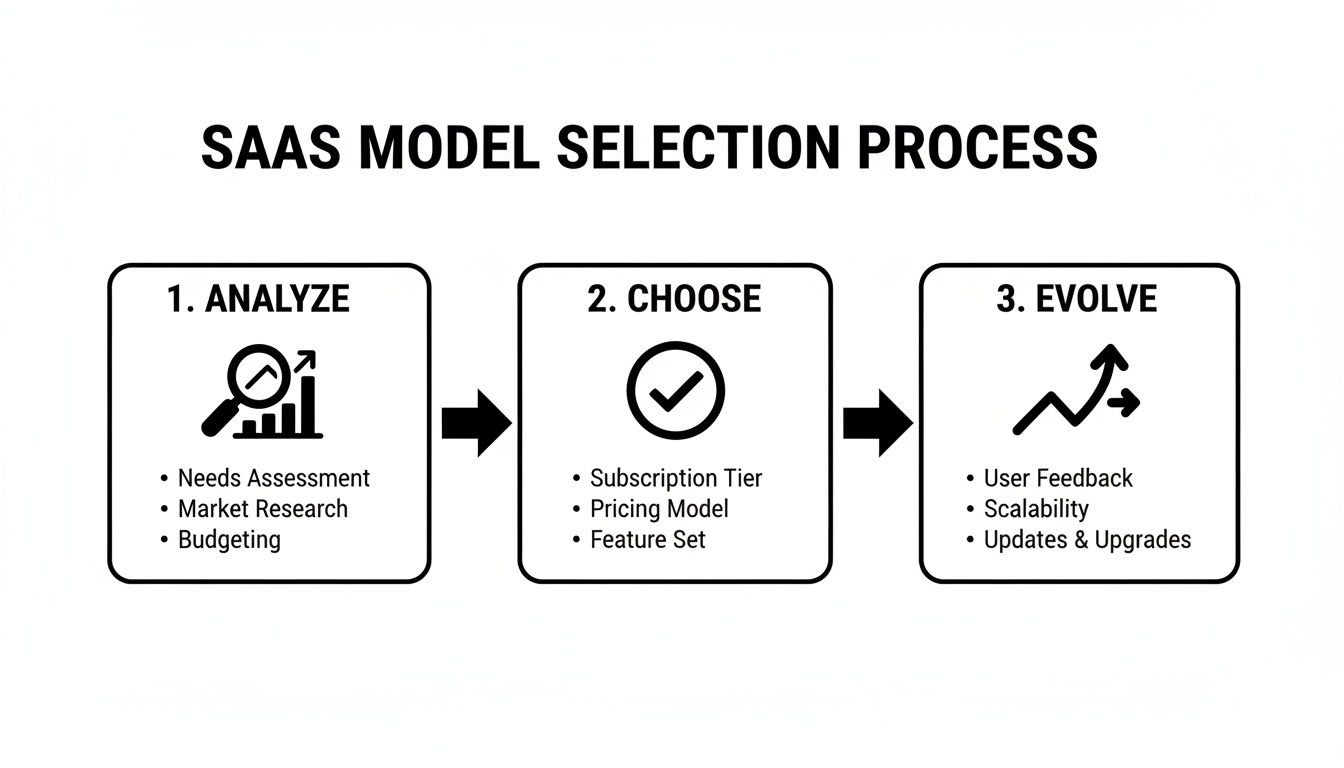
As the flowchart shows, your billing system needs to adapt right alongside your business as it grows and changes.
Solving Global Payment Headaches with Predictable Settlements
If you’re operating globally, setting up recurring billing gets complicated fast. Traditional payment processors often introduce a ton of friction, like currency conversion fees, long settlement delays, and the nightmare of managing multiple international bank accounts. It makes forecasting your revenue a constant guessing game.
A more modern approach completely sidesteps these problems. By using a global payment layer, you can offer a familiar checkout where customers pay with their card (like Visa or Mastercard) in their local currency. Here’s the clever part: on the backend, your revenue settles directly into a stablecoin like USDC.
This model delivers true financial predictability. You get your funds without sweating currency fluctuations or waiting days for bank settlements. It radically simplifies global operations and protects your profit margins from being eaten by hidden fees.
This is precisely where a solution like Suby comes in. Suby is a global payment layer for online businesses and creators, combining card and crypto acceptance with fast, predictable USDC settlements. It lets you sell anywhere in the world without the usual headaches of currency conversion, FX fees, banking delays, or payout uncertainty.
Flexible Integration for Any Type of Business
How you plug this system into your business really depends on your technical comfort level and goals. The good news is, you don't need a team of developers just to get started.
Here are a few common ways to get up and running:
Payment Links: This is the simplest method by far. You can generate a unique, shareable link for a specific subscription plan and send it directly to customers. It's perfect for one-off invoices or situations where you don't need a checkout flow embedded on your site.
Embedded Checkout: This offers a great balance between ease and professionalism. You can drop a pre-built, conversion-optimized checkout form right onto your website. This keeps customers on your domain for a smooth, branded experience without you having to write a line of code.
Full API Integration: For businesses that need total control and a completely custom experience. A powerful API lets you build your entire billing and subscription management logic directly into your app. This is the way to go for handling complex pricing, unique user flows, and deep product integrations.
A truly flexible payment provider will support all these methods, letting you start simple and evolve your setup as you scale. For a closer look at the tools out there, check out our guide on the best subscription billing software to compare different options. Whether you're a creator monetizing a community or a SaaS founder taking on the world, the right system turns payments into a source of strength, not stress.
Reducing Involuntary Churn with Smart Dunning
Failed payments are one of the most frustrating ways to lose customers. This isn't someone actively canceling, it's involuntary churn, a simple technical glitch like an expired credit card that silently kicks a paying customer out of your service. If you're serious about managing SaaS subscriptions, you need a smart dunning process to catch this revenue before it disappears.
Think of dunning as the automated process of chasing down failed payments. Done poorly, it feels like harassment. But when it's done right, it's a helpful nudge that gives customers a chance to fix their billing info and keep using the product they love. It's all about preserving that customer relationship you worked so hard to build.
Building a Smart Dunning Flow
An automated dunning sequence is your best defense against involuntary churn. But a smart one does more than just retry a failed card over and over. It's a more thoughtful approach, combining pre-dunning notices, intelligent retries, and crystal-clear communication.
Here’s what a truly effective flow looks like in practice:
Pre-Dunning Notices: Send a friendly, automated email a week or two before a customer's card is due to expire. This simple heads-up gives them plenty of time to update their payment details, stopping the payment failure before it even happens. It’s a proactive win.
Intelligent Retry Logic: When a payment does fail, don't just hammer the card every 24 hours. Some failures, like insufficient funds, are temporary. Others, like a reported stolen card, are permanent. A smart system knows the difference. It might retry a "soft" decline a few days later, or even try again at different times of the day when people are more likely to have funds in their accounts (think: right after a common payday).
Clear Communication: Every failed payment needs to trigger an email that is helpful, not alarming. It should clearly explain what happened, provide a direct link to a secure page to update their billing info, and gently state the consequences if the issue isn't fixed, like a temporary account suspension.
The whole point of dunning isn’t to strong-arm customers for money. It's about helping them continue to use a service they already value. Getting the tone and timing right can turn a potential cancellation into a positive touchpoint that actually builds trust.
Handling Disputes and Chargebacks
Now, even with the best dunning process in the world, you’re going to run into payment disputes, or chargebacks. This is when a customer goes directly to their bank to reverse a charge, often because they don't recognize it or have an unresolved service issue. To really get a handle on this, check out this proven guide to retaining SaaS customers, which is a great complement to your dunning strategy.
When a chargeback hits, your payment processor usually freezes the funds and you have to prove the charge was legitimate. You need to respond fast. Be ready with evidence like:
The initial subscription agreement or terms of service sign-off.
Server logs showing the customer logging in and using your product.
Copies of any emails or support tickets with that customer.
Dealing with disputes is a time-suck, no doubt. A modern payment platform can make this much less painful by giving you a dashboard to manage everything. For example, our system lets you handle disputes right from your account. We operate with a PCI-DSS Level 1–certified partner and bake in security like strong customer authentication, so you're already on solid ground.
The ability to offer zero-fee refunds is another powerful tool in your arsenal. If a customer has a valid complaint, issuing a quick, no-hassle refund can prevent a formal chargeback and save the relationship. It’s always better than losing a customer for good over a billing disagreement. For a deeper look at this, our article on the essentials of the dunning process has you covered. With the right setup, you can navigate these challenges without losing your mind, or your revenue.
How to Measure and Optimize Your Subscription Performance
Once your billing system is up and running, the real work begins. It’s easy to get caught up in vanity metrics like total sign-ups, but those numbers don't tell you the whole story. To build a truly sustainable business, you have to dig deeper into the metrics that actually signal health and momentum.
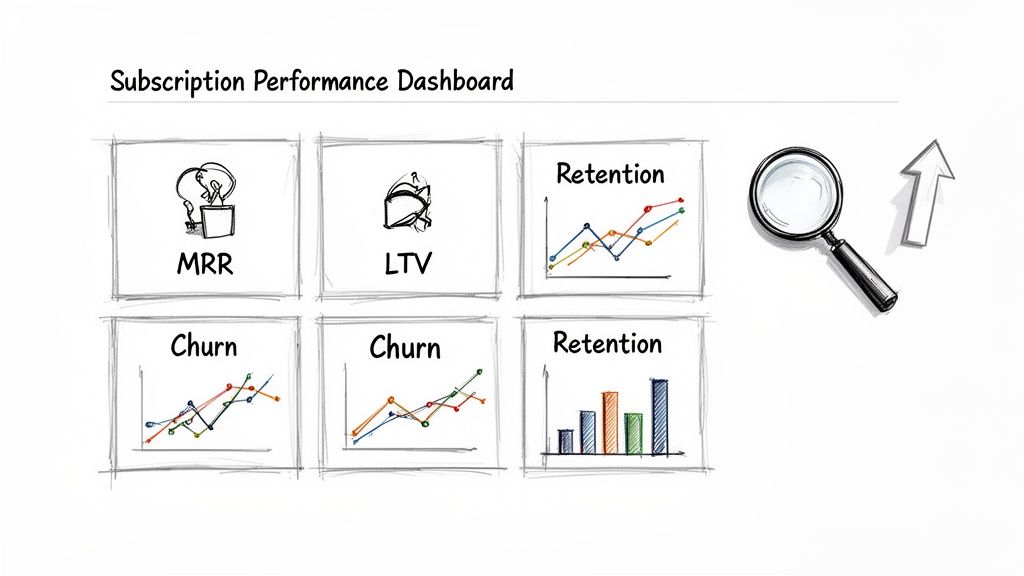
This is all about making smarter decisions. By consistently tracking a few core Key Performance Indicators (KPIs), you get the data you need to fine-tune your product, marketing, and pricing. It’s how you find out what’s working, what’s broken, and where your best opportunities lie.
The Metrics That Truly Matter
You could track dozens of different numbers, but a handful are absolutely non-negotiable for any subscription business. These are the KPIs that give you a clear, honest look at your financial stability and growth potential.
Monthly Recurring Revenue (MRR): This is the heartbeat of your SaaS. MRR is the predictable, reliable income you expect from all active subscriptions each month. It's not just a number; it’s your growth trajectory and your best tool for financial forecasting.
Customer Lifetime Value (LTV): How much is a customer actually worth to you over time? That’s LTV. It’s the total revenue you can realistically expect from an average customer before they churn. A high LTV is a fantastic sign that people stick around and find real value in what you offer.
Churn Rate: This is the percentage of customers who cancel their subscriptions in a given period (usually a month). Churn is the silent killer of growth. Keeping this number low is critical because acquiring a new customer is almost always more expensive and difficult than retaining an existing one.
These three metrics don't live in a vacuum, they tell a story together. A rising MRR looks great on its own, but if it's paired with a climbing churn rate and a flat LTV, you have a serious problem with retention.
From Data to Actionable Insights
Just knowing these numbers isn't the point. The magic happens when you use them to ask tough questions about your business.
What if your churn rate suddenly spikes after a pricing update? That’s a direct signal to rethink your pricing model or how you communicated the change. Or maybe you notice one specific customer segment has a dramatically higher LTV. Now you know exactly where to double down with your marketing budget.
The goal is to create a feedback loop where data informs your decisions, and you can measure the impact of those decisions back on your core metrics. This iterative process of measuring, analyzing, and optimizing is the engine of sustainable growth.
Trying to piece this all together manually with spreadsheets is a recipe for headaches and missed opportunities. This is where a unified, real-time dashboard becomes your most valuable tool. A real-time dashboard gives merchants visibility into payments, subscriptions, churn, and payouts.
It brings all of your crucial metrics into one place for an at-a-glance health check. You can learn more about how Suby is designed to be launched in minutes and scaled internationally without you needing to build out any additional payment infrastructure.
Our API and native integrations with platforms like Discord and Telegram ensure that every payment and subscription event is fed directly into your dashboard in real-time. Whether you're running a traditional SaaS or a paid community, this automates all the tedious data-wrangling, freeing you up to focus on what actually moves the needle: growing your business.
Getting Your Billing System Hooked Into Your Product
You've mapped out your pricing and defined your key metrics. Now for the fun part: actually connecting it all to your product. This is where your strategy meets the customer. Get it right, and signing up feels seamless. Get it wrong, and you'll create friction that costs you sales.
How you wire everything up really depends on your technical team's bandwidth and your immediate goals. The good news is you don’t have to build the most complex system from day one. Many successful companies start with a simple setup to get to market quickly, then layer on more sophisticated integrations as they grow.
Choosing Your Integration Path
There are three main ways to bring subscription billing into your product. Each strikes a different balance between speed, control, and brand experience.
Payment Links
Think of this as the "get it done now" approach. You generate a unique, shareable link for a specific subscription plan. It's incredibly fast.
You can place these links anywhere:
On a simple landing page
In an email invoice to a specific client
Directly in a chat message
This is perfect for validating an idea, selling access to a simple service, or when you just don't need a full-blown on-site checkout experience yet.
Embedded Checkout
For a more polished feel, an embedded checkout keeps your customers on your website throughout the entire payment process. You’re essentially dropping a pre-built, secure payment form right onto your page.
This is a huge step up in professionalism. It keeps your brand front and center and removes the jarring experience of being redirected to another site to pay. Best of all, you get this improved user experience without having to write a single line of payment code yourself.
Full API Integration
This is the path for total control and deep customization. Using a robust API, like the one offered by Suby, lets you build the entire subscription logic directly into your application.
This is the go-to for founders who need to handle unique billing scenarios, create custom upgrade or downgrade paths, or tightly couple payment status with in-app features. If you can dream it, you can build it with an API.
A Special Case: Monetizing Online Communities
If you're running a paid community, your integration challenge isn't just about payments, it's about access control. Manually adding new members to a Discord server or Telegram channel when they pay, and, just as importantly, removing them when they stop, is a nightmare. It's tedious, error-prone, and simply doesn't scale.
This is where a unified system becomes a game-changer. Suby also provides automatic access management for Discord and Telegram communities, allowing creators and businesses to monetize memberships and digital access globally. The payment, the access, and the entire subscription lifecycle are all handled in one spot. No more spreadsheets or manual "bouncing" of non-paying members.
When a user successfully subscribes, they’re automatically granted access. If their payment fails or they cancel, their access is just as cleanly revoked. It creates a fair and seamless experience for you and your members.
To see exactly how this works, you can dive into the full documentation on monetizing communities.
Our entire platform is built for this kind of flexibility. You can start with a simple payment link for your Discord server this afternoon. As your community and ambitions grow, you can transition to a full API integration on a custom platform later on. The goal is to give you the tools you need to accept card payments from a global audience and get fast, predictable USDC settlements, no matter which path you choose.
Common Questions About Managing SaaS Subscriptions
Once you dive into managing subscriptions, you'll find the same questions pop up time and time again. Founders and operators are always wrestling with a few key challenges, so let's get you some straight answers based on what we see in the real world.
How Can I Accept Global Payments Without High FX Fees?
Dealing with global payments and getting hammered by foreign exchange (FX) fees is a classic headache for SaaS founders. The modern way around this is to use a global payment layer that separates how your customer pays from how you get paid.
This lets your customers pay in their own currency using their preferred card, like Visa or Mastercard. But on your end, the revenue settles directly into a stablecoin like USDC. This completely sidesteps the volatility and hidden fees of traditional currency conversion. You get predictable revenue from every single transaction, without the friction of cross-border banking.
What Is the Best Way to Handle Failed Subscription Payments?
A failed payment doesn't have to mean a lost customer. In fact, if you handle it well, it can actually be a positive touchpoint. The key is an automated dunning management system that's more about communication than just retrying a card.
A solid dunning strategy is really about proactive, helpful communication:
It sends pre-dunning emails before a customer's card is about to expire.
It uses intelligent retry logic, attempting the charge at smarter times after a soft decline instead of just spamming the network.
It gives customers a simple, secure link to update their payment details themselves.
This approach turns a potential churn event into a moment where you're actively helping a customer.
The goal of a good dunning process isn't to pressure customers. It's to help them seamlessly continue using a service they already find valuable, which protects your recurring revenue.
Can I Manage Subscriptions for a Discord or Telegram Community?
Yes, absolutely. We're seeing a huge rise in paid communities on platforms like Discord and Telegram, and managing those subscriptions used to be a real pain. Today, modern payment platforms offer native integrations that solve this problem elegantly.
These integrations automate the entire user lifecycle. When someone subscribes, the system instantly grants them the right role and access in your community. If their payment fails or they cancel, their access is just as cleanly revoked. This connects payment, access control, and subscription management into one seamless flow, so you can stop manually managing roles for good.
Suby is a payment gateway and payment processor for subscription businesses. Your customers pay with card, bank transfer, Apple Pay, Google Pay, Klarna, and more, or crypto, and you get paid out to your bank account, or in stablecoins (USDC, EURC) to your wallet, anywhere in the world with no bank account required. For managing SaaS subscriptions, it pairs with smart dunning, auto-retries, and embedded checkout so recurring revenue keeps flowing with far less manual work.
