

Gaspard LEZIN
How to Accept ACH Payments Instantly (a 2026 Guide)
Learn how to accept ACH payments instantly. This guide covers the tech, provider choices, compliance, and common pitfalls for businesses and developers.
The most popular advice about accepting ACH payments instantly is also the least precise: turn on Same Day ACH and call the problem solved. Same Day ACH is faster than standard ACH, but it isn't continuous, 24/7 settlement. It runs through processing windows and settles within hours, while RTP and FedNow are separate real-time rails with different reach.
That distinction matters because payment speed affects cash flow, fulfillment, account funding, refunds, and customer trust. The ACH Network processed 35.2 billion payments worth $93 trillion in 2025, with average daily volume reaching 141 million payments. Even modest improvements across a network of that size have broad commercial consequences.

The practical question isn't whether ACH can be instant. It is which rail should process a payment, what happens when that rail isn't available, and when your business can safely release value. Businesses that want a wider view of faster digital communication can also review Exerta explains instant messaging ROI, particularly when evaluating response speed as part of the customer experience.
For a closer explanation of ordinary ACH timing, see how long an ACH transfer takes. The answer helps establish the baseline before you design an experience that promises faster access.
Table of Contents
Why Businesses Want Instant Payments
Businesses rarely request instant bank payments because speed sounds modern. They need to remove a specific operating delay. A merchant may want to release inventory sooner, a marketplace may need to fund a seller, or a software company may want to activate a paid account without leaving the customer in a pending state.
Traditional ACH remains useful for broad bank-payment coverage, yet its batch process can leave businesses uncertain after a payment is initiated. The merchant may not know whether the funds will remain available, whether the debit will be returned, or when the customer can safely use the service. That gap between initiation and operational confidence produces support requests, manual review, and reconciliation work.
Speed changes more than the checkout screen
Faster confirmation can improve several workflows:
Cash flow visibility: Finance teams can see payment progress instead of planning around an unclear settlement cycle.
Customer activation: A subscription, download, course, or account credit can become available closer to payment time.
Fulfillment decisions: Merchants can hold fewer orders solely because a bank payment remains pending.
Support workload: Clear status updates reduce questions about whether a payment succeeded.
Time-sensitive operations: Businesses can respond outside ordinary banking schedules when a supported real-time rail is available.
The operating benefit depends on what “instant” means in your system. A payment may be submitted instantly, settled instantly, or used to grant customer access instantly. Those are separate events, and each needs its own status, control, and fallback logic.
Practical rule: Define the business event you want to accelerate before choosing a rail. “Payment submitted,” “funds settled,” and “customer access granted” may be separate events in your system.
Instant settlement also does not eliminate payment risk. A business still needs identity checks, authorization controls, reconciliation, and exception handling. Faster movement of money changes the timing of those processes, not the need for them. For additional context on ordinary ACH timing, review how long an ACH transfer takes before setting a faster-payment promise.
ACH remains foundational
ACH's scale explains why companies continue improving bank-payment experiences instead of replacing the rail entirely. The network processed billions of payments and trillions of dollars in 2025, as reported in the Nacha network statistics. Its broad reach makes it a practical base, while faster rails can handle eligible transactions where timing and bank participation support them.
The stronger product promise is specific: use the fastest eligible route, show the accurate payment status, and keep a fallback for customers who cannot use the preferred rail. That approach gives businesses room to improve payment speed without describing every bank payment as instant. Clearer customer communication also supports the wider case for faster digital interactions described in Exerta explains instant messaging ROI.
Understanding Your Instant Payment Options
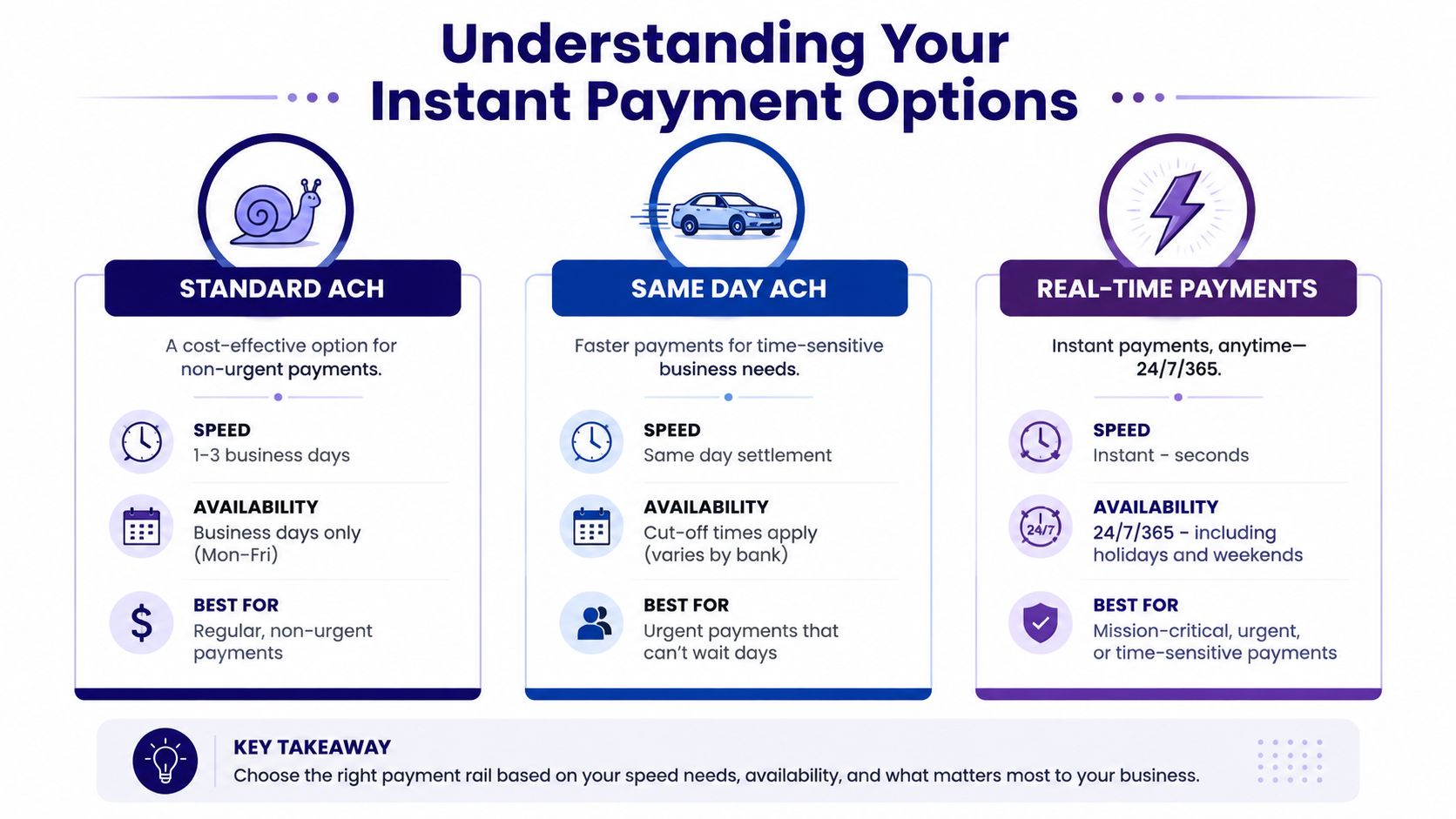
Think of U.S. bank payments as a road system rather than a single highway. Standard ACH is a scheduled route that moves in batches. Same Day ACH uses the same general network with faster processing windows. RTP and FedNow are separate real-time roads that can move eligible payments continuously, but only when the relevant financial institutions and use cases support them.
Start with the settlement promise
Standard ACH works well when the customer and merchant can tolerate a conventional processing cycle. Same Day ACH compresses that timing, but it still depends on submission windows and eligibility rules. It isn't the same as a payment rail that operates continuously.
Same Day ACH launched for credits in September 2016, recorded 1.3 million payments during its first six processing days, and added debits in 2017. By its fifth anniversary in September 2021, it had recorded 1.2 billion payments. In 2025, Same Day ACH reached 1.4 billion payments valued at $3.9 trillion, up 16.7% in volume and 21.4% in value from 2024, according to Nacha's Same Day ACH information.
RTP and FedNow are designed for real-time bank transfers, but participation isn't universal. FedNow reported 1,725 banks and credit unions, 2.73 million quarterly transactions, and $271.25 billion in quarterly value in Q1 2026, while RTP has broader reach among demand deposits because of larger-bank adoption. Those figures describe network participation and activity, not a guarantee that every customer can use either rail.
Build for more than one rail
A single-rail strategy leaves coverage gaps. The overlap between RTP and FedNow is incomplete: 70% of RTP participants also have FedNow membership, while only 49% of FedNow members are on RTP (Fifth Third's instant-payments overview). Banks may also support a rail while limiting particular use cases.
A practical routing model looks like this:
Offer RTP or FedNow when the customer's bank and transaction qualify.
Fall back to Same Day ACH when faster batch settlement is available.
Use standard ACH when neither faster option fits.
Show the customer the expected status and timing before confirmation.
Developers evaluating the wider market can use this framework alongside a guide to top online payment providers. Settlement choice also matters for international operations, so the explanation of stablecoin settlement is useful when bank receipt and digital-asset receipt are both part of the operating model.
Choosing Your Integration Path
You can integrate directly with banks and payment rails, or you can use a provider that abstracts the routing and operational differences. Direct integration gives your team control, but it also makes your team responsible for every connection, status transition, authorization flow, and exception.
That burden grows when the product serves customers across different banks or countries. Each relationship can expose different API conventions, onboarding requirements, supported payment methods, settlement behavior, and operational procedures. Your developers must also maintain monitoring and reconciliation logic while your compliance and finance teams manage the corresponding controls.
The direct route
A direct build can make sense for a large payments organization with specialized engineering, treasury, compliance, and support teams. For most product companies, however, the cost isn't limited to the initial integration. The ongoing work includes:
Rail routing: Determine which payment path is available and appropriate for each transaction.
Bank coverage: Maintain relationships and test behavior across participating institutions.
Status management: Distinguish authorization, submission, settlement, return, and failure states.
Reconciliation: Match processor events with orders, subscriptions, refunds, and ledger entries.
Operational recovery: Handle duplicate events, delayed notifications, rejected payments, and customer disputes.
A direct connection may also solve only one part of the checkout. If customers want cards, wallets, bank methods, or crypto, separate integrations can create separate customer experiences and separate reporting systems.
The provider route
A payment provider places an abstraction layer between your application and the underlying rails. Your application can send a payment request, receive structured events, display an appropriate status, and let the provider manage more of the bank and payment-network complexity.
Suby is one product with four ways to use it: Suby Payments, an API-first stack for cards and crypto through one checkout; Suby Crypto, a gateway that handles the swap, sponsors gas, and settles to a non-custodial wallet or the Suby balance; Suby Gating for paid Discord, Telegram, downloads, and courses; and Suby Invoicing for client payments. Its site describes acceptance across cards, wallets, bank methods, BNPL, and crypto, with settlement to a bank account or in stablecoins. See the practical considerations in payment gateway API integration.
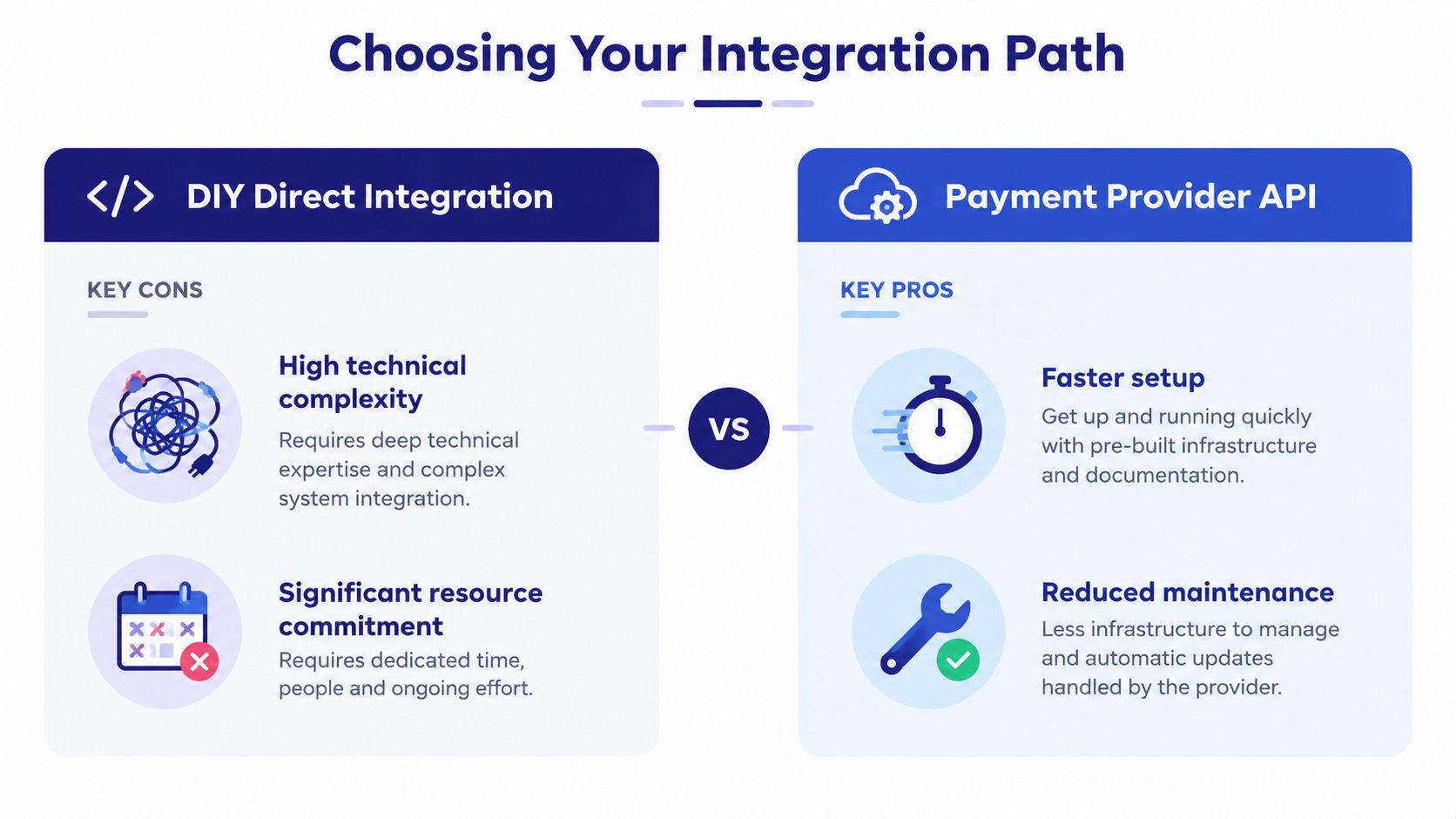
The trade-off is control versus operational advantage. You still need to design your own order state machine and risk rules, but you avoid making your core product responsible for every rail-specific implementation. Pricing also depends on the payment method used, so check Suby's pricing page for exact current figures rather than assuming one universal rate.
How to Implement Instant Bank Payments
A reliable implementation starts with a status model, not a button. Your system should know the difference between a customer selecting a bank method, completing authorization, submitting a payment, receiving confirmation, settling funds, and encountering a return or failure.
Map the customer journey
At checkout, present the available payment methods based on the customer's context. If your provider supports bank-account connection through a tool such as Plaid, guide the customer through account selection and authorization without asking them to expose bank credentials to your own application.
The customer should see:
The selected payment method: Make it clear whether the payment uses a real-time rail, Same Day ACH, or standard ACH.
The expected status: Explain whether the order is confirmed immediately or remains pending.
The next action: Tell the customer whether they need to authorize a mandate, approve a bank prompt, or wait for confirmation.
The fallback behavior: If a real-time route isn't available, explain what happens instead of changing the promise without informing the customer.
Don't grant irreversible value merely because the frontend received a success response. Your backend should rely on the provider's signed event or documented confirmation mechanism, then apply your own business rule for fulfillment.
Build the server-side flow
A typical API implementation has four layers:
Create the payment request. Send the amount, currency, customer reference, order details, and requested payment method to the provider.
Collect authorization. Complete the bank connection or mandate flow and store only the identifiers your application needs.
Receive webhooks. Listen for payment creation, status changes, settlement, return, and failure events. Make handlers idempotent so a repeated event doesn't create duplicate fulfillment.
Reconcile independently. Compare provider events with your internal order and ledger records, then surface mismatches to operations.
The application should treat webhook delivery as an event stream, not as a single notification. Store the event identifier, verify authenticity using the provider's documented method, and make retries safe. A customer can close a browser after authorization, so the backend must continue processing even when the original checkout session disappears.
Implementation insight: The frontend tells the customer what is happening. The backend decides what the business is allowed to do.
Test each bank-payment path separately. A bank may support an instant rail but restrict a use case, require a particular authorization sequence, or return a different exception. Test onboarding, authorization, posting, webhook delivery, reconciliation, refunds, and failure handling across representative bank types before launch.
For subscriptions, don't treat the first successful debit as proof that future debits will behave identically. Store mandate state, monitor recurring payment events, and give customers a clear way to update or cancel their authorization. The most usable checkout is fast when it can be fast, honest when it can't, and recoverable when something goes wrong.
Navigating Risk and Common Pitfalls
ACH risk appears after submission as well as during checkout. A debit can look successful in the initial customer experience and later return because of insufficient funds, a closed account, or an unauthorized transaction. That makes ACH operationally different from a flow where the merchant receives a strong authorization decision at the moment of purchase.
The common failure is to store every negative outcome as payment_failed. That label hides the action your team should take. An insufficient-funds return may justify a retry policy, while an unauthorized debit may require account review, customer contact, and a different authorization process.
Separate the failure modes
Use distinct internal categories for at least these cases:
Insufficient funds: Decide whether a controlled retry is appropriate and prevent repeated attempts that frustrate the customer.
Account closed: Stop future collection attempts and request a different payment method.
Unauthorized debit: Review the mandate, authorization record, customer identity, and transaction context.
Technical failure: Check provider events, duplicate requests, webhook delivery, and reconciliation state.
Fulfillment exposure: Identify whether goods, credits, access, or withdrawals were released before the payment became safe to honor.
Nacha-linked guidance has used a 2.5% return-rate benchmark as a high-risk threshold for certain ACH web-debit activity, while recent survey reporting has placed ACH returns near 1.2% of ACH debit transactions. The figures come from different contexts, so they shouldn't be treated as a universal prediction for your business. They do show why return monitoring deserves its own operational process. The Minneapolis Fed paper on ACH risk and returns provides the relevant background.
Design controls before volume arrives
Account verification, authorization records, velocity rules, customer-risk review, and return-code monitoring work together. None replaces the others. A business should decide which products can be delivered immediately, which require confirmed settlement, and which transactions need manual review.
Monitor return rates by entry type, customer segment, acquisition source, product, and payment experience. Review unusual changes quickly instead of waiting for a monthly finance report. Also connect payment status to fulfillment, because the hidden cost of a return can include a shipped product, consumed service, support case, manual recovery, and bank fees.
Operational rule: A fast checkout with weak exception handling only moves losses through the system faster.
Modernize Your Entire Payment Stack
The stronger objective isn't “make every ACH payment instant.” It is give customers a practical choice of payment methods while giving the business control over how it receives and uses funds. Bank payments may be appropriate for one customer, a card or wallet for another, and crypto for a third. A single payment operation should be able to represent those choices without forcing the buyer through unrelated checkout experiences.
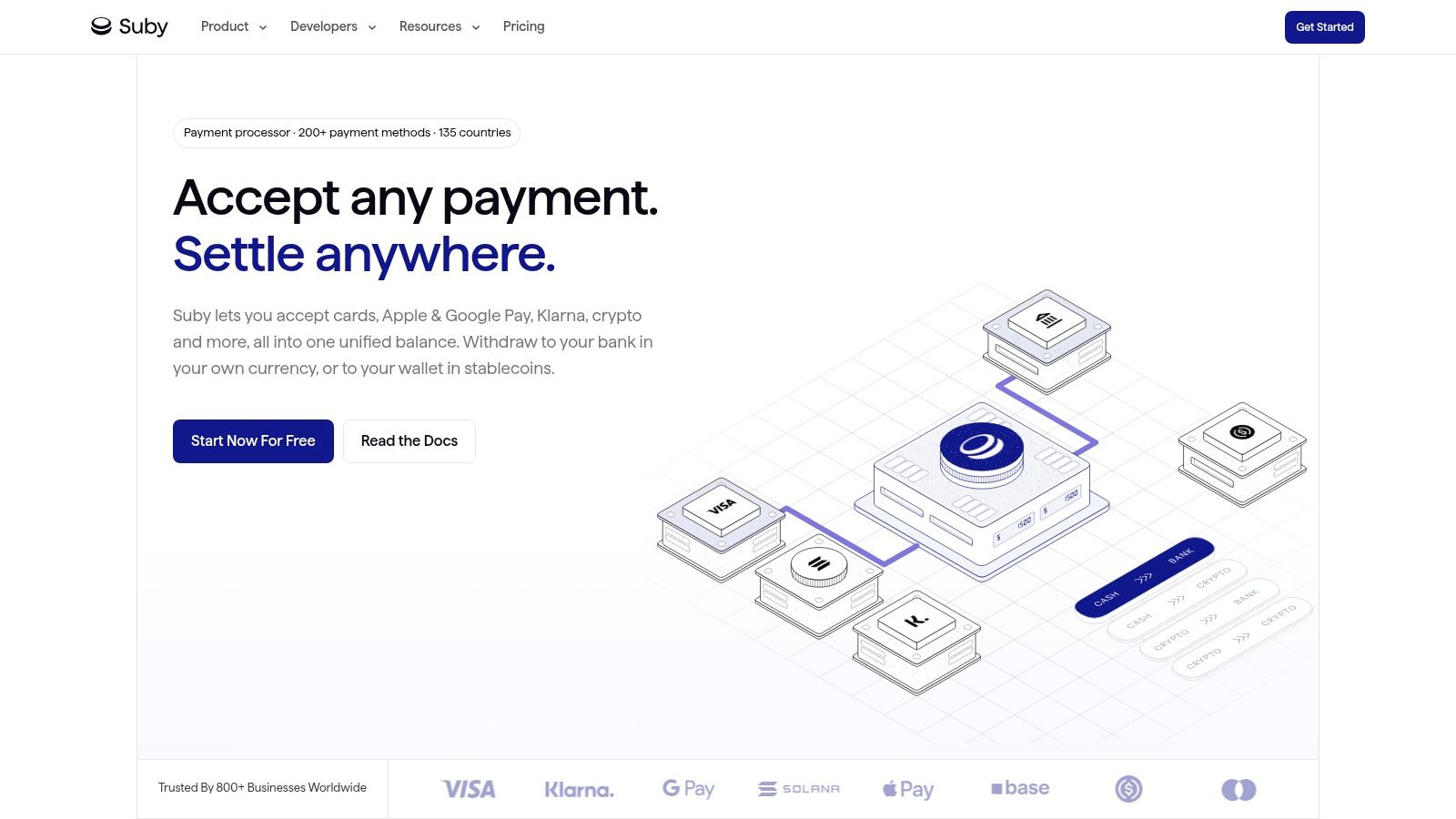
Suby positions itself as payment infrastructure for the global internet economy. It provides an API that lets businesses accept payments by card or crypto, and its product also supports cards, wallets, bank methods, BNPL, and crypto in one broader checkout model. On the settlement side, a business can choose a bank account or stablecoins such as USDC, in the currency it wants, making the flow where a customer pays by card and the business receives USDC one option among several.
Four ways to use one product
The four product paths map to different operating needs:
Suby Payments: An API-first payment stack for accepting cards and crypto through one checkout, with API and webhook-based integration options.
Suby Crypto: A crypto payment gateway that handles the swap, sponsors network gas, and lets the merchant settle to a non-custodial wallet or aggregate funds in the Suby balance.
Suby Gating: Paid access for Discord, Telegram, downloads, and courses, useful when payment and entitlement need to stay connected.
Suby Invoicing: Client billing where the payer chooses a supported payment method and the business chooses how to receive the proceeds.
Suby's documentation says crypto payments are priced in USD, converted at checkout into the exact token amount using Pyth price feeds, and locked for the session. The customer sees both the USD price and exact token amount before confirming. Crypto payments carry a flat 1.5% transaction fee, while network gas fees are paid by the customer during the on-chain transaction. The documentation also states that there are no fixed fees on crypto payments and that net funds can settle to a non-custodial wallet or be aggregated in the Suby balance, so method-specific pricing should be checked before launch.
Payments and access belong together
The platform's subscription and one-time payment documentation supports access through PayLink, API, Discord, or Telegram. Native Discord and Telegram integrations can gate paid roles, private channels, groups, and courses, while recurring subscriptions can run on weekly, monthly, quarterly, semiannual, or yearly cycles. A configured webhook can send the subscription.created event, giving a product team a way to connect payment creation with its own access logic. See the official subscriptions and one-time payments documentation.
That combination is useful for creators, communities, SaaS businesses, and agencies because the payment method and settlement preference can vary without changing the central business promise. Customers pay any way they want, and businesses get paid the way they choose.
Suby provides an API for card and crypto payments, supports bank-payment use cases, and includes native Discord and Telegram integrations for subscriptions and paid access. Visit Suby to evaluate a checkout and settlement setup that fits your customers, your risk controls, and the way your business wants to receive funds.
