

Gaspard LEZIN
12 Best Alternative To Stripe Options for Global Payments in 2026
Searching for an alternative to Stripe? We review the top 12 platforms for SaaS, e-commerce, and creators, focusing on fees, features, and global payouts.
Stripe is a dominant force in online payment processing, but it isn’t the perfect solution for every business. High transaction fees, slow payout schedules, and operational hurdles can create friction, especially for global companies, and even routine tasks like learning how to cancel a Stripe subscription can add avoidable overhead. For businesses that require faster, more predictable cash flow without the typical complexities of international banking, finding an alternative to Stripe is a critical strategic decision.
This guide is designed to simplify that search. We've curated and analyzed 12 of the best Stripe alternatives, providing an in-depth look at their features, pricing, and ideal use cases. You'll find everything from enterprise-grade global acquirers and merchant-of-record services to modern platforms that settle card payments directly in stablecoins like USDC.
Whether you're a SaaS founder managing subscriptions, an e-commerce merchant selling across borders, a creator monetizing a community, or a developer needing a robust API, this listicle will help you find the right fit. We'll explore solutions that solve specific problems, like accepting crypto, managing global tax compliance, or enabling instant USDC payouts from standard card transactions.
Each profile includes direct links and practical insights to help you make an informed decision. We cut through the marketing fluff to deliver a clear comparison, helping you identify the payment processor that aligns with your operational needs and growth ambitions. Let’s dive into the top contenders.
1. Suby
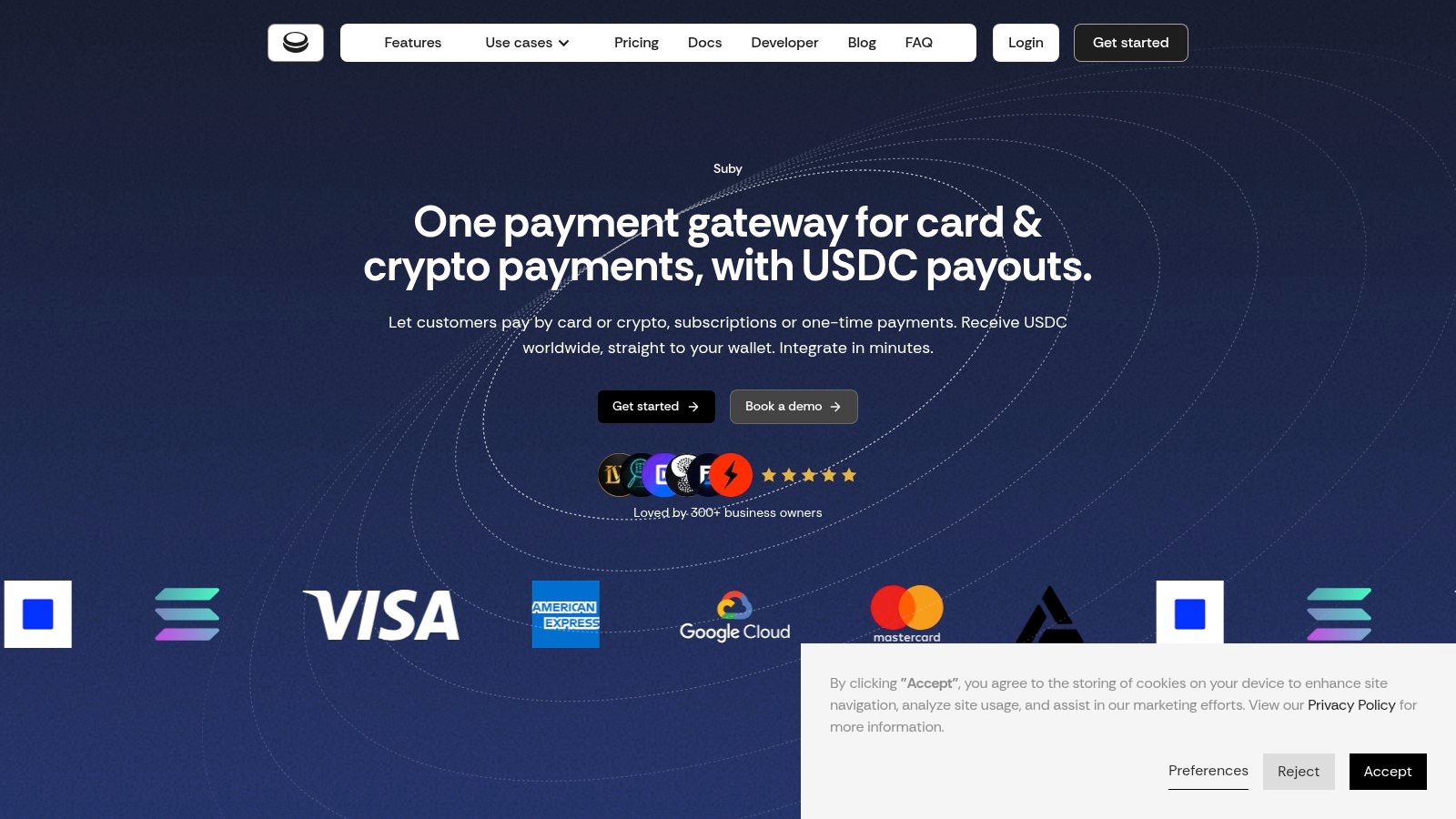
Suby stands out as a powerful alternative to Stripe for internet-native businesses seeking to eliminate the friction of traditional cross-border payments. Its unique model is built around a simple, powerful concept: customers pay with their card, and merchants receive every settlement directly in USDC. This approach bypasses the delays, high FX fees, and payout holds often associated with the legacy banking system.
It is designed for global-first businesses that value speed and predictability in their revenue operations. For SaaS companies, e-commerce stores, agencies, and creators, Suby provides a unified payment layer that maximizes conversion by accepting familiar card payments while streamlining treasury management with stablecoin payouts. This makes it an exceptional choice for anyone invoicing international clients or selling to a worldwide customer base.
Key Features and Use Cases
Suby's platform is engineered for flexibility, offering multiple ways to integrate and accept payments.
One Unified Balance: Every payment, cards, Apple & Google Pay, Klarna, and crypto, lands in a single balance. You withdraw to your bank in your own currency (USD, EUR, or local currencies) or to your wallet in stablecoins (USDC, EURC), removing exposure to currency fluctuations, SWIFT delays, and unpredictable bank holds.
Flexible Payment Tools: Businesses can integrate payments using our developer-friendly API that allows any business to accept payments by card or crypto. We also offer shareable paylinks for simple invoicing and an embeddable checkout widget for seamless website integration.
Creator-Focused Integrations: Suby includes native integrations for Discord and Telegram. This allows community managers to automate paid access for subscriptions, roles, and exclusive channels without manual effort, which also makes it a practical Whop alternative for creators monetizing a community.
Security and Compliance: Card processing is handled through a PCI-DSS Level 1 certified partner, and the platform supports Strong Customer Authentication (SCA) to meet regulatory requirements and protect against fraud.
Pricing Structure
Suby uses transparent, pay-as-you-go pricing, no plans, no monthly fees, no minimums. You pay one flat rate per payment category:
Cards & wallets: 2.9% + $0.30 per transaction
Crypto (USDC): 1.5%
Bank transfers: 1% + $1 per transaction
Custom rates are available once you process over $100k/month, and every account includes zero-fee refunds and a real-time dashboard for tracking payments and subscriptions.
Pros and Cons
Pros:
Fast, Predictable Payouts: One balance gives you a single source of truth for revenue, and you cash out to your bank or in stablecoins without traditional banking delays.
Unified Checkout: Accepts both major credit cards and popular cryptocurrencies (USDC, USDT, ETH, SOL, BNB) in one flow.
Developer and Creator Friendly: Offers a simple API and webhook system alongside no-code tools and community integrations.
Cons:
Newer Platform: Suby is younger than incumbents like Stripe or PayPal, so its third-party plugin ecosystem and brand recognition are still growing.
Best for Global, Online Businesses: Suby is optimized for cross-border and crypto-friendly flows; a purely domestic, card-only seller might find a specialized local processor marginally cheaper.
Website: https://suby.fi
2. Adyen
Adyen is a powerful end-to-end payment platform designed for enterprise-level and rapidly scaling businesses that require a unified global solution. Unlike many payment processors that rely on a network of partners, Adyen acts as its own acquirer, payment gateway, and processor. This direct connection to card schemes like Visa and Mastercard allows for richer transaction data, higher authorization rates, and more control over the entire payment flow. This unified commerce approach makes it a strong alternative to Stripe for businesses managing complex, high-volume operations across multiple countries.
Key Features and Use Cases
Adyen excels in handling the complexities of global commerce. It supports processing in over 150 currencies and offers more than 100 local payment methods, ensuring customers can pay how they prefer, wherever they are. For businesses expanding internationally, understanding the nuances of different payment ecosystems is critical. You can explore our guide to the best international payment gateways to learn more about this topic.
The platform is particularly well-suited for marketplaces and platform businesses. Its features include sophisticated tools for splitting payments, managing surcharges, and routing funds between multiple sellers, which are essential for complex revenue models.
Pricing and Limitations
Adyen’s pricing model is not a simple flat rate. It uses an Interchange++ pricing structure, which includes an interchange fee, a card scheme fee, and a processing fee. This is typically quoted on a case-by-case basis through their sales team and is most cost-effective for businesses processing significant volume. For smaller businesses or those just starting, the custom quoting process and higher complexity might be a barrier compared to more straightforward solutions.
Website: https://www.adyen.com/
Best for: Large enterprises, global e-commerce, and marketplaces needing a single, unified payment infrastructure.
3. Braintree (by PayPal)
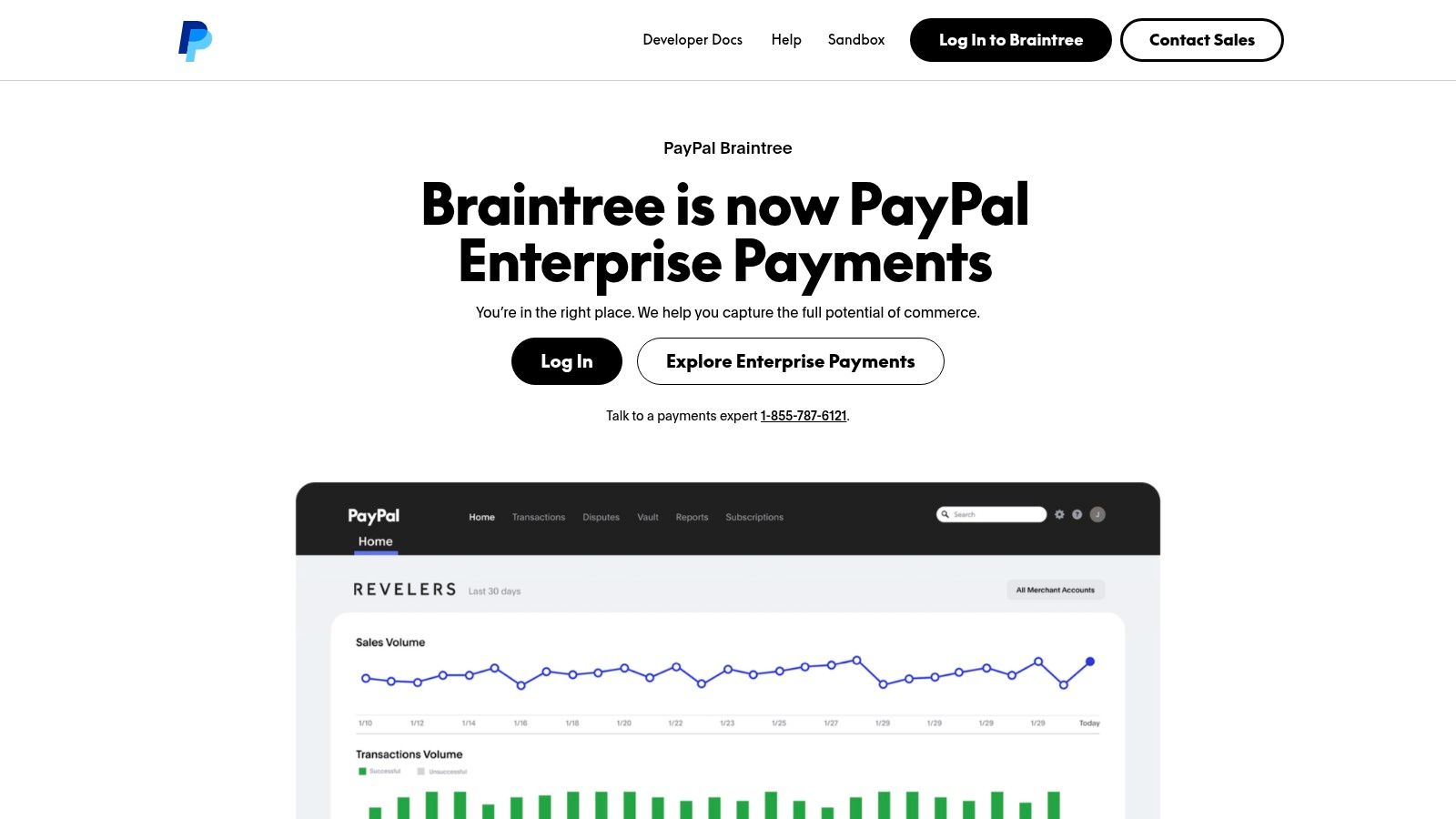
Braintree offers a developer-centric payment platform that combines a traditional payment gateway with the extensive reach of the PayPal network. Acquired by PayPal, it provides a unified API for accepting cards, digital wallets like Apple Pay and Google Pay, and, most importantly, PayPal and Venmo. This deep integration makes it a compelling alternative to Stripe for businesses that want to offer a wide array of popular payment methods through a single, streamlined integration, especially those with a strong U.S. customer base where Venmo is prevalent.
Key Features and Use Cases
Braintree’s strength lies in its comprehensive feature set, which includes advanced fraud tools, support for recurring billing, and secure data vaulting for tokenizing customer payment information. The platform's unified API simplifies the process of adding diverse payment options, from standard credit cards to ACH direct debits and the full suite of PayPal products. This makes it an excellent choice for e-commerce stores and subscription-based businesses that want to maximize conversion by offering familiar, trusted payment options to their customers. The built-in support for multiple currencies also facilitates international expansion.
Pricing and Limitations
Braintree’s standard pricing for cards and digital wallets is 2.59% + $0.49 per transaction, which is competitive but slightly different from Stripe's model. Fees for other payment methods like ACH and Venmo vary. A significant limitation is that access to the platform requires a full merchant account application and approval process, which can be more involved than some instant onboarding solutions. Additionally, while the integration is powerful, some advanced features or preferential rates may depend on your business’s specific eligibility and processing volume, adding a layer of complexity for smaller merchants.
Website: https://www.braintreepayments.com/
Best for: E-commerce businesses and SaaS companies wanting deep PayPal and Venmo integration alongside traditional card processing.
4. PayPal for Business
PayPal for Business is one of the most widely recognized payment platforms globally, offering a suite of tools that go beyond simple online transactions. Its immense consumer adoption and brand trust can directly translate to higher conversion rates at checkout, as customers are often more comfortable using a familiar payment method. This makes it a compelling alternative to Stripe, particularly for businesses targeting a broad consumer base that values convenience and security. The platform consolidates multiple payment options, including PayPal, Venmo, Pay Later, and traditional card processing, into a single integration.
Key Features and Use Cases
PayPal excels at providing a fast and user-friendly checkout experience. It offers both hosted checkout pages for quick setup and robust API integrations for custom solutions. Seller Protection on eligible transactions adds a crucial layer of security against fraud and chargebacks. For businesses considering PayPal, understanding the initial setup is a key first step. This guide on how to set up PayPal for receiving payments offers a clear walkthrough of the process.
The platform is highly versatile, supporting in-person sales with card readers and a virtual terminal for processing payments over the phone. This flexibility makes it suitable for a wide range of businesses, from e-commerce stores and service providers to brick-and-mortar retailers looking to unify their payment systems.
Pricing and Limitations
PayPal’s pricing can be more complex than a single flat rate. Fees for accepting branded PayPal and Venmo payments are often higher than its standard rates for online card processing. For example, standard online credit and debit card transactions are priced at 2.99% + $0.49 per transaction. However, other products like in-person payments or the virtual terminal have different fee structures. This variability requires businesses to carefully evaluate which services they need to accurately forecast their costs.
Website: https://www.paypal.com/us/business
Best for: E-commerce businesses and consumer-facing brands that want to leverage high consumer trust to boost conversions.
5. Square
Square is a comprehensive commerce ecosystem best known for its point-of-sale (POS) systems, but it has evolved into a powerful omnichannel solution for businesses of all sizes. It excels at unifying online and in-person sales, offering a suite of tools for e-commerce, invoicing, subscriptions, and terminal hardware. Its fast, self-serve setup and transparent pricing make it an excellent alternative to Stripe, particularly for small to medium-sized businesses (SMBs) that require a blend of digital and physical payment processing.

Key Features and Use Cases
Square provides developers with a robust set of tools, including the Web Payments SDK, Checkout API, and Subscriptions API, for building custom online payment experiences. Beyond standard e-commerce, its invoicing and link-based checkout tools are ideal for service-based businesses and freelancers needing to collect payments quickly. The platform also supports ACH payments for lower-cost bank transfers.
The key differentiator for Square is its extensive hardware lineup and large partner app ecosystem, allowing businesses to create a seamless, integrated system for managing inventory, customers, and payments across every channel. Like all reputable processors, Square handles security diligently, and you can get a deeper understanding of the standards involved by learning what PCI DSS compliance is and why it matters.
Pricing and Limitations
Square offers a straightforward, flat-rate pricing model with no monthly fees for its standard accounts. For online transactions in the US, the rate is typically 2.9% + 30¢. While this transparency is a major benefit for new and smaller businesses, these rates can be higher than Interchange++ models for high-volume merchants. Custom pricing is available but generally requires significant processing volume, making it less accessible for businesses that are just starting to scale.
Website: https://squareup.com/
Best for: SMBs, retail, and service businesses needing a unified solution for online, in-person, and invoice-based payments.
6. Authorize.net (by Visa)
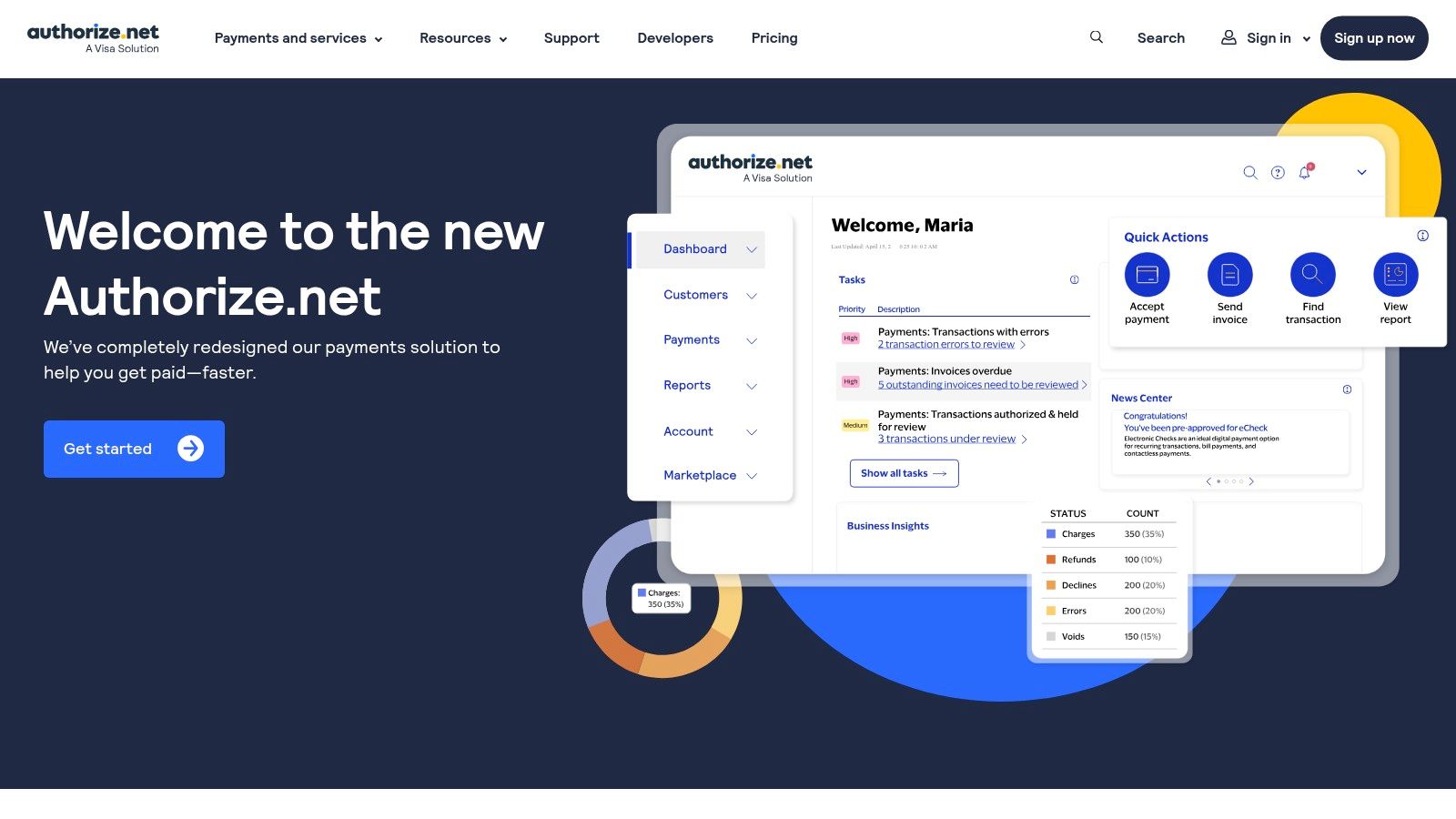
Authorize.net is one of the most established and widely recognized payment gateways in the United States. Acquired by Visa, it offers a reliable and secure way to accept credit card and electronic check payments online, through mobile devices, or at retail locations. Its key differentiator is flexibility, you can use it as an all-in-one solution with a merchant account or as a standalone gateway connected to your existing merchant account provider. This makes it a dependable alternative to Stripe for businesses that already have a banking relationship they want to keep or require a familiar gateway that integrates with a vast ecosystem of shopping carts and platforms.
Key Features and Use Cases
Authorize.net is well-suited for businesses that need robust, traditional payment processing features. Its Automated Recurring Billing (ARB) and Customer Information Manager (CIM) tools are ideal for managing subscriptions and securely storing customer payment data for future use. The platform also includes an Advanced Fraud Detection Suite, which provides a set of customizable filters and tools to help merchants identify and prevent suspicious transactions.
Its long history means it has pre-built integrations with hundreds of e-commerce platforms, CRMs, and business management tools. This makes implementation relatively straightforward for merchants using popular software who need a proven payment gateway without extensive custom development.
Pricing and Limitations
Authorize.net’s pricing includes a monthly gateway fee, which is a key difference from many pay-as-you-go models. The "All-in-One" plan combines the gateway and a merchant account for a monthly fee plus a per-transaction rate. The "Gateway Only" option also has a monthly fee, along with a per-transaction fee and a daily batch fee. This pricing structure can be less appealing for startups or businesses with low transaction volumes, as the fixed monthly costs can add up regardless of sales.
Website: https://www.authorize.net/
Best for: Established US-based e-commerce businesses, retailers with existing merchant accounts, and companies needing a widely supported and secure gateway.
7. Checkout.com
Checkout.com is an enterprise-grade payment platform focused on providing global acquiring and modular payment solutions for large-scale businesses. It acts as a direct acquirer, gateway, and processor, giving merchants a unified view of their payments across different regions. This end-to-end control allows for detailed data analysis and performance optimization, making it a powerful alternative to Stripe for international merchants who need flexibility and granular control over their payment infrastructure, particularly for cross-border scaling.
Key Features and Use Cases
Checkout.com's strength lies in its expansive global reach, supporting over 150 currencies with a domestic acquiring presence in more than 45 countries. This setup helps businesses reduce cross-border fees and improve authorization rates. The platform offers powerful, platform-ready APIs and a suite of modular tools for risk management and payment optimization, allowing businesses to tailor their fraud prevention and performance strategies to specific markets.
This solution is ideal for large e-commerce businesses and marketplaces that require sophisticated payment routing and reporting capabilities to manage international operations. Its consultative onboarding process ensures that complex payment flows are configured correctly from the start.
Pricing and Limitations
Checkout.com does not offer a public, one-size-fits-all pricing model. Instead, it provides custom pricing structures, including flat-rate or Interchange++, which are negotiated directly with their sales team. This tailored approach is designed to be cost-effective for high-volume merchants but can be a barrier for smaller businesses or startups looking for transparent, predictable fees without a sales engagement. The pricing is highly dependent on transaction volume, business model, and regional mix.
Website: https://www.checkout.com/
Best for: Large, international e-commerce businesses and platforms seeking a customizable, high-performance payment solution with dedicated support.
8. Airwallex
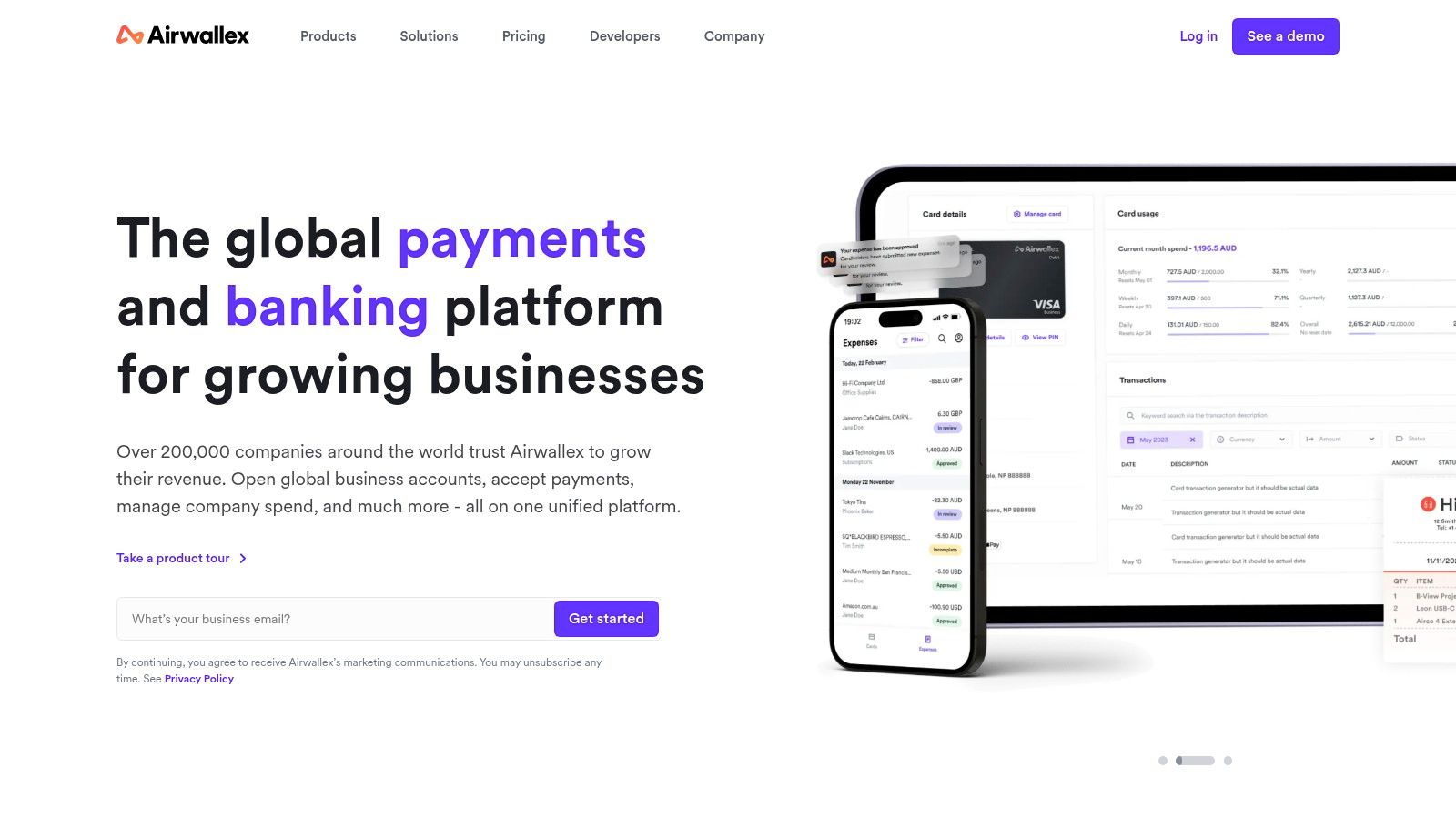
Airwallex is a global financial platform built for modern businesses, combining international payments, multi-currency accounts, and card processing into a single ecosystem. It offers a powerful infrastructure for companies operating across borders, allowing them to collect, hold, and send money globally while avoiding excessive FX fees. By providing tools for both payment acceptance and business finance management, it serves as a comprehensive alternative to Stripe for businesses that need more than just a payment gateway.
Key Features and Use Cases
Airwallex stands out with its ability to manage multi-currency transactions efficiently. The platform supports collections in over 130 currencies and allows for like-for-like settlement in more than 20 currencies, which is a significant advantage for international e-commerce and SaaS businesses looking to minimize conversion costs. It offers a full suite of payment acceptance tools, including no-code payment links, eCommerce plugins, and developer-friendly APIs.
The platform also provides solutions for billing, subscription management, and invoicing, making it a good fit for businesses with recurring revenue models. Its integrated approach means a company can accept payments from a customer in Europe, settle the funds in EUR, and use the same account to pay a supplier in the UK, all within one unified dashboard.
Pricing and Limitations
In the US, Airwallex offers competitive and transparent interchange-plus pricing for card processing, which is published directly on its website. This clarity is a welcome contrast to the custom-quoted models common among enterprise-focused platforms. While the all-in-one account is a major benefit, some advanced features, like payment surcharging, may have limited availability depending on the business's region. Businesses should also verify that specific configurations or advanced tools are available in their operational countries, as capabilities can vary.
Website: https://www.airwallex.com/us
Best for: Global e-commerce, SaaS, and platform businesses needing integrated payment processing and multi-currency financial accounts.
9. BlueSnap
BlueSnap is a global payment orchestration platform designed for B2B and SaaS businesses that need a comprehensive, all-in-one solution. It provides a single connection to a network of global acquiring banks, which helps improve payment authorization rates and reduce cross-border fees. This structure is particularly beneficial for companies managing subscriptions, invoicing, or embedded payments, making BlueSnap a strong alternative to Stripe for businesses with complex, international revenue models.
Key Features and Use Cases
BlueSnap excels in optimizing global payments by intelligently routing transactions through its network of acquiring banks to achieve the best approval rates. The platform supports a wide array of payment methods and includes robust subscription and recurring billing features, such as automated retries and an account updater to minimize churn.
Its flexible architecture is well-suited for SaaS companies and B2B merchants that require sophisticated invoicing and customizable pricing configurations. The platform's native integrations and advanced payment routing logic are built to handle the specific challenges of selling software and services to a global customer base.
Pricing and Limitations
BlueSnap does not offer a simple, flat-rate pricing model that is publicly listed for all services. Instead, its pricing is typically customized based on business volume, transaction type, and specific needs, requiring engagement with their sales team. While this bespoke approach can be cost-effective for larger businesses, it may present a hurdle for smaller companies or startups that prefer transparent, out-of-the-box pricing. The need for a custom quote makes it less straightforward to get started compared to other platforms.
Website: https://www.bluesnap.com/
Best for: B2B companies, SaaS platforms, and businesses needing embedded payment solutions with optimized global acquiring.
10. Paddle
Paddle is a Merchant of Record (MoR) platform specifically designed for software and digital product sellers. Instead of just processing payments, Paddle acts as the legal seller of your product, taking on the responsibility for complex tasks like global sales tax and VAT collection, remittance, and compliance. This unique model makes it a powerful alternative to Stripe for SaaS businesses that want to offload the entire financial and regulatory burden of selling internationally. By handling these critical back-office operations, Paddle allows you to focus solely on building and selling your product without becoming a global tax expert.

Key Features and Use Cases
Paddle’s all-in-one platform combines checkout, subscriptions, and invoicing with built-in global compliance. The MoR model is its key differentiator, as Paddle becomes the reseller for every transaction. This means they manage tax registrations, payment localization, currency conversion, and even fight chargebacks on your behalf. This is especially valuable for SaaS and digital download businesses targeting a global audience from day one. Their system includes a compliance-optimized inline checkout and robust developer tools, making integration straightforward.
Pricing and Limitations
Paddle offers transparent, all-inclusive pricing that bundles payment processing, currency conversion, tax compliance, and fraud protection into a single per-transaction fee. This predictability is a major advantage, as there are no hidden costs for international sales or tax calculations. However, this all-inclusive fee can be higher than what you might pay with a traditional payment service provider, especially at very high transaction volumes. Additionally, because Paddle is the merchant of record, businesses have less direct control over the end-to-end sales process compared to a direct processor relationship.
Website: https://www.paddle.com/
Best for: SaaS and digital product businesses that want to completely offload global tax compliance and payment operations.
11. FastSpring
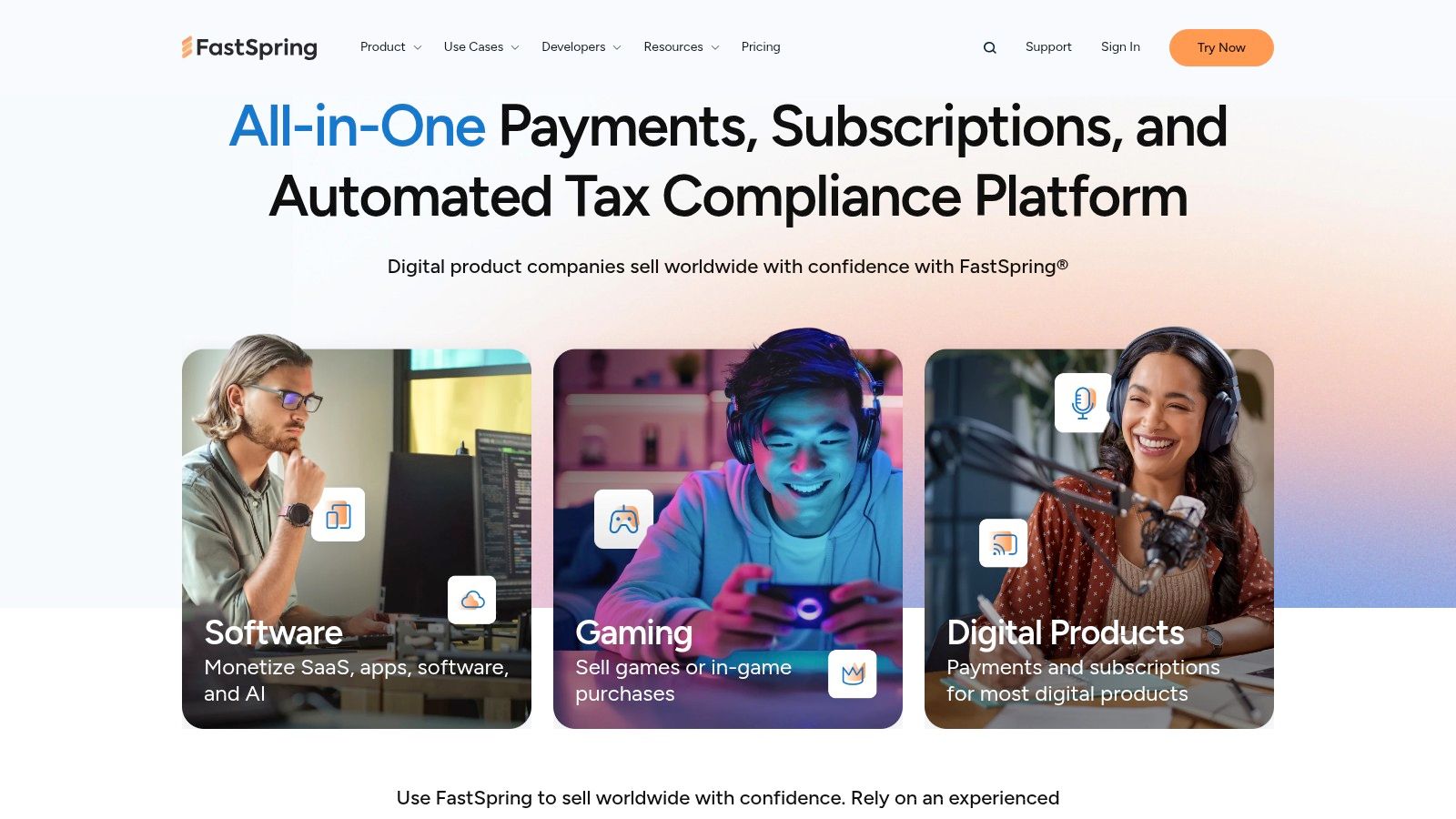
FastSpring operates as a full-service Merchant of Record (MoR), making it an excellent alternative to Stripe for businesses selling software, SaaS, and other digital goods globally. As an MoR, FastSpring takes on the complexity of global sales tax and VAT collection, remittance, and regulatory compliance. This model allows digital sellers to focus on their product and marketing, effectively outsourcing the entire financial and legal infrastructure of global e-commerce, similar to how an app store functions but with the flexibility of the open web.
Key Features and Use Cases
The platform's core strength lies in its all-in-one approach. It provides comprehensive subscription management tools, branded checkout pages, and global invoicing. Crucially, services like fraud prevention, chargeback management, and even buyer support are included in its core offering, not as à-la-carte add-ons. This integrated solution is ideal for software developers and SaaS companies who want to launch globally from day one without building a dedicated compliance and finance team, though sellers weighing simpler storefronts often also ask whether Gumroad is safe before committing.
FastSpring handles the entire payment lifecycle, from checkout localization to handling disputes. This simplifies operations significantly for businesses that lack the resources to manage the intricate rules of selling digital products in multiple countries.
Pricing and Limitations
FastSpring does not list a public rate card on its website. Pricing is typically provided via a custom quote obtained through their sales team or during a trial period, tailored to the business's volume and needs. While this all-inclusive model provides immense value and predictability, it may be more expensive than using a standalone payment gateway, especially for high-volume businesses that have the resources to manage compliance internally. The platform is less suited for businesses selling physical goods, as its features are highly optimized for the digital product ecosystem.
Website: https://fastspring.com/
Best for: SaaS, software, and digital goods sellers who need a comprehensive solution for global sales, tax compliance, and subscription management.
12. BitPay
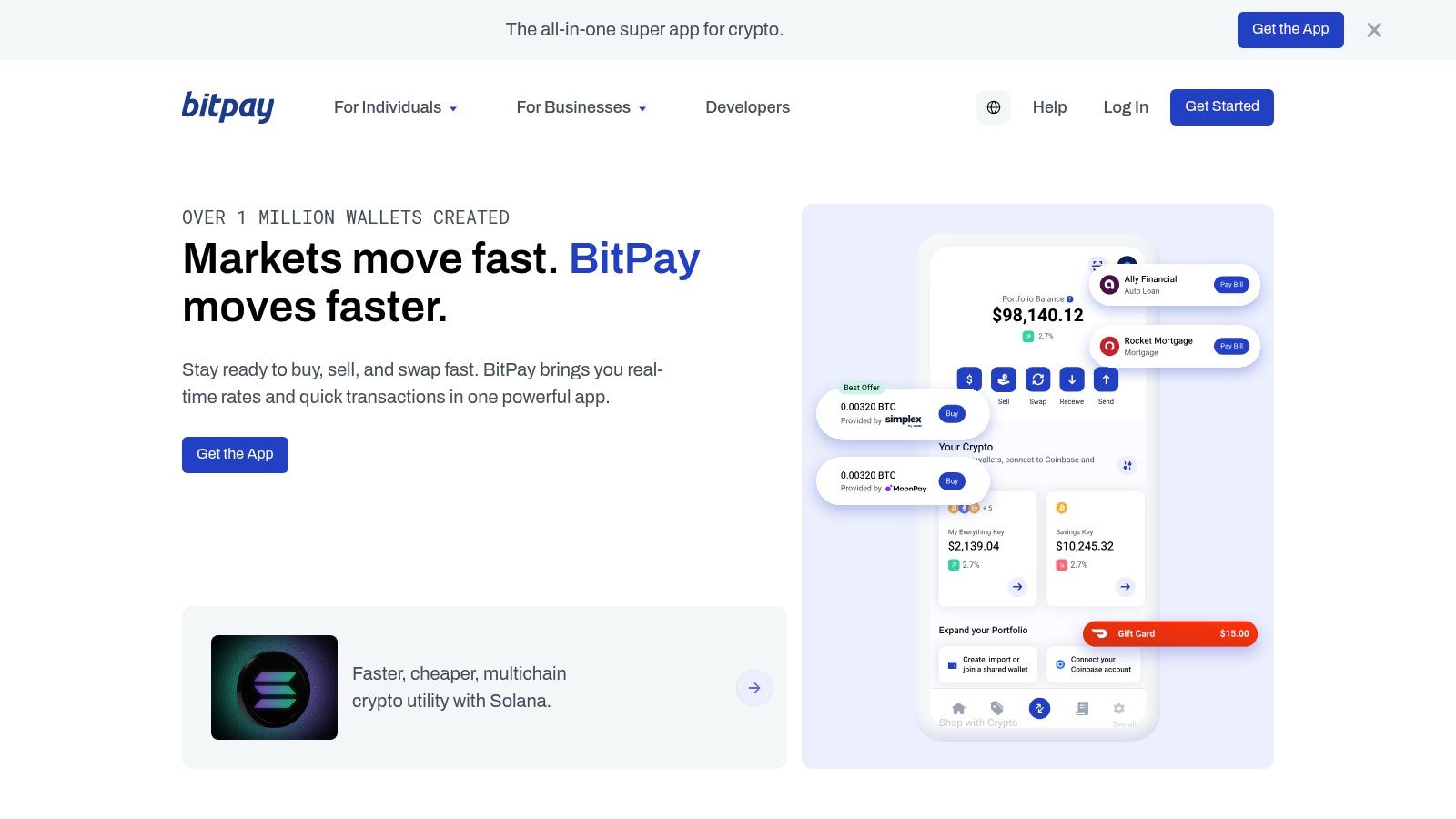
BitPay is a specialized crypto payment processor that enables businesses to accept payments in major cryptocurrencies and stablecoins. It serves merchants who want to tap into the crypto-paying customer base or eliminate the risk of traditional credit card chargebacks, and it is one option among any top crypto payment gateway shortlist worth comparing. Instead of being a direct card processor, BitPay focuses exclusively on digital asset transactions, making it a unique alternative to Stripe for specific use cases. It allows merchants to receive funds either in crypto or have them automatically settled into fiat currency like USD.
Key Features and Use Cases
BitPay provides a suite of tools for e-commerce, retail, and donations, including email billing and integrations with platforms like QuickBooks. Its core value is providing a bridge between crypto customers and traditional business operations. For companies new to this area, understanding the process is key. You can explore our guide on how to accept crypto payments to get a better grasp of the fundamentals.
The platform is ideal for businesses with a significant number of customers who prefer paying with digital assets. A major advantage is the complete elimination of chargeback fraud, as crypto transactions are irreversible. This provides a level of security that card payments cannot match.
Pricing and Limitations
BitPay offers a transparent, tiered pricing model based on processing volume, which is a clear departure from the custom quotes often required by enterprise-level gateways. The standard processing fee starts at 1%. However, businesses must consider the implications of crypto price volatility if they choose to hold the assets instead of settling to fiat.
The main limitation is that BitPay is not a card processor. It must be used alongside a traditional payment provider to handle standard credit and debit card transactions. This means managing two separate systems, which can add complexity for businesses seeking a single, unified payment solution.
Website: https://bitpay.com/
Best for: Merchants targeting crypto-native customers and businesses looking to eliminate chargeback risk.
Top 12 Stripe Alternatives — Quick Comparison
Product | Core payments & settlement | Target audience / use case | Key features & integrations | Pricing & fees (public?) | Unique value / differentiator |
|---|---|---|---|---|---|
Suby | Card + major crypto (USDC, USDT, ETH, SOL, BNB); revenue settled to merchants in USDC | Internet-native businesses, creators, global SaaS, e‑commerce, communities | Shareable paylinks, embeddable checkout, API & webhooks, subscriptions, Discord/Telegram access mgmt, realtime dashboard, PCI‑DSS L1 partner, SCA/2FA, zero‑fee refunds | Flat per-category pricing: cards 2.9% + $0.30, crypto 1.5%, bank transfers 1% + $1; no plans, monthly fees, or minimums (see pricing page) | Fast, predictable USDC settlements worldwide; unified card+crypto acceptance; built‑in community access automation |
Adyen | Global acquiring, card + 100+ local methods, multi‑currency settlements | Large enterprises, marketplaces, cross‑border platforms | Intelligent routing, revenue optimization, marketplace fee-split & routing controls | Not publicly posted; sales‑quoted | Enterprise-grade unified global acquiring and advanced routing |
Braintree (PayPal) | Cards, digital wallets (Apple/Google Pay), PayPal, Venmo, ACH | Developers, merchants wanting deep PayPal ecosystem | Unified API, tokenization/vaulting, recurring billing, fraud tools | Varies by merchant eligibility; terms by application | Strong PayPal/Venmo integration and mature developer APIs |
PayPal for Business | PayPal, Venmo, Pay Later, cards; hosted & API options, in‑person | Merchants seeking consumer familiarity and fast go‑live | Hosted checkout, virtual terminal, seller protection, in‑person solutions | Pricing varies by product; branded acceptance fees can be higher | High consumer trust and wide plugin/commerce support |
Square | Online, in‑app, POS, invoicing, subscriptions, ACH; hardware | SMBs needing omnichannel, simple setup and hardware | Web Payments SDK, Checkout & Subscriptions APIs, invoicing, app ecosystem | Transparent US fee schedules; basic accounts often no monthly processing fee | Quick self‑serve setup + integrated hardware ecosystem |
Authorize.net (Visa) | Gateway, virtual terminal, recurring billing, digital wallets | Merchants needing gateway flexibility or using existing processor | Automated Recurring Billing, CIM, fraud detection, 24/7 support | Monthly gateway fee + per‑transaction/daily batch fees for gateway‑only plans | Familiar, widely integrated gateway with gateway‑only option |
Checkout.com | Card acquiring, 150+ currencies, alt payment methods, risk tooling | Enterprises scaling cross‑border with custom needs | Platform APIs, reporting, modular risk & optimization tools | Pricing tailored via sales (not a single public rate) | Flexible commercial models and consultative onboarding for cross‑border scaling |
Airwallex | Card acceptance, multi‑currency pricing & settlement, wide payment methods | Businesses needing FX, multi‑currency settlement and global treasury | No‑code paylinks, APIs/SDKs, billing & subscription mgmt, dispute tools | Published US card pricing (region/tier dependent) | Competitive posted US pricing + integrated FX/settlement capabilities |
BlueSnap | Global payments + local acquiring (50+ countries), subscriptions | B2B, SaaS, embedded‑payments use cases | Subscriptions, invoicing, payment optimization, auto‑retries, account updater | Many terms bespoke; sales engagement required | Payment orchestration focused on approvals and authorization lift |
Paddle | Merchant‑of‑Record (MoR) for software/digital sellers | SaaS & digital sellers wanting compliance/tax offloaded | Checkout, subscriptions, tax/VAT collection & remittance, chargeback handling | Transparent all‑inclusive per‑transaction pricing (public model) | Handles tax, compliance and buyer support as the seller of record |
FastSpring | MoR for software/digital goods, global taxes & support | Digital sellers wanting an app‑store‑like all‑in‑one service | Branded checkout, subscriptions, tax remittance, fraud & buyer support | Pricing via sales/quote (not publicly listed) | End‑to‑end MoR service for global digital commerce |
BitPay | Crypto & stablecoin acceptance; settlement to fiat or crypto (incl. USDC) | Merchants targeting crypto payers or avoiding card chargebacks | Ecommerce/retail tools, exports (QuickBooks), integrations, published volume tiers | Published tiered, volume‑based crypto processing fees | Crypto‑native payments with option to settle to fiat or crypto; avoids card chargebacks |
Choosing the Right Payment Partner for Your Business
Navigating the crowded landscape of payment processing can feel overwhelming, but moving beyond a one-size-fits-all solution is a critical step toward optimizing your revenue operations. As we've explored, the best alternative to Stripe is not a single platform but the one that aligns perfectly with your business model, operational needs, and global ambitions. The search is less about finding a direct replacement and more about identifying a strategic partner for growth.
Throughout this guide, we've dissected a dozen powerful contenders, from enterprise-grade giants like Adyen to specialized platforms like Paddle for SaaS. The key takeaway is that the ideal choice depends entirely on your unique circumstances. A traditional brick-and-mortar store expanding into e-commerce might find Square’s integrated ecosystem a perfect fit, while a developer-centric business might gravitate toward Braintree’s robust API. Resellers evaluating sourcing tools, for instance, will weigh very different criteria, as our Deal Soldier review illustrates. The decision requires looking past headline transaction fees and considering the total cost of ownership, which includes everything from currency conversion losses and payout delays to developer hours spent on complex integrations. Strong payment analytics can make those hidden costs visible so you compare platforms on real numbers rather than headline rates.
Key Factors to Guide Your Decision
Making the right choice involves a careful assessment of your priorities. As you finalize your decision, revisit these critical questions:
What is your primary business model? Is it SaaS subscriptions, digital downloads, e-commerce sales, or creator memberships? Platforms like FastSpring and Paddle are built for digital goods, whereas Checkout.com and BlueSnap offer broad solutions for global e-commerce.
Where are your customers and where do you operate? Global reach is not just about accepting payments in multiple currencies. It is about efficient settlement. If you operate internationally, consider how currency volatility and cross-border transfer fees impact your bottom line.
What are your technical resources? Do you have a development team ready to work with a complex API, or do you need a no-code solution with simple integrations? Solutions range from developer-first APIs like Adyen’s to user-friendly setups like PayPal for Business.
How critical are payout speed and stability? Are you tired of waiting days for funds to settle or losing revenue to unpredictable foreign exchange rates? This is where modern solutions that leverage stablecoins for settlement, such as Suby, offer a distinct advantage by providing near-instant access to your revenue in a stable digital currency.
Thinking Beyond Traditional Payment Rails
The core theme connecting many of the challenges with traditional payment processors is friction. This friction appears as multi-day settlement periods, opaque currency conversion fees, and the administrative burden of managing payouts across different regions. For modern, internet-native businesses, this friction is a direct barrier to scale.
This is why an alternative to Stripe might mean rethinking the payment rails themselves. For businesses and creators serving a global audience, the ability to accept familiar card payments from customers while receiving funds directly as USDC presents a powerful new model. It eliminates the intermediaries and delays associated with the traditional banking system, giving you faster, more predictable access to your cash flow.
For many businesses, the final choice will come down to a balance of features, fees, and operational efficiency. To make an informed decision and explore a wider range of solutions beyond Stripe, you might want to review some of the top payment gateways for ecommerce. Ultimately, selecting your next payment partner is an investment in your company's future. Choose a solution that not only meets your needs today but also has the flexibility and innovation to support your growth for years to come.
Suby is a payment gateway and payment processor. Your customers pay with card, bank transfer, Apple Pay, Google Pay, Klarna, and more, or stablecoins. You get paid out to your bank account, or directly in stablecoins (USDC, EURC) to your wallet, anywhere in the world, no bank account required. If your search for an alternative to Stripe is really a search for faster, more predictable global settlement without payout delays or FX fees, that is exactly the payment rail Suby was built to be.
