

Gaspard LEZIN
What Is Payment Acceptance and How It Works in 2026
What is payment acceptance, really? A practical guide covering payin methods, merchant flow, fees, compliance, and how modern platforms handle global checkout.
Payment acceptance is a business's ability to take a payment through a usable channel, get it authorized, and have the transaction recorded and settled. That distinction matters because a customer's choice of how to pay and a business's choice of how to receive the money are separate decisions.
A SaaS founder selling across borders might see customers reach checkout, then hesitate when the familiar card option isn't available, or when the payment method they prefer isn't offered. Even after a customer pays, the money may not yet have reached the business's account. Acceptance covers the path from a usable way to pay through authorization and the later movement and recording of funds.
Digital merchant payments are becoming an important part of that path. In low- and middle-income economies, 42% of adults made a digital merchant payment in 2024, compared with 35% in 2021, according to the World Bank's Global Findex data. For a business, the practical lesson is simple: checkout needs to fit how customers in each market pay.
Table of Contents
What Payment Acceptance Actually Means
A customer reaches checkout with a preferred way to pay, but the business must do more than display a button. The payment request needs to reach the right parties, return an approval or decline, and leave a record the business can use. Acceptance is the system connecting those steps.
In plain terms, payment acceptance is a business's ability to take payment through a usable channel, such as a card, mobile wallet, bank account, or online checkout, and have the transaction authorized and recorded. The payment method is the customer's choice. How and when the business receives the money is a separate decision.
The World Bank data defines digital merchant payments as payments retail customers make to businesses in stores or online. Its measure includes online purchases, mobile payments, and other digital transactions between customers and merchants. For a business serving multiple markets, that range helps explain why acceptance cannot be reduced to card terminals alone.
What acceptance includes
The customer sees the payment option; the business needs the systems behind it. Transaction routing sends the request onward, authorization returns an approval or decline, and records show whether the payment was completed, refunded, or disputed. Without clear transaction records, a checkout may take a card payment yet leave the business unable to manage it properly.
Acceptance also sits within a broader money movement system: payins, the funds customers send; a balance, where funds may be held or managed; and payouts, which move money to the business or others. These are distinct building blocks, not different names for the customer's payment method. A business can choose how customers pay and separately decide how funds are settled and paid out.
Settlement happens after authorization. It refers to the transfer of money between financial institutions and, according to the business's setup, onward to its account. An approval confirms that the transaction can proceed; it does not mean the business already has the funds.

In short: acceptance connects a customer's payment choice to authorization and reliable records. The merchant's settlement choice determines what happens to the funds afterward.
The Authorization Flow From Request to Settlement
A checkout can show an approved payment while your business is still waiting for the money. To understand why, follow the transaction through its distinct stages: request, authorization, capture, clearing, and settlement.
The customer submits payment details, and the merchant or its payment service sends an authorization request to an acquirer or processor. The request passes through the relevant card network to the customer's issuing bank. The issuer responds with an approval or decline, which travels back to the point of acceptance. The U.S. Treasury's explanation of card acquiring describes this electronic request-and-response flow.
An approval means the issuer has authorized the transaction. It does not mean the funds have reached the merchant. Clearing and settlement are separate steps: during clearing, transaction records are reconciled among the acquirer, processor, network, and issuer. Settlement then moves the corresponding funds between acquiring and issuing accounts.
Keep the transaction states distinct
The sequence maps to three moments: the request, the authorization, and the capture. Settlement follows, as funds move through the financial system. Capture records the transaction for processing after authorization, though the timing and exact flow depend on the payment setup.
That distinction matters when checkout displays “paid.” The label may refer to an authorization or capture event, rather than settled funds reaching the business's bank account. Payment software should track authorization, capture, settlement, reversals, refunds, and disputes as separate states. Treating them all as one permanent “paid” status can complicate accounting and customer support.
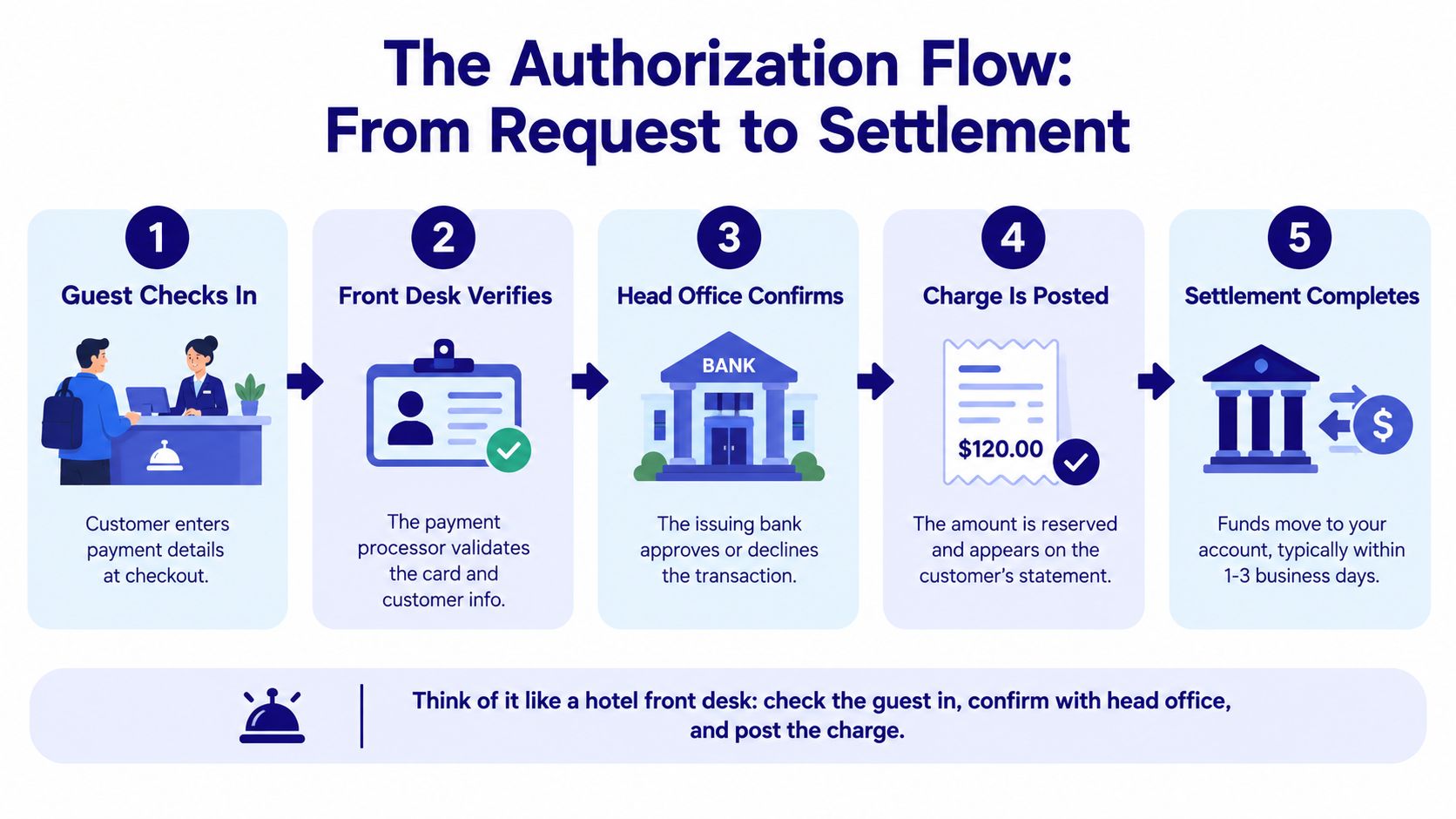
Settlement timing varies by arrangement. For example, the Treasury card-acquiring service makes prior-day funds available the next day. That timing applies to its service, not every payment setup.
The Three Building Blocks of Modern Payment Acceptance
When a customer checks out in another country, their preferred way to pay may differ from how your business wants to receive its proceeds. A global payment setup works like a relay: payins bring money in, a balance organizes it, and payouts deliver it to the business. Keeping these three jobs distinct makes it easier to understand what a provider can and cannot handle.
Building block | What it covers | Examples |
|---|---|---|
Payins | The payment methods customers can use | Cards, wallets, bank payments, BNPL, stablecoins |
Balance | The place where proceeds are gathered and tracked | A provider balance used to manage incoming payments |
Payouts | How the business receives funds | A bank account or stablecoins |
Payins are the customer-facing options. Depending on the market and provider, a customer might pay by card, mobile wallet, bank payment, or crypto. Suby's official product documentation lists cards, bank payments, Apple Pay, Google Pay, and stablecoins including USDC and USDT across multiple chains as native options.
The balance sits between the customer's payment and the business's withdrawal. It records incoming proceeds, giving the business a place to track them before choosing how to receive funds. This middle layer helps explain why a customer's payment method does not automatically determine the merchant's payout method.
Payouts are the merchant-facing choice. A customer could pay by card while the business receives USDC, or pay by bank transfer while the business receives funds in a bank account. These are examples, not a promise that every provider supports every combination. Confirm the available methods and settlement options in the provider's current documentation.
Separate the decisions: Ask what customers can use to pay, then ask how your business can receive the proceeds.
The distinction has a practical effect: a customer paying by SEPA bank transfer could still leave the business with a USDC balance, if the provider supports that arrangement. Evaluate the incoming payment options and the outgoing settlement options separately. For membership businesses comparing recurring-payment needs, this guide to gym payment software for owners offers an industry-specific perspective. It also helps to distinguish the roles involved in processing a payment. Read this payment processor versus payment gateway explainer to understand how those functions differ.
Why Local Relevance Beats Method Count
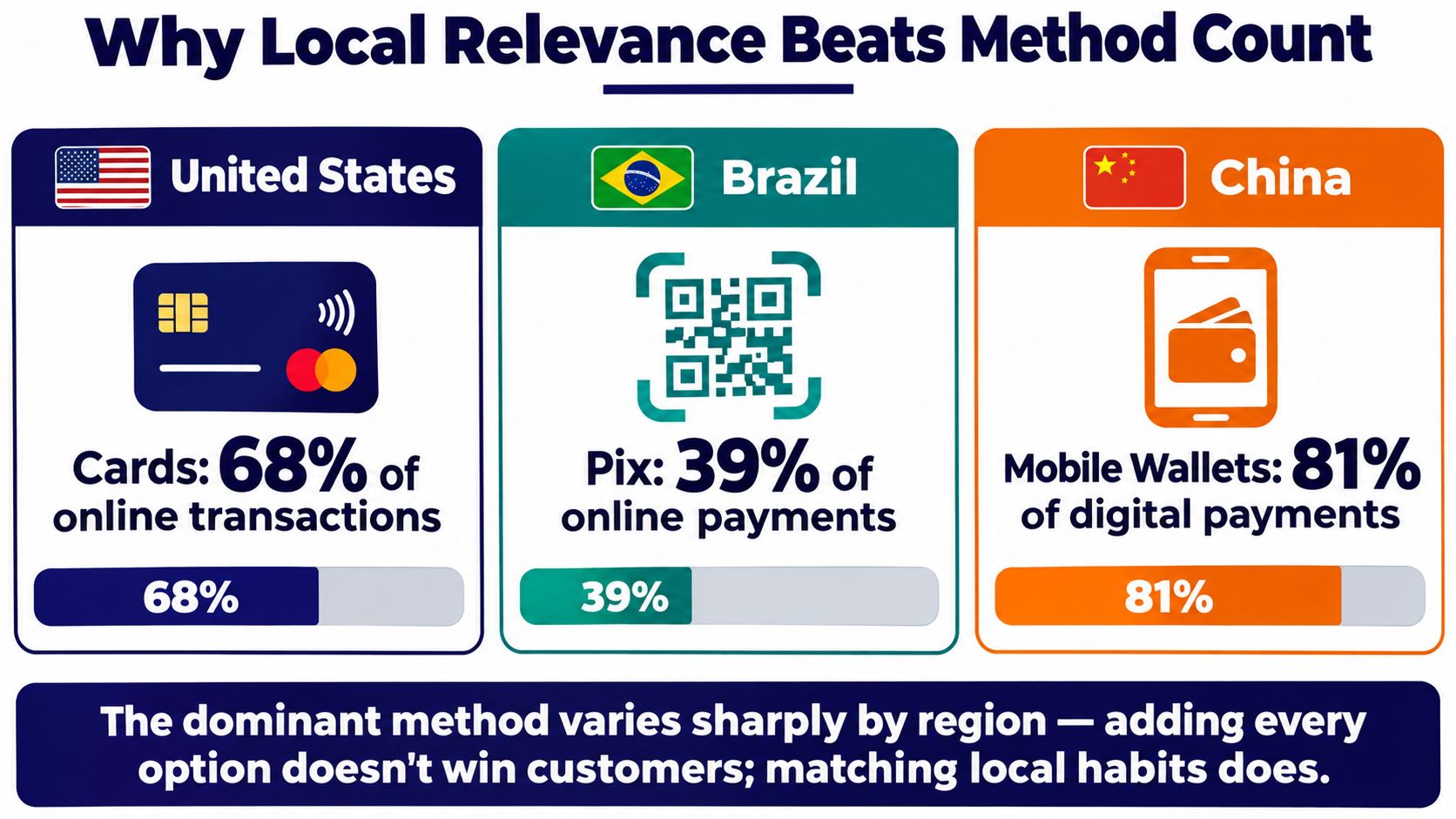
A long list of payment methods can look impressive and still miss what customers in a particular market expect. Availability means a method can technically be used. Relevance means customers in that market recognize and prefer it. Operational usability means the business can handle settlement, refunds, recurring payments, and reconciliation without adding unnecessary friction.
The regional differences can be substantial. The 2025 global payments report cited in the research reports mobile-wallet usage among consumers at 96% in Malaysia, 93% in Singapore, and 91% in Hong Kong, compared with 43% in the United States. It also reports U.S. debit-card usage among households at 90%. These figures describe different places and measures, but they underline the same point: payment habits vary by market.
The implication for a founder is practical. A checkout built only around the methods familiar to the business may not match customer preferences elsewhere. At the same time, adding every available option isn't automatically a good strategy. Each method can bring its own support, reconciliation, refund, and settlement requirements.
Use a market-by-market test
Before enabling a new method, ask three questions:
Can customers use it? Check that the method is available to the customers and devices you serve.
Do local customers use it? Prioritize methods that fit the market's habits instead of assuming a familiar global option will be enough.
Can your team operate it? Confirm how settlement, refunds, recurring charges, and records will work.
The overview of global payment methods can help merchants think through what different markets may call for. The strongest mix isn't necessarily the largest one. It's the set of payment options that customers can use and the business can support cleanly.
Fees, Compliance, Reconciliation, and Security
A checkout can feel simple to the customer while creating real work behind the scenes. Four operational layers deserve attention before you choose a payment setup: pricing, compliance, reconciliation, and security.
Pricing depends on the payment method. A card, bank payment, and stablecoin transaction may sit in different pricing categories, so a single rate may not describe what your business will pay. Suby's pricing page lists separate categories for fiat, stablecoins, bank payments, and other methods; it also lists crypto and stablecoin processing at a flat 1.5% and states there are no setup fees, monthly minimums, or contracts. Check the page for current, method-specific figures before making a decision.
Reconciliation is the work of matching payment records to the funds that settle. Your team needs to connect each transaction to its capture, payout, refund, or dispute so the books reflect what happened. If records don't line up, even successful checkouts can create confusing balances and time-consuming manual checks.
Check what the provider documents
Compliance and security claims should be specific. Ask what processing certifications and authentication protections apply, and how the provider handles disputes and refunds. Suby documents PCI-DSS Level 1–certified processing, Strong Customer Authentication, two-factor authentication, dispute handling, and zero-fee refunds. For background on the card-data standard, see this explanation of PCI-DSS compliance.
A provider should also explain how payment credentials are protected. EMVCo describes payment tokenization as replacing a primary account number with a payment token, which can be limited to a particular merchant or acceptance channel. Tokenization can reduce exposure of card numbers, but it doesn't replace issuer authorization, fraud controls, or accurate transaction records. Read EMVCo's payment tokenization explanation to understand how tokens move through the authorization flow.

The right setup isn't just the one that displays a preferred payment button. It should also give the business clear costs, documented protections, and records that staff can reconcile.
How a Single Platform Handles Four Real Jobs
A founder selling to customers abroad can face four different workflows: checkout inside an app, a crypto payment, paid access to a community, or an invoice for a client. They resemble different doors into the same shop. In each case, the customer's way to pay is one choice; the business's way to receive the proceeds is another.
Suby brings these workflows together in one product with four ways to use it. Each addresses a different operational job, rather than adding another payment button.
Suby Payments gives teams an API-first way to build checkout into a product. Its dashboard also supports subscription management, churn tracking, and payouts.
Suby Crypto handles the conversion and gas costs for crypto payments, with settlement to a non-custodial wallet or the Suby balance.
Suby Gating connects payment to access, helping businesses manage paid communities, downloads, and courses.
Suby Invoicing gives international clients an invoice-based route to pay, while leaving the business to choose how it receives the funds.
One card payment, one possible settlement choice
A customer could pay with a Visa or Mastercard, while the business receives USDC in a connected wallet. The customer chooses the payment method; the merchant separately chooses a supported settlement route. In this example, conversion happens behind the scenes. The documented card-to-USDC payment flow explains how that arrangement works.
This distinction helps clarify the platform's role. A checkout decision answers, “How will the customer pay?” A settlement decision answers, “Where should the proceeds go?” Depending on what the setup supports, the business may select bank or stablecoin settlement. Those choices do not have to match the customer's method.
Invoices can serve teams that bill clients around the world, especially when payment is arranged outside an app checkout. For businesses in services or education, Tutorbase billing offers another example of tools for managing charges and customer payments.
Across these jobs, the same principle applies: customers pay any way they want, and businesses get paid the way they choose.
A Practical Checklist for Evaluating Any Setup
Use the three building blocks, payins, balance, and payouts, to assess what a platform supports. Then check the operational details that determine whether your team can run it reliably.
Payins: Does the platform support payment methods relevant to the markets you serve, including the customer's preferred cards, wallets, bank options, or crypto?
Balance: Can your team track incoming payments clearly and identify what has been authorized, captured, or settled?
Payouts: Can the business choose between bank settlement and stablecoins where those options are supported, and are the available currencies clear?
Pricing: Is pricing explained by payment method, and can you verify the current cost for the methods your customers will use?
Compliance and security: Are processing protections and authentication requirements documented? Can you find clear information about dispute handling and refunds?
Reconciliation: Can you match each transaction to its payout, refund, or dispute without relying on a single checkout status?
Use case: Does the setup fit how you sell, whether that means API-based checkout, subscriptions, paid community access, or invoicing?
Test the payment journey from both sides. Place a test payment using a customer method, then check how the transaction appears in your records and how the payout is handled. A payment acceptance setup should give customers a usable way to pay and give your business a clear, manageable way to receive and account for the money.
If you're building a global checkout, Suby offers an API for accepting payments by card or crypto, alongside payment options for wallets, banks, and stablecoins, with payouts to a bank account or in stablecoins. Explore Suby to see whether its payment, crypto, gating, or invoicing options fit the way your customers pay and your business wants to settle.
