
Gaspard LEZIN
Launch: starting a software firm - A practical playbook for fast validation
Thinking about starting a software firm? Get a concise founder's playbook with practical steps for idea validation, setup, building, and scaling.
Everyone has an idea for a software company. But an idea, no matter how brilliant, isn't a business. The real work, and the part that separates successful founders from the ones who flame out, is a disciplined, almost obsessive focus on finding product-market fit before anything else. It all comes down to a simple sequence: find a real problem, confirm people will pay to solve it, and then build a product they can't live without.
Laying the Groundwork for Your Software Startup
The dream of launching a software company is exciting. The reality? It’s a minefield. Success has little to do with having a groundbreaking idea or elegant code. It's about systematically de-risking your venture from day one. I've seen too many founders fall in love with their solution before ever confirming anyone actually has the problem. That's a direct path to failure.
Let's be blunt: starting a software firm is tough. Recent analysis shows a staggering 90% of global startups fail. To make matters worse, a tiny fraction, just 0.05%, or about 1 in 2,000, ever manage to secure venture capital. In the US alone, you’re up against roughly 39,500 to 46,000 other custom programming firms. You can get a clearer picture from these global startup funding statistics, but the message is clear: the odds are not in your favor unless you're methodical.
Pinpoint a Specific Niche
Before you even think about code, your first job is to find a small, well-defined group of people wrestling with a big, expensive problem. Forget trying to build the next "everything tool." Instead, find an underserved niche. Think of professionals still stuck using clunky spreadsheets or ancient desktop software to manage a vital part of their job.
This laser-focused approach pays off immediately:
Your marketing becomes easier. You know exactly who you're talking to and where to find them.
The competition thins out. You aren't going head-to-head with industry giants.
You get better feedback, faster. A small, passionate group will tell you exactly what they need.
For example, don't build a "project management tool for everyone." That's a recipe for disaster. Instead, try building a "project management tool for independent architects struggling with client billing." See the difference? The second idea is specific, targets a painful financial bottleneck, and clearly defines your first customer.
Validate Your Idea Before You Build
Once you have a niche and a problem in your sights, you have to prove it's real. Validation means getting cold, hard confirmation that the problem is painful enough for people to actively seek out and pay for a solution. And no, asking your friends and family doesn't count.
Your mission is to find at least 10-20 people who perfectly match your ideal customer profile and just talk to them. Ask open-ended questions about their workflow, their biggest frustrations, and what they’ve already tried (and spent money on) to fix it. Your goal here is to listen, not to pitch.
To keep yourself on track, use a simple checklist to make sure you're asking the right questions and looking for the right signals.
Initial Idea Validation Checklist
This checklist will help you move from a vague idea to a validated concept, ensuring you're building something people actually want.
Validation Step | Action Item | Success Metric |
|---|---|---|
Problem Discovery | Conduct 10-20 interviews with your target audience. | At least 80% of interviewees confirm the problem is a top-3 pain point. |
Pain Point Analysis | Ask what they currently do to solve the problem. | They are using a makeshift solution (e.g., spreadsheets) or have tried other paid tools. |
Willingness to Pay | Ask if they would pay for a solution that solves X, Y, and Z. | You get verbal commitments or, even better, pre-orders from at least 3-5 people. |
Market Sizing | Research the size of your niche market. | The target market is large enough to support a business but small enough to dominate. |
Following this simple framework prevents you from wasting months, or years, building something nobody will buy.
A founder’s biggest mistake is building in a vacuum. The most valuable insights you'll ever get come directly from potential customers, not your own assumptions. Your first title isn't CEO; it's Chief Problem Investigator.
This entire validation loop is about following a clear, sequential path. You can't skip a step.
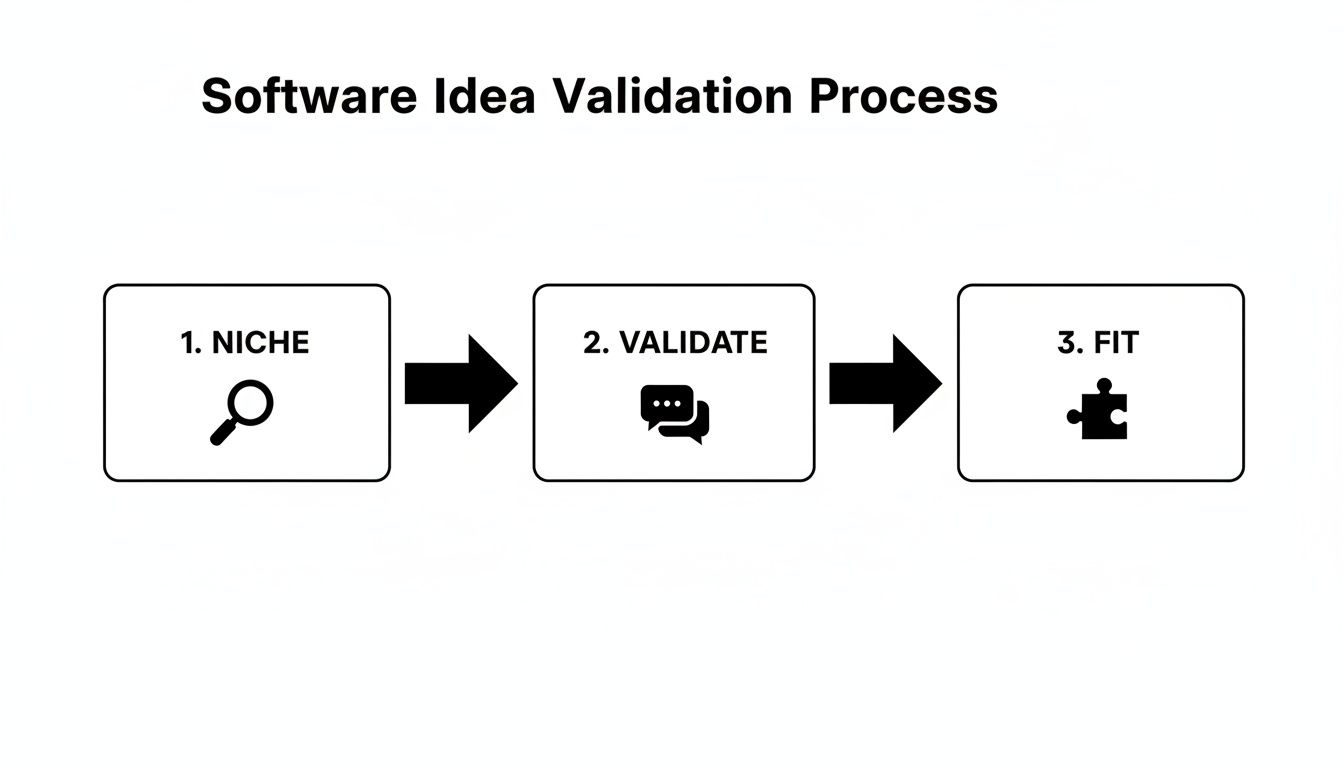
Starting with a tight niche, validating the problem through real conversations, and then aiming for product-market fit isn't just a good idea, it's the only way to build a sustainable software business.
The Goal is Product-Market Fit
Product-market fit is that magic moment when your product starts to sell itself. It’s when you've built something that satisfies such a strong market demand that users can't imagine going back to their old ways.
You’ll know you have it. The signs are unmistakable: organic growth kicks in, user retention is high, and your customers become your best salespeople, actively recommending your product to their peers.
Everything you do in the early days, from your feature roadmap and user conversations to your pricing experiments, should be focused on achieving this one goal. Don't get distracted by scaling, massive marketing campaigns, or hiring a huge team. Nail this first. The rest can wait.
From Idea to Company: Nailing the Legal and Financial Setup

Alright, you’ve confirmed your idea has legs. Now for the part that can feel daunting: turning your side project into an actual, legitimate company. Getting the legal and financial stuff right from the get-go is one of the smartest things you can do. It’s all about building a solid foundation to grow on, protecting yourself, and avoiding messy situations down the road.
Your first big move is picking a business structure. For most software startups, it boils down to two real options: a Limited Liability Company (LLC) or a C-Corporation (C-Corp). The LLC is usually simpler, offering a nice layer of protection between your personal and business assets. But if you have your sights set on raising venture capital, the C-Corp is the industry standard.
Making this choice isn't just a whim; it has long-term consequences. It's wise to get advice from a lawyer who knows the startup world. Understanding the legal services commonly needed by tech startups can save you a fortune in headaches later.
Defining Ownership and Protecting Your IP
If you're not going it alone, the co-founder conversation needs to happen immediately. Seriously, don't put this off. A solid founders' agreement is your roadmap. It should clearly define who owns what percentage, who does what, and what happens if one of you decides to leave. This document is your best defense against future fallouts.
Just as critical is protecting your intellectual property (IP), the code, brand, and design that make your business unique. This is your company's crown jewel.
Copyrights: Your source code is automatically protected by copyright the moment you write it. This stops others from straight-up copying your work.
Trademarks: This is for your brand. Lock down your company name, logo, and any key phrases so no one else can use them.
Patents: Patents are the heavy-duty option, protecting a truly unique process or invention. They're also expensive and complicated, so this is a bigger strategic decision.
Get these protections filed early. It establishes you as the owner and gives you a leg to stand on if you ever need to defend your turf.
Setting Up Your Financial Plumbing
Once your legal entity exists, you need a way to manage the money. Start with a lean budget. Map out your essential costs, like server hosting, software tools, and maybe a small marketing experiment. Your goal right now is survival. Keep your burn rate as low as possible while you hunt for product-market fit.
Next, you absolutely must separate your business and personal finances. This is non-negotiable. Open a dedicated business bank account. Or, for a more global-first approach, a dedicated digital wallet to handle your revenue can work wonders. This keeps your accounting clean and makes tax time infinitely less painful.
The way you handle money from day one sets the tone for your entire business. A clear budget and a dedicated business account or wallet are not just good practices; they are foundational to building a scalable, professional operation.
Finally, you have to think about getting paid. You need a flexible system that allows customers to pay you easily, whether it’s a one-time fee or a monthly subscription. We provide a simple API that lets any business accept payments by card or crypto. This allows you to tap into an international market without wrestling with currency conversion headaches, as businesses receive their payouts in USDC. If you're building a more complex model, you might want to look into how a Merchant of Record simplifies global sales tax and compliance. It’s all about letting you focus on what you do best: building a great product.
Building Your Minimum Viable Product (MVP)
Alright, it's time to roll up your sleeves and actually build this thing. This is where your validated idea starts to take shape as a real product people can use. The goal here isn't perfection, it’s about making tangible progress.
Your first mission is to build a Minimum Viable Product (MVP). Think of it as the leanest, most focused version of your software that solves the single biggest problem for your customers. You will be tempted to add "just one more feature." Resisting that urge is the most critical discipline you can practice right now.
An MVP isn't a buggy, half-baked product. It’s a sharp tool, not a Swiss Army knife. By shipping something functional, and fast, you kickstart the most valuable feedback loop in business: learning from how real people interact with your product. This saves you from over-engineering and gets you to market quicker, which is a massive leg up for any new software firm.
Prioritize Features and Define Your Core Loop
Before a single line of code gets written, you have to be ruthless about what makes the cut for your MVP. Go back to the notes from your validation interviews. What is the one essential task a user absolutely must be able to do to get value from your product? That's your core loop.
Let's say you're building a tool for freelance architects to manage their billing. The core loop isn't a flashy dashboard or a slick mobile app. It's much simpler:
Create a project.
Log hours against that project.
Generate an invoice.
Everything else is just noise at this stage. By focusing on this core workflow, you guarantee your first version delivers immediate, tangible value. A simple "Must-Have," "Should-Have," and "Nice-to-Have" list will do the trick. Your MVP should only contain the "Must-Haves."
Building an MVP is an exercise in disciplined subtraction, not addition. The question isn't "What else can we add?" It's "What can we remove and still solve the core problem?" Ship fast, learn faster.
This lean approach keeps your development cycles short, your initial costs down, and your product in the hands of real users as soon as humanly possible.
Choosing Your Technology Stack Wisely
Picking a tech stack can feel like a huge, permanent decision, especially with new frameworks popping up every other week. My advice? Don't chase the shiny new thing. The best tech stack is the one that lets your team build and iterate quickly and can handle early growth.
Here’s what really matters:
Speed of Development: How fast can you get from an idea to a shipped feature? Frameworks like Ruby on Rails or Django (Python) are famous for helping teams move incredibly fast.
Scalability: Can the stack grow with you from 10 users to 10,000? Most modern stacks are built for this, but it’s something to keep in the back of your mind.
Talent Pool: How easy is it to find developers who know this tech? Sticking to mainstream languages like JavaScript, Python, or Go will make hiring a whole lot easier down the road.
Your goal is to choose a practical stack you or your founding team already knows well. Wrestling with an unfamiliar technology will only slow you down, and right now, speed is your greatest asset.
The Build vs. Buy Decision
As you start your software firm, you'll constantly face the "build vs. buy" question. For any piece of functionality that isn't your core, unique value proposition, the answer is almost always to buy.
Your engineering resources are finite and precious. They should be 100% focused on what makes your product special.
Take payments, for instance. Building a secure, compliant, and global payment system from scratch is a monstrous task. Instead, you can integrate a solution with a simple API to handle all of it. This is a classic "buy" decision. With our API, you can accept both card and crypto payments globally and get settled in USDC, all without writing complex payment logic or dealing with PCI compliance.
Think of the months of development time you just saved. That’s time you can now spend perfecting your core product. The same logic applies to other non-core features like email delivery, analytics, and customer support. Buy, don't build.
Setting Up Payments for a Global Audience
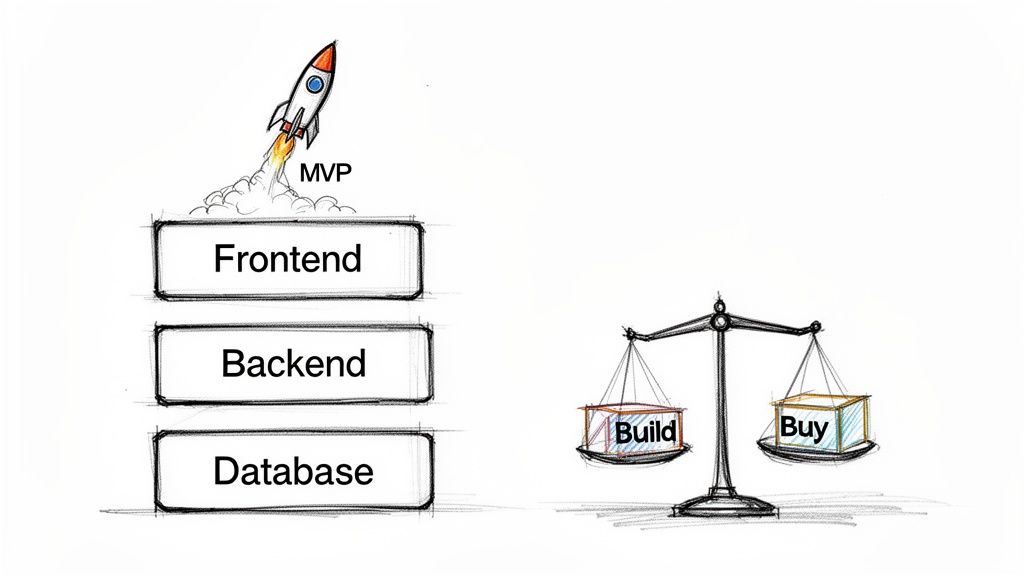
You’ve poured everything into building your software. Now comes the crucial question: how do you actually get paid for it, especially when your customers are scattered across the globe?
Relying on traditional banking for international payments can feel like a step backward. You’ll quickly find yourself tangled in a web of high fees, unpredictable currency conversion losses, and frustrating delays just to get your own money. It’s a major bottleneck for any software company aiming for global reach right out of the gate.
To truly succeed, your payment system needs to be as borderless as your software. The goal is simple: a customer in Japan, Brazil, or Germany should be able to pay you as easily as someone next door. This means accepting the usual suspects like Visa and Mastercard, but it also requires a much smarter way to manage the money you earn.
A Modern Take on Global Revenue
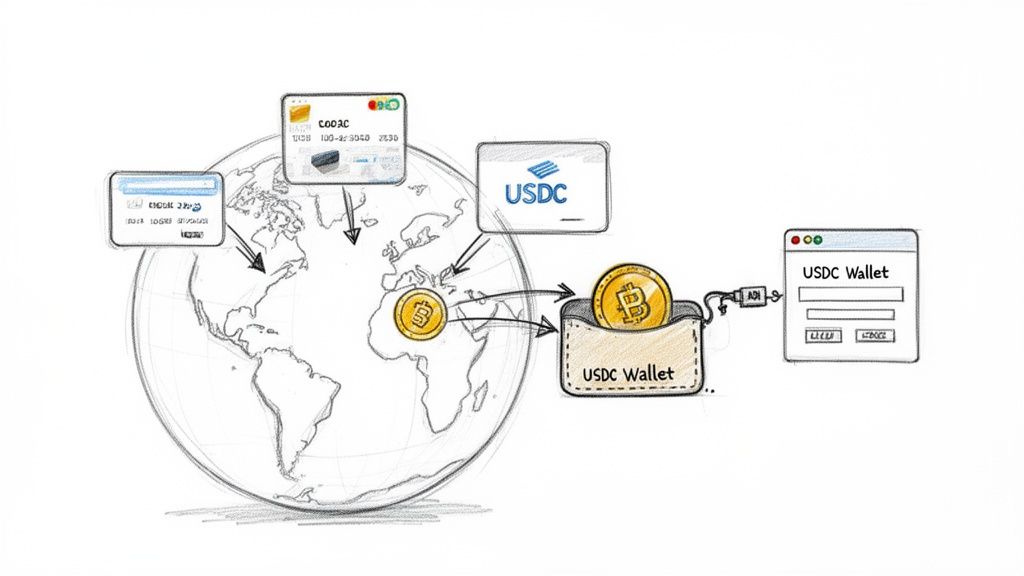
The most effective approach for a new software firm is to separate what your customer pays with from how you get paid. Think about it: your customers can use their local card or even crypto, but every single payment lands in your company’s account as a stable currency like USDC. This simple shift helps you sidestep the biggest headaches of cross-border commerce.
Here’s what that looks like in practice:
No Forced Currency Conversion: You stop losing a percentage of your hard-earned revenue to volatile foreign exchange rates.
Faster Access to Funds: Money settles directly into your digital wallet, bypassing the sluggish and expensive international banking system.
Cleaner Accounting: With all revenue flowing in as USDC, tracking your finances becomes incredibly straightforward.
This isn't some far-off, futuristic idea. A straightforward API, like the one we've built at Suby, can manage this entire flow. You can embed a checkout on your site, generate payment links for invoices, or build a completely custom experience. It’s a direct path to operating like a global business from day one.
Implementing a Flexible Payment Solution
As a founder, your time is your most valuable asset. Do you really want to spend it wrestling with payment infrastructure? By plugging in a ready-made payment layer, you can offer a world-class checkout experience without writing a single line of payment code.
Let's say you're selling a SaaS subscription. A customer in Europe pays with their card, and that revenue instantly appears as USDC in your wallet. It's that simple.
This model is especially powerful for businesses with recurring revenue or paid communities. We even offer native integrations for platforms like Discord and Telegram, so you can automate selling paid access and managing subscriptions. When a user pays, our system automatically grants them the right role or access. It connects your product, community, and revenue into one seamless loop.
A payment system should accelerate your business, not slow it down. The right solution lets you sell to anyone, anywhere, while giving you fast, predictable access to your cash. That stability is a powerful asset for any startup.
This modern approach to payments aligns perfectly with the explosive growth we're seeing. The global SaaS market is on track to hit $465.03 billion by 2026, and overall software spending is growing at 15.2% year-over-year. To grab a piece of that pie, you have to be ready to sell across borders from the very beginning.
Thinking Globally from Day One
Building a global-first company means thinking about how your customers pay in their own markets. While a unified card-and-crypto solution covers a huge portion of the world, being aware of regional payment methods is always a smart move.
For instance, if you're targeting customers in Europe, you'll want to get familiar with their local banking systems. This definitive guide to SEPA bank transfers for businesses is a great place to start.
Ultimately, your choice of payment provider is a strategic decision. Look for a partner that offers transparent pricing, solid security, and the flexibility to scale with you. By setting up a modern, stablecoin-settled payment system, you’re not just collecting revenue, you’re building a resilient financial foundation for your software firm's future.
Finding Your First Customers: An Early Go-To-Market Playbook
You’ve built a solid MVP and your global payment system is humming. Now comes the hard part, the question that keeps founders up at night: where do the first customers come from?
Forget about blowing your budget on paid ads or elaborate marketing funnels. Your early go-to-market (GTM) strategy needs to be scrappy, direct, and centered on one thing: learning. The goal isn't just revenue, it's about getting real-world feedback to guide your next move.
Your First Engine: Founder-Led Sales
In the early days, you are the company's best salesperson. No one else has your depth of understanding of the problem or the passion for the solution. This is what "founder-led sales" is all about, and it's less about a slick pitch and more about genuine conversation.
Start by circling back to the people you interviewed during your idea validation phase. These are your warmest leads. Show them what you built, based directly on their input, and watch their reaction. That initial feedback is gold.
Your first major milestone is to personally sign up your first 10 customers. This hands-on grind forges strong relationships and teaches you exactly how to talk about your product. If you built a billing tool for architects, for instance, get on a call with those who complained about invoicing. Offer them a founding-member discount or a long trial. In return, ask for their brutally honest opinion.
Creating Content for Your Niche
Content marketing isn't just for established brands with big teams. For a new software company, it’s a powerful tool for attracting your ideal customer profile without a big spend. The key is to ignore broad topics and get laser-focused on the specific pain points of your audience.
What questions are your future customers typing into Google? What are they complaining about on Reddit or LinkedIn? Create content that answers those exact questions.
Solve a Specific Problem: Instead of a generic post, write a detailed guide like, "The Freelance Architect's No-BS Guide to Project Invoicing."
Offer Quick Wins: Package your expertise into a simple checklist or a one-page PDF guide. This gives people immediate value and helps you build an early email list.
Show, Don't Just Tell: Once you land a few happy users, turn their success into a case study. A story from a peer is far more convincing than any marketing copy you could write.
This strategy establishes you as an expert and pulls in qualified leads over time. For more on connecting content to your sales efforts, check out our guide on how to sell digital products online.
Expert Insight: At this stage, marketing should feel like helping. Be relentlessly useful, and the right people will find you. This isn't about volume; it's about attracting the few who desperately need what you've built.
Engaging Where Your Customers Live Online
Your first users are already talking about their problems online, you just have to find them. They're gathered in niche subreddits, specialized Discord servers, LinkedIn Groups, and old-school forums. Your job isn't to parachute in and drop links; it's to become a trusted voice in that community.
Show up consistently. Answer questions, offer legitimate advice, and share what you know without asking for anything in return. When the context is right, you can organically mention the solution you're building. This approach builds a foundation of trust and frames you as a helpful expert, not just another vendor trying to make a sale.
For example, if you're building a tool for community managers, become an active, helpful member of a Discord server for other server owners. Help people solve moderation headaches. Then, when someone complains about the exact workflow you automate, you have the perfect opening to introduce your product. It’s a slow burn, but this method delivers highly qualified users who feel connected to your mission.
Early-Stage GTM Channel Comparison
Choosing where to spend your limited time and money is critical. This table breaks down some of the most common channels for an early-stage software firm.
Channel | Typical Cost | Time to Impact | Best For |
|---|---|---|---|
Founder-Led Sales | Low (your time) | Immediate | Getting the first 1-10 customers and gathering deep feedback. |
Niche Content | Low to Medium | Medium to Long | Building a long-term, organic lead source and establishing authority. |
Community Engagement | Low (your time) | Short to Medium | Finding highly targeted users and building authentic relationships. |
Cold Outreach | Low to Medium | Short | Reaching specific roles at specific companies, but can have low response rates. |
Paid Social Ads | Medium to High | Immediate | Quick validation or scaling, but expensive and requires expertise. |
Ultimately, your best bet is a mix of these channels. Start with founder-led sales and community engagement for immediate feedback, while planting the seeds for long-term growth with niche content.
Common Questions About Starting a Software Firm
Moving from a great idea to a real, functioning software business is a journey filled with questions. It’s completely normal to hit roadblocks and feel uncertain about what to do next. Let's tackle some of the most common questions founders ask, with some direct, practical advice to help you move forward.
How Much Capital Do I Really Need to Start?
There’s no magic number here. The real answer depends entirely on your approach.
If you’re a developer or have a technical co-founder who can build the Minimum Viable Product (MVP), your startup costs can be incredibly low. You're mostly investing your own time, along with some basic software and hosting fees.
However, if you need to hire developers or designers to build that first version, you'll need some cash. A reasonable estimate for an outsourced or small-team MVP build can fall anywhere between $20,000 and $100,000, depending on how complex your idea is.
The smartest path is to focus on a super-lean MVP to prove people actually want what you're building. Once you have that validation, you can think about funding. Bootstrapping, funding the business with your own revenue, is a powerful and sustainable way to grow if you can get sales going early.
Should I Focus on a Niche Market or a Broad Audience?
When you’re just starting out, targeting a niche market is almost always the right move. Trying to build a product for everyone is a classic startup mistake that often leads to building a product for no one. A niche audience has a specific, urgent problem that you can solve better than a generic, one-size-fits-all tool.
Going niche gives you some serious advantages:
A Clearer Message: It's so much easier to explain your software's value when you're speaking to a specific group with shared pain points.
Cheaper, Better Marketing: Your marketing becomes more efficient because you know exactly who you’re trying to reach and where they hang out online.
Less Competition: You sidestep going head-to-head with big, well-funded companies in crowded markets.
Once you’ve dominated that niche and become the go-to solution, you can then start planning your expansion into related markets.
How Do I Accept Global Payments Without High Fees?
For any modern software company, old-school international banking is a huge drag. You're hit with currency conversion risks, hidden fees, and long settlement delays that can absolutely wreck a startup’s cash flow.
A much better way is to use a payment system that combines global payment methods with stablecoin settlements. This setup lets your customers anywhere in the world pay with their standard card, like a Visa or Mastercard, while you receive the funds directly as USDC in your company’s digital wallet.
This model just cuts out all the friction of cross-border banking. You get your revenue faster, the pricing is transparent, and you have the financial stability you need to grow.
For example, a provider with a simple API can manage this whole flow. Your customers get a familiar checkout experience, and you avoid the volatility and delays of the traditional banking system. Some services, like our own, even have native integrations with platforms like Discord and Telegram to automate paid access for your online community.
How Do I Handle Security and Compliance as a Small Startup?
Security and compliance can feel overwhelming for a small team, but you don't have to build it all yourself. The key is to lean on trusted partners for the really critical functions.
When it comes to payments, pick a provider that handles PCI-DSS compliance for you. This takes the massive responsibility of storing and securing sensitive credit card data completely off your plate. That alone is a huge operational and security relief.
For your application's own security, just start with the basics:
Always encrypt sensitive user data, both when it's moving (in transit) and when it's stored (at rest).
Use modern, secure authentication methods for user accounts.
Build on top of established, secure platforms for your hosting and infrastructure.
As you grow, you can layer on more advanced security measures. But relying on compliant, third-party platforms is the most practical way to keep your business and your customers safe from day one.
Suby is a payment gateway and payment processor. Your customers pay with card, bank transfer, Apple Pay, Google Pay, Klarna, and more, or stablecoins, and you get paid out to your bank account, or directly in stablecoins (USDC, EURC) to your wallet. Anywhere in the world, no bank account required. For a new software firm, that is the fastest way to start selling globally from day one: one integration handles worldwide checkout and payouts so you can focus on your product instead of payment infrastructure.
