
Gaspard LEZIN
How to Sell Digital Products Online: A Practical Guide to Success
Discover how to sell digital products online with a practical, step-by-step guide to creating, pricing, and marketing your offerings.
When you’re gearing up to sell something someone actually needs, focus on three things: a product that answers a real question, a checkout process that doesn’t hiccup, and a clear path to the people who want it. Nail those, and you’ll move from whiteboard sketches to sales notifications in no time.
Building Your First Digital Product From Scratch
Before you dive into design mockups or sales emails, validate your idea. Sketch out a rough outline or run a quick survey to see if anyone bites. This early check can spare you wasted hours.
Find A Problem Worth Solving
Great products spring from genuine pain points. Your job is simple: spot a struggle your audience faces, then map out how you’ll guide them past it.
Listen In: Browse niche forums, social media groups or Q&A sites. What do people keep asking?
Tap Your Expertise: Which challenges have you already solved, for yourself or a client, that others might pay to learn?
Spot The Gaps: Do existing solutions feel overpriced, overcomplicated or just missing the mark?
Once you’ve narrowed in on one clear issue, pitch the idea to a handful of prospects. Their feedback will tell you if you’re onto something or need to tweak your angle.
Choose The Right Product Format
How people like to learn should drive what you build. Whether it’s something they can read, watch or plug straight into their workflows, match the format to their habits.
Ebooks And Guides: Ideal when you need to dive deep into concepts with text and images.
Online Courses: Perfect for step-by-step video demos and worksheets. Many creators package their expertise into a structured info product business once they see steady interest.
Templates And Tools: Give them a ready-made framework so they skip straight to results.
Paid Communities: Create a members-only space for networking, ongoing Q&A and peer support.
For a full breakdown of where each format shines, see our detailed comparison of the best platforms for selling digital products.
Choosing Your Digital Product Type
Below is a quick side-by-side look at popular digital formats to help you decide which one aligns best with your content and audience.
Product Type | Best For | Effort to Create | Monetization Model |
|---|---|---|---|
Ebook | Coaches or experts sharing in-depth knowledge | Low to Moderate | One-time purchase |
Online Course | Visual learners needing structured guidance | High | Tiered pricing or subscriptions |
Template | DIYers who want plug-and-play solutions | Low | Pay-per-download or bundles |
Paid Community | Professionals seeking ongoing support | Moderate | Recurring subscriptions |
Whichever path you choose, make sure it fits both your strengths and how your audience likes to engage.
We’re not working in a vacuum here. The global digital goods market is on fire. It’s set to hit USD 157.39 billion by 2026, and climb to USD 511.43 billion by 2031 (Mordor Intelligence).
A strong product-market fit is the bedrock of any successful online business. Before you write a single line of code or design a single page, make sure you are building something for a specific someone.
Getting Paid: How to Set Up Your Checkout for Global Sales
You've built a fantastic digital product. Now comes the moment of truth: making it easy for people to actually buy it, no matter where they are in the world. A clunky or confusing checkout is the quickest way to kill a sale, so your goal is a smooth, secure experience for every single customer.
Selling globally introduces a whole new layer of complexity, and the same friction hits anyone shipping physical goods too, from software sellers to those figuring out how to sell jewelry online. Traditional payment systems are notorious for currency conversion fees, frustrating bank holds, and long payout delays that can seriously mess with your cash flow. The answer isn't to piece together multiple systems, but to find a unified one that handles everything.
Building a Modern Payment Foundation
The secret to seamless global sales is flexibility. You absolutely need to accept the payment methods your customers know and trust, whether that's a standard Visa or Mastercard or even modern digital assets. By offering these choices, you're not just catering to a wider audience; you're actively removing the friction that leads to abandoned carts.
A modern payment layer lets you do this without the headache. Instead of juggling different processors for different regions or payment types, you can manage everything from one place. This isn't just better for the customer, it massively simplifies your own financial admin.
A checkout page isn't just a form; it's a handshake. It's where you build trust. When international buyers see familiar payment options and a professional interface, their confidence in making a purchase skyrockets.
Getting to this point is the culmination of a lot of hard work, from finding your niche to actually creating the product. This visual lays out that journey.
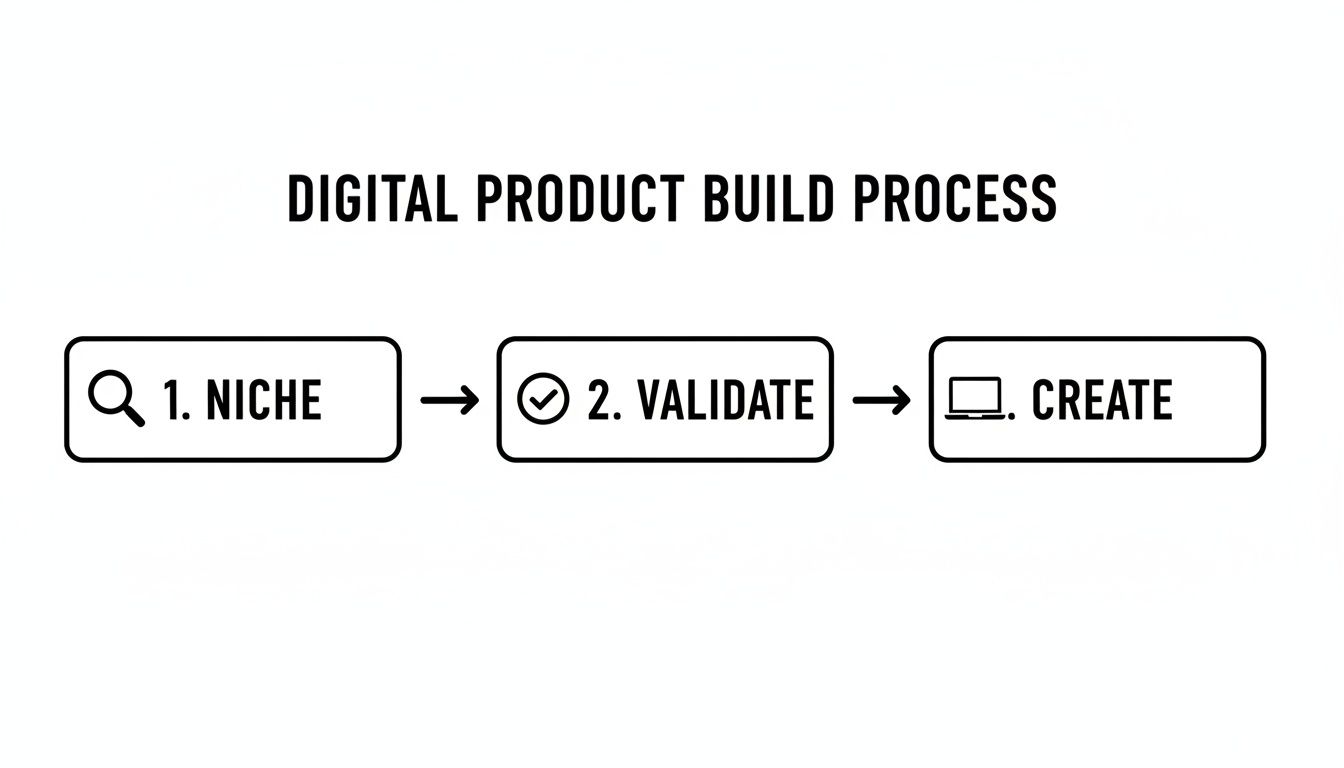
Now, it's time to make sure you have a reliable way to get paid for all that effort.
Three Ways to Go Live with Your Checkout
Getting your payment system up and running shouldn't require a team of developers. Depending on your technical skills and how you sell, you can start accepting payments almost immediately.
Here are the three most common ways people get this done:
Paylinks: These are the simplest option. Just create a shareable link that takes customers to a dedicated checkout page. They're perfect for selling on social media, in email newsletters, or even directly through DMs. No website required.
Embedded Checkouts: This is my preferred method for a seamless brand experience. You just embed a checkout form directly onto your landing page or website, keeping the customer on your domain from start to finish.
API Integration: If you need total control and have the technical chops, a payment API lets you build a completely custom checkout flow. This is the go-to for integrating payments into your own software, mobile app, or a complex sales funnel.
We provide an API that allows any business to accept payments by card or crypto. The system handles both one-time purchases and recurring subscriptions. Your customers can pay with Visa or Mastercard, and you receive your revenue settled instantly as USDC.
The Real Advantage: Getting Paid in Stablecoins
Here’s the part that really changes the game for international sellers: how you actually receive your money. When a customer in Germany pays in Euros and another in Japan pays in Yen, traditional systems leave you exposed to wild currency fluctuations and tedious bank transfer times.
Receiving all your revenue in a stablecoin like USDC sidesteps this entire mess. It provides a predictable, stable financial base for your business.
Think about it: customers pay with their card, but you receive USDC. This means:
No More Currency Conversion Fees: You stop letting those hidden charges chip away at your profits.
Payouts in Minutes, Not Days: Funds settle directly to your digital wallet, completely bypassing the slow, traditional banking network.
Truly Global from Day One: You can sell to anyone, anywhere, without the hassle of opening multiple international bank accounts or juggling payment processors.
This is how modern creators sell digital products at a global scale. If you're looking to dive deeper into this topic, check out our guide on choosing the best international payment gateway.
Choosing a Smart Pricing and Subscription Strategy
How you price your digital product is more than just a number. It's a direct message to your customers about its value, quality, and the results they can expect. Nailing your pricing can be the single factor that turns a side project into a scalable business. A smart strategy simply aligns your product’s benefits with a price that feels right for both you and your target audience.
Before you set anything in stone, it’s worth exploring different pricing models to see what fits. This decision will ripple through everything, from your monthly revenue and customer lifetime value to how people perceive your entire brand.
One-Time Purchases vs Recurring Revenue
The most straightforward path is the one-time purchase. A customer pays you once, and they get permanent access to your ebook, template, or course. It’s simple, easy to understand, and works great for standalone products.
But for many online businesses, the real engine for growth is recurring revenue from subscriptions. This model gives you a predictable income stream, which is a game-changer for long-term planning. It also encourages you to build a loyal community that stays engaged with your work month after month.
Building a recurring revenue stream is like planting a tree instead of selling a single piece of fruit. It takes a little more effort upfront, but the long-term payoff is significantly greater, providing stability and predictable growth for your business.
The market is definitely shifting this way. The subscription economy has exploded, and it’s now a central part of how people access digital goods. In fact, transaction volume in the digital product space shot up by nearly 70% between 2022 and 2024, showing a massive appetite for these products. If you want to dig into the numbers, you can find more digital product statistics on whop.com. This data really drives home why a solid subscription strategy is so crucial today.
Structuring Your Subscription Tiers
If you go the subscription route, tiered pricing is a fantastic way to appeal to different types of customers. By offering a few distinct packages, you can guide people toward the option that best fits their needs and budget.
Most businesses use a structure that looks something like this:
Basic Tier: Offers the core features at a low-barrier price. Perfect for getting new users in the door.
Pro Tier: Adds more advanced features or higher usage limits. This is usually aimed at power users or small businesses.
Premium/Enterprise Tier: Delivers exclusive access, priority support, or custom solutions for your most committed customers.
Let's say you're selling access to a private Discord community. Your basic tier might just offer general channel access. The premium tier, however, could include one-on-one coaching calls or exclusive content drops. This structure lets you capture more revenue from your biggest fans without pricing out newcomers.
Automating the Entire Subscription Lifecycle
Trying to manage subscriptions manually is a nightmare. It just doesn't scale. You need an automated system that can handle everything from the initial sign-up to recurring billing and, eventually, cancellations. This is where a solid payment platform is non-negotiable.
An automated service puts this whole process on autopilot. It handles the recurring billing without you lifting a finger, making sure you get paid on time, every time. Customers simply pay with their card, and you receive the funds as USDC directly in your crypto wallet.
This is especially powerful if you're monetizing an online community on a platform like Discord or Telegram. With our native integrations, you can automate access completely for subscriptions, paid access, and other community use cases. When someone subscribes, they're instantly given the correct role. If their subscription lapses, their access is automatically revoked. This frees you from all that tedious admin work, so you can focus on what actually matters: creating value for your members. This kind of automation is the key to selling digital products online at scale.
How to Set Up Automated Delivery and Access
This is where your digital business truly starts to work for you, even when you’re not working. The biggest unlock in selling digital products is automating delivery. It’s how you go from a side project to a scalable business that can serve 10 customers as easily as 10,000. Getting that system right, where a customer pays and gets instant access, isn't just a nice-to-have. It's the professional standard.
When someone buys from you, they want their stuff now. Making them wait for a manual email or an invite kills the excitement and introduces friction. A smooth, instant handoff after payment is what makes a customer feel like they've made a smart purchase.
Connecting Payments to Product Access
So, how do you make this happen? The secret lies in connecting your payment system to whatever "door" your customer needs to go through. This connection is usually made with an API and webhooks.
Think of a webhook as a digital flare gun. When a payment goes through successfully, your payment system fires off a flare (the webhook) to another system. That system catches the signal and knows exactly what to do next, whether it's generating a license key or adding someone to a private group. It all happens in seconds, and you don’t have to lift a finger.
Real-World Automation in Action
The "how" of automation really depends on what you're selling. There’s no single button to press, but most delivery setups fall into a few common patterns.
Here’s what this looks like in practice for different types of products:
File Downloads (Ebooks, Templates, Presets): Once a payment is confirmed, the system should automatically email the customer a secure, expiring download link. Using expiring links is a simple but effective way to prevent people from sharing your product all over the internet.
Software and License Keys: Your payment processor’s API can talk directly to your licensing server. A successful payment triggers an API call, telling the server to generate a unique key and send it to the buyer. This is a must for any SaaS or software product.
Online Course Access: The payment confirmation can trigger an API call to your course platform (like Teachable or Kajabi). This automatically creates a new user account for your customer and enrolls them in the right course. No more manually adding students one by one.
Getting this integration right from the start is what separates a frustrating customer experience from a delightful one.
The Special Case: Paid Communities
Running a paid community on a platform like Discord or Telegram is a fantastic business model, but it can turn into a logistical nightmare if you're managing members manually. Adding new people, assigning roles, and, most importantly, kicking people out who stop paying is a soul-crushing, full-time job. This is where a native integration is a lifesaver.
A successful payment should be the only thing a customer needs to do to get access. Any manual step on your end is a bottleneck. It slows down delivery for the customer and puts a hard cap on how much your business can grow.
When your payment platform talks directly to Discord or Telegram, the entire member lifecycle is automated.
Our platform is built to handle exactly this. It automates access management for communities, allowing you to accept global payments and manage members without any manual work. You can dig into the specifics of setting up automated access management for online communities to see how it works.
When a user pays, their subscription starts, and they are instantly granted the correct role in your Discord server. The moment their subscription ends or their payment fails, their access is automatically revoked. This simple, API-driven process ensures only paying members get your premium content and frees you up to actually build and engage with your community.
Marketing Your Product And Increasing Conversions
Having a great product and a smooth checkout process is only half the battle. Next, you need to catch your ideal buyer’s eye and guide them toward a purchase. That’s where strategic marketing and conversion focus step in, turning curious visitors into paying fans.
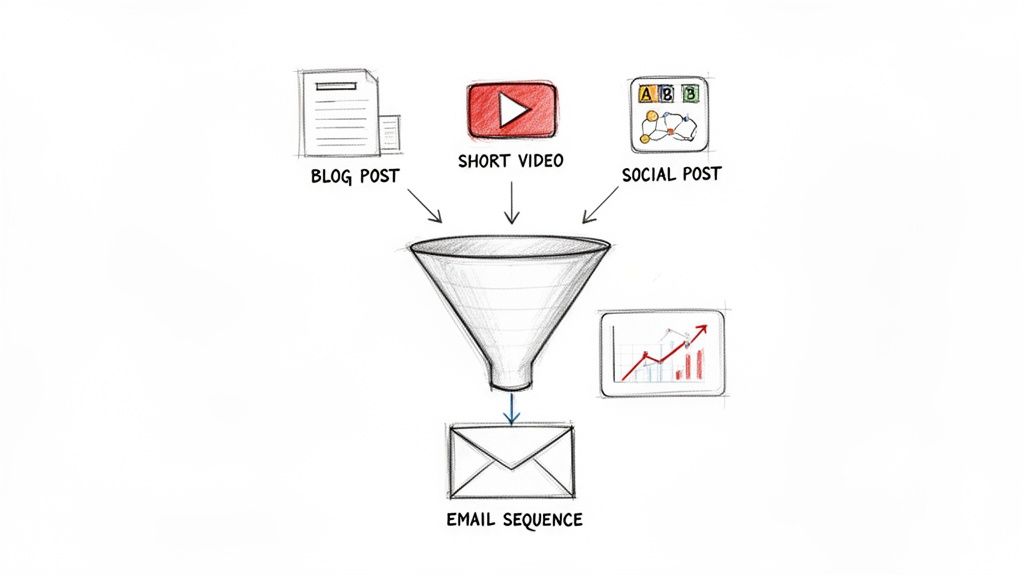
Effective promotion isn’t about broadcasting your message to the masses. It’s about crafting a clear path that attracts the right people, nurtures their interest, and guides them to click “buy,” often on autopilot.
Build A Simple And Effective Marketing Funnel
Think of your funnel as the roadmap from “Who is this?” to “I need this.” For digital products, the magic happens when you trade something valuable for an email address, then follow up until your offer feels irresistible.
Attract With Content: Publish blog posts, tutorials, or social updates that tackle a core problem your audience faces. This positions you as the go-to resource.
Capture With A Lead Magnet: Offer a free checklist, template, or mini-course. Visitors swap an email address for instant value, becoming warm leads.
Nurture Through Email Sequences: Automate a short series of emails. Share deeper insights, answer common questions, and weave in a personal anecdote that highlights your paid product.
Convert With A Compelling Offer: Close the sequence with a clear call-to-action driving traffic back to your sales page. Emphasize the transformation your product delivers.
Your funnel acts like an introduction between your product and new visitors, warming them up before you ever push for a sale.
Optimizing Your Sales Page For Higher Conversions
Bringing traffic to your page is great, but turning clicks into customers is the real win. Tiny changes in headlines, copy, or buttons can boost revenue significantly. If you haven’t already, explore proven conversion optimisation strategies to lift your results.
A Standout Headline: Your headline has seconds to capture attention. A/B test different angles until you hit one that resonates.
Benefit-Driven Copy: Focus on the end result, not just features. Mirror the language your audience uses to describe their pain points and goals.
Clear Calls-to-Action: Buttons like “Buy Now” or “Get Instant Access” should pop off the page. Repeat them in logical spots so visitors never wonder what to do next.
Treat your sales page like a round-the-clock team member. It needs to answer every doubt and make the purchase feel like the obvious next step.
Remove Friction From The Checkout Process
No matter how seductive your funnel or sales page, a clunky checkout will send people running. Simplify every field and eliminate distractions. The fewer clicks between cart and payment, the lower your abandonment rate.
Offer familiar payment methods and instant validation. Modern systems let you accept cards or wallets, while you receive payouts in USDC, which is critical when you’re selling worldwide. Online sales are on track to hit USD 6.86 trillion by 2025, with 2.77 billion people shopping online. For deeper insights, check out global e-commerce statistics on craftberry.co.
Finally, monitor a real-time analytics dashboard to keep an eye on sales, subscriptions, and conversion rates. That data reveals what’s working and what needs tweaking, empowering you to grow your digital product business with confidence.
7. Compliance, Security, and Taxes: The Serious Side of Selling
Look, let's talk about the stuff that isn't as exciting as product creation but is absolutely critical for building a real, sustainable business. Selling online means you're handling sensitive customer data, and that's a responsibility you can't take lightly.
Getting compliance, security, and taxes right isn't just about ticking boxes. It's about protecting your customers, building trust, and ultimately, protecting yourself from massive headaches down the road.
A huge part of this is payment security. The moment a customer types in their credit card number, you're on the hook for keeping it safe. This is why you must work with a payment processor that is PCI-DSS compliant. It’s the gold standard for securing card data. For a deeper dive, check out our guide on what is PCI-DSS compliance.
Security and Compliance in the Real World
Protecting card numbers is just the start. Today's online world has multiple layers of security, and they're not just technical jargon. They're fundamental to building the trust that gets people to click "buy" and to meet legal standards across the globe.
When you're evaluating a payment partner, make sure they have these bases covered:
Strong Customer Authentication (SCA): This is a legal requirement in Europe, but honestly, it’s a best practice everywhere. It adds an extra layer of verification to fight fraud, confirming the buyer is actually who they say they are.
Dispute Handling: Chargebacks are a fact of life in e-commerce. You need a platform with a clear, efficient system for managing and resolving these disputes without it becoming a time-sucking nightmare.
Security isn't a feature; it's the foundation. When customers feel safe, they buy. A transparent, secure checkout is one of the most underrated conversion tools you have.
For instance, we use a PCI-DSS Level 1–certified partner and have built-in tools for things like SCA and dispute management. We've baked these security and compliance guarantees in from the start so you don't have to worry about them.
Getting a Grip on Taxes
Now for everyone's favorite topic: taxes. This is easily one of the most complex parts of selling digital products, especially if you have a global audience. The rules are often based on your customer’s location, not yours.
This means you could be on the hook for collecting and paying taxes like Value Added Tax (VAT) in Europe or various sales taxes across the United States. It can feel overwhelming.
The key is to start with the main regions where you have customers. A payment platform that gives you detailed transaction records is your best friend here, it makes organizing your finances so much easier.
Let me be crystal clear: this is not legal or tax advice. As your business scales, one of the smartest investments you'll ever make is hiring a tax professional who specializes in e-commerce. They'll help you navigate the specific rules that apply to your business, so you stay compliant and avoid any nasty, expensive surprises.
Frequently Asked Questions
Got a few more questions? Let's tackle some of the common hurdles people face when selling digital products online, from payment methods to managing a global community.
What's The Best Way To Accept Payments For Digital Products?
Honestly, the best approach is a unified one. You want a system that lets customers pay with their credit cards, the way they're used to, but settles the funds for you in a stable digital currency like USDC.
This hybrid model gives you the best of both worlds. Your customers get a familiar, frictionless checkout, and you get to sidestep all the typical headaches of currency conversion and international banking. It's simple: they pay with a card, you receive USDC.
Can I Automate Access To My Discord Or Telegram Community?
Absolutely, and you really should. Manually adding and removing members is a huge time-sink that gets worse as you grow. A payment platform with native integrations for Discord and Telegram can handle this for you automatically.
Think about it: when someone subscribes, the system instantly grants them the right role. If their payment fails or they cancel, their access is just as quickly revoked. Our API is built for exactly this, linking payments directly to community management so you can focus on your members, not your member list.
Automation here isn't a luxury; it's essential for scaling. It guarantees only paying members have access and frees you from endless administrative busywork.
How Do I Handle Taxes For Digital Products Sold Internationally?
This is a big one. Generally, you're responsible for collecting and remitting sales tax or VAT based on your customer's location, not where your business is based. Getting this right is a non-negotiable part of running a legitimate online business.
Tax laws for digital goods are a complex web that differs wildly from country to country. Your best bet is to talk to a tax professional who specializes in e-commerce. They can help you figure out your obligations and set up a compliant system for the regions you sell in.
Ready to build a global business without the usual payment headaches? We offer a complete payment layer that lets your customers pay by card while you get fast, stable USDC payouts. Get started for free at suby.fi.
