

You usually notice billing problems late.
A SaaS product starts with a simple setup. One plan, one monthly charge, maybe a manual invoice for the first enterprise customer. Then the business adds annual contracts, seat-based pricing, usage overages, discounts, coupons, upgrades in the middle of a cycle, and a few customers who want to pay in ways your original stack never anticipated. Finance builds workarounds in spreadsheets. Support starts answering invoice questions every week. Product wants to launch a new package, but billing has become the bottleneck.
That's the moment a SaaS billing engine stops being a back-office tool and becomes a growth system. If the engine is weak, every new pricing idea creates risk. If it's strong, pricing becomes something the business can use.
Table of Contents
- The runtime layer protects the product
- The financial layer turns activity into money
- What usually goes wrong
- Checkout, app events, and back-office systems
- Hybrid pricing changes are where cracks show
- Compliance isn't just a legal checkbox
- Start with the workflows that hurt today
- Evaluate the system behind the UI
- SaaS Billing Engine Evaluation Rubric
- What to ask in the final round
Why Your Billing System Defines Your Growth
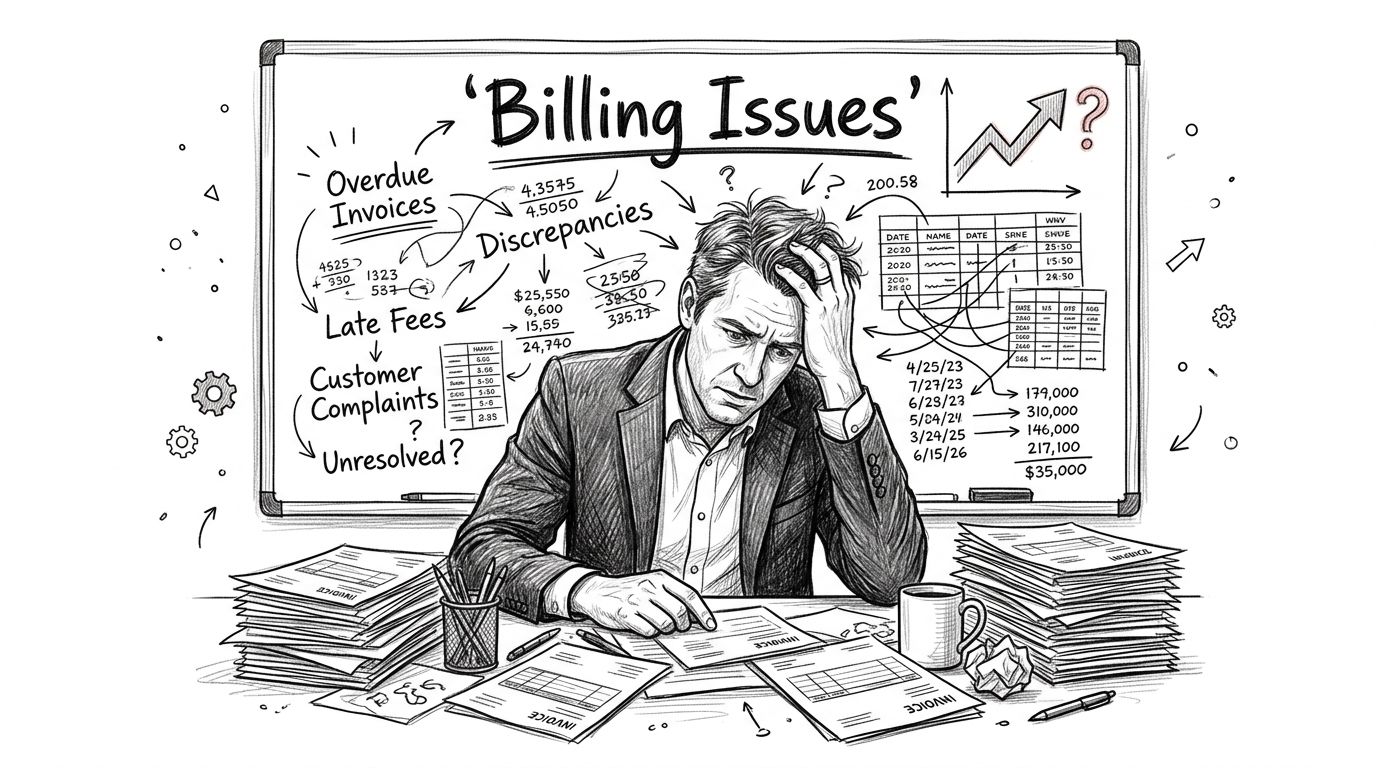
A familiar story plays out in growing SaaS companies. Sales closes a custom deal. Product launches usage-based pricing. Finance now has to reconcile recurring subscriptions, one-off charges, credits, and exceptions across several systems. Nothing is fully broken, but nothing is clean either.
That's where a billing engine earns its place. It automates recurring charges, applies pricing rules consistently, generates invoices, and creates a reliable path from customer activity to recognized revenue. More importantly, it gives teams the confidence to change pricing without creating operational chaos.
The category is growing quickly because the problem is real. The global subscription billing management market was estimated at USD 7.15 billion in 2024 and is projected to reach USD 17.95 billion by 2030, growing at a CAGR of 16.9%, driven by broader adoption of subscription business models across industries, according to Grand View Research's subscription billing management market report.
Billing breaks before finance says it breaks
The first signs usually show up outside accounting:
- Support feels it first: customers ask why an upgrade charge looks wrong, or why access changed before an invoice updated.
- Product hits friction: the team wants to test a new package or entitlement rule, but billing logic is hard-coded.
- Sales works around the system: reps promise terms that the current stack can't represent cleanly.
A weak process also hides problems. A spreadsheet can make a bad setup look manageable for months.
Practical rule: If pricing changes require manual cleanup, billing is already limiting growth.
Good billing infrastructure also improves visibility. Teams that care about revenue quality usually want better reporting long before they replace their billing stack. That's why work on billing often starts with analytics, not checkout. A useful example is thinking through what your payment analytics setup should actually show the business, especially when revenue comes from more than one model.
What a billing engine changes
A proper engine shifts billing from reactive operations to controlled execution.
It lets a company launch pricing with fewer manual exceptions, handle renewals reliably, and maintain a cleaner handoff between product, finance, and support. That's why the right question isn't “Do we need billing software?” It's “Can our current setup support the next pricing decision we want to make?”
The Core Architecture of a Modern Billing Engine
A common practice is to evaluate billing engines by feature lists. That's a mistake. Architecture matters more than surface features because billing failures usually happen between components, not inside one screen of a dashboard.
The easiest mental model is a utility company. One part of the system measures consumption. Another decides what that consumption costs. Another issues the bill, collects payment, and records the transaction correctly. SaaS works the same way, except the triggers are seats, API calls, storage, feature access, credits, and contract terms.
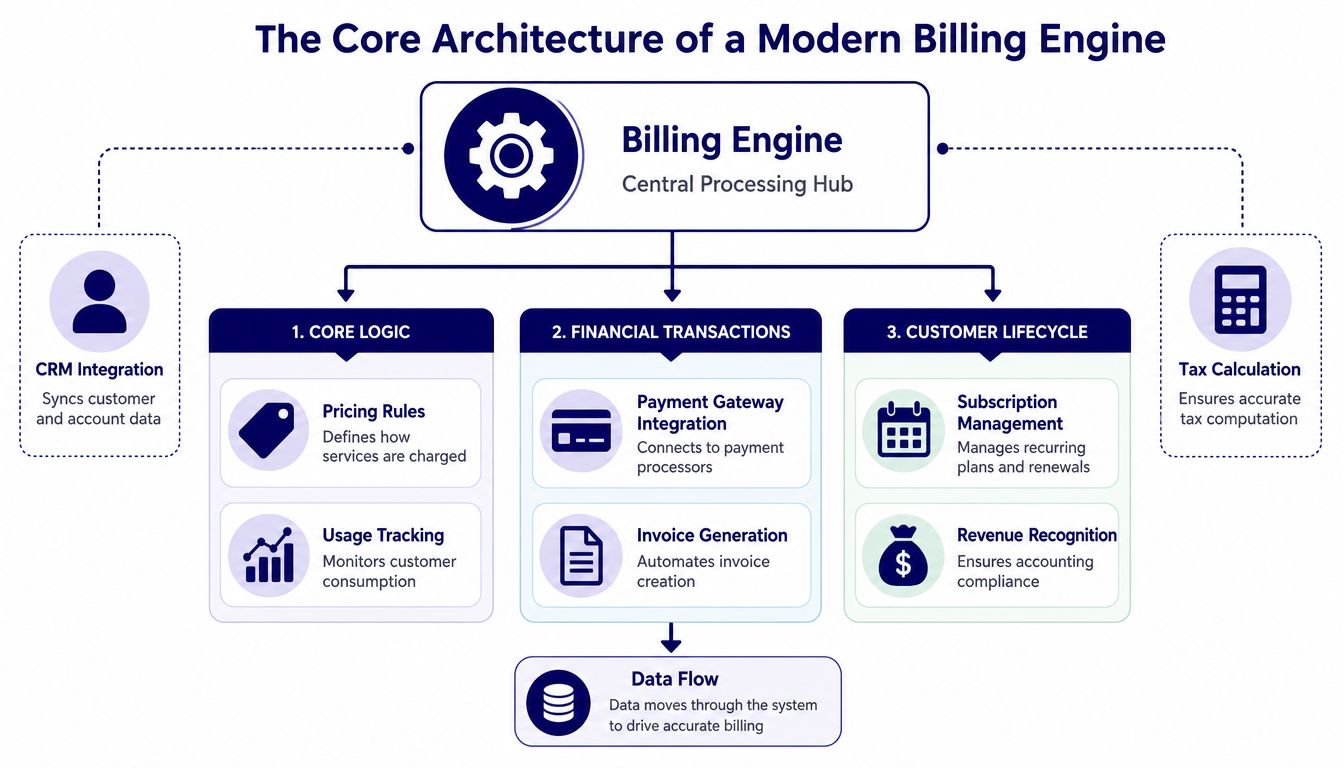
A modern design needs two distinct layers. The financial layer manages invoicing and payment processing. The runtime layer handles real-time entitlement checks and usage governance before compute is consumed. That dual structure keeps enforcement separate from downstream financial logic, as described in Stigg's billing software architecture guide.
The runtime layer protects the product
This layer sits close to the application.
When a customer tries to access a premium feature, exceed a usage cap, or consume prepaid credits, the runtime layer decides what should happen immediately. It doesn't wait for month-end invoicing. It checks entitlement, wallet state, or usage limits in real time.
That matters because delayed enforcement creates two expensive problems:
- Revenue leakage: customers consume more than they should before billing catches up.
- Bad customer experience: finance later invoices for usage the product never controlled clearly.
The financial layer turns activity into money
The financial layer is slower, but no less important. It takes the events and contract terms that the runtime layer allowed, then translates them into billable records.
Core responsibilities usually include:
- Metering: capturing billable usage in a structured way
- Rating: applying pricing rules to usage, including tiered or volume logic
- Invoicing: generating the bill on the right schedule, with proration where needed
- Payment collection: charging cards, initiating payment workflows, and handling failures
- Dunning: retrying failed collections and managing account state
- Revenue recognition inputs: producing data finance can trust downstream
A billing engine should answer two different questions cleanly: “Can this customer use the product right now?” and “What do they owe for what they used?”
That separation also makes integrations easier to reason about. Product teams can focus on enforcement and entitlements. Finance teams can focus on invoice integrity and reconciliation.
What usually goes wrong
The biggest architectural mistake is letting billing logic spread across too many places. A bit in the app, a bit in the CRM, a bit in custom scripts, a bit in finance tooling. It works until a customer changes plan mid-cycle or moves onto a custom contract.
When teams evaluate platforms, they should look closely at API design and workflow control, not just invoice templates. That's especially true if the product roadmap includes usage-based packaging or complex payment flows. A practical place to start is understanding what a strong payment gateway API integration should expose to developers and operators, not just what marketing pages promise.
Common SaaS Billing Models in Action
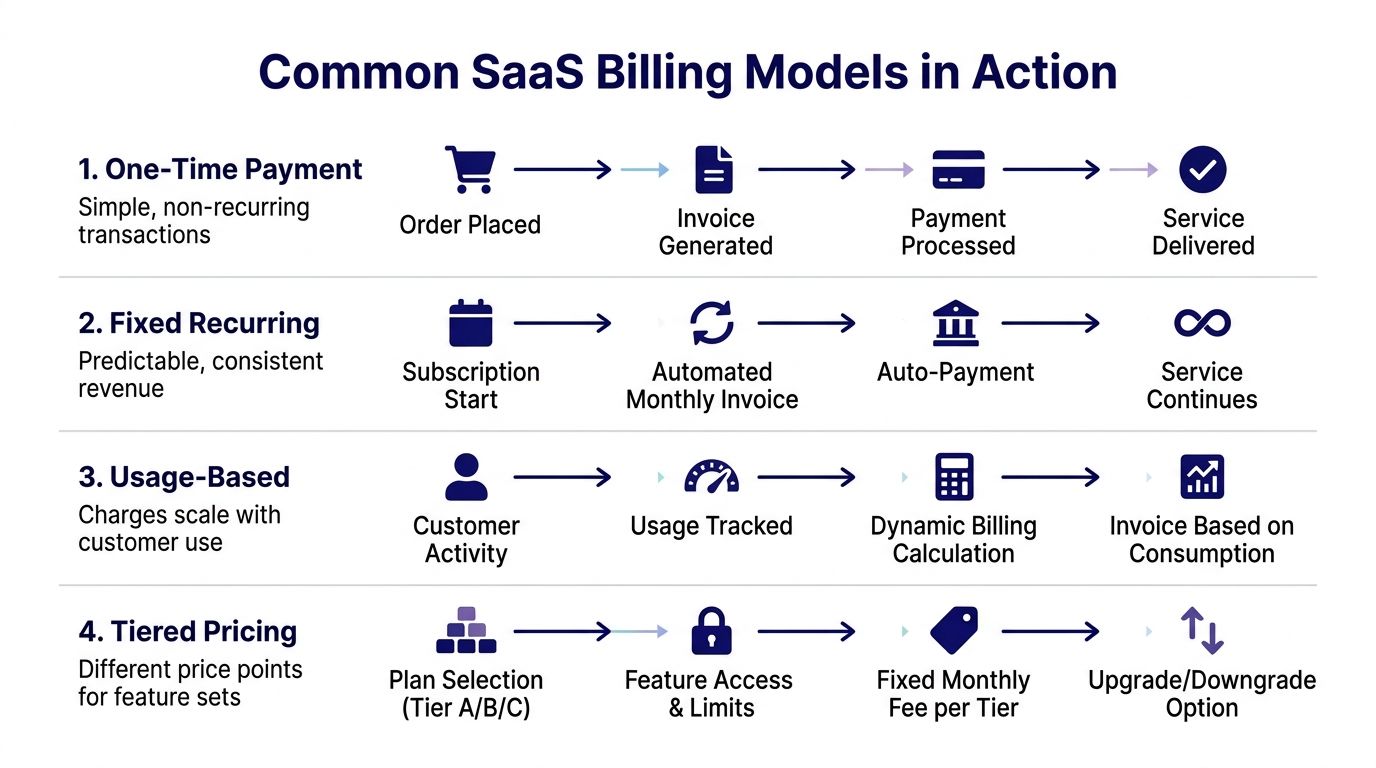
Billing models look simple on pricing pages and get messy in production. The issue usually isn't the first invoice. It's everything that happens after customers upgrade, consume more than expected, or combine multiple pricing mechanics in one account.
One-time payments
A lightweight SaaS tool might sell a setup package, migration service, or paid onboarding session as a single purchase. This is the simplest case. The billing engine creates the invoice, collects payment, and marks the order complete.
What matters isn't the transaction itself. It's whether one-time charges can coexist with subscription records without forcing manual reconciliation later. Teams often underestimate that part.
Fixed recurring subscriptions
A classic subscription business starts here. One plan, one monthly or annual charge, automatic renewal. This model is operationally stable, which is why so many companies begin with it.
The complexity arrives when the customer changes terms before renewal. Mid-cycle upgrades, seat increases, plan downgrades at term end, and contract-specific discounts all require the engine to apply timing rules consistently. If it can't, support becomes the billing correction team.
For teams working through packaging options, this breakdown of strategies to monetize your app is useful because it connects pricing design to monetization mechanics, not just marketing positioning.
A good billing walkthrough helps to visualize how these models behave in practice:
Usage-based billing
Now the billing engine has to become a data system.
An API platform, for example, may charge based on calls, storage, or compute time. Every relevant event must be captured, de-duplicated, attributed to the right account, and aggregated into a billing period. That's why event ingestion quality matters so much. Modern billing engines must ingest usage events at extreme scale with idempotency guarantees. Industry-leading systems can ingest up to 1,000,000 events per second using a unique transaction_id per event to prevent double billing before aggregation for invoicing, as outlined in Lago's guide to architecting billing systems.
If usage data isn't trustworthy, the invoice won't be trustworthy either.
Many internal builds struggle with the lack of strong rules for retries, idempotency, aggregation windows, or corrections, even though they can track raw events.
Hybrid models
This is the model more SaaS companies eventually reach. A customer might pay a base subscription for platform access, then additional usage fees, overages, or prepaid credit drawdowns on top.
Hybrid pricing is attractive because it aligns value and revenue better. It's also the easiest way to expose weaknesses in your billing setup. The engine has to combine contract terms, runtime usage, plan entitlements, and invoice timing without creating conflicting records.
A practical test is whether you can handle all of these without manual intervention:
- A subscription starts on one plan, then upgrades mid-term
- Usage exceeds included volume during the same billing period
- A sales rep adds a negotiated credit or custom override
- Finance still gets a clean invoice and usable reporting
That's why teams evaluating a SaaS billing engine should study usage-based billing design patterns early, even if they aren't charging on usage yet. If your product gains traction, you may need the option sooner than expected.
Choosing Your Path Build vs Buy vs API-First
There are three realistic ways to approach billing infrastructure. Build it yourself, buy an all-in-one system, or use an API-first platform and assemble the workflow around your product.
None is universally correct. The right choice depends on where your complexity lives and how much control you'll need later.
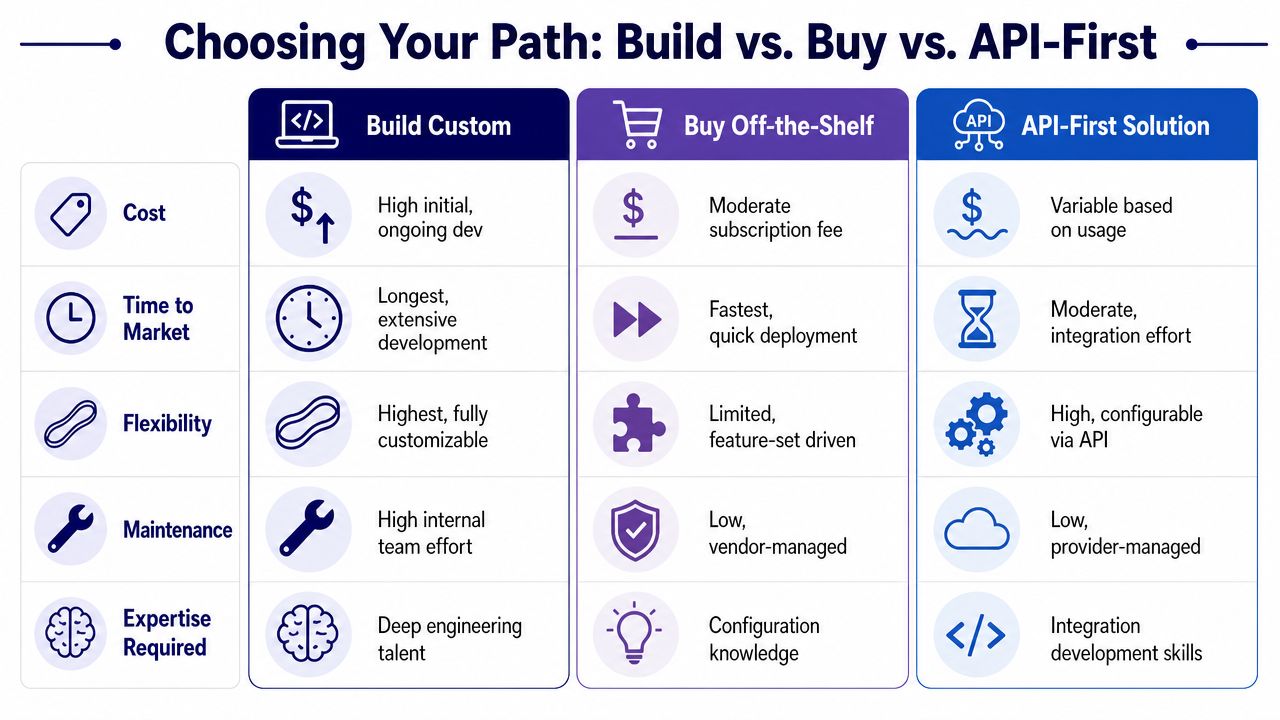
Build custom
Building gives the product and finance teams full control over pricing logic, entitlement rules, invoice generation, and reporting flows. If your contracts are unusual or billing is part of the product itself, that control can matter.
The cost is ongoing ownership. Billing isn't a one-time engineering project. It keeps expanding as your packaging, tax footprint, geographies, and finance requirements change.
Custom builds work best when billing is strategic and the company is willing to invest in maintaining it for years.
Buy off the shelf
Buying a packaged billing platform is the fastest route to a working baseline. You get standard subscription workflows, invoice generation, retry logic, and administrative tooling without building everything internally.
The trade-off is rigidity. Many platforms handle straightforward recurring billing well, then become awkward when you need unusual contract structures, real-time product enforcement, or less common payment and settlement flows. At that point, the business starts adapting to the vendor instead of the other way around.
API-first
API-first sits in the middle. You don't own the full infrastructure, but you do control how billing fits into your product and internal systems. That usually makes more sense for software companies that want flexibility without building every component from scratch.
API-first is a strong fit when:
- Product and billing are tightly linked: entitlements, credit systems, or usage controls need application-level logic
- The business expects pricing changes: you don't want every packaging update to depend on vendor limitations
- Multiple payment methods matter: the payment layer needs to support a broader customer base without turning operations into a workaround
The wrong billing strategy usually looks fine at launch. It becomes expensive when pricing evolves.
A practical decision lens
Use a simple filter:
| Option | Best when | Watch out for |
|---|---|---|
| Build custom | Billing is a core product capability | Long-term maintenance load |
| Buy off the shelf | You need standard billing quickly | Workflow rigidity later |
| API-first | You need speed and flexibility together | Integration quality still matters |
A lot of teams over-index on launch speed and underweight future pricing complexity. That's why vendor demos can be misleading. The hard questions aren't about creating a plan. They're about changing one in production, with active contracts, usage data, and finance controls already in place.
Key Integration and Compliance Considerations
Most billing implementations fail at the handoffs.
The checkout works, but customer records don't sync correctly. The CRM reflects the new plan, but the invoice doesn't. Usage updates in the app, but finance sees a stale state in the ERP. Billing looks like one system, but operationally it's a chain of dependencies.
Checkout, app events, and back-office systems
A billing engine has to connect to at least three operational surfaces.
First is the purchase layer, which includes checkout, subscriptions, invoices, or sales-assisted orders. Second is the product layer, where entitlements, plan limits, or usage events originate. Third is the financial layer, where accounting and revenue workflows need clean outputs.
The failure mode is usually fragmented ownership. Product owns events. RevOps owns CRM updates. Finance owns invoicing and reconciliation. Nobody owns the full lifecycle.
A healthier setup uses explicit event flows:
- Customer action: purchase, renewal, upgrade, cancellation
- Product event: seat change, feature activation, usage consumption
- Financial event: invoice issued, payment collected, failure retried, credit applied
Hybrid pricing changes are where cracks show
Billing processes present the greatest difficulty for modern teams. Recent data from 2025 shows 65% of B2B SaaS firms use hybrid pricing, but 52% report billing errors from mid-term changes due to lack of unified visibility in their CRM/ERP, according to Nue's analysis of B2B SaaS billing.
Those errors are predictable. A customer upgrades seats halfway through a month, adds a usage-based add-on, or converts from trial to paid under custom terms. If the billing engine and the surrounding systems don't share the same contract state, invoices drift from reality.
Compliance isn't just a legal checkbox
Billing touches card data, authentication flows, invoice records, tax logic, and customer account history. That means security and compliance decisions should be part of evaluation from day one, not after integration starts.
At a minimum, teams should verify:
- Payment security controls: card processing architecture, authentication requirements, and dispute handling
- Data access patterns: who can change plans, credits, invoices, and customer metadata
- Auditability: whether finance can trace a final invoice back to source events and contract changes
- Operational controls: webhook reliability, retry behavior, and change logs for critical billing actions
Clean reconciliation starts with clean system boundaries.
The newer complexity is mixed payment environments. Some businesses now need to accept both traditional payment methods and crypto while keeping reporting unified. That creates a reconciliation problem many legacy billing guides barely address. It isn't enough to collect payment. The system has to map what the customer paid with, what the business received, and how finance will report it consistently.
How to Evaluate and Select a Billing Vendor
Most billing vendor evaluations focus on visible features. Can it create plans, generate invoices, and retry failed payments? Those questions matter, but they're table stakes.
The better test is whether the vendor can support the business you're becoming, not just the one you are today.
Start with the workflows that hurt today
List the workflows that currently create manual work or billing risk. Not abstract requirements. Real ones.
Examples include mid-cycle seat changes, usage overages, sales-negotiated credits, subscription pauses, multiple payment methods, or mixed settlement requirements. A vendor that looks polished in a demo can still fail your actual workflow test.
One under-discussed issue is reconciliation between crypto payments and standard financial reporting. A major gap in standard SaaS billing engines is integrated crypto-to-fiat billing reconciliation, and 78% of companies report manual errors due to a lack of native tools, as noted in Zuora's SaaS billing glossary context referenced for this gap. If your business expects to accept both fiat and crypto, this should be part of the core evaluation, not an edge-case question.
Evaluate the system behind the UI
The nicest admin dashboard in the market won't save a weak underlying model.
Ask vendors to show how they handle:
- Plan changes in active billing periods
- Usage corrections after delayed event delivery
- Idempotent event ingestion
- Credit balances, drawdowns, or prepaid constructs
- Mixed payment types with unified reporting
- Export quality for accounting and revenue workflows
Also inspect documentation quality. Good docs usually signal mature operational thinking. Poor docs often predict implementation friction.
Choose the vendor whose constraints you understand clearly, not the one with the longest feature list.
SaaS Billing Engine Evaluation Rubric
| Evaluation Criterion | What to Look For | Red Flags |
|---|---|---|
| API quality | Clear endpoints, predictable objects, strong webhook model, usable docs | Vague object relationships, shallow docs, limited webhook support |
| Pricing model support | Native support for recurring, usage-based, hybrid, and exceptions | Works only for simple monthly plans without awkward workarounds |
| Mid-cycle change handling | Proration, credits, upgrades, downgrades, and contract amendments handled cleanly | Requires manual invoice edits for normal lifecycle events |
| Reconciliation | Clean exports and a reliable path from payment event to financial record | Payment records and invoice records drift apart |
| Payment flexibility | Broad support for how customers want to pay and how the business wants to receive funds | Forces one narrow collection or settlement path |
| Crypto-to-fiat workflow | Clear handling of payment conversion and reporting consistency | Accepts crypto but leaves finance to reconcile manually |
| Runtime alignment | Product entitlements and billing state can stay in sync | Billing and app access logic live in separate realities |
| Admin controls | Audit logs, role controls, change visibility | Critical changes happen without clear traceability |
| Support and implementation | Competent technical onboarding and realistic migration guidance | Sales-led promises with little implementation depth |
| Total cost of ownership | Cost aligns with complexity removed and flexibility gained | Hidden operational costs in custom workarounds |
What to ask in the final round
The best final-round questions are scenario-based.
Ask the vendor to walk through a customer who starts on a monthly subscription, adds usage charges, changes plan mid-term, pays in a different way than another customer, and needs a clean final invoice and finance export. If the answer gets hand-wavy, the risk is real.
A good vendor can explain the data model, not just the feature. That's what separates a workable billing engine from a future migration project.
Conclusion Your Next Steps to Smarter Billing
A SaaS billing engine isn't just a system for charging customers. It's the operational layer that connects pricing, product access, payments, and finance.
When it's poorly chosen, every pricing change becomes a project. Teams patch gaps with manual steps, finance loses confidence in the numbers, and product slows down because billing can't keep up. When it's designed well, the company can launch new models, support more payment paths, and keep reporting cleaner under real operating pressure.
The practical next step is simple. Audit your current billing flow from checkout to invoice to reconciliation. Look for manual corrections, plan-change confusion, mismatched system states, and payment workflows that don't fit how your customers want to pay.
If those problems show up regularly, the issue probably isn't execution. It's architecture.
Suby is a good fit for businesses that need more flexible payment infrastructure around billing. It provides a single API that lets any business accept payments by card or crypto, and it also offers native integrations with Discord and Telegram for use cases like subscriptions, paid access, and online communities. Suby works as one product in four ways: Suby Payments for accepting cards and crypto through one checkout, Suby Crypto for crypto payments with swap handling, gas sponsorship, and settlement to a non-custodial wallet or Suby balance, Suby Gating for paid access across Discord, Telegram, downloads, and courses, and Suby Invoicing for letting clients pay how they want while the business receives what it wants. The core model is simple: customers pay any way they want, businesses get paid the way they choose, whether that means receiving funds in a bank account or in stablecoins like USDC. A common flow is that the customer pays by card and the business receives USDC, but that's only one option. Pricing depends on the payment method used, so check Suby and its pricing page for current details.


