

Gaspard LEZIN
Your Guide to Seamless PSP Payment Solutions
Discover how a PSP payment system simplifies global transactions. This guide explains how to choose the right provider to accept card payments and receive USDC.
So, you've heard the term "PSP payment" thrown around. What does it actually mean? Simply put, a PSP payment is any transaction that's handled from start to finish by a Payment Service Provider.
Think of a PSP as your single, all-in-one partner for getting paid online. Instead of wrestling with a dozen different systems and contracts, you get one streamlined solution that lets you accept all kinds of payments.
What Is a PSP Payment and Why Your Business Needs One
For any online business, the goal is simple: make it easy for customers to pay you. But behind the scenes, a single credit card transaction can be surprisingly complicated. Without a PSP, a business owner would have to manually piece together a complex puzzle of different services.
You’d need to find and integrate:
A Payment Gateway to securely capture your customer’s card details.
A Payment Processor to shuttle that information to the card networks like Visa or Mastercard.
An Acquiring Bank to manage your merchant account and actually receive the money.
Juggling all those separate relationships is a massive headache. It’s a ton of technical work, a mountain of paperwork, and often, a lot more expensive. A PSP payment elegantly sidesteps all of that by bundling these services into a single, cohesive package.
The PSP as a Universal Adapter
The best way to understand a PSP is to think of it like a universal travel adapter. If you want to plug your laptop in across different countries, you can't just stick it in the wall, you need an adapter that understands both your plug and the foreign outlet.
A PSP does the exact same thing for your business. It connects you to the entire global payment ecosystem, translating and managing all the complex interactions so you don't have to. You plug into the PSP, and the PSP handles the rest, ensuring you get paid no matter how or where your customer pays.
This diagram shows just how central the PSP is to the whole process.
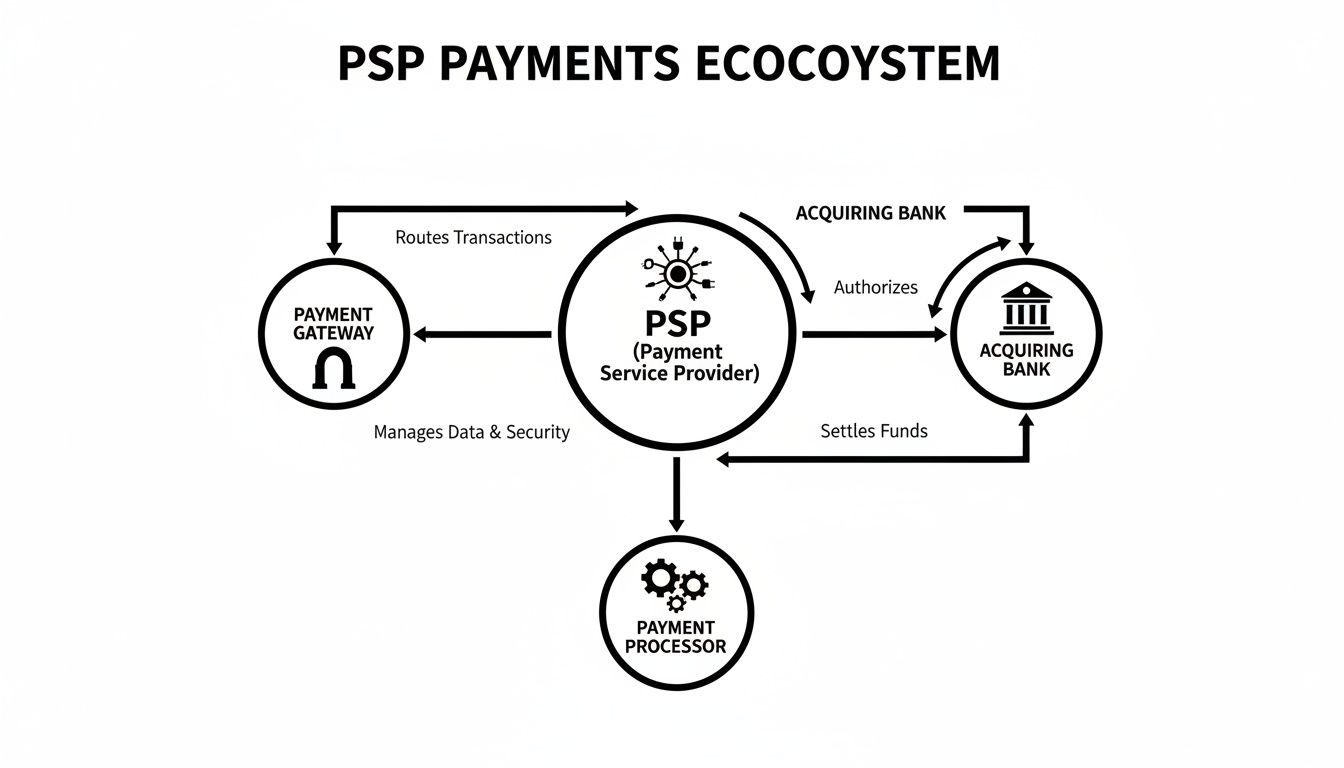
As you can see, the PSP sits right in the middle, coordinating everything between the gateway, processor, and banks. It’s your mission control for payments.
To help clarify these different roles, here's a quick breakdown of who does what in the payment world.
The Payment Ecosystem at a Glance
.tbl-scroll{contain:inline-size;overflow-x:auto;-webkit-overflow-scrolling:touch}.tbl-scroll table{min-width:600px;width:100%;border-collapse:collapse;margin-bottom:20px}.tbl-scroll th{border:1px solid #ddd;padding:8px;text-align:left;background-color:#f2f2f2;white-space:nowrap}.tbl-scroll td{border:1px solid #ddd;padding:8px;text-align:left}EntityPrimary RolePayment Service Provider (PSP)Acts as an all-in-one intermediary, bundling gateway, processing, and acquiring services into a single integration for merchants.Payment GatewayThe secure "front door" that captures customer payment details on a website or app and encrypts them for transmission.Payment ProcessorThe technical messenger that routes transaction data between the gateway, card networks (Visa, Mastercard), and the banks.Acquiring BankThe merchant's bank. It holds the merchant's account, receives funds from the customer's bank, and deposits them.
This table highlights how the PSP consolidates multiple functions, saving you the trouble of managing each one separately. To dive deeper into just one of these components, our guide on what a payment gateway is breaks down its critical role in online security.
A great PSP isn't just a middleman, it's a partner. It simplifies your entire financial workflow, from security and compliance to reporting, all through one relationship.
Today's PSPs are pushing the boundaries even further. We provide an API that allows any business to accept payments by card or crypto. This is incredibly valuable for reaching a global audience. We also offer native integrations for platforms like Discord and Telegram, perfect for communities selling subscriptions and managing paid access.
The core value is always the same: no matter how the customer pays, the business gets its money efficiently. A customer can pay with their card, but the business receives the funds settled directly as USDC, completely bypassing the delays and friction of the traditional banking system.
How PSPs Simplify Your Global Operations
Not too long ago, taking your business global was a logistical nightmare. Every new country you wanted to sell in meant starting from scratch, finding a local bank, applying for a new merchant account, and then wrangling a separate technical integration. The process was slow, costly, and buried teams in administrative work.
A modern Payment Service Provider (PSP) changes the game completely. Instead of juggling dozens of different contracts with banks, gateways, and processors, you work with a single partner. This PSP payment partner gives you one agreement and one integration to start accepting payments from customers all over the world.
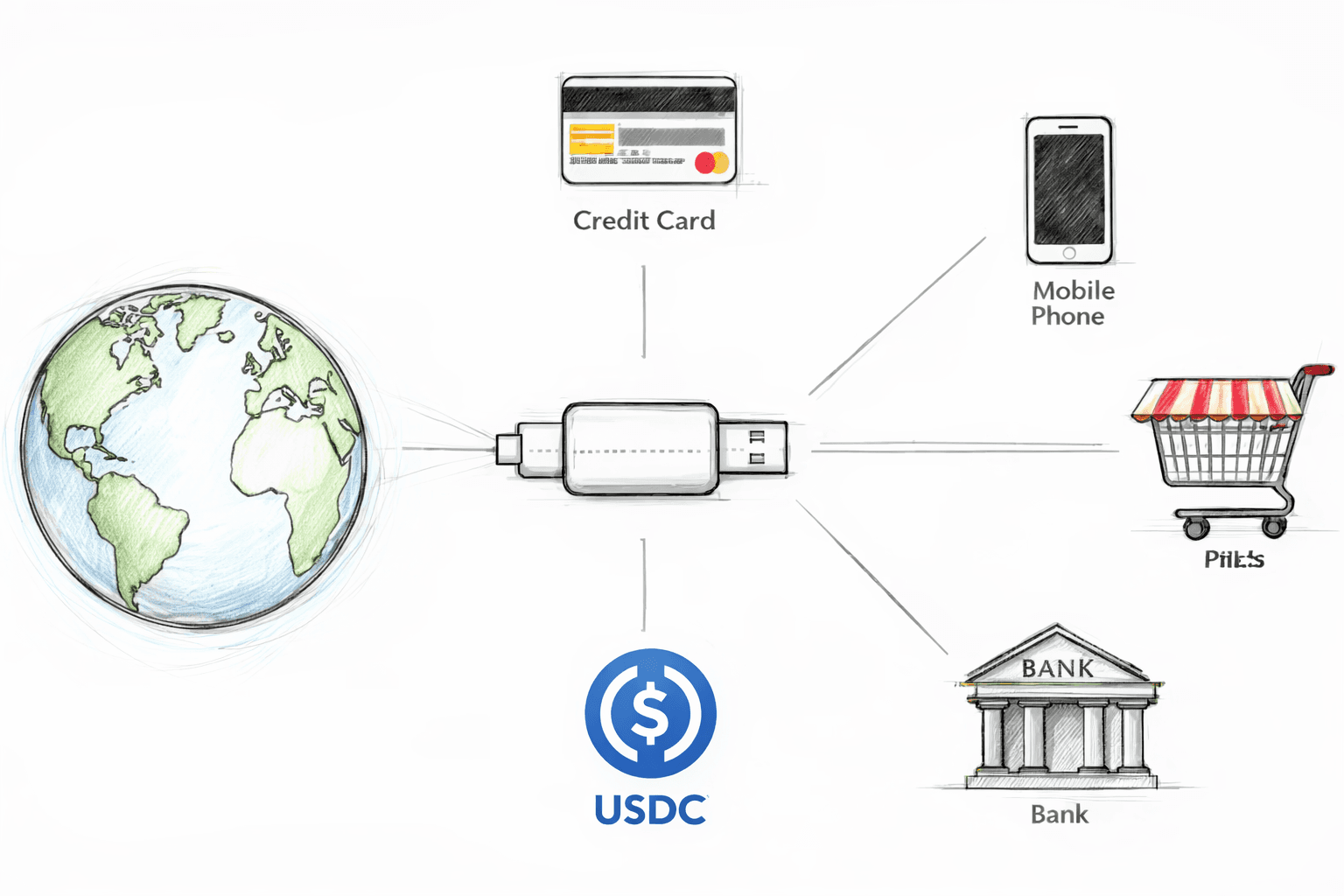
Suddenly, all that complexity disappears. You dramatically reduce administrative overhead and technical headaches, letting your team focus on what actually matters: growing the business.
One Partner for All Your Payment Needs
Having a single PSP as your central hub for payments makes everything from setup to daily reconciliation incredibly efficient. It's a unified approach that really shines when you're operating across multiple borders.
Just think about the practical benefits:
Painless Onboarding: Forget about filling out mountains of paperwork for multiple banks in different languages. You go through one straightforward onboarding process with your PSP, and you're ready to go.
Unified Reporting: You get a single, clear dashboard showing all your global revenue. Every transaction, fee, and payout is in one place, which makes bookkeeping and financial analysis simple.
Global Payment Options: With one connection, you can immediately offer the payment methods your international customers know and trust. This is huge for conversion rates, as people are far more likely to buy when they can pay their favorite way.
This model lets you enter new markets in a fraction of the time and with far less friction, and it's one of the reasons modern online payment solutions for businesses have become so popular. You're no longer held back by whether your payment infrastructure can keep up with your ambitions.
A Truly Global Solution From Day One
Here’s where it gets really interesting. We offer a single API that lets any business accept both card and crypto payments right out of the box.
By combining card processing with stablecoin settlements, a PSP can help you bypass the friction of the international banking system. This means faster access to your money and more predictable cash flow.
For example, a customer in Japan can pay with their Visa, while another in Argentina pays with crypto. To you, the merchant, the experience is exactly the same. The PSP handles the entire transaction behind the scenes, and you receive your funds settled directly as USDC into your digital wallet. This setup sidesteps the high fees and frustrating delays that come with currency conversions and international bank transfers.
What's more, we provide native integrations for platforms like Discord and Telegram. For creators and community-led businesses, this is a massive advantage. We can automate everything from collecting subscription fees to managing member access, creating a perfect, hands-off experience for both you and your customers. It's a powerful, modern way to run a truly global business.
The Evolution of PSPs and Future Trends in 2026
The world of online payments is moving faster than ever. It's no longer just about accepting a credit card; customers now demand seamless, one-click experiences. For businesses, keeping up isn't optional, it's essential for survival. This pressure is forcing a fundamental rethink of how Payment Service Providers (PSPs) work.
The numbers tell a staggering story. The global PSP market was valued at around USD 82.64 billion in 2024, but it's projected to skyrocket past USD 5.3 trillion by 2030. That explosive growth isn't just a line on a chart; it represents a massive global demand for better, more efficient payment solutions. You can dig deeper into this trend in this in-depth PSP market analysis.
The Rise of Real-Time Payments
One of the biggest shifts we're seeing is the global move toward real-time payment networks. Just look at Brazil's PIX system. It’s been a phenomenal success. In 2024, it processed over 63 billion transactions, a 50% jump from the year before, and now has more than 160 million users.
And Brazil isn't alone. Countries all over the world are launching similar instant payment infrastructures. This puts traditional PSPs, many of which still lean on slower, decades-old banking rails, in a tough spot. They have to adapt quickly or risk being left behind as both businesses and their customers gravitate toward instant, more reliable options.
This is exactly where modern PSP payment solutions are carving out their niche, offering merchants a direct line to global processing.
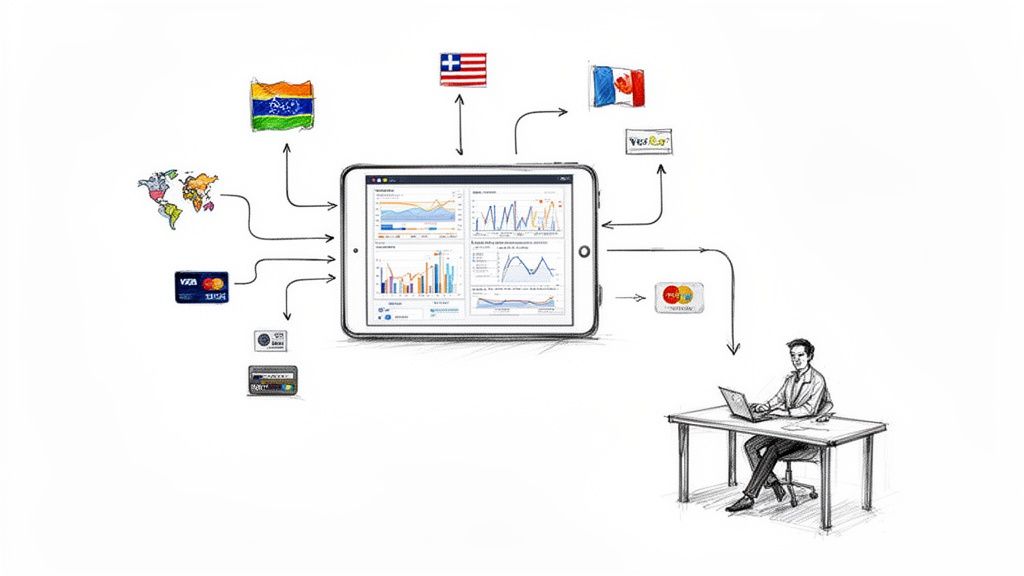
The image here really brings it to life: a modern PSP serves as a single control panel, connecting a business to a whole world of payment methods through one simple interface.
Bypassing Legacy Systems with Stablecoin Settlements
To deliver the speed and global access that businesses need, some of the most innovative PSPs are taking a completely different approach. They let customers pay with their cards just like they always do, but the merchant gets the money settled as USDC directly into a digital wallet.
This card-to-stablecoin model allows businesses to completely bypass the slow, expensive, and complex international banking system. It’s a practical, modern alternative to waiting days for bank transfers to clear.
For any business operating internationally, this is a game-changer. Revenue from a customer in another hemisphere can arrive almost instantly, without the punishing currency conversion fees and unpredictable settlement delays. This flips the psp payment process from a frustrating bottleneck into a real strategic advantage, giving businesses the power to manage cash flow in real-time and operate on a global scale from day one.
Choosing the Right Integration Method for Your Business
So, you've decided a PSP is the way to go. The next logical step is figuring out how to actually connect it to your business and start taking payments. This is where integration comes in.
Don't let the term "integration" intimidate you. You don't need a team of developers on standby. Modern PSPs offer a range of options, from simple links you can paste anywhere to fully custom-built checkouts. The right choice just depends on what you're selling and how much technical control you want.
Simple Paylinks for Fast Invoicing
The absolute quickest way to get paid is with a paylink. Think of it as a secure, shareable invoice. You generate a unique link in your PSP dashboard that takes your customer directly to a payment page. You can then send this link through email, a social media DM, or even a text message.
This method is a game-changer for:
Freelancers and agencies who need a straightforward way to bill clients.
Creators selling digital goods or services without needing a full-blown e-commerce site.
Community managers on platforms like Discord or Telegram selling access or subscriptions.
A paylink cuts out all the complexity. There's no website to build and no checkout flow to design. You just create the link, send it, and collect your money. It’s the fastest way to go from setup to revenue.
Embedded Checkouts for Higher Conversion
If you already have a website or app, an embedded checkout is a fantastic option. Instead of sending customers to another website to pay, you place the payment form directly onto your own page. This creates a seamless, professional experience that builds trust and keeps your customer in one place.
The result? People are far more likely to complete their purchase. For example, our solution lets you embed a form where customers can pay by card, but you receive the funds settled instantly as USDC on the backend. This offers a familiar experience for them and a modern settlement process for you.
Direct API Integration for Full Control
For businesses that need to build a truly custom experience, nothing beats a direct API integration. An API (Application Programming Interface) is essentially a toolkit that lets your developers connect your software directly to the PSP's payment rails. This gives you complete control to design the checkout process from the ground up.
You can learn more about the technical details in our guide on payment gateway API integration.
This approach is the go-to for platforms with unique requirements, like usage-based billing, complex subscription models, or marketplaces. It offers total flexibility, ensuring the payment flow feels like a natural part of your brand and product, not an add-on.
Navigating Security and Compliance With Your PSP
When you accept payments, you're not just moving money, you're handling sensitive financial data. For any business, security isn't a bonus feature; it's the bedrock of customer trust. This is exactly why your choice of a Payment Service Provider is so important. A good PSP shoulders the heavy burden of security and compliance for you.
Think of your PSP as your in-house security team, navigating the alphabet soup of payment regulations so you don't have to. This lets you get back to what you do best: running your business, knowing your psp payment system is secure.
Understanding Key Security Standards
The world of payment security is full of acronyms, but a couple stand out as non-negotiable. These standards are what keep customer data locked down and protect your business from fraud and painful liabilities.
PCI DSS: You can't handle card payments without dealing with the Payment Card Industry Data Security Standard (PCI DSS). The good news? When you partner with a PSP that holds a PCI DSS Level 1 certification, you're essentially offloading the most intense compliance work. Their systems have already passed the highest security audit.
Strong Customer Authentication (SCA): This is a big one for anyone selling in Europe. SCA mandates multi-factor authentication to cut down on fraud. A compliant PSP bakes this right into their checkout flow, handling the extra verification steps automatically so you don't have to.
Want to get a better handle on how this all works to protect your business? We break it down in our guide on what PCI DSS compliance means for you.
Keeping Up with Evolving Regulations
The rules of the game are always changing. New regulations constantly pop up to make payments safer and more competitive. Just look at the EU, by 2026, major shifts like PSD3 and the Instant Payments Regulation will be in full force, demanding things like instant euro transfers and mandatory payee verification. These changes also give non-bank PSPs a more direct seat at the table.
A modern PSP doesn't just meet today's standards; it anticipates tomorrow's. This forward-looking approach ensures your business remains compliant and secure without you needing to become a legal expert.
By choosing a PSP that stays on top of these complexities, you shield your business from the whiplash of regulatory changes. Your provider takes care of the technical and legal updates behind the scenes, from supporting two-factor authentication (2FA) to managing disputes, so you can operate globally with peace of mind.
How to Choose the Right PSP for Your Global Business
Picking a Payment Service Provider can feel like a simple cost-saving exercise. You look for the lowest transaction fee and call it a day, right? It’s a trap. For any business operating on a global scale, the sticker price is just the beginning of the story.
The "true cost" of your psp payment solution is a much bigger picture. It includes everything from hidden currency conversion fees and frustrating payout delays to the sheer operational drag that slows down your growth. A slightly lower per-transaction fee means nothing if your cash is tied up for weeks or you're losing money on every cross-border sale.
The right questions cut through the noise. Does the PSP handle all the currencies your customers want to use? How fast does your revenue actually hit your account? How easily can the platform grow with you? A good payment processor comparison is a decent starting point, but for a global business, your checklist needs to be sharper.
Key Criteria for Modern Global Businesses
When you’re vetting a potential PSP, don't get distracted by the flashy marketing. You need to dig into the features that determine how a provider actually performs when money is on the line, especially across borders.
Settlement Speed and Currency: This is huge. How long does it take for your earned revenue to become cash you can actually use? Traditional PSPs can leave you waiting days, or even weeks, for international funds to clear. Compare that to a provider offering instant USDC settlements directly to a digital wallet. You get immediate access to your money, completely sidestepping the usual banking delays and friction.
Transparent and All-Inclusive Pricing: Look for a dead-simple, flat-fee structure. So many providers lure you in with a low base rate, only to tack on extra charges for international cards, currency exchange, and fighting disputes. A partner with one clear, all-inclusive price means your costs are predictable, making it far easier to protect your margins.
Integration Flexibility: Your business isn't static, and your payments partner shouldn't be either. The best PSPs give you options. They should have a straightforward API for custom checkout experiences, simple embeddable forms for your website, and easy-to-use paylinks for invoicing. We also offer native integrations for platforms like Discord and Telegram.
The best PSP for a global business isn't just a payment processor; it's a financial operating system. It should simplify your cash flow, not complicate it, by giving you fast, predictable access to your revenue in a stable currency like USDC.
A PSP That Understands Modern Business
Recent studies on small and medium-sized global businesses show a clear trend: they crave payment transparency and easy integration above all else. What’s interesting is that while only 15% currently expect instant settlements, that number is set to climb.
The entire financial world is shifting. The global adoption of the ISO 20022 messaging standard in November 2025 is going to make data-rich payment information the new norm, making reconciliation much easier for everyone. As you can see from these insights on the future of payments, PSPs built for predictable financial flows and interoperability are the ones who will lead the pack.
Ultimately, you’re looking for a partner that solves the most painful parts of traditional global commerce. By choosing a PSP that supports both card and crypto payments with instant USDC settlements, you’re not just processing transactions, you’re building a more efficient, resilient, and truly global business.
Frequently Asked Questions About PSP Payments
Even after getting the basics down, you probably still have a few questions about how a Payment Service Provider works in practice. Let's tackle some of the most common ones that come up.
What Is the Main Difference Between a PSP and a Payment Gateway?
It helps to think of it like this: a payment gateway is just one piece of the puzzle. Its only job is to securely grab a customer's payment details and pass them along to the next player in the chain. It’s a vital, but single-purpose, component.
A Payment Service Provider (PSP) is the whole puzzle box. It’s an end-to-end solution that bundles the gateway, processing, fraud monitoring, and the merchant account all under one roof. Instead of juggling multiple vendors, you get a single partner to manage everything, which is a massive simplification for your business.
Can I Use a PSP for My Subscription or Community Business?
Yes, and honestly, a modern PSP is practically built for businesses that rely on recurring revenue. We offer direct integrations with platforms like Discord and Telegram, making them a perfect fit for managing community subscriptions or paid group access.
This setup lets community managers and creators put their entire membership billing on autopilot. The PSP handles it all, from the first payment to ongoing subscriptions and even managing member access roles, which creates a seamless experience for you and your members.
Why Would I Want to Receive Payments in USDC?
For any global business, getting payouts in USDC solves some very real and very expensive problems. First off, you can say goodbye to costly currency conversion fees. You also protect your revenue from the wild swings of foreign exchange rates and skip the frustrating delays common with international bank wires.
With a USDC settlement, funds from a psp payment land in a digital wallet you control almost instantly. This gives you immediate access to your cash without having to deal with bank holds or cross-border complications. It's simply a faster, more predictable way to get paid when your customers are all over the world.
Suby is a payment gateway and Merchant of Record. Your customers pay with card, bank transfer, Apple Pay, Google Pay, Klarna, and more, or stablecoins, and you get paid out to your bank account, or directly in stablecoins (USDC, EURC) to your wallet, anywhere in the world, no bank account required. It bundles gateway, processing, and settlement into one PSP relationship, with native Discord and Telegram integrations for subscriptions and paid access, so your entire psp payment flow runs through a single partner.
