

Gaspard LEZIN
Payhip vs Gumroad: Which Is Best for Creators in 2026?
Payhip vs Gumroad detailed 2026 comparison. We analyze fees, payouts, tax handling, and USDC settlement options to help you choose the right platform.
Most payhip vs gumroad articles make the same mistake. They treat the decision like a fee chart problem.
That’s too shallow for a creator selling globally in 2026. A deeper question isn’t just what each platform charges on paper. It’s how much friction you absorb after the sale, when money has to move across borders, taxes have to be handled correctly, and payout timing starts affecting your cash flow.
Payhip and Gumroad are still two of the most common choices for digital products. Both can work. But they were built with different assumptions about what a creator business needs, and those assumptions matter a lot more once your customers live in multiple countries, pay in different currencies, and expect a smooth checkout.
A useful comparison has to look at three layers at once:
Platform economics, meaning fees, monthly plans, and payment processing
Operational drag, meaning tax handling, payout methods, and settlement delays
Business durability, meaning how tightly your audience, purchase history, and recurring revenue get tied to one platform
That broader lens changes the conclusion. A platform that looks cheaper on a pricing page can become more expensive once accounting work, FX friction, and payout limitations enter the picture. A platform that looks simple for a beginner can become restrictive when your store starts behaving like an international business rather than a side project.
Here’s the quick view before we go deeper:
Criteria | Payhip | Gumroad |
|---|---|---|
Core positioning | E-commerce efficiency with more built-in operational features | Creator-first simplicity and branded selling |
Entry pricing | Free plan with 5% transaction fee | Flat 10% fee |
Higher-volume option | $99/month Pro plan with 0% transaction fees | No equivalent zero-fee plan |
Licensing | Built in | Requires add-ons |
Email marketing | Not native | Included |
Payouts | Instant payouts, supports Stripe and PayPal | Direct Deposits Plus and PayPal, no instant withdrawal |
Tax handling focus | EU & UK VAT automation only | Became Merchant of Record in 2024 |
Best fit | Sellers optimizing margin and store control | New creators optimizing for speed and simplicity |
If you want a broader market view of digital selling stacks, this rundown of platforms for selling digital products is a useful companion.
Table of Contents
Payhip vs Gumroad The Comparison You Haven't Seen
Gumroad is built for fast creator deployment
Payhip is built for sellers who think operationally
Why this matters before you look at fees
The headline numbers already favor Payhip at scale
A concrete monthly comparison
The trap is assuming every seller should optimize the same way
What fee pages still don't tell you
What happens at checkout matters less than what happens after
The overlooked issue is settlement friction
Why some global sellers separate storefront from payment infrastructure
Different creator stacks need different foundations
Community access is where generic storefronts start to feel clumsy
When payments need to plug into your own systems
For the first-time digital seller
For the established creator with meaningful volume
For the operator thinking beyond one platform
Is Payhip or Gumroad better for selling courses
Is Gumroad better for beginners
Is Payhip cheaper than Gumroad
Which platform is better for international sellers
Can I migrate later if I start on one platform
Should I use a storefront and a separate payment layer
What should I read next if I’m building support content around payments and store operations
Payhip vs Gumroad The Comparison You Haven't Seen
The usual payhip vs gumroad advice says to compare percentage fees, pick the lower number for your revenue band, and move on. That approach misses the part that hurts most once your business becomes international.
A creator in one country may sell to buyers in many others. That means the sale itself is only one event in a longer chain. Funds have to clear. Taxes have to be accounted for. Payouts may land through systems that weren’t designed for fast, predictable cross-border operations. If your store earns in one currency and your business expenses sit in another, conversion risk enters the picture too.
Payhip and Gumroad matter because they represent two different answers to the same problem. One leans toward operational efficiency and built-in commerce tools. The other leans toward fast setup and creator-friendly simplicity. That difference affects far more than the checkout page.
Practical rule: If most of your customers are international, don't evaluate a sales platform only by its listed fee. Evaluate the whole path from buyer payment to usable funds in your business.
A lot of creators don’t notice this until they’ve grown. Early on, simplicity is enough. Later, they start asking harder questions. How quickly can I access revenue? What extra work appears when I sell into more countries? How much margin am I losing outside the visible platform fee?
Those are the questions that make this comparison worth revisiting. The strongest choice for a local side business isn’t always the right one for a global, internet-native operation.
Understanding The Core Platform Philosophies
Payhip and Gumroad don’t just have different pricing. They reflect different product philosophies, and that shapes almost every tradeoff a seller feels later.
According to this Payhip and Gumroad platform comparison, Gumroad originated as a straightforward solution enabling creators to sell products directly to fans, emphasizing creator branding and ease of setup. The same comparison says Payhip was architected from inception as an e-commerce efficiency platform with integrated functionality for digital product licensing, course building, and advanced affiliate programs.
Gumroad is built for fast creator deployment
Gumroad makes immediate sense if your priority is speed. You want a product page, a storefront, and a workflow that doesn’t ask you to think like an e-commerce operator on day one.
That design bias shows up in how people use it. Gumroad tends to appeal to solo creators who want to publish quickly, present their brand cleanly, and avoid heavy setup. The platform is often easier to grasp at the start because it narrows the number of decisions you have to make.
There’s a tradeoff. A system optimized for simplicity can feel less flexible once your catalog expands or your business starts needing more specialized controls.
Payhip is built for sellers who think operationally
Payhip starts from a different angle. Its feature set points toward sellers who want a store that behaves more like a focused commerce system than a simple creator checkout.
That same comparison notes a key distinction: Payhip includes built-in licensing features, while Gumroad requires add-ons for equivalent functionality. If you sell software licenses, protected downloads, or products where access control matters, that difference isn’t cosmetic. It changes how much operational patchwork you need.
A few other distinctions reinforce the split:
Built-in licensing: Payhip includes it as part of the core product, which matters for software, templates, and gated digital goods.
Email marketing: Gumroad offers this natively, which can matter if your storefront and audience communication are tightly linked.
Payout setup: Payhip supports Stripe and PayPal with instant payouts, while Gumroad uses Direct Deposits Plus and PayPal without instant withdrawal functionality, as noted in the same comparison.
Gumroad feels closer to a creator storefront. Payhip feels closer to a lightweight digital commerce system.
Why this matters before you look at fees
Most fee comparisons assume the platforms are interchangeable. They’re not.
If your business depends on fast launch, simple pages, and low setup burden, Gumroad’s philosophy can be an advantage. If your business depends on licensing, more structured store operations, and deeper commerce features, Payhip starts with a stronger foundation.
That’s why a payhip vs gumroad decision often goes wrong. Sellers compare percentages before they decide what kind of business they’re running.
Pricing and Fees The Real Cost of Selling
For most sellers, the payhip vs gumroad debate typically commences at this juncture. Yet, many comparisons often cease prematurely at the same point.
The fee story changed in a meaningful way. According to this 2026 fee comparison of Gumroad and Payhip, Payhip’s free plan charges 5% transaction fees, its Plus plan costs $29/month plus 2% transaction fees, and its Pro plan costs $99/month with 0% transaction fees. The same source says Gumroad moved to a flat 10% fee plus payment processing fees of approximately 2.9% plus $0.30 per transaction.
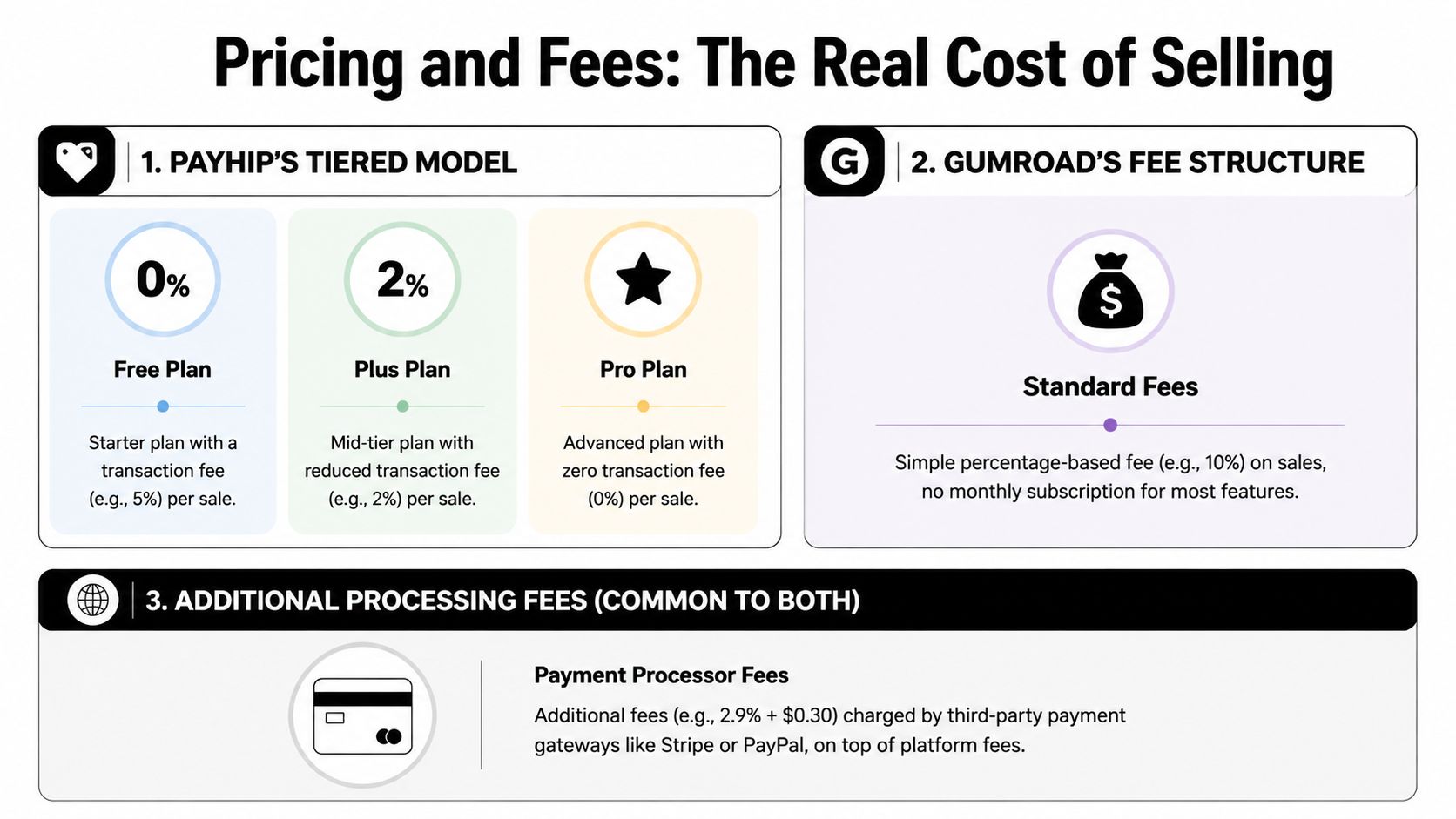
The headline numbers already favor Payhip at scale
That same analysis gives a blunt example. For a creator with $100,000 in annual sales, Gumroad's fees would be approximately $10,000 plus processing costs, while Payhip's Pro plan would cost $1,188 for the year, making Payhip substantially more economical for high-volume sellers in that scenario.
That’s a big change in the value proposition. Gumroad used to reward higher lifetime sales with lower percentage rates. Under the newer flat structure, that margin advantage is gone.
A second pricing breakdown from this fee architecture analysis reaches a similar conclusion from a different angle. It states that Payhip’s Pro plan becomes economically superior at sales volumes exceeding approximately $3,400 monthly.
A concrete monthly comparison
The same analysis provides one usable operating example. At $2,000 in monthly sales, it says:
Monthly sales scenario | Payhip free plan | Payhip Pro plan | Gumroad |
|---|---|---|---|
$2,000 monthly sales | Approximately $158 | $99/month plus processor fees | $250 total |
Margin implication | Lower than Gumroad | Depends on your volume and processor costs | Highest cost in this example |
This table is helpful for one reason. It shows that the platform fee alone doesn’t tell the whole story. Monthly subscription cost, transaction structure, and payment processing all interact.
The trap is assuming every seller should optimize the same way
A beginner with low sales volume may still prefer a simpler flow, even if the percentage drag is higher. A mature seller usually cares more about retention of gross revenue, cost predictability, and the ability to avoid penalty pricing as volume rises.
That leads to a practical split:
Low-volume creator: Gumroad can still make sense if simplicity matters more than fee efficiency.
Growing store operator: Payhip’s free or Plus structure may fit during the transition phase.
High-volume seller: Payhip Pro is usually the more rational cost model based on the figures above.
The right pricing model depends less on your product category than on whether your sales are still experimental or already repeatable.
What fee pages still don't tell you
Even the better pricing comparisons leave out costs that global sellers feel quickly:
Currency conversion drag: If settlement and expenses don’t match, part of your margin disappears outside the platform fee.
Payout timing: Delayed access to funds creates working capital friction.
Administrative overhead: Reconciliation across processors, countries, and payout methods takes time.
The visible platform fee is real. It’s just not the full bill.
Checkout Payouts and International Payments
The part most creators underestimate isn’t product setup. It’s getting paid cleanly across borders.
A checkout can look polished while the payout process remains awkward, delayed, or expensive once conversion and tax responsibilities start piling up. That’s why the payhip vs gumroad decision gets more interesting after the customer clicks buy, not before.
What happens at checkout matters less than what happens after
Gumroad’s creator-first design tends to make checkout setup feel straightforward. Payhip, by contrast, leans more toward structured commerce features and operational control. For many sellers, either can be acceptable on the customer-facing side.
The larger difference appears in payout design. The earlier platform comparison noted that Payhip provides instant payouts and supports Stripe and PayPal, while Gumroad uses Direct Deposits Plus and PayPal without instant withdrawal functionality. That distinction affects how quickly revenue becomes usable cash.
For a domestic seller, that may be manageable. For an international seller, payout timing interacts with exchange rates, accounting cycles, and liquidity needs.
The overlooked issue is settlement friction
According to Payhip’s own comparison discussion of these platforms, Payhip only automates EU & UK VAT, leaving creators to handle tax obligations in over 150 other countries, while Gumroad now acts as Merchant of Record, absorbing more compliance risk but at the cost of higher fees. The same source adds that for a global seller, the administrative cost of manual tax filing can easily outweigh any platform fee savings.
That point deserves more attention than it usually gets.
A creator selling globally doesn’t just compare 5% versus 10%. They’re choosing where tax complexity sits. If a platform absorbs more compliance burden, the fee may look high but the operational workload may be lower. If a platform keeps headline fees lower but leaves more tax handling to the seller, total cost of ownership can rise elsewhere.
Here’s the practical decision frame:
If you want lower visible platform fees, Payhip can be attractive, especially when volume is high.
If you want more compliance burden handled by the platform, Gumroad’s Merchant of Record posture changes the calculation.
If you sell broadly across jurisdictions, tax administration may matter more than a narrow percentage comparison.
International selling isn't only a checkout problem. It's a settlement, tax, and reconciliation problem.
A short demo can help if you're evaluating broader global payment infrastructure and checkout flows:
Why some global sellers separate storefront from payment infrastructure
Many comparisons stop at this point, even though the hardest pain usually starts here. Traditional platform payouts still route your revenue through fiat rails, payment processors, and bank-linked systems. That creates familiar friction: conversion spreads, payout windows, and uncertainty around when funds are available.
For businesses that want to reduce that friction, one option is to separate the storefront decision from the settlement decision. If you’re comparing alternatives for international collection and payout design, this guide to a best international payment gateway is a useful reference point.
One example is Suby, which provides an API that lets businesses accept payments by card or crypto, while the business receives USDC. It also offers native integrations with Discord and Telegram for subscriptions, paid access, and online communities. The important distinction is operational: users pay with cards, businesses receive USDC. For global sellers, that can remove part of the currency conversion and banking delay problem that normal platform payouts don’t solve.
That doesn’t automatically replace Payhip or Gumroad for every seller. It changes the architecture of the decision. You might still use a storefront platform for product presentation while choosing a different payment layer when payout stability and international settlement become the priority.
Monetization Tools and Community Integrations
Creators rarely stay in a single-product business forever. An ebook store turns into a course catalog. A paid newsletter turns into a membership. A private customer group becomes part of the product itself.
That’s where payhip vs gumroad starts to matter less as a storefront debate and more as a creator stack decision. The question becomes: which system supports the way you monetize?
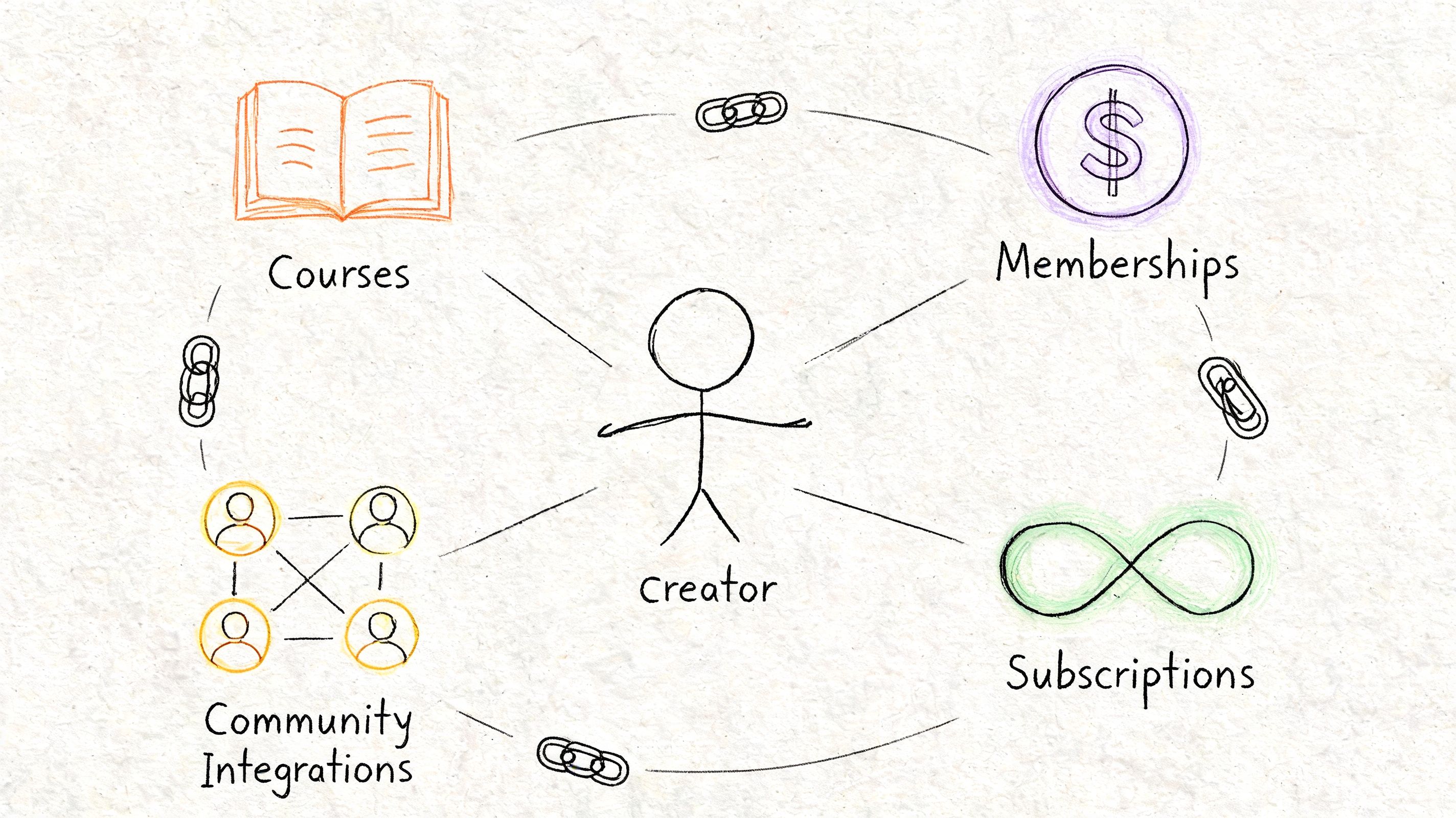
Different creator stacks need different foundations
Payhip’s architecture makes more sense for creators who want structured selling tools inside the same platform. The earlier source established that Payhip was built with integrated features like course building, affiliate programs, and digital licensing. That tends to fit operators who think in terms of catalog management, product control, and layered offers.
Gumroad is stronger when the business still revolves around fast publishing and direct fan sales. It keeps the selling flow simple, and that’s valuable if your model depends more on audience momentum than on operational depth. If your model leans more toward memberships and recurring content, our Patreon vs Substack breakdown covers a different pair of creator tools worth weighing.
A useful way to approach this subject is:
Single digital download business: Gumroad often feels lighter.
Course, license, or product bundle business: Payhip usually matches the workflow better.
Audience-led brand with repeat launches: Your email and community tools may matter more than either storefront alone.
Community access is where generic storefronts start to feel clumsy
Membership businesses usually hit a different constraint. Selling access is easy. Managing access is the hard part.
If your paid offer includes Discord or Telegram, you need role assignment, subscription tracking, failed-payment handling, and access removal when a member stops paying. Traditional digital product platforms can support parts of that workflow, but they often depend on extra tools or custom processes.
That’s why many creators start building a stack around the payment event itself rather than the storefront page. If you’re mapping that stack, this overview of a creator monetization platform is worth reading alongside the storefront comparison.
For operators who want a more programmable workflow outside classic storefronts, tools that integrate crypto payments with Google Sheets can also be useful for lightweight automation, reporting, or internal ops. The practical value isn’t the spreadsheet itself. It’s the ability to move payment events into systems your team already uses.
The more your product depends on ongoing access, the less useful a basic storefront becomes on its own.
When payments need to plug into your own systems
This is the point where some teams stop asking which storefront is better and start asking which parts should remain on-platform at all.
A creator selling files can live comfortably inside one platform for a long time. A SaaS founder, educator with recurring cohorts, or community operator often can’t. They need webhooks, direct control, and payment logic that fits their app or access system.
In that environment, Payhip and Gumroad are still relevant, but mainly as packaged selling environments. They are less compelling if your monetization depends on custom app behavior, direct wallet settlement, or native community automation tied to subscriptions.
Making The Right Choice Use Cases and Recommendations
There isn’t one universal winner in payhip vs gumroad. The right choice depends on the shape of the business, not on a single fee row.
The better way to decide is to match each platform to the operational reality you’re facing today, then pressure-test whether it still works when your revenue, product mix, and customer geography become more complex.
For the first-time digital seller
If you’re launching your first ebook, template pack, or small digital offer, Gumroad is still easy to justify. Its creator-first setup reduces friction at the start, and that matters when you’re trying to get a product live rather than architect a full commerce stack.
That doesn’t mean it’s the cheapest long-term option. It means the simplicity can be worth paying for during the early stage, especially if your sales are still irregular and you don’t yet know whether the offer will stick.
For the established creator with meaningful volume
If you already have repeatable demand, Payhip often becomes more compelling. The fee structure discussed earlier makes that clear for higher-volume sellers, and its built-in licensing and broader e-commerce orientation make it easier to run a more organized digital product business.
This matters most when your business has moved beyond “sell a file” and into a broader operating model. Courses, product variants, affiliates, and tighter store control all push the decision toward Payhip.
A related practical note applies to adjacent business models too. If your revenue depends on structured programs, sessions, and client workflows, an all-in-one coaching platform may solve a different set of problems than either storefront does. That’s useful context if you’re comparing creator tools across multiple business models rather than only product downloads.
For the operator thinking beyond one platform
The longest-term issue is usually not fees. It’s dependence.
According to this discussion of creator platform risk and migration friction, existing comparisons often omit vendor lock-in and data portability, even though creators may face significant friction when trying to migrate customer lists, transaction history, or subscription metadata. That matters a lot if you’re trying to build a durable brand rather than a convenient storefront.
Here’s how I’d frame the recommendations:
Business profile | Likely fit | Why |
|---|---|---|
New solo creator testing demand | Gumroad | Lower setup burden and cleaner path to first sales |
Established seller with growing revenue | Payhip | Better economics at scale and stronger built-in commerce features |
Global business with payout and settlement concerns | Dedicated payment infrastructure alongside or beyond a storefront | Storefront convenience stops solving the hardest operational problems |
A platform can be easy to join and still expensive to outgrow.
If you expect to switch later, start acting like that now. Keep your customer records organized. Avoid relying too heavily on one platform’s internal logic for your entire recurring revenue model. Think of storefront software as one layer of your business, not the business itself.
That mindset won’t matter much in month one. It matters a lot in year two.
Frequently Asked Questions
Is Payhip or Gumroad better for selling courses
Payhip usually makes more sense if courses are part of a broader product operation. Its architecture is closer to a structured digital commerce system, and that tends to fit sellers who want course delivery alongside licensing, affiliates, and other store controls. Gumroad can still work for simpler audience-led products, especially if speed matters more than operational depth.
Is Gumroad better for beginners
Often, yes. Gumroad’s appeal is that it gets a creator selling quickly with less setup complexity. That advantage is strongest when you’re still validating demand and don’t yet need more specialized store functions.
Is Payhip cheaper than Gumroad
For higher-volume sellers, the evidence points that way based on the fee structures covered earlier. Payhip’s Pro plan creates a predictable ceiling that Gumroad’s flat percentage model doesn’t match as well once revenue rises. For lower-volume sellers, the answer depends more on whether you value simplicity over fee optimization.
Which platform is better for international sellers
Neither answer is perfect on its own. Gumroad’s Merchant of Record posture may reduce some compliance burden. Payhip may look more efficient on visible fees. Ultimately, the decision depends on how many countries you sell into, how much tax handling you want the platform to absorb, and how painful fiat payout friction is for your business.
Can I migrate later if I start on one platform
You can, but migration isn’t just a product import problem. Customer lists, transaction history, and subscription metadata can create real friction. That’s why portability should be part of the decision before you commit, not after.
Should I use a storefront and a separate payment layer
For some businesses, yes. That’s especially true when checkout simplicity is no longer the main constraint. If payout predictability, direct API control, subscriptions, or community access management matter more, separating presentation from settlement can be the cleaner architecture.
What should I read next if I’m building support content around payments and store operations
If your team is refining buyer education and post-purchase support, it’s worth looking at how to optimize your Shopify FAQ page. The platform focus is different, but the principles around reducing buyer confusion and support load carry over well.
If you’ve outgrown the usual storefront tradeoffs, Suby is a payment gateway and payment processor worth evaluating as the payment layer for global sales and subscriptions. Your customers pay with card, bank transfer, Apple Pay, Google Pay, Klarna, and more, or stablecoins, and you get paid out to your bank account, or directly in stablecoins (USDC, EURC) to your wallet, anywhere in the world, no bank account required. It also offers native Discord and Telegram integrations for paid access and subscriptions, so you can keep a storefront for presentation while settling international sales cleanly on a separate payment layer.
