

Gaspard LEZIN
Paddle vs FastSpring Comparison for Software Sales
An in-depth paddle vs fastspring comparison for software sales in 2026. Discover which merchant of record boosts conversion and handles global tax best.
If you're comparing Paddle and FastSpring right now, you're probably already past the basic question of whether you need payments. The fundamental question is what kind of selling infrastructure you want to build your software business on, and what that choice will cost your product team, your finance team, and your cash flow once you start selling across borders.
I've looked at this the way a software founder does. Not as a feature checklist, but as an operating model decision. Both platforms can take tax and compliance work off your plate by acting as merchant of record. What matters is where each one fits, where each one creates friction, and what changes once payouts, reporting, and internal finance workflows enter the picture.
Table of Contents
Paddle and FastSpring At a Glance
What you can compare confidently
Why fee comparisons often mislead
The practical conclusion on pricing
Checkout Experience and Localization
Subscription Lifecycle Management
Developer and API Integration
A simple capability summary
What merchant of record actually removes
Where finance teams still do real work
How the model differs from a traditional MoR
Who this model makes sense for
The bootstrapped SaaS startup
The established B2B software vendor
The global creator with a digital community
Do I lose my customer relationships with a merchant of record
How difficult is it to migrate away from Paddle or FastSpring
Can I use my own payment processor with these platforms
Which is better for SaaS, Paddle or FastSpring
When should I consider a non-MoR alternative
Paddle and FastSpring At a Glance
For most software companies, merchant of record means one thing. The platform becomes the legal seller for the transaction, handles tax collection and remittance, manages parts of compliance, and takes on payment-related operational burden that you'd otherwise carry yourself.
That sounds simple on paper. In practice, the choice shapes how you price, how you report revenue internally, how much subscription visibility your team gets, and how comfortable finance feels at month-end.
Here's the short version:
Category | Paddle | FastSpring |
|---|---|---|
Core model | Merchant of record | Merchant of record |
Historical positioning | More directly aligned with SaaS growth and billing flexibility | More broadly aligned with software and digital-goods commerce |
Strength in messaging | SaaS billing, localized pricing, payment optimization | Reporting, analytics, software commerce operations |
Good fit | Subscription-led software businesses | Broader software vendors, including desktop and digital goods |
Paddle's own comparison material presents it as a modern payment stack for SaaS, with emphasis on country-specific pricing controls, automatic payment-method selection, and support for one-off and recurring payments, while FastSpring's comparison content puts more weight on reporting and operational metrics like MRR, churn, revenue, chargeback rates, and webhook status in Paddle's FastSpring comparison page.
That difference matters more than most buyers realize. Paddle has historically leaned into the needs of SaaS teams that care about pricing iteration and recurring billing mechanics. FastSpring has looked broader, with a stronger software-commerce framing that can appeal to vendors selling beyond a pure SaaS model.
A second useful signal is market visibility. Independent comparison data reported by WMTIPS says Paddle is about 2.3× more popular than FastSpring overall, and more popular in markets including the United States, Germany, and France, while FastSpring is stronger in the United Kingdom, Austria, and Romania. The same comparison references a 2026 Trakkr analysis showing an AI visibility score of 88/100 for Paddle versus 81/100 for FastSpring, which suggests Paddle is currently surfacing more often in AI-driven merchant-of-record recommendation contexts in this independent Paddle vs FastSpring comparison.
Both platforms solve the same top-level problem. They don't solve it with the same assumptions about what a software company needs next.
Head-to-Head Pricing and Fee Models
Headline fees rarely tell the whole story. For software sales, the fundamental question isn't just "what percentage do they charge?" It's "what happens to my margin when order size, billing model, support load, and payout friction all start interacting?"
The challenge here is factual. The verified data for this paddle vs fastspring comparison for software sales doesn't include a full published pricing matrix for both platforms, and it doesn't verify worked example costs for specific transaction scenarios. So any article that gives you exact side-by-side math without a documented source is usually guessing.
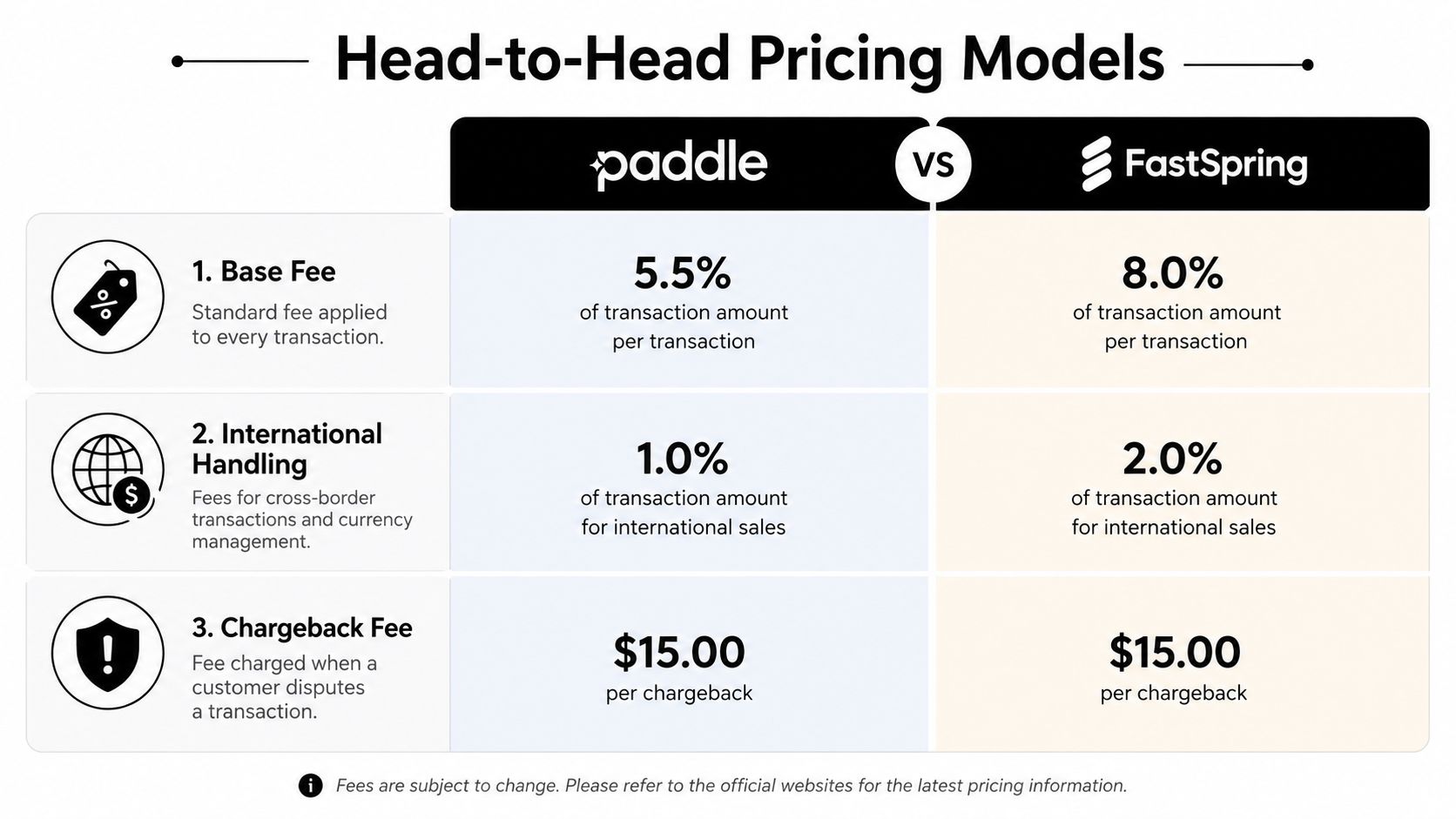
What you can compare confidently
A practical pricing review should separate four cost layers:
Platform fee structure. The listed transaction pricing or negotiated commercial terms.
Billing-model fit. Recurring SaaS and one-time software sales don't create the same operational load.
Currency and payout handling. Settlement mechanics can alter your effective economics behind the scenes.
Internal labor cost. Finance, support, and engineering time count too, even if they don't show up as a payment fee.
If you're a subscription software company, a platform that gives cleaner recurring revenue instrumentation can justify a higher headline fee if it reduces churn analysis work, failed-payment follow-up, and revenue reconciliation. If you're selling one-time licenses or digital downloads, breadth of checkout support and software-commerce workflows may matter more than deep SaaS metrics.
Why fee comparisons often mislead
Most pricing pages are read in isolation. That's the mistake.
A founder sees one platform with a simpler commercial model and another with more sales-assisted pricing, then assumes the cheaper-looking option will stay cheaper at scale. But software sales create edge cases fast. Different tax footprints, refund patterns, regional payment preferences, and reporting requirements all change the practical cost of ownership.
Practical rule: treat payment pricing as an operating-cost model, not a line-item procurement decision.
That means asking questions like these before you commit:
What happens when you expand internationally? A fee that looks clean in one market can feel different once local payment preferences and cross-border settlements enter the picture.
How much reporting do you need internally? Growth, finance, and support teams don't all need the same data.
Will your sales model stay simple? A SaaS business that later adds annual contracts, usage-based add-ons, or regional pricing can outgrow a platform faster than expected.
The practical conclusion on pricing
Paddle tends to make more intuitive sense when your revenue model is heavily subscription-led and your team wants billing and growth tooling to live close together. FastSpring becomes easier to justify when the business is broader than recurring SaaS, especially if sales ops, reconciliation, and software-commerce flexibility matter more than pure subscription instrumentation.
If you're still comparing options at a wider level, this guide to review payment systems for your business is useful because it helps frame the decision beyond just transaction fees.
Comparing Core Platform Capabilities
The fastest way to evaluate these platforms is by job to be done. Not "who has more features," but "what does my team need to execute every week without workarounds?"
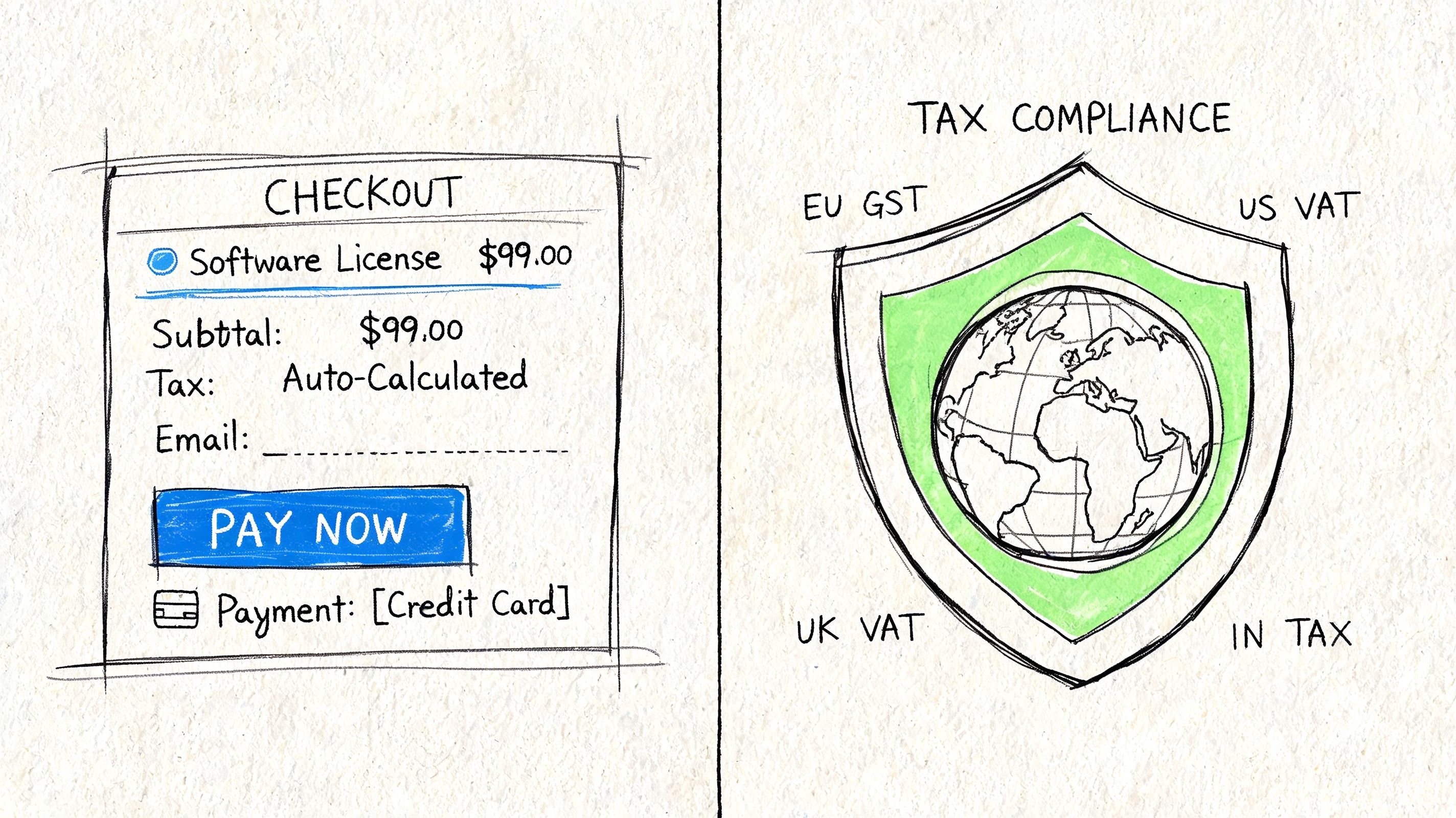
Checkout Experience and Localization
Paddle's positioning has long centered on giving SaaS businesses more control over how offers are presented across markets. Its comparison material highlights country-specific pricing controls, automatic payment-method selection, and support for both one-off and recurring payments. That tells you a lot about how Paddle thinks. It assumes pricing optimization and conversion localization are part of growth, not just checkout plumbing.
FastSpring's orientation is different. Historically, it has put more emphasis on broader software-commerce support and operational reporting. For companies selling software globally, especially outside a strict SaaS-only model, that can be valuable because checkout requirements often connect to product delivery, invoicing expectations, and regional commerce workflows more than to subscription experimentation.
Best fit here is straightforward. Paddle fits teams that treat checkout as part of SaaS growth. FastSpring fits teams that need localized commerce support across a wider software selling motion.
Subscription Lifecycle Management
At this point, the platforms separate more clearly.
Independent summaries describe Paddle as more strongly positioned for subscription management, standard SaaS metrics, and faster iteration for SaaS and app businesses, while FastSpring is framed as stronger for digital goods, desktop software distribution, and more enterprise-specific sales patterns in this Paddle vs FastSpring analysis.
If your company runs on recurring revenue, that distinction is not cosmetic. It affects who owns retention workflows, how quickly product and finance can answer churn questions, and whether billing data supports decision-making or just reconciliation.
Paddle tends to feel closer to the operating model of a modern SaaS company. FastSpring tends to feel closer to the operating model of a global software seller.
Developer and API Integration
Both platforms support integrations and operational event handling, but they signal different priorities in how they talk about those capabilities.
Paddle's comparison positioning is wrapped around billing flexibility and SaaS motion. FastSpring's own comparison emphasis includes webhook status and operational metrics, which suggests a stronger overt focus on reporting visibility and transaction monitoring for commerce operations, as noted earlier.
For engineering teams, the practical question isn't "does it have APIs?" Both do. It's whether your implementation is likely to support the business questions you'll ask six months later.
A useful way to judge that is to ask:
How many billing states matter to your product? Simple subscriptions are different from mixed one-time and recurring catalogs.
Who consumes event data? Product, growth, support, and finance often want different outputs.
Do you need speed or control? Some teams want a fast default implementation. Others want more structured operational visibility.
A simple capability summary
Capability area | Paddle | FastSpring |
|---|---|---|
SaaS-oriented billing posture | Stronger | Less central to positioning |
Broad software commerce framing | Present, but less central | Stronger |
Localized pricing emphasis | Stronger in positioning | Less central in messaging |
Operational reporting emphasis | Present | Stronger in positioning |
Tax Payouts and Global Compliance
The most misleading sentence in this category is "they handle tax." They do, but that's not the end of the work. It's the beginning of a different workflow.
The undercovered issue in most comparisons is the difference between tax compliance relief and finance operations simplicity. Those aren't the same thing. A merchant-of-record platform can remove major legal and filing burdens while still leaving your team with meaningful reconciliation, audit-prep, and internal reporting work.
What merchant of record actually removes
The strongest reason companies choose Paddle or FastSpring is that both can take on the merchant-of-record role and absorb a large share of the tax and compliance burden attached to international software sales.
That matters most when your team wants to avoid building tax registration, remittance, and cross-border compliance processes internally. For a lean SaaS business, that abstraction is often the main benefit.
But even strong merchant-of-record coverage doesn't answer every internal question. This is the gap highlighted in this analysis of Paddle vs FastSpring tax and finance tradeoffs. The key point is that mainstream comparisons usually don't quantify how the MoR structure changes audit scope, finance workflows, local-entity decisions, or internal headcount needs.
Where finance teams still do real work
This is where the buying decision gets more serious.
A company with simple SaaS pricing may prefer a cleaner abstraction layer, fewer moving parts, and less tax complexity visible to the internal team. Another company may care more about reporting exports, control, and how data maps into an existing entity-by-entity accounting structure. Same category. Very different needs.
If tax and compliance are central to your evaluation, it helps to read a broader explanation of the merchant of record model before treating any platform's "we handle tax" claim as complete.
The right question isn't who handles tax better. It's which model leaves your finance team with the least painful month-end.
Payout friction belongs in the same conversation. If your revenue settles on schedules, through banking rails, and across currencies that don't match how you hold funds, then tax simplification may come bundled with slower cash access or added conversion complexity. Those costs are easy to miss in a product demo and impossible to ignore in operations.
A Modern Alternative Suby for Direct USDC Payouts
Not every business wants a traditional merchant-of-record structure. Some want a simpler payment flow, especially if the bigger pain is settlement delay, forced currency conversion, or dependence on bank-based payout cycles.
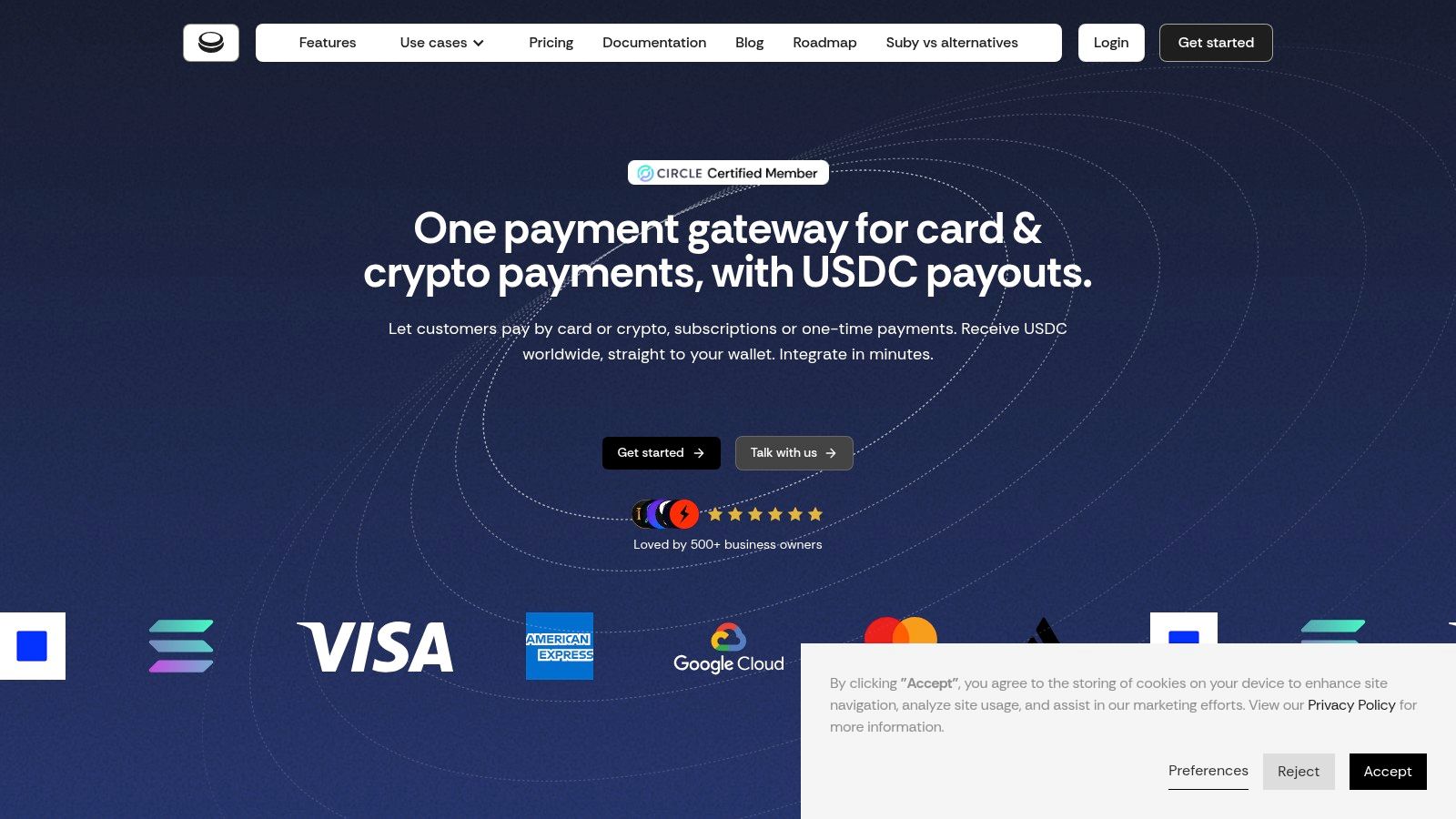
That creates a different category of option. Suby is not a traditional merchant of record. It's a payment API that lets businesses accept payments by card or crypto, while the business receives USDC. In plain terms, users pay with cards, businesses receive USDC.
How the model differs from a traditional MoR
The difference is structural.
Traditional merchant-of-record platforms package payments, tax handling, and commerce operations together. A stablecoin-native payment layer changes the emphasis. Instead of optimizing around tax abstraction and bank settlement, it optimizes around direct, predictable receipt of funds in USDC.
According to Suby's official product information, businesses can accept card payments or crypto payments, use paylinks, embedded checkout, API, and webhooks, and support one-time payments and recurring subscriptions. It also offers native Discord and Telegram integrations for use cases like subscriptions, paid access, and community monetization. The core payout message stays the same. Users pay with cards, businesses receive USDC.
Who this model makes sense for
This model is most relevant when payout simplicity matters as much as checkout conversion.
Examples include:
Global online businesses that don't want revenue trapped in slow banking cycles
Agencies and freelancers that prefer receiving revenue directly in USDC rather than through currency conversion chains
Community-led products using Discord or Telegram for paid access and recurring memberships
Developers who want API and webhook control without adding a traditional merchant stack first
Suby's official pricing states that pricing starts at 5 percent and is all-inclusive on its pricing page. The more important distinction, though, is not just the fee. It's the settlement model. If your biggest pain point is currency conversion or payout delay rather than tax registration complexity, a stablecoin-native flow can change the economics of the whole system.
Which Platform Is Right For Your Business
There isn't a universal winner here. The right choice depends on what kind of software business you're running, not the one your homepage claims you're running.
The bootstrapped SaaS startup
Pick Paddle if your company lives and dies by recurring revenue visibility.
That's because Paddle is more strongly positioned around SaaS-style subscription billing and analytics, while FastSpring is less centered on deep SaaS instrumentation. If your team needs recurring billing logic, retention workflows, and standardized SaaS metrics close to the payment stack, Paddle usually lines up better with how the business operates, based on the positioning summarized in the earlier independent comparison.
The hidden advantage is organizational. Product, growth, and finance can all work from a billing system that was shaped with SaaS in mind.
The established B2B software vendor
Pick FastSpring if your business is broader than recurring SaaS.
That often means desktop software, digital goods, software distribution requirements, or a sales motion where operational reporting and reconciliation matter more than subscription-led experimentation. FastSpring's framing has historically fit companies that need global software commerce support rather than a pure SaaS growth stack.
If you're in this group, it also helps to compare your priorities against a broader buyer guide on the best merchant of record for SaaS, especially if your model sits somewhere between enterprise software and recurring app revenue.
The global creator with a digital community
Pick a direct USDC payout model if speed of access to funds matters more than a traditional merchant-of-record abstraction.
This is a different decision from Paddle versus FastSpring. If your business sells memberships, subscriptions, private access, or online community products across borders, then payout flow can matter more than classic software-commerce tooling. In that case, a card-or-crypto checkout with direct USDC settlement may be the cleaner fit.
If your pain starts after the payment is accepted, you're not choosing a checkout tool. You're choosing a cash-flow system.
That profile includes creators, community operators, and internet-native businesses that don't want revenue slowed down by bank settlement and conversion layers.
Frequently Asked Questions
Do I lose my customer relationships with a merchant of record
You don't lose the relationship, but the commercial structure changes. The merchant-of-record provider becomes the legal seller for the transaction, which affects how billing, receipts, tax handling, and some support processes are presented. Before choosing a platform, check how much customer data, branding control, and post-purchase workflow visibility your team needs.
How difficult is it to migrate away from Paddle or FastSpring
Migration difficulty depends less on the logo and more on how extensively the platform sits inside your billing logic. If subscriptions, entitlements, invoices, tax treatment, and reporting all depend on one provider's workflow, moving later will take planning. The hardest part is usually not the payment form. It's mapping customer states, billing history, and internal reporting to a new system.
Can I use my own payment processor with these platforms
For a merchant-of-record platform, that's usually not the main model. The value comes from the provider acting as seller of record and managing tax and compliance responsibilities around the transaction. If your goal is to control your own payment stack directly, you're usually looking at a different category of product from a classic MoR.
Which is better for SaaS, Paddle or FastSpring
If your business is strongly subscription-led, Paddle usually aligns better with SaaS billing and analytics priorities. If your company sells across a broader software-commerce model, FastSpring may be the better operational fit.
When should I consider a non-MoR alternative
Consider one when the biggest problem isn't tax abstraction. It's payout friction, conversion losses, or delayed settlement. That's where a direct USDC payout model becomes worth evaluating.
Suby is a payment gateway and payment processor. Your customers pay with card, bank transfer, Apple Pay, Google Pay, Klarna, and more, or stablecoins, and you get paid out to your bank account, or directly in stablecoins (USDC, EURC) to your wallet, anywhere in the world, no bank account required. If your Paddle versus FastSpring decision keeps coming back to payout friction, forced currency conversion, and slow bank settlement rather than tax abstraction, Suby gives software sellers direct, predictable settlement through an API, paylinks, embedded checkout, subscriptions, and native Discord and Telegram integrations.
