

Gaspard LEZIN
Merchant of Record Latam
Merchant of record latam. Learn how a merchant of record works in Latin America, what it covers across tax and payments, and how to choose the right setup
A US SaaS team can win its first Brazilian customer and still discover that accepting the money is the easy part. The buyer may expect a local invoice, a familiar payment method such as Pix or Boleto, and a checkout that reflects Brazilian buying habits. The tax treatment won't match Mexico, and a payment provider that works well in one market may leave gaps in another.
That's the practical problem behind merchant of record LATAM expansion. Latin America isn't one payment market. It's a patchwork of tax registrations, indirect-tax rules, local payment rails, currency expectations, and settlement constraints. Online retail sales reached about US$272 billion in 2023 and more than US$319 billion in 2024, according to HKTDC's overview of Latin America's e-commerce market. The opportunity is substantial, but the operating model determines whether that opportunity becomes manageable.
A merchant of record can absorb much of the legal transaction burden. It can also hand unexpected costs and control issues back to you if its country coverage, payment methods, or contract terms aren't precise. The right choice depends on what you're selling, where you're selling it, and how much operational control you need.
Table of Contents
Why LATAM Looks Hard and What a Merchant of Record Actually Does
The first distinction is simple but often missed. A merchant of record, or MoR, is the legal entity that sells to the end customer on your behalf. It isn't merely a payment gateway that moves card data, and it isn't automatically the same thing as a standard PSP.
The MoR appears as the seller in the transaction and takes responsibility for defined legal and operational duties. Those duties can include tax registration, indirect-tax calculation, invoicing, payment collection, fraud controls, chargeback handling, refunds, and regulatory reporting. Your company still owns the product, pricing, marketing, delivery, and brand experience.
Practical rule: If the provider only processes your payment while your company remains responsible for registration, filing, tax remittance, and merchant liability, you're using a PSP, not outsourcing the full MoR role.
The model matters because LATAM demand is increasingly cross-border. Cross-border e-commerce in the region grew 44% in 2023, and an industry forecast projects a 34% compound annual growth rate, with cross-border sales expected to double by 2026 and reach 13% of online sales in the top six Latin American markets, according to Parcel Perform's analysis of Latin American delivery and e-commerce. International sellers need a way to sell without creating a separate operating structure for every market.
A strong MoR can act as the local legal seller, calculate and collect applicable taxes, issue compliant invoices, and manage local collection. That can reduce the need for separate entities and tax operations, but it doesn't erase every country-specific obligation. Mexico, Peru, and Chile, for example, have rules that can still require nonresident suppliers to register, file, collect, or manage withholding arrangements.
For that reason, treat MoR as an expansion architecture, not a universal shortcut. Before signing, ask which entity is legally selling in each target country, who files the returns, who remits the tax, and who carries the liability when the transaction is challenged. A useful plain-language overview of the model is available in what a merchant of record does.
The Core MoR Model in Plain English
The cleanest way to understand an MoR is to divide the transaction into two ownership columns. The MoR owns the legal sale and the payment obligations. The seller owns the underlying product and customer proposition.
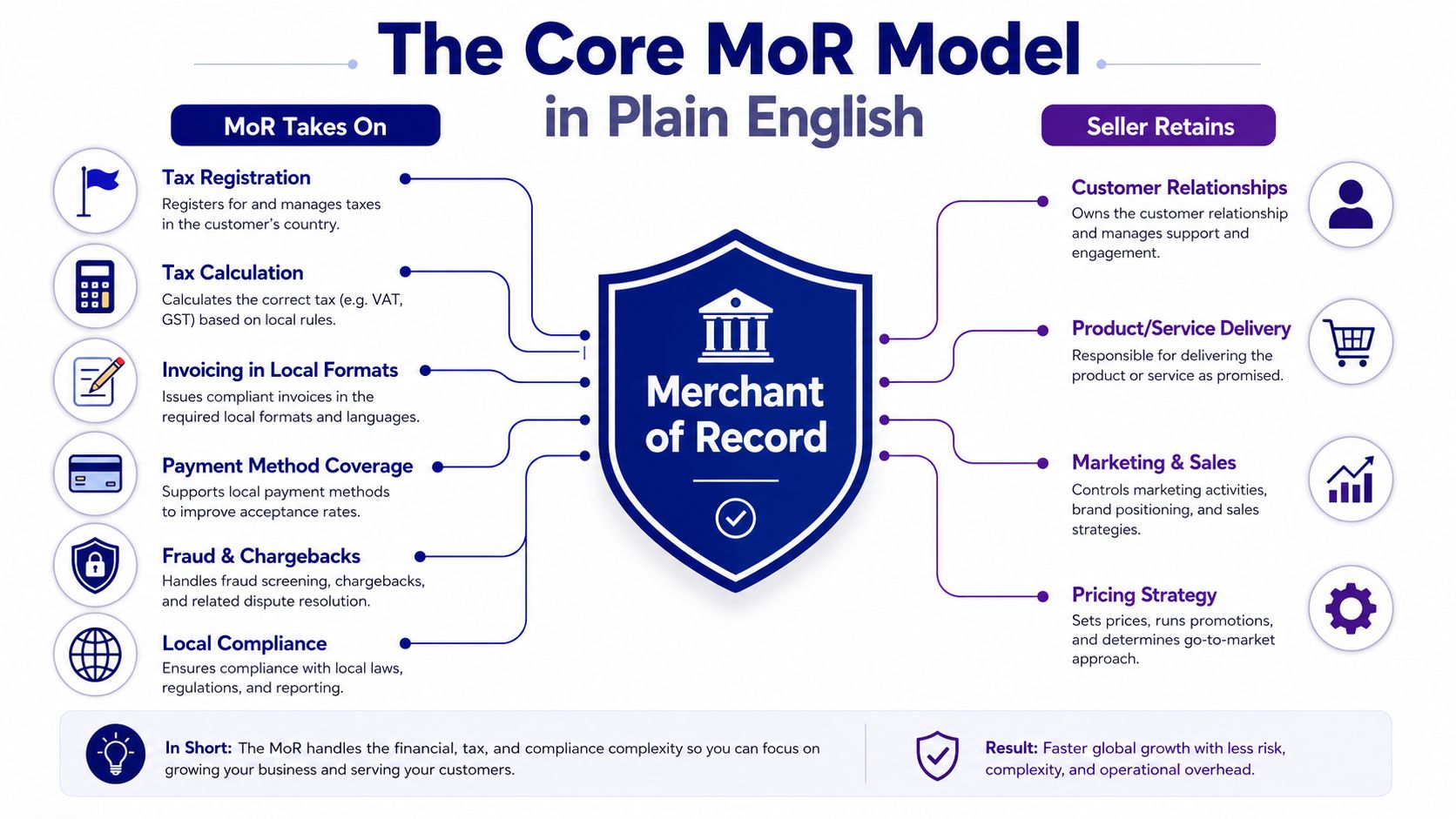
What the MoR takes on
The provider should manage the parts of the transaction that require local legal and financial execution:
Tax registration and calculation: It identifies the relevant indirect-tax treatment, applies it at checkout, and manages the agreed filing and remittance process.
Local invoicing: It issues receipts or invoices in the required language, currency, and format where its coverage supports that requirement.
Payment method coverage: It connects the checkout to cards, wallets, bank methods, and domestic rails relevant to each market.
Fraud and chargebacks: It screens transactions, manages disputes, and defines how fraud losses and chargebacks are allocated.
Regulatory reporting: It maintains the transaction records and reporting workflows required for its seller-of-record responsibilities.
The technical stack may still use a separate acquirer, processor, gateway, tax engine, or local payment partner. That doesn't change the central question. The MoR must own the legal sale and related obligations, rather than passing payment data through another provider.
What the seller retains
You still deliver the software, goods, course, or community access. You set the price, control the product roadmap, own the intellectual property, and support the product itself.
You also retain responsibility for lawful product distribution, accurate business information, privacy commitments, sanctions controls relevant to your business, licenses, and customer promises. The MoR can manage tax on the transaction, but it can't make an illegal product legal or replace your responsibility for what you sell.
Responsibility | MoR | Seller |
|---|---|---|
Legal sale to the customer | Yes | No, where the MoR model is valid |
Tax collection and remittance | Contract dependent, but central to the role | Oversight and product classification |
Product delivery | No | Yes |
Pricing and marketing | No | Yes |
Payment routing | Usually managed or coordinated | Product and checkout requirements |
Customer support | Payment issues may be covered | Product and service issues |
Chargebacks | Usually managed by the MoR | Evidence and cooperation may still be required |
Read the contract line by line. Terms such as “tax support,” “payment facilitation,” and “global coverage” don't necessarily mean the provider is the legal seller in every country.
Country-by-Country Reality Across LATAM
A regional label hides important differences. Brazil, Mexico, Argentina, Chile, Colombia, and Peru each combine local tax rules, payment behavior, registration requirements, and settlement expectations differently.
Mexico generally requires nonresident digital suppliers to register, collect, and file VAT monthly. Peru introduced similar simplified VAT rules in December 2024, while Chile expanded simplified VAT coverage in October 2025 to low-value imports up to US$500 for remote overseas sellers, according to PayRetailers' LATAM cross-border payments guide. These changes make country-level verification essential, especially for B2C digital services and low-value goods.
Brazil is the region's largest commercial opportunity and a market where payment localization matters immediately. Pix and Boleto can be central to acceptance, while local invoicing and business documentation can create friction for a foreign SaaS seller. Mexico combines cards with methods such as OXXO and SPEI, so a card-only checkout can miss important buyer preferences.
Argentina brings its own currency, settlement, and payment constraints. Chile has a comparatively clear digital-services registration path for overseas sellers, but its tax and low-value import rules still need to be mapped to the product. Colombia requires attention to VAT and possible withholding structures, while PSE can matter alongside cards. Peru has moved toward simplified VAT treatment for foreign digital suppliers, but that does not make the broader region uniform.
Country | Indirect tax model | Foreign seller stance | Key local payment methods | Recent regulatory direction |
|---|---|---|---|---|
Brazil | Indirect taxes and invoicing can involve layered local requirements | Foreign sellers need a country-specific legal and tax assessment | Pix, Boleto, cards | The framework is changing, so ongoing monitoring matters |
Mexico | VAT applies to digital services | Nonresident digital suppliers generally register, collect, and file | OXXO, SPEI, cards | Registration and monthly filing duties remain important |
Argentina | Digital services and cross-border payment treatment require local analysis | Currency, withholding, and collection mechanics can affect the seller | Cash vouchers, bank methods, cards | Operational treatment can change quickly |
Chile | Simplified VAT treatment applies to covered foreign digital sellers and certain imports | Remote sellers may register or face alternative collection treatment | Cards, bank methods, local wallets | Coverage expanded in October 2025 |
Colombia | VAT or alternative withholding arrangements may apply | Foreign suppliers need to confirm the correct regime | PSE, cards, bank methods | Regime selection affects reporting and settlement |
Peru | Simplified VAT rules apply to covered nonresident digital suppliers | Registration and filing requirements need confirmation | Cards, bank methods, wallets | Similar simplified VAT rules arrived in December 2024 |
Payment acceptance and tax treatment must be evaluated together. A provider that covers Brazil legally but can't support the payment methods Brazilian buyers prefer isn't a complete LATAM solution. Use payment providers in LATAM as a starting point, then validate each country's exact coverage with tax counsel and the provider's legal documentation.
How the Payment and Settlement Flow Actually Works
A workable MoR flow separates customer payment from merchant settlement. That distinction matters because the buyer may pay in a local currency through a domestic rail while the seller wants consolidated funds in another currency.
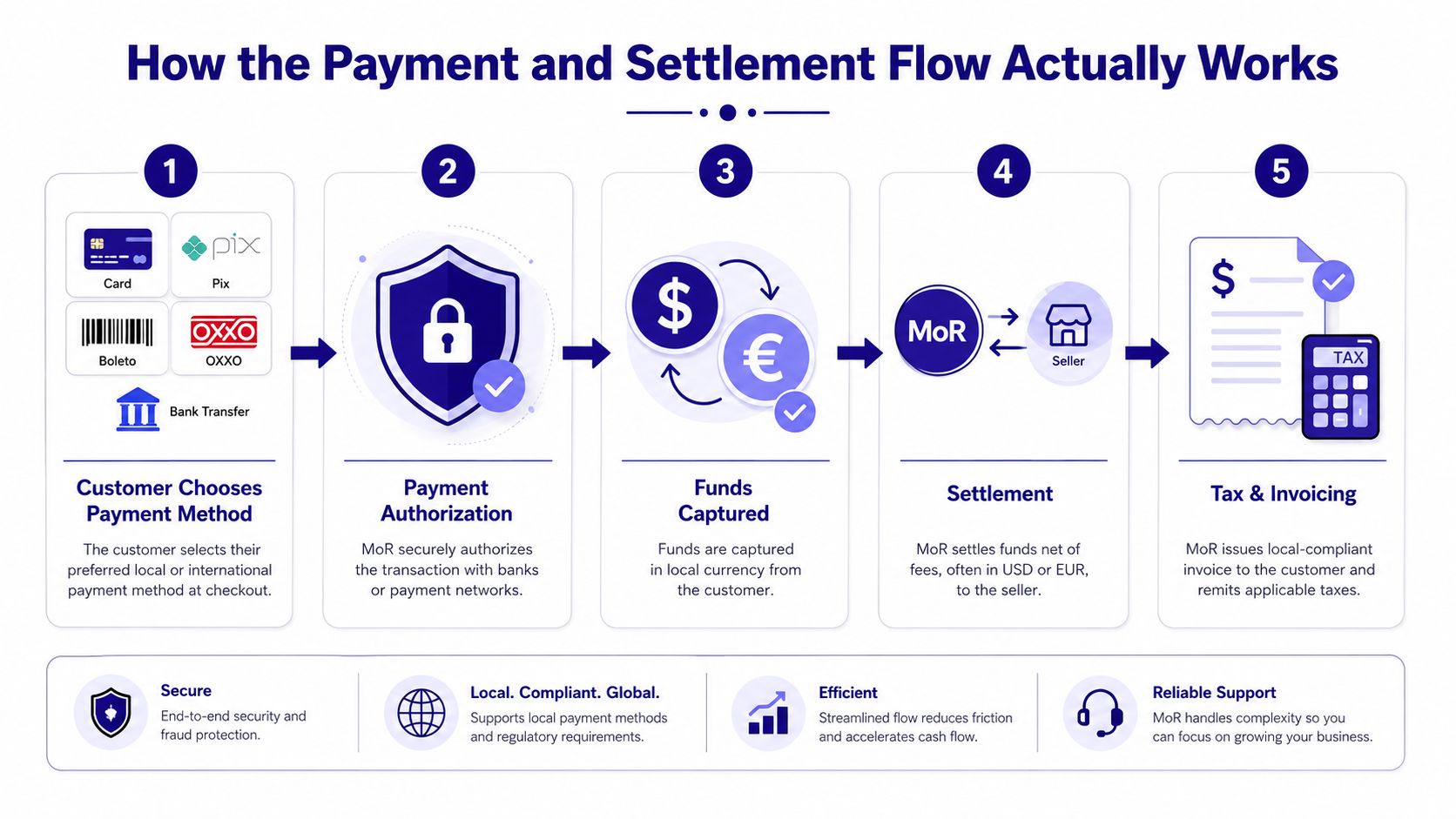
Five stages of the transaction
The customer chooses a method. The checkout may offer cards, Pix, Boleto, OXXO, wallets, or a country-specific bank-transfer option. The available mix should reflect the target market, not the seller's preferred global checkout.
The transaction is authorized and screened. The payment partner routes the transaction through the relevant card network or local rail. The MoR's risk workflow can apply fraud screening and determine whether the payment should proceed.
Funds are captured in the offered currency. The customer usually sees a local-currency price, and the payment is collected through the selected method. The MoR records the sale, tax treatment, refund terms, and transaction identifiers.
The MoR reconciles and settles. The provider aggregates balances, subtracts agreed fees, refunds, chargebacks, reserves, and any applicable tax treatment, then pays the seller in the selected settlement currency where supported.
Tax and invoice records are produced. The customer receives the applicable receipt or invoice, while the seller receives reporting needed to reconcile gross sales, deductions, taxes, refunds, and net payout.
LATAM payment performance depends on local rails and settlement design, not card acceptance alone. Regional payment methods can be domestic-first, and cash or voucher methods such as Boleto Bancário, OXXO, and Rapipago remain relevant. One regional source reports that 40% of online purchases are paid in cash in the markets it discusses, as described in Rapyd's LATAM cross-border payments analysis.
Consider an illustrative US$100 annual card sale. The customer pays the displayed amount, the MoR records the sale and applicable tax line, and the settlement report might show a payment-processing deduction, an MoR fee, a refund reserve, and an FX adjustment before the net amount is converted into USDC. The example is a reconciliation model, not a universal provider promise. Confirm whether your chosen provider supports card collection and payout in BRL, as well as settlement to USDC.
Stablecoin settlement can remain entirely in the back office. Stablecoin card-acquiring settlements can pay the merchant in approved stablecoins while the customer still pays by card. The checkout doesn't need to expose crypto, and the seller can choose bank settlement, local currency, or stablecoin settlement where the provider supports it.
Real Benefits and Honest Risks of Going MoR in LATAM
The strongest argument for an MoR is operational compression. One provider can give a seller one commercial counterparty while coordinating local checkout, payment collection, tax calculation, invoicing, refunds, and dispute workflows across several countries.
That matters when a SaaS or e-commerce team wants to test multiple markets without building a separate tax and finance process for each one. It can also reduce reconciliation work because domestic payment methods and local-currency collections feed into a consolidated reporting structure.
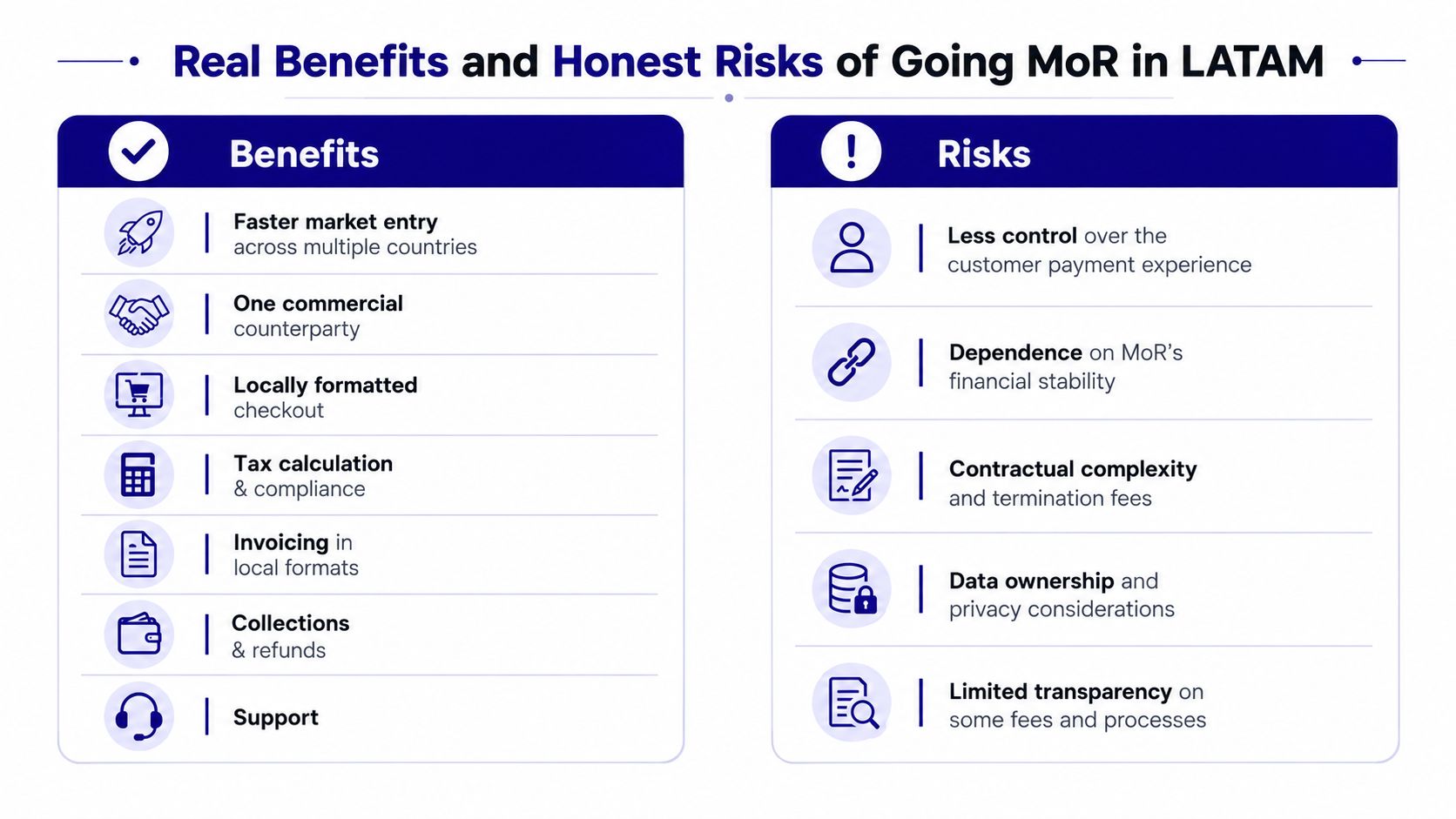
What you gain
Faster market entry: You can avoid building every local registration and filing workflow before testing demand.
Broader payment coverage: A capable provider can connect cards with domestic methods and local collection rails.
Simpler finance operations: One reporting relationship can reduce fragmented settlement files.
Delegated payment liability: Fraud and chargeback processes move into the MoR workflow, subject to the contract.
Local transaction documentation: The provider can issue supported local invoices and receipts.
What you give up
The price may be higher than a direct PSP. MoR pricing can include payment-method fees, currency-conversion spreads, reserves, chargeback costs, payout fees, and commercial minimums. Pricing depends on the payment method used, so don't compare providers using a single headline rate. Check the Suby pricing page for exact figures where relevant.
The MoR may control the merchant descriptor, payment page behavior, customer-facing terms, and parts of the refund process. Your customer may see the MoR rather than your company on a statement or invoice, which can create support questions and weaken brand continuity.
Termination deserves equal attention. Review reserve release, open refunds, chargeback ownership, tax records, data portability, payment-token migration, and the process for leaving a country. A provider's regional footprint also doesn't prove that it supports your product category, recurring billing model, or preferred payment method.
You remain accountable for product legality, intellectual property, privacy commitments, sanctions obligations, licenses, and accurate business information. Tax collection by an MoR isn't blanket legal protection.
MoR Versus Marketplaces, Local Entities, and PSPs
There are four practical routes into LATAM. The right one depends less on ideology than on the balance between speed, control, compliance, and margin.
A marketplace works when distribution is the main obstacle. It can provide audience access and may simplify parts of collection, but you usually sacrifice control over branding, pricing, customer data, and recurring billing. It's a sensible test route for low-volume demand, not usually the ideal long-term home for a subscription business.
A local entity gives the strongest control. Your company can own the customer transaction, choose local acquirers, shape invoicing, and manage settlement directly. The trade-off is a real operating function, including registration, accounting, tax filings, local payment relationships, and ongoing legal administration.
A direct PSP gives you more checkout and payment-method control than an MoR. It typically leaves your company as the legal seller, which means you retain responsibility for tax registration, invoicing, consumer rules, fraud exposure, chargebacks, and remittance.
An MoR sits between those models. It usually launches faster than a local entity and carries more transaction responsibility than a PSP, but it costs more and gives you less control over the legal sale and customer-facing payment experience.
Model | Setup and cost | Compliance and payments | Control and best fit |
|---|---|---|---|
Marketplace | Fast to test, but commercial deductions and platform rules apply | Marketplace may manage collection, but coverage varies | Lower control, useful for demand testing |
Local entity | Slowest and most operationally demanding | Seller owns registrations, filings, local rails, and liability | Highest control, suitable for committed scale |
Direct PSP | Faster than building every payment relationship, with lower intermediation | Seller usually retains tax and merchant obligations | Strong checkout control, suitable for teams with finance capability |
MoR | Faster regional launch, with higher total commercial cost than a basic PSP | Provider takes the legal sale and agreed tax, invoicing, dispute, and payment duties | Moderate control, suitable for cross-border SaaS and e-commerce |
Choose an MoR when compliance capacity is the bottleneck. Choose an entity when control, margin, and local operating presence justify the overhead. Choose a PSP when your team is ready to remain the merchant and manage the obligations directly.
A Practical Checklist for Evaluating MoR Providers
Don't start with the provider's country list. Start with the legal relationship. Ask for the entity that will appear as seller in Brazil, Mexico, Argentina, Chile, Colombia, and Peru, and confirm whether it owns the registration, filing, remittance, and liability obligations in each market.
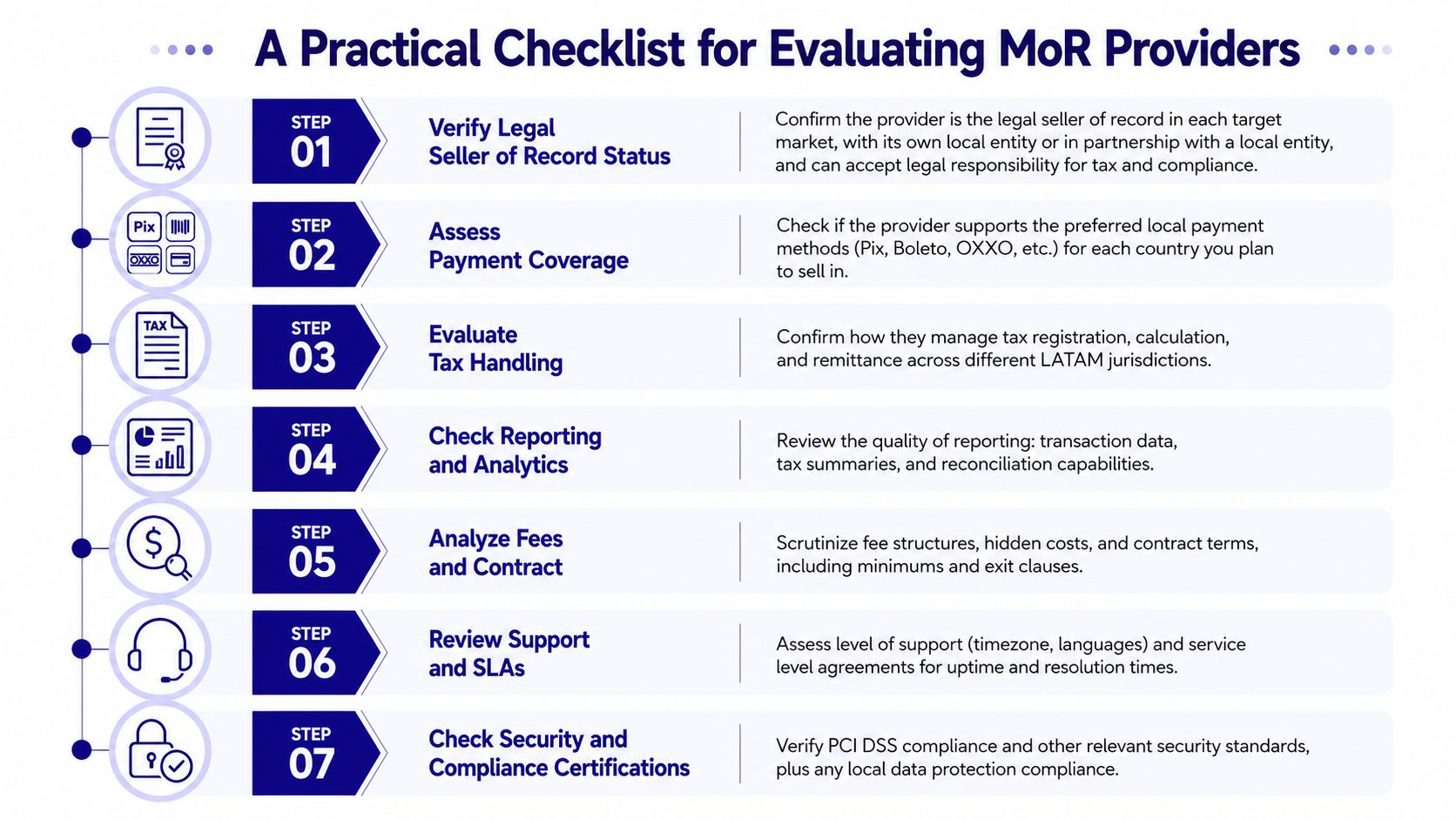
Validate coverage in operating terms
Ask the provider to map your actual products and flows, not just its geographic footprint.
Verify legal seller status: Confirm the MoR is the legal seller in every target market and can accept responsibility for the documented obligations.
Test local payment methods: Request live or sandbox evidence for Pix, Boleto, OXXO, SPEI, PSE, cards, wallets, and bank methods relevant to your launch.
Review tax treatment: Ask who registers, calculates, files, remits, corrects errors, and responds to authority queries.
Inspect invoice output: Check local language, tax fields, currency presentation, refunds, credit notes, and recurring-payment records.
Reconcile a complete transaction: Match the checkout amount to gross capture, tax, payment fee, MoR fee, reserve, refund, FX conversion, and net payout.
Confirm settlement choices: Ask whether settlement can be made in local currency, USD, EUR, or USDC, and whether the provider supports aggregated settlement.
Test disputes: Review fraud controls, evidence requirements, chargeback ownership, response deadlines, and service-level commitments.
Read the contract before integrating
Look for exclusivity, auto-renewal, minimum-volume commitments, reserve rights, payout delays, unilateral pricing changes, and unclear responsibility for tax filing errors. Confirm data ownership, reporting access, customer support boundaries, and what happens to open refunds and disputes after termination.
Integration depth matters too. Check API and webhook support, subscription events, reconciliation exports, and compatibility with your billing platform, e-commerce stack, or internal ledger. Native community access can also matter for creators. Suby provides an API that lets businesses accept payments by card or crypto, and it offers native integrations with Discord and Telegram for subscriptions, paid access, and online communities. Its four use cases are Suby Payments, Suby Crypto, Suby Gating, and Suby Invoicing, with customers paying by card, wallet, bank, or crypto and the business selecting an available bank or stablecoin settlement path.
Don't accept “LATAM coverage” as a sufficient answer. Demand a country-by-country responsibility matrix and a settlement report that your finance team can reconcile.
Next Steps and Common Questions for LATAM Expansion
Start with the operating model that matches your seller profile:
SaaS subscriptions: Begin with an MoR when recurring billing, local tax handling, and payment-method coverage are more urgent than maximum transaction control.
E-commerce brands: Use an MoR for early cross-border expansion, then consider a hybrid structure with local entities when volume, margin, inventory, and customer ownership justify it.
Agencies billing regional clients: Compare direct invoicing and PSP collection with an MoR or invoicing platform, focusing on client payment preference and settlement currency.
Creators and digital communities: An MoR or paid-access system can simplify recurring access, refunds, and payment collection across Discord, Telegram, courses, and downloads.
Make the decision with three questions. Do you need local-currency pricing and domestic payment methods? Can your margin absorb the MoR's full cost, including FX and reserves? How important is it for your brand to own the checkout, statement descriptor, invoice, and customer payment data?
Common questions
Who handles refunds? The MoR usually processes refunds for transactions it legally owns, but your contract should define approval rights, funding, timing, and customer communication.
What happens if the MoR exits a market? You need an exit plan covering open refunds, disputes, tax records, customer data, payment tokens, and migration to another provider or entity.
Is MoR income taxable in the seller's home country? The MoR structure doesn't decide your home-country income-tax treatment. Have your tax advisor review revenue recognition, payout records, and the legal contract.
How long does onboarding take per country? It depends on product category, documentation, risk review, payment methods, tax scope, and technical integration. Get a country-level implementation plan rather than accepting one regional timeline.
Suby provides one API for businesses to accept payments by card or crypto, while its Payments, Crypto, Gating, and Invoicing options support different checkout, settlement, access, and billing needs. If you're evaluating a merchant of record LATAM setup and want customers to pay their preferred way while you receive funds in the currency or stablecoin you choose, visit Suby and review the available options.
