

Gaspard LEZIN
How to Create a Membership Website That Thrives in 2026
Learn how to create a membership website with our 2026 guide. We cover planning, technology, global payments, community building, and scaling your business.
Building a membership website that actually thrives comes down to a few key phases: nailing your strategy, picking the right tech, sorting out payments, and managing who gets access to what. Think of it less as a technical project and more as building a digital home your members will love enough to pay for.
Defining Your Membership Website's Core Strategy
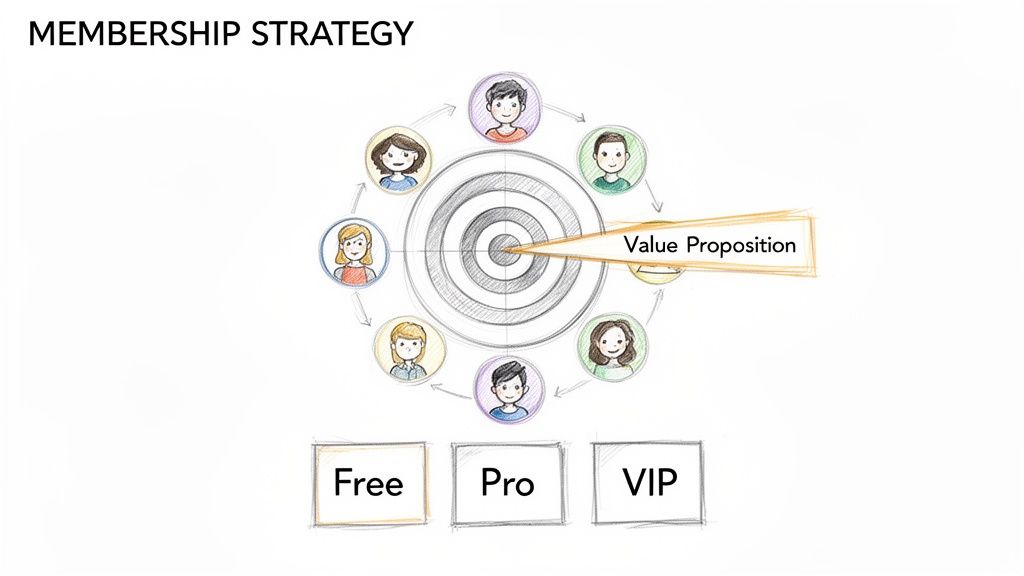
It’s tempting to jump straight into choosing a platform or designing your site, but that’s a mistake I see all the time. Before you write a single line of code, you need a rock-solid strategy. This is the foundation that supports every other decision you’ll make, turning a fuzzy idea into a concrete plan built for the long haul.
At the heart of it all is your value proposition. What are you offering that’s so valuable people will open their wallets for it? This isn’t just about putting content behind a paywall; it's about crafting an experience they can't get anywhere else.
Find Your Niche And Ideal Member
First things first, get specific. Don't just pick a broad topic like "fitness." That's a crowded space where it's tough to stand out. Instead, carve out a niche like "kettlebell workouts for busy parents." See the difference? Now you have a target.
Once you’ve found your niche, get laser-focused on your ideal member. Ask yourself:
What are their biggest struggles or pain points?
What are they desperately trying to achieve?
What kind of content or community would genuinely solve their problems?
Where are they already spending money to find a solution?
Truly understanding your audience is the single most important factor in creating a membership site that doesn't just launch, but lasts. Every piece of content you create and every community decision you make should be guided by this member profile.
Choose Your Membership Model
With a clear picture of your audience, you can start thinking about the structure. There are several proven models, and you can even mix and match them to create something unique to your brand.
Here is a breakdown of the most common models to help you decide which structure best fits your content and community goals.
Choosing Your Membership Model
Model Type | Best For | Pros | Cons |
|---|---|---|---|
All-In Access | Evergreen content libraries, self-paced learning, reference materials. | High initial value for new members. Low maintenance once the content is built. | Can lead to high churn if members consume everything quickly and leave. |
Drip-Feed | Structured courses, sequential learning paths, ongoing content series. | Keeps members engaged over time, reduces overwhelm, creates anticipation. | Requires a consistent content production schedule to keep up. |
Community-First | Niche groups, masterminds, networking, and peer support. | Fosters deep loyalty and high retention. The community generates its own value. | Requires active moderation and community management to thrive. |
Hybrid Model | Combining content with a strong community element (e.g., courses + Discord). | The best of both worlds, offering structured value and a sense of belonging. | Can be more complex to set up and manage multiple moving parts. |
Each of these models has its place, but the right one for you depends entirely on the value you promised your ideal member.
The most successful membership sites I’ve seen almost always blend content with community. That feeling of belonging and shared experience is a powerful glue that keeps members subscribed month after month.
The data backs this up. Community-focused models can hit 85-92% retention, blowing past the 60-70% typical for content-only sites. This incredible retention is a key driver in the creator economy's growth, which is on track to jump from $191.55 billion to $234.65 billion by 2026.
The model you pick has a direct impact on your pricing and tech stack. For example, if you're building around a private Discord or Telegram, you'll need a payment system that can talk to those apps. We offer native integrations for Discord and Telegram for this exact reason, which automates access when a subscription starts or stops. We’ll dig into this later.
As you flesh out your plan, you can get more ideas from our guide on how to make money as a a content creator. For a complete walkthrough of all the moving parts, this practical guide to building membership websites is an excellent resource.
Choosing the Right Technology for Your Members
Once you have a solid plan for your membership, it's time to pick the tech that will run the show. This is a huge decision. The platform you choose becomes the backbone of your entire business, handling everything from how you deliver content to how you manage your members. It will directly affect your budget, your daily workload, and how easily you can grow down the road.
You’re looking at three main routes, and each comes with its own trade-offs. The right choice really boils down to your technical comfort level, your budget, and what you want this business to become in the long run.
All-In-One Hosted Platforms
Hosted platforms are often the go-to starting point for creators, and for good reason. Think of them as the 'move-in ready' option. They handle all the messy technical stuff for you like hosting, security, bug fixes, and updates. You get a clean, straightforward dashboard to build your site, add content, and manage your community all in one spot.
The upside: They are incredibly fast to get started with and don't require you to be a tech wizard. Plus, customer support is usually part of the deal, which is a massive help when you're stuck.
The downside: Convenience has its price. You give up a lot of control over customization, and your site's look and feel will be constrained by their templates. Transaction fees can also be higher, and moving your business off the platform later can be a real headache.
This is a fantastic choice if you want to launch quickly, test your membership idea, and avoid getting bogged down by the technical details.
Self-Hosted Solutions Like WordPress
Taking the self-hosted path, which usually means using WordPress, puts you completely in the driver's seat. Here, you're in charge of arranging your own hosting, locking down security, and keeping everything updated. You then use a mix of plugins to build out your membership features, like gating content and processing payments.
A self-hosted site gives you complete ownership and customization freedom. You can design any experience you can imagine and integrate with any tool you choose, but you also become responsible for every piece of the puzzle.
This approach is perfect for anyone who wants to build a truly unique brand and isn't afraid of a little hands-on work. The WordPress ecosystem is massive, with thousands of themes and plugins that let you fine-tune every corner of your site. The flip side is that you're also the one on call when something inevitably breaks.
A critical piece of this puzzle is your payment system. You’ll need a flexible solution that can handle both one-time fees and recurring subscriptions from a global audience. With a modern payment API, you can integrate a checkout that lets members pay by card, while you get the funds settled directly as USDC. This neatly sidesteps the headaches of currency conversion and international bank transfers, a must-have for a worldwide member base.
Building A Custom Solution From Scratch
For those with a development team or the resources to hire one, a fully custom build offers the absolute pinnacle of control. This means creating your membership platform from the ground up, piece by piece. It allows you to craft a user experience that is perfectly aligned with your specific business model.
This is by far the most complex and expensive route. However, it can be the only real option if you need highly specialized features that no off-the-shelf product can offer. For example, if you're envisioning a platform with unique community mechanics or incredibly complex access tiers, a custom build might be the only way to bring that vision to life.
No matter which path you're leaning toward, getting a sense of the broader market is always a good idea. For a deeper look, check out our analysis of the best platforms for selling digital products, as many of the same concepts apply here. At the end of the day, the best tech is the one that fuels your business goals instead of creating roadblocks.
Alright, you've nailed down your strategy and chosen your tech stack. Now for the most important part: getting paid. This is the engine of your membership business, and setting it up to work globally can feel like a huge hurdle. But it doesn't have to be.
Forget the old, clunky payment gateways that seem designed to create headaches. We're talking about a modern approach that handles one-time payments and recurring subscriptions without a hitch, no matter where your members live.
Think Globally from Day One
For your membership site to truly grow, anyone, anywhere needs to be able to pay you. This simple idea is where many businesses stumble. They run into declined international cards, confusing currency conversions, and unpredictable payout schedules from legacy banking systems.
A global-first payment philosophy is the answer. You need a system built to solve these problems from the ground up.
Look for a payment partner that offers:
Payment Flexibility: Let your members pay how they want. That means accepting major credit cards like Visa and Mastercard, but also giving them the option to use popular cryptocurrencies.
Unified Settlement: Stop juggling a dozen different currencies and paying outrageous exchange fees. A modern system should settle all of your earnings into a single, stable currency, like USDC.
Direct Payouts: Your money is your money. The revenue should go straight to your own crypto wallet, cutting out the middleman. This eliminates the risk of a platform suddenly holding or freezing your funds.
This isn't just about collecting money; it's about building a resilient business. You can confidently market to a global audience when you know your checkout is frictionless and your revenue is secure.
The real magic of a modern payment API is how it separates the way your customer pays from how you get paid. A member in Japan can pay with their Visa, and you instantly receive USDC in your wallet. You never have to touch the foreign exchange market or worry about conversion rates.
Whether you go the self-hosted route with WordPress or use an all-in-one platform, the goal is the same: integrate a payment system that enables growth, not one that restricts it.
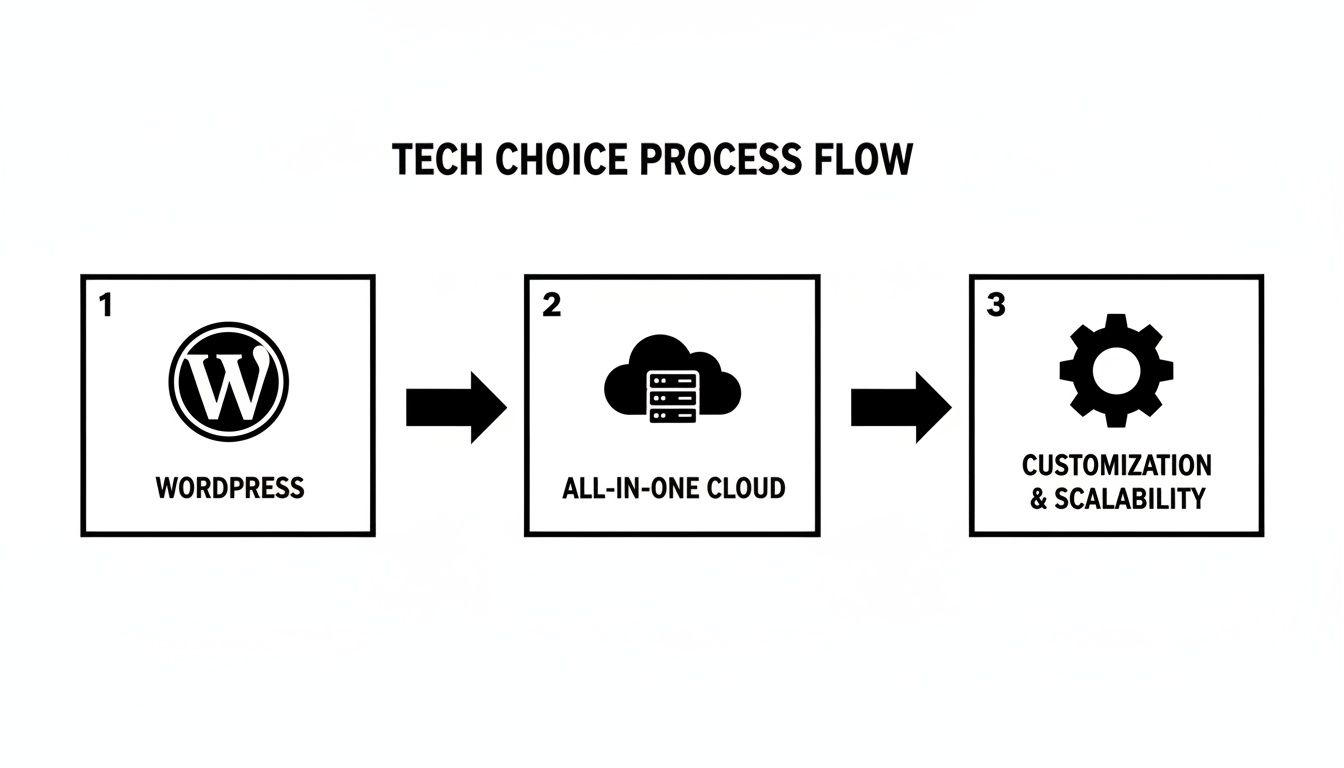
As you can see, no matter which path you start on, it all leads to integrating a robust payment and access control system. This is where your community becomes a business.
How to Integrate Your Payments
You have a few options for plugging payments into your site, each with its own trade-offs between simplicity and control.
Here’s a quick breakdown of the most common methods.
Payment Integration Method Comparison
Integration Method | Technical Skill Required | Use Case | Example Implementation |
|---|---|---|---|
Payment Links | None | The simplest way to start. Good for one-time products or a single membership tier. | Create a link in your payment dashboard and paste it on your website or share it on social media. |
Hosted Checkout | Low | A branded, secure checkout page hosted by your payment provider. Offers more customization than a simple link. | Redirect users from your "Join Now" button to a hosted checkout URL. |
Embedded Widgets | Low to Medium | Add a payment form directly onto your site using a small snippet of code. Better user experience. | Embed a JavaScript widget on your pricing page that handles the entire payment flow. |
Full API Integration | High (Developer needed) | Complete control over the entire user experience. Essential for custom features and deep automation. | Use the payment provider's API to build a fully custom checkout and subscription management system. |
While payment links are a great way to test an idea, most serious membership sites will eventually need a more robust solution.
The Power of a Payment API and Webhooks
For ultimate control, nothing beats a direct API integration. It might sound intimidating, but a good API with clear documentation makes the process surprisingly straightforward for a developer.
For instance, our own Suby API was designed to give any business a simple path to accepting both card and crypto payments. It gives you the power to build the exact experience you want for your members, where they pay by card or crypto and you receive USDC.
The real game-changer with an API, though, is webhooks.
Think of webhooks as automated notifications that your payment system sends to your website. When something happens, like a new subscriber signs up or a payment fails, a webhook triggers an action on your site. No manual work required.
Here are a few essential events you’ll want to automate:
subscription.created: When a new member successfully pays, this webhook can instantly grant them access to premium content and trigger a welcome email.invoice.payment_failed: If a recurring payment fails, you can automatically email the member, letting them know they need to update their card details.subscription.canceled: When a member cancels, this webhook can schedule their access to be revoked at the end of their current billing cycle.
This is how you build a membership machine that runs on its own. It frees you up to focus on creating content and growing your community, not managing accounts. For a more technical deep dive, we’ve put together a guide on how to set up recurring payments that walks through the entire flow.
Automating your payments is critical for tapping into the creator economy, a market valued at an incredible $250 billion in 2023 and projected to nearly double to $480 billion by 2027. This explosive growth is fueled by creators monetizing their communities, and seamless global payments are the foundation of it all.
Whether you're starting with a simple WordPress site or building a custom platform from scratch, a flexible payment API is what makes your business ready to scale globally from day one.
Automating Member Access and Community Roles
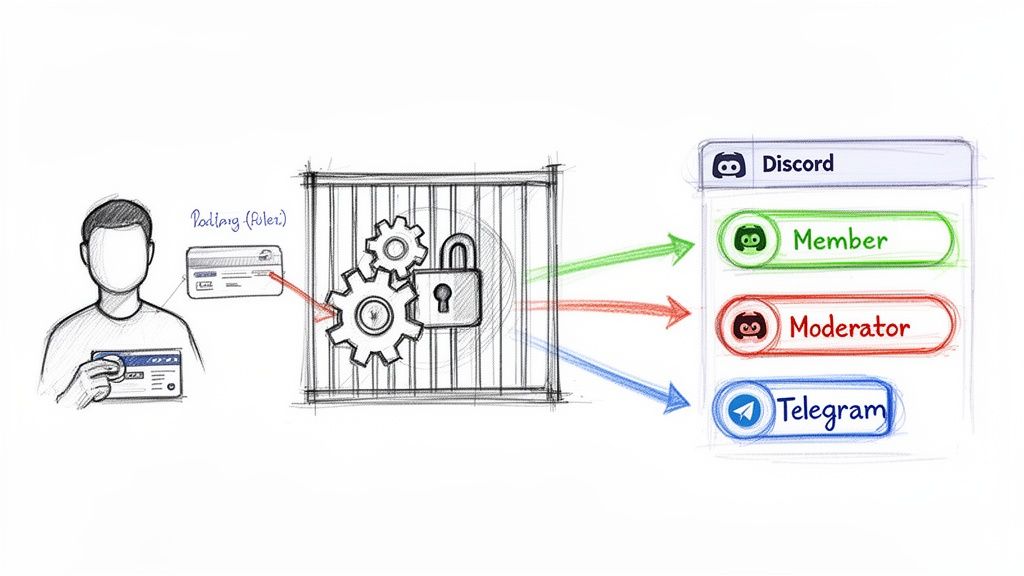
The moment a member's payment goes through, the clock starts ticking. They expect immediate, seamless access to the exclusive content and community they just paid for. Getting this right isn't just a nice-to-have; it's fundamental to starting the relationship off on the right foot.
Nothing sours a new member's experience faster than hitting a "permission denied" error or having to wait for a manual approval. It creates instant frustration and can trigger refund requests before they've even had a chance to see the value you offer.
The secret to avoiding this mess is automation. By linking your payment system directly to your content and community platforms, you can grant access the second a subscription is confirmed. This not only creates a fantastic user experience but also eliminates the risk of human error and frees you from the mind-numbing task of managing permissions by hand.
Implementing Content Gating and Access Control
First things first, you need to protect your premium content. This is often called content gating, and it’s essentially putting a digital lock on your exclusive articles, videos, or courses that only paying members have the key to. How you build this lock depends entirely on your tech stack.
WordPress Sites: If you're on WordPress, you'll almost certainly be using a membership plugin. These tools are built for this, letting you easily restrict access to specific pages, posts, or entire categories with a few clicks.
All-in-One Platforms: Hosted solutions like Kajabi or Mighty Networks typically have content gating built right in. You just toggle the access settings on the content itself.
Custom-Built Sites: For a fully custom setup, your developers will need to work with your payment API. They'll use webhooks to create a system that checks a user's subscription status in real-time before serving up any protected content.
No matter which path you take, the logic is the same: the system must verify that a user has an active, paid subscription. If they do, they see the content. If not, they're prompted to subscribe or log in.
Your access control system should be the silent, reliable engine of your membership site. Members should never have to think about it. For them, paying for a subscription should feel like turning a key in a lock, instantly opening the door to everything they were promised.
This automated check is what protects the value of your membership and ensures only active subscribers get the goods.
Integrating Access with Community Platforms
For many businesses, the community is where the real magic happens. Private channels on platforms like Discord and Telegram become vibrant hubs for connection, networking, and support. But manually adding and removing people from these groups is a nightmare waiting to happen. It's slow, error-prone, and simply doesn't scale.
This is where integrating your payment system with your community platform is an absolute game-changer. A properly unified system can automate the entire lifecycle of a community member without you lifting a finger.
Here's how that flow typically works in practice:
A new member successfully subscribes on your website.
Your payment system immediately sends a signal to Discord or Telegram.
The platform automatically grants the new member a specific role (e.g., "VIP Member"), which unlocks access to private, members-only channels.
Later, if that member cancels or their payment fails, another signal is sent. Their role is automatically revoked, removing their access at the end of their billing period.
This level of automation keeps your community exclusive and professional. It also prevents former members from lingering in private channels long after their subscription has lapsed.
To pull this off, you'll want a payment provider that has native integrations with these platforms. For example, Suby provides automatic access management for Discord and Telegram, designed specifically to help you monetize your community on a global scale. It unifies payments, access control, and subscription management into a single flow, cutting out the need for extra tools or manual work. You can see how this integrated system works by exploring the features for global businesses on Suby's website.
Launching and Growing Your Membership Business
Getting your site live is a huge milestone, but launch day is really just the starting line. The true challenge, and the most rewarding work, begins the moment your first members join. Long-term success isn't about a flashy launch; it's about retention, smart growth, and building an experience that keeps people engaged for months and years.
Think about those first few moments after someone signs up. A clunky, confusing, or unwelcoming experience can trigger instant buyer's remorse. Before they've even seen the value you offer, they're already thinking about canceling. Your job is to make them feel immediately welcomed, confident in their decision, and excited to dive in.
Create a Welcoming Onboarding Experience
A smooth onboarding process is your single best defense against early churn. This is your chance to take new members by the hand and show them exactly how to get the most out of their subscription. Don't just dump them on a dashboard and hope for the best.
A great onboarding experience really comes down to a few key touchpoints:
A Personal Welcome Email: This needs to be more than just a payment receipt. Send a dedicated email from you that expresses genuine gratitude, reminds them of the value they just unlocked, and gives them a clear first action to take.
A Quick-Start Guide: A short video tour or a simple checklist can work wonders. Point out the most important features, like where to find content, how to join the community, and how to manage their account details.
An Early Engagement Prompt: Gently nudge them to take a small, specific action. This could be asking them to introduce themselves in the community forum or start the first lesson of a course. That first small step makes a massive difference in making them feel like a part of things.
Making new members feel at home from day one sets the entire tone for their journey with you. It builds trust and dramatically increases the chances they'll stick around. As you map out your own platform, it's worth taking the time to learn to build a subscription website with these foundational pieces in mind.
Use Analytics to Understand Your Members
You can't improve what you don't measure. To grow your membership effectively, you have to move beyond gut feelings and start making decisions based on data. That means digging into your analytics to see what your members are actually doing.
A real-time dashboard is your command center. It should give you an instant, clear snapshot of your business's health. For example, we provide a dashboard that gives merchants complete visibility into their payments, subscriptions, and revenue, all in one place.
You’ll want to keep a close eye on these key metrics:
Monthly Recurring Revenue (MRR): The lifeblood of your business. This is your predictable monthly income.
Churn Rate: The percentage of members who cancel each month. A high churn rate is a flashing red light that something is wrong with your content, community, or user experience.
Member Lifetime Value (LTV): The total revenue you can expect from a single member over their entire time with you. Increasing LTV is a powerful path to profitability.
Engagement Metrics: How often do members log in? What content do they consume the most? How active are they? Low engagement is an early warning sign of a member who might churn soon.
By watching these numbers, you can spot trends, diagnose problems, and double down on what’s working. If one course is incredibly popular, make more content like it. If you see members consistently dropping off after three months, you can investigate why and introduce something new to keep them hooked.
Research shows that getting members engaged early is everything. A key statistic for anyone in this space is that retention skyrockets from 46% after the first visit to 90% after the fifth. This proves that those early visits are what turn a casual new member into a long-term subscriber. You can find more insights on these critical membership trends on MemberSolutions.com.
To make this happen, you can integrate tools like our subscription API for recurring payments. It’s designed to handle both one-time and ongoing billing while letting you receive all funds in USDC, which simplifies your entire financial workflow.
Scale Your Business Without Friction
As your community grows, the systems that worked for 100 members might start to buckle under the weight of 1,000 or 10,000. Scaling isn't just about getting more sign-ups; it's about ensuring your tech stack and business processes can handle that growth without creating a frustrating experience.
One of the biggest friction points for any growing global business is payments. If you're constantly wrestling with different currencies, cross-border banking headaches, or payout delays, you're actively holding your business back.
A scalable payment solution is non-negotiable. By using a system where customers can pay with their local card but you receive everything as a stablecoin like USDC, you effectively erase borders from your business. Your revenue becomes predictable, you sidestep currency conversion nightmares, and you can focus on serving your members, no matter where in the world they are. This model ensures your financial operations are as ready for growth as the rest of your tech.
Common Questions Answered
When you're mapping out your membership business, you're bound to run into some big questions. I've been there. Let's tackle some of the most common hurdles you'll face, from figuring out your budget and handling security to managing a global audience. Getting these things right from the start makes all the difference.
How Much Does It Cost to Start a Membership Website?
The startup cost for a membership site can swing wildly. You could get a basic self-hosted WordPress site off the ground for a few hundred dollars, but a premium, all-in-one hosted platform might run you several hundred dollars every month. Your main expenses will be the platform itself, hosting, any must-have plugins, and design.
But don't forget about the ongoing costs, especially payment processing. Many traditional payment systems nickel-and-dime you with complex fee structures and hidden charges. A more modern approach simplifies everything with clear, predictable pricing, like a single percentage fee that covers both card and crypto payments. This makes your accounting so much easier, especially when you start getting paid in USDC and don't have to worry about surprise currency conversion fees.
Can I Accept International Payments on My Site?
Yes, and you absolutely have to if you want to grow. Sticking to domestic-only payments is like putting a "closed" sign up for the rest of the world. The problem is, old-school payment processors are notorious for creating a terrible experience for international customers, from declined cards to outrageous currency exchange fees. For you, it often means waiting forever for your payouts.
The only real solution is to use a system built for global business from the ground up. This lets customers anywhere pay just as easily with their local card as they can with popular cryptocurrencies. On your end, you get all your funds settled instantly as USDC right into your wallet. It completely bypasses the cross-border banking headaches and opens your business to a worldwide audience on day one.
Partnering with a payment processor that is PCI-DSS Level 1 certified is non-negotiable. This is the highest security standard in the card processing industry and ensures all payment data is managed in a secure, encrypted environment.
How Do I Keep My Members' Payment Data Secure?
Whatever you do, never handle or store raw credit card details on your own servers. The liability is massive, and it's just not worth the risk. Security and compliance should be handled entirely by your payment provider.
Look for a provider that takes this seriously. For instance, Suby works with a PCI-DSS Level 1–certified partner and has features like Strong Customer Authentication (SCA) for European payments, two-factor authentication, and a secure process for handling disputes. By outsourcing this responsibility, you protect your business and give your members the confidence that their data is safe. You can learn more about Suby’s built-in security features and see how they keep both you and your members protected.
What Is the Best Way to Manage Access to a Members-Only Discord?
Automation is the only way to do this without losing your mind. Manually adding and kicking members from a Discord or Telegram channel is a recipe for disaster. It's slow, full of mistakes, and becomes completely unmanageable once your community starts growing.
The best setup connects your payment system directly to your community platform. Some solutions offer native integrations that do all the work for you. When someone subscribes, the system instantly gives them the right role and access. If their subscription lapses, their access is just as quickly revoked. This automates the entire member lifecycle and makes your operation look professional and run smoothly.
Suby is a payment gateway and processor. Your members pay with card, bank transfer, Apple Pay, Google Pay, Klarna, and more, or stablecoins, and you get paid out to your bank account, or directly in stablecoins (USDC, EURC) to your wallet, anywhere in the world, no bank account required. With native Discord and Telegram integrations that grant and revoke access automatically, it is the payment and access engine your membership website needs to run subscriptions on autopilot.
