

Gaspard LEZIN
Card on File Explained: Security, Billing, and Payments
Learn how card on file works, why tokenization protects data, and how to use Suby for one-click billing and global subscriptions with cards or crypto.
79% of consumers globally either already have a card on file or are open to saving one, while 74% already have one. The central question isn't whether people will use stored cards. It's whether merchants can make that convenience feel safe enough to earn continued trust.
Card on file sits at the intersection of checkout speed, recurring billing, security, and payment operations. It can remove repeated data entry, support subscriptions, and help a business serve repeat customers. But it also creates a permission relationship that merchants must manage carefully, from the first authenticated payment to later charges, token updates, disputes, and refunds.
Table of Contents
Why Card on File Changed Digital Commerce
Mastercard reported that 79% of consumers globally either already had a card on file or were open to saving one in 2024. In Europe, Mastercard said its tokenised checkout program was processing three in five e-commerce transactions with tokens rather than static card credentials by 2026, and that the capability was active across 45 European countries and territories. These figures show that stored credentials have moved well beyond an optional checkout shortcut. They now support how many digital businesses acquire, retain, and bill customers. (Mastercard's credential-on-file overview)
The adoption story has a tension inside it. Customers may be willing to save a card because the next purchase becomes easier, yet willingness doesn't remove concern about fraud, unauthorized billing, or what happens after a breach. A merchant that treats card on file as a button labelled “save card” misses the actual job. The merchant is asking for permission to create a reusable payment relationship.

Convenience became operating infrastructure
A saved card can shorten a repeat checkout, power a scheduled subscription charge, or support an account that bills customers when a service renews. That changes the merchant's operating model. The payment system must remember consent, identify the type of later charge, handle a token rather than raw credentials, and provide a clear recovery path when authorization fails.
The trust gap becomes especially important in markets where customers are more worried about card security. Mastercard's research found that over 75% of consumers in India, Brazil, and Mexico worry about card-detail security and fraud or identity theft. The same research reported that 74% already had a saved card and 9% were open to saving one, which makes the commercial lesson clear: adoption is already broad, but merchants still need to explain consent, security, and account recovery in plain language. (Mastercard's consumer research on credential-on-file payments)
Practical rule: Treat a stored card as a permission and lifecycle problem, not merely as a faster checkout field.
A clear explanation of how one-click payment works should tell customers what will be stored, what future charges may occur, and how they can remove or replace the payment method. That communication supports the technical controls. Speed matters, but predictable billing and visible customer control are what make speed sustainable.
What Card on File Actually Means
A card on file is a stored-credential arrangement. The customer authorizes a merchant or payment provider to retain a reusable payment credential, then the merchant uses that credential for a later transaction. The later transaction might be a recurring subscription charge, a renewal, a repeat purchase, or another permitted payment that doesn't require the customer to type the card details again.
That definition is more precise than “the customer checked save my card.” The checkbox describes an interface action. The stored-credential model describes the business and payment relationship created by that action. A merchant must know whether the customer is actively confirming a later purchase or whether the merchant is initiating it automatically.
Historical behavior helps explain why this model became central to digital commerce. A 2019 industry analysis citing the Mobile Card Services Playbook reported that 78.9% of customers stored payment information online. Of those customers, 44% stored a card on three to five different sites, while 30.8% stored one on five or more sites. (The industry analysis on stored-card behavior)
The use case determines the permission
Stored cards tend to appear where customers have a repeated reason to return. The same analysis reported that 54.1% of cardholders stored a card for recurring household bills, 52.5% did so at a favorite online store, and 46.9% used one for online subscriptions. Those patterns describe more than checkout preference. They show why recurring billing and customer retention depend on a reliable stored-credential flow.
Consider two examples:
Subscription renewal: A customer authorizes a streaming or software subscription at signup. The merchant later initiates the renewal under the terms the customer accepted.
Repeat purchase: A customer returns to an online store, selects a saved card, and actively confirms the new order. The card is stored, but the customer is still participating in that payment.
Both use stored credentials. They aren't necessarily classified or authenticated in the same way. The merchant's system needs to preserve the original consent and correctly identify the role of the customer in each later transaction.
Card on file is best understood as a controlled payment permission that supports future transactions, not as a database record that happens to contain card details.
How Tokenization Keeps Stored Cards Safe
Tokenization changes what the merchant stores and what an attacker could obtain from the merchant environment. Instead of retaining the primary account number, commonly called the PAN, the payment system replaces it with a randomly generated or network-issued token. The token can then represent the customer's card for approved future payments without exposing the raw card number to the merchant's systems.
The basic workflow looks like this:
The customer enters card details during checkout.
A secure payment environment receives and protects those details.
The payment network or provider creates a token that represents the card.
Future transactions use the token, subject to the relevant consent, merchant, network, and issuer controls.
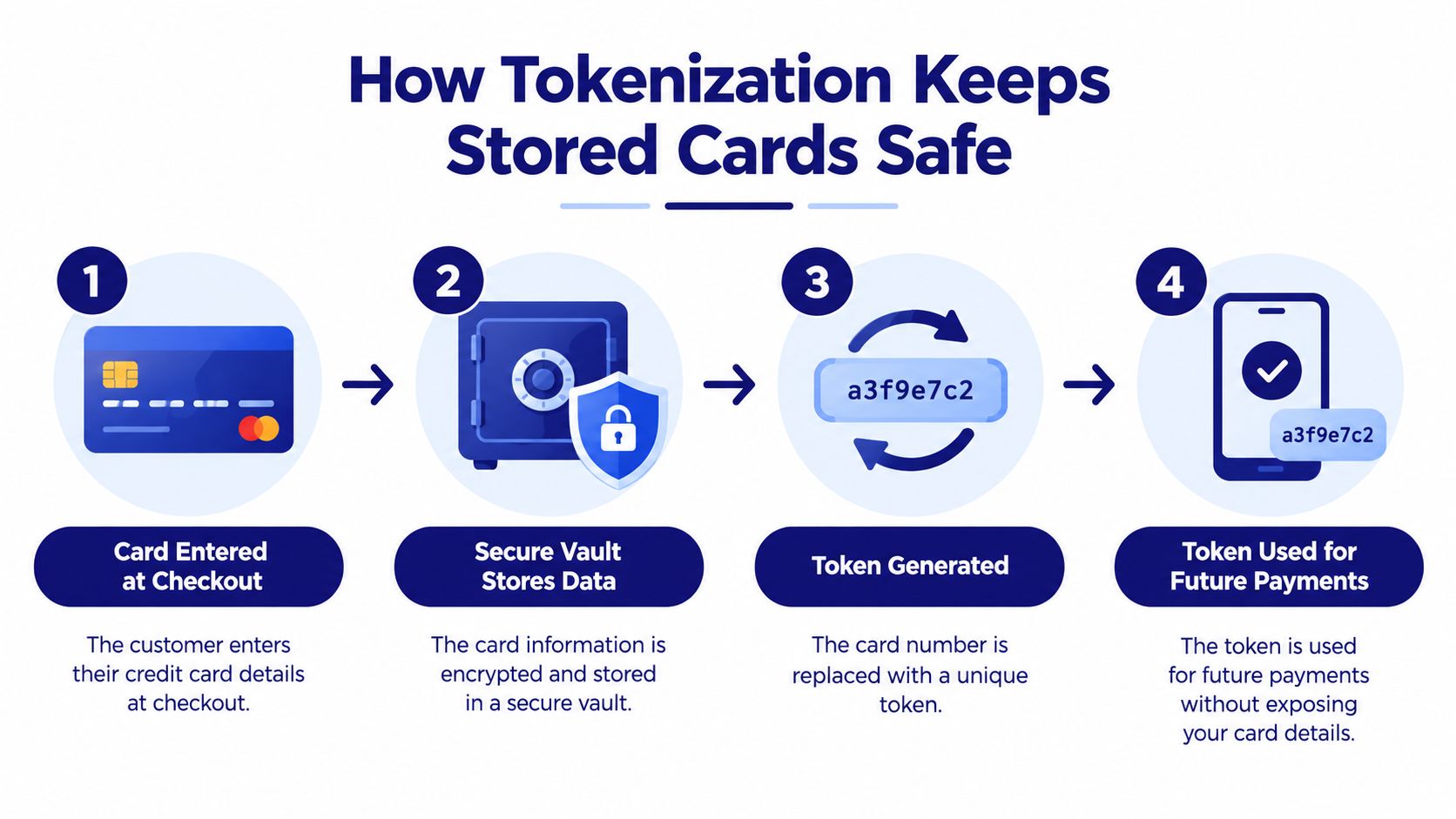
American Express and Mastercard describe tokens that can be limited to a merchant domain. That restriction reduces the potential impact of a merchant breach because a stolen token isn't equivalent to a universally usable card number. Tokenization also lets a merchant support subscriptions and repeat checkout without keeping raw card data in its own application database. (American Express explanation of card-on-file tokenization)
Token quality affects payment performance
Tokenization isn't a guarantee that every later authorization will succeed. The result depends partly on whether the token is merchant-bound and whether the card issuer participates in the applicable network token program. Network controls and cardholder enrollment can therefore affect coverage and authorization behavior.
That distinction matters for engineering teams. A token isn't just a replacement string to copy into any payment request. It has a lifecycle, scope, status, and relationship to the original card and merchant. The payment provider must handle token updates, expired cards, issuer decisions, and the metadata needed to identify a legitimate stored-credential transaction.
Security principle: Reduce the amount of sensitive card data your business handles, then make the token lifecycle visible to the teams responsible for billing and support.
Merchants should also avoid building a private vault that stores more card data than the business needs. A hosted or provider-managed payment environment can keep card details away from merchant servers, while the merchant retains the payment reference required to run its business. The exact implementation depends on the provider and integration, but the architectural goal is consistent: raw PAN data should not become an unnecessary internal dependency.
Authenticating the First Charge vs Later Charges
The first stored-card payment establishes the customer's permission trail. Later payments rely on that trail, but they aren't identical events. A merchant that treats every charge as the same can misclassify transactions, lose authorization context, or create confusion when a customer asks why a payment occurred.
The initial transaction is usually customer initiated. The customer is present, agrees to the purchase or subscription, and provides consent for future use of the credential. Where strong customer authentication applies, the initial authorization requires active verification. This first payment creates the reference point for later merchant-initiated transactions. (Adyen's documentation on recurring payments)
Later charges may be merchant initiated. A subscription renews automatically, a scheduled instalment becomes due, or an unscheduled stored-card charge occurs under an established agreement. The customer isn't actively entering payment details at that moment, so the merchant must identify the transaction as a later use of the stored credential.
Classification is part of the payment data
Recurring payments must be declared according to their type, such as:
Subscription: A service renews according to an agreed schedule.
Instalment: A planned payment is one part of an agreed series.
Unscheduled card on file: The merchant charges when a permitted event occurs rather than on a fixed schedule.
This classification can influence how acquirers and card networks handle authorization. It also gives the merchant a practical checklist. The billing system should preserve the original consent, store the payment reference returned by the provider, identify whether the customer is present, and send the correct stored-credential indicators with each later request.
A repeat purchase made from a saved card can still be customer initiated if the customer actively confirms it. An automatic renewal is different, even though both transactions use the same underlying payment method. That distinction is why a product team should map payment flows before implementing a “save card” feature.
For a deeper explanation of the initial authentication layer, review 3-D Secure payments. The practical objective isn't to challenge customers unnecessarily. It's to authenticate the first permission correctly, then give later transactions the context they need.
Failed renewals need a recovery path
A valid token doesn't make a card immune to expiration, replacement, issuer decline, or insufficient funds. When a later charge fails, the merchant needs a customer-facing recovery flow that explains the problem without exposing sensitive data. That may include prompting the customer to update the payment method, retrying under an appropriate policy, or pausing access according to the service terms.
The business outcome depends on this operational detail. A subscription system that can charge successfully but can't recover from a failed charge will turn a payment edge case into avoidable churn.
PCI Compliance and Building Consumer Trust
Security language becomes useful only when it changes what the merchant stores, shows, and does. Customers don't need a vague promise that payment data is “secure.” They need a clear explanation of who handles the card details, what the merchant retains, when future charges may happen, and how refunds or payment-method changes work.
PCI DSS provides a concrete boundary. The PCI Security Standards Council says merchants must not store card verification codes or values after authorization, including for card-on-file and recurring transactions. Those values aren't needed for later stored-credential flows and must be removed from systems to comply with Requirement 3.2. (PCI Security Standards Council guidance on card verification codes)
Compliance starts with data minimization
A sound implementation separates the data needed to operate billing from data the business has no reason to retain.
Keep the reference: Store the provider's customer or payment-method identifier, along with the consent and billing information your service needs.
Remove prohibited values: Don't retain the card verification code after authorization, even if the transaction is recurring.
Limit internal exposure: Keep raw card details out of merchant application databases where a provider-managed environment can handle them.
Explain the lifecycle: Tell customers how they can update, replace, or remove a stored payment method.
These controls support trust because they make the merchant's behavior understandable. They also reduce the number of systems that need access to sensitive payment information. A founder should ask the payment team to document the data flow from checkout through authorization, recurring billing, refunds, disputes, and account deletion.
Suby uses a PCI-DSS Level 1-certified processing partner, supports strong customer authentication and two-factor authentication, and includes zero-fee refunds according to its published product information. Those features don't remove the merchant's responsibility to obtain consent or describe billing terms, but they can reduce the amount of card data the merchant's own systems handle. (Suby's official website)
Trust is operational: Customers judge security by what they can understand and control, especially when a charge fails or a refund is needed.
Merchants should publish straightforward billing language rather than hiding recurring terms behind a generic save-card label. A customer who knows why a future charge will occur is less likely to treat a legitimate renewal as a surprise. That clarity supports retention without relying on exaggerated security claims.
Using Card on File with Suby for Subscriptions and Global Payouts
A subscription business may want customers to pay with a card, while its finance team wants settlement in a different currency or asset. That doesn't require the customer experience and the merchant payout experience to match. Suby is payment infrastructure for the global internet economy. Its API lets any business accept payments by card or crypto, while the business chooses how to receive the money.

Suby supports four ways to use the same product:
Suby Payments is an API-first payment stack for accepting cards and crypto through one checkout. It supports one-time payments and recurring subscriptions, with integration through an API, webhooks, or payment links.
Suby Crypto is a crypto payment gateway that handles the swap, sponsors the gas, and settles to a non-custodial wallet or to the Suby balance.
Suby Gating provides paid access for Discord, Telegram, downloads, and courses. Native Discord and Telegram integrations support use cases such as subscriptions, paid access, and online communities.
Suby Invoicing lets a client pay by the method they prefer while the business receives what it wants.
A card-on-file subscription can therefore begin with a customer paying by card and later settle to the business's bank account or in stablecoins like USDC, in the currency the business chooses. That card-to-USDC flow is one option, not the only one. Customers can pay by card, wallet, bank, or crypto, while the business chooses how to receive the funds.
For a subscription product, the implementation still needs the fundamentals described earlier. The checkout should capture clear consent, the payment provider should manage the stored credential or token, and the billing system should distinguish the initial customer-initiated payment from later merchant-initiated renewals. Suby's subscription payments can fit into that broader model when a business needs recurring billing alongside flexible payment and settlement options.
Pricing depends on the payment method used, so there isn't one flat rate. Merchants should check the Suby pricing page for the exact figures that apply to their selected pay-in methods and settlement setup.
A business may also use Suby Gating to connect payment status with access to a Discord or Telegram community. An agency can send an invoice that lets a client choose a card, bank method, or crypto payment, while the agency receives its preferred settlement. In each case, the customer chooses how to pay and the business gets paid the way it chooses.
This video provides a visual introduction to the payment experience:
The right decision is less about adding every payment feature at once and more about matching the stored-credential flow to the business model. Start by documenting consent, token handling, recurring transaction classification, failed-payment recovery, and refund communication. Then choose the payment and settlement paths that fit the customers you serve.
If you're building subscriptions, paid communities, global checkout, or client invoicing, use Suby to accept payments by card or crypto through an API, with native Discord and Telegram integrations and settlement options that match your business. Review your payment methods, stored-card requirements, and preferred payout currency, then check the applicable pricing before launching.
