


If you're still exporting invoice data to a spreadsheet, checking card payments in one dashboard, bank transfers in another, and then asking finance to reconcile everything by hand, your billing stack is already slowing growth. That pain gets worse when you sell internationally. Currencies multiply, payment methods fragment, and one failed renewal can turn into a support ticket, a churn risk, and a manual write-off.
A common initial approach involves patching the problem by adding an invoicing app, then a subscription tool, then a separate crypto checkout, then custom scripts to glue it together. That works for a while. It doesn't hold up once billing becomes part of the product experience, not just a back-office task.
Table of Contents
What Is Billing Automation Software
Billing automation software is the system that creates, sends, collects, retries, reconciles, and records charges without forcing your team to touch every invoice manually. In practice, that means less spreadsheet work, fewer billing exceptions getting lost in email, and a cleaner path from customer payment to recognized revenue.
For a domestic business with a simple monthly plan, manual billing is annoying. For a global SaaS company, it becomes risky. Teams end up dealing with multiple currencies, local payment preferences, tax and compliance requirements, and different settlement expectations from customers and internal finance. The operational drag isn't theoretical. It's daily work.
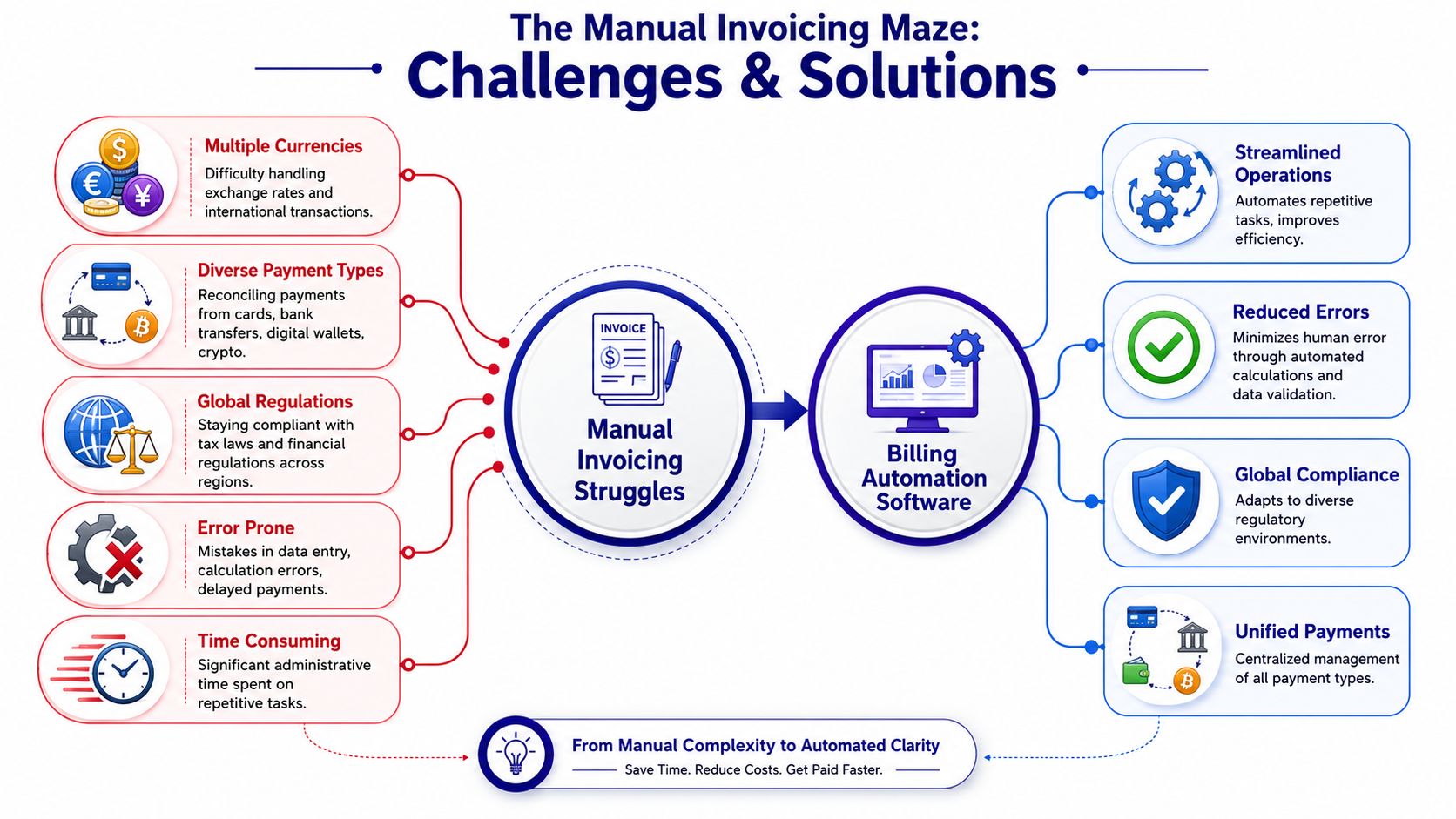
A useful way to think about billing automation software is this: it turns billing from an admin process into infrastructure. The platform stores billing logic, handles recurring schedules, applies pricing rules, tracks failed payments, and keeps records aligned with accounting systems. That matters because billing mistakes compound fast. A wrong invoice amount, a missed renewal, or a broken plan change usually creates work across support, finance, and product.
The market direction makes that shift hard to ignore. The global billing automation market was valued at $16.3 billion in 2025 and is projected to reach $37.8 billion by 2034, with a projected 11.2% CAGR. That isn't just software category growth. It's a signal that businesses increasingly treat billing as core operating infrastructure.
Why the definition has changed
Older billing tools were built around invoicing. Modern ones have to support a broader job:
- Recurring revenue logic for subscriptions, renewals, upgrades, downgrades, and one-time charges
- Payment orchestration across cards, bank methods, wallets, and newer payment rails
- Reconciliation and reporting so finance isn't rebuilding records after the fact
- Settlement flexibility when customers and merchants want different ways to pay and get paid
Practical rule: If your team exports payment data just to understand what happened, you don't have billing automation. You have billing software with manual reconciliation attached.
The part many guides still miss is the split between fiat and crypto billing. A lot of companies now need both, but most software still treats them as two separate systems. That's where operational complexity spikes, especially for SaaS, agencies, creators, and internet businesses selling globally.
Core Features of Modern Billing Automation
Teams usually discover billing architecture problems after a payment succeeds.
The card charge goes through, but the invoice sits in one system, the subscription state updates in another, finance reconciles in a spreadsheet, and payouts arrive somewhere else entirely. Add crypto to that stack and the gaps get expensive fast. A modern billing system has to keep pay-ins, billing state, and settlement connected, even when customers want to pay in fiat and the business wants to receive fiat, stablecoins, or both.
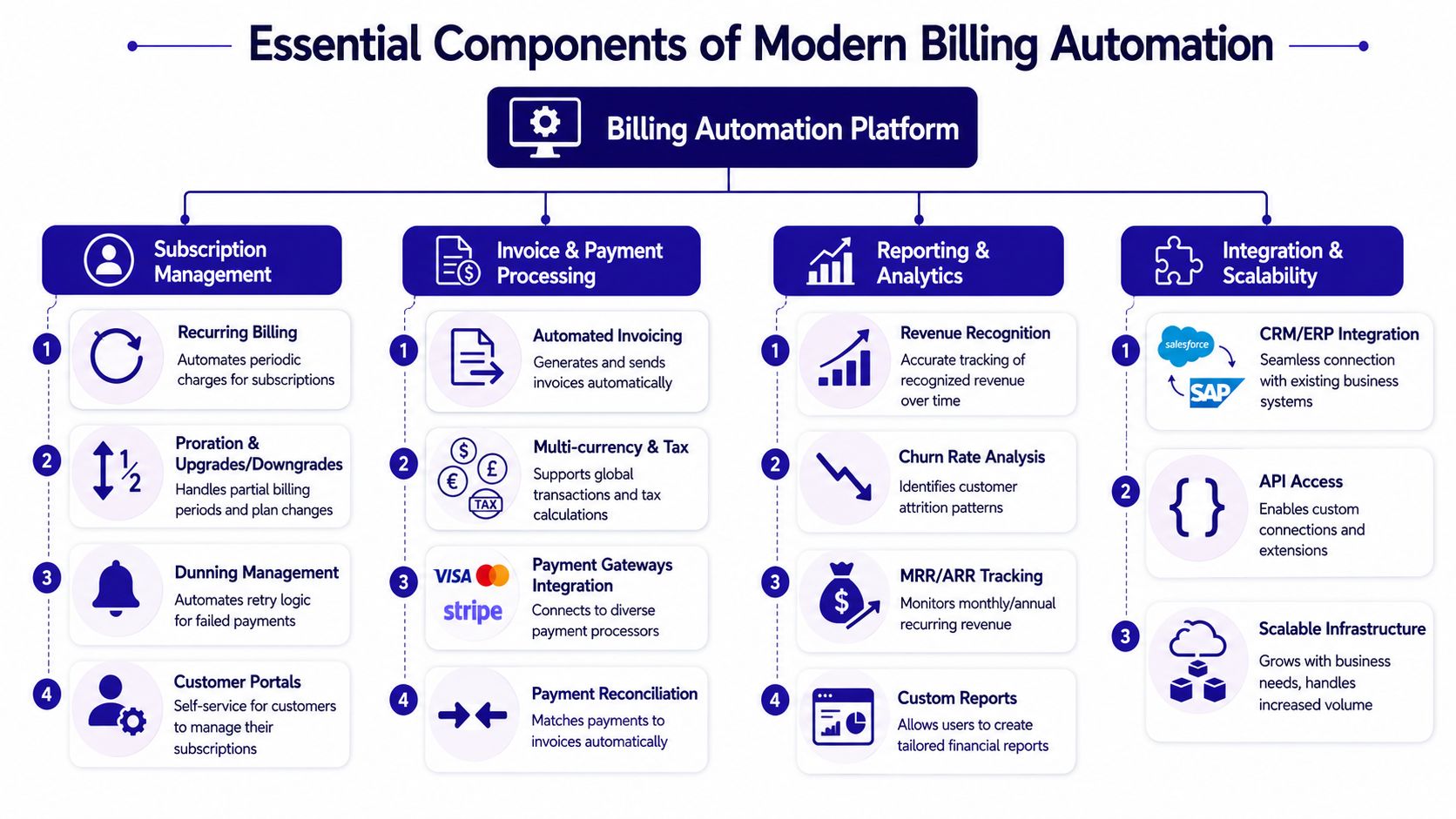
From pay-in to payout
Pay-ins cover the customer-facing side of billing. That includes one-time charges, recurring subscriptions, upgrades, downgrades, prorations, retries after failed payments, invoicing flows, and support for the payment methods your customers use. For global internet businesses, that now includes cards, bank methods, wallets, and crypto. If fiat and crypto require different workflows, support rules, and reporting paths, the billing layer is adding complexity instead of removing it.
Balance is the operating layer in the middle. It tracks what was charged, what cleared, what failed, what changed on the subscription, and what finance should recognize. Weak setups often break down under these conditions. Teams end up comparing payment processor exports against invoice records and customer status by hand. Good billing software gives product, finance, and support the same record of payment events and account state.
Payouts determine whether the rest of the system is usable in practice. Many platforms can collect money. Fewer can settle it in the form the business wants to hold. For companies serving global customers, that often means accepting local fiat payments while choosing whether treasury lands in a bank account, stablecoin wallet, or a mix of both. That payout flexibility matters if you are paying contractors internationally, reducing FX exposure, or managing treasury across entities.
Features that matter once the system is live
In production, the useful features are rarely the flashy ones. The features below are the ones that reduce manual work and keep billing reliable as volume grows:
- Recurring billing logic: The system should handle plan changes, seat changes, pauses, trials, coupons, annual contracts, and restarts without manual intervention.
- Dunning workflows: Failed payments need retries, reminders, and account rules that match your business model. This guide to the dunning process in subscription billing is a good reference if your recovery flow is still ad hoc.
- Automated invoicing: Invoices should be generated from actual billing events, with tax, line items, and payment status kept in sync.
- Multi-currency and multi-rail support: Customers should be able to pay with the method and currency that fits their market, while the business keeps control over how funds are settled.
- Reconciliation: Payments, invoices, subscriptions, fees, refunds, and payouts should map cleanly enough that finance can close the books without rebuilding the transaction history.
- Reporting: Teams need current visibility into MRR movements, failed payments, churn signals, cash collection, and settlement status.
The finance layer matters too. Revenue recognition, contract changes, credit notes, and tax treatment do not disappear because checkout looks clean. For larger SaaS and services businesses, billing software has to support the accounting workflow behind recurring revenue, especially when pricing changes mid-term or different entities sell into different regions.
One useful way to evaluate vendors is to ask who can use the data without exporting it. Product needs entitlement and subscription state. Finance needs invoice, tax, and settlement records. Support needs to see what happened to a payment without opening three tools. If every answer starts with "we can export that," expect more operational overhead than the demo suggests.
That applies to company research too. Teams reviewing billing vendors often look at product fit alongside market context, partner ecosystems, and investor backing. A leading US investor database can help identify which parts of the billing market are attracting capital and where vendor consolidation may happen.
Teams replace billing systems when payment collection, customer state, and settlement records stop matching reliably.
One product worth examining in this category is Suby. It provides an API for card and crypto payments, plus integrations with Discord and Telegram for subscriptions, paid access, and online communities. Its product structure reflects a real market need that many billing guides skip: some businesses want one system that accepts fiat and crypto on the pay-in side, while also letting the merchant choose how to receive funds. Suby is organized into four usage paths. Suby Payments covers API-first card and crypto checkout. Suby Crypto supports crypto payment flows where the platform handles the swap and sponsors gas. Suby Gating covers paid access to Discord, Telegram, downloads, and courses. Suby Invoicing supports client billing where the customer chooses how to pay and the business chooses how to receive funds. Pricing varies by payment method, so teams should verify current fees in the product documentation before rollout.
Why Global Businesses Need Billing Automation
The companies that feel billing pain first are usually the ones doing well. They start selling in more markets, add more plans, take on more client billing edge cases, and suddenly discover their operations were built for a smaller business.
The operational problem is usually hidden at first
A digital agency with international clients might bill retainers, one-off project work, and recurring support on different schedules. A SaaS company might have self-serve subscriptions, enterprise invoicing, and manual exceptions for annual contracts. None of that seems impossible until payment methods start diverging and settlement becomes a finance issue.
What breaks first is rarely the invoice itself. It's the layer around it. Someone on the team starts chasing failed renewals. Finance checks whether a payment arrived. Support gets pulled into access issues because billing status didn't sync cleanly. Leadership asks for revenue visibility and gets three slightly different answers.
Billing complexity doesn't announce itself. It shows up as support load, delayed close, and a finance team that no longer trusts the dashboard.
Where the payoff shows up
Global businesses need billing automation because it reduces the amount of human coordination required to get paid. That matters in four practical ways:
| Business issue | Manual approach | Automated approach |
|---|---|---|
| Cross-border billing | Finance adapts invoice by invoice | Rules are built into the platform |
| Failed payments | Team follows up manually | Retry and recovery flows run automatically |
| Payment method mismatch | Customer is told how to pay | Customer pays with their preferred method |
| Settlement preferences | Merchant accepts operational friction | Merchant chooses how funds are received |
This is also why investors care about billing infrastructure earlier than many founders expect. If you're researching how finance and vertical software investors think about this category, Gritt's leading US investor database is a useful starting point because it shows how visible billing and payment infrastructure have become in the software market.
The biggest gain isn't just efficiency. It's market access. When a business can bill a client anywhere, accept the customer's preferred payment method, and receive funds in the form it wants to hold, expansion gets simpler. You don't need separate regional workarounds just to support commercial reality.
How to Unify Fiat and Crypto Payments
Most billing stacks still treat fiat and crypto as different worlds. Product teams bolt on a crypto checkout for one audience, keep card billing in the main system, and leave finance to reconcile both after the fact. That setup works only while volume is low and exceptions are rare.
Why separate systems create avoidable work
The core issue isn't whether a customer pays by card or crypto. The core issue is whether your billing system can process both through one operating model. If not, you create duplicate logic for subscriptions, payment status, refunds, reconciliation, and reporting.
That gap matters more now because demand is moving faster than most billing tools. WithVayu reports that 42% of SaaS companies plan to integrate crypto payments in 2025–2026, yet most billing platforms still don't address crypto-native billing automation workflows. That's exactly why teams end up managing two systems instead of one.
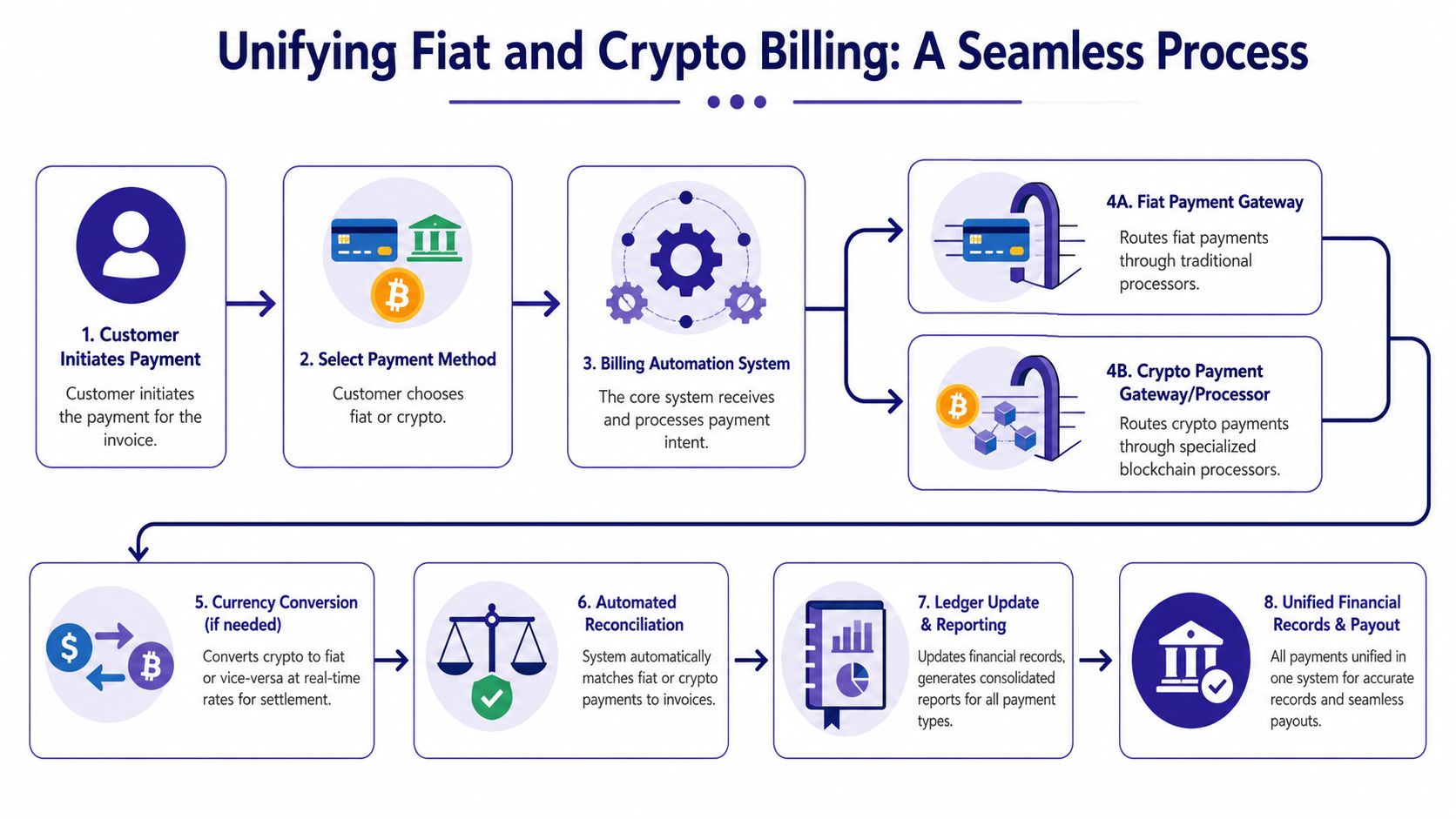
A unified approach means one customer journey, one event stream, and one internal ledger logic. The customer picks the payment method. The business picks the settlement outcome.
To see how businesses are approaching this in practice, this guide on accepting crypto payments for business covers the operational side well.
Here is the basic shape of a unified workflow:
- Customer selects a payment method. That can be card, bank, wallet, or crypto.
- The billing platform applies the same billing rules. Subscription renewal, invoice creation, and payment tracking shouldn't depend on the rail.
- The system converts when needed. The customer might pay one way while the merchant receives another.
- Records update automatically. Payment confirmation, subscription state, and ledger entries stay aligned.
What a unified flow looks like
A practical example helps. A customer pays by card. The business receives USDC. Another customer pays in crypto. The business settles to a bank account in its preferred fiat currency. Those flows are operationally valuable because they remove a false choice between customer convenience and treasury preference.
Here's a short walkthrough before the product demo below:
What makes this work is the billing layer behind the payment. The platform has to handle payment acceptance, settlement routing, event notifications, and reconciliation in one place. If that logic is split across vendors, teams spend too much time normalizing data and too little time improving collections or retention.
For businesses that need this kind of setup, the requirement is straightforward:
- One checkout surface for card and crypto
- One subscription engine for recurring and one-time charges
- One balance view so incoming funds are visible in a single place
- Flexible settlement so the merchant decides how to receive funds
When that architecture is in place, billing stops being a set of exceptions. It becomes a clean commercial system that supports global customers without forcing the company into separate finance workflows.
How to Choose the Right Billing Automation Software
A billing platform becomes hard to replace the moment it starts touching checkout, invoice logic, tax treatment, revenue reporting, and support workflows. I treat this as an operating model decision, not a software purchase, because the wrong fit creates workarounds that stay in place for years.
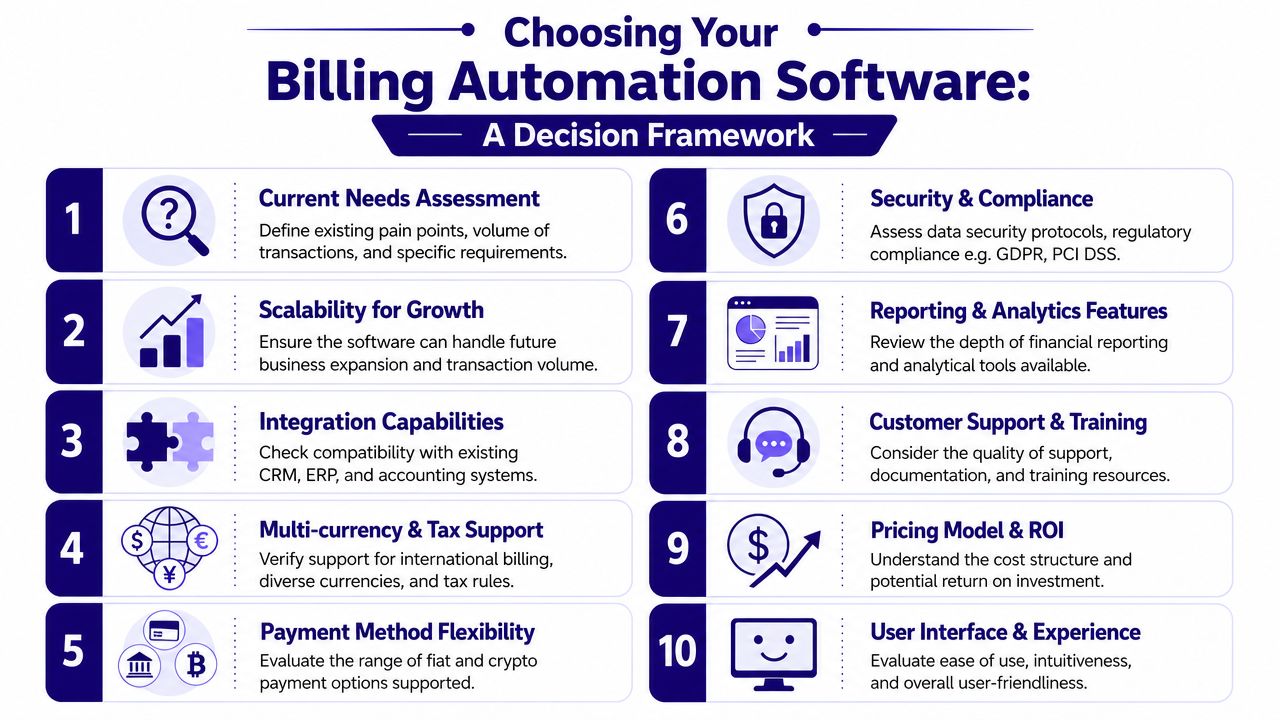
The first screen I want to see in a vendor demo is not the dashboard. It is a real billing flow: a new subscription, a mid-cycle upgrade, a failed renewal, a refund, and the accounting result after each event. For global businesses, I also want to see what changes when one customer pays by card and another pays in crypto while finance still needs one clean commercial record.
That requirement rules out a surprising number of tools.
Evaluate the hard-to-change constraints first
Start with the constraints that will be expensive to fix after rollout:
- Payment model fit: Support for recurring billing, usage charges, one-time invoices, and contract amendments should match how you sell today and how you expect pricing to evolve.
- Fiat and crypto in one system: Check whether the platform can support both payment types without splitting subscriptions, customer records, or reconciliation into separate tools.
- Settlement control: Treasury and finance may want different outcomes. Some businesses want local fiat settlement. Others want stablecoin balances or a mix by market.
- Integration depth: API quality, webhook reliability, accounting sync, ERP compatibility, and data export quality matter more than polished sales pages.
- Finance readiness: Revenue recognition support, tax handling, audit trails, and clear ledger mapping become more important as contract volume and pricing complexity increase.
Finance usually finds the weak spots quickly. Mid-term plan changes, credits, prepaid contracts, and multi-entity reporting expose whether a platform was designed for real billing operations or just payment collection.
Ask questions that expose operational gaps
Vendor evaluation goes faster when the questions are specific.
Ask for a walkthrough like this: a customer starts on a monthly plan, upgrades halfway through the period, changes payment method at renewal, then requests a partial credit. If your business accepts both fiat and crypto, add one more condition. Show how that same account behaves when the payment rail changes but the subscription record, invoice history, and ledger treatment still need to stay consistent.
Then pressure-test these areas:
- Failure recovery: Retry rules, dunning configuration, customer messaging, and account access after a failed payment
- Customer self-service: Payment method updates, invoice access, plan changes, and wallet or card changes without creating support tickets
- Global coverage: Local currencies, tax support, cross-border payments, and region-specific payment preferences
- Reporting clarity: Deferred revenue, cash collection, settlement timing, and payout visibility across payment methods
- Real implementation cost: Internal engineering time, finance validation, migration cleanup, and vendor onboarding support
Pricing deserves extra scrutiny. Billing vendors often charge by transaction type, invoice volume, feature tier, payment rail, or entity count. A platform can look inexpensive in procurement and become expensive once you add revenue reporting, advanced subscription logic, or support for both crypto and fiat flows.
If budget is part of the decision, small business digital payment financing is a useful framing for teams treating billing infrastructure as a cash flow project, not just a line-item software expense.
For teams narrowing the vendor list, this comparison of subscription billing software options for recurring revenue teams is a practical place to benchmark capabilities before a formal review.
A good selection process ends with a pilot using your own edge cases. Use real product catalog rules, real tax settings, and a sample of migrated customer data. If the platform handles those cases cleanly, adoption gets easier. If it needs manual fixes at every exception, the ROI will disappear into finance ops and support time.
A Practical Guide to Implementation and Integration
Implementation goes smoothly when the team decides one thing early: are you replacing a billing tool, adding payment flexibility to an existing stack, or fixing a manual process that never had a true system behind it? Each path needs a different rollout plan.
Choose the right integration path
There are usually three workable ways to implement billing automation software.
API integration fits teams that want billing built into product flows. This is the right route when checkout, subscription state, and account access need to be tightly connected. It gives product and engineering the most control, but it also requires clearer ownership across engineering, finance, and support.
Webhooks matter when real-time events drive downstream systems. Payment success, renewal failure, invoice status, and subscription changes should trigger actions in CRM, internal tooling, access control, or reporting systems without manual polling.
Paylinks and hosted flows are often the fastest route for lean teams. They work well for invoices, one-off charges, community access, and quick subscription launches when a full custom checkout isn't necessary.
Suby.fi's API documentation states that merchants can accept both credit and debit card payments and cryptocurrency payments for one-time and subscription models, with support for multi-currency payments in USDC, USDT, ETH, and SOL, automatic renewal handling, and real-time webhook notifications for payment events. That combination matters because it maps directly to the three common implementation paths above: API for deep integration, webhooks for live system updates, and lighter payment flows for faster rollout.
Migration mistakes to avoid
The biggest implementation mistakes are rarely technical. They're process mistakes.
- Don't migrate broken pricing logic. Clean up plan definitions, invoice rules, and exception handling before import.
- Don't skip customer communication. If invoice formats, payment methods, or renewal flows are changing, explain it early.
- Don't launch without reconciliation testing. Run sample charges through the full cycle, including failed payments and refunds.
- Don't assign billing to one department only. Product, finance, support, and engineering all need visibility into how the system behaves.
A practical rollout usually starts with one segment first. For example, self-serve monthly subscriptions before annual invoicing, or new customers before legacy migrations. That staged approach reduces risk and helps the team catch edge cases while the volume is still manageable.
Measuring the ROI of Your Billing System
If the business case for billing automation software depends only on saving finance time, it's incomplete. The better ROI model combines operational savings with revenue protection and market flexibility.
Track operational and financial outcomes together
Start with the metrics your team can observe directly:
- Manual workload: How many hours does finance or operations spend creating invoices, fixing billing errors, or reconciling payments?
- Collections health: Are failed payments recovered systematically, or only when someone notices?
- Cash flow speed: How quickly does a completed payment become a confirmed, usable record inside finance systems?
- Customer friction: How often do billing issues become support tickets, access problems, or cancellation triggers?
Then look at strategic outcomes. Can the business support new payment methods without adding another billing workflow? Can it bill internationally without creating special cases for each market? Can leadership trust the data enough to use it in planning?
The strongest ROI cases usually come from avoided complexity, not just reduced admin time.
What a good ROI review looks like
A simple review cadence works better than a giant post-migration report. Check the system after launch, then review it again once recurring billing cycles, failed payments, and payout routines have had time to run.
The market trend supports that long-term view. In the related subscription billing management category, the global market was valued at USD 8.51 billion in 2025 and is forecast to reach USD 37.02 billion by 2035, with a projected 15.84% CAGR from 2026 to 2035. That projection reflects how central recurring billing infrastructure has become for businesses that want clean revenue operations at scale.
The practical takeaway is simple. A billing system should pay for itself in fewer manual interventions, cleaner revenue operations, and better payment flexibility. If it only gives you prettier invoices, it isn't solving the underlying problem.
If you're evaluating billing automation software for a global business, Suby is worth a look when you need card and crypto acceptance in one system, flexible settlement to a bank account or stablecoins like USDC, and native Discord or Telegram support for subscriptions, paid access, and community use cases. The product is built around a simple model: customers pay any way they want, and the business gets paid the way it chooses. Pricing depends on the payment method used, so check the pricing page before making comparisons.


